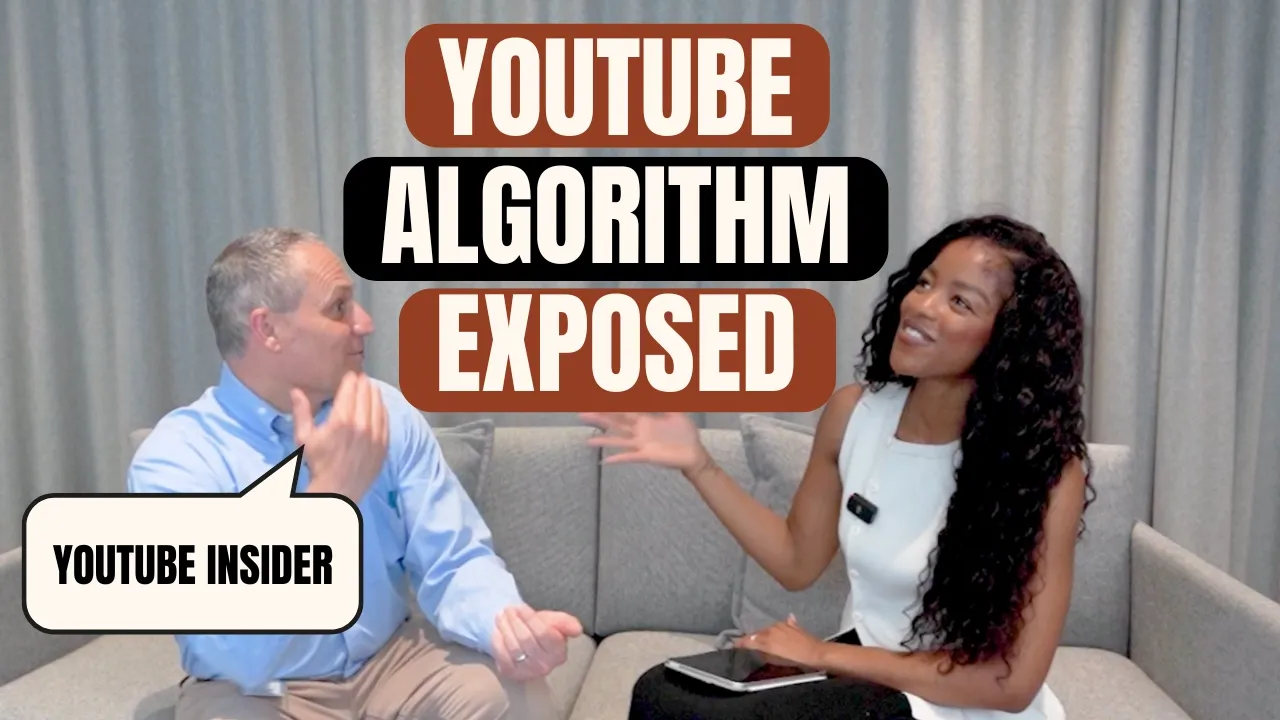
I'm about to interview the man behind the YouTube algorithm. And no, I'm not kidding. I have secured an interview with the vice president of engineering at YouTube, also known as Christos Goodro. If you are a budding YouTuber, I'm about to give you unparalleled access to the ultimate YouTube insider. We cannot keep him waiting though, so let's go learn about the algorithm. [Music] How to set up. >> So, first of all, thank you so much for joining me. >> It's my pleasure. It's good to see you again. >> Big win for my channel. It's a big
moment. I've been referring to you as the guy behind the algorithm. Is that your official title or do you go by something else? >> No, I'm responsible for the engineering team that builds some of the systems That are often called the algorithm. >> Okay. All right. We're already exposing some things that I wasn't aware of previously. I'm going to dive into a really big question and I'm just going to ask you a favor to explain it in the most layman's terms possible. Speak to me like I'm five. >> Yeah. >> Okay. >> How does the
algorithm work? >> How does the algorithm work? Well, first Of all, the algorithm is >> not just one system. It's many systems. Uh there's a search system. There's a recommendation system for clicktoplay videos. We often call them VODs or VODs. There's another system for shorts. Okay? >> There's a system that recommends things on the homepage. There's a system that recommends things in what we call watch next or we used to call them related videos. Now we call them >> is that the suggested video on the Right? >> That's right. That's got it. >> And so
all of these systems probably collectively are referred to as the algorithm because they all play a role in surfacing videos and um parts of them work a little bit differently. I would say um they all try to help people find what they want to watch >> given whatever context >> the person has provided. And so when you go to search it's pretty clear, right? You've typed in a query >> and so the search system is going to try to help you find what you want to watch given the fact that you typed that query. M
>> one of the things that it uses which is probably not a surprise to anyone is it just remembers what the other people who typed that same query went on to watch and it says well that's what worked for them maybe this will work for this person too and so I would say the top Few results are typically very dependent on the fact that other people have typed the same query in the past >> they maybe clicked on a few different results eventually were satisfied with one of them and then that one tends to move
up >> right Okay. So, I want to go back to a point you mentioned about there being different algorithms for different parts of the YouTube platform. Are there different algorithms because they're Working in different ways? So, you know, on other platforms, they have different algorithms for different features because they know that the viewer is looking for different types of content depending on what that feature is. Is that the same for YouTube? >> I think that's part of the reason. Yeah. >> Like I just mentioned search, right? search works very differently than the homepage because the
homepage you show up, you haven't typed in a query yet. >> And so we've just got to try to figure out, well, based on all the things that you've watched in the past, what might you be interested at this moment right now? Yeah. >> And so that's a different problem than having typed a query. So that's one of the reasons why they're different. The other reason they're different is because um we just like to figure out ways to bring more people to improve them. And if they were all one thing, It's hard to figure out
how to have more and more people help improve them. And so if you split them up somehow, they often rely on underlying technology that's the same, but each one of them is sort of specialized for its own purpose. >> Okay. All right. So let's talk about your homepage first of all. >> Yes. >> What could creators do to increase their chances of their videos appearing there? Because for my personal experience, if I've uploaded a video and it's doing really well, nine times out of 10, I will look at my analytics and I will see that
a lot of my traffic has come from browse features and I'm like, "Oh, YouTube has picked up on this." The algorithm is pushing my content and that's usually the video that will like blow up or go viral. So, what can creators do to increase their chances of experiencing something similar? >> Make videos that the first few people Who see it really enjoy it. >> Okay? And so I often think about and I've seen this in the past that videos that become popular typically start with the reliable audience of that creator. Okay? >> And these are
the people who may have for instance subscribed to your channel >> who might have opted into being notified when you upload a video. >> And so if those people see that video and choose to watch it and then really Enjoy it, >> then the system starts to say, "Oh, okay. Well, let's find other people like those people. And then it just sort of and and and then if those next people then like it, then then it just sort of keeps going, right? And so that's one thing that seems to have worked as I've seen for
creators in the past is um I think you want to make sure that um you try to anticipate, okay, so who, >> you know, where is this video going to Show up first? >> And in those contexts, will those people really like it? So, you have a following and so you'd like to make sure that the people who get notified the next time you upload a video really like it and um but there might be other creators who are more focused on um maybe how to fix things or learning something and so they feel like
their following might not be so much around um subscribers but perhaps more like in search. >> Okay. >> Right. And so if I'm trying to, you know, fix some dishwasher or something, I'm probably not subscribed to the dishwasher fixing channel, right? But when I need it, I need it. And so they might want to make sure that when somebody types whatever model of dishwasher, you know, uh the title and the description are very clear and that it really solves that person's problem. Yeah. And so if that's what happens, as I described before, then the people
who type that query, watch that video, if they're satisfied with it, it'll tend to move up in the search. >> Got it. Okay, I have so many questions off the back of that because it sounds like when you have an audience already and when your audience is there for a specific type of content that you share quite regularly, perhaps that system and that process is a bit easier for you. So, I've got an audience already. Everyone's interested in similar topics. So, if I upload a video, it is probably a bit easier for me to get
them to click and therefore be satisfied with it. What do you do if you don't have an audience yet? >> I can't say that I really know. Would you say it's more search? Cuz I think in the beginning search helped me because I didn't have an audience but I was creating content that people were searching for. >> I think that's clearly a way to think about it, right? Because although a lot of these systems will try to find new videos from new channels and try to find them an audience. It's not an easy thing to
do, right? Because you're like, well, I'm not sure with whom this video might resonate. uh I might be able to figure out okay well this video is in English you know maybe don't show it to the people in you know who don't speak English for instance but narrowing it Down further can often be quite difficult and so search is a good guide because even if that's not exactly how it happens at least when you're thinking about search you're thinking about making it clear to whomever sees it what the video is about and that makes it
not only clear to the people who might see it let's say it does get in someone's home screen, but also to the system. And you have to remember like, yes, it's it's one thing for our systems to show It to people, >> but once they've seen it, they have to choose to watch it, right? So, it's not just the system just decides what everybody watches. The system gives an opportunity doing its best job of trying to find something someone might want to watch, but then ultimately like especially on the homepage or in the watch next
suggestions, >> the person has to choose it. >> Yeah. Right. So, let's talk about that Because I'm assuming there are signals that the algorithm will look for to try and figure out if someone's decided to watch it, how they felt about it, and therefore like is this video worthy of it being pushed out to more people like you said. So, what are some of those signals? >> Well, the simplest is how long the person engaged with the video, right? >> Okay. And by engaged, do we do we mean watch? >> Typically watched. Okay. >> Right.
Sometimes it's not exactly watched. Uh, of course there are other ways like if someone likes the video, if someone shares the video, if someone saves the video, those are all indications that someone was pretty interested in that video and it wasn't something that they might regret having selected. Years ago, we had a problem where we had a system that was mostly focused on trying to increase views, >> right? >> And as a result, it would show people videos that they that looked like what they wanted >> but actually weren't. >> Clickbait error. >> Yeah, kind
of a clickbait error, right? M >> and if you can imagine the problem with that is it's not just that you see some videos people click on it you know they see it's not the right thing and then They sort of move on to the to the one that's right >> it's that the system sees the the clicking and not watching as a win. >> Oh >> right. So now it's like wow I got that person to click on a video that they didn't watch. Let's see if I can get them to click on five
videos that they don't watch. How about 10? Right. And so you can imagine like how many can I put in front of them before they finally Give up, you know? >> Oh gosh. Okay. So, I'm glad that we moved on from that. >> Yeah, that's right. >> So, now we're very much valuing watch time and kind of engagement in that sense. That's right. >> You mentioned there's a few different signals there. Would you say that watch time is a stronger signal than if they like or comment or does it depend? >> Well, I mean, it
it really does depend. And the reason it depends is because time is something that's like at least this is the way we've often thought about it is precious to everyone >> and you know not we don't have an infinite amount of it and some people have a little more than others but not like a hundred times more a thousand times more >> and so um it's one thing that uh it's not compressible right like you can >> I don't know if you've seen this but uh If I watch my daughter uh scrolling through Instagram her
thumb can like >> I I it's amazing how many things in a row her thumb like, right? And so if you think about that, it's like, okay, well, >> she said that she liked it, but like she she spent literally a second on that. Like I mean, >> did she like it in the same way that she liked the video that she watched for 10 minutes? It's hard to think that she did, right? Um the other thing we found Is that there's just a such a wide variety of how people feel about this feedback that
they give. I'll give you an example. We used to we used to observe that people who visited YouTube a lot and seemed to get a lot of value out of it had a lot of subscriptions >> and so we thought oh great idea we'll just give everybody subscriptions. Right. Okay. >> Right. So we had like you know a page where with one button you could Instantly subscribe to like 50 channels. Right. Interesting. >> Yes. And then it turned out that >> the cor it was a it was a correlation and not a causation. Right. It
turned out that the people who watched a lot happened to have a lot of subscriptions merely because they were on YouTube a lot. And then we did this study where we asked a bunch of people who watched a lot about their subscriptions. And some of them had many, >> like hundreds, maybe even thousands. And some of them had very few. And so you'd ask these people who had thousands. They're like, "So you subscribe to this channel. Does that mean you'd really like to watch more of that channel?" And they would say, "Oh, no, no, no.
I don't want to watch anymore." I'm like, "Well, then why did you subscribe?" They're like, "I was just, you know, giving a high five to that person." and like you go. That was love it. Keep it up. You Know, I'm not into it. It's not my thing, but hey, I'm glad you're doing it. And so that was one view of how people thought of subscribe. And then we talked to the people who watched a lot of YouTube and yet hardly had any subscriptions or none. >> And we said, gee, you watch this channel every time
they post a video. Interestingly, you've chosen not to subscribe. Why? >> And the person would say, well, you Know, I'm not in a financial place right now where I can really subscribe to anything. We said, but but you know that it's free, right? It doesn't cost you anything. They're like, "Look, I'm just not into commitment at this point in my life." Right. So, I'm like, "Okay, power to them." >> Yeah. Exactly. >> Boundaries. I love that for them. >> Right. And so, that's why um all of These signals have a personal component to it. The
other thing that we do that probably is an evolution of watch time that uh we hope has made it even more indicative of what we're looking for ultimately, which is value, >> is we ask people after they watch things, like a day later. Yes, you watched this video. >> How did you feel about it? And we asked, we've tried like smiley faces and different kinds of things and we ended Up with stars >> and we only count as valuable if someone gives it four or five out of five stars. >> Okay. What do you mean
count as valuable? As in like you only take that data into account if they >> we only count that as a what we say valuable watch time or sort of a success. Right? So if the system is trying to maximize value, then it's looking for the things that are successes and it would only count as a Success if someone says it's four or five stars out of >> Got it. Okay. So when you guys get the survey, if you could give it a five, that'd be fantastic. Let's do our own experiment. Okay, that really gave
me a lot of insight there. Actually, there's a few questions that came to mind, more so for my community than anything. Like I I see these questions all the time. How important is the first 24, 48 hours of your video's lifespan when it comes To how it goes on to perform? >> Well, I think the reason why that might be important is because that's likely when the people who typically watch your videos will see it. >> Yeah. >> And so, like I said, if the people who typically watch your videos, like first of all, they're
the ones who are most likely to see it. Some of them are probably subscribed. Some of them will get notifications. Many of them, even if They're not subscribed, will see it on the homepage because, well, they watched the last video and the one before that. So, the system will say, "This is probably a good idea, right? Like, there's a new video from this channel. They seem to watch it all the time. Let's show it to this person." And that will happen in the first, you know, however 24, 48 hours after uploading a video. And if
those people like it, >> then that's an indication that, you Know, okay, well, at least we can start there and start expanding to more people who are like that, >> right? But if those people tend not to want to watch it, >> well then you're like, "Okay, well now I'm not sure who to show it to anymore." Right? Like, >> so I This is going to be such a hard question. I've had videos in the past where the first 24 hours, the first few months it's just kind of in that and Then randomly one day
it has a moment and it spikes and then it goes on to be like one of my most successful videos. Why does that happen? >> Well, first of all, that's got to be pretty exciting, right? >> Yeah. No, it is. I go to my analytics and I'm like, "What's driving this?" And I'm like, "Oh, it's that. It's you." So, it's a great feeling, but I never quite figure out. Sometimes I'm like, "Okay, it might be that I uploaded a video About podcasting and I did it at a time when not many people were doing podcasts."
So, in a couple years time, it then starts to, you know, get a moment and I understand that. I can rationalize it. But other times, I'm like, hm, I'm not quite sure what drove that. Any insight? only that it works the way I describe which is we try to find some people who like it >> and then once we find some people who like it much of the system works by Finding people who are similar to them in terms of what they watched and then showing it to them. >> Yeah. >> And so maybe in
the first few months, you know, the people who typically watch your videos maybe weren't interested in that one for some reason, but then like you said, it caught a moment. Maybe it showed up in search when people were searching for podcasts. Or maybe one of your fans went back and said, "Oh, wait. You know, podcast. I didn't know Jade made a video about podcast. Let me check that out." Right? I was thinking of doing a podcast, too. Let me see. And then once they watch it, then then you can start imagining and expanding to more
people essentially through what we call co-watch, which is essentially like uh okay, what what was the video that they watched afterwards or before? And those videos might be >> got it. >> You know, okay, so if we wa you know, they watch another video afterwards, then when someone watch that video, then maybe we'll recommend your video, right? Or just um looking at the histories of those people. So, okay, well, they they watch this video and they they watch these other videos. Let's find other people who watch those other videos and see if they like this
one. >> Right. Right. What's your opinion on going back to these old videos and Making changes like to the title, a new thumbnail? Quite often people ask me like, is is it worth me going through my entire library? My general stance is like I just focus on the future. So I'm like I put my energy on my future videos, but I've never quite known if that works. And I guess there's so many variables and I'm sure the answer is it depends. But I'd love your thoughts on that. From my perspective, if you see something, especially
when you're Getting started, if you see something that >> maybe you've made recently or in the past suddenly strike a moment or have some momentum, >> then I think it makes sense to take a look at that and say, "Okay, well, is the title the best I could make it? Where's the traffic coming from? Is it coming from search? Is it coming from home? Maybe I could think about the thumbnail. Like, could I improve that Somehow?" I mean, you know, don't mess it up. Try not to mess it up. which is why you might try
I think we have AB thumbnail testing right so that would be a thing to maybe you didn't do it whenever you know you didn't think it would be worth it but now might be a good time right >> yeah no that's a really good point is it the same advice for old videos that aren't having a moment >> so you just have a library of videos that aren't performing well but you believe in them is it worth going back and maybe using the thumbnail testing feature and making >> perhaps I think what you really have
to do though is you have to be thinking about at least this is the way I'm Not a creator of course, but if I were to be a creator, then I would >> my advice I think would be you have to try to think about the audience. >> You know, who are the people who are most likely to really enjoy this video and get value out of it and what would they be looking for? Yeah. >> What would they be searching for? What kind of a thumbnail would they be interested in? You kind of have
to anticipate that somehow. Once you uh meet that, you know, then you can imagine expanding to more people. >> Yeah. You know what? I would love to dive a little bit deeper into that Because I feel like we're coming out of like a niche epidemic or something. I use very very dramatic vocabulary. You've probably noticed we went through a phase where niching down was like the thing. Everyone said you need to niche down. It's not enough that you're interested in plant care. You need to be interested in plant care in the UK in the winter.
Like it has to be as specific as possible. And I understand the rationale behind that. It's like, Okay, well, if you get so specific with your audience, then surely it's easier for YouTube to understand who your audience are and therefore share your content to the right people. But a lot of people are rejecting that now because they're like, I don't want to niche down. I just want to be me. So, how do you balance the two? Because you do still need to have a clear audience, right? You still need to be clear so that the
algorithm knows who your Content is for. Do you think there's still value in niching down because of that? I really don't know. Although I could imagine it might be different if you're just getting started >> or if you've already built some momentum, right? If you're just getting started, I can imagine YouTube is a tremendously competitive place, >> right? Like you said, there's already gardeners. Yeah. >> How many gardeners are there? Right. And So, and so you do have to imagine like, okay, you're just getting started. Maybe your video shows up in search or maybe it
shows up on someone's homepage, but this is a person who likes gardening probably. And so there's lots of gardening videos. Yeah. >> And so there's got to be something and maybe it is niche that kind of um attracts someone to say, "Oh, that's different or I haven't seen that before or something." And then once you've got Started and you've sort of built some momentum and audience, then I could imagine maybe niche isn't quite as important for you, right? Because then you're like, "Okay, well, I can figure out how to broaden this audience. I already have
a strong base. I'm sort of building a name. There are people who will surely see my video, right? Cuz I have subscribers and they're notified and stuff like that." And so, you can start to imagine, okay, well, now I can Maybe build it out a little bit. >> Yeah. No, that makes a lot of sense. I wonder if your advice is different if you have a dormant channel. So, a lot of people want to become YouTubers. They start a channel when they're like 13 and then they're 18 and they're like, "Wait, this is this is
my dream. I want to want to start this again. >> What is your thoughts or advice on reviving a channel that they might see as dead >> from an algorithm perspective? >> Yeah, I mean I I don't think a channel is ever really dead per se. It could be dead in the sense that if you've built a negative reputation, >> then you could imagine that like you might need to escape that somehow. I imagine that well I don't know. I guess I guess Mr. Beast would be a counter example, right? He did gaming for 5
years before he finally did something else and sort of broke out. But I Imagine if if sort of you you know your channel was all about something that's sort of no longer >> okarant or you know sort of pay >> that might be a little bit of a problem right you need to sort of escape that somehow. >> Um but I wouldn't say I mean I wouldn't say that a channel is like dead per se like the next video will get a chance right somehow. And I think that's that's what people want to hear is
that it's Like just because your channel wasn't doing so well 10 years ago, it doesn't mean that it has no chance of doing well now. So I think that's going to be reassuring to >> I mean I I I think that especially if some number of years have passed then it's like starting from scratch again. If that hasn't happened like let's say you know you were doing this for a long time it wasn't working you want to switch to something completely Different. Well, if you've built a little bit of momentum in one direction, >> we
have to remember that those are the first people who are going to see your next video. >> Yeah. >> Right. And so, you know, you're doing gaming and now fashion. I don't know if that's going to work. >> Yes. >> Yeah. Yeah. That's true. Yeah. That's really good to know as well. Okay. Some Great tips there. Let's move on to talk about a very, very hot topic, which is consistency, frequency. Everyone wants to know how often should I be sharing content on YouTube? How many shorts? How many long form? Does it matter? What if I
want to take a break? So, let's dive into it. Let's start off with, is there an ideal posting frequency for YouTube? Is there like a gold standard of how often you should be sharing content? >> I wouldn't say there's one for YouTube. >> I suspect that it depends really on the kind of show >> you've created. >> Yeah. >> Right. So if if you're doing a daily vlog like my life, well if you vanish for a week or two that you know people will find other people to watch their lives, right? Like they're going to
watch other people's lives. On the other hand, if you're a channel that does um something about science, I mean I know Very successful science creators who post once maybe twice a month at most, right? Because they're just spending a lot of time making a video that really explains something. um you know maybe there's a new discovery or something and and they'll do that uh and that works very well for them and I don't think people would be >> you might say okay but if they what if they did like you know video every day or
a video every week >> I don't know if that would really be as satisfying for their audience right because their audience wants a certain level of um of depth I guess yeah >> so I think it depends a lot on it's just it's very much like television right we had you know 60 minutes whatever you know however often and nightly news and but we had you know >> all shows I don't know >> I think I've heard of 60 Minutes >> have you heard of friends >> yes of course of course well that was when
I was younger that was once a week >> oh wow okay >> and so that's just how it was right once a week and that's what people expected and could I have watched friends twice a week sure but probably not every night right >> I literally have it on going on on the back >> that's right yeah that's right yeah so now that's right things that were once a Week for me are probably >> every day and multiple times a day for others. >> That's so funny. Yeah, you make a few really really good points
there. And I think a good example what came to mind is like chicken shop date. I remember Amelia doing an interview or something and I remember she spoke about the fact that she doesn't have a posting schedule like she is working with incredibly huge talent. She kind of posts when she can And everyone knows that and gets excited cuz it's like oh a new one's coming. But at the same time, to your point, there are vloggers who I watch and if they miss a week, I'm like, I feel untethered. I'm like, I don't know what
to what do you mean? What happened this week? Do you know what I mean? >> Right. Are they still around? Like, what are they stop? Will they come back? >> Exactly. So, I think to your point, I completely understand that. Um, does That change for shorts? >> That's an interesting question. >> I honestly don't know. >> I can't say. >> Yeah. Sometimes I think, oh, to be honest, most of the time I think if anyone's unsure on their posting frequency and they're in the early days, sometimes I think instead of thinking about it from an
algorithm perspective, think about it just from like a practicing creating content perspective Cuz I uploaded two long forms every week for years and only now did I like sometimes I only do one a week, right? And I credit that to improving my content as quickly as I could. I think if I was doing two a month then my content would still look how it looked a few years ago. Do you know what I mean? So sometimes I think that makes it even more >> Well, I think that after watching some of your videos, I think
that you make a Great point that >> in the beginning part of what you're doing is you're practicing, you're improving, and you're really setting personal goals. >> Yeah. >> Right. About your own journey and your own um improvement and kind of your own commitment maybe, right? are >> on a regular basis and that might be more important than you al Mentioned a few different features. So we said shorts, there's long form, there's obviously lives, you've got a whole community tab now. I know they all have different algorithms as well. Does the algorithm favor you if
you upload multiformat content? Like if you are utilizing all those different features, does it favor you in some way? I don't know if I'd say it favors you, but I think what it does is it allows it sort of gives you more chances. >> Yeah. >> Right. So, just more opportunities for someone to see what you're doing. >> And I know that sometimes people worry about how often someone who sees their short ends up watching their long form video. And I don't know if it happens as often as I'm sure it doesn't happen as often
as people who who who are creators would like it to happen, but it happens sometimes. And so, you know, if you can commit to a reasonable schedule of doing Those things, like, okay, like you said, I'm going to make a couple of one or two long form and then like a few shorts every week. Well, that's like a reasonable amount. That gives you a fair number of opportunities for people to see what you're doing. >> Yeah, I'm glad you brought that up because that's a really common question as well, which is like, I'm uploading my
shorts, but they're not watching my long form. Like, what do I do? Do I have a Separate account for my shorts or do I have a separate account for my long form? Any thoughts on that? or maybe even some insight as to whether or not that might improve in the future. Like there might be new tools that will allow us to link our shorts better to our long form. I know some exist, but >> yeah, I I think that having a separate channel is probably not a good idea >> once you have two entities now
you're trying to build >> two >> two things, >> right? And that's it's hard enough to do one, right? And like you said, there are ways right now in the shorts player >> to get from, you know, to get to the channel from whence one can see the other the other content. And so my suggestion is, especially if you're just getting started to focus on trying to do one thing. And yes, I I understand that people are probably disappointed. Well, Not not as many as I would like who watch my shorts go on to watch
the long form content, you know, but but maybe some do. >> Yeah. Yeah. And that would be a win, right? >> Yeah, you're right. Sometimes I think as creators we forget how big of a deal it is to get even like 10 100 people. That's 100 people. It's so easy to lose the value of those numbers and forget that there's real lives attached to Those. So yeah, I think you make a good point. I want to talk a little bit more about engagement and audience cuz a few questions have been submitted to me that I
thought these are actually amazing. One is is it better to have a small smaller highly engaged audience or a larger but less active one. >> I think I'd ask you that question. >> Okay. >> I mean, you know, reverse card. >> Well, from a from a from a from a Business perspective, what's better? >> Okay. So, if you are a creator who's trying to earn money in some ways, I actually think it's more powerful to have a smaller and higher engaged audience. I think that that way for a few reasons. One, when you work with
brands and stuff, they're looking for engagement. They're looking for view counts. they're at the end of the day, you're trying to sell a product or a service on their behalf and you're going To be able to do that better if you do have a highly engaged audience. And then I also think I think it just depends on your objectives cuz if you're a creator, you're like, "No, I want to be famous. I'm trying to reach as many people as possible. I want as many people out there to know my name as possible." Then obviously having
a huge subscriber base is amazing. Even if they don't watch the rest of your content, they watch one video, so now they somewhat know you. So Yeah, I think it does massively depend. But I do often see channels that might have, let's say, a lot fewer subscribers than me. They might have like a hundred thousand, but their view counts are insane. They're getting 50,000 views per video, 60,000 views per video. And I personally think that is an incredibly valuable channel, you know, more so than mine or someone else's what might have 300,000 and are getting
less. >> I actually made a video that ruffles Some feathers actually where I was I was suggesting that subscribers aren't that important. I was suggesting that actually it's more about even when it comes to your AdSense and how much money you can earn. Really, it's about your views and how much of your video they're watching and how much of the ads they're watching. You're not getting paid based on how many people are actually subscribed to you. I've had months now where I will make the same amount on my Channel that I made in my first
month of ever being monetized, even though then I had a thousand followers and now I have 300,000. So, I'd actually love to get your thoughts on that. Do you think subscribers are as important as they used to be? I would say that their their impact has diminished over 15 years. And it's not because it's not diminished. It's diminished relative to the fact that now you can actually get a big audience without more subscribers. Yeah. >> And that wasn't the case 15 years ago. 15 years ago, the homepage of YouTube and a lot of other services
were just like a list of things from the channels or the accounts you follow. That was it. >> Yeah. >> Right. Like I don't know what um what yours looks like, but I still look at Facebook once in a while >> and it's rare that any of my friends content actually shows up. Yeah. >> Right. But it used to be just their Content. It used to be just a list of the things that my friends, my Facebook friends had done. And that was the YouTube homepage 15 years ago. >> It was basically the subs tab,
>> right? >> And so if the YouTube homepage is just the substab, well then subscriptions matter a lot. I think subscriptions still matter. They probably matter more than they did 15 years ago, >> but what matters way more is the people Who may not be subscribed, but who frequently watch your videos because now they don't need to subscribe to have them show up again. >> Okay. >> And that's what's changed. >> Yeah. That you've really validated that video for me now. I feel really good about it because I remember making a similar point that there
are people whose videos I watch every single week without fail and every now and then I'll Be like, "Oh my god, I'm not subscribed to you, but I've been watching you for years." But the algorithm is so good and so advanced that I don't need to subscribe to you because it knows that I want to watch you. Right. >> Yes. >> Okay. See, I was right. >> And and this goes back to the point I made earlier, which is that we learn that people subscribe for all different reasons. And only one of those reasons Is
I'd like to see more from that creator. Other reasons were just, hey, high five. I like you. Keep it up. >> Yeah. Yeah. That's >> or or people who like, you know, aren't subscribed, but who are real fans, right? And so that means that subscription, you know, it's an indicator, but it's not the same thing as being part of the regular audience. >> Yeah. Yeah. No, I totally agree. Totally agree. I also had another question come Through that was very very specific but I thought it was a really good one because at the start of
this we spoke a bit about the different signals and you mentioned things like likes and comments were really important. How important is responding to comments? I know it's important from a community building perspective but from an algorithm perspective if you're responding there's more comments on your video. Does that mean it's going to potentially rank a Bit higher? I don't think that we use the amount of comments as an indication of the video. I think that we might try to anticipate the likelihood of someone being interested enough to comment. Um, but that's not the same thing
as there being a lot of comments. So, I suspect that responding to comments is like you said, it it matters because it builds a community and as we were talking about before, it makes it more likely when the person who made that comment or maybe The ones that read it, when they see the next video that you make, they're more likely to be interested in watching it because they've had this um interaction with you. >> Yeah. Yeah. So true. >> Do you respond to all your comments? I try my best to respond to a lot
of them, but once I got to maybe 100 videos, I was like, "This is impossible now." Because the beautiful thing about YouTube as well is that my content is Pretty much evergreen. So, I'll have videos from years ago still getting a lot of views. So, then you end up having like now I have maybe 500 videos that are all getting comments. >> So, that's when it becomes really difficult. But, in the early days, I would respond to every single one until I physically couldn't anymore. >> And, you know, it literally it was a lot of
work, >> right? I'll bet it. >> But, it was great. And you also got so much insight as to what your audience found the most interesting additional questions. It is the perfect place to find topics for your next videos, especially for like educational content content creators like me. >> So that's very validating for me. >> Yeah. >> Because well, you can imagine that it's only a small portion of the overall audience of YouTube that comments, >> right? Which means you have to look at you you know comments and you say well gee like >> how
prominent should it be >> given the fact that it's very unlikely the person who watches the video will comment. But one of the reasons why it needs to be there and needs to continue continue to be prominent is for exactly the reason that you mentioned which is it's sort of like the um it's like what fuels new content creation >> because it gives creators ideas for the next topics for the next video. And so if we're YouTube, we're thinking, okay, well, not that many people use it. But if we diminish it in somehow or make
it harder to do, then there will be not enough new videos and that will be a problem, right? >> Yeah, 100%. And yeah, and also the creators just wouldn't feel connected to their audience. I would feel quite lost if I didn't have the comment section. So That's Yeah, definitely keep it as prominent as it is, please. My personal request. Okay. >> All right. There's I was going to say quickfire round, but I know these questions, they need like detailed answers. So don't worry if you can't do it quickly. I'm not going to force you to
do it in two seconds. Yeah. Yeah. Literally, >> how often does the algorithm at large change? >> Oh my. >> See, this is why I said it can't be a quick one, >> right? I mean, if you think about all the different systems, my expectation is each one of them changes at least every other week. >> Wow. Okay. >> And maybe more frequently than that. I I I remember when we got to the point where we did um over 300 changes to some part of the system in a year. >> Wow. >> Or over 400,
which meant we were doing on average a change a day. >> And so um and I'm sure it's much higher than that now. >> Yeah. Yeah. Okay. That's also good to know because I think sometimes people um convince themselves there's been a really big shift, >> right? >> You know, they're like once a year they're like, "Oh my god, they've Completely changed everything." So that's also really good to know. It's always changing, >> right? Typically, um, there have been a few pretty big changes, but not >> not for a while. And they're very unusual. And
so, um, sure, when we went from views to focusing on watch time, that was a big change. when we went from watch time to what we call valued watch time or satisfaction. Um sometimes when we changed the underlying technology From one type of machine learning system to another that was a pretty big change. But you know this is like once every few years maybe and otherwise like you said the system just always changing right and and the changes as you can imagine are relatively small. I mean we'd like to think that they're important. We measure
them as being significant but I think to the overall to the whole of YouTube and especially to a particular creator's experience it would it would Be unnoticeable >> right okay even though as you said it's probably unnoticeable do you tell us so like in there'll be another shift at some point maybe not for a few years do you let us know that there's been a shift is that like communicated >> um we often do yeah and in a few of the instances where we uh like when we switch from views to watch time we 100%
told creators in advance. That was especially a big one because views went Down a lot. The other thing that went down a lot was revenue, >> right? Of course. >> So, if you're going to change somebody's >> Yeah. >> earnings, then you need to tell them. >> Okay. >> Uh so, yes, in in some cases, we have told when we knew it was going to be a big change. But like I said, most of these things aren't like that >> and so there's not much to say. >> Yeah, totally fair. Totally fair. What are some
common mistakes that you see new creators make? Hm. I don't know if I I observe new new creators enough to be able to say what like mistakes uh they would make. I guess I could imagine that that people maybe don't stick with something long enough. Maybe they're >> too anxious to get something to catch on and they're sort of all over the place. My guess is at least that's what I'm afraid I would be if I were trying to be A creator, right? Like this didn't work. Let me try something totally different. Right. And I
think some of your advice is often no, don't do that. set yourself a longer term goal and realize that it's gonna take some time. So, you know, you can't just say, "Oh, well, that video didn't work. I'm switching to a whole different kind of thing, right?" >> Yeah. That actually brings me on to the next question, which is if a video flops, >> what should they do? Should they delete it or should they leave it up? This is a very common question that people ask. Usually, I'm like, just leave it up. You never know. There's
an example that I shared previously where there was a video that didn't do that well and then a few months down the line, it absolutely spiked and it's very successful now. But, you know, sometimes people need to hear it from someone else. >> I can't imagine from sort of a viewership perspective or an audience perspective, unless it's like tremendously upsetting for people, why you would want to remove it. >> If a video you made in, you know, flops, as you said, what I think that means to me is it just didn't resonate with the audience
or we can't find the people who with with whom it would resonate. >> And so what, right? Like I mean maybe someday we can find right because Because something happens because eventually somebody finds it, watches it, loves it and we're like oh my gosh, you know people who I don't know do this you who like like gardening, winter gardening and whatever seem to like this video. I didn't who knew, right? And then we show it to other people who like that sort of thing, right? And so that could happen and I think you've mentioned that
that sometimes has happened and leaving it up. I mean Unless you're really worried somebody's going to find it like it exposes something that you're you know that you that you don't want people to know. Uh I I don't see the the disadvantage of leaving it up. >> Yeah, we speak a lot about YouTube and the algorithms plural trying to ensure that the content you're pushing out is being shared to people who are interested in our content. What are some ways that we can help YouTube and the Algorithms understand what our content is about and therefore
share it to the right people? Mhm. >> From my perspective, I think um having a good title and a good description is very important. >> What would you how would you describe a good title and a good description? >> Well, I often think about it as um think about what if your content's going to show up in search, what are the queries that you think someone would want to, You know, would type that you would like your content to show up for? and make sure that those terms if possible are in the title. That s
serves two purposes. One, it makes sure that like your video, you know, shows up when someone searches for that. But the second thing is we find that once, you know, once there's a list of search results, people will tend to select the one that has a portion of their query in the title, >> right? So, you know, for instance, I Remember there was an example where um there was like a I forget what it was. Oh, maybe it was like a boxing match or something, >> right? >> And it was footage of the boxing match,
but somebody had put a title. The title was like um wow, check this out. >> Okay. >> Okay. So imagine if somehow by some like deep learning magic technology we were able to know that you Know the boxing match you know Smith versus Burns or whatever you know that that was this content and show it up would someone really click on the title wow check this out right or would the next one down say the name of the match and someone would probably click on that and so I think that's one of the challenges you
have to kind of say okay >> if I were looking through a list of results results. >> Yeah. >> And I was looking for this certain kind of thing. Would I select this one? >> Yeah. And what about the description then? >> And so the description is um is important not so much for people selecting it because they don't get to see it, but it is important for the systems to understand what's going on in that video. And so um the more you can put something that's like >> I mean it doesn't have to be
verbose, But like succinctly describe, you know, why would someone find this video interesting? Not just oh this is what happens but like there's something compelling about it then that will that will help the recommendation systems and search systems show it to people. >> Got it. Amazing. That's really good advice. Any new features or anything coming up in the future that you are excited about and that you are allowed to share. >> H >> cuz there's probably a lot that you're excited about that you can't share. >> Yeah. I I mean I tend to get excited
about the improvement to the recommendation systems but those are mostly not new features per se. I would say from a viewer perspective, one of the things that you may not know, but the way we think about things is how can we help people who haven't really found what they what they deeply appreciate on YouTube. How can we help them make that connection? Okay? >> Because we sort of start with the premise that for every person on this planet, there's a 100 hours of YouTube that they would love to watch because we think that I mean
the content is just that good, right? And so there are people who haven't found it yet. and how can we overcome that? And so, one of the things we're trying to do is figure out how uh generative AI can help with that Situation. So, one example is like, well, what if someone could just >> tell YouTube the kind of stuff they like, >> you know, not in like a short search query way, but like in a in a long prosy kind of way, and that somehow the system could use that to figure out good videos
for people to watch. So, that's something that we're working on. Of course, it depends on people being a lot of stuff and we'll see whether or Not they're willing to do that. >> Yeah, you got to have a dictation element of it, right? I barely even write anymore. I just dictate to various chat bots. So, >> that's my personal recommendation there. But that's really exciting. >> Okay, so tell me voice is important. >> Voice is important. People like to talk. People don't write them as much anymore. >> I'm just talking for myself, but I think
that's true. Now's my chance to like Give request some specific products just for me. Okay, this has been so so so insightful. I'd love to finish with your top tip for creators, whether they're new creators, they're existing creators who are just trying to navigate the platform and they're just trying to grow their audience. >> I think my top tip is to appreciate that the algorithm, as we say, the systems, they're trying to help you. like it is in our interest to figure out the people Who will love to watch your video and we are trying
very hard to do that. >> And so I think that the a tip might be don't think about it as like your antagonist. Think about it as the thing that's trying to help you find an audience and be thinking about that audience. >> Yeah. >> Who is it that's going to love your video? and how can I improve the title, the thumbnail, you know, maybe the Editing so that the first few people really like it. How can I improve it so that once you do find that connection with people, >> then the algorithm can do
what it does, which is find more people like that. That's what it's really good at. It's not so great at sort of um you know being preient and and and figuring out the very first person who's never seen something that you've watched. But once it finds a few people, what it's really Good at is finding more people who are similar, at least in what they're watching, and showing it to them. >> Okay. Amazing. Thank you so much for your time. >> It's my pleasure. Thanks for asking me. >> This has made my year. How insightful
was that? Oh my gosh. Do me a favor. If you found this useful, share it with someone else who is a budding YouTuber. We need to spread the word about this interview. And who Knows, if this video performs well, maybe this is just the start of a new interview series. Thank you so much for watching this very special video. If you feel like hanging around, I recommend watching this video. It's all about my top storytelling techniques. Thanks so much for watching. As always, I can't wait to see you in my next video.