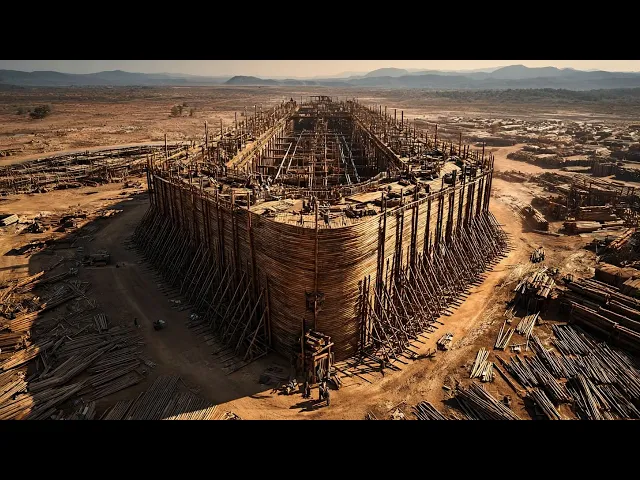
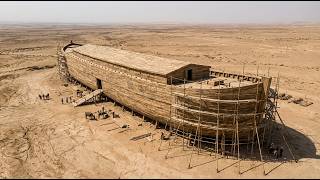
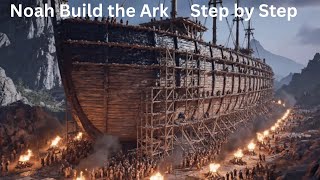
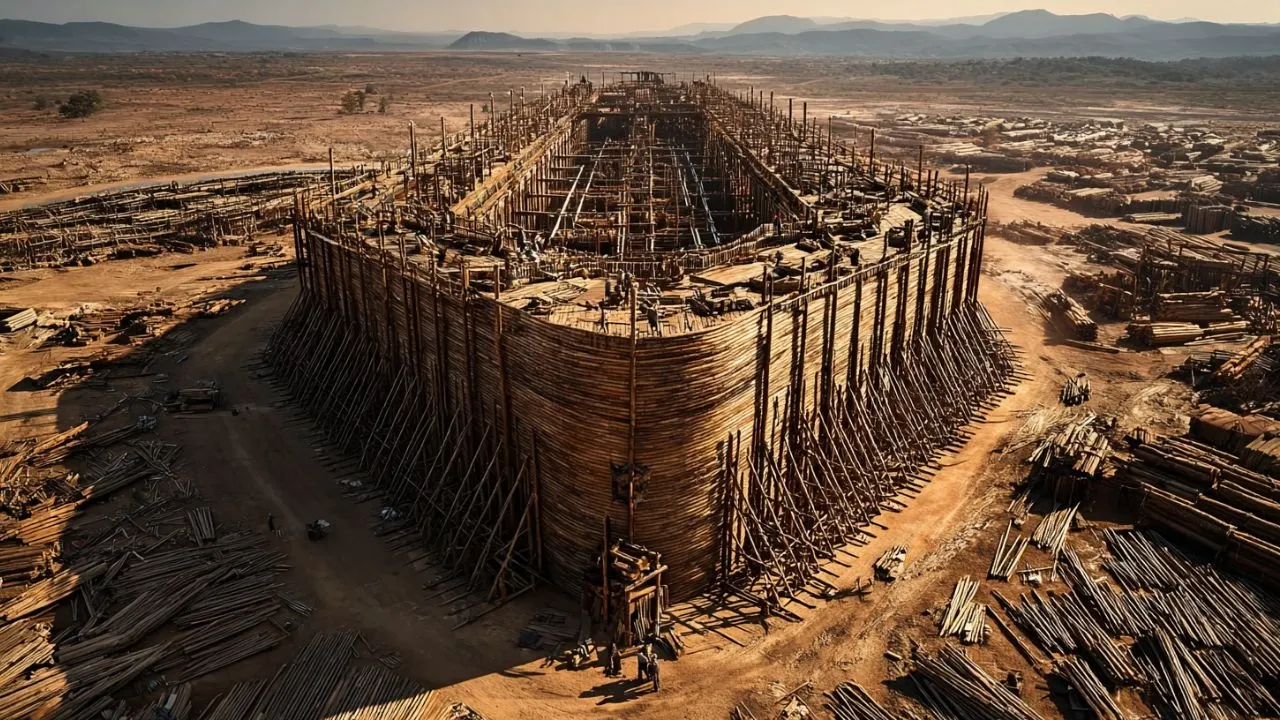
Measuring approximately 450 ft in length and 75 ft in width, its three levels rose like a giant wooden structure. Scripture records every dimension with precision. Yet, it does not say what mattered most.
How to build something so immense. It does not explain how to fell trees that stood like living pillars, nor how to move trunks that weighed many tons as heavy as the houses of the very men cutting them down. There is no manual for fitting wood together without iron nails, nor for sealing every crack in a colossal structure against an event the world had never seen.
God gave the order, but did not explain the process. And Noah, standing before a task that defied logic, had to discover on his own how to turn a heavenly vision into something real, solid, and seaorthy. For decades, he and his sons woke every day with the same burden in mind and in their hands to raise the largest vessel in human history, without previous experience, without engineers, without advanced tools, without any reference, only faith and a bronze axe.
As they [music] labored, neighbors passed by, mocking, murmuring, pointing. How does a man build the [music] impossible when all he has is courage and a divine promise? and how can one construct a colossal ship in a place with no seas, where narrow rivers do not justify such an outrageous undertaking?
The question seemed absurd to any observer. But Noah had no choice. God had spoken, and that was enough.
"Build an ark," he said. He did not explain where to [music] build it, nor how to prepare the ground, nor which technique to use. He only gave the measurements and ordered, "Do it.
" So Noah did what any practical man would do. He studied the land around him, measured distances, imagined the hull stretching almost 450 ft across the earth. He needed space, real [music] space.
A 450 ft structure is a giant of timber. A 75 ft width demands a foundation where the ground does not narrow, does not sink, does not buckle. The first battle, therefore, was not cutting trees.
It was finding [music] the right terrain. He needed a flat, firm, extensive area, far from fragile slopes, but close enough to the forest so the wood could be transported. He also needed access to a source of drinking water, not for sailing, but for survival.
And there was another concern, the world's climate before the flood. There was no rain. The soil received moisture only from the condensation that appeared at dawn, a thick fog that covered everything like a white blanket.
During the day, however, the heat was intense, nearly suffocating. The sun scorched the land, cracking the soil, drying tools, making heavy labor even more exhausting. The wind [music] lifted clouds of fine dust that infiltrated everything, eyes, mouth, [music] fresh cut wood.
For this reason, when preparing the ground, Noah had to consider how to protect the work site from extreme heat and [music] constant dust. He likely built small coverings of branches, marked boundaries with stones, and raised simple [music] wooden barriers to prevent dust from invading critical areas, keeping the soil firm and stable. While Noah dug, leveled, and worked under the relentless sun, his neighbors watched.
Some laughed openly, others merely shook their heads. To them it was madness. Who prepares a massive foundation in [music] the middle of a dry valley to build a ship that will never touch water?
But there was something they did not understand. Noah was not building for the world. They [music] knew he was building for the world that was about to disappear.
Weeks, perhaps months later, the ground was finally prepared, firm, broad, [music] and shielded from the harshest heat. But the next task made all previous work seem light. Gathering [music] enough timber to erect a structure equivalent to a four-story building.
How many trees would be needed? Hundreds? Thousands.
Massive [music] cypress trees that had taken centuries to grow. Trunks so heavy they could crush a man if they fell the wrong [music] way. Each one weighing several tons.
And felling them was no small task. A bronze axe dulls quickly. Every strike [music] demands strength, precision, and endurance.
Blow after blow. [music] Splinters flew. Muscles burned.
Hands blistered and bled. Often hours of labor yielded only a deep [music] notch in a single trunk. This is why Noah and his sons likely worked in pairs, alternating strikes to maintain rhythm without complete exhaustion.
When the trunk finally began to tilt, the most dangerous moment arrived. The fall. A tree around 65 ft tall could crash down [music] like a beast, destroying everything in its path.
So they surely prepared wedges, guided the cut, tied long ropes to direct its descent. And when at last the tree collapsed with a muffled thunder that echoed through the hot, silent forest, the task only shifted. It did [music] not end.
For now came the next challenge. how to move a log the [music] size of a bus, weighing as much as a tower, with no wheels, no cranes, and not enough animals to pull it. The newly felled trunk lay on the dry ground like a sleeping titan, so massive and unmoving that [music] it seemed to mark any human attempt to set it in motion.
The most efficient solution Noah likely found was the same one used by Egyptians, Mesopotamians, and other [music] ancient civilizations. wooden rollers. It was a simple yet brilliant technique.
He would cut smaller, [music] thinner logs and position them in a row beneath the main trunk. Then he tied strong ropes to [music] the front and began pulling. As the massive log advanced, rolling over the cylinders, the men would retrieve the rollers left behind and placed them again in front, repeating the process [music] dozens, perhaps hundreds of times it worked.
But it worked at a tremendous [music] cost. strength, time, and precision. And there was one detail that made everything even more difficult.
The terrain. Moving logs across flat ground is already hard, but dragging them across uneven areas is nearly insane. A poorly prepared trail, a hidden stone, a slightly steeper slope.
[music] Any of these could turn a multi-tonon trunk into a deadly weapon rolling uncontrollably downhill. It could crush anyone standing in front, shatter upon hitting a rock, or veer sharply enough to tumble into a deep ravine and be lost forever. For this reason, even before moving the first log to the [music] work site, Noah likely spent weeks preparing pathways.
He leveled the ground wherever possible, removed large stones, filled holes, cut exposed roots, and created trails wide enough for several men to work side by side. Every yard of path came from days of effort under the intense constant heat that dominated [music] the pre flood world. No sudden rainstorms, no relief, only blazing sun, fine dust, and the morning mist that evaporated [music] quickly, leaving the air dry and heavy.
And then there was the issue of strength. Even with rollers, it was impossible to move a giant log with only four men. Noah had three sons, and together they were capable of much, but not of everything.
[music] So, it is very likely they hired local workers, simple men accustomed to hard labor, who did not care if the project seemed absurd. Some may have helped for [music] money, others out of curiosity, others because they needed work. But all of them knew that every single trunk transported represented [music] entire days of effort, ropes that could snap at the worst moment, and accidents that sometimes caused serious or even fatal injuries, [music] while some timbers were left to dry, stacked with space between them, so the hot breeze could pass through without letting them rot.
Noah returned to the forest to cut down more trees. The work felt [music] endless. Still, a cycle was formed.
cut, transport, stack, dry, cut again. But the most critical moment was approaching. The moment that would truly distinguish a mere [music] pile of wood from a vessel capable of surviving waters the world had never known, [music] raising the structure without letting it tip over, warp, or sink into the ground.
This was [music] the true test of a builder's skill. How do you erect a three-story structure without it collapsing before it's even finished? The answer began with the most important piece of any ship.
The keel, the spine of the vessel, a central master beam that would support the entire shape of the ark. Without it, everything would [music] be nothing more than a heap of loose planks. But here was the great obstacle.
The keel needed to be about 450 ft long. No tree on Earth grew anywhere near that length. >> [music] >> This meant Noah would have to create the keel by joining multiple massive beams, trunk after trunk, fitting the ends together with [music] near surgical precision.
He likely used male and female joints reinforced with hardwood pegs [music] hammered with heavy mallets until fully locked in place. The line had to be perfectly [music] continuous. If the keel cracked, warped, or came apart, the entire ark would be compromised.
Then came the ribs, curved beams rising along both sides like gigantic bones shaping the hull. But how do you bend wood [music] without breaking it? There were no modern ovens or metal structures.
The answer was ancient steam and heat. The wood needed to be warmed gradually, softened with controlled heat, wrapped [music] in damp fibers, perhaps kept inside makeshift frames where steam accumulated. When it became flexible, [music] Noah and his sons would slowly bend it, secure it inside simple molds, and let it cool until it hardened again.
It was a delicate process. A crack during bending meant [music] weeks of work lost, and there were dozens upon dozens of massive ribs, [music] all needing to fit into the keel with exact spacing. A mistake of only a few degrees in alignment would leave the entire structure crooked, heavy on one side, unstable on the other.
To avoid that, Noah likely stretched ropes [music] as guidelines, marked measurements on the ground with stakes, and used stone plum lines to check every angle. Even so, adjusting a multi-tonon beam required more than calculations. It demanded coordinated brute strength, improvised levers, logs used as primitive pulleys, men pulling ropes in perfect synchrony, every movement calculated to the inch.
And even with all that effort, the work had only just begun. There was still another critical detail in the construction, the diagonal reinforcements. These were cross beams forming triangles, not for aesthetics, nor by accident.
Noah certainly knew just as [music] ancient builders intuitively knew that the triangle is the strongest geometric [music] shape that exists. It does not deform without breaking. It is the only structure that remains rigid even under extreme pressure.
For this reason, the interior of the ark was not just a simple skeleton of beams. It was a complex network of interlocked wood with diagonal braces that turned the hull into a true floating fortress. When the skeleton of the ark finally rose, immense, imposing, [music] cutting the horizon like the silhouette of a giant, Noah may have paused for a moment just to breathe, [music] and to understand that the most critical part was still ahead.
He could build walls, beams, and ribs, but all of it would be useless if water found the smallest path inside. Now began the stage that would determine whether the ark would float [music] or sink, sealing every gap, every joint, every microscopic crack. A single floor would be enough to seal everyone's fate.
Scripture is clear. You shall pitch it inside and out. That double coating saved lives.
External pitch alone would not be enough. Water always finds a way to infiltrate. Moisture would seep through invisible seams, rotting [music] the wood from the inside out.
That is why Noah had to seal everything, layer after layer, from both sides. Pitch was a mixture of boiled tree resin, natural oils, and thick substances found in the earth. A sticky, [music] black, scalding, and toxic paste.
Boiling that mixture under the already suffocating heat of the pre flood world was exhausting. The smoke stung the eyes, clung to the skin, and filled the air. But the worst part was not working outside, where the wind dispersed some of the fumes.
It was working inside the ark. The internal application was like entering a hot, poorly ventilated cavern. The dense [music] vapors of the pitch accumulated quickly, making the air hard to breathe.
Workers had to go inside, [music] apply it, retreat, step out for fresh air, return, apply more, step out again. Hours of interrupted labor, burns, skin irritation, [music] dizziness from lack of oxygen. And it was not a single layer.
[music] It was multiple layers applied successively. Dr, reinforce, apply again, test with thin wooden slats, search for microscopic cracks, and seal again. A process that may have lasted weeks, perhaps months.
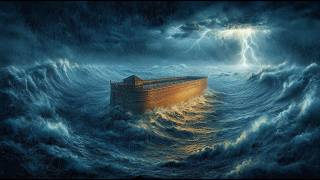
But the harsh truth was this. The real test would only happen once the ark was in the water. Until that moment, all Noah had was faith.
Faith that no joint, no seam, no small imperfection would betray his efforts [music] when the abyss opened. When the final layer of pitch finally dried under the parched sun of that ancient world, the ark was completely sealed. But now another immense challenge arose.
Turning that cavernous space into a livable environment for thousands of animals for more than a year. Without order, everything would become chaos. Without planning, [music] certain death.
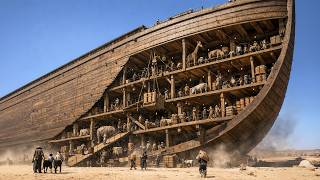
The Bible gives the essential clue. Three levels [music] and internal compartments. The Hebrew word used kin means literally nests or cells, individual spaces.
And that made perfect sense. Without divisions, there would be fights, predators attacking prey, animals trampling smaller ones, diseases spreading with terrifying speed. But this planning was not simple.
Building internal walls meant adding weight, redistributing loads, [music] and ensuring nothing compromised the stability of the hull. Noah had to think like an engineer. The logic was clear.
Heavier animals on the lowest level, elephants, [music] rhinoceroses, hippos, creating a low center of gravity that would keep the ark from swaying dangerously. [music] Medium-sized animals would occupy the second level. Horses, cattle, large bears, big cats.
On the upper level would be the smallest birds, small mammals, [music] light reptiles. a strategic weight distribution essential for maintaining balance in turbulent waters. But there was a problem few ever consider.
Waste. Thousands of animals producing waste [music] daily with no modern drainage system. Within weeks, the inside of the ark would become a toxic environment, a deadly hazard for both humans and animals.
Diseases would spread long before the flood reached half its length. That is why Noah likely [music] created simple but ingenious solutions. floors with a slight incline, small channels carved into the wood, grooves [music] that directed liquids to specific points, perhaps discrete openings along the lower sides designed to allow natural drainage once [music] the ark was afloat.
Nothing sophisticated, only efficient, and in that world, efficiency meant survival. [music] And this was only one more among the countless challenges he still had to solve. There was also the vital issue of ventilation.
[music] Scripture mentions only a single upper window. But one opening alone would never be enough to [music] renew the air of three enormous levels packed with living creatures. The world before the flood was dominated by constant heat and the morning moisture that rose from the ground at dawn, forming a mist that dissipated quickly inside a sealed hull.
This would create a stifling, suffocating environment. For this reason, it is likely that Noah created strategically positioned side openings protected by outward wooden overhangs that kept excessive [music] dust and later water from entering while still allowing air to circulate. Without proper ventilation, the natural gases of the animals would accumulate, oxygen would drop, [music] and everyone would die long before the world was underwater.
And then there was the storage of food. A year's worth [music] of provisions for thousands of creatures could not be improvised. It required tons of compressed hay, dried grains, roots, dehydrated [music] fruits, and specialized feed for certain species.
Noah had to dedicate entire areas solely [music] to storage, organized on raised platforms, lifted off the floor, and protected from any trace of moisture brought by [music] the morning mist. corridors, internal pathways, and small circulation routes had to be designed so everything could [music] be accessed without chaos. When all this internal architecture finally took shape, [music] three full levels, cells, nests, corridors, storage rooms, Noah realized [music] he had built something far greater than a simple ship.
It was a closed city, a living fortress. But the most critical part of the entire construction [music] was still missing. The door.
The ark's door could not be small. Animals of monumental size had to pass through it. Giraffes, [music] elephants, large herbivores.
It was a colossal opening, and this created a massive structural problem. The larger the [music] opening, the weaker the wall. A door of that size could compromise the entire lateral integrity of [music] the ark, especially when the pressure of the rising waters struck the wood.
That is why the [music] location mattered. Scripture reveals the door was set on the side. And this detail shows remarkable engineering sense.
[music] Sidewalls distribute pressure far better than the ends, and a side door allowed the animals to enter without throwing the ship off balance. But for that to [music] work, Noah had to reinforce the entire surrounding area. Thick beams framing the opening, forming a robust border, solid wood locked with joints stronger than usual, all to compensate for this vulnerable point.
and the ceiling. Scripture mentions no locks. And there is a clear reason.
God himself [music] would close the door. It was not Noah's job to shut the world out. [music] His job was only to build.
Even so, the ceiling around the edges [music] had to be perfect. Noah likely used extra layers of pitch and some type of flexible material between the borders. vegetable fibers soaked in hot resin, forming a kind of primitive [music] gasket.
When the door was closed, those fibers would be compressed against the structure, sealing everything completely. No gaps, no air or moisture slipping through. An absolute [music] seal.
And what about the opening system? Metal hinges would have been rare and far too expensive for something [music] so heavy. Far more likely is that Noah used a massive vertical pivot, a reinforced wooden [music] post set into a stone socket or a hardened trunk at the bottom, allowing the door to move slowly, heavily, but effectively.
When the door was finally installed, tested, [music] aligned, and sealed, the ark was for the first time complete. Decades of uninterrupted work, mountains of wood felled, [music] dragged, shaped, structures raised, sealed, reinforced. A vessel so [music] gigantic that it seemed to defy human logic.
But now came the most mysterious part of all, something no engineer could predict or control. Suddenly, without Noah calling or directing them, the animals [music] began to appear on their own. And before that miraculous event reached its peak, there was still one more question.
How do you test a ship of such size without putting it in the water? The answer was brutal. You don't.
The ark had been built on solid ground, far from any body of water capable of supporting it. Therefore, all those decades of labor depended solely on calculations, basic experience with wood, and absolute [music] faith that the proportions given by God were perfect. Still, [music] Noah could perform final inspections.
He walked through the immense interior of the ship, touching every beam, pressing every wall, checking joints, observing whether the pitch had contracted during the [music] drying process, searching for hidden cracks. He certainly loaded provisions [music] gradually, increasing the weight little by little, listening to how the structure responded, [music] because wood under pressure speaks. It caks, pops, groans, and if something were [music] wrong, Noah would hear it.
But nothing could prepare him for the moment when coming from every direction, the animals simply began to arrive. Scripture makes it clear. They came to Noah two by two.
They were not hunted, chased, or lured [music] with food. They came on their own, obeying a call that no human ear could hear. Imagine the scene.
From every corner of the earth, animals began to appear [music] as if responding to a silent command. Great herbivores emerging from the trees. [music] Predators walking beside prey without the slightest hint of hostility.
Birds circling in the sky before landing at the entrance. Reptiles gliding over the dry soil. All converging [music] toward the same point.
There was something supernatural in that silent march. Every step, every growl, every call seemed guided [music] by an invisible force. And then something even more astonishing happened.
Each animal went straight to its [music] designated compartment. No confusion, no disputes, no fear. It was as if they already knew exactly where they were meant to remain during the great journey.
The natural chaos of wildlife simply did not exist there. That moment made it clear that the ark was not merely a human project. It was a work sustained by the very hand of God.
When the last animal found its place, Noah, his wife, his three sons, and their wives entered as well. Eight people, the last righteous family on earth. And then the event written from the beginning took place.
God himself closed the door. Not the arm of a man, but the divine [music] touch sealed the entrance, shutting the old world outside and protecting the new world that would be born after the waters. The construction was complete.
Decades of labor had come to an end. But after all, why did God command the building of this ark? Why did he send the flood?
What had happened to the ancient world to justify such [music] a devastating judgment? If you want to understand what truly existed before the flood, the corruption, [music] the giants, the fallen angels, and the reason the creator intervened, we have an entire film revealing that forgotten [music] world. Click the video now appearing on your screen and discover what humanity lost forever.
See you soon.