[Music] China 1949 from Ping's Tanan Man square communist leader Mao Zaong has proclaimed the establish Establishment of the People's Republic of China. A new age for China, for the Chinese Communist Party, and for Chairman Mao. He has devoted his life to revolution and to his dream of transforming China.
Now is his moment. Mao's government calls itself a people's democratic dictatorship, but democracy is not on the agenda. Instead, the heart of government is the central committee of around 100 senior party members.
Above that the 12 strong polit bureau and within that the poll bureau standing committee where true power lies. There are five members including Leo Shiaoqi a veteran labor organizer who studied in Moscow. He is now vice chairman of the communist party.
Joe and Lie, a hero of the revolution, once Mao's superior within the party, but who has now publicly and privately committed to Mao's leadership. Charming and polite, he has shown a great talent for diplomacy and will serve as Communist China's first state premier and foreign minister. and Mao himself, chairman of the Chinese Communist Party and paramount leader.
Aged 55, Mao now wields unchallenged personal authority, the result of his inspiring leadership in the struggle against the Japanese and nationalists. Though never a natural orator, Mao is a charismatic figure capable of deep intellectual thought, shrewd political tactics, and stirring writing. Since 1938, he has been married to his fourth wife, the famous actress Jangqing.
[Music] She is a powerful personality in her own right, ferociously loyal to Mao and scathing of his rivals, real or imagined. After years of revolution, invasion, and civil war, China is impoverished and in desperate need of reform and rebuilding. The Communist Party gets to work immediately to impose a vision on the country that is heavily inspired by Soviet thinking.
To this end, around 10,000 Soviet advisers arrive in China to assist in reconstruction. The country remains an overwhelmingly agrarian society. In 1949, by rough estimate, every fifth person on earth is a Chinese peasant.
They have long provided the base for communist success in China, wooed by the promise of land redistribution, which has been enforced in communist controlled areas since the early 1930s. Now, it is to be rolled out on a national scale. Rural land owners who have dominated the Chinese countryside for centuries are vilified for abusing their power over peasants.
They are publicly humiliated by the communists, put on trial and executed in huge numbers. More than a million are killed. Their land is seized and redistributed.
[Music] Over the next 3 years, about 300 million peasants receive land for the first time. Early reforms are intended to fundamentally reshape Chinese society. New laws improve the rights of women and protect their role in the workforce.
To improve literacy rates of just 20%, the government promotes the use of simplified Chinese characters. Huge propaganda drives in theaters, public storytelling, and posters aim to both educate and indoctrinate in communist revolutionary values. [Music] Suspected counterrevolutionaries such as nationalist sympathizers, corrupt officials, and capitalists are to be reported and eliminated.
The campaigns upend China's traditional class structure, humiliating and impoverishing bourgeois and middleclass families. The number of victims is impossible to quantify, but hundreds of thousands suffer loss of status, confiscation of property, or imprisonment. Some are even forced to take their own lives.
[Music] [Music] China's new communist leaders seek to build alliances abroad, but World War II has been followed by the Cold War, and the world is now divided between a democratic capitalist West and the Sovietled Communist block. The Western powers offer no support to communist China. In fact, they continue to recognize their wartime ally, Tiang Kai-shek, as China's legitimate ruler.
His authoritarian nationalist government, officially known as the Republic of China, still holds Taiwan and small islands in the Taiwan Strait. Inevitably, it is to the Soviet Union that Mao turns. In December 1949, he travels to Moscow for 3 months of talks with Soviet Premier Joseph Stalin.
Their relationship is not an easy one. In imposing his own brand of communism in China, Mao has often overruled his Sovietbacked rivals. Nevertheless, in February 1950, the two leaders sign a treaty of friendship, alliance, and mutual assistance, unlocking economic and military cooperation between China and the Soviet Union.
By the 18th century, theQing dynasty had added several remote western territories to its empire. Mongolia, Shinjiang, and Tibet. But in the tumult following the 1911 revolution, they had escaped Chinese control.
Now the communist government acts to reimpose central authority. In 1949, the People's Liberation Army is sent to reoccupy Shinjang. In 1951, Tibet is occupied and annexed.
Following a short conflict, the Chinese government euphemistically calls the peaceful liberation of Tibet. As part of the settlement, the Dalai Lama is allowed to remain at the head of a local government. No attempt is made to regain out Mongolia, which is now within the Soviet sphere of influence.
[Music] Taiwan remains a major source of contention. Both the communists and Chang's nationalists continue to denounce the other side as bandits and their governments as illegitimate. Elsewhere, China's borders seem settled.
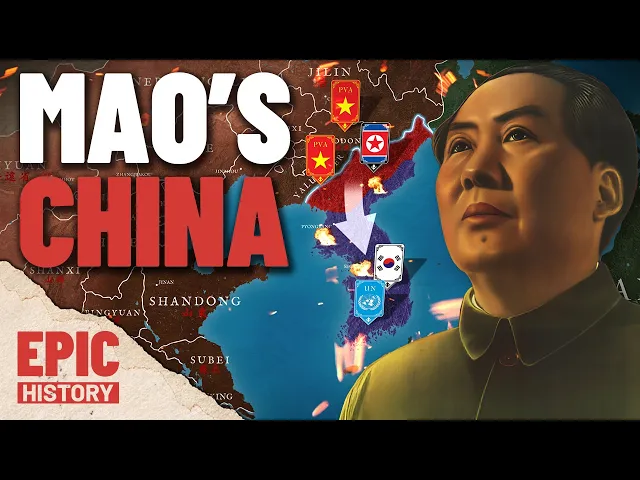
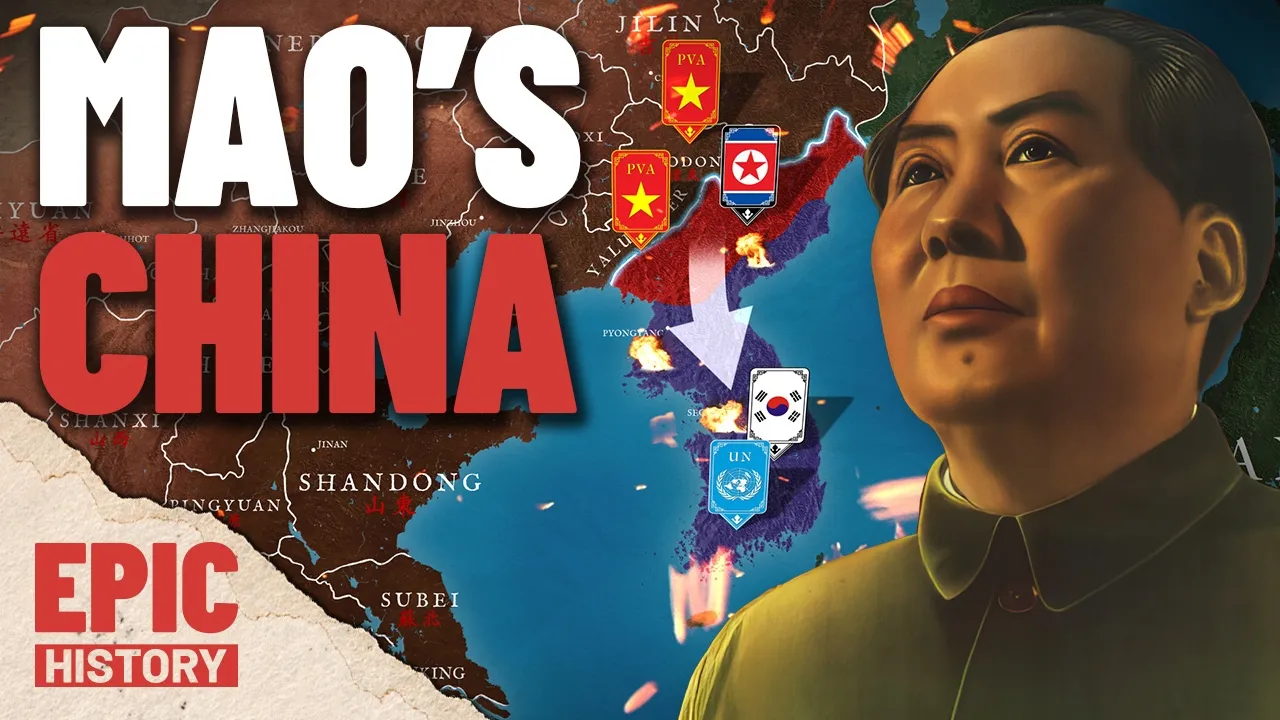
But in 1950, the People's Republic of China faces a major conflict on its doorstep. The Korean War. After World War II, Korea had been divided into two separate states, a communist North and Democratic South.
In June 1950, northern forces invade the south, advancing rapidly and capturing Seoul. Within a week, [Music] Korea becomes a cold war battleground. Under US leadership, UN troops intervene in support of South Korea.
By the end of the year, they have pushed the front line back to the Yaloo River, close to the North Korean Chinese border. Fearing a US-led invasion and hoping to shore up a communist ally, Mao sends in Chinese troops to support North Korea. More than a million Chinese troops enter the battle, soon rising to 2.
5 million. In the face of this onslaught, UN forces retreat south. After months of heavy fighting, the war enters a stalemate, both sides dig in along the 38th parallel.
In 1953, an armistice is agreed, and this becomes the heavily fortified border between North and South Korea, known as the DMZ, demilitarized zone. For China and for Mao, the Korean War is presented as a triumph. They have championed the global socialist cause and stood up to the US superpower.
Perhaps even more importantly, communist legitimacy within China is greatly bolstered. But it comes at a huge cost. The Korean War claims an estimated 3 million lives.
Chinese military casualties are more than half a million, possibly many more. [Music] They include Mao's own son, Mao Aning, killed in a UN air strike while serving with Chinese forces. [Music] In its efforts to curb the spread of communism, the US has now imposed a total trade embargo on communist China.
The war has also strengthened US support for Chiang Kaishek's government in Taiwan with President Truman sending the US 7th Fleet to deter a potential communist attack. [Music] In 1953, China's government introduces its first 5-year plan, inspired by similar economic programs in the Soviet Union. One aim is to swiftly and massively increase Chinese industrial output.
Huge efforts backed by Soviet technical expertise produce remarkable results in transport, industry and infrastructure. [Music] Production of coal, iron and steel all exceed their ambitious targets. [Music] While China becomes a major oil producer for the first time, the second aim of the 5-year plan is to rapidly boost agricultural output.
To this end, the Communist Party pushes farmers to collectivize on a massive scale, forming cooperatives that include dozens, sometimes hundreds of households. By 1956, 80% of peasant households belong to a cooperative, meaning they share the land, tools, and harvest. [Applause] [Music] Cooperatives also have an ideological aim to tighten party control over the lives and thoughts of rural communities.
At breakneck speed, communist reforms are overturning a rural way of life that's centuries old and sewing the seeds of disaster. Mao is encouraged by the apparent success of the first 5-year plan. Hoping to encourage further innovation, in 1956 he announces, "Let a 100 flowers bloom.
Let a 100 schools of thought contend. " It is an invitation for others to come forward with constructive proposals for the government. In response, criticism of the party comes flooding in from intellectuals, academics, and scientists.
Mao and the leadership are dismayed and angered. Rather than welcome proposals, they move to crush what they now regard as dangerous descent. A new anti-rightist campaign punishes at least 500,000 men and women who are considered insufficiently loyal to the party.
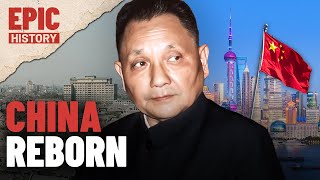
Penalties include public humiliation, hard labor, and execution. Among the leaders of this brutal campaign, a new addition to the pallet bureau standing committee, the 52-year-old Dang Xiao Ping. A veteran of the long march, he will become a crucial figure in the years ahead.
[Music] 1958, the start of a second 5-year plan. This time even more ambitious. Mao calls it the great leap forward.
A huge program to create a truly socialist state and dramatically expand industrial output to catch up with the world's leading economies. A huge public information campaign spreads the message throughout the country, urging every Chinese citizen to rise to the challenge and embrace Mao's leadership. Existing rural cooperatives are merged into vast people's communes in which the party controls every aspect of daily life.
The state now owns the land, buys harvests, and distributes rations. Private kitchens are banned as representing selfish individualism and replaced by communal cantens. Very quickly, the Great Leap Forward's ambitions become detached from reality.
Many of the technicians and experts who should have overseen the campaign have been purged. Under intense pressure to meet unrealistic targets, local party officials exaggerate harvest figures. These inflated reports suggest large surpluses of grain which is then taken from the communes to supply the cities.
In reality, this means far too much grain is taken from the communes, often leaving them without enough to feed themselves. [Music] Drught, mismanagement, and corruption actually mean agricultural production is in steep decline. Millions of peasants now face starvation.
On top of this, farmers face new nonsensical demands like an order to use homemade foundaries to produce iron, often of such poor quality, it's unusable. The result is a disastrous famine across China. By some recent estimates, Mao's great leap forward is responsible for at least 45 million excess deaths, around 7% of the population.
It ranks as one of the greatest man-made disasters in history. In the most hardpressed areas, whole communes starve to death. Famine had always been a feature of life and death in China.
But the winter of 1960 is perhaps the darkest hour in the country's history. Reports of widespread chaos and suffering eventually seep through to the upper echelons of the party. In the summer of 1959 at a conference in Luchan, Minister of Defense Pong Dai openly denounces the great leap forward and Mao's leadership.
Mao is not in listening mood. Pong is placed under house arrest and removed from office. His replacement, General Lein Bao, is one of Mao's most loyal supporters.
But as the months go by, the evidence becomes impossible to ignore. When news of the famine reaches Taiwan, Chiang Kai-shek seeks to humiliate Mao by ordering air drops of food to the mainland. [Music] By 1961, the party has to acknowledge reality.
Mao Sidong publicly accepts that mistakes were made. He remains chairman of the Chinese Communist Party, but for the next few years, he steps back from frontline politics. In his place, more pragmatic leaders, notably Leo Xiaoi, Joe Li, and Dang Xiao Ping, take on the day-to-day business of government.
[Music] Some of the policies that had led to the famine are abandoned. Communes are reduced in size. Communal cantens are abandoned and some land returns to private ownership.
But the party still controls all aspects of daily life, providing everything from health care to housing, education and employment. [Music] While food remains rationed, the work unit, not the family, is the basic unit of social and economic existence. Meanwhile, in 1958, the government adopts a new phonetic alphabet to encourage literacy in China.
It is called pin and becomes the new system for the romanization of Chinese names. Ping becomes Beijing. Canton becomes Guangjo.
Nanking becomes Nanjing with countless more changes. [Music] Pin Yin spreads only slowly across China itself and it is not until the 1980s that the new names are taken up abroad. [Music] While enacting the great leap forward at home, Mao takes an increasingly aggressive approach abroad.
In August 1958, the Chinese army starts shelling islands in the Taiwan Strait belonging to the Republic of China, testing nationalist defenses. The US response is emphatic, sending naval and air reinforcements to the region and deciding to use nuclear weapons if necessary. It is one of the world's first serious nuclear crisis.
The situation eventually reverts to a hostile standoff. But Soviet Premier Nikita Kushchev, who is pursuing a policy of peaceful coexistence with the West, is furious at Mao's recklessness. Relations between China and the Soviet Union, the world's two great communist states, are in steep decline.
In 1956, Kruchchoff had denounced the excesses of Stalinism and the cult of personality. Mao is outraged by these views and in turn denounces Kushchev's views as a betrayal of communism. In his eyes, the Soviet Union has gone soft.
It is a fatal ideological split and after 1959 the two leaders will never meet again. That year, China faces a revolt against its rule in Tibet. In response, the Chinese army shells Laza.
The uprising ends after 3 days of bloody street fighting. The Dalai Lama and 80,000 Tibetans flee to India. From now on, Tibet is under direct Chinese rule.
In 1962, tension on the Himalayan border between China and India explodes into a month of fighting as China grabs disputed territory. Tellingly, the Soviet Union backs India, not China. A sign of how far their relationship has broken down.
The Soviets have already withdrawn all technical support for Chinese weapons programs, but China is no longer so reliant on foreign expertise. 1958, for example, had seen the founding of the University of Science and Technology of China in Piking. And in 1964 at Lopnor in Shinjiang province, China tests its first atomic bomb.
Two years later, it detonates its first thermonuclear device. China has joined the United States, Soviet Union, Britain, and France to become the world's fifth nuclear power, adopting a no first use nuclear policy. [Music] There is no longer any question that China stands on its own feet as a major world power.
But Mao and the Chinese Communist Party still see much work to do. Their next battleground will be within Chinese society itself. [Music] [Music] The Epic History team uses heaps of technology to make our videos.
From laptops and drives to headphones, microphones, and of course, the dreaded cables. And when we're off on our travels, we all know how difficult it can be to keep those things organized. Thanks to our video sponsor, Broy, we may have just found the perfect solution.
Because the entire Epic History team is now equipped with the sleek and versatile Broy Tech kit. As you can see here, mine is in a stylish slate color. There are other colors available.
It zips and unzips very neatly and accommodates a multitude of cables and chargers and power bank in at the back there. keeps them all safe, keeps them organized. But tech kits are not the only thing Broy can offer.
This Australian brand started 15 years ago by breaking the rules of wallet design, but now offer everything from phone cases to bags, backpacks, and suitcases. Basically, if you ever need to carry something, they'll help you to carry it better. With a design philosophy based around functionality and durability, you're guaranteed to find highquality accessories that stand the test of time.
Broy also puts sustainability at the heart of its design and manufacturing processes. They're investing in the development of more sustainable materials, and all their main body fabrics and linings are made from 100% recycled materials. So, where's my Epic History discount, we hear you ask?
It's in the link in the video description. Use it now to start browsing the huge range of products at belroy. com and get 10% off everything.
Thanks again to Broy for sponsoring our video. Big thanks to our series historical consultant Dr Lily Chang of University College London. And thanks as always to the Patreon supporters who helped to make this channel possible.
From builders such as Fury Road, Alan Jang, and Frank McLaclin to citizens like Jason Rimer Deong and Ell. And heroes like Stuart Walker. And now you can also support the channel by joining the ranks of the Groyards, our valued YouTube members who gain access to loyalty badges, custom emojis, and merch discounts.
Click the membership link on our channel page to sign up now.