You've played this game if you just if I hold my finger up in front of you it's very thin and I look at you but not my finger I see two c unless I've got a dominant eye but for those of you don't have a dominant eye you'll see two copies of your finger and each will be semi-transparent now you're see you know what you can see through it right so what what one eye is being blocked with the other eye is seeing the world beyond That and so your brain is evolved to just create
two copies of it and you're not confused like oh my god I've got two figures no you know what's going on it's just you you have this perception that combines them and creates semi-transparency um so that you can see beyond [Music] it hello everybody I'm going to start today with a couple of announcements the first is that I published this book we Who wrestle with God perceptions of the Divine it came out November 19th it's number one on Amazon right now which I'm pretty happy about and it's also the basis for a tour which I'm
starting started in November continues through December then January through April as well you can find information about the tour at jordanbpeterson.com uh it's about this new book which is about biblical stories but you should also understand that I'm doing the same thing With these stories that I did with the other tours that I had conducted before and the other books for that matter which is to take high level abstract ideas in this case foundational narratives to explain what they mean but also to explain why knowing what they mean can make a real practical difference in
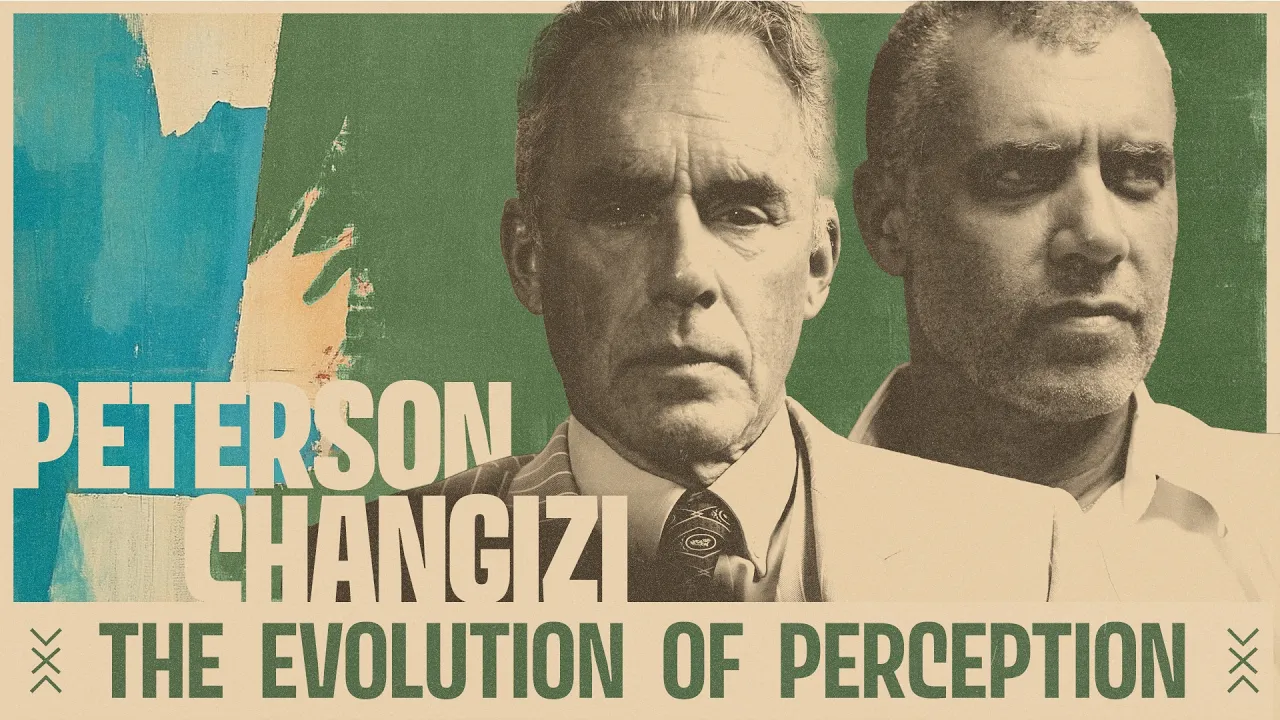
your life you know I want to bridge the gap between the abstraction and the reality so that you can put into operation the principles That I'm discussing so that it does produce a tangible Improvement in how you attend to things and how you act so come out to the lectures if you're interested in continuing with that today I had the opportunity to talk to Mark changii who is an author of this book expressly human and a number of other books and I wanted to talk to Mark for two reasons one was because we share an
interest in evolutionary biology and evolutionary psychology especially with Regards to perception emotion language and mass group behavior and so I've been trying to Wade through the literature on perception um Mark is very interested as an evolutionary biologist psychologist in the function of evolved traits like perception and one of the hypothesis that we discussed which is a very interesting one was his explanation rather unique explanation for the evolution of color vision he believes For example that we have uh additional color vision not so much so that we could detect ripe fruit for example which was one
hypothesis but so that we can better attend to the emotional signals that people display as a consequence of alterations in in their circulation especially displayed facially so we have color vision so that we're better at detecting signs of health or ill health as a consequence of skin tone but also detecting and Reacting to emotional displays and so um join us if you're interested in evolutionary biology evolutionary psychology emotion language communication and the behavior of mass groups so I think we'll start our discussion by talking about perception and you've studied visual perception for a long time
and so I'd like you to outline if you would what you understand about visual perception and then we can contrast our viewpoints and see where we Can go with that and I think we'll segue into emotion and language from perception yeah I mean so you know my background is is sort of mathematics and I went into um cognitive science and I was really more of an evolutionary biologist and so one of the areas that I worked and have a bunch of discoveries happens to be VIs so other things in other areas of sort of evolutionary
biology why we have as many fingers and why animals have as many limbs as they Do why you get pruny fingers when you're wet they're actually optimized to be rain tread so that when you you when you you don't want a hydroplane so they suddenly have the optimal pattern so that you can channel the water out as quickly as possible so these are all the sorts of things that I was very sneaky us people that's right so yeah always I was interested not in the specific mechanisms by which our brains work but but on the
ultimate sort of design Questions for why it would have evolved that way so so functional it's all about function and and strangely I mean this is more on the political side strangely even though the biological World claims uh to believe in Darwin when you're when you're actually there in the evolutionary biology World almost nobody believes in in natural selection they nod to it but if you actually do a paper that argues here's why it evolved to be this way here's the functional reason For why it's this way they'll say you you're doing a just so
story you're not allowed to make hypotheses about design that's a just so story that's thology I like you're missing the entire point of natural selection Darwin's Discovery is that yes there's design that's that's not an issue well sexual selection also amplifies that well I mean sexual selection has things that are not leading to perfect uh natural selection design but set let's set that aside for The moment the whole point is not that there's not design the whole point is that there need not be a master designer that is you can explain all this design all
the seeming te ology without a designer that's the whole point right but what they want to reject is not just a designer but they want to reject design itself and so that there there's an immense reology reology no like my eyes yeah yeah that's weird all it's bizarre so right and and so it's a very Small community and it becomes across as you know they attack sociobiology EO on the same kind of basis you start want to be it happens not just when you enter into human behavior and human psychology it happens even generally when
you're talking about even r Treads you know rain tread pruning fingers like I did or any of stuff that I do that is a just so story and it is not allowed right now it's true that you can't study design the way that you study mechanisms you Can't do a lab experiment in quite the same way you have to ask it in different kinds of way you have to say if this is really designed for what I'm claiming it's designed for let's say you know if the pruny fingers are designed to be rain treads well
then here's let's derive what the optimal morphology would be what should the wrinkles actually look like so that's one kind of prediction looking at the morphology or the shape another might be if it's Really the case that it's for design well it should only occur in animals that you know have wet dewy conditions whereas certain kinds of animals that are never in wet Dey condition shouldn't have this you know this morphological feature shouldn't appear there's different kinds of predictions you can make but there are often philogenetic predictions morphological predictions um sometimes you can do behavioral
do they actually behave perform better in what Conditions when they're wrinkly versus when they're not wrinkly and all the kind of combinations of these things what you don't you can't typically do the mechanism kinds of experiments it's just a whole different kind of things so you have to do a L but the I the strange weird thing in in Inc incredibly farle communities as they are is that they somehow have thrown Darwin out entirely and you can't talk about natural selection which was an incredibly Bizarre thing know so okay so I can think of a
variety of possible reasons for that and I'd like your opinions about those reasons I mean the you you you you Tangled together a couple of things you said that even as an evolutionary biologist if you start to tread in the water of te iology or purpose you you uh receive push back from your colleagues and then you mentioned that that was also a far-left phenomenon and so I'm curious about it Seems to me that the relationship with the far-left is likely the fact that the far-left farle political philosophy is predicated on a radical social constructionism
essentially that every single thing that everyone does especially human beings but to the degree that the same thinking paralyzes speculation about animal Evolution there's an insistence among Those on the far left that there's no essential human nature everything's infinitely malleable and I see that as a reflection of an incredible intellectual arrogance because the reason for the insistence that everything is socially constructed is because that allows for the possibility for everything to be 100% modifiable by those for example who would like to modify human behavior in what the image of their own philosophy do you think
there's is there anything Else do do you think that's going on with regards to the rejection of of of purpose or or or so-called design I mean I I I my pet assumption has been that uh their U hair stands on end or they get they you know if they feel backed up against the wall when you get to human behavior uh this you know Stephen Pinker and blank slate arguing this as well um the idea that there's any notion of instinct or or or a human nature is against uh something you know they want
Really want to push back on that because they want to think of us as infinitely malleable and subject to socialism and whatever you know policies that they have they can shape shape us however they wish and so even when we're in things like pruny fingers it's it's as if they've uh uh taken that kind of prohibition of human psychology and and push it into any realm at all and have a have a general uh uh admonition not to do any kind of design uh or research That concerns the design of animals of themselves so I'm
not sure what else it could be but at any rate it's it's a bizarre thing because the only there's something else too there maybe it's something like a there's a lot of reasons for rejecting the idea of purpose one is to reject the idea of an ultimate designer so there's a religious argument say lurking at the bottom of that but it's also very convenient to reject the notion of purpose or meaning Because it also allows you to reject the idea of any kind of implicit responsibility like if if nothing has any meaning the disadvantage to
everything being meaningless is that things are meaningless but the advantage to everything being meaningless and purposeless purposeless is that you can do whatever the hell you want and so it's a very good rationalization for like short-term hedonistic power mad behavior and if you combine that with The problem of like infinite social constructionism then you have a real problem it's a weird thing that you would encounter that among at least among hypothetically evolutionary biologists and thinkers because why would they be concerned with evolutionary biology if they are going to toss out Darwin for example and most
of them don't really have to think about Dar because they're doing mechanistic experiments they're not doing hypothesis About its design um I'm one of the rare people back you know in the 1920s you had the ethologists who did a lot more thinking in terms of the design and the function really thinking about their evolutionary connection uh but that's gone way away everybody's dealing with really complicated experiments with mechanisms they don't have to think about it so they've somehow developed this knee-jerk reaction that you don't have to understand design and purpose But you cannot understand any
machine without understanding what it's designed for so if I often use an example if you were to find a stapler out of the middle of nowhere natives find a stapler for the first time um and they want to try to understand there's not much to a stapler you know there's like four parts or whatever six parts uh but you can't you might work out all the mechanisms this opens this there's these there's like seven things let's say and they do These sorts of kinds of actions well that's not an understanding of it that you can
you could might start saying well maybe there it's a weapon and you start shaking around like numchucks you open it up well now you can work out how how does it break when you hit someone in the face is it Bend and maybe that's part of it there's tons and tons of mechanistic behaviors that it have that have nothing to do with what it's in fact for how it deforms when this Happens there's lots of of infinite numbers of kinds of beh mechanisms that are involved with it that are completely irrelevant right um only by
understanding the mechanisms in the context of what the function is for this is where the computational hard you've got function you've got the algorithm level you've got the mechanistic implementation level you have to understand all these systems by understanding it by all of these parts All cohering together in one in relationship to function in relationship to function at the top and so they're throwing out the very thing that allows you to understand even if they're even if they are only interested mechanisms which my eyes glaz over with mechanisms um you can't understand mechanisms without inherently
understanding the functions in the beginning was the word Christ is a master at using short mysterious stories they change the Listener who takes them seriously my experience with the biblical text is that they're inexhaustible sources of wisdom if I find something in them that is an obstacle it's because there's something in me that has yet to be transformed I just don't get it the person that you do not think could ever be virtuous oh let me show you this is the person who is fulfilling the law and the prophets but seek first His King and
his righteousness and all these things shall be added to you as well I don't believe in that promise I'll just be honest on this point that has not been part of my experience this Parable I've been trying to understand forever while we were talking and while we were sitting there then it hit me I saw it made me one ideology that has supplanted Christianity that has done good for Humanity this Jew is very frightened of a postchristian society he Was the god man the model the example of what we ought to become and what we
can become it's okay it's safe for you in all of your doubts and apprehensions to open up and to let these stories in he is the temple he is the Torah he is the Covenant he is prophecy fulfilled if you're doing this and it isn't also the love of wisdom it's also an attempt at wisdom without love in both ways you're going radically wrong power of love it sounds so cliche when you say 60s I Don't want to be in a hallmar cart I tell you we've got our work cut out for us gentlemen this
is one peculiar time and one peculiar text and I sure hope we're up to the task okay so that's a that's a very interesting place to segue into perception itself because I got very interested I don't know probably 20 years ago in pragmatic philosophy the pragmatic philosophy of William James and Paris and they were all part of the Metaphysical Club in Cambridge at the turn of the 19th century and they were also extremely influenced by Darwin um and the the uh pragmatists have been deemed the only genuine American stream of of philosophy and the pragmatists
were very concerned with function in fact their definition of Truth was essentially functional that we determine what's true by examining the concordance of a proposition even in relationship to its Effectiveness with regard to purpose And and they've made a case for that on the scientific side of things that things that we regard as true we regard as true because they provide an effective means for us to move towards a desired end so for the pragmatist there was really no separation of Truth itself even at the level of perception of fact there was no separation between
that and function purpose and I'm curious about your opinion in that regard in relationship to perception itself Because the best models of perception that I've encountered the ones that seem to make the most sense in keeping with everything else I know about psychology are pragmatic models and that that they're predicated on the idea that what we perceive this is part of the thing that like V argued about for example with Sam Harris is that the radical empiricists who believe that we can Orient ourselves in the world merely in consequence of the facts don't take into
Account the fact that when we perceive a fact we actually P we're actually perceiving something much more akin to a function so for example I was very influenced by um visual approach to ecological perception Gibson Gibson yeah yeah and not in all regards but much I thought much of Gibson's work extremely useful that his sense is that when we're looking at the world we're seeing something like like I broadened it a bit but Pathways to a desired Destination tools that can facilitate our movement forward obstacles that might come up in our path and and a
a vast domain of irrelevance around that and that's true for every perceptual act seems to be particularly evident in the case of vision a vision is is something like a navigation Aid that's one way of thinking about it so I'm curious what you think about that and and well if any of those ideas how those ideas might be related or not related to the manner in Which you're conceptualizing object perception let's say well I I mean ecological capital E uh ecological perception e ecological Vision with Gibson ended up biting onto a whole lot of philosophical
backage that I never bought into I consider myself a lowercase e ecological Vision person in which case you can't understand what Vision or any or any mechanisms are doing unless you understand what it was functioning for In the natural environment for all of those millions of years and so uh let me just give you some specific examples uh so one of the things that I had noticed was that people had talked about color uh for a 100 years and color vision uh first of all to back up um we primates we and some other primates
um have a third dimension your dog just has gray scale and yellow blue two Dimensions um all the bunny rabbits horses just have two Dimensions but some of us primates Um have a third dimension red green and so for 100 years they thought well maybe it has something to do with finding fruits in the forest right and there was never any good evidence for this at all um there's incredible varieties and variability in terms of the kinds of diets that they would have not to mention just even generation to generation is going to experience radically
different kinds of diets of fruits but they all have the same um Pegged the exact same um kind of color vision and it's a weird kind is across primate groups across across Tri chromate primate groups all all the old world uh Tri chromates have so dog um dogs and bunny rabbits have one low wavelength sensitive cone down in the 550s and then the other one um sorry um in the in the 400s 450s or so and that's the blue cone and then the other ones we have one in the 550s or so um for the
dogs that's around here so you've got Two and then what you'd expect if you're going to have a third one would be that suddenly it might be over here you'd have the uniformly distributed like RGB for your cameras they're uniformly distributed across the Spectrum which is sort of a a poor man spectrometer you've got three across the Spectrum you put them uniformly but in fact ours is this we ended up with another cone sensitivity right next to the other one they're exactly side by side in a really Weird peculiar way why would you want to
have a third cone sensitivity the same part of the spectrum it's just like 15 nanometers away right because in principle it wouldn't be detecting anything radically different no that's the pro okay so that's the problem you're trying to address right so it's I I realized later that when you look you know i' noticed that one of the things that matters is uh blood under the skin blushes blanches Health modulations um All of these kinds of emotions signals that humans and other primates are doing on be skin um is shown by virtue of the blood of
the skin and it's by virtue in particular of the oxygenation deoxygenation of O of hemoglobin Under the Skin and it turns out that when you're looking at the completely arbitrary and weird uh spectrum of hemoglobin which is a bunch of it has a little W in one this one part so it goes like this and there's a little W and When it's that's when it's oxygenated and when it de oxygenates that W in that little region turns into U and so these little little Peaks right there in the W part if you wanted to be
sensitive to this oxygenation de oxygen you actually have to have two cones right there so the little W peak in the middle as it goes down in terms of U and the other parts that go up you have to sense it you have to have a peculiar spots of two cones in this exact spot so I was like Oh my God exactly where you'd have to put cones to be sensitive to the only spot where you could tell that it's getting oxygenated versus deoxy is exactly in the spots where we have our cones okay so
you're let me sum that sum up that just so that I make sure I'm following you so the first the objection you have to standard theories of Tri chromat perception is that the two of the color Spectra that we see are so close together on the electromagnetic Spectrum that that there's no advantage to distinguishing them that's clear in the natural world as such and you're associating that with the enhanced ability to detect difference in oxygenation in the skin and you're going to associate that I presume with the emotional display is that right so this is
an empath sense so this is in short our color vision our primate color vision is an empath s sense it's only by virtue of that that we can see these These blushes and blanches and it's only by virtue of that that you can actually see veins at all the veins of course are the deoxygenated parts and the more fleshy RED parts are the more oxygenated Parts this stuff is completely invisible if you're colorblind if you're a color blind doctor even going back to Dalton he had complained about you know um his complete inability to see
if someone had a you know infected in one eye versus the other no idea uh if they have got Blood or or stool on their paints they can't tell the difference between whether it's blood or stool these things go back for a long way as soon as you're um color deficient you're missing one of those now it's just you can't distinguish these we know do we know if people who are colorblind are deficient in facial emotional processing we we that has been very hard to test um because but what we do know is that uh
there there's a long history of medical Doctors who have have known problems in just detecting blood State related diagnosis symptoms that are recognizable by but actually doing controlled experiments where you're able to um do this with it has been very hard uh so no one has quite that data there's a lot of what would my dad color blind on happen if you did rapid um rapid presentation of angry faces like almost at a subliminal level do you think that people who were colorblind would be less Able to detect the difference between angry and non- angry
faces if at least to to the degree that that's signaled by by facial flushing well yeah I mean you can certainly mimic on on screen you could try to mimic the the spectral difference in some sense so that oh first of all just to back up yeah the one of the interesting side effects of this is that your camera doesn't show you color vision your TV doesn't show you color Vision all of the cameras that we use are still in some sense to color vision because their third uh uh receptivity is way out you know
it's distributed way out there so none of those cameras that we take these pictures of are able to sense these oxygenation modul so that's an experimental problem yeah so this is what makes it deeply difficult it also means that literally we're not seeing all of the states states that we experience in real life the the glow of Youth when you see glow of Youth you're talking about the glowing of oxygenated blond of skin none of that's available that is okay so you mentioned the glow of Youth I mean hypothetically one of the markers that could
drive transformation of color vision Vision in the direction of of of of of emotion detection that was blood rated would be for picking up signs of fecundity and that would be a direct Association and there is evidence That I think is quite compelling that one of the things that makes women attractive to men are signals of Health that are associated with enhanced fertility all of those signals seem to be associated with what people conceive of as feminine beauty and you picked one that was Cardinal there which is that flush you call it the flush of
Youth right and it's not just on or off I mean the different motions uh will lead to different kinds of gradients on the face And of course it's not just the face it's the whole body can flush and the other primates the rump become so exaggerated that they literally the UK would take some of these the females when they were having estris out because it was almost embarrassing for the kids to come and watch so it's so you know there's it's multi-dimensional it's certainly it's color related but it's not just red red green but there's
actually you know where you have more Like if I squeeze my hand and let go you get yellow blue differences um now it's not because when it's squeezed out it's more yellow when there's more blood it's all things equal more blue but if it's oxygenated blood then it's blue and red so it's more purple if it's deoxygenated blood it's it's green and blue and so bluish green so in fact you end up by virtue of concentration variations blue yellow and oxygenation red green you can get any possible Hue At all which is why if you're
a painter and you're trying to actually paint human faces when you when we go back and look at their paintings which I could never do like you're like oh my God they're using all they're using all the Hues yeah right you know because we don't typically consciously notice it we just look at the skin we think of it as sort of this matte you know like a doll but in fact pink yeah some pink but of course it's not and it's you're really Seeing the blood you are not look skin is not if you've ever
you know if you get if you get a bruise F the first thing you notice is that it's of course total discoloration and so we we uh you're really seeing a dynamic view into the the very um State and function and health of the of the individual it's completely a highly transparent uh surface and we're not consciously aware of it although we're certainly reading it all the Time and so how has that so that's a theory of color vision as health detection is it a theory that but mostly I I I don't know whether it's
mostly health or mostly emotion it's emotion state it would only have to be one of those things anyways okay well could you make a separate case for emotion okay so one of the things that I've read I don't know if you uh believe that this is true but um you know because everything turns out to be debatable among scientists uh Just like everyone else but I've read that one of the things that shape the evolution of our eyes is their shaping to be maximally visually evident to perceivers right we're unbelievably good at determining exactly where
someone's eyes are pointed so even if someone is sitting across the room from you you can tell if they're looking at your eyes or at the tip of your nose which is such a tiny fraction of of movement at the eye level or a fraction of angle that it's Almost amazing it's amazing that you can detect it at all and that we have the white background and the colored iris in the black pupil partly because that maximizes the degree to which our eyes are salient the hypothesis being that anyone in our evolutionary history whose eyes
weren't salent was Salient was someone whose intentions were very difficult to determine and was much more likely to be misunderstood saying killed in consequence or much less likely to to Find a mate and so our faces have evolved at least at the level of of our perception of the eyes of others to ensure that we can understand intent and we do that by inferring attention by looking at eye gaze and you're making a strong case in your work for the relationship between perception color vision and emotion perception so we talked a little bit about cues
of Health that might be associated with skin coloration and cues of fecundity but Tell me about the emotional cues that are associated with differences in color so you know the first thing I think people think about with with uh spectral skin signaling is blushes right and blanches and flushes but that's really just the beginning you know this barely touches the surface so uh you can imagine someone's angry and they can get red face which is very different from when somebody blushes and they get a with embarrassment and people actually If I'm in front of a
stage and something happens is slightly embarrassing uh and the audience is over there and I'm looking this way um you actually blush more on the side that's facing the audience your body right yeah this is known this is a Drummond some that's a very specific response so this is these are strong arguments that these are signals uh not just automatic side effects of you know some kind of implicit side effect with no Purpose in a world where life's most fundamental questions often go unasked there are organizations making a real difference pre-born Ministry stands at the
front lines of one of our society's most critical moments when a mother faces the profound decision about her unborn child's future pre-born network of clinics operates in areas where these decisions are being made every day they offer something invaluable clarity through technology by providing free Ultrasounds they allow mothers to see their developing child and hear that remarkable heartbeat a moment that transforms an abstract Choice into a tangible reality the impact is remarkable when mothers receive an ultrasound and witness their child's development firsthand the majority choose life this isn't about politics it's about giving women the
information that they need to make a truly informed decision here's where you can make a Difference just $28 provides one ultrasound 140 sponsors 5 and right now through a special matching campaign your contribution will be doubled that means your 140 gift becomes 280 potentially helping 10 mothers and their unborn children to support this vital work dial P250 and say the keyword baby that's pound 250 keyword baby or visit preborn dcom Jordan pre-born maintains a fourstar charity rating and all gifts are tax deductible join us in supporting This crucial work visit preborn docomo today well that's
so complex too because it opens up the question like first of all not everybody blushes and the issue is what does the blush signify and it it signifies something like self-conscious shame and then the question is well why would you want to Signal self-conscious shame to people I mean because it's a shameful signal but it does indicate that you're the sort of one of the Things it might indicate is that you're the sort of person who can't get away with what exactly violating the social Norm something like that right and it's and it's an honest
signal because it's out of your control so honest honest signal just in this context is doesn't is a sort of a technical term of art so we we mean by Honest signal that you have no control over it and when and it wears its meaning on its sleeve in some sense right right so it yeah that's Right it's a signal of your intent beneath your conscious awareness laughter genuine laughter seems to be a signal like that too and there's some evidence that genuine Smiles are like that too right because if you smile falsely your eyes
don't smile although I think you can train yourself to do that but generally speaking someone is yeah it's hard if someone is manipulating with a smile they don't do it the same way they do when they smile Spontaneously and so those rapid onset implicit emotional displays are a signal about our genuine motivations and if those signals are obvious it's in principle easier for people to read us and therefore in principle easier for th for them to engage in trusting negotiations with us right because we wear our heart on Our Sleeve that's right and so I
mean other predictions that come out of this by the way it should be the case that if this Is true then um the primates with color vision as opposed to the primates it didn't have three three three color vision the primates with color vision should have more naked spots they should have bare faces and in fact when you look the primates with with color vision are the ones with naked faces they often have naked rumps uh you know naked genitalia which because all of these things are signaling the ones without color vision are furry face
like your Typical bunny rabbit typical dog nakedness and color vision three color vision are opposite sides of the same coin H okay okay okay does the theory that Tri chromate Vision evolved at least partly or perhaps in the main as a Aid to emotion detection contradict the frugivore theory like is it possible that color vision also gave us an edge at least in some environments with regards to the Detection of higher quality food sources it's it's certainly possible but it wouldn't have driven there's no reason to think that fruit would have driven those particular wavelength
sensitivities of the middle and long wave wavelength sensitive cones you particularly given that they're so close together so that's the Cru crucial issue yeah and and there's all kinds of things where we we we ex we leverage our color vision which is peculiarly for empath Kind of Health senses but we obviously use it for lots of things probably in nature beyond that um and in culture use all over the place uh but that doesn't mean that's that that doesn't amount to an explanation for what drove it I mean part of the problem I guess that
people have with evolutionary ex functional evolutionary explanations for the purpose of Any Given human attribute is that there's no reason ever to assume that any given attribute is singular in Its function it's sort of like asking what the hand can do what's the hand for well you know the hand is for a lot of things what's the is there a cardinal purpose to the hand that's a hard question to ask but there's no reason to assume that Evolution wouldn't operate so that a given biological phenomenon well here here would be other than multi-purpose right well
so the everything might be Multip purpose but uh the odds of there being two competing or multiple competing deata that are determining the design that they're close to one another are going to be typically fairly rare typically one of them might be 10 times more important than the right you know or a thousand times more important usually in my experience it turns out that one of these is the principal drivers it can explain first order even second order Properties of the thing and yeah there can be other third or fourth order stuff but that's that's
slight mostly irrelevant so you can get away with with explain so for example another another one why we have forward facing eyes standard story and the fun thing all of these these these explanations whether it's pruny fingers still probably in the Wikipedia page it says it's a side effect of Osmosis or some bull crap right it's just it's still there to the Stay these old narratives and then for forward- facing eyes it's G it's always has something to about about Predators want forward- facing eyes well except that every fish is a predator eating a smaller
fish all the birds are pred they're all have sideways facing Eyes by our standards they're all sideways facing eyes um even all all the carnivores the the paradigmatic you know mamalian meat eaters Predators have sideways facing eyes relative to us I Mean they still have forward facing eyes in terms of the big picture of things so there's a lot of variability and forward- facing eyess across the mammals and the question is why um is there this variability and so um there's been multiple kinds of one is uh is stereoscopic better stereoscopy and but it's it's
you even get stereoscopy in a bunny rabbit bunny rabbit has a very thin binocular field and it see stereoscopy within that thin binocular Field but it also gets the benefit of seeing everything you can see directly behind it below it above it so you've got this full panoramic Vision whereas we've chosen to lose right a lot half of our visual field or you know a lot of our visual field just to have better stereoscopy up in front now so one of the bad sorts of you have these two currencies like you know the standard arguments
oh I've got this great wide stereoscopy field of better 3D Vision up Front at the expense of losing into everything how do you balance B those things what how is that an argument that I would want more of of you know apples to have while getting less adverbs in the backg not even obviously comparable things that I can trade trade off so my argument was like first of all stereoscopy is not it's like the the it's the least important 3D sense we have all of these there's there's many many threedimensional senses one is just What
kinds of objects they are how far down uh towards the the towards the horizon are they how they overlap things yeah occlusions in front of other things if I just do this with one even with one ey I'm getting amazing much better than stereoscopy all these things when you when you do if you're perception psychologists who create stimula with that have competing cues of two different kinds and they say which one's Trump um a stereoscopy loses always all Of these other ones Trump they win if there's oh I see so that's a good way of
testing what what's the most Cardinal element of the oh yeah and so none of stereoscopy always loose and if you played firstperson shooter video games you're you yeah you have both eyes open but you're being fed one image on screen and these things are so immersive you never are confused as to where the guys are that you're shooting right they're always really Unambiguously in one particular spot yet you're a cyclops right so um it it had occurred to me back then I said I don't think it has anything to do with stereoscopy whatsoever and it
turns out it's all about one currency this is again to this idea of why why aren't there three two or three or more equivalent kinds of functions that are all competing and then it's just some ugly mess and it's not a good you know design hypothesis at all it's s to be Sort of ugly Cloe that happens to it's it's it's almost never a clug and so in this case um the reason that we have forward facing eyes and the more forward- facing they are is is to see better and clutter and so what I
mean by that animals that evolved with leaves all over the place when there's leaves if your eyes are more widely separated than the Clutter leaves let's say so for example if you if you you've played this game if you just if I hold my finger up In front of you it's very thin and I look at you but not my finger I see two c unless I've got a dominant eye but for those of you don't have a dominant eye you'll see two copies of your finger and each will be semi-transparent right all right now
right you're see you know what you can see through it right so what what one eye is being blocked with the other eye is seeing the world beyond that and so your brain has evolved to just create Two copies of it and you're not confused like oh my god I've got two figures no you know what's going on it's just you you have this perception that combines them and creates semi-transparency um so that you can see beyond it now I even my whole hand I'm almost missing nothing even with my whole hand in front of
me you know there's a little bit of a core in the middle but there but I'm I'm capturing most of it so for for objects that are less uh that objects that are Not as big as this inter pupilary distance the separation between my eyes then when you're an animal in that with those kinds of eyes in a forest with leaves that are typically smaller than that you actually get uh I call it x-ray you actually can see it's problemistic summation you actually can see much much more of the environment Beyond than when you're a
cyclops so in fact I notic this playing video games back 20 something years ago when I would be you know Because you're a cyclops and you're hiding in bushes and I'd be trying to snipe people and when you're in a bush you can't see anything of course these are fake bushes I get it you can't see anything because you're just looking at the but where in real life you're in a bush you pretty much see the entire world outside of it you can you know peek from outside of your inter so you have to keep
shaking to get different shots and someone shoots you because They see you wiggling in the bush in real life you're designed to be in these um cluttery environments and to see perfectly well beyond that without having to move too without having to move and yes you're losing what's behind you but then you can start calculating how much of the environment can I see if I'm a forward- facing animal with this x-ray ability that is my eyes are bigger than the leaves versus a rabbit let's say uh effectively you know who has a Full panoramic view
yeah he can see he can see entirely behind him but he can't you can actually then calculate how much of the world outwards can you see he's actually I can see up to in if you think about it two-dimensionally I can see up to uh one two three three and a half times better than him if you think about as a two- dimensional grid but in fact it's more of a threedimensional grid then you have to sort of think about spheres sphere packing problem and so I Can see only the front half of my little
sphere is but if the the little uh the world is sort of built out of these spheres of these little um uh surrounded by lots of clutter I can see the six spheres in front of me fully and I can't see beyond that and only half of minees but I can see now six and a half times more of the there's like simple models that you can build of of simple models of forested kinds of environments where you can show that no you're going to see Uh really almost an order of magnitude more it's see
the most right it's not a little bit more stereoscopy here but a little bit less seeing no just see the most and so animals have depending on their environment they have uh more forward- facing eyes the more the greater the extent to which they're in in cluttered forced kinds of environments and so one Deiter aom C the most suffices to explain all the variability that we find across mammals In terms of how forward- facing eyes so does that mean that our forward-facing eyes evolved when we were still in arboreal primarily environments and are chimpanzees still
primarily in Aral environments I guess they're are yeah yeah I think yeah yeah so so the fact that we were on the African plane for some millions of years wasn't sufficient to even there even in the African PLS so even even when you have animals in the same habitat you have some animals that Find Micro niches for example cats who like to to hang out in the Clutter and just and and wait for their prey and then let's say the gazel who don't want to be anywhere near that clutter because they can't see crap when
they're inside it so they will find Micro environments within even habitats that at first glance we kind of don't think of them as very cluttery but uh animals that are good at clutter will find those cluttery spots and and and leverage Them for those of us watching the major issues facing our country one stands out Above the Rest our national debt the fact is our nation's finances rest on a precarious Foundation that can't be quickly stabilized with so much beyond our control and yes even beyond our leader control having a save Haven for your savings
isn't just smart it's essential that's where Birch gold group comes in they'll help you convert your IRA or 401K into a physical gold IRA and Here's the best part it doesn't cost you a penny out of pocket in these uncertain times protecting your savings with a tangible asset like gold could make all the difference as the exclusive gold partner of the daily wire for the past 8 years Birch gold group has earned their reputation for trustworthy service text Jordan to 98 9898 to get your free info kit plus right now through black fr Friday you'll
receive a free 1oz Silver Eagle for every $55,000 purchased as the Exclusive gold partner of the daily wire for the past 8 years you can trust Burch gold as I do to help you protect your savings text Jordan to 98 9898 today okay okay okay well that's that's that's an interesting account of of binocular vision let's if it's all right let's turn our attention back to emotion perception and then segue from that into the development of language in this book expressly human uh which was published in 2022 you talk about the evolution of language which
is a relatively new phenomena you um date it back several hundred thousands of years and we could talk a little bit about that but you also make the case that our linguistic ability although it's relatively newly evolved is scaffolded on an underst structure of emotional display and emotional language and so this is in keeping with the Notions of perception that you put forward that our faces are Skin surface but primarily our faces are emotional display mechanisms and that we can read a tremendous amount about the intent of others intent and desire of others merely as
a cons merely as a consequence of reading off emotions and that language evolved with that as its underlying AC atic set of axiomatic presumptions I mean one of the things that I can't remember even where I read About this but it's the problem of infinite regress in language you know if I and how we solve it if I tell you I was angry this morning your likely question is what made you angry not what do you mean angry and the reason that you don't ask what do you mean angry is because you know what it's
like to be angry and so we share the underlying psychophysiological platform and all the experiences that are part and parcel of that platform and then we can use words To refer to those that's a situation where you could think of emotions and I think object perceptions are the Same by the way emotions are the axioms of the linguistic of our linguistic capacity and you seem to be making an argument that's analogous to that in your book and that well I I so way before there were social animals um every animal would have had emotions right
so these are just these are just Rough and Ready one way to think about emotions it's Just states that you're in that feel like something that motivates you to to to engage in a certain kinds of behaviors right and none of the they would have all been deaded shark like creatures that have they're they're filled with lots of emotions filled on the inside with emotions but they're they're not social animals so they never had to signal to anybody anything so what really what Darwin was concerned about I was like okay that's great There's all these
animals with all these emotions and it feels like something to be them and there's like all this internal stuff and there's no reason for them to tell anybody so why are all these social animals signaling so much to one another what's the point of it what does this language mean so the what what's what we do here is just ask if you're social animals and you don't have a language of any kind that we can you know that we're so used to you need to Have uh what is the um optimal language uh stimulus signaling
system such that you can carry out negotiations and compromises and you can negotiate and someone can back down or can someone can raise and someone can do so let me give you an example where we do where people can come to a decision and come to an agreement without ever saying a word we do this when we play poker so I know something and you know something I've got cards a certain hand you got cards a Certain hand and we don't know and and imagine that we can never talk about it like it turns out
I could say actually it's but imagine I've got these things that I know in the world and you've got these things and we're arguing over zucchini bread keeps arguing over some particular thing that we want to split um and here we want to split the pot or whatever the antie there's the antie in there and we want to get the an out and I can't talk and uh we can even play Online where we can't even talk right there's not even any emotional expression sir but what I do to make my case is I just
slide in a certain amount of of stake i i i stake something and then you stake something and it could be that after a while I go okay I think he's Jordan's pretty confident I'm going to I'm GNA fold that is I'm agreeing okay your hand is stronger than mine we've come to an agreement I never signaled anything I never spoke um but We nevertheless managed to solve a potential conflict because it could call call would be to say screw you I'm going to like we're going to go all in and that means in this
in the case poker just laying down to see whose cards are better and so figuring out who you know whose cards are better in real life might be oh yeah I'm a better fighter than you or whatever it might have have have come to blows or whatever it might be or um something that we don't want to Have to get involved with all the time we'd like to make our lives much smoother in terms of the utility to negotiation right so poker is how you do it and so what we're able to show is that
you need to have the ability you need to have a signal that saysi think I'm really confident or really really confident and you do this by shoving in Social Capital chips shoving in reputation so when you signal Pride or I also signal that I don't think you're Confident at all I have disdain for you so either I'm signaling that I'm really confident or that your claims are not very you've got a bad hand either of those things amounts to a certain amount of stake or or bedding Social Capital but I can also show humility humility
and now I'm sort of pulling off chips to say okay you know I'm not so great or I show respect to you I'm also pulling out chips off the table so it's you can't do that in actual poker but you can just Start working out you need to be able to to to both make claims strong and weak or pride and sort of humility about my own confidence and also respect or disdain concerning yours and then you can start to work out I also need to have the ability to acknowledge what you just claimed okay
you you're saying that you're really confident that I'm and and I'm not confident well given that that also is a particular signal and it has something to do with with happy that Confidence too you know that confidence must be something like the end result of an internal darwinian competition between different competing motivational States right is that because you might ask yourself why should I accept your confidence as a signal of your competence right and one answer to that would be I know something about you and know that you can do things and so that would
be a consequence of me actually knowing you in a social circumstance but Another would be that if your evaluation of the situation is sufficient so that the emotion of moving forward and dominating isn't being challenged by a number of other potential emotional states like anxiety I'm going to be able to read that on your face and so I'm going to know that you undertook the internal computations that were sufficient to at least convince you that you're correct well I I mean I think you're you're overthinking of here for This argument we don't have to we
don't have to think about it being honest signals like for color vision even if we were I mean and we're not consciously doing these we have evolved to just do these signals often implicitly Without Really and that's really when we're good is when we're not consciously thinking it through um but the the reason that you're willing to believe me when I show confidence that I'm the one who should get you know uh most of the cake that Mom laid out let's say you're my brother is because we're part of a social community and I'll get
humiliated if I turns out mom tells people that I'm wrong the reason that it works is because I care about what I staked I care about the reputation they're at risk in the social Community is always watching and gossiping and then you and I'll lose reputation the reason yeah it's all about these reputations okay so you're building in I think you're Building in something like uh appreciation for the fact that the reputational exchanges that we're making are cumulative across time in a social Community that's actually right that's actually continually interacting so it's never a one-off
game and so that means sometimes manag somehow with humans it seems to sometimes work even with oneoff right like because we're so instinctively doing but you know we've been instinctively designed thinking That we're part of a single community that we're we seem to get off you know we get on pretty well and we're all nice to the bar you know to the Baristas and everybody's nice to even though we could be real jerks right so it seems to hold over pretty well but yeah it definitely brings up more troubles in bigger cities where there's fewer
interactions of you with the same people sure yeah well I've also been well and I'm curious about what you think about this as well Because I've been working out the idea it's not only me obviously but many people work on this idea that and I I think it's associated with the IDE with this this it's the same idea as the idea of natural law in more pure philosophy is that there's a pattern of e ethos that emerges as a consequence of the fact of iterated exchange you know like if it so I'll give you I'll
give you an example of this from the animal literature So when when animal behaviorists first started studying rat play and we trying to understand it physiologically and functionally one of the things they would do was match juvenile rats together so that they could wrestle but they do one-offs and what they found was invariably that if one of the rats had about a 10% weight advantage over the other rat that he could win the vast majority of times and so the the idea of play was something Like you put two animals into a ring they compete
with one another the larger animal can dominate the smaller animal and the purpose of the play bout is to establish dominance without damage right but but the problem with that hypothesis was that rats don't play with each other once they play repeatedly and it turned out that if you put rats together juveniles repeatedly the big rat has to let the little rat win at least 30% of the time Or the little rat won't play anymore yeah and so this is it's it's a remarkable Discovery this is yach pp's Discovery it's an absolutely brilliant Discovery because
it shows first of all that the purpose of play is not dominance it also in implies that the social hierarchy order isn't dominance related but even more importantly it shows that reciprocity is the basis for social organization even among rats and not the expression of power and that's Like that's a radically different idea now FR dewal has found something like that as far as I'm concerned found something very similar with his studies of chimpanzees because it was thought for the longest time I think by Marxist oriented evolutionary biologists fundament that the substructure for dominance with
regard to the alpha chimps was the physical expression of power but what dwall showed was that that that happens Now and then you get a chimp troop where the major Alpha is a bully and a successful one but he tends to get torn to shreds as soon as he has a weak moment by like two subordinates have had enough of being pushed around the stable Alphas are often smaller males although that's Irrelevant in a sense what they are is extremely good at continuous reciprocity and they tend to rule over much more harmonious social troops and
have a much longer Reign so the reason I'm asking about this is because you you talk about the importance of staking Social Capital when making a claim for confidence and I'm I'm curious I'd like to have you elaborate on that more you used the poker game analogy you said I'm staking something and you implied that well if I'm wrong in my confidence and word gets around it's going to damage my reputation which means that the next time I act confidently no one's going to believe me Right so you the implication is is that if you're
reciprocating with people across a long span of time then you're only going to make confidence claims where you're relatively certain that being wrong isn't going to damage your long-term reputation that that's basically the right yeah so and I haven't there's two different this is a and here here we work out the um in some sense argue it here's the fundamental and minimal uh signaling system that is Absolutely needed for two creatures to engage in these kinds of staking conversations you have to have exactly 81 it's a four dimension of signals now the optimal way to
use it is like asking what's the best way to play poker now there's more than one way to play poker it's deeply complicated this is one of the most complicated it's the most complicated game that exists as long as it's there's no limits uh poker super complicated so there's and there's Certainly more than one way to play one way is to is to say no you go first no no you go first and you're always being you never go be you you're never more confident than your actual levels of confidence you're not blustery and that
kind of you can build up conf uh reputation over time and you probably are helping your friends also build up their reputations which is kind of what reciproc reciprocity is as opposed to the Blustery kind of he just Bluffs his Way to the top and is just mean to everybody around and he's a chip bully right he's a chip bully he's got a big stack of chips and poker and he's just pushing everybody out they bet something he sh and they just fold out of fear there's other ways and you can rise to the top
that way as well but it's probably fragile long exactly exactly so uh but key here is is what is what is the language that you need and it turns out the language once you work it out It's exactly the space of emotional Expressions that we have the emotional Expressions that we have are exactly what's needed to engage exactly the kind of generalized poker game that that social animals that don't have language need to to actually communicate and stake things and and car so that that would be the basis for establishing Cooperative Endeavors over the medium
to long run but also properly regulating competitive Endeavors so that they don't end in catastrophe both of those that would be the that would be the negotiation landscape okay so why don't you tell us why you think that our emotional displays are optimized for solving the problem of of cooperation and competition they they they probably are all I'm saying is that um my ability to I I didn't try in this book to work out what are the what it would be nice to it'll say and here's the optimal way to Use this or here's let's
say several optim study of Ethics in general right the optimization of of strategy I mean that the philosophy of Ethics is exactly that study and it does have something I think it has something to do with it's it's something like optimization of reproductive strategy but over over the largest possible number of environments and time frames it's something like that right because one of the things you pointed out with the poker example is The strategy that use while you're playing poker is going to be dependent to some degree on how many times you're going to play
poker with these people no that's true right right right so that that's like but less so because in poker you when you earn currency money in poker it's spendable anywhere right but social currency is inherently often spendable only within the the particular community that you're involved right so the rules there even more constrained Yeah yeah well so this is a very cool thing to understand and I think it's one of the things that's very powerful about your book is that I have thought for quite a while that the analysis of reciprocal interactions this is something
economists did very badly for a very long period of time because they thought of people as um rational maximizers but their notion of the time frame of across which you maximized rationally was one interaction and That's just absolutely 100% not true and it's also not how people behave right there's that famous behavioral experiment where you can take two people and you can say to one of them you can make one offer to your partner you get $100 you can make them one offer you have to give them some money if they reject the offer neither
of you get anything and across cultures the the standard offer is 50/50 and if you take poor people they're even more likely to Make a 50 50 offer rather than less which is not what they should do if they're rational rational self- optimizers but it doesn't take into account something you alluded to which is we're very very cognizant of the manner in which our decisions propagate reputationally across our social space right because I think there isn't anything that it seems to me that for social animals there actually isn't anything more important than reputation I know
for example among hunter gatherer Hunters There are rules for how you conduct yourself if you're a successful Hunter the rules are very interesting and they're quite stable across different cultures so imagine that you're the best hunter in the group you still fail most of the time and you would fail almost all the time alone so even if you're the best hunter you need all the other hunters and so and even if you're the best hunter you're going to Fail a lot so you can't only rely on your own skill now the problem with being the
best hunter is that you can provoke jealousy and disruption in the group group and so people will be jealous of you and they won't cooperate with you properly and so even if your skills are optimized if you disturb the skill set of the group you're all going to fail and so one of the rules for example if you're a good hunter in a Hunting Community is that you don't take The best cuts of meat for yourself you distribute them yeah if if you're the guy responsible for the kill and you also downplay your contribution yeah
oh this old thing yeah it's very yeah yeah yeah no no you know you were you were very very helpful and the idea it's it's quite straightforward I think once you understand it properly is that you're storing the results of your current hunt where you've actually brought down an animal that's larger than you could Consume or that your family could consume you're storing that in your reputation among the other hunters and that's by far the best way to store it and you could think about that as a I think you can think about that as
the basis for something like natural law it's like cuz I was thinking about that there's there's an injunction in the in the gospel accounts about storing treasure up in heaven rather than on Earth where it can rust or where moths Can consume it and I have thought uh recently that that's a that's what a reference to the utility of storing your treasure in reputation because that's the best possible currency if you have a stable social group and people think highly of you they know that you've contributed generously in the past if you hit a rough
patch the probability that you're going to invite reciprocity on the part of people you eved in the past is extremely High okay now your concept of the relationship between emotion and language is that we're using we need to we need to we need to bridge that Gap we're using emotion to Signal our to Signal our strategies in reciprocal interaction so that they're structured optimally how do you see language emerging out of that got this emotional under well structure I mean language is a whole other story but you know one thing this does is and I
I'll Get to language in a second the way that often we think of language is that you've got this really you know rigorous grammar you know these propositions and then emotions are these little colors that they've added to like there's a little bit of flavor and color and or or something that's interfering with rational discourse right right or but really I think it's the other way around the real language that we speak even on Twitter even when it's just texts is is Ultimately it's all of this stuff it's all of these emotional Expressions being done
in very complicated FL complicated ways um and nowadays with gifs and you know gifs if you look at the GIFs that we use the the animated GFS that you they're all deeply there are ways and memes these are all ways of getting across your archetypal emotional Expressions yeah um really it's all emotional Expressions sprinkled um with with propositional like content attach To rather than propositional content sprinkled with emotions this is the wrong way to think about it most of what we're doing all of these things are are amounting to pushing in chips because I've said
that I'm so right about something for these reasons or I think you're so wrong for these Reasons I'm pushing in chip Social Capital chips when I tweet or I'm saying I'm not really sure but maybe it's this so I pushed in one tiny little chip so it's a Betting Market on the validity of propositions using Social Capital as exactly what I it's a it's a it's a market it's a Marketplace and that's what this is how that's why free speech is free speech is really a Marketplace of ideas literally um because one of interesting things
about about um social capital is is a decentralized currency right now the other most of us didn't know anything about decentralized currencies until Bitcoin came along and Now we've got all these cryptocurrencies which are decentralized currencies and the one of the interesting things about decentralized currencies because there's not a there's no bank with some boss looking at the ledgers of who sent you know money to somebody else it's there's there's that's not going to work cu the whole point of a decentralized currency is that it's not in any one person's hand instead it's spread across
you know many many it's an unfalsifiable Ledger That's right so this this notion of a blockchain and a blockchain is just like okay today Doug sent suie point3 Bitcoin and it's just list of all the Bitcoin transactions that occurred and it's in everybody's computers everywhere and when there's a new block added to the chain there's some particular work that has to be done called proof of work or there's proof of stake there's different kinds of ways of adding it such that it once you've built up let's say years Worth of these sort of reput uh
uh block uh Bitcoin let's say transfers um it's impossible practically impossible to go back and mess with the history of it and the reason it has to be like this is because it's decentralized and there's no other way to do it there's so well reputation is another decentralized currency how do you get it so that within a community social Community you can make sure that when I had an argument with you and you won I don't go Around later and say oh actually I won that argument I totally humiliated Jordan right I could just start
lying about the past about what happened say I'm it's like me saying no actually you gave me the Bitcoin I didn't give you the Bitcoin and that where we call Double spending like I give you Bitcoin but I still have the Bitcoin because it's not The Ledger is not keeping track of the fact that I gave it to you this would undermine the currency would Nothing would work so the same problems that decentralized currencies have that lead to blockchain is why um we end up with social narratives social narratives are the answer that we already
had up and running social narratives are are the humans social groups way of remembering okay this week uh Mark lost Social Capital to Jordan and Susie lost it to Betty and like we keep track and we keep track of these little Stories the most stories that we remember are One stories about like the argument that we had Mark was being a douchebag but it's also really about the mark lost Social Capital to Jordan because of those things those things are helping me remember how much Social Capital that I lost so and and there's like often
people that are good at gossip these are the people like that are good at minors these are like or proof of well one is proof of stake uh uh they they own a lot of they're already high reputation People in the community these are like people who own a lot of Bitcoin say or some other currencies and then they can say we have a higher vote as to whether a new block comes onto the chain and they're they're worthy of listening to because they care about the the validity the you know whether the currency stays
good so gossipers are typically High ranked reputation people in the community and they spin stories about what happens taking sort of accumulating Say oh yeah they they come up with simpler versions of whatever happened that helps it remember it gets added to the chain and often um gossip is really easy to um check that it's preserving what actually happened in the community but it's really hard to come up with good gossip good gossip that elegantly explains the happenings of the week it's like a condensed narrative like a really condensed narrative easy to verify hard to
come up with only certain kinds of Individuals are could come out with so these are a lot similar to what's called proof of work proof of works are things that are really hard to do this work to glue one block to the next but they're really easy to verify that it's a it's a correct solution so you end up with these sort of analogies that we've already been using for hundreds of thousand well millions of years well at least hundreds of thousands of years that we ended up with these social Narratives that in order to
have a have a have reputation currency that is preserved over time and we can't mock with um builds these blockchain like social narratives that's great but the downside is that once a narrative gets up and running just like on once a blockchain gets up and running you can't mock with it and so if it creates something false it you're stuck with it for Generations potentially so this is one Of the things that that I talk about a bit here and I'm trying to work into a next book taking seriously some of these kinds of emergent
phenomena that you have to deal with when you have decentralized currencies like these blockchain like properties which are what social narratives are um have these downsides of being almost unalterable right right permanent mistakes permanent mistakes that go on and on forever uh you know the Jews deal with this I think The Jews got added to as being the evil you know Goblin type group that's that's controlling and puppeteering every two three two or 3 thousand years ago and it just never goes away you know it's just it just keeps on and it just keeps going
getting added to the same kind of narratives keep moving on so there's all these terrible things but it's also all these great things because you wouldn't have reputation systems that work none of our social none of the Public Square Would work none of the social interactions would work at all without it so so let me ask you one of the things that I've been concerned about for whatever that's worth is online anonymity we know there's an endless number of I think valid social psychology studies which is a very small proportion of social psychology Studies by
the way that show that when people are shielded from the reputational consequences of their actions they're Much more likely to misbehave and that that's why for example you know if someone steps in front of you while you're walking down the street you're very unlikely to curse whereas if they cut you off in your car you're very likely to curse so so anonymity um facilitates a more Psychopathic and impulsive style of responding and one of the problems we have on the net now is that anonymity I wouldn't say Reigns but it's very very pervasive and that
means You can say whatever the hell you want with absolutely no reputational consequence and so my view of the online world this might be particularly relevant on X is that an ious signaling facilitates a psychopathic and sadistic form of social interaction yeah I I I I hear that a lot I I've argued against that often and the reason I I don't think that's right is Every day you have you have countless encounters with folks in real life at the copies place or wherever it is uh cars signaling to one another and very we we emotionally
signal even our cars all the time and you don't know one of these folks uh and you're you know that you you don't know these folks and what's usually though there that's not there on on the on the web is is a full Rich soci emotional interactions that are allowing you to go through your Dayed yeah your body you're you're really able to get along well I think because all of your emotional expressions are there I think that online and well and your habits too I mean because it's an embodied environment you're running on the
habits that are a consequence of the fact that you are in something approximating an intact social environment no no doubt No Doubt but then and let me give you an example online where things are work Terribly um unlike X or Twitter where we typically don't know people in real life in Facebook everybody you kind of know who they are like at least back in the day you know that that's Doug's friend that you whatever you kind of have some idea who these people are in real life and people are even meaner on Facebook to one
another in these little comment arguments they're just vicious and vile and they're so mean even though they know each other I think that what's uh And to the ex I think that really what matters in both of these worlds is having some notion of identity that extends over time yeah and allows you and you need to be able to socially uh soci emotionally express yourself and as best you can so on on Twitter I think really what matters is sud pseudonim P pseudonyms are fine you know I can't say pseudonymity because they're stable they're stable
you know there's some of the the best accounts of these folks They've once you've built up a thousand or 10,000 or hundred of thousand it takes years to get to this point you you got voice no one knows who they are but they don't want you're not exact I see you're making a distinction between they're an individual reputation Anonymous is not the same as low reputation and and that's true right yeah they're they're real people as far as they concerned they really have something well it might even be that Their pseudonymous identity is actually trumping
their genuine identity if they have like 500,000 followers online yeah they often these people are nobody's in real life and they I mean they could well have be jobless living in their parents B who knows we no one knows but they've got something really good to say as far as their their their followers are concerned and they care and they um they have a lot to lose if they were to start saying things that that ruin their Reputation and they lose their followers so I think that what's important is that continuity over time and as
pseudonyms are fine it's the anonymous folks um it's not anonity that's okay well that's a good objection that's a good objection because you're you're basically pointing out that stable pseudonyms that extend across time and that acrew rap a crew reputation then become subject to the same regulating forces as a genuine identity okay I'm That that seems perfectly reasonable to me and there are Anonymous accounts or pseudonymous accounts that I follow in X that I think are of high quality so I don't think there's a necessary relationship between the use of a pseudonym and pathology but
and frankly 99% of the people who have their real names are I don't really know if that's real names I'm never going to meet them in real life it's so abstract that it's it's academic really what matters their Identity there even their real name there is amounts to a pseudonym as far as I'm concerned practically speaking you know yeah well there's always the lurking possibility that they'll be discovered but I get the I get okay fair enough okay so let's let's leave out the more reputationally significant pseudonymous accounts and concentrate on the non so a
lot of the I read a lot of comments partly because I I find that's a very useful way of first of all Evaluating how people are actually responding to the material that I'm putting up you know and and that's very necessary if I'm going to be communicating with very large number of people but it also gives me a good sense of the tone of the social world at any given moment around any given topic now there are a multitude of accounts that are Anonymous that are low reputation no followers no postings right and they're often
exceptionally vitriolic and I Guess one of the concerns that I've had is that the lack of consequence that's that they experience as a con because of their derisive and pathological utterances polarizes the social discussion in a manner that's genuinely counterproductive so tell tell me what you think of this so so imagine that there's a distribution of attitudes around any given concept right or any given topic and the more extreme Attitudes are rarer but if the extreme attitudes are emotionally Amplified and there's no punishment that's consequential to that emotional amplification in fact perhaps the reverse because
if it's piy and striking even if it's derisive and denigrating it's going to pick up more influence than it would under normal circumstances so I've wondered if the political polarization that characterizes our time is a partly a consequence of the Exaggeration of longtail distribution opinions in a manner that would never occur in face-to-face social interaction yeah I mean they the the folks that have you know let's just say a dozen followers and they certainly have very little to lose because they can just restart a new account and for some reason they if those 12 followers
stop following they just like screw it I'm going to start over again so they got sure or they Might have two dozen accounts but they're a lot like the town drunk for example you know they don't they could cause a lot of havoc and uh they can enter into conversations sort of cause Havoc but no one really would be listening to them I suppose you could argue that they're getting their their um they're getting to say something with the same status as somebody else with a lot of followers right there in the Stream whereas in
realiz that's the Issue and that may not even be true it could be that that musk has it so that often when they're they're just not even visible and you say there's more and you got to click it and then it opens up some others that it it is suspicious whether you even want here so they may be doing some mechanisms that hide the very low reputation uh low follower count folks which is probably a good idea at some point because you need to have these people earn their earn your Way to being listen worth
listening to right of of course yeah of course otherwise you'd have to have seven billion people in your house all the time right right yeah so I I I I think there's there's there's that and a thousands of other issues in terms of how to optimize uh social networks and public squares um given that it's no longer you know 100 people in your your village or you maybe 500 people in your village or kind of or high school like Well there's also not face Toof face emotional display as we've been discussing there's been a Evolution
towards that like you know now in the last three or four or five years you can do different kinds of emotional Expressions on Facebook you can choose to laugh or smile there's a lot of these you can just respond not just with a like or not like and even a like is is effectively an emotional Express expressive response um and we manage Just just in the pros that we use of course we're using it's constantly emotional responses that amount to an emotional response even if you don't think of this emo you're either you're either showing
confidence in yourself or disdain in the other these are emotional Expressions as far as because you're staking or pulling off stake almost at all times um that's how you show confidence to real people not you know not P values we do it through staking Stuff that's how we do it so um the way that that hope hopefully the designers don't need to to to to fix it um in real life the Public Square has local spots where people let's say in their local Village argue and then maybe the best couple of them go to the
bigger city and they argue with other people from different villages in the big city and these are just basic and then those some represent it ends up hierarchical the Public Square in the old days and in in Principle if you look at the hierarchy that happened organically through through something like Twitter I I think you're going to see similar kinds of hierarchies that you I think you do I think you do already self organizes so that it's not just a bunch of everybody talking to every body right it end up self-organizing into a kind of
representative democracy kind of way so that you you end up dealing with this yeah well musk is gambling with X that That's what'll happen organically as well right you know I guess part of the problem there is that we don't exactly know what the algorithms that operate behind the scenes how they're waiting the discourse in manners that we might not understand yeah well you you ran a follow of that which is something that we're going to talk about more on the daily wire side of this so yeah so you so you're not you don't seem
to be as concerned as I am potentially with the Pervasive polluting effect of the anonymous troll demon types amplifying viewpoints that under normal circumstances wouldn't wouldn't come wouldn't rise to the top you skeptical of their ability to do any amplification because they they have no followers so no one's seeing them now you may not sometimes I see them just because even though I don't follow them I do go through my comments as well so I do end up seeing some of them to the extent That they're not themselves Deb boosted but they in principle should
have very little effect right unless the algorithms are somehow accidentally um augmenting could they make up for their effect in volume what they lack in specific following like the the anonymous troll types there's a pattern to their communication and they're relatively interchangeable there's a lot of resentment and derision that characterizes the landscape of that kind Of communication and so Well you certainly have to be I mean someone like musk has to be beware of of Bot Farms that create Bots that can then leverage and hack you know some diagonalize against whatever their systems are so
that they turns out when you have tens of thousands of comments in the right way it ends up ends up doing something to the algorithm that ends up boosting um the wrong not you it ends up allowing them to boost things just on the basis Of a whole bunch of no follower Bots you can imagine having the wrong kinds of algorithms so those are the kinds of things they have to be aware of and no matter what they do it could be that I haven't thought about this kind of problem could be there's ways of
of sort of all always finding some new crack and they've got going well it's going to be an evolutionary arms obviously and whether the rules can keep up with the most creative trolls is it's unlikely I Would suspect guess they never do I mean we would have criminals in in the real world if people couldn't gain even wellestablished reputational systems yeah so and but you know it's weird I guess we we can think about this from an evolutionary perspective because a lot of online activity is criminal or quasi criminal probably half of it right it's
about 25% pornographic and about 20% outright criminal so that's 45% right there then there's a Periphery of pathological troll types that's got to add at least another 5 or 10% and so one of the things we might ask ourself is like is that a Devolution to the standard form of human interaction because be before there were wellestablished free rule abiding law govern societies it was probably something like a quasi criminal Wild West and it looks like to me like we're duplicating that at least to some degree online Um I wonder if the fact that we've
removed so many of the cues that help us regulate social behavior by abstracting up our communication pattern so intensely like narrow channeling them these 144 character tweet tweets for example whether we've lost a lot of the systems allowed us to regulate social interaction like we stepped out of our evolutionary landscape so that to me is more important than than uh pseudonyms are fine to me a lot of the reason all All a lot of these you know small accounts that walk up with all this attitude out of the blue if I saw them in real
life I guarantee you they would have a different Behavior toward me in real life absolutely doubt 100% not to mentioned that I'm probably twice their age and I've got a little bit of gray and just just younger men typically just behave a little differently to older guys there's just something that happens in normal life when you when you see Someone yeah well you never have an interaction like that in normal life ever like I don't think anybody has ever spoken to me once in my life the way people speak on in the troll comment sections
right so I don't know whether there's some way to you know I thought a lot about how can you um allow much more full expressive you know this I know what full expressive capabilities are how can you add them so that you can actually for example not just like or Not just happy you actually pull up a two dimensional like array and actually just pick from at least a two dimens a full four dimensional space but at least a two dimensional quick space to give you a much more exact you know but still it's not
going to be the same it's going to be still some tech so well it's also not the same partly because you know you talked about the way that young men react to you or men in general I mean one of the things that regulates male Communication at least in the public space is the probability if you say something sufficiently stupid you're going to get smacked m so and that's definitely not something that happens online and you might think well that's good because we've abstracted oursel away from the violence it's the risk of a fight always
always there's the call and without the call poker wouldn't exist right if like poker wouldn't exist if I knew that you couldn't call we had There was a risk of us turning turning our cards over um the entire game of emotional Expressions is trying to avoid the call yeah right the fact that the call is there is is is an everpresent that we could fight about it we could and lawyers are involved the entire game of lawyers is each of them potentially willing to call and let's go to court but you know they're all trying
to Bluff that they're totally willing to go to court but no one wants to go to court They all want to pretend like they are that's all emotional signaling to avoid the fight to hopefully settle and come to an agreement without having to go uh to court yeah well that's another kind of stake it's like there's hierarchies of stakes right so to begin with you signal your willingness to potentially sacrifice your reputation so it's sacrificial signaling it's not sacrificial because I'm saying that I'm I'm really confident or I think I showed The same right but
you'll take the risk well yeah that's that's the that's the value of the signal is that you think that you're right enough so that you'll take the risk that you might have to sacrifice something right right right so which shows that I think I'm going to win or right right or that you're well and not only win the immediate argument but win in a manner that sustains your reputation across time yeah well when you jump out of that domain you're in Another domain of of stake because when I move from reputational fighting let's say to
physical fighting what I'm putting on the line is the in my psychophysiological Integrity right I'm willing to say no I'm I'm going to stake myself on this particular proposition even if it even if it's at risk to my physiological integrity and so we we try to avoid that obviously I mean anxiety is one of the things that helps us avoid that pain signif signifies actual Physical damage and anxiety just the threat of that but it's interesting that just as language grounds out in Emotion negotiation grounds out in something like willingness to to contend physically yeah
or signaled willingness you know BL a lot of us of course Bluff of course of course and with anyone with anyone with any sense it's Bluff until that's absolutely impossible but it's not it it's a pointless bluff if the reality isn't there at some level and And people are always checking each other out to see whether or not that bluff is pointless as well yeah so yeah so what are you working on next well I was gonna I was going to quickly we we sort of skipped language talk about but you know the real and
this is not just language this writing language and music and and all of the things that make us human 2.0 as as I call ourselves so in in in my second book Vision revolution in addition to some of these you know Color and forward facing eyes and why we see Illusions which we didn't talking about um the reason that we can read at all so if you think about it reading we didn't evolve to read you know it's just 2,000 years old at best often our great-grandparents didn't even read most of us have illiterate great
or great great grandparents um reading is much too recent and yet we seem to have visual word form areas I mean neuroscientists know that we didn't Evolve but they've named some of the areas of our brains even you know basically reading areas and we know that they're not actually reading areas so how did that happen in fact we read so well it really is like an instinct we read often more than we we we listen to all day long um reading is and we're so amazingly good at even children are great at it by four
years old and they're barely being read to that is they're not having much they're not Having much practice compared to being spoken to right so it's almost as if it's an instinct so how is that possible so what I argued 20 years ago was um is that over time cultural Evolution itself shaped the look of writing to look like nature so in you we already have you know visual systems that are incredibly good at processing natural scenes object recognition and so all that culture had to do was invent writing systems that looked like nature in
in in our case so For example you got L Junctions just just whenever there's some kind of Contour in the world meaning the tip of another Contour you've got T Junctions whenever something goes behind something there's my Contour here goes up against this Contour those are the two main ones there's X Junctions but X Junctions don't happen amongst in in a world of obake objects it's very rare in fact and then you can look at all the different kinds of Junctions that have three Contours let's say y Junctions and K Junctions and it turns out
there's 30 two of these different kinds of topologically distinct Junctions with three Contours and then you can ask well how commonly do these things happen in natural scenes of just opaque objects either you can look at like different kinds of varieties of scenes as well as just turns out it doesn't really matter where you look it's all the same as just a world with opaque objects strewn about Is basically that drives the same relative probability of which of these cont of Junction types happen and then you can just ask well if this is if this
idea is right then you should find that across human writing systems writing tends to have The Junction types that are found in nature and that's in those proportions in those proportions and is that the case and that's the case in those proportions right this is a 2006 paper American Natural so the idea is That we read we can only read which is part of what we take to be Central to our human nature even as be the ability to be literate right I me of course it's not part of a human nature this is this
is culture which is harnessed especially silent reading right not to mention Sil it's this is a cultural evolutionary process which has harness a visual object recognition brain for reading by tricking it by by not because it's we've evolved for it but instead evolving Writing to fit us now the same idea I argued then the next book in harness that spoken language is like this as well so spoken language instead of instead of writing evolving to look like nature it's spoken language evolved to sound like nature in in particular sound like solid object physical events when
there's solid objects um that's a consonant that's a consonant well aive in particular this and then you've got Fricatives well this sliding this doesn't make any sound at all you got sliding sound and then you have when when either of those things happen the things vibrate they ring and those are like the sonants sonant are things that ring vowels and any kind of like Y and W and also just AE I O U these are the basic notion of a syllable is a hit and in a ring it's either you know sa is SL slide
and those objects are vibrating or a B is is there's a there's a collision A bell yeah it's like a bell something hits and something they're ringing thereafter and then this is just what you can then start working out when I do the book is like look there's all these grammars of what solid object events do so you can actually work out they typically are going to start with a consonant or aive or artive because those are just the more often with aive because that what starts the event and it'll typically end in certain kinds
of Ways because that's what physical events amongst solid objects do and you can you can start working out all of these many dozens of kinds of regularities and then ask whether across human languages you find these same morphemic regularities at that level so a pool pool ball the white ball hits the black ball the black ball hits a yellow ball that black ball yellow ball hitting is something like C right starts with a consonant ends with a consonant in that case because the Rolling maybe you can't hear but if it if you're Imaging sliding bricks
it could be b b right right say BOS right like bash like bash right and if it ran into something else there'd be another consonant at the end of it cons at the end right so when you work out then you but you can work out many kind of mathematical regularities that that happen in exactly in those systems and are peculiar and then across humankind You can show that oh my gosh over and over again these same regularities of solid object physical events are found as universals across human life so the story in both these
cases and then music let me before I make that kind of summary Thing music um also sound like like speech but of course fundamentally difference it's utterly evocative we could listen to music all day long in the car in our houses my my my music is on literally All day long we just enjoy it so much um why would I enjoy listening to these weird sounds that some people have thought well they're like mathematical things from Plato's realm there's always bull crap this doesn't make any sense we didn't evolve to like mathematically beautiful things we
evolve to like things that are human those are things that we want to touch and be with and the humans are the most important stimulate in our lives which is why Colors are so important colors are ultimately emotional and evocative because they're about human skin and bodies and emotion and health so forth and the sounds of music I I hypothesize and this this was I guess 15 20 years ago are the sounds of humans moving in your midst in fact this has been an old idea even since the Greeks that music has something to do
with movement or you know some sounds of but trying to make it rigorous of working out okay what do Humans sound like when they move well the one of the most basic things is there's a gate there's the footsteps sure and that's just the beat and then of course there's um there's there's loudness modulations which is the fortisimo down to panimo and there's the scales at which those things change and you can work out one of the scales with which those things change there's also the do there's also we wouldn't be able to dance to
music if that wasn't the Case that's right you would be able to dance so it's not like some accidental side effect that you're able to dance to it no it's literally designed to be the sounds of a human mover moving evocatively in your mist and another thing that happens when things move through the world is you actually hear their Doppler shifts now Doppler shifts you know right and faster it is bigger doler shifts are faster moving things now even the movements of humans Which are a little bit they're they're much smaller kinds of Doppler shifts
but my claim in the in in that book was that the kinds of patterns that you end up with a Doppler ships which which are exaggerated Doppler ships as if it's moving faster still have the fundamental signature of of of human movement and uh so for example um if you're moving faster there's a bigger difference between high pitch and low pitch because of the dopper shift um but also if You're moving faster the tempo of the song is going going to be faster it's going to be a higher faster tempo right those two Thor faster
moving things will have a bigger difference between top and bottom and the music that's called the tesur the difference between the top and the bottom but also so the prediction here is that um faster Tempo things correlates with higher bigger tesur sort of in real world movement is that true in music do higher bigger tesur songs Actually tend to be more bigger faster in Tempo or and vice versa which is not what you want when you're the piano player when when someone says here's a much faster song you're like great hopefully it's a really small
tesur because I can just no in fact the faster the song um the tesur get wider and wider for example so these are these are these kinds of predicted regularities between these different kinds of patterns of of of of modulations of of Of loudness uh uh uh beat and and rhythmic things that are connected to time lock to the beat as well as to to so that there's like 80s something different kinds of regularities you can show for example how fast do humans turn and so we have got data from soccer players how many steps
do they take to turn 90 degrees and so at the top of the high pitch is when it's coming directly toward you low pitch is when it's moving directly away from you in the testur so Typically people when they turn 90 degrees take about two steps to do it on average they can go obviously faster if they just go one way really quickly so it's 100 you know to go from toward you to away from you quickly would still be about four steps and so that would be about four beats it typically takes a measure
so you can actually look across thousands of songs and ask is it usually the case that you move a half a testur in about two beats and in fact you can Show you yet that's this is this these are where these are how these these in fact determine the Baseline time ranges of how quickly Melodies move through things like that so you're mapping the basic structure of music onto the kinetics of human movement that well it makes like I said that if that wasn't the case the dance wouldn't work that's right right and music is
very evocative of motion it's very we HS sit still no to sit still we want Tove our body time and not only that it's interesting too because music unifies us socially as well because when we're moving in time to the music we're all music moving in the same way exact so it's evocative of a of a of a what of a pattern of movement that unites everyone right right right right right well and there's also the emotional display element I mean you can see in musical compositions argument there'll Be a proposition and then a counter
proposition that's right it's not always just one guy or G walking it's often complicated the Duets and different things on and I I'm in some sense what I work out in the book is sort of the Baseline boring you know you know here's the Baseline Baseline kind of things that humans do any good composer is deviating from that Baseline to create interesting stories right so I'm not I'm not the Artist type I'm trying to like here's the typical Baseline that's what determines the average across all these songs none of which would be potentially very good
if they actually stuck to the average that I'm finding right they're all deviating from that right right but the the bigger story about this these these kinds of um cultural harnessing of us I call this harnessing by looking like nature sounding like nature is that it you know we we often think of Ourselves as the speaking animal right or as the music animal or the artistic animal this is what often we Define what it is to be Human by a lot of these things the Arts and and and the ability to talk the abil be
literate but up until just a couple hundred thousand years ago it's exactly unclear we didn't have language at all we certainly didn't have writing we didn't have music we may have had some vocalization stuff that people did but probably a million years We didn't may not have even had that all of the things that we mistakenly think of ourselves as human aren't human 1.0 at all all of the stuff that we take to be human today are really human 2.0 these are things that are products of cultural engineering that now is harnessing us and turn
giving us all these modern Powers so you know it always was remarkable you've got chimpanzees with their iniz quotient you know and it's it's a little bit bigger Than these other other great apes and so forth and then you've got us it's again it's a little bit bigger on a log scale so but but it's it's not you're not looking at you're going oh this totally explains the difference between us and no chimpanzees are like super dumb compared to us because look at all the stuff that we could do we can ride drive cars and
we can like do math and all the crazy stuff that we can do in our real lives makes us seem like we're literally Off the page and you know miles away um so how can you make sense of the fact that we're only just a little bit higher and yet we're it's because biologically our human 1.0 selves are just this little bit higher you know when it in this world you know just Expressions we're just a little bit smarter yeah you know but what we have is all which is why we can understand other animals
we emote very very directly that's right and and dogs and we get along great um It's the cultural technology that's fundamentally changed who we are so uh the first big one of course was the language which has made us the language a but we're not the language a per se say at all this is a cultural product of this Evolution cultural Evolution Co co-evolving not co-evolving just evolving for us to plug into our brains and give us language when we never had one harnessing um object uh uh object Event Systems to make it so that
we can Suddenly communicate with one another and then music is evolving to the sounds of human movement recognition systems and then much more recently writing evolving culturally evolving to to look like natural objects allowing us to read all of these things are exactly who we take to be human today but none of this are human 1.0 selves and so right but you draw but you draw a Continuum because you're pointing out that even these abstract capabilities are grounded At a perceptual level in in our ability to perceive phenomena that we're real world phenomena that's right
that's very cool but yeah I never thought about consonants as as collisions but of course that makes perfect sense and I like the I like the idea of vowels as the ringing elemented that's right right right right so I I I feel like this this is a so for example it typically for language you've got two sides you've got in their gorillas like like Stephen Pinker and Chomsky chomsky's been on and off of this for years but but roughly you've got the language Instinct folks that we' we've we evolved over millions of years or hundreds
of thousands of years to evolve to really have a language Instinct there was part of our brain that's designed for language and I think that's wrong and the other side all these years was like no we're infinitely plastic infinitely malleable we do all these things we never evolved To do like riding horses whatever like there's millions of things we do we're just initely plastic well that's totally wrong as well and in fact Pinker is one of the best people that argues against that neither of these are right right so my view is like completely is
like no this is this is a a kind of zooc centrism in my opinion because each of these are violating zooc centrism zooc centrism is the hypothesis that we're animals for God's sakes we're not Special having a language continuity there's just continuity we're not special and have a language Instinct that makes us human like nobody else's language Instinct but we do and we're not special in the in the blank slate like s like all these other animals they're filled with instincts but we we're blank slates we're like totally have all these General plastic mechanisms no
that's just another violation of zooc centrism we are just Animals this and to the extent that we now seem to be something fundamentally different is because of cultural Evolution another blind designer blind watchmaker that has got up and running several hundred thousand years ago mildly it that's been designing all this tech for us and giving up all these new powers and the fun you so of course language is a big one writing is another huge one but all around us right now there's so much more we can't even put Our like you the the phones
all of these things are are constantly evolving to raise us to be becoming more and more intelligent um and farther from the other great apes well that's probably a good place to stop as it turns out that that wraps things up quite nicely you are making in a way a modified language Instinct argument it seems to me be although what you're doing is pointing out that the instinctual elements of language have to do with the fundamental Elements of language and their ability to what would you say abstract out of a a substrate that's associated with
our evolved perceptions of the natural world right so it's not language per se that the is the Instinct but it preserves zo centrism would be the way I'd like to say it makes it's so I'd like to think of this if you really want to be the Galileo of biology like and say look no there's nothing special about the Earth you know the world doesn't move around The earth the earth is just one part of the you same thing for us we're not special then then you have then this allows you to say it like
there's no language Instinct it's really we're just animals and this to the extent that we seem not to be it's because of culture and but we're truly a zentric creature right right all right so look for everybody watching and listening um we're going to switch the topics up when we switch over to the Daily wire side Because Mark is also um somewhat famous I would say for running a foul of the internet sensors in a very interesting way I follow him in Twitter that's where I've discovered him and and his work um and I had
two reasons for inviting him as a guest today and one was because we share an interest in the evolution of perception and cognition and language for that matter and art for that matter and so I wanted to have that discussion which I thought was very productive but There's another element to Mark too which is his um his conflict with the powers that be behind the scenes at the social media networks and he was subject to Rel relatively Draconian censorship in the covid era and uh we're going to talk about that on the daily wi side
so join us there thank you very much sir for coming in today pleasure yeah very good talking to you yeah thank you everybody for your time and attention [Music]