so now we are going to talk about social exchange theory in the social exchange theory which is a part of the systems theory which we just did we are looking at a sub-system and that in that sub-system we are looking at the donor and the fundraiser or your zone your temple or you as a leader of that zone and how do these two components of the subsystem interact they interact in a way that's mutually beneficial that helps both parties donor provides financial support and the temple provides something in return so which one comes first that
we'll talk about later but both parties are benefiting temple is benefiting by the support of the donor and the donor is benefiting by one of these things that the donor perceives or receives they feel good at heart they receive some kind of a warm feeling from the temple or temple authorities or from the zone zonal leadership and they also get some prestige among their peers because now they are part of the donor club or they are one of the big donors they their self esteem is increased their self respect is increased and the temple or
the zone might do some kind of recognition for them by giving them a plaque by putting their name on the donor's board etc so when this social exchange continues then it becomes what is called a relationship uh and that relationship is what we call in fundraising as friend raising so now from fund we have raised a friend what is the basis of this social exchange it may be prompted by the motivations of the donor so what are the donor motivations ultimately we want the donor to give selflessly but when you initially contact a prospect or
a donor they may not be at that stage yet so we are looking at different motivations of the donor the donor may do it because of status whose status because they get a status of being a donor they might be treated with more respect there might be status attached to being a certain type of donor some privileges attached but they also look at the status of the fundraiser status of the person who is asking for funds for example with the tovp team it was a good strategy that they brought amrish prabhu with them so some
people i heard just showed up because they wanted to shake hands with alfred ford the great grandson of henry ford they brought jana nivas prabhu who's been a pujari for several decades in mayapur so that became a status symbol and rather even prabhu himself so it's the status of the person who is doing the ask sometimes you see that bhagavatam sets are distributed that are autographed by certain maharajas so it becomes a status symbol to receive that bhagavatam set to donate for that bhagavatam said identity sense of uniqueness you become a life member of iskam
so for that reason you want to donate you become a part of this club and then there is a need to belong to this community so that's part of the motivation of the donor some sometimes they the donor who may have been coming associating with the devotees coming to the temple they want to express to the temple authorities that hey they are legit so to express that legitimacy of their relationship with the temple they might give they might donate loyalty again they want to express their loyalty to the organization by giving funds they want to
express their love for the temple for the temple authorities for our mission or they also want to be loved by that act of donating and then finally trust they want to buy donation they want to express their trust in organizations integrity in the integrity of the leaders of that organization next we are going to talk about the need for reciprocity as the basis for social exchange they want to reciprocate with the temple authority now this reciprocity now we are seeing a particular pattern here there is a there is a direction the temple takes the first
step of providing some services to the attendees for example people come for sunday feast it's a free sunday feast they come to attend our services we do not charge any fee etc so we are supplying some services that the attendees that the potential donors appreciate and then the potential donors they feel obligated after they receive these services so once they feel obligated obviously they want to then discharge their obligation by making a donation or offering service in return so they give their time they give money that's their reciprocation so sometimes reciprocation is done for social
approval from peers because other people are doing it and when they reciprocate with the temple they will gain the social approval from their peer group what are the benefits of reciprocating the benefits can be seen as extrinsic benefits or intrinsic benefits intrinsic that are inherent in the process extrinsic more like external so the extrinsic benefits are to both parties and both parties have to see benefits in this reciprocal exchange otherwise either one might stop doing things i mean we are selfless missionaries so we want the welfare of the people so regardless of what we get
in return we will continue to provide our services but in general in a reciprocal exchange it has to be the benefits have to be seen by both parties so the extrinsic benefits are the donor may receive advice from the fundraiser the donor may receive invitation to some special events by the fundraiser by the temple authorities by the zonal leaders or they may get some special assistance when they need it likewise the temple may also receive advice for example if you have a lawyer in the community who is a part of the congregation or who is
part of the temple then you might seek legal advice from that person and and so on so as temple authorities you may get invited to for example to a yoga studio if a yoga student is coming to the to the temple and feels obligated and wants to maintain this reciprocal relationship the intrinsic benefits are social acceptance and they may be personally attracted to our mission so that's what they get out of this reciprocal exchange the other type of benefits are personal benefits and social benefits personal benefits are for example they may get some respect for
being a donor they get some prestige they might get some privileges they might get nice treatment at the temple and that leads to personal power for the donor because then they are regarded as some type of an authority their voice is heard they might even start serving on the temple board because they have been contributing etc and social benefits are again as we mentioned earlier they get approval from their peers they get approval from the temple authorities and a social bond develops as a benefit of reciprocal exchange and we'll talk more about social bond in
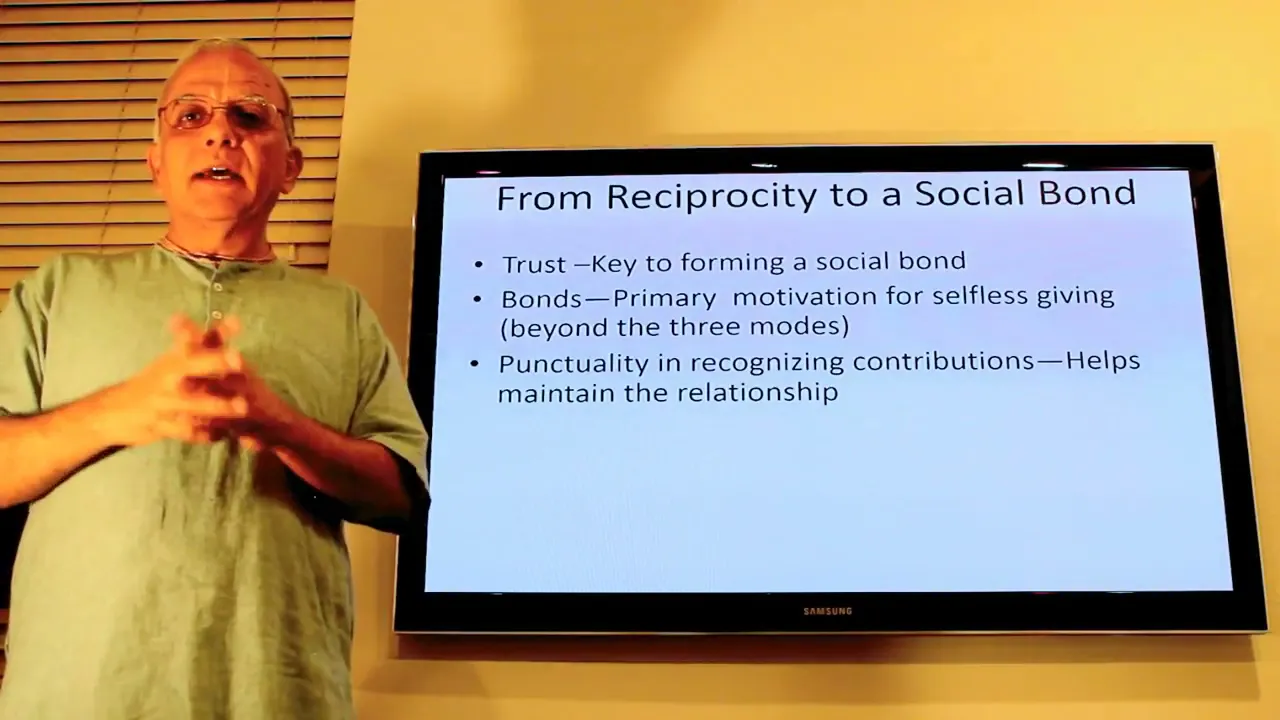
a minute but again the important thing is that both parties have to value the benefits they receive in this exchange and by seeing the benefits it trust develops trust develops between these two parties donor and the fundraiser and then a relationship based on the reciprocity will continue so if both parties do not see the benefit then the trust may not develop and when the trust doesn't develop obviously the relationship may not continue now how do we go from this reciprocal exchange to developing a social bond again as we said earlier our focus is to make
these prospects of these donors a lifelong devotees so we want to develop this bond with them so trust is the key to forming a social bond but how does trust develop in the first place when the donors see fairness fairness of procedures that procedurally what we do at the temple is fair there is no uh partiality and also trust of how we distribute the so-called benefits for example the benefits the temple can distribute is doing some artis on a festival those kind of things so if the donor perceives fairness in this in in distribution of
these benefits if he sees distributed fairness as well as procedural fairness then the likelihood of trust developing is higher and that trust is key to forming a social bond when the social bond is formed then that social bond becomes the primary motivation for selfless giving by this donor earlier we talked about motivations of the donor but now once you develop it relations once they enter into this reciprocal relationship trust is formed and the social bond is developed now because of that bond because they're bonded with the temple they're bonded with the community they're bonded with
the leadership they are now motivated to give because they feel internally that that's the right thing to do and that is sort of beyond the three modes or at least in the mode of goodness now once this bond is formed it's very important for us so the social bond becomes the primary motivation for selfless giving and that is where we want to bring our prospects and donors that's the point that we want to bring them to because that is beyond these three modes or at least in the mode of goodness because they're feeling internally motivated
to give not for the motivations that we talked about earlier when they started giving so what do we do after we have developed a social bond we should not take them for granted we still want to do our part we want to be punctual in recognizing their contributions that will help maintain the relationship we also want to report our accomplishments we want to show them that their money is well spent and some temples that have this practice of writing year-end letters of thanks for their support throughout the year and that helps reinforce this bond that
is developed and we have to also make sure that donor continues to believe in the mission and values of the temple and as well as the authorities that's essential to maintain this bond now next you are going to see this schematic that puts the organization iscon on one side and the donor or prospect on the other side this may so this depicts the social exchange theory in fundraising so let's say once the bond is developed we can approach the donor tell them the need of the temple need of your zone for example you want to
build a new temple you want to replace windows in your building you want to pay up the mortgage of the temple and once that need is expressed and because the donor has trust donor trust the integrity of the organization of the fundraiser they give you a gift and what do they get in return the things that we showed earlier but if the bond is strong what they get in return is this this internal satisfaction they feel that what they have done is the right thing was the right thing to do is the right thing to
do the same model applies to a prospect too with whom we do not have a social bond yet so we may approach a a prospect with the need and if they believe in the mission if they believe in the purpose for which we are raising funds they might give us a gift and this happens when there are for example for helping flood victims for earthquake victims organizations do this massive fundraising mass fundraising and people respond so we're going to now look at some caveats some precautions that we should take when we are using the social
exchange theory social exchange theory may be used in a non-manipulative way but it may also be used in a manipulative way in a non-manipulative way for example as i said organizations when they are genuinely trying to help victims of a natural disaster or they are simply trying to raise money for their non-profit organization for example in america there is disabled american vets organization they simply mail out letters and they did this experiment when they simply mail out letters asking for donation about 80 percent of the people who receive these letters they respond with a donation
when they enclose an unsolicited gift such as the gunned address labels then they get then the response rate doubles which is an incredible thing because now the recipient feels obligated they understand that this organization has already spent money in making my address labels so i should pay them back does or did iskan ever use a similar strategy if we did or if we are doing then what are the results or what were the results what was public perception or what is the public perception of our use of this strategy is it manipulative is it seen
as manipulative or non-manipulated this is not my opinion but this is what is in the academic literature unfortunately this is from a book that was published in 2011 on principles of fundraising by this person linda and in that book he cites cialdini a professor from a university in arizona in as you can read in this quote from that book they are talking about the practice that the hare krishnas used for reciprocity so they would according to this statement they would give a flower to a person and expect a donation in return and unfortunately as you
can see in the last second or last sentence it says eventually people caught on to this manipulation so it was seen as a manipulation and the society went bankrupt in the united states i'm not sure if that's true or not but at least in public perception our strategy of handing a book or handing a flower and expecting a donation was seen as a manipulation let's look at cialdini himself what did he actually write about this he published this article in stanford social innovation review in 2003 and again as you can see he is describing this
this is the original article that was quoted in the other book in the book they talked about a monk giving a flower but here the author himself says that the monk gives either a flower or a copy of the bhagavad-gita and then if you look at the underlined sentences the krsna's the hare krishnas they were using reciprocity to create obligation that did not exist naturally exploiting it to only benefit themselves so in other words their gesture their handing over this bhagavad-gita to this prospect was seen as a manipulation because the receiver obviously did not value
that act of kindness or they did not value the gift that was given to them which is unfortunate but that is what the public perception is so again as you see it the last sentence they say what had been a short-term fundraising success was a long-term failure so we had to be very careful in our fundraising attempts that when we use the social exchange theory reciprocity we do not want to come across or we do not want to be seen as manipulating the other party so what went wrong in this social exchange both parties obviously
did not value the benefits they did not value the benefit of receiving this transcendental literature bhagavad-gita or the flower that was given to them as a result the trust in that relationship did not develop when the trust did not develop then obviously the relationship based on the social exchange did not manifest or did not continue some people might have taken the book once but as the article says then they started to avoid the hare krishnas or they did not accept because they understood what their motive was to give the book i mean the motive we
know what the motive was we simply wanted to benefit them but unfortunately that's not how it was perceived we perhaps still continue this practice of book just not perhaps but we do continue this practice of the distribution and maybe there are some lessons to be learned from this article so what happened in this case based on the theory that we discussed based on what you heard so far did the donors or the prospects not see the monk as an authority did they not want to reciprocate with that monk because it would not meet the social
approval from their peers was it too weird to interact with the monk did they not trust the integrity of the organization that they were representing or did they not trust the integrity of the monk himself or herself so these are some questions that you can ponder on and will have an assignment on these thank you very much hare krishna