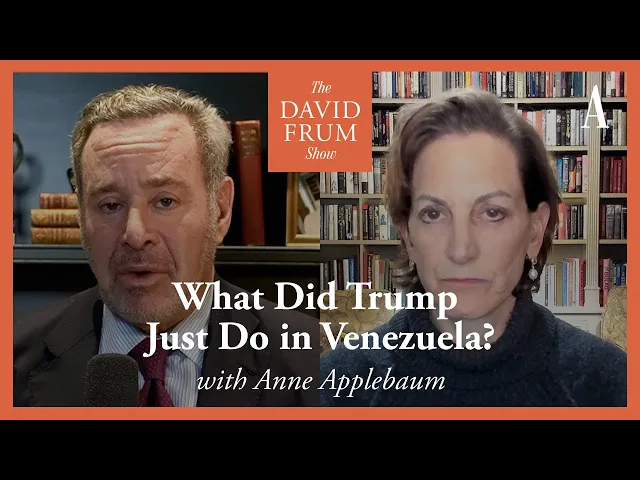
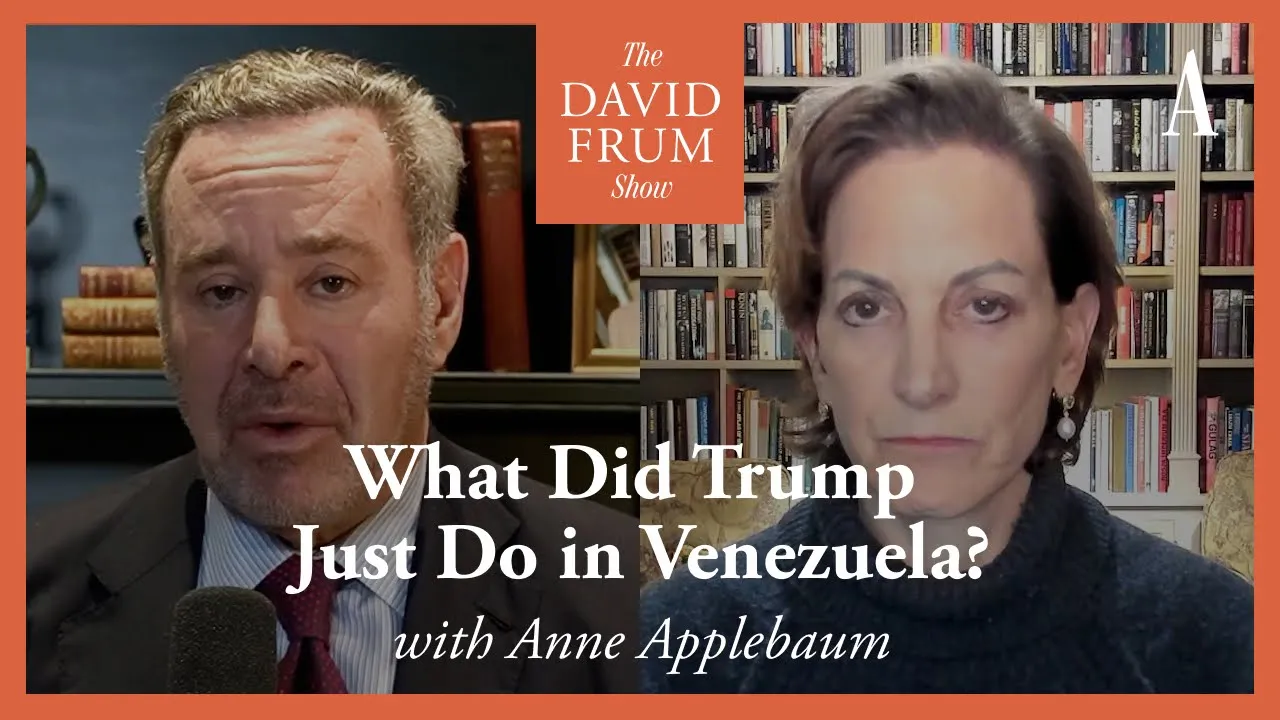
Hello and welcome to a special edition of the David from Show. I'm David from a staff writer at The Atlantic. Early this morning, January 3rd, US Armed Forces apprehended the dictator of Venezuela, Nicholas Maduro, and his wife to stand trial in a series of indictments for drug trafficking and other charges.
Um, it's an extraordinary moment and rather than wait any longer, I thought it would be helpful and useful um to viewers and listeners if I invited a journalist who knows Venezuela and his opposition well and Apple bomb to share her thoughts with me about what this moment means and what's to come. >> Delighted to join you. >> Let's talk about our concerns and our worries and our hopes.
Um, the Maduro regime is desperately unpopular in Venezuela. um it uh staged a sham election in 2024 which it lost even though it controlled all of the apparatus of the election. There is a legitimate um recognized by the United States president of Venezuela.
But Donald Trump seems to have something more militaristic and imperial in mind at least according to his press conference today >> possibly. The only thing that Trump has said is very vague. He said America is going to run Venezuela.
what that can mean given that we don't have an embassy in Kacus right now. We don't have US troops in Caracus right now. It's uh not clear to me how we would run Venezuela.
Um maybe it means that we would hand over to the existing regime, which is of course what the Venezuelan opposition has been afraid of. Maybe it means that the opposition will be allowed to come back. But what by what process that would happen and how that transition would be made legitimate, that's all pretty unclear.
and pretty murky. I mean, I should say there, as you said, there was an election in 2024. Um, the the the the leader of the opposition, which is Maria Karina Machado, who's recently won the Nobel Peace Prize, was not allowed to run.
Uh, and so in her place, Edmundo Gonzalez, a former Venezuelan diplomat, ran and he won. Um he the the Venezuelans staged this really incredible operation whereby they uh they collected they had people in all the polling stations or in many of the polling stations across the country and they collected the original vote tallies. They proved that Gonzalez was the victor.
Uh the Venezuelan courts in the Venezuelan regime which are controlled but were controlled by Maduro refused to let him take power. And not only that, they really and truly violently repressed people who were his advocates and people who had been working for him. So this is a country that was will not be sad or sorry to see Maduro go, but is but is is very very nervous about what might come next.
>> Yeah. One of the things I was struck by at the press conference was the nationalist bragging by American leaders that this is a thing they did for the United States, not for the Venezuelans. They act the United States of course acted entirely alone without any regional support or allies without any form of international legitimacy without any action of Congress.
There is a there is an indictment by an American court of Nicholas Maduro. So I they're trying to say this is like what happened in Panama in 1990 with Manuel Noriega where US troops enforced a court order. But again, the ambitions here are much greater, but but they um but they look kind of selfish and um without regard to the Venezuelan people themselves.
And one thing that um I think is going on here politically maybe that the Trump administration wants to rule Venezuela or at least wants to control who does rule. At the same time, millions of Venezuelans have sought refuge outside Venezuela and the United States is treating them like enemies and has sent is detaining them, expelling them, sending some of them to torture prisons. Um maybe this is the way that they reconcile those two imperatives by saying, "Okay, now there's a dictator we like in charge in Venezuela and we can now round up and expel everyone who fled the last decade.
" I >> I mean that's possible. I mean the some of the language used at the press conference today was Trump once again repeating that Venezuela had sent its criminals and it's emptied out its insane asylums and so on for none of which there's any proof. Um you know actually many members of the Democratic opposition fled the United States.
many people who were simply seeking a a decent place to live and and a place to work. There have been a lot of successful Venezuelans in the United States. I mean, the the smearing of Venezuelans has been one of the ugliest things that this regime has done, I mean, the American regime, I should say, has done uh since Trump took office.
Um, but you're right, to focus on the lack of concern for Venezuelans and for what happens in Venezuela. Um, all of the narrative from the very beginning of this conflict has been about, you know, the the glory of the United States, the reconquest of the Western Hemisphere. There was a bit more of that today.
Um, the supposed loss of US oil that is somehow owed to the United States because it was stolen in the past and nobody's really unpacked that or explained it. um you know and and again this idea that Venezuelan criminals and and and crazy people were somehow sent to the United States which again there's there's no proof. So it's a it looks very much like a war or a military action if that's what we're calling it that has been designed for domestic purposes.
You know this is for this is for US domestic political consumption rather than to achieve something in Venezuela. I notice that and speaking of the US political purposes, the Trump made the first announcements of what he had done on his wacky social media platform, True Social. He called into Fox.
Um it's as if he says, "I'm accounting only to my half or my 40% of American opinion or these days maybe 38%. Um I'm not accepting any responsibility to the whole country and certainly not to anybody else in the world. " Um, one of the things that I I I wonder there there's been an eruption of Democratic Party opposition to this, uh, emphasizing how wrong it is to intervene in Venezuelan affairs.
I'm not sure that many Venezuelans would agree with that view if it had been done properly. that is if there were some kind of multinational um operation involving Colombia which is Venezuela's neighbor um long history of the two countries the single the the country that is received the most Venezuelan exiles and has treated them very hospitably giving them rights to work and so on in a way the United States has not done um if there if there had been some kind of international coalition and if there were a clear plan to restore the democracy that Venezuela enjoyed from um the 1950s until the 1990s There could be there there could be more and broader support, but I mean and one of maybe the strangest thing about this whole thing is the administration's failure in the runup to this um to this I don't even know what to call it. Is it an invasion?
Is it a is it a military event? I mean, in the runup to it, they made >> we could call it a special military operation. >> That came to my head, but I was I was thinking, no, I think I'm going to not go there just yet.
it. Um, but no, the the the the failure to justify it to the American people, the failure to sell it, um, the failure to explain it, the multiple explanations for it that have been offered, none of which are quite satisfying or seem quite true. You know, the kind of belated adding on of the oil thing as somehow oil was stolen from Americans and we have to get it back and with again without any explaining of the history of that or whether it's even true.
And then you're right. I mean, I would say that not only has he appeared only not only has President Trump appeared on Fox and on and on his own social media, he also apparently and we'll have to we'll have to find out whether this is really the case in the in the coming hours, he apparently has only spoken to or his administration has only spoken to Republican members of Congress and of the Senate. So rather than rather than creating a bipartisan congressional agreement to do this, he simply appealed to his own side.
Um, and that doesn't seem to be unanimous either. But it's a it's a it's in that sense it's a kind of we are at a kind of breakthrough moment. I mean it is a different kind of um US military operation.
I mean US has invaded other countries before. You can argue US has broken international law before. but to to do so without any justification, without any explanation, without any support in Congress or any attempt to get it uh without looking for any legal cover, you know, even without having a coherent set of reasons or a coherent strategy.
It's all very it's it's all very strange. And again, my assumption is that because in fact, the true purpose is domestic. The true purpose is to deepen the president's arguments about supposed you know, narco terrorists or immigrants whom he's fighting against maybe to give him the opportunity to say America's at war and therefore more more emergencies need to be declared and more laws need to be bent.
But it it looks more like a as you said at the beginning, a kind of nationalist um you know moment to describe America's armed forces and how great they are rather than something that was designed to do some good or achieve something in another part of the world. And I say that as somebody who's as I I've been writing for years about how um how tragic the story of Venezuela is and how how much damage first Chavez and then Maduro did to Venezuela and how um and how impressive the Venezuelan opposition is and how it's worked under these very tough circumstances to pull together. And so I I really wish the best for them and I am sorry that this is how the United States has decided to intervene there.
The reason I I went there on the phrase special military operation, which is the term of course that Vladimir Putin uses to describe the Russian aggression in Ukraine, um is uh that there does seem to be a whiff of a deal that Donald Trump has in mind with the Russians and maybe with the Chinese, too, to say, you know, how the United States historically rejected spheres of influence, we're rethinking that. Russia, you can have Ukraine, and I will help you get it. Um and I will backstab Europeans who try to support Ukraine and resist you.
Um, meanwhile, China, uh, I'm not going to meaningfully resist your operations in your own neighborhood. I'm not even that serious about protecting Taiwan. In return, I want V I want your okay to overthrow your client in Venezuela because the relationship between Maduro and Russia was close and the relationship between Maduro and China was getting closer.
Um, we have aggression in mind against Panama, against Greenland, and maybe also Canada. So, uh, we will have we we will be the empire of the Western Hemisphere. You guys take your sections.
Um, and we will each be masters of our own domain without regard for concepts like democracy or self-determination or meaningful alliances or mutual respective nations. >> So that idea that the world is going to be split into three spheres of influence has been kicking around for a while. And so I first started hearing it a couple of years ago as an idea kind of bubbling up and moving around in the, you know, in in in right-wing media.
And I've I have heard a couple of people who were close or claim to be close to the Trump administration talk about it in the last year. Um and of course it's terribly dangerous. Um it's dangerous for the United States because of the kind of backlash that it may create in in Latin America and and Europe and elsewhere.
It's dangerous for America's trading partners and allies around the world. It's incredibly dangerous for Europe, which then somehow becomes open to Russian manipulation and maybe Russian invasion. Um, and of course, it's very dangerous to America's allies in Asia, you know, Taiwan, Japan, South Korea, the Philippines, and others.
Um, and it really creates the prospect for a reordered world, one in which violence becomes much more common and the use of military power by big countries against smaller ones becomes normalized. Uh, and that of course will have economic effects and will eventually be felt by all Americans. I mean because our you know America's uh prosperity and America's power and America's success over the last several decades I mean certainly since the second world war have been based on a very different idea of how the world should work and it looks like at least a part of the Trump administration is ready to give up that idea.
>> Let me go through that. That's such an important point and especially the point about how you make violence more acceptable and more common. Let me just go through something for people who don't think about this as much as you as you do.
why Americans have, at least since 1945 and really longer than that, rejected the idea of spheres of influence. Because it may seem logical to some people, well, let you know, China has its backyard, Russia has its backyard. Why can't the United States have its backyard and everybody leaves everybody else alone?
The reason the United States historically rejected this idea was twofold. The first was Americans said when we um call for collective defense, when we call for free trade, when we call for democracy and human rights, we're not doing that to assert American dominance over others. We're we're using the extraordinary advantages of the United States, the security, the natural resources, the wealth to deliver something to other people that all human beings want.
Not all human beings should want. All human beings do want. They all want to have the benefits of of freedom and material prosperity.
So we're going to speak for all. The United States has more means, but the ends are not American. The ends are are universally human.
So we're going to speak for that. And then what's our sphere of influence? The answer is the whole thing.
There are practical limits. We're not going to go out there looking for wars and causing trouble. But our ideal is that ultimately all human beings will live this way and we'll want we'll we'll live together in cooperation.
And so we're not and so the sphere of influence argument is never an American argument. It's always an argument by other people who want some carve vote from human rights and freedom and democracy and international peaceful commerce. Um, and we're not going to give it to them.
Now, the the fact that the Trump administration is so open to these ideas is to me, and this is let me I think this is one of the things that um is most surprising is it's a doctrine of American weakness and retreat, saying that the United States is no longer feels able to defend Europe, much less Ukraine on Europe's east. no longer feels able to defend the free peoples of Asia. So, we're just going to retreat.
And and because that makes the American um project much less attractive to other countries, there's going to be more within the American sphere of influence. There will be more force and and Greenland has been a target of this. Canada has and now Venezuela is.
>> No, absolutely. I mean, it's a it's a it's America giving up on uh on relationships with the world and America retreating into a a kind of 19th century idea of, you know, we dominate our neighbors and we don't have anything to do with anything else. It it it means that America's global companies will suddenly discover that the the rules that were very often created to help them and help them succeed in Asia or in Europe will change and they will be they'll be less successful.
Uh it means that American things that Americans took for granted, you know, the ability to travel or the ability to do do business in different parts of the world, the maybe even the dominance of the American dollar that was accepted by people as a as a kind of quid proquo in exchange for the pox americana. You know, all those things will begin to fall away and they will make Americans poor. I mean, I think every American will feel it.
Americans will feel it economically. They'll feel it politically. They'll feel it in terms of how they are defined in the world and therefore how they define themselves.
So the United States will no longer see itself as a beacon of democracy or as a country that stands for freedom, but rather as an ordinary neighborhood bully. And I think that will affect the way Americans perceive their own country as well. And I think it will have an echo in domestic politics.
I I I've seen this happen in other countries. You know, when the nature of the country changes, when the role it plays in the world becomes different, that affects people. I you know, I think Americans have grown used to the idea that we were a good power in the world or we tried to be and we didn't always succeed.
Um but we had some ideals or we there were there were things we stood for. There was international law. There were international institutions that we backed.
And once we don't do that anymore, I think Americans will will will feel differently about their country. And I think I really do believe it's something that's going to affect everybody. >> It's not this is not a hypothetical point.
This is a point rooted in American history. Um if you lived in the United States a 100 years ago, 1926 over much of the country was fastened a system of laws that bear a lot of resemblance to what the Nazis imposed on German Jews at Nuremberg. Um over maybe a third or a quarter of the country.
There were all kind and beyond that not just in the old deep south but in other places too there were uh restrictions imposed by race on where you could travel how you could travel what facilities you could use who could marry whom that that that extended beyond the south too. Um it was the need to defend democracy first against Nazi Germany or to defend American interests first against Nazi Germany and then against the Soviet Union that um transformed a lot of what Americans regarded as acceptable at home. that the country had to be a democracy at home if it were to demand democracy abroad.
And the classic statement of this I refer people if they have a chance to look at it to watch or to read President Kennedy's civil rights speech in 1962 when he he made this explicit how he said how can we defend freedom in Berlin if we don't have freedom in Alabama. Uh and and so the United States to win the cold war became a more perfect democracy at home. If the United States gives up on that, the way is set to unravel all those changes that happened comparatively recently, the 19 between the 1930s in the 1960s.
>> There's another example of that as well, which is that in the arguments that were made for desegregation of schools in the United States, um I the the in the Supreme Court arguments that were made, the American Justice Department specifically made a reference to, you know, the US presenting itself abroad. you know, how can we argue for democracy abroad if we aren't if we aren't willing to have desegregated schools, you know, here in the United States. So, you know, starting in about the 1940s and 1950s, you're absolutely right that the idea of what America stood for abroad, again, theoretically, it wasn't always true in practice, and what America should be at home, again, theoretically, not always in practice, you know, that those ideas came together.
And as they split apart, as the United States becomes something different abroad, you're right that we may find ourselves becoming a different country at home or certainly the constituency, the people who want us to return to an older way of running the country and older ideas about race and hierarchy. Um you'll you'll see them saying, "Well, since we don't have to play this role in the world anymore, you know, why shouldn't we? What do we need civil rights legislation for?
" Now, >> let me ask you just to go back to the point about special military operation. One of the big mysteries about Trump has always been what's the special sauce? What's the hole that Putin has over him?
>> I think his business links to Russia go back a long way. Uh I think his interest and admiration for for Putin is very deep and of course he knows that Putin helped him win the 2016 election. So I think I don't think you need a specific deal like that.
But I mean we can speculate that it's it's not absolutely impossible. I mean it does look like and I've some of the Venezuelan opposition are saying this again there's no proof so I have to be I have to be careful. It does look like some kind of deal over Maduro was done that you know that he was given up you know that he was handed over.
Maybe that was done by people who did it in exchange for hoping that they would stay in charge you know that the other members of the regime would would take over after him. Um maybe it was done with help of others, maybe the Russians, I mean Chinese, we don't know. But but but but the links between um between Trump and Putin and between Trump and Russia are go go well beyond Venezuela.
>> Well, that that point about what the Venezuelan opposition fears brings me to maybe this closing segment of of our dialogue today, which is my concern about the way some of the Democratic opposition, capital D, in the United States has been talking about this. um that you are hearing from some very outspoken people say it's wrong for the United States ever to help to overthrow a dictatorship. Um that whatever government a country has, that's its business.
And however much the vast majority of that country's people hate that government and fear it, however cruel and authoritarian and even aggressive it is because the Maduro regime has committed aggressions um against neighbors Brazil and Guyana and Colombia too. Um that it's none of our business and we should leave it alone. And I think in reaction to uh Trump's militarism and imperialism, we're getting a kind of small an isolationism from his opponents that is very dangerous.
And I I wish I heard more Democrats saying if this war were about restoring the legitimate winner of the 2024 election. um if it were uh waged in with backing from Congress and in in with support from Venezuela's neighbors then yeah helping to bring about the restoration of the legitimate president of Venezuela that would be a proper thing for the coalition of the Americas to do um not to replace dictator with dictator but but to work in tandem with others but there does seem to be a kind of in reaction to Trump's America first a kind of similar kind of chauvinism that we're hearing from that this is none of our business. We have we have no concern with who governs Venezuela and how.
>> It also ignores the fact that we have influence over not over Venezuela but in Venezuela in other countries whether we want to or not. I mean we're the elephant in the room in a lot of places. And had we decided to support Maduro, which I think some members of the Trump administration did want to do and do oil deals with Maduro, for example, um which we might easily have done.
Um I I think there were as as I say I think there were people who wanted to do that then we would also be affecting the outcome of politics in Venezuela. So to pretend that you know we live by ourselves you know in a bubble and we don't influence anybody else is is also wrong. I mean, I do have to say that given how little uh Trump involved the Democrats and how how how minor his effort is even today to reach out to people and explain what he's doing and justify it.
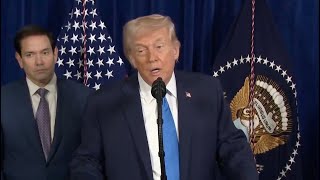
Um, and how half-hearted it all seems. I mean the I thought I found his press conference very half-hearted and he seemed kind of unenthusiastic and you know it wasn't you know wasn't it wasn't you know you people were sort of repeating themselves and saying things by wrote you know how great our soldiers are and what a what a marvelous thing this was and you know given that it's not really surprising that people have have reacted this way it's also you know to say well it would be great if we had done this on behalf of you know on behalf of democracy in Venezuela feels a bit empty given that obviously Trump wasn't going to do that because he doesn't care about democracy anywhere. So I have some I have some sympathy with people who who who you know who who who are who are very critical.
I mean I would like to emphasize you know it is important to keep remembering how happy a lot of Venezuelans are and how delighted people are you know across the continent that Maduro is gone and to just keep that in mind as a factor going forward. >> This is a more marker for the future. I mean, obviously it's true, as you say, Trump didn't do this for democracy.
Indeed, and he didn't do it to stop the drug flow, either. Um, Maduro is right now an alleged and indicted drug trafficking president, but there was a convicted drug trafficking president in an American prison, and he was released at the end of November, pardoned at the end of November. I guess they announced the pardon at the end of November and made it legal at the beginning of December in exchange for what?
One can only speculate, but I I I don't think it was just for a Christmas card that Trump would let somebody like that. >> This was the president, former president of Honduras. Yeah.
No, no. I mean that, you know, there's hypocrisy all over this story. You know, the the, as I said, the conversations with Maduro about oil that took place last year.
Uh, you know, the letting go other drug kingpins. Um, you know, the question of whether Venezuelans were really importing that many drugs to the United States anyway. Um, that seems like most of >> they're sending the the Venezuelan drug traffic was cocaine, which was on its way to Europe.
And by the way, blowing up boats is a judging by market prices, uh, the Wall Street Journal reported, I think in the fall, that the retail price of cocaine in the United States over the first year of the Trump administration was down, if I remember this right, something like 25%. The one price he successfully brought down was the price of cocaine. That's the drug that is flowing via Venezuela.
So obviously blowing up boats doesn't work. >> No, no, no. I mean, all when you look at any of his reasons, they all, you know, they kind of shrink on touching them.
I mean, and and this is why we're all looking for other kinds of explanations. You know, is there a secret oil deal? Uh is there a secret deal with Putin?
You know, is there some, you know, is there some deeper plan to to to spread this form of conquest across uh you know, across the Americas? You know, because the the reasons as stated just don't make any sense. They don't add up.
They're not a strategy. They aren't a plan. They're not a plan.
They're certainly not a plan for Venezuela, but they also don't really make sense for the United States. there. It's not about increasing American prosperity or safety uh or or or or even, you know, America's good name in the world.
And I think that's that's what's perplexing people and causing this really angry reaction, which I you know, I agree that there's a there's an aspect of it that's that's um maybe small-minded, but but I but I empathize with it, too. >> Well, I I just worry that the parts of Trump won that proved most enduring that he that Biden continued were Trump's protectionism. And I worry that it would be it would be a a bad result if the part of Trump too that continued is this um this spreading to both parties of American narrow nationalism um and disregard for as you say the hope and faith that the Venezuelan people are have put in a different America, the America they remember and many of them still believe in which is a country that would say look we're not going around the world starting wars.
We're not intervening promiscuously but uh how other people do is matters to us. there um especially in this hemisphere but everywhere but especially in this hemisphere um and if the United States in conjunction with law and partners can restore a democracy that was stolen in uh and support people who have cou as you say courageously acted to defend and maintain and reassert their democracy. You know that's that's not none of our business.
That's that's part of the common business of humanity. I no I I I agree and and that the United States aspired to be a beacon and aspired to be a country that wanted to make itself better and make the world better uh was I think one of the things that gave Americans a lot of pride and a lot of satisfaction and it would be I think tragic for us to lose that. As we're talking, uh, Secretary of State Marco Rubio has apparently added a threat to Cuba to the list of reasons, uh, that the United States supposedly acted in Venezuela.
Do you have any thoughts about how to make sense of that threat? >> So, people should understand that there is a deep and close relationship between the Venezuelan regime and the Cuban regime. So much so I was talking to a Mexican journalist recently who told me he'd been to Venezuela not that long ago and was very struck by the fact that all the people around Maduro were all Cuban.
Uh so a lot of his security guard was Cuban and a lot of the people who were protecting him were Cuban. Um the Cubans were supplying security help and advice to the Venezuelans and have been really important part of keeping the regime in power especially as it became more and more unpopular. Um, Cuba also gets oil from Venezuela and has a kind of symbiotic trade relationship with Venezuela.
And so it may be that Rubio hopes that the fall of Maduro or the change of regime in Venezuela will eventually have a knock-on side effect in Cuba. So he may be hoping for that um, you know, as as a possible consequence. Domino theories have a way of proving incorrect or dangerous or wrong.
And so for Rubio to hope that by changing the government of Venezuela he will somehow affect the government of Cuba um you know there's a there there's a you know there's a long history of those kinds of theories being wrong but it's perfectly possible that that was one of the things in his head when he when he pushed for this operation as we know he did. >> Seems unlikely that President Trump was thinking about >> seems very unlikely that President Trump cares one way or the other about Cuba. I agree.
and thank you for taking time today. >> Thanks for thanks for devoting the time yourself. >> And we're going to resume normal scheduling with the program releasing on Wednesday.
Thank you all for watching um the David from Show. Um remember the the best way to support the work of this program and of myself is to subscribe to The Atlantic. I hope you'll continue doing that.
See you on Wednesday when we release the next episode of the David from Show.