[Music] today we're at Bletchley Park in honor valent touring's 100th birthday Bletchley Park just north of London in between Cambridge and Oxford was considered by many as the birthplace of modern computer science in 1938 uh again in anticipation of War uh the government code in Cypher gr uh through and in in in the main their operational director a gentleman called Alistair Dennison had drawn up a list he had sent two people out to troll through the uh people at Oxford and primarily Cambridge and some exent Oxford up a list of people who they approached who
agreed in the event of War uh would uh report immediately to blle park Britain declared war on September 3rd 1939 the following day September 4th churing uh and several others reported to blle par as the the requirement for more people was needed uh some predominantly a gentleman called Gordon welchman who had he had been on the initial list he arriv the same day as cheering he went back to Cambridge and he started recruiting all his best students and and in effect what they created here was the world's first Skunk Works a secret intive organization where
there were no rules eventually uh their main benefactor became the Prime Minister Winston Churchill uh and they persuaded Churchill that this place needed uh more resources Churchill agreed and he wrote a famous uh uh a letter was written by welchman churing and the two deputies to Churchill and one of number a gentleman called steuart nner Barry actually delivered it in person to Downing Street Churchill amazingly rece read the letter the same day it was delivered he put a famous actionist day stamp on it with a handwritten note to his chief of staff chap called general
lme which said expedite with extreme priority and report to me when it is done and really from that point September 1941 blaty Park got all the resources they needed uh they threw in effect the smartest people together in Britain and said here's a budget this is the endgame uh and that's why they invented some of these Technologies which probably wouldn't have been invented for years in many ways Bletchley Park was an early version of a multi-disciplinary science center much like CERN or NCSA is today many brilliant people with different skills and backgrounds were brought together
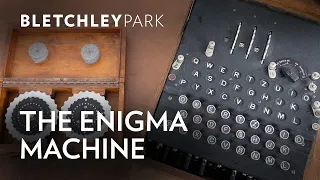
to solve difficult problems the combination of the skills and collaborative environment resulted not in just solving the problems of cryptography that they were facing but in addition solved broader problems for all of computing and all of society when the people arrived here they knew when they arrived uh that the Germans had taken a machine uh an machine which we tend to call Enigma Enigma was a particular variant of an encryption machine uh that machine was modified from the commercial version and it allowed them to encrypt messages this was going to become a machine to be
used for operational Communications very short 200 250 character messages Hitler had conceived and as generals a type of warfare never seen before which became known as Blitz Creek very fast movement 50 m a day particularly when they invaded France uh and the latter stages of their invasion of Poland you couldn't use fix line Communications you needed to use Wireless Communications here was a device which was portable weighed 25 lbs ran off a battery you could encrypt messages and then it's a separate process they could be sent using the fairly new technology of wireless radio it
was the polls who were the first to recognize that the age of machine cryptography had arrived and the sort of people who would be good at dealing with it were mathematicians uh in fact they even went so far as to put on a course in cryptography at the University of pman uh invited 20 or 30 young German speaking mathematicians to enroll it was very difficult course and by the time the course was finished there were really only three graduates who they recruited their names were Mario rki hendrik zagalsky and Yazi Orit and these three were
the core of this team uh and they are the ones who really made the early breakthroughs they convened a conference at their secret headquarters this was actually July 3 9 and at that conference they gave the British everything they revealed what they had done they gave them rep replica Enigma machine and all of their work that information came back to blechley park and once they were established in Bley Park they then used the Polish method to break the Enigma machine the polls had actually built some machines themselves one of which was called aboma uh that
machine the name uh apparently comes from a Polish ice cream dessert of the same name it's in effect vanel ice cream with chocolate sauce around it this machine was called bom in honor of what the polls did but the polls technique was based on the particular way that at that time the Germans enciphered their message heads they at that point were repeating the message header and that was the attack which the poles developed on it they believed correctly that whence When The War would start that the Germans would change the way they were doing that
and they called for help they told churing of the people here everything they' done which we are and should be very grateful but they also proved that it was possible and that I think was the spur that kicked the Brits into actually doing something about it now churing understood the weaknesses of the way they had done it and developed a crib based mechanism based on the fact that every military organization in the world cannot stop itself sending stereotyped messages he then talked to to a brilliant team of Engineers led by doc Keane um who told
him roughly the speed that it would be possible to examine potential stops for so between between them they then designed the machine called bomb which would look for that and do so in a sensible time um here is an an example where we have intercepted this message SNM kg we're pretty sure that that is because this particular operator always did this this is his morning weather forecast so here we have the guest German PL text Veta for ha zaga weather forecast and the two are lined up at that point the enigma's ability or inability to
encode a letter as itself is useful because you can make sure you've got no clashes here and from these guest letters we that the crib makers would derive a picture like this called a menu where you'll notice that at position z z e here G is encoded as e so we have G going to e z zp at the end here e goes to V this is reversible of course we can describe this other way up so here's e to V that's z z g here s is going to a sorry s is going to
V excuse me so here's another link and eventually we can go all the way around and we can close this Loop like that it was a closed loop that they were looking for the operation of the bomb was simply that if there is a letter which you can feed in at this point and which comes around through a string of 1 2 3 four five six enigmas and comes back as that same letter then it's possible the position of these wheels match the position of the wheels when gun started encoding his message on his Enigma
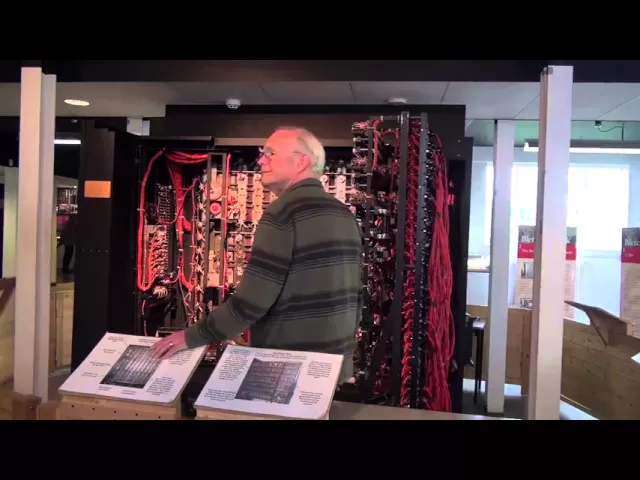
it turned out to be a bit more picky about loops and menus than um perhaps they had hoped although it worked and at that point welchman added a completely Left Field Master stroke called the diagonal board which I think it is fair to say made the difference between success and failure to turing's original idea and here are my three diagonal boards that's one that's the other this is the third one cing any place where you can't see it but can can you see Zed down to a okay um there's nothing connecting that to the machine
it's just bolted there for convenience I the only connections to the machine are when you connect X into one of the enigmas as it well what will happen is when we turn the machine on you'll see it will run up to speed okay um the motor will be running and the clutch will drop in then you'll see the various carry mechanisms happening um then when we stop the machine you'll see it slow down and then the clutch drops out so Tony if you'd run it up for us please okay go would you turn on carry
home please okay you so what you saw there was the middle carry then we switched on carry home to make the slow carry work all the time so these bars are just pushing round all the drums and you can see that all the 36 enigmas are just in Step they're all just turning and they are a resource these are the very fast relays the three Banks actually four for the chains that do the detection here um this is the control logic okay and then these are this is the 26 bit register that notes a stop
and then allows the machine to slow down before it stops reveal that our favorite statistic is the sheer amount of wire in the thing there we've lost count but it's somewhere between 10 and 12 miles of wire in each one of these Germans really there was two main systems they were using Enigma was their operational system that was being used for all specific operational Communications again very short maximum of 250 characters uh instructions orders for a Panzer Division uh to move from one location to other orders for a submarine to attack a convoy for aircraft
uh to during the Battle of Britain to attack specific targets the Germans started to introduce through probably 1941 a different system uh The Intercept service which Britain had put into place to intercept these messages started hearing traffic which was clearly not Enigma traffic Enigma traffic was moris code easily identifiable uh people can be trained fairly clear uh simply to transcribe to listen to moris code and transcribe the letters this was a totally different signal it was not discernable it was not transcribable this was ADF Hitler's Communication channel to his army General so very long-winded Communications
top secret uh and so this was an even more daunting task arguably than an IGN because uh this encryption machine that was used with this system uh there were various uh ones of them Hitler referred to these as his gim shers his secret writers several company Seamans uh that exist today making were making a machine Haggin but there was also the Loren company and that was a primary machine particularly Loren at s42 that machine and unlike Enigma that had three encryption Wheels had 12 encryption Wheels they approached uh the post office research lab at Hill
in London uh a young engineer called Tommy flowers brought into the project uh he was in effect told well go ahead if you can get approval flowers went back to the post office got approval put a small core team together and in less than a year had a working prototype uh quite a remarkable achievement uh the first coloss Colossus as this machine became known the Mark 1 had 1,500 valves or vacuum tubes in it they brought it to bchy park it worked almost stra away the people here were convinced they asked for a more powerful
computer uh flowers already had anticipated this he already had it in production 2,500 valves in an errow when no machine had more than that used valves had more than about 15 here was a machine with 2 and 1 half thousand flowers was told that they need the mark two by June 1st 1944 because there was a certain date in the diary June 5th 1944 was a scheduled day for Operation Overlord dday it actually ended up in June 6th because of bad weather flowers delivered the mark first Mark 2 to bchy park on June 1st they
switched it on it worked straight away they immediately started decrypting messages between the German High command and much to the Delight Delight they discovered that all of the subus about The dday Landings had worked Hitler had believed that the main invasion was going to be at the Kell not at Normandy that intelligence was fed back to General Eisenhower at Allied uh Supreme command headquarters and there is reasonable evidence to conclude that DD might will not have gone ahead on June 6 1944 without the intelligence from Bletchley Park this is the Colossus computer at Bletchley Park
now we're in Hut for at Bley Park which was the one of the first purpose built computer centers and some 10 of these machines were installed here starting in January 1944 now in the Years previously a new way of encrypting messages was discovered that was being used in Germany and it was those high level messages between Hitler and his General and they were encrypted on a machine called R machine and it used teleprinter traffic teleprinter codes to actually transmit those messages now by 43 it was taking some 6 hour so 6 weeks to actually decode
those messages and decode those messages laboriously by hand the problem with that is uh within 6 weeks the usefulness of the intelligence that you gain from those messages is obviously gone so that process needed to be speed it up now some techniques have been tried some semi- electronic techniques have been tried here at Bley Park um but this machine when it was put into use in early 44 reduced that 6 week period to decode the message down to 6 hours and that's really just a phenomenal jump um the machines the messages themselves were received at
various intercept stations around the country and were punched onto paper tape now there are two paper tapes on the machine here at the moment one that we're running and one which is um ready for the next run now this tape there are two here if I take one each row across the tape are punched fire poles and each of those is an alpha numeric character and that's the encrypted message that was received has been punched onto tape now although Colossus has really all the elements of a modern electronic computer it doesn't have the memory that's
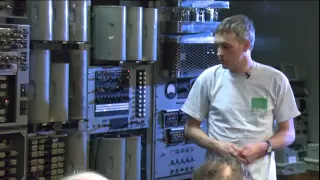
we expect in a stored programed computer so what happens is that tape of that message some 5,000 characters of that message is actually formed in a loop and is read over here with a pH series of photo El electric sensors and lights and each character is red and the 5,000 characters are 5,000 characters a second are red now each clunk of the machine we can hear there is another 5,000 characters being read into the machine so we're reading that same 5,000 characters each time this is the control panel of the Colossus computer so it's this
side of the machine that would would actually be the Rens and the war time would actually be using now I can set up the particular algorithm I want to test and routines I want to test using these control panels and each clunk of the machine at the moment is another state where we're actually trying a new algorithm and repeating that algorithm on that repeating 5,000 characters the results that the machine detects are presented here now we're doing a statistical analysis of that encrypted tape now the machine was run for some 6 hours uh there are
2 and a half thousand valves in this machine uh you can't see that many from the front but once we go between the act of the machines you get an idea of the scale 2 and 1 12,000 valves each valve has a heater a hot wire heater in the center of the valve and operates at about 2 300 volts DC now 5 1/2 uh 2 1 12,000 valves plus the power suppliers generates over 8 Kow of uses over 8 Kow of of electricity and by this point when we're standing in between the racks you can
feel the heat coming off of these [Music] racks Colossus is a combination of electronics and we can see the the electronics here in these valve um chassis members and also electromechanical um switch gear so there are backs of relay panels here these big single motion detectors are a sort of motorized switch that will actually spin around there's Banks of those in the machine the technology is equipment that was well known for the British post office this machine was designed by chap called Tommy flowers and Tommy flowers was an engineer at the uh Research Center in
London for the British post office Tommy was asked to look at the problem of how to automate this task this manual task and Tommy came up with the idea of using Electronics to do this at the time the idea of using more than half a dozen valves in any circuit which just just simply poo pooed um valves had a bad reputation people had valves in their radios at home they failed when they switched the radios on so the idea of using 2 and a half thousand was just simply just phenomenal but Tommy understood that it's
probably it's almostly the thermal shock that kills valves in the first place so if you leave the machine on and don't subject it to that shock you won't have a problem now all the 10 Colossus machines here at blch partk were left on permanently the machines were operated by uh Rens in in three shifts throughout the day um we have to be see equally careful this is obviously this is a replica of the machine itself uh but the same problem apply we need to be careful in bringing the supply voltages up gradually so we don't
suffer from thermal shock and in the same way shutting the machine down Tommy had the idea of generating the key because it's a key that we're comparing with that encrypted tape generating that key electronically and these counters here that are called the thyratron Rings the thyratron valves actually hold that um that count now we describe Colossus as not having a memory we say not not having a memory in the sense that um modern computers have a a memory that's common for data and for programs well the program here is set on those control panels at
the front and that's switch um switch and plug programmed much like say it's contemporary eniac machine um but these machines these valves at the back do act as a store in the sense of counters and they're actually counting the score that we're actually getting each passed through the algorithm the we can see at the back here uh well certainly some of the modern technology um I suspect the wartime guys that were building and debugging these machines would have given anything for Reliable oscilloscope and let alone a logic analyzer but if I look into the machine
down here back you can see the projected image that's coming off the tape and that's shining onto five photosensitive valves and it's those valves that are actually reading the 5,000 characters every second and paper tape was used well into the 1960s and70s that this speed was simply phenomenal and hadn't really been thought of before and um original Museum director te male wanted to rebuild the Colossus and build a replica of the Colossus machine and this was some 20 years ago there's very little information out there there are a few pictures that were kept possibly IL
legally a few scraps of circuit diagrams and just the memories of some of the original Pioneers who worked on the machine and when Tony started the plan Tommy flowers was still alive and remembered and was able to draw circuits because finding the parts as well but the important thing is the machine was designed by a post office engineer at the time an engineer that was used to designing systems for telephone switching so a lot of the components here everything from the relay Banks to the switches to the power supplies were common to um British post
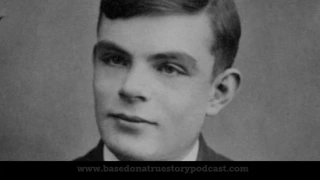
offices in the pre-war period so when Tony then wants to find the components to rebuild the replica he's lucky in the sense that the last of those exchanges are being decommissioned from post offices around the country Tony was therefore able to really to back up a pickup truck at the back of the exchange and take away all of those components and dismantle all of those components and they are they were absolutely perfect and it was just that tiny really couldn't have been better so Alan Ching actually left Bletchley Park after about three and a half
years his involvement really uh uh finished he went to the United States Turing became was not actually involved in the development of Colossus some of the statistical work that he did was used by the people predominantly Bill Tut who's the guy that actually reconstructed the lorence machine quite remarkably a remarkable feat uh uh indeed uh cheering got involved in things like speech scrambling systems and went to the United States and was involved in other projects so he wasn't really involved in Colossus uh at the end of the war Cher went to work for the national
Physics laboratory again pursuing these sort of ideas and then of course he ended up at the University of Manchester where Max Newman who had run the department where the Colossus computers had been located at Ley Park also ended up as the head of mathematics and obviously then at that point churn became involved in the very early uh computer developments in Britain uh Gordon welsman immigrated to the United States at the end of the war 1948 he immigrated to the United States and became involved in many of the early American communting developments project Whirlwind uh welsman
worked at MIT taught the first course in Computing science at MIT so cheering then was involved in things like the Manchester baby and the frany Mark 1 and the early competing developments uh I guess this is well known of course Turing tragically committed suicide in 194 [Music] 1954 [Music] you