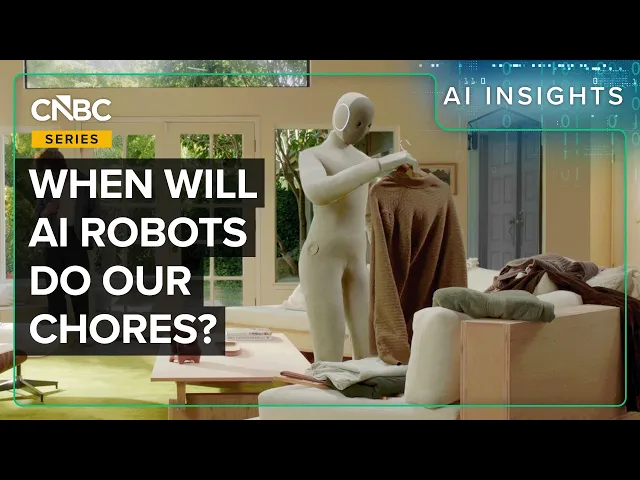
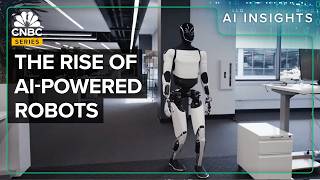
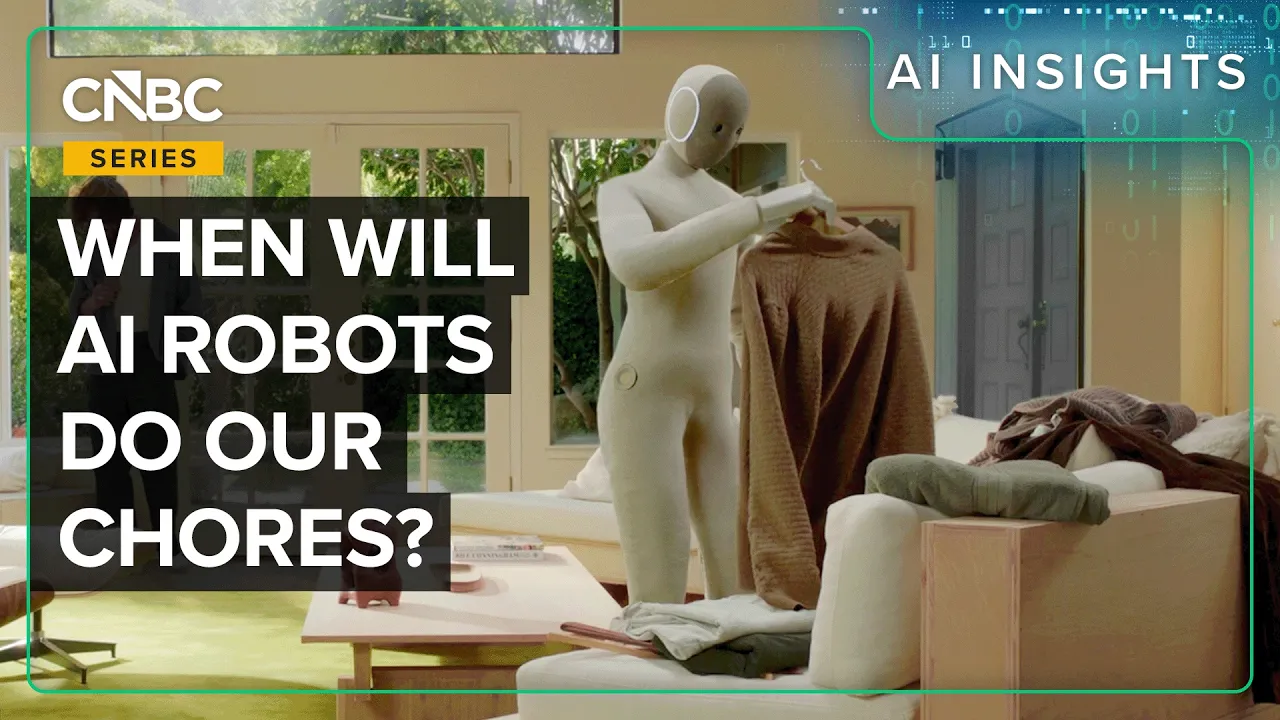
This is Treadle the Humanoid by Weave Robotics that's folding laundry for businesses in the Bay Area now, and has plans to tidy up for some hotels soon, too. We're shipping to our first home customers in 2026, and we are live in businesses now in 2025. There's no doubt that AI robots are here, in Amazon warehouses, car factories, even farms.
But the home is proving a harder task. Every home is different and the home has unpredictabilities like kids and pets. Plus, there's the issue of privacy and safety.
The robot falls over, it loses power, the battery goes dead. There's a lot of bad things that can happen in a home and in a factory, which is why you don't see any robots, at least in the United States, any humanoid robots working side by side with people. Yet still, companies like Unitree out of China and 1X in the U.
S. are betting that people want robots in their home. 1X's $20,000 NEO Robot is available for pre-sale now, although it has to be teleoperated by a human.
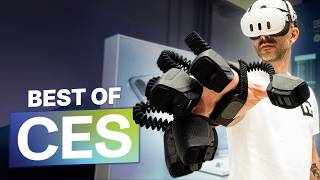
I don't think they're quite here yet, but I don't think they're too far fetched of an idea. We saw some humanoids at CES and went to the second annual Humanoid Summit in Silicon Valley to ask robot developers and industry experts, are in-home robots really ready for the mainstream, or will they still be in demo mode for years to come? On first glance, humanoid robots seem to have hit mainstream, appearing at every turn at January's Consumer Electronics Show and sharing the stage with tech billionaires like Elon Musk and Jensen Huang.
The ChatGPT moment for general robotics is just around the corner. There's always something new at CES, whether it has adoption yet or it's in startup phase. That's a whole nother story.
But in reality, many humanoids are still controlled by human teleoperators. So we went to the second annual humanoid summit in Silicon Valley to dig a little deeper, because it's not clear they're truly ready for their ChatGPT moment, and they're certainly not ready for mass deployment in the home. I think it's still a far away dream.
The capabilities, it's questionable. Instead of the all purpose Rosie envisioned by the creators of The Jetsons more than 70 years ago. The most common AI powered home robots, three years into the generative AI era are still simple.
The only home robots that have really been successful have been vacuum cleaners. Limited purpose robots are the only ones that have actually found a home in the home, and I think that that is because the world is so dynamic and so complex that it really helps to be the master of one trade. Only two or three of the 60 or so exhibitors at the Humanoid Summit were focused on the home.
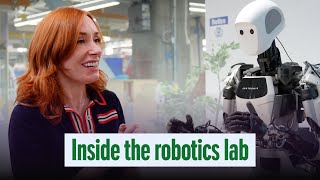
The most prominent was Weave Robotics' laundry folding robots thought up by Kaan Dogrusoz and Evan Wineland At the end of 2023 2024 beginning, did not see anybody actually building a product that we would actually want to put in our own living room and we set out to build Weave. Weave's Treadle is already deployed in some laundromats and Wineland says they're in talks with hotels for ordering a coming model that will also tidy up floors and surfaces. The consumer-level model, Isaac, can be reserved now.
At CES LG's humanoid ServeBot CLOiD showed off doing laundry too. Both Weave and LG's robots are humanoid, but with a major exception they're on wheels instead of legs. It has fewer components, and that makes it faster to build.
It also means that we passively balance. When inevitably, as first of their kind products, will they encounter something or they struggle. We don't have to worry about actively balancing to stay upright.
Indeed, there's a reason robot vacuums aren't bipedal. Still, some say the human form will dominate in-home robotics eventually. Our world is made or built by the, built for humans.
We have ladders, we have stages, we have stairs that are suitable for human forms to do. And secondly is that robots need data. In order to collect those data, it will be the best to use existing human data and retarget to the robot.
But today, humanoids are still making some embarrassing mistakes, like when Russia's first AI-powered humanoid fell on stage during its debut. Instead, most humanoid robots operating today have been quietly deployed in factories or warehouses. Those are pretty much confined environments.
They're structured. Home is very unstructured. You can't plan for a child running into the robot or the robot running over a pet.
The biggest U. S. companies in humanoids include Agility Robotics, which says its Digit robot has moved more than 100,000 totes for logistics company GXO.
Although it's been stuck in testing mode at Amazon warehouses for more than two years. Tesla's Optimus is designed for industrial uses first, although it failed to launch as planned in 2025. Boston Dynamics' Atlas is being trained at a Hyundai factory, and will now integrate Google's Gemini AI models too.
Figure AI humanoids helped assemble some 30,000 BMW X3's during a 2025 trial run, although it's facing some major allegations about safety. And Apptronik's Apollo is also an active pilots in Mercedes Benz and GXO facilities. With the rapid advances in AI, it's certainly conceivable that if these use cases are developed that it is going to receive widespread adoption in factories.
Home, I think, is longer. We're a lot further away from that. When it comes to true multimodal robots in the home, only one U.
S. company has a humanoid on the market today, Palo Alto based 1X. If someone comes over, I'll say like, hey NEO, can you get the door?
The robot goes over it, opens the door, lets people in, says hi to them. But it's $20,000 price tag comes with one major caveat. Yes, NEO is technically a robot, but it is operated by a human being wearing a headset.
In other words, a human being is watching its and your every move. Would you pay $20,000 for a robot to come in your home and be operated by a human behind the scenes? I would not.
Yeah, I think that is a stretch. I understand why they're doing it, to collect data on what goes on in the home, so that they can iterate and have, ultimately, robots that don't require teleoperation. Tesla's Optimus, which Musk told investors could be the biggest product of all time, has been seen handing out party favors, scooping popcorn, even taking out the trash.
But it's reportedly had help from a human remote assisting. Teleoperation is really just a way to get us to full autonomy. It's the bridge, or the gap that still needs to be filled, from no autonomy to full autonomy.
It is going to be here for a while. Weave's laundry robots are also not yet fully autonomous, but like many robotics companies, it's building its own foundational model that trains on the data collected by the robots as they work so they can iterate. One example could just be like the diversity from one family to another family's laundry that we fold on any given day.
There can be a world of difference, and being able to do that autonomously for people, as is the goal. That's something that will take time, that will take data collection, that will also just take deployment and real world experience. So what does all this teleoperation and data collection mean for privacy?
I was joking about how, you know, people who like to run around at home naked might want to think twice about letting NEO Gamma into your house, right? What about privacy though? This is going to be a huge issue if teleoperators are involved.
I think it's all about like transparency and like there's no way we can make this product really good for you without a lot of your data. I don't want to share everything going on in my home with a robot that might be sharing that with somebody else. Still, some say robots don't introduce any new privacy concerns.
I think there are a lot of devices in our homes today that are listening to what we're doing, from our phones to our smart speakers, etc. . This is really just an extension of those machines.
Another reason for Teleoperation is safety. Experts told us not much is known yet about what guardrails will protect against dangers like hacking a robot to do dangerous tasks or mechanical malfunctions. What would happen if something goes wrong with your child or your elderly parent?
We develop the first American National Robot Safety Standard back in 1986. Now with new form factors, we did it with collaborative robots, we did it with mobile robots. We're working on it with humanoids.
Critical. In China, there's been a major push to accept humanoids, risks and all. China's working toward getting as much data as you can in the real world.
That's why they're pushing deployment of humanoids. We're not doing that yet here in the U. S.
They want to get the population excited about them. And this is a wide open space right now. It's not clear which country is going to win.
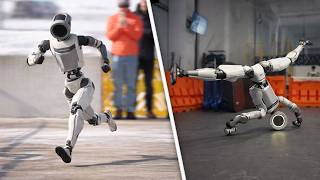
China-based Unitree is generally considered the leader in the humanoid market, with its $70,000 G1 Koid, sold in the U. S. by New York-based distributor Robo Store.
This today, now it is operated by a human being via remote control. X-Peng's Iron looked so realistic when it debuted in November, the Chinese company cut open its leg on stage after crowds accused it of having a human operator inside. And the Walker S2 by China's UBTech says hundreds of its humanoids have been deployed, including on production lines of Chinese carmakers like BYD.
The next generation is just going to grow up with these machines as whether we accept it or not. For now, most humanoids are not focused on the home, accomplishing tasks with enough speed and efficiency to make the price tag worthwhile remains a challenge. Weave's robots, for instance, fold much slower than a person, which is why the first humanoid robots to take off in the home may be for entertainment.
Did you tell R2-D2 you're going to be here? Did you and C-3PO. We spoke to two companies working on that, both based in China.
They have language models deployed so they can voice, interact, chat with children, and even teach them different classes. It's like a pet, like a teacher of your children. Booster's K1 starts at $6,000 and High Torques Pi at $5,000.
And so far, both companies say the only customers are robot enthusiasts or developers. It's called character humanoid robotics. It is what's going to enable homes to have humanoids at home for the first time, in a form that caters more to children and whatnot.
And then when more safety guardrails, when more societal acceptance occur, then we're going to see more of these humanoids at home. In-home multimodal robots may first find footing for specific purposes, like eldercare. If there was a robot capable of lifting somebody up, whether it be in a facility or in a home, or getting them in and out of the shower, that would be a big advance.
I don't know how close we are to that. As for when some predict humanoid robot orders will explode in 2026, while others think it'll take much longer. How many years before they might be in homes everywhere?
Smart. Autonomous? Uh, maybe next year I think.
Humanoid robots will just be like the computers in the 1980s. They will enter every single household. And this is a really market with a lot of potential.
It will take at least maybe five years from now. Dexterity is an issue. Safety, of course.
But all these issues, it's just not clear that it'll ever happen. I'm somewhere closer to more than a decade in our homes.