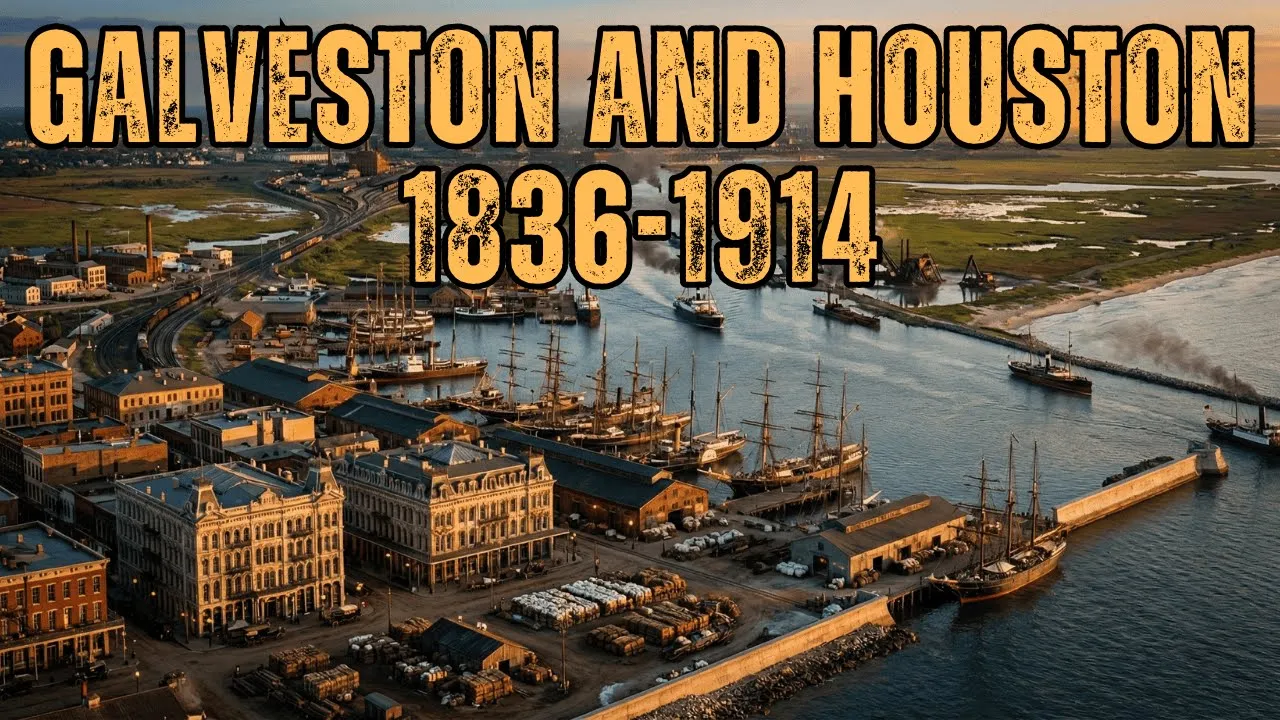
If you could stand on the deck of a deep water steam ship entering the Gulf of Mexico in the late 19th [music] century, your eyes wouldn't be searching the horizon for the glass towers of Houston. In that era, Houston was little more than a whisper in the marshes. Instead, you would be looking for the queen of the Gul.
You would be looking for Galveastston. At its peak, this single barrier island was the wealthiest city in Texas. A glittering metropolis of ironfronted banks and Victorian mansions that earned it the prestigious nickname the Wall Street of the South.
But as I began researching the old maps and ledgers of this era, I realized [music] that Galveastston's Golden Age was actually a highstakes drama. It was a story of a sophisticated, [music] wealthy island elite locked in a bitter decadesl [music] long struggle with a muddy, relentless upstart located just 50 [music] mi inland. Today, we are going to use modern AI to step off that steamship and into a world of silk hats, cotton bales, and global Caribbean [music] trade.
We are going to reconstruct a time when these two cities were economic twins tied together by 50 mi of friction, water, and raw [music] ambition. If you enjoyed this journey into the past, please make sure to like and subscribe so you don't miss our future [music] reconstructions of history's lost worlds. Our story begins in 1836, the year of Texas independence, when both cities were essentially just speculative lines on a surveyor's [music] map.
In this first reconstruction, we see the raw, swampy reality of Houston's birth. The Allen brothers had purchased this land for less than $10,000, and their advertisements in New York and London promised [music] a great interior commercial emporium. But for the first settlers who arrived by boat, the reality was a [music] desperate struggle against a prehistoric landscape.
You are looking at a scattering [music] of canvas tents and rough hue log cabins perched precariously on the edge of buffalo bayou. A narrow winding [music] waterway that was often choked with fallen cypress timber and thick with the hum of millions of mosquitoes. [music] In these early years, Houston was a place of black gumbo mud, so [music] deep that wagons frequently sank to their axles, and the heavy, humid air was a constant [music] carrier of the dreaded yellow fever.
It was a town built on a swamp, [music] sustained only by the fanatical belief that it could one day control the gateway to the Texas interior. While Houston was [music] slogging through the Bayou mud and battling the elements, Galveastston was quickly becoming the center of the Texas universe. Because it sat on a natural barrier island with a [music] rare deep water harbor, it was the only place in the fledgling republic and later the state where large oceangoing vessels could safely dock [music] and discharge cargo.
By the 1850s, the Queen of the Gulf was thriving with a cosmopolitan energy that rivaled New Orleans or even New York. As we sweep our lens across the iron fronted [music] banks of the Strand, notice the sheer opulence of the architecture. These buildings weren't [music] just offices.
They were cathedral-like statements of power. This street was the financial heart of the region, housing the wealthy cotton factors and insurance titans who controlled the flow [music] of white gold. During this era, Galveastston was the first city in Texas [music] to have gas lights, the first to have a telephone, and the first to have an opera house.
It was an island of luxury in a frontier state where the elite wore the [music] latest European fashions and toasted to their success with imported champagne. By the 1880s, the port of Galveastston had become a dense forest of [music] masts and smoke stacks. You would have heard a cacophony of languages on the docks, German, [music] Czech, Spanish, and French, as ships flying the flags of the United [music] Kingdom and the Mediterranean waited to load cotton, grain, and cattle destined for global ports.
But beneath this international [music] glamour, a resentment was simmering 50 mi inland. Every [music] single bale of cotton grown by a Texas farmer had to pass through Galveastston. And every [music] single crate of imported medicine, tool, or luxury good coming back in had to pay a [music] fee to the Galveastston Warf company.
This company held a private ironclad [music] monopoly over the island's docks, and their high warage fees felt like an [music] unfair tax on the labor of the entire state. Galveastston's elite grew incredibly rich off these fees, building palaces like the Bishop's Palace and [music] the Gresham House, while the merchants of Houston felt they were being held hostage by a 50-mi bottleneck. The [music] men of Houston eventually decided they were tired of paying Galveastston's tax on [music] trade.
And this is where the rivalry turns from simple competition into a feat of engineering. In our next scene, we see the shift toward [music] industry and relentless infrastructure. Houston began marketing itself as [music] the place where 17 railroads meet the sea.
While Galveastston relied on its [music] natural god-given deep water harbor, Houston began the backbreaking hustle of engineering its [music] own destiny. They spent decades lobbying the federal government and raising private funds to dredge Buffalo Bayou. They wanted [music] to turn a narrow, muddy creek that was once barely wide enough for two rowboats to pass into a massive [music] deep water channel.
It was a project that the elite of Galveastston openly mocked. In the newspapers of the day, islanders dismissed it as a mud digging pipe [music] dream. They believed that no captain in his right mind would ever navigate 50 m of [music] winding, treacherous bayou just to reach a humid inland town.
when they could simply dock at the sophisticated peers of the island. This rivalry reached a terrifying breaking point [music] at the turn of the century. On September 8th, 1900, the weather in Galveastston was unusually sultry, and the tides [music] were rising in a way the locals hadn't seen before.
But at the time, there was no satellite tracking, and no one suspected that the deadliest natural disaster in United States history [music] was barreling toward the Texas coast. The great hurricane of 1900 brought a 15 ft storm surge that swept completely across the low-lying barrier island. In this reconstruction, we see the terrifying [music] aftermath.
A wall of debris three stories high composed of shattered homes, [music] grand pianos, and the remains of a city stretching for miles along the shoreline. At least [music] 6,000 people, perhaps as many as 12,000, perished that night. The Wall Street of the South was left in ruins.
Its streets filled with sand [music] and its legendary wealth buried under the wreckage of the Goth. The people of Galveastston showed incredible almost superhuman grit in the years that followed the storm. They refused to let their city sink into the sea.
They undertook one of the greatest [music] engineering feats of the early 20th century, building a massive concrete seaw wall and literally [music] raising the entire island's elevation by 17 ft. They pumped in millions of tons of sand from the Gulf floor, lifting up houses, churches, and even the grand St. Patrick's Cathedral on jacks to create a new, safer [music] foundation.
But while the city was physically rebuilt, the confidence of the global [music] market had shifted. Investors and cotton merchants wanted the safety of the mainland. They had seen that a city on a barrier [music] island, no matter how grand, was always at the mercy of the unpredictable [music] Gulf of Mexico.
The 1900 storm proved to the world that Houston's inland location, once seen as its greatest weakness, was actually its greatest [music] strategic strength. The final victory for the upstart city came in [music] 1914. After years of dredging through the silt and political maneuvering in Washington, the Houston ship channel was officially opened to deep [music] water traffic.
In this scene, we see the culmination of 80 [music] years of ambition. As the first large oceangoing steamers began to sail 50 mi inland, passing the very spots where the Allen brothers had first pitched their tents in the mud, the balance of power shifted forever. These massive vessels could now bypass [music] the Galveastston Warf company entirely.
They could deliver their cargo directly to the [music] massive rail heads of Houston, where those 17 railroads stood ready to carry goods across the American West. The mud digging dream had become a [music] reality that changed the map of American commerce, and the era of Galveastston's [music] economic dominance over Texas was officially over. Today, Houston [music] is a global titan of commerce and the energy capital of the world, and its ship channel is one of the busiest [music] and most vital waterways on the planet.
Galveastston, meanwhile, has found a second life as a beautiful, resilient, and historic retreat. If you walk through the Strand historic district [music] today, you can still see the very same ironfronted buildings we've reconstructed in this video. You can see the scars of [music] the 1900 storm and the height of the seaw wall that saved the city.
When you stand on those streets [music] today, you are standing in the echoes of a lost empire. These two [music] cities, only 50 mi apart, are two halves of a single Texas story. It is a story of a world built [music] on the natural gifts of the sea and a world built on the relentless, stubborn will to overcome it.
One city was the queen, but the other was the hustler, and together they shaped [music] the destiny of the Lone Star State. I really appreciate [music] you joining me for this walk through time. Your feedback helps me decide which era to rebuild next.
So, let me know [music] in the comments which city you want to step into. Until next time.