We are heading towards something terrible... We are entering the... We are truly entering the most total darkness, darkness in my opinion. We are entering darkness. What is happening now is a small reflection of what is to come, very small. We are going to fall, in my opinion, more and more into this type of situation in which the totalitarian State is going to tell you what you absolutely must do and what is expected of you. And you are going to say be careful, I have a conscience that is above the totalitarian State. And so, there are
things I'm not going to do, even if you kill me. Living according to one's conscience will in fact mean saying: I am going to death. You understand ? And there, people need to be prepared. When a society becomes radicalized or when a society becomes a concentration camp in reality, as we are seeing in the West, there are only two possibilities. Hello, Alexandre Dianine-Havard. Good morning. I am delighted to welcome you for another interview. I remind listeners who don't yet know you that you are of French, Russian and Georgian origin. You worked as a lawyer in
France and Finland for several years before putting your career on hold to devote yourself to the study and teaching of Virtuous Leadership. A vision of leadership, we will come back to this, but which consists in particular of growing by helping others to grow and which is today taught throughout the world through around twenty institutes. You are also the author of around ten books devoted to Virtuous Leadership and you regularly give conferences on this subject. In your book, Free Hearts – On the Education of Feelings, published by Le Laurier in 2019, you explain that man has
a free will which allows him to make his own choices, but that he has a “ higher freedom, freedom of the heart.” And you add that “a free heart is a heart that is used to saying Yes to transcendent values”, and that “this freedom of the heart is the fruit of profound work on oneself”. What is freedom of the heart? Why is it superior? And in what way is it the fruit of deep work on oneself? So, I had to think a little bit about the concept of freedom, since freedom is still a very important
element of my Virtuous Leadership system. I talk a lot about freedom and dignity, but I think that modern man talks a lot about freedom, but in reality he has lost the meaning of freedom. I thought a little bit, ultimately, what is freedom? And I came to the conclusion that in fact, there are really two stages of freedom. There is a step that is obvious, which is that we are human beings who are free because we have the capacity to make choices. This is what I call freedom of the will, that is to say that human
beings, unlike animals, have rational knowledge and this rational knowledge precisely allows them to make choices that are free. . This is the first stage of freedom for me . This is the universal stage of freedom. No one can say, “I don’t have this freedom. ” » Everyone, all beings... All human beings, even those who are in prison, have this basic freedom which is the freedom to make choices, and sometimes even existential choices, very important choices, very deep. And that is the basic freedom which is the beginning of freedom. And I think that for me, the
second freedom, the one which is for me the most beautiful, the highest which comes next, it is not a freedom of the will, it is not the freedom to make choices between A and B is freedom of the heart. And there, I had to think a little about what I mean by freedom of the heart. And the freedom of the heart is the freedom, in reality, of the person... It is a capacity, in fact. It is the capacity of this person who is receptive, receptive to the transcendent values which are the Beautiful, the Good, the
True. A person who is very receptive to these transcendent values and who, at the same time, responds to these values that he perceives and who responds in a generous, magnanimous, effective, rapid way. So, for me, a free heart, and I really like this expression “free heart”, a free heart is not a free intelligence, it is not a free will, it is a higher state of a person who not only can make existential choices, but is a person who perceives. It's actually an ability. The free heart is a heart that has a capacity that many people
do not have, which is the capacity to perceive these transcendent values which are the Beautiful, the Good, the True and to respond to them immediately, and to Respond with generosity, I repeat, and magnanimity. For me, that's the concept of a free heart and it's the title of one of my books in fact. A free heart, that’s it. We talked a lot a little bit about what the heart is after all. And in my system of Virtuous Leadership, in this book “Free Hearts”, I come to the conclusion that there are three spiritual faculties in the person:
there is the heart, there is the intellect and there is the will. And that finally, these three things, the heart, the intellect and the will, we can say intelligence or reason in place of the intellect, at our level These words replace each other, therefore the heart, the intellect and the will are three spiritual faculties which… not only complement each other, but which must be constantly in interaction. Constantly in interaction, that is to say that a free heart is of course a heart which is in interaction with its intelligence and with its will. I especially don't
want people to think when Alex speaks of the heart, he means that we must live from the heart and that we must forget the other spiritual faculties which are the intellect and the will. When I talk about the heart, I'm not talking about sentimentality. I don't fall into sentimentality. When I speak of the heart, I always speak of a heart which is deep, which is real, which is solid, but of a heart which is always in interaction with intelligence and will. Otherwise, for me it is no longer a heart. That is a very interesting question,
it is that a heart which does not interact with the intellect and the will is no longer a heart, it is something else, we must find another name. The heart of the sentimentalist, therefore of a person who has ruined, quote unquote, The intellect and the will to live from the heart is no longer a heart, it is something else. So, you must hear me clearly when I speak of a free heart, I mean this heart which is extremely, of course, attentive to these transcendent values and which is capable of responding to these transcendent values. ,
therefore, it is a heart which also has intelligence and which has a will. Because if you don't have intelligence, you don't perceive anything. And if you don't have will, you can't do anything, you can't respond. So it is a heart which is extremely sensitive and at the same time which is very quick to respond to these transcendent values, but it is the heart. It is at this level that everything is located, it is at this level that everything starts. Everything starts from the heart in the person. The heart is truly the foundation of the personality,
it is the most important of the three... of the three elements, of the three spiritual faculties of the person. And I talk a lot about a free heart because I realize that today, ultimately, there are many people who no longer have a free heart, that is to say they live solely From will of the intellect, that is to say the choices that we can make, existential, and which say I am free because I make choices. I make the choice... I make choices between A and B and the possibility of making choices, people tell you: “That's
a free choice. » So you are a free being because you can choose between eating chicken or eating steak. You know what I mean ? And so they tell you, “Well, you’re free. » While the idea here is to show to people: “No, no, freedom is still a little more than choosing between eating steak or eating chicken. » Freedom is a higher level and people who have not achieved freedom of heart are not free, even if they shout: “Freedom, Freedom, Freedom darling!” » in reality, they are not free because they do not have this capacity,
in reality, to understand things which are above them, things which are more beautiful than them, things which are bigger than them. And they don't have the capacity especially to respond to them, to respond to these things and live a life that is worthwhile. So, I think the concept of a Free heart is extremely important. This is why I really gave the name “Free Hearts” to this book, because I would like many people to discover that fundamental freedom, supreme freedom, is above the will. It is freedom of the heart and that we must work on the
hearts of people. And there, we must improve the heart. We must ensure that people who do not have a free heart transform their hearts so that they become truly free. And that 's a big job. And I explain this in my book “Free Hearts”, I explain how we do this work on the heart, how we do this work on ourselves, how we deepen all of that. And we're going to talk about it a little bit during this interview, I imagine. These are extremely practical things, but extremely profound. People need direction. When they tell you: “Alex,
I want a free heart. What should I do about this? What should I do to be sensitive to these realities you talk about? And what should I do to answer it? » That's it, I want to train my heart and therefore I Understand how we train the intellect, since the intellect is about carrying an intention, a knowledge. And I understand how you train the will, you do push-ups every morning, you get up at five in the morning, you take a cold shower, you do fifty push-ups, you build the will. But what does that mean to
train the heart? The heart is something much more interesting than the other two. All these spiritual faculties are interesting, but the heart is something more complex, since the heart is both physical and spiritual. The heart is really the heart of the person, that is to say it is the center, we say that the heart is the center of the person because ultimately, the heart is both both physical and spiritual. In my diagram, in my vision of the heart, I had to think a little about how we position the heart in the person. And I came
to the conclusion that ultimately, you have three levels in the person. There is what we call the level of the physiological heart, it is the level of physiology, of biology, it is the body. Human beings have a body like animals And in this body there are what we call sensations. And then there is a physical heart. All doctors will tell you that there is a physical heart there. Then, there is a second level that we also find in animals, which is the psychological level. It is not the physiological level, it is the second level, it
is the physiological, psychological level ( forgiveness), which comes from the word “psykhḗ” in Greek which means the soul. The soul is the principle of life. So animals of course have a soul, too, since they have a principle of life otherwise they would have died. So animals live and therefore they have a “psykhḗ”, that is to say they have a principle of life. And at the level of this principle of life, we have what we call emotions. So human beings like animals have emotions, fear, anger. Animals have fears and anger, and so do human beings. So
here, we are at the psychological level, at the level of the “psykhḗ”, therefore at the level of the soul. This is the soul level. So you have the body, you have the soul, animals also have a soul, an animal soul, and you have the third level which is The spiritual level. And the heart, you find it on three levels. You find it on the physical level, you find it on the psychological level and you find it on the spiritual level. So the heart, on a spiritual level, is the feelings. So, at the first level, it's
the sensations. The second level is emotions. And the third level is feelings. And animals have no contact with this spiritual reality since they have no mind. They don't have a mind, they don't have rational knowledge, they don't have a free mind, they only have an instinct. So the animal has no mind, but the human being has a mind. And in this spirit, you have two faculties which are purely spiritual, which are the intellect and the will, purely spiritual, and you have one faculty which is both spiritual and physical, spiritual and material, which is the heart.
So the heart, its great specificity is that it is both spiritual and physical. What is the spiritual heart? The spiritual heart, for example, is a sacrificial love, a person capable of dying for another person. That's a Spiritual heart. That's a spiritual feeling. It is no longer love as a love emotion. It is not physical love, physiological love. It's not emotional love, it's spiritual love. The ability to die for another person is sacrificial love, it is something spiritual. For example, deep compassion. You feel deep compassion for someone who is suffering. That's the level of the mind.
A contrition. Contrition is the ability to ask forgiveness from others for one's errors, for one's sins, for one's miseries, it is something spiritual, it is feelings. And there, we are in the zone of the mind. You understand ? So, we really have three zones. You have a physiological zone, you have a psychological zone and you have a spiritual zone. In the human being, there is the body, there is the soul, the principle of life, and there is the spirit which comes above all that. And the heart, what makes it specific, is that it is in
the three levels. There is the physiological heart, there is the psychic heart and there is the spiritual heart. The heart is truly a Spiritual faculty of the human being. So the heart is the center, it is the foundation of everything because the center of your personality... The center of your personality must be spiritual as well as physical, because you and I are spiritual and physical beings. . So the center of your being cannot be your intelligence. The center of your being cannot be your will, since those are purely spiritual faculties. The center of your being
must be both spiritual and physical. And that what is it ? Well, that's the heart. This is why the heart is the center. Moreover, in Russian, “сердце”, the heart, means the center. It's the center. This is why the philosophers were not mistaken, the intuition of the people was not mistaken, the heart is really the center of the person, that is to say that you are worth what you are. worth your heart. Because you are a material and spiritual being at the same time, so you are worth what your heart is worth. You can't say, "I'm
worth what my intelligence is worth." » You cannot say: “I am my intelligence. » On the other hand, you can say: “I follow my heart. » You cannot say: “I am Worth what my will is worth. » You cannot say: “I follow my will. " Of course not. Because that is purely spiritual. So that you can say: “I am my heart. » My heart and I are the same thing. I am, AM, my heart. You understand ? I'm worth what my heart is worth. What is your happiness? It is not the happiness of your will.
It's not the happiness of your intelligence either . Your happiness is the happiness of the heart. Only the heart can give happiness to a person, since the heart is your whole being. The heart is the center, it is so your whole personality. And the heart is both, I repeat, material and spiritual. You have to talk a lot from the heart. We excluded him a lot, poor heart. He was excluded a lot. It's true, it is quite excluded elsewhere in Aristotle, among the ancient Greeks or later in Saint Thomas Aquinas in the Middle Ages, although he
talks a lot about love. Plato, he talks about love, it’s extraordinary. Saint Thomas Aquinas also speaks of “caritas”, of supernatural love, it is extraordinary. But their vision of the heart... The heart is not really part of spirituality. And I tried to make people understand a little, following Blaise Pascal, also following people like von Hildebrand, who is a great European philosopher who lived in the United States, that the heart is a spiritual faculty. real. We must reestablish the heart as a spiritual faculty, otherwise we will not get through this. So for me the free heart is
a spiritual faculty, but a spiritual faculty which is at the same time a material faculty and that is why we must speak of the heart, it is the foundation. Blaise Pascal wrote superb things and unfortunately Descartes took the upper hand on that, on Pascal, but I think that the French have a huge interest in returning to Blaise Pascal, because Descartes directed them towards rationalism in fact. Descartes is the modern father of rationalism, and from there you have the ratio, but there is no place for the heart, the heart no longer exists in him. There is
no heart, it doesn't exist. And so Descartes cannot give people happiness. First, he creates people who are perhaps mathematically efficient, that's clear and clear, but they are people who are not Humanly efficient at all. Humanly. Even if they are purely mathematically good, from a human point of view they are nullities, because there is no more humanity, there is only ratio. And it is the ratio in addition which works only at the level of mathematical knowledge, but it is not a ratio of ordinary life. It's a very specific ratio. People often say to me: “Alex, you
criticize Descartes, but look what he did for science. » Yes, yes, yes, for mathematics, he did incredible things, I don't deny that. But for philosophy, he did a lot of harm. He destroyed it, he destroyed anthropology as it was considered until Descartes. And that did damage. It did incredible damage. And it's time to say it. Yes, because in this book “Free Hearts”, you also emphasize that “the truths of the heart, the intuitive truths are more often certain than the rational truths”, the truths produced by reason, but above all that they “ are Almost always more
fundamental and more necessary to our personal growth and happiness.” Why are these truths of the heart more valuable than truths from reason? And why are they essential to our elevation? I would like to take a few examples so that we understand what we are talking about when we talk about the truths of the heart. You think, for example, that intuitive truths are more important than truths that can be demonstrated, I would say, by mathematics. You simply think of the intuition of the immortality of the soul. A person who has this intuition deep within themselves, and
I think we all have it, that our spiritual soul is immortal precisely because it is spiritual and not material, the intuition of eternity is not is not demonstrable by mathematics, that. You cannot prove that mathematics exists. Even the intuition of God, you can rationally arrive at God, his existence, and even rationally understand the nature of God. You can reach the level of reason, But mathematically, you cannot demonstrate the existence of God. Mathematically, you cannot prove the existence of immortality. Mathematically, you cannot prove eternity. And these are intuitive truths, but which are not opposed to reason,
but which are intuitive, which you discover through intuition, which are inscribed in your heart. And these truths have an enormous consequence on your behavior, but enormous. A person who believes that there is eternal life, that there is a particular judgment, that is to say that if I act crazy and I massacre people or I behave badly, well one day I'm going to be judged for this. You know what I mean ? And if I do good, one day I will also be judged for the good that I do. You say to yourself, the consequences of
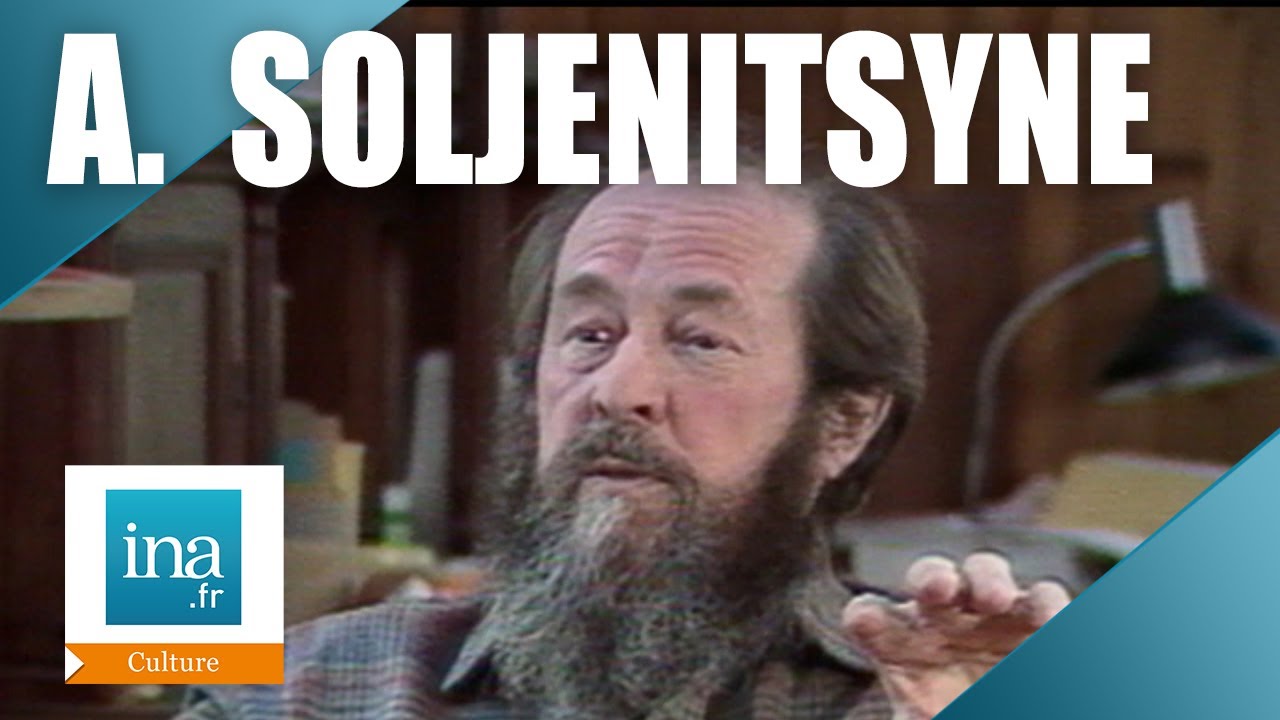
this intuition, they are enormous in the behavior of people, but enormous. This is what Solzhenitsyn often reminded us of. This is something that he really liked to say, Solzhenitsyn, is that the autocratic governments of the Middle Ages or the post-Middle Ages, before democracy was established in Europe, you Say these very people They were autocrats, they had limits. That is to say, they believed that in the end there is a judgment. You understand ? So, he said Solzhenitsyn, these guys were still limited. That is, there was a limit to their power because they knew that they
must one day be held accountable. And report not to a board of managers, not to a Parliament that you can manipulate. Because we know perfectly well that we can manipulate parliaments , and we can also manipulate a board of directors. But God, you can't manipulate him. It's impossible. These people, Solzhenitsyn said, he repeats in several of his books, they were limited. He says the big problem... They were limited in the sense that they realized that they could not do anything, because afterwards there is a judgment and they are not going to escape the judgment of
eternity , to the judgment of God. So, Solzhenitsyn says that the problem with many modern democrats is that their only limitation, since they no longer believe in eternity, they no longer believe in God, Their only limitation is Parliament or the council of management. I repeat that these are institutions that you can quite easily manipulate, but that is where you are accountable, your final accounts. And he says that these people are extremely dangerous, because there is actually no limit to their power. Although they call themselves democrats, in fact there are no limits, because precisely, they do
not believe that then comes this truth which will judge them. And he is very deep, Solzhenitsyn. How nice it is to read it, because what he really says is the truth in all its splendor. These are obvious things that he says, but he says it in such a clear way that no one can say, “No, I don't believe in those things. » And indeed, that is the great problem of modern democracy. Where there is no longer any transcendent truth, you understand, well it is no longer a democracy, it becomes a hidden totalitarianism. A democracy without
value is a hidden totalitarianism. It becomes a totalitarianism, it is a totalitarianism even more dangerous than the totalitarianism of… I Would say that the authoritarianism that there was a hundred or two hundred years ago of the French monarchy, etc. So we must not lie to ourselves. When we talk about power, we say: “Ah, democracy is beautiful!” » Yes, but be careful, a democracy without value is a real, hidden totalitarianism. And there is no limit to the power of these people, let's be clear, there is no real limit. Whereas often, among monarchs, I repeat, among autocrats,
there were a minimum of limits. It was: “Me, be careful, the day I die, I will be asked to account. » That no longer exists among most of these politicians. But that 's much more dangerous when it no longer exists. There is nothing that can control you anymore. You think it's... There's nothing that's going to control me. I do what I want and I manipulate institutions as I want. So, what I meant by that is that intuitions, intuitive truths are truths that have a consequence on your behavior... Huge, very superior to the truths that you
can demonstrate through mathematics. From an existential point of view, These truths are incredible and that is why you have to develop your heart, you have to develop your intuition. Every day we must try to understand more intensely these truths which transcend us, because the consequences of their acceptance and the response we give to these truths completely change our existence and change our way of perceiving ourselves, of understanding ourselves, of perceiving others, to understand others. So all your social, personal, professional, family behavior ultimately depends on these intuitive truths that have always existed. What is happening is
that today, with the rationalism that developed in the 19th century, which had dramatic consequences, this part that we call the heart no longer exists. There is only this rational part. Rational, by that I mean... For people, moreover, for the French, being rational means... It's a mathematical demonstration, in reality. Rationality as it is perceived today is not the rationality of a person who manages to understand through intuition. He is a person who understands only through logic, so it is a purely mathematical rationality. And I don't call that rationality. It is the same thing as the heart
which is not in interaction with the intellect, it is no longer a heart, it has another name, it is something else. The sentimentalist is not a heart, he is something else. It's the same thing for the rationalist. The rationalist who is not in interaction with his heart, who puts the heart aside, is no longer ratio, it is no longer rationality. He falls into what is called rationalism and therefore his ratio is no longer ratio. This is another thing. It becomes a computer, a bit like a... Human will becomes a turbojet, whereas human will is not
a turbojet, since it is in action, it is constantly interacting with the heart normally and with the intelligence. But if you separate it, it becomes a turbojet. It's rubbish, a turbojet, actually. It's rubbish. In a human being... Well, that's good, a turbojet is beautiful, But if your will becomes a turbojet, you're worthless, you're a zero. If your intelligence becomes a computer, you also become a zero. There is no more intuition, there is only pure logic, but there is no intuition. There is no more... As I said, there is no longer any contact with transcendent truths,
there is no longer any response to these transcendent truths. It's the same. All these elements that we call the heart, the intelligence and the will, in fact, they lose their own name if they are not in constant interaction with each other. This is a little bit of what we can say on this subject of truths, intuitive truths which are existentially much more important than the truths that can be demonstrated by the natural sciences. You were talking earlier about the period of the fact that ultimately, today, in the modern world, the place of the heart, the
importance given to the heart, has considerably shrunk. Also in this book “Free Hearts”, you evoke “a civilization which has buried the heart because it knows no other loyalty than submission to Ideological slogans”. And you also say that the greatest victims of ideologies are “the generous but imprudent hearts”, who give themselves entirely, ultimately, “to the process of self-destruction” into which the ideology leads them. Why do you think our civilization has buried the heart in favor of ideology? And how does this lead us irremediably towards self-destruction? I was talking a little bit before about the rationalist. This
mainly concerns the 19th century, the beginning of the 20th century, where there were a lot of rationalists. They were not yet people of will, but they were above all people of ratio, they were really Descartes, they were people for whom only intelligence works, he It's only the intellect that counts and everything else is stupidity, it makes no sense. But at the same time what we call modern voluntarism developed , that is to say the entire century of ideology, which is the 20th century, is a century which stopped being rational to fall in what we call
Voluntarism. That is to say, the voluntarist is a person who says: “Reason no longer interests us. We're no longer interested in that. What matters is the will. » But a will which also excludes the heart, that is to say a will in which it is pure and hard will. It’s voluntarism, “volo”, I want. With Descartes, it was: “I think, therefore I am.” » Now it is: “I want, therefore I am.” » It's Nietzsche. It's Nietzsche, it's the whole philosophy of Nietzsche. There are no logos, there is no rationality, it is the hatred of rationality, it
is the hatred of the ancient Greeks. Nietzsche is the hatred of Plato, it is the hatred of Socrates, it is the hatred of all these great thinkers, because he says these people have limited us, they are fascists, in fact. They are fascists. And he says I'm free, I'm above all that. You really have to want what you want, achieve what you want. Be what you want, says Nietzsche. Become what you are, for him that means… Be what you want to be. So voluntarism has taken an Exorbitant place in the hearts of certain people today. In
the 20th century, there was of course Bolshevism, that's obvious, because it is a voluntarist ideology, like all ideologies it is voluntarism. All modern movements, modern ideologies, gender, etc., are pure will. There is no more room for the heart. There is no more room for intelligence. There is only one place, and that is the place for the will. It's the will and that causes terrible disasters because you have people who are very generous of heart, but when they fall into ideology, they become real monsters. I remember a rather interesting anecdote. The first time I went to
St. Petersburg was in 1992. I was living in Finland at the time and arrived in St. Petersburg by boat. It was the time of... It was... It was just after, it was perestroika. It was the time of freedom, it was just after Russia became free from communism, since it became free from communism in 1991. So Russia became free from communism in 1991 , and in 1992 I arrived in Saint Petersburg and I remembered that I had a cousin who was there, because another cousin from Georgia had given me her phone. She said to me: “When
you get to St. Petersburg, it would be nice if you called aunt Valentina to tell her that you are here and that you are calling her on my behalf and that you need to get to know her because she's a cousin of yours. » And I had never seen her. This is a woman who was already sixty years old at the time. And I pick up the phone in the street, I call and I say to him: “I'm your cousin, I'm coming to see you. » She said: “Come right away, we want to get to
know you. » I arrive and we start talking, etc. And here I begin to discover, she and her husband were professors at the University of St. Petersburg, so they were communists, they were members of the Communist Party. They believed it completely, especially her. She had completely given her conscience and her heart to the system. They received... They received papers from the KGB every month with lists of people who had to be excluded From the university because they were not good communists or because they were people who had more traditional values, religious values, Christian values or
who were practicing and it was necessary to exclude them from the university, it was necessary to find a legal way to exclude them because we could not exclude them on the basis of their beliefs. So she had the obligation every month to evacuate a certain number of students, you understand, she was a very good woman, very generous, but she said to herself that's for the idea. In the name of the idea for which I live, the communist ideology in which I believe, I have to do these things, even if I find it, personally, individually, deep
in my conscience, absolutely disgusting. I have to do it. And she did it. It hurt him enormously. It hurt her enormously and she couldn't talk about it, it was her husband who opened his mouth and told all this because she couldn't talk about it. And besides, her husband was telling all that and then at one point she comes out of the kitchen and says to her husband, Whose name is Micha: “You don't have to tell Alex all that stuff. . » That means that he didn't care because he realized that he had no choice. But
he didn't believe in anything, you understand, he had no choice, he was a careerist, an arriviste as they say in French, and so he made his own way and he realized that it was horrible, but he had no choice. She, deep in her conscience, realized that it was also horrible, but she realized that she thought she really had an inner choice. And so, she was a generous woman, a woman who had given herself completely to the system, completely given to the ideology. This is where I answer your question, people who are generous but who abandon
themselves to ideology, these are people who go very quickly towards the process of self-destruction, because they are generous in their self-destruction, you understand, they are generous because they say to themselves: “We have to go to the end. We believe in it. And so we have to do it, we have to realize it. » And You see today, perhaps, it is also a very good example for many Westerners who easily fall into ideology and who can have a big heart by telling them: “Be careful, be careful, your heart no longer is generous, the more you will
self-destruct by falling into ideology, because there you will completely destroy this generous heart that you have. » Whereas a person who is not generous, who is super limited, who is mediocre, when he falls into ideology, he remains in his mediocrity. Not much happens. But a person who gives his heart to an idea, if this idea is a false idea because it is an ideology, well that person will have consequences. There will be consequences. And Aunt Valentina went half crazy. She became half crazy because she sees her whole life, everything she did, and she was super
generous, she wanted to help humanity and she believed in the ideology and she's half crazy. Now she has gone half mad, she has died half mad. Whereas her husband, who is not a generous guy at all, Who was a careerist, he gave himself to communism, etc., for personal interests, he never went crazy. You know what I mean ? That's it, that's what I mean: the more generous your heart is, the more when you give yourself to ideology you have to know that the disasters are going to be radical. You're going to go crazy because then
you realize that it doesn't work anymore. You killed your heart, you amputated your heart even though you had an extremely beautiful, extremely generous heart. Now all you have left is the will and you believe in this will because you believe in the ideology. This is a very concrete example which shows you that generous people, before giving themselves to the ideology they must think ten times, is this ideology is it true or is it false? Because I'm going to give it my all. You know what I mean ? But totally. That is, I'm going to give
up my consciousness, because that's what's happening. Ideology, you abandon your conscience, you trust, you have an idea which is an ideology, therefore which is in fact reductive of human nature, which is false, because All ideology is false, because all ideology is is a partial truth. But a partial truth is a truth that is false since it is only partial, you understand? Anything partial is false. But in every ideology, there is an element of truth, of course. And that’s what makes an ideology attractive, you understand? In feminism, there is a truth, it is the truth that
we have perhaps mistreated women for centuries and that it would still be time to think a little about this subject. In gender ideology, there is perhaps also a truth, a truth which is that people who had inclinations that did not correspond to the universal inclinations of human beings were not respected. And we said to ourselves, these people must be destroyed or I don't know what. So if you want, there is some truth. But then saying, we don't care about all that, what matters now is how I feel, woman or man, etc., and so that's my
truth, that's a lie, you understand ? So there is always a part of truth, a small part of truth, but This little part of truth, you make it a truth and that is where the lie is. That's where the lie is. In any ideology, there is always an element of truth. Bolshevism, there is a part of truth, it is that wild capitalism does not lead to justice. This is Bolshevism, this is its truth if you like. It's a small truth, but based on this small truth you create a whole system that is a lie. And
the more generous people are at the level of their hearts, the more they will give their all to this idea, to this ideology of forgiveness, and the more they will self-destruct and they will destroy the people around them. So that's it you see, I was talking a little about rationalism, now we're talking a little about voluntarism which still exists today and which is very strong because we see that ideologies, unfortunately, have not disappeared. There are new ideologies that have come. In the past it was mainly Bolshevism, Communism, Socialism which were really very strong, now it
is other ideologies which are taking power and we have the impression that they will never Stop in reality, the ideologies . When devils, when demons flee a country, flee certain people, well they go somewhere. They can't go anywhere . Moreover, we see in the Gospel, Christ casts out demons from a person and these demons go into pigs. He sends them into pigs, that is, the demons cannot disintegrate, they have to go somewhere. So you put them in pigs, you know what I mean. In Russia, I think the demons left Russia when Russia collapsed ... Well
when Russia broke free from communism in 1991, but at that time the demons of Bolshevism left in the hearts of other people and with another name. There are always some, they are always somewhere. They are in other countries, probably, in other places, but they are taking over the whole world again. And they are the same, only they manifest in a different way. These are the demons of ideology, these are the demons who will probably continue to operate according to their principles until the end of time. You spoke about the importance and sometimes difficulty of living
according to one's conscience. You took the example of your Russian cousin in particular. This is something you also talk about in the book Created for Greatness. You insist on the importance of listening to your conscience and to live according to what it tells us. But you say that living according to one's conscience, ultimately, constitutes a form of heroism and that it is also a necessary condition for developing one's moral sense. Why, perhaps especially in the modern world, is living according to one's conscience a form of heroism? And how does living according to one’s conscience allow
us to develop our moral sense? It is important to understand that consciousness is not the same thing as the heart, that is to say that the heart is your most intimate self. I told you earlier, I told you earlier, you are your heart. You are not your conscience. You are your heart. That is to say that your most intimate self, this self that is both material and spiritual, is your heart. You are your heart. But above your heart, There is another thing called conscience. The conscience is not you. Consciousness… “Conscientia” is knowledge in cooperation with
something else. It is the voice of God in your intelligence. It is an intimate, secret voice of God in the intelligence of the person. And you have to listen to this voice before listening to your heart. It is very important to listen to your heart to be able to do what you really are. I want to behave based on who I am and not based on other criteria. But I also want to listen to my conscience, that is to say… And even my conscience must be primordial. So consciousness is something that is above the heart.
This is something that Rousseau, for example, never understood. Rousseau, when he uses the word conscience, in fact he is talking about the self, he is talking about his heart. And that's why one day Diderot will say to him: "You, Rousseau, ultimately, you can justify everything you do since ultimately, you no longer have a conscience. Everything you do is what your heart tells you. And when you Give your five children to public assistance, you say I am happy to do so and I act according to my conscience, says Rousseau, but in reality, his conscience he understands
through my heart. It's not conscience, it's not the voice of God in him, it's my heart. My heart tells me that it is right to give my five children to public assistance and not raise them myself so, I am doing right. And Diderot will tell him but you, Rousseau, with your theory you will always be right. You no longer have any conscience, in fact. You use the word conscience, but in reality you no longer have conscience. And it's true, Rousseau no longer has a conscience because he only has his heart. I operate according to my
heart and my heart is my conscience. And there he is fundamentally wrong. The heart is not your conscience. Your conscience is the voice of God within you and you must listen to it before listening to your heart. You have to listen to your heart, that's obvious, but first, you have to listen to your conscience. And living according to one’s conscience, well that presupposes a certain heroism. You understand ? And we will fall, in my opinion, More and more into this type of situation in which the totalitarian State will tell you what you absolutely must do
and what is expected of you. And you are going to say be careful, I have a conscience that is above the totalitarian State. And so, there are things I'm not going to do, even if you kill me. You understand ? And so conscience, we see it in Bolshevism. People who lived according to their conscience were heroes. Because living according to your conscience in a Bolshevik system is impossible. In fact, you are heading towards death. You are going towards death. It's as stupid as that. But in the Western totalitarian system, more and more, this is what
will happen. Living according to your conscience will in fact mean saying: “I am going to death. " You understand ? And there, people need to be prepared. People who experienced Bolshevism know perfectly well what it means. But people who have not experienced this communism of the Soviet era, they do not know what it means to live according to one's conscience, because they have never been tested. My conscience and what I'm told to do, You understand? So, living according to one’s conscience presupposes a certain heroism. And besides, this word that I have... this sentence that I
put out in my book “Cœurs Libres”, where I talk about this woman who had lived according to her conscience and that it was true heroism, in fact I I took from a story that happened to me when I lived in Finland. And I knew a lady… A lady who was the heroine of the book “The Cancer Ward” by Alexander Solzhenitsyn. Irina Meyke, that was her real name, Irina Meyke, which is in the film… In the book she is called by another name, she is called Vera Gangart in the book. She is one of the heroines
of Solzhenitsyn's “Cancer Pavilion”. She was a woman in Tashkent, where Solzhenitsyn had been after leaving the Gulag, you remember, Solzhenitsyn was in the concentration camp, when he left the concentration camp he had this terrible cancer and he went to die in Tashkent. He thought he was really going to die, that he couldn't take it anymore. He went to die in Tashkent in the cancer ward. And it’s his book, “The Cancer Pavilion”, he tells us a bit of this whole Story. And it's this nurse, well she's not a nurse, she's a doctor. A doctor who started
to be interested in Alexander Solzhenitsyn, to know where this guy came from. She realized that he came from the concentration camps, that he had lived through the war, the concentration camps, that he was still alive, that now he had cancer. She thought, “This guy has to survive. He must survive. After everything he's been through, he has to survive. » And so, she made it her obligation to ensure that this guy, Alexander Solzhenitsyn, did not die of cancer. And indeed, a few years later, when Solzhenitsyn was known and he wrote this book, “A Day in Ivan
Denisovitch”, A Day in the Life of Ivan Denisovitch, he sent her, to this woman, he will send him a copy of this book with a superb dedication: “To my doctor who forbade me to die. » And I knew this woman a few months before her death and when she... She was buried in Helsinki by an Orthodox priest, and the priest said... Russian Orthodox priest, who said at The funeral: "The life of this woman is heroic. She is a woman who always lived according to her conscience. » And he rightly said, in the conditions of communism,
living according to one's conscience is heroism. And so this woman is truly a hero because she lived according to her conscience in the conditions of a totalitarian regime. And I come back to what we are perhaps experiencing in the West, in America, in many countries, more and more, we will have to remember that and remember the example of this female. This woman, heroine of The Cancer Pavilion, is a woman who is a hero because she lived according to her conscience in dramatic conditions, the conditions of totalitarianism. The conditions of totalitarianism. We in the West must
learn from these people. Of course we have to learn because that's what's coming our way now. This is what is going to fall on us in a terrible way. Modern totalitarianism is going to be... It's going to be Orwell-style. It's going to be "1984", Orwell. Well you have to continue to live according to your conscience. You have to say, well sometimes It’s heroism. And remember, Thomas More, this is something universal, eternal, which has existed in all eras. Thomas More is practically the only one in England who was able to say to King Henry VIII, who
was his great friend, “Listen Henry, are you kidding me? " You know what I mean ? And as a result, Henry had him beheaded. But Thomas More said: “For the sake of my conscience.” In the name of my conscience, I will never accept what you are doing, because what you are doing is bad. It's bad, bad, bad. » Henry VIII sends Thomas More to the Tower of London for 15 months, he makes him suffer like crazy, he hopes that Thomas will kneel before him and will finally sign the paper which recognizes Henry as the new
head of this self-proclaimed church which is the Church of England, and Thomas said to him: “For the sake of my conscience. » It's impressive, it's in the name of my conscience. In the name of my conscience. Always, he says in the name of my conscience. He doesn't say "In the name of God." " It's interesting. He never says, “In the name Of God,” Thomas More. However, he is a great Christian. He is a saint in fact, he was canonized. He said: “In the name of my conscience. » That is to say, he is a person
who... Thomas is trying to make us understand that it is not only a question of God, it is a question of conscience. It’s because I have to be faithful to my conscience. And that is as important to me as being faithful to the God who created me. I want to be faithful to my conscience because my conscience is something so intimate to myself that I cannot go against my conscience. And so, in the name of his conscience, Thomas accepts martyrdom and dies beheaded. There are plenty of events in history which show us that we must
listen to our conscience, we must live according to our conscience, sometimes it is an act of heroism. We also see an interesting thing, which is that a person who does not listen to their conscience, after a certain time, they no longer hear it. Because if you no longer listen to your conscience, well there comes a time when you no longer hear anything at all, but you are responsible for the fact that You no longer hear your conscience. Very often, we say: “This guy has no conscience. » In reality, what is happening? This guy had a
conscience, what happened was that by dint of stepping on his conscience, by dint of not listening to his conscience or rather of not acting according to the recommendations of his conscience or the indications of his conscience, or the orders of his conscience, well this person, suddenly, he loses... He loses consciousness and then he no longer has consciousness , because by dint of doing... By dint of act against my conscience, ultimately, I submit my conscience to my way of being, and therefore my conscience is below my actions and therefore it is no longer a judge for
me since it is below my actions . I do what I want and I flout my conscience. So when we very often say this person has no conscience, what do we actually mean? We want to say that this person had a conscience. What is there is that by dint of flouting it, well she no longer has it, she destroyed it, but she is responsible for the fact that she flouted it and that today 'today she can't see anything anymore, You see? She can't see anything anymore today. There is no longer any indication of consciousness, but
she no longer sees anything because she has completely flouted her conscience, by the fact that she lives against her conscience. By living against it, by living... As Pascal said, you remember, he who does not live according to what he thinks will end up thinking as he lives. And there, then everything is justified. And there, indeed, we fall into Rousseauism, that is to say that there is no longer any conscience and I… Everything is always well Madam Marquise, everything is well. I do everything well because in reality everything I do… My conscience is subject to all
my actions so I can justify everything. Conscience is a judgment, you understand? Conscience is a judgment before acting on the good and evil of what you want to do, and it is a judgment after acting on the good and evil of what you have done. And so this judgment no longer exists from the moment you submit your conscience to your... to your... to your... To your actions, well there comes a moment when consciousness no longer exists. There is no more judgment. There Is no longer any moral judgment on the actions you do, neither before the
action nor after the action. All is always good, everything is always justified because there, really, you no longer have a conscience. You violated her so much that she disappeared. In the book “Cœurs Libres”, you also talk about the role of suffering in human beings. You say that it “is a privileged instrument of this formation of the heart”, provided that the heart is “sufficiently humble and sufficiently mature so that it can emerge victorious from such a test”. And you also say that if we should not look for suffering, we must accept the challenge it throws at
us when it presents itself to us and try to discover “its deepest meaning ”. Why is suffering a privileged instrument for the formation of the heart? What lessons can it teach us? So, suffering is a mystery in reality, that's what makes suffering difficult, is that it's an absolutely incredible mystery. We see that you have people who become worse in suffering, and that Suffering makes them bad people. You have other people, you see that suffering makes them remarkable people. You think of Tolstoy's War and Peace, you see Andrei, Natasha, Piotr, Pierre. You see, these people in
suffering become better. Suffering makes them better beings because they are people who have a certain inner maturity, a certain inner humility, which means that they try to understand the meaning of this suffering and they try to respond to it. And that makes them grow. It makes them grow. Whereas a proud person or rather one who does not have the necessary humility, not necessarily proud, but who does not have a good level of humility, is a person when suffering comes, he does not understand why. Why me, you see? Why me ? This is a person who
thinks she has rights. I have the right not to suffer. When in reality, a humble person is a person who says to himself: I have no rights. I was created. I do not exist without God. He created me, he keeps me in being at every moment. He gave me a lot of Things. I have absolutely no rights. I received everything. There is nothing I have that I have not received. So I have no rights. I only have obligations. And if suffering comes, I must try to understand the meaning of this suffering in my existence and
I must try to ensure that this suffering is for my personal good. And there, I perceive suffering at this level also as a good, also as a gift, you understand? And I tell myself, if I have enough maturity, this suffering will make me grow because everything is a gift in life . Everything is a gift. Everything is a gift. And so even suffering is a gift because it will make you mature, because it will make you grow, because it will enlarge your heart, because it will make you more generous, because it will transfigure your existence,
it will transfigure your person. And the people who grasp this and who have the maturity of intelligence, the maturity of the heart, the maturity of the will, the virtues to accept this suffering, to even love this suffering when it comes, these are people who let themselves transfigure. It's an absolutely incredible mystery. But from a philosophical point of view if you like, there is no explanation for suffering. People often try to give certain explanations, suffering purifies... I think no, there is no philosophical explanation for suffering. The only explanation, ultimately, is given by Christianity. And you remember
, in fact, in “The Brothers Karamazov”, there is an extremely interesting dialogue between Ivan Karamazov and his brother Alyosha. And Ivan, who is an atheist, an atheist intellectual, explains to his brother: I accept the idea of God, but the world that God created is so unjust, there is so much suffering that I give back to God my ticket, my ticket. I don't want this lottery, I don't accept its system. I understand that there is God, the Creator, but I don't accept the world he created. This world where there is freedom and therefore there is evil
. So I want to create a world where there will be no more freedom, so there will be no more suffering. It's like that. And then he begins to… And Alyosha, his brother, has no Philosophical arguments about suffering. The only answer he has is Christ crucified. There are no other answers. It's a person, it's God crucified on a cross who dies for you. And that is where the meaning, the only meaning of suffering lies. So, we can say that the unique meaning of suffering, in fact, is theological, it is not philosophical. There is no serious
explanation of the meaning of suffering in philosophy. The only explanation is that God himself chose this path to save men. And so, there is something in suffering that is unheard of, incredible, but that we will only discover after death. But on this Earth, it is very, very difficult to find out. So suffering is a great mystery. It's a very big mystery. But I repeat, there are two types of approach to this suffering. And I think it's a subject we need to talk about a lot because we're going to suffer. We're going to suffer, guys. It’s
obvious that we’re going to suffer. It's true that we 're entering the world of ideology and it's true that we're going to suffer a lot. And that we will have to Pay attention to conscience. You're going to have to live a heroic life. We will also have to say to ourselves: Well, suffering is not an evil in itself. You understand ? Suffering is not an evil in itself. The only evil in itself is saying no to God, that is sin, but physical, psychological, even moral suffering is not evil in itself. It's something that can make
you grow, and so it's very important that more and more people understand this suffering. We talk a lot about euthanasia today, it's the big subject in France, euthanasia. Oh no, people must not suffer, people must certainly not suffer. We must tell all these idiots: suffering is not an evil in itself. The great evil in itself is lying, it is sin, it is saying to God: “I don’t care if you exist. Your creation, I spit on him. » That's the horror. But suffering in itself is not a problem. On the contrary, it is something that can
help us, if we receive it, to transform us, to transfigure us, to become much better, as We see in the lives of many people. You know, I was talking about Alexander Solzhenitsyn and you compare Alexander Solzhenitsyn, for example, to Varlam Shalamov who is also a person who lived for thirty years in the Gulag. Chalamov is very well known in Russia, he is also a little known in the West. He wrote a book called “The Stories of Kolyma”. The stories from Kolyma are therefore the stories from the concentration camp. Chalamov is a person where everything is
negative, that is to say he only sees the bad. He sees the evil of the concentration camp, but everything is bad, that is, the people are bad, the horses are bad, nature is bad, he is bad, everything is bad. There is absolutely nothing good. That's why it's unbearable to read. The stories of Shalamov's Kolyma are unbearable, you understand? Because with him, everything is black, whereas with Solzhenitsyn, you can read until the end. For what ? Because the background is black, but on this background there are human beings who are impressive. Human beings who stand out,
people who have a Sense of freedom, responsibility, human dignity, and who go to death with their heads held high. At Shalamov's, they all go to their deaths with their heads bowed. At Solzhenitsyn, many people who are going to die will die there with their heads held high. That's what makes Solzhenitsyn strong, it's the aspect... It's human, it's the truth. He understood the meaning of suffering. Suffering has transformed. Suffering made Solzhenitsyn a truly remarkable person, and you see in his works that he is an incredible person. And he always said it: If I had to do
it again, I would do it. If I had to go through the concentration camps again, I would do it again, I learned so much, I received so much. He says: Before, I was a loser. Before, I didn't even realize the truth. Thanks to this suffering, this experience, I understood everything and I understood myself, and I understood the created world, and I understood everything that happens, and I understood people . And at that moment, he became a great writer. He sees the positive aspect of this experience, of the pain, he draws something positive from it for
himself. So, It must be repeated, suffering is not an evil in itself. Through suffering, many people have become truly exceptional beings. That doesn't mean you have to look for suffering. That means that when suffering comes, I have to understand why it comes to me, you understand? And often, suffering seeks out people who are good, who are mature, who are exceptional, because it says to them: “I want to offer you because I know that thanks to the suffering that I offer to you, you will be able to become a completely exceptional person. » But sometimes, suffering
falls on people... Suffering thought that these people would be able to mature, but these people, in reality, do not have the necessary humility. They do not have the maturity of virtues necessary to accept it, to understand it, to grow in this suffering and they become worse. You have a lot of people, suffering makes them bad, bad, bad. Stalin, when he was a child, suffered a lot. His father beat him almost every day. His father was a drunk and became a monster. Adolf Hitler, Same. His uncle was... Well, I don't know if it was his uncle
or close family, they beat him too. Beaten children. It creates... It's very easy for... The devil is just waiting for that, beaten children. Where you have beaten children, be careful. Because there you create conditions by which diabolical forces can enter these hearts very easily. You see Stalin's faces at the age of 10 in the photos we have of him, you say: He already has an unusual look, the guy. He already has a devilish look. You saw photos of Stalin at the age of 10, you see that the guy in the photos is already not normal.
He has a look, you say... It's not a child's look. There is something, there is someone who already lives in him. There is someone who already lives inside himself. That's Stalin when he was a child. And so you see that here we are talking about really serious things. Suffering, if you are not mature, if it comes too young or if... Even, well... It is wrong to say if it comes too young. I knew children at the age of seven or eight, suffering arrived, fell On their family, and these people, they had to make existential choices:
either rebel against God or accept God's will with humility and try to understand what is happening. And those who did it, who understood what was happening, became saints, true saints, completely extraordinary beings. Even if this suffering happened, fell on them when they were very young. So I take back my words when I said very young. In fact, you can be very young and very mature. Very young people can be very mature for suffering, prepared for it, because they have the humility to understand that they are not gods, but they are created beings and that they
have no rights , they only have obligations, ultimately. Everything they have is a gift and that suffering, ultimately, is a gift. You have to try to understand to what extent it is a gift, but it is still a gift. So, still in this book “Cœurs Libres”, you also emphasize that the West has placed emphasis on the place of intelligence and will in the life of man, while the East Focused more on the heart. You also raise this question in the book “A Russian Path”, this time through a quote from the philosopher Pyotr Tchaadaev, who explains
that the East and the West do not constitute “just geographical divisions ”, but are “two principles which correspond to two dynamic forces, two ideas which embrace the entire vital constitution of the human race. What distinguishes Western culture from Eastern culture for you? How are they complementary? Why is their coexistence, ultimately, necessary for the balance of the world? So, you are right to have cited the great Russian writer and philosopher Pyotr Tchaadaev. He is indeed the great... Well, he is one of the first... He is really the first great thinker, I would say, Russian. He had
this vision, finally he completely understood that there is something anthropological. The West can be interpreted anthropologically and the East can also be interpreted anthropologically. That is to say, he saw that indeed, the West is much More rational, it is much more logical in its way of being. In a way, he's more masculine. The Orient is more feminine, it is much more intuitive. He is much more intuitive in his way of being. It is more mystical. It is much less rational and much less logical, which is why Westerners very often do not understand Easterners. And Easterners
sometimes have difficulty understanding Westerners. And there is a complementarity which is obvious because the West aims to be rational, without falling into rationalism. But to avoid falling into rationalism, you need a little intuition. You know what I mean ? Otherwise, you fall into rationalism, that's what I said at the start, a computer. And that is a monstrosity. It's an anthropological catastrophe , in fact, to become a computer when you have human intelligence. It is an anthropological catastrophe. It's like willpower becoming a turbojet. It is a human will that becomes a turbojet. It's a machine. So
it’s an Anthropological catastrophe. Among the Orientals, there is this intuition. This intuition and mysticism which is specific to them and which perhaps defines Russia in particular, but the Christian East by being more feminine, I would say, more receptive. It's interesting actually when you... Well, you see this complementarity, you see that indeed, it is a complementarity. Man-woman is an obvious complementarity, even if today we deny it. The entire history of humanity shows that it has always been a complementarity. So man and woman are complementary. In principle, man seeks in woman what he does not have, he
seeks something other than himself, you understand? And the woman looks for something other than herself in the man, that’s obvious. And that's a bit like Europe, I mean, Western and Eastern Europe, especially Russia and Europe, in my opinion they are two lungs, two lungs which must breathe hand in hand because 'one without the other works very poorly. Intuition without logical rationality makes progress, but it doesn't go too much, too far, you understand? And mysticism, without a minimum of Rationality, falls into anything, into esotericism. The human being has a logos, he has a rational thought which
must be able to be expressed in words, you cannot only live a mystical experience, you must also be able to express it otherwise there is something unnatural in there. This is what the great Russian philosopher always said, Vladimir Soloviev, who I like to talk about, he is the greatest Russian philosopher, he died in 1900, the same year as Nietzsche, Soloviev said... He was a great mystic, but he said: Mysticism which cannot not express himself in rational language, he says: “It is false. "Of course, there are limits to rational language for a mystic, but if he
has no ability to express himself rationally, he says, "It's wrong. » It's not mysticism, it's something completely subjective which cannot be... Which has no basis in truth in reality. Because the human being, there is a ratio. You see, it's interesting, that is to say you see that you can't live on just one, you need the other. So this complementarity between East and West is Extremely important. You see, for example, there is also a great Russian philosopher called Nikolai Berdyaev. He is known in Paris of course, since he lived in emigration, he was a friend of
Maritain, he was a friend of all the French philosophers of the post-war period. Berdyaev, who wrote in Paris, who lived in Paris and who died, I think, just after the Second World War, was quite a remarkable guy too. He takes this example from the comparison between, for example, Gothic churches and Russian Orthodox churches. You see that in Gothic churches, there is an external movement, that is to say that it is really… it points towards the sky. And so there is… It’s really dynamic, it’s very, very dynamic. It is the person who comes out of himself
and rushes forward to try to find God who is above himself. The Orthodox Church, there is no dynamism. You will find God inside yourself. God is Heaven on Earth. You see, in orthodoxy, that's it. It is Heaven on Earth, that is to say that it is there, in yourself, around yourself that everything is at stake, that everything is There. So, there is not this movement that there is in the West. This is why the West is very active and the East is rather contemplative. He is not action-oriented. So there, you see this... I find that
indeed, it's a beautiful image, Gothic art, you see, which is the art of entrepreneurs, the art of people who emerge from themselves themselves and who destroy all obstacles to obtain the object of their love. You see, that’s the West. The West, that's it, that's the object of my love, I rush in and destroy everything in my path. Until I get it , I'm not stopping. So the West is very constructive. The West is extremely... It is powerful from a certain point of view. He is a builder and until he achieves his goal, he does not
stop. The Orient is not like that. The Orient is very intuitive, it is very focused on itself, introspective. He is introspective. And so from a certain point of view, as Berdyaev says, Western civilization is a civilization of progress, of advancement, of development. You know what I mean ? He says that the West is more civilizational Than the East, but he says that the East is the culture of the end, Berdyaev. The culture of the East… He says: “Russia is the country of the end. " What does that mean ? That doesn't mean it's the final
country. The culture of the land of the end, that is to say, it is what remains when there is nothing left. That is to say, once the East has exhausted itself and no longer understands what is happening, Russia is a salvation for it. Because it is the country of the end, it is the country, in reality, where everything is introspective, everything has been kept, everything is there. And when you get a little lost in the action, you need to know where you are. And he said: “There, in Russia, people will meet up. » That's why
he sees, he saw Berdyaev when he thought about Russia's mission, he thought that it has a final mission. Not a civilizational mission, it is not an intermediate mission. He says it, he uses this word “intermediary”. He says that Russia actually has a final vocation. It is the people who remain when there is nothing left, that is to say, their mission is not to advance the Civilization. Its mission is, at the moment when civilization collapses, to say: “Be careful, I’m still here.” You know what I mean ? This is what Berdyaev perceived in his book called
“The Russian Idea”. It's interesting, it's interesting to read because this conception of the country of the end is quite interesting. It is an eschatological conception, they say. Eschatological is the end in Greek. These are the people who live... These are the people at the end. The Russians are the people at the end, they are not the people in the middle. These are not the people of the intermediate periods says Berdyaev, these are the people of the end, that is to say when we have nothing left, where do we go? Well we go to Russia when
we have nothing left. Basically, that's it. So the idea is... This complementarity of the East and the West, for me, is something completely divine. And besides, I live it because I have as much Russian blood as French blood. I have Georgian blood too and I feel 100% French, 100% Georgian, 100% Russian. Very often people say to me Alex, but you have to be 30%, 33% each of these things. I say no, I am 100% each of these things and it is possible. The human heart is not something you can cut into parts. I feel 100%
Russian, 100% Georgian, 100% French, so there you go. And that’s because it’s a complementarity that I find extraordinary and which has given me a lot in particular. In my books, I realize when rereading my books that it is not pure French. There is something and it's not pure Russian. There are mixtures, there are lots of things that ensure that the rational logic is there, but at the same time, I realize that I received a lot in terms of intuition from my Russian grandparents and my Georgian grandfather and that I am grateful to divine Providence for
having been able to experience this multiplicity, this unity I would say in multiplicity and in diversity. First on a biological level, but then on a cultural level, because I was lucky enough to be able to live with my grandparents for quite a while before they died. You also regularly talk about your Grandparents and the heritage they passed on to you in your books. I talk about it a lot because it's a reality. And I like the truth. And to say that I was not under the influence of my grandparents is false. I was of course
under the influence of my parents, who were quite extraordinary beings. My father of Russian origin, my mother half Georgian, half French. They gave me a lot. They were born in France, they were French, but they also lived a little of this spirit that they had received. But I was also very lucky to live with each of my grandparents and to have known them well, to have had deep interactions with each of them. The tragedies they experienced, the tragedies of the 20th century, of revolution, famine, civil wars, suffering , blood, all of that, they communicated to
us. They communicated it to us, each of the grandchildren. And I admit that I talk about it because it is a question of justice on my part. We talk a lot in France about being rooted. Indeed, I am not a cosmopolitan. That is to say, as I told you, I am perhaps a citizen of the world because I travel a lot and I see people everywhere and I know a lot of civilizations, whether it is China, 'Africa, the United States or Latin America and Europe, of course, so I see people of all colors, through my
professional work which is Virtuous Leadership which is spread everywhere, but I realize that I am not cosmopolitan, that is to say that I have roots. I have roots and these roots were given to me by French culture, Russian culture, Georgian culture, by very concrete people who continue to live in me. And it's because I have roots that I can spread, I would say spread throughout the world without dissolving, without dissolving, without becoming a cosmopolitan. You understand ? I am a citizen of this world, but I am… It is another thing to be a citizen of
the world than to be cosmopolitan. Cosmopolitan is when you are nothing, you are nothing at all. You know what I mean ? That is to say, you No longer have roots. I am not a cosmopolitan. I have roots and these roots, in France, we talk a lot about the need for French people to put down roots. And this rooting is very, very important. Everyone must make this effort to understand: where I come from, who my grandparents are, who my parents are. And if I don't know, well I'm going to think and I'm going to ask
questions and I'm going to contemplate and I'm going to be interested in it all. And in my book “A Russian Path” I talk about it a lot. I talk a lot about my grandparents, I start with them. Their lives interested me enormously. What they communicated to me, for me, is extremely important. They really continue to live in me. So I am a being, I think, fundamentally grounded. And so that's why I'm not under the influence of ideology. Because the more rooted you are, the less you are under the influence of ideology. Because the more roots
you have, you cannot be manipulated, you understand? You cannot be manipulated because you are rooted. But people who are not rooted are numbers . They become easily, absolutely manipulated. You also understand many people who have finished Harvard University in the United States or some American universities, they are told: “Forget your past, forget your family. Now everything is possible. Everything is possible for you, do what you want. Enter the absolute imagination. » They are told: “You no longer have roots. » In fact, we don't tell them like that, but basically, that's it, you then listen to
them: no family, no territory, no country. I have nothing left, so I can do whatever I want. I am independent. They call it freedom. In reality, it is not freedom. It's... It's... It doesn't have a name, but it's not freedom. Freedom is power. This is the power of education, this is the power of your story, this is the power of the people who live inside you. These people no longer have any power. They only have one desire, it is the desire to do anything, to do what they want to do. That's what they call power
today, originality, power, "self-realization", Realizing yourself, well that's forgetting that you have roots. Destroying all these roots to achieve self-realization leads to personal unhappiness. These people are absolutely in total misery. There is nothing more magnificent than remembering your roots, living from your roots. Of course, you shouldn't exaggerate. You also have to be open, constantly open to the future, realizing that I have received a lot but that the world is changing and I have to perceive things in this world that are positive. There are many positive things in the world and I must perceive them, use them
to develop myself. I can't live from the past, that's not possible. Nostalgia is very positive, it's a spirit... There's a strength in nostalgia that's incredible, but you can't live on that alone. If you only live on nostalgia, there is no future for you. You are a man from the past or a woman from the past. The past is there to push you precisely to be generous towards the future, to be strong towards the future, to be enterprising towards the future with security. I think the key word is security. That is to say , a person
who is truly rooted knows perfectly well that he can go into the future with his eyes closed practically because he is rooted. She can take risks. She knows that in any case, there are always her roots and that therefore you are not lost. If it works, if it doesn't work, who cares. You have the roots, you are not lost. A person who has no roots knows that where he starts if it doesn't work, it's ruined, there's nothing left. So I think what rooting gives is security. It gives a strength, an inner security which means that
in a world that is moving, in a even violent world, in a terrible world, I have an inner security, an inner peace, and I know that I can move forward in this world. I can take risks, I can go left, right, etc., either way I know perfectly well that I will never collapse because I am truly grounded. So this rooting, I repeat, is not a rooting that pushes you towards the past. In fact, it is a rooting that pushes you towards the future, precisely, and you Can go much further, much stronger than other people who
say they have no roots, who call themselves free, when in reality they are not free at all. Above all, they are weak, they are very, very weak. And so they have no security in themselves, but you can go much further than these people, precisely because you are rooted, I repeat. The more rooted you are, the further you can go, the more you can make personal or even cultural, political discoveries, which are absolutely incredible, precisely because you know, you have a base and therefore your risk is minimal. Whereas when you don't have a base, you don't
know at all where you're going, you don't know what's going to happen and so you live in fear. This is why progress without roots is, in fact, madness . It's headlong flight. Progress without roots is headlong flight. And the headlong rush is something dramatic. These people cannot be happy, and they cannot make humanity happy. In the book “Created for Greatness”, you Also explain that the modern world is characterized by the omnipresence of a hedonistic culture which manifests itself in particular through the cult of pleasure and lust. You emphasize that this triumph of hedonism has the
effect of degrading youth and confiscating the opportunity to rise. How do you think this hedonistic culture is harmful? What are its concrete effects and how can we protect against them? If you want the problem with hedonistic culture, therefore with the cult of pleasure, it is that it fundamentally reduces the human heart. Many people think that the problem with hedonism is that you become addicted to pleasure. It's true, it's a big problem, but the fundamental problem in my opinion with hedonism is the reduction of the human heart. A person who is obsessed with his pleasures, his
heart becomes small. There is no longer room for great generosity, for great ideas, for ideals, for elevation. There is only one place left for my pleasure. I become obsessed with satisfying my pleasures. And so, in fact, I become a very small, very small, small human being. This is the problem With hedonistic culture. And yet... And that's why we need to talk to young people about it. You know the problem with hedonism, what you're going towards, many young people are going there, the problem is that it's self-destructive. And it's not just, I repeat, the addiction to
pleasure, it's that your heart is becoming smaller and smaller. This is very well portrayed by this book “The Picture of Dorian Gray”. It's very, very well portrayed, it's extraordinary. This is how this man disappears. He disappears little by little, he gets older, he gets older. He's getting old, he's getting old, he's the old one. It's a bit like this idea that in pleasure, if you seek pleasure for pleasure's sake, etc., what happens is that you're going to age. And there are many people of seventeen or eighteen who are already old people. And on the other
hand, you see other people of eighty or ninety years old who have always lived with this great inner purity of soul and body and you see, they are still young. They are young. And so, in my opinion, it is extremely important to understand that the big problem with hedonism is above all the Destruction of the heart. And here, I think of a phrase from CS Lewis, who is an English writer. He was talking about what we call “men without a chest”. He says that modern man is men without thoraxes. That is to say, these are
people who only have the stomach and the intellect left. And there is no thorax, because the thorax is the place of the heart. You understand ? This is the place of magnanimity. This is the place of humidity, it is the thorax. And so, it is above all the place of magnanimity, it is the place of greatness. So, where there is no longer a thorax, there is no longer a heart. And so, you are left with the stomach and the intellect. And I realized while reading CS Lewis how right he is, and even in France we
had people like Camus who had a very strong intuition on this. Camus in “The Fall”, he tells us: “The people who come to the 21st century, what will they say about the 20th century? » And they will say: “People in the 20th century read newspapers and made love. » That's the definition, it's actually the intellect and the stomach, You know what I mean? And so I think that the big problem of modern civilization is above all that. I have a friend of mine who runs a certain number of schools, who writes books, etc., and he
actually tells me what I was saying earlier, young people are a little more than a brain with a schoolbag. It's a little more than that. And it's not just a brain with a schoolbag and a stomach, it's also a brain with a thorax. And we must form this thorax, because it is in the thorax that the heart is located. And so there, I see that there is a big problem. There is a big problem in the training of young people. We no longer form the thorax. We need to pay more attention to the thorax. Not
biological, but the thorax in what it represents, the place of the heart. Because otherwise, this intellect is no longer an intellect. An intellect which is no longer in relation with this thorax, that is to say with this heart, is no longer a true intellect, it is something else. And it is extremely limited. It is extremely limited. It's a computer, as I said earlier. We fall back into the computer, That is to say I constantly repeat this idea, the heart, intelligence, will are three things which must work hand in hand constantly. Otherwise, you have a computer
here, you have a turbojet here and then, instead of the heart, what do you have? There is nothing. Instead of the heart, you have what we call the cradle of sentimentality. That's the heart, it becomes the cradle of sentimentality. It's no longer a heart, it's no longer feeling, it's truly sentimentality. And the word sentimentality in French is not a very positive word. Yes, because in the book “Free Hearts”, you also say that this training of the heart, there you were talking about education, it begins very early and that “the most fundamental orientations of our existence
are forged in the first years of our lives, long before intelligence is capable of taking action. And you also say that "it is in the intimacy of a child's heart that the first, often decisive, battle between good and evil, between generosity and selfishness takes place." Absolutely, it's impressive to see How much the person develops first at the heart level. This is where you see that the heart is really the foundation of the personality, the center and the foundation. But already in the maternal womb, children are receptive. They are receptive not through intelligence, because they don't
have any, you have to be realistic. Not by will, because they don't have any either. And so, they are receptive through the heart, through the flesh. It is through the flesh that they perceive reality, they feel it. And so, indeed, what happens in the first years... Besides, all parents who are really interested in the training of their children will always tell you the same thing. From three years old, everything is there. The kid will follow, of course we will have to educate him, we will have to give him intelligence, we will have to help him
exercise his will, but the major vital guidelines are already there. At three years old, he has already perceived everything. That is to say, he has already perceived what will be for him in the future, his future. And so there, you see that indeed, it is so important the first years of A child's education. This is where you create almost everything. Which does not mean that a child who has been poorly trained from youth cannot change at some point. The strength of the human being is the capacity to convert into reality. It is the ability to
realize, perhaps there was no leadership, that there was no direction in one's existence, but that now there will be because you are doing a free act Besides, I often tell my students, the most powerful act of leadership is to say: “There has been no leadership in my life. Now guys, let's get started. » That is an incredible act of leadership. And so no one can say to me, “Alex, look, I didn't have parent leaders, so I'm a poor guy. » I tell them: "Listen, you can perform a magnificent and excellent act of leadership, which is
to say I didn't have parents who were leaders, I didn't have leadership in my life, I didn't I didn't have direction, now I'm starting. And I set the conditions to really move forward in my leadership. » And That, human beings always have this capacity, of course, but having this capacity does not mean that the first years of your life do not matter. It's the opposite. The first years of your life are extremely important. Man is made up of habitus and these habitus... We develop these habitus as soon as we are in mother's womb, we already
develop these habitus unconsciously. And that's why I say that the formation of the heart begins in the heart of the mother, so to speak. In your mother's heart the development of your own personality begins, because that is where the development of your own heart begins. So, once the child advances, advances, advances, there is a moment, obviously, when he is at the age of reason and there we must make him understand things. He does not want to live only according to his heart, otherwise he will fall into sentimentalism, emotionalism and he will not go very far
in life. But this heart has already given him, I would say, everything he needs to move forward, to move forward with security, with peace, with strength. Everything is there and then, Of course, you have to develop practical intelligence, you have to train your will. The child must learn to think, he must above all learn to understand the relationships between the rules that are set for him, the rules that parents set for children so that they know what they must do, what they must not do, the relationship between these rules and their personal development. Because if
children don't understand why these rules, at one point they will change rules, they will take other rules. I knew people, it was the Ten Commandments, but we had never explained to them the why of... The relationship between the Ten Commandments and human virtues, therefore human excellence. And one day, they made other rules. It could be the rules of the Communist Party or the Nazi Party or the LGBT. The important thing for these people who live by rules is to always have rules. We don't care which ones, but to have them. You have to be connected,
as they say in French. The important thing is that you're connected somewhere. You're going to be plugged into a system in which You can make money, careerism. The important thing is to be connected. So, you see for example, when the Soviet Union collapsed in 1991, people said: "How is it possible that a guy who was a communist for fifty years, overnight, becomes a wild liberal? » It's obvious, it's very easy. You just need to have no character, you just need to live by the rules. You cling to rules that allow you a certain social status,
if the rules change and you want to keep this social status, well you take these other rules. In you there is no character, there is no virtue, there is no inner stability, therefore you can change. But people who have character, who have virtues, who have stability, who have assimilated the principles of human nature, you cannot make them change overnight. Because the regime changes, but they do not change. Because there is something in them, there is substance, you understand? But people without inner substance can change from a fascist regime To a communist regime or an LGBT
regime in thirty seconds, it's no problem for them. What matters is to follow the rules. So children are the same. Children, they must not be... They live when they are little with rules, because they cannot understand, but as soon as they can understand the meaning of the rules, we must explain them to them. The rules are at the service of virtue, therefore at the service of character, and if you explain to them well the relationship between the rules and their personal growth as a human being, they will begin to understand, they will begin to develop
what we call practical wisdom, the ability to think, to say to yourself: “Okay, there are rules, but wait, this situation is a little different. We cannot apply the rule there, we must live according to other principles. » These people live less and less according to the rules and more and more according to the principles of human nature which are always creative principles, which allow them the development of wisdom. And wisdom is not... It's not... It's not Rules. Wisdom tries to understand in each situation what is happening and what to do in this situation which is
new. So it's very, very creative. The idea is that at the beginning you have the heart, the heart is the most important thing, but that fairly quickly you have to move on to developing the person's intelligence so that they do not fall into the ethics of rules and that it can develop according to the ethics of virtues which gives, I would say, a certain happiness, a certain satisfaction, but also great effectiveness. Virtue ethics is very effective because it is freedom and creativity. Freedom, responsibility, creativity, you realize what is happening and that we cannot act the
way we have always acted. There, something completely new is happening, while the rules are set in stone. They do not allow personality development. Although we live in a world today, it's really 100% rules ethics, people are very afraid of breaking the rules. And as a result, there is no virtue, there is very little character, but there are a lot Of rules. And the fewer virtues there are, the more rules there will be. And the world we are heading towards will be a world of rules. Totalitarianism is 100% rules. The totalitarian does not need character, he
certainly does not want it. And people of character, he destroys them, he puts them in prison, he tortures them. And so he only needs rules, people who submit to rules. So the ethics of virtues, which I talk about a lot in my Virtuous Leadership system, is something absolutely... Very, very important for personality development today. You also devote several lines to egalitarianism in the book “Created for Greatness”. You write that we must “flee all forms of egalitarianism”, that if human beings are equal from the point of view of their dignity, they are not from the point
of view of their talents. And you even add that there is “ something demonic in the search for equality at all costs”, referring to the novel “The Possessed” by Dostoyevsky. Why do you think egalitarianism is bad and Why should it be avoided at all costs? In my opinion it's relatively simple, it's that when you say... When you say that human beings are absolutely equal, that's a lie. Quite simply, it's a lie. It must be said, it must be explained, in what way are they equal? They are equal in dignity. We are all… we all have
the same dignity. That is to say, we all have the dignity of being spiritual. We all have rational intelligence and we all have free will. So we are all, we all have a spirit, we all have a spirit. We are not just material beings. So, we all have a spirit, we are not animals. That's the big truth. We are all equal in… in dignity. But in talents, we are completely unequal, but absolutely unequal. And fortunately that’s how it is. First, we all received very, very different talents, then we didn't all receive the same talent number.
And so there is a terrible, incredible inequality. And this inequality is not bad. This is precisely what allows for this great Diversity that we see among human beings. And this is what also allows sociability to be achieved, because when you see someone who is much less gifted than you, love pushes you to help them, you understand? If everyone was as good as you, you wouldn't help anyone, you would always be focused on yourself. Even when you see poor people, you ultimately say to yourself, it 's not bad that there are poor people, because I feel
inclined to help the poor because I have something, I have a little money, he doesn't have any. You understand ? So, in these inequalities, I would say, there is talent, there is... Talent and also resources, there is something positive, it is this complementarity which pushes some to move towards others. So, when we say that we need equality, everyone must have the same resources, everyone must... Let us all be equal. At that moment, you realize that this is incompatible with freedom. That is to say that the slogan “freedom, equality”, moreover, it is Solzhenitsyn once again who
says it, he analyzed it, he says: “What stupidity. Where there is Equality, there cannot be freedom. » But it's obvious, you understand? Because we all have different talents. If you want everyone to be equal in talents, etc., well you have to zombify human beings. Human beings must be eliminated and transformed into animals or machines. At that point, we are all equal. And so, he says “liberty, equality”, but it is stupid to put equality after freedom. He says that indeed for there to be equality, we will have to create... We need a powerful secret police, we
need a totalitarian state. We need the dictatorship of the proletariat. It takes a monstrous dictatorship, of course, which goes against freedom to establish equality. And that, in France, we still haven't understood this thing. We still live by a beautiful slogan: “Liberty, Equality, Fraternity!” » But in reality... Especially the second one, you say to yourself how can the word equality come after the word freedom? It seems like people didn't even think for a second. We have the impression of the philosophical, anthropological emptiness of these revolutionaries. They didn't see that there is a problem here. It's Practically
mathematical, you don't need a lot of intuition to understand it, it's practically mathematical, if there is freedom, there is no equality. And so we are fundamentally all unequal because we all have different talents, we all have different resources, we are not all born in the same family. Dad had a lot of money, maybe my friend there, his father has nothing, he's an emigrant, I don't know what. We are all completely different. And if we want us all to be equal, well then we're going to have to use violence. It will take violence. And it's going
to be a draw, that's obvious. A tie at a discount. And who will benefit from it? Well, those who organize all this terror are going to be rich. These people will live, as Orwell says, some will live more equal than others. You know what I mean ? That's it. When you want equality, you produce people, some people, more equal than others. And the majority, 99%, in shit as they say. But you are more equal than the others, you are a little bit Above. So we have to completely rethink all that, it's an absurd slogan. “Liberty,
equality” is the most absurd thing that has ever existed in terms of oral expression. So, perhaps for the last part of this interview, I would like to return with you to an interview that you gave a few months ago where you explained that we were going through " particularly difficult times", but that these times are nevertheless “wonderful, because they call us to make radical choices or risk being devoured by the spirit of the world.” These last few years have been particularly trying and perilous, with the health crisis and the war between Ukraine and Russia. Today,
the situation in the Middle East, not to mention the deterioration of economic conditions and the explosion of inflation in the West. How do you view the succession of these crises, the difficult times we are experiencing, what do they say about the state of the world in your opinion? The crises that we are experiencing, indeed, they are… They are not exceptional. The world has always experienced crises like this. Only, they show us that we don't really know where we are heading and probably, we are heading towards something terrible... We are entering the... We are truly entering
the most total darkness, darkness in my opinion. We are entering darkness. What is happening now is a small reflection of what is to come, very small. Because ultimately, if you see the world today, compared to what it was a hundred years ago, it's not dramatic. It's not dramatic. A hundred years ago it was much more dramatic than today. But these little wars, these little things that happen, they can make us understand that maybe we are heading towards something much more dramatic than what happened a hundred years ago. If we start to think a little bit
about the whole development of new ideologies, you see the situation in Europe today, you see this zombification of people, you see this new totalitarianism that is emerging. People are still very different from a hundred years ago, especially in Europe. You tell yourself that absolutely incredible things Are possible, much worse than in the past. Men, in the past, seemed better prepared in fact than today. Today, they are uprooted, they are much less prepared for, in my opinion, what is coming. That's the slightly negative aspect. But the positive aspect, which is an existential aspect which is always
there, which is at the level of the person, to ultimately say, for me everything is always good. That is to say, in any situation, I who am rooted, I who have a conscience, I who try to practice the virtues, to understand my dignity as a son of God or a daughter of God, I say, you tell yourself, everything is an opportunity for personal growth, you understand. If you are sent to the gulag, it must be said that it is horrible, but it is an opportunity for personal growth in this dramatic situation which is the concentration
camp. If you are put in prison because your ideas do not correspond to the ideas of the majority or of Parliament, or of the totalitarian state which is taking power in the West, you say: “Okay, but it is also a way to develop myself personally. » That is to say , everything is good, everything is good. You have dramatic situations in which you can grow and you have situations where everything seems fine in which you can also grow. So in my opinion, you have to be extremely open, you have to be humble, you have to
be open, and each of us has to say to ourselves, I'm doing what I can to make things go well, but if I have the impression that Things are so bad, I must not lose control. I don't have to tell myself that this is the end of the world for me. For you, it is an opportunity for personal growth and a very strong opportunity, that is to say… Remember Viktor Frankl who wrote this book “Man in search of meaning”. “The man in search of meaning”. Viktor Frankl was in Auschwitz since he was Jewish, I believe
his parents died. His wife in any case died there, in Auschwitz. He was a psychiatrist or doctor, and at Auschwitz he analyzed people. He was analyzing. He wanted, as a doctor, to understand what is happening. And he realized that actually there are two types of people. We became either one or the other. There was no Third way. Either the saint or the pig. And he said the whole strategy of Auschwitz was to make pigs of us. So, the pig is if you want to survive at least a few years, you have to be a pig.
The saint is the guy who… He's the one who understands: “I don't want to be a pig and I'm ready to die. But anything but being a pig. » And he finally said, deep down in our conscience, each of us made our decision, intuitively. Without telling the others, intuitively, everyone had made their decision. For me, dying is not a disaster. Disaster is being a pig, you know? And so I make a personal decision, if they want to make me a pig I will die. And the one who says: “No, dying is still a disaster. I
would rather be a pig than die. » So we arrived at this situation which he depicts very, very well by saying that when a society becomes radicalized, or when a society becomes a concentration camp in reality, as we are seeing in the West, it does not There are only two possibilities. Either you Choose the path of the pig, or you choose the path of the saint, but you no longer have an intermediate path, the path of the mediocre. There, you have to make choices. And indeed, what is extraordinary is that in the situation... I think
that the world is becoming radicalized in the West and as we are called, we are all now called to make radical choices. And we must say that, we must remember these words of Frankl, Viktor Frankl, “The man in search of meaning”. Either the pig or the saint. And he said: “In the depths of our hearts, each of us made our decision. "It's not the result of circumstances, he says. It's not because these are the circumstances that you act in this way. I act this way because I made a decision. To survive or to stay, or
to preserve my human dignity. So it's not the circumstances that make you a pig. It's not the circumstances that make you a saint. It's the decisions you make in this radicalism that cause you to become either a pig or a saint. It's the same in the modern world which is increasingly becoming A concentration camp. We must say to ourselves: “It is not the world that is going to make me what I am going to become, it is the personal decisions that I am going to make in these personal situations. » Hence the importance of thinking.
What is the world I am in? What can I afford? What do I definitely not want to allow myself? What does consciousness mean? How can I live according to my conscience? What do virtues mean ? How to live by virtues? This is the minimum amount of personal reflection that should be have each person realize that I need to act. I have to make decisions that are radically, existentially interesting. And so it becomes an opportunity. I think it's like always, mature people, mature people, as we say in French, mature people are people who can always grow,
whatever the circumstances. The big problem that always arises is, are you mature enough? Hence the importance of Virtuous Leadership training, which is Training that pushes people to discover maturity, to discover what it means to be a mature being and to practice it, to practice this maturity. We cannot think: “I know that I am mature. » No, you're not sure you're mature. “I know I’m humble. " Absurd. How do you know ? You know what I mean ? Like the guy who says, “Now I’ve figured out something amazing.” Now I am humbled. " It's absurd. You
understand ? You want to laugh. Virtue is something that is infinite, you practice it all the time, there is no limit and you cannot say: “Now I am careful. Now I'm brave. " No. That is to say, you must be... You are on the way to developing these virtues. And so there, the idea is that everything is an opportunity, what is important is that you perceive these possibilities for growth and that you say to yourself: “If I want to use this situation which seems bad in opportunity for growth, I will have to make radical decisions.
» Thank you very much for your insight, Alexandre Havard. Thank you.