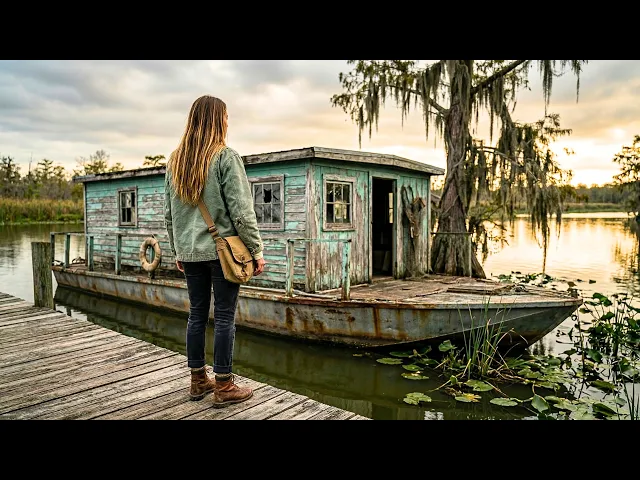
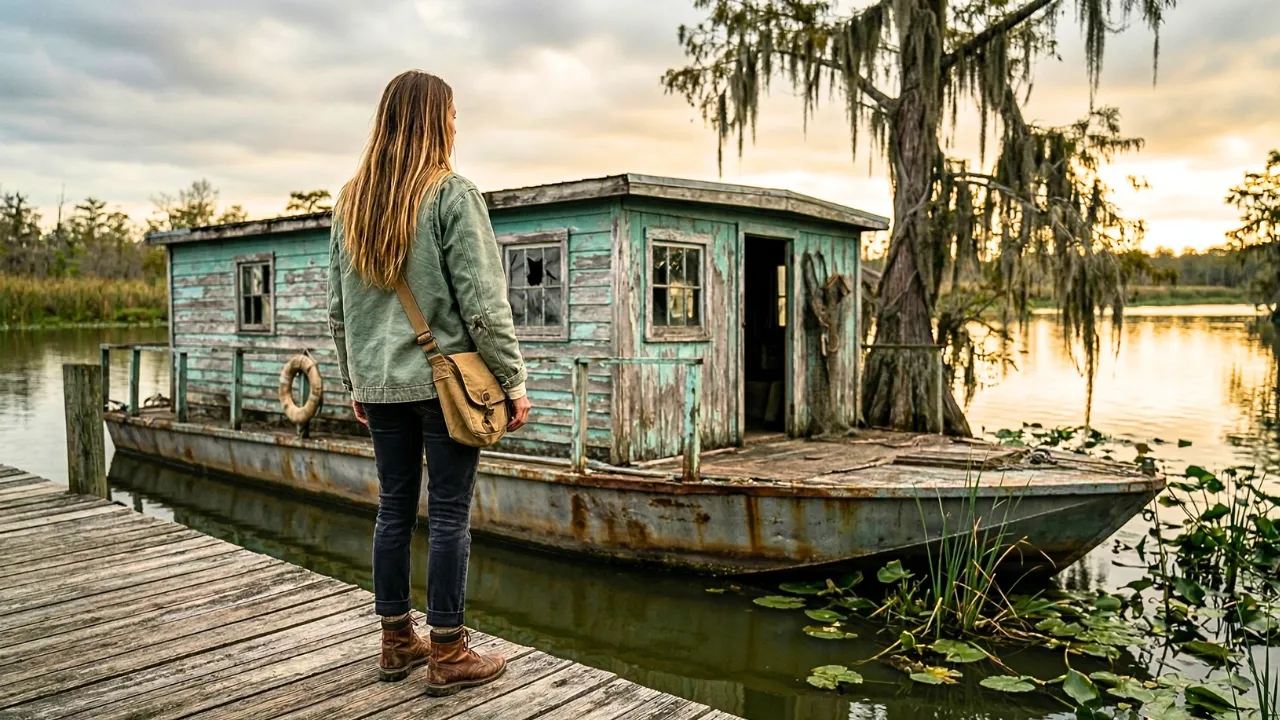
She was 19 and homeless. No family she could go back to, no money in the bank, just a backpack and $10 she'd been saving in a coffee can. And with that $10, she bought a rusted housebo tied to a forgotten dock on a backwater inlet in southern Louisiana.
The hull leaked. The cabin walls were rotting. The marina owner said she'd be lucky if it stayed afloat for a month.
But what nobody knew was that below the deck of that old houseboat, hidden in a compartment that hadn't been opened in over 40 years, was something that would change her life forever. Before we continue, if stories like this mean something to you, hit subscribe and tell us in the comments where you're watching from. We love seeing how far these stories travel.
June Prescott had been moving toward water her whole life without knowing it. She was born in a small town in central Mississippi, the kind of place where the nearest body of water was a muddy farm pond and the nearest river was 40 mi away, but she had been drawing pictures of boats since she was old enough to hold a crayon. Her mother saved them in a folder in the kitchen drawer.
Crayon boats, marker boats, pencil sketches of boats with crooked masts and stick figure sailors. By the time she was nine, the folder was an inch thick. Her mother died when June was 11.
Brain aneurysm. One Tuesday, she was making dinner. By Thursday, she was gone.
June's father, a quiet man named Cal, who worked maintenance at the high school, did his best, which was a phrase that everyone in town used about him with a kind of sympathetic resignation. He did his best. He showed up to school events.
He packed her lunches. He never raised his voice. But after his wife died, something inside him stopped.
Not all at once, but gradually, the way a fire stops, ember by ember until what's left is gray and cold. By the time June was 17, her father was a shell. He still worked at the school.
He still came home and ate dinner and watched the news, but he was no longer reachable. June would talk to him and he would nod and answer in single syllables and look past her at something only he could see. She stopped trying to reach him.
It hurt less to stop than to keep failing. She got a job at 16 at a small marine supply store outside of Jackson, an hour from her town. She had to ride the bus to get there.
The store sold boat parts, fishing gear, life jackets, rope, the kind of stuff that smelled like saltwater, even though the nearest saltwater was 200 m south. The owner, an older man named Thaad, who had been a Coast Guard rescue swimmer in his 20s, took an interest in June, not because he felt sorry for her, but because she actually wanted to learn. She memorized the parts cataloges.
She learned the difference between marine epoxy and regular epoxy. She learned what a stuffing box was, what a billagege pump did, why fiberglass needed gel coat. She learned that ropes were called lines on a boat, and that everything had a specific name, and that the names mattered because in an emergency, you didn't have time to point.
Thaad taught her things her father couldn't teach her. He taught her to splice a line, to read a tide chart, to identify a boat by its hull design. He taught her that a boat is a system and a system can be fixed if you understand how it works.
And understanding how a system works is the most useful skill a person can have because everything in life is a system. Houses, cars, people, weather, money. If you can see the system, you can fix the system.
If you can't see it, you're at its mercy. June saved every dollar she could from her marine supply paycheck. She kept the money in a coffee can in the back of her closet, an old folders can that still smelled faintly of grounds, even though she had cleaned it.
By the time she was 18, she had $880. By the time she was 19, she had $1,140. Her father died on her 19th birthday.
Heart attack. He was sitting in his recliner watching the evening news. June found him when she came in from work.
The television was still on. He looked peaceful, which was a strange thing to feel grateful for, but she felt it anyway. He hadn't suffered.
He had just stopped the way she had been watching him stop for 8 years, except now it was final. The house wasn't hers. It had been rented from a man named Berkeley who owned three houses in town and rented them to people who would pay on time and not complain.
After the funeral, Berkeley gave June 2 weeks. He wasn't unkind about it. He had a daughter of his own who needed the house, he said, and the rent was paid through the end of the month, and that was the best he could do.
June nodded. She had been expecting it. She packed her father's things into boxes for goodwill, kept his old wool fishing sweater and a framed photograph of her mother and him from 1998, and put the rest of her own life into a backpack and a duffel bag.
On the morning the lease ended, she walked out of the house with her bags and her coffee can and stood on the porch and looked at the door for a long moment before she pulled it closed. The bus to Jackson left at 9:15. The bus from Jackson to Baton Rouge left at 11:40.
June had been thinking about Louisiana for months. Thad had a brother who ran a marine repair shop on the bayou outside of Huma, and that had said more than once that if June ever wanted to learn boats from the inside out, his brother would teach her. She hadn't planned to take him up on it.
But standing in the bus station in Jackson with everything she owned in two bags and $1,128 left in the coffee can, she realized she had nothing else to plan toward. She bought the ticket. The ride south was long.
Mississippi rolled into Louisiana as the land flattened and the air grew thick and wet. The trees changed, oaks giving way to cypress and tupelo, their roots standing in dark water like the legs of patient animals. Spanish moss hung from the branches in long gray curtains.
June watched it all through the bus window with the kind of attention she gave to anything she was trying to memorize. This was a place she had never been but had always somehow known about. The way you know the shape of a word in a language you don't speak.
She arrived in Huma at dusk. The bus station was a small concrete building beside a gas station. And Thaad's brother, a man named Walker, who looked exactly like Thaad, but with a beard, was waiting for her in a dented Ford F2.
He didn't say much on the drive to his shop. He drove with one hand on the wheel and one elbow out the window and let the warm, wet evening air do most of the talking. The shop was on a backwater inlet about 10 mi outside of town, an open-sided wooden building with a corrugated metal roof, and a small dock that extended into the dark water.
A handful of boats were tied along the dock, a fishing skiff, a cabin cruiser with weed streaked sides, an aluminum johnboat, and at the end of the dock, listing slightly to port, was an old housebo. Walker pointed at it. That's what I wanted to show you.
Old Tilden Budro's place. He died last year. No family.
That said, you might be looking for something. June walked down the dock to look at it. The housebo was about 30 ft long.
The hall was steel, painted white originally, now mostly rust with patches of bare metal showing through. The cabin sat on top of the hole, a flat roofed wooden structure with peeling turquoise paint. Two small windows ran along each side.
A weathered wooden door faced the dock. An old life ring hung crooked on the railing. The rope rotted but still attached.
The whole thing sat low in the water, weighted with whatever was inside it and whatever water had seeped in through the hull over the years. But she could see the lines. She could see what the boat had been.
The hall was steel, which meant it could be patched, sanded, painted. The cabin was wood, which meant it could be replaced board by board if necessary. The shape was good, low, and stable, designed for slow water, for floating, not racing.
It was the kind of boat that didn't need to go anywhere because it was already where it was supposed to be. How much? June asked.
Walker scratched his beard. Tilden owed back fees on the slip. Marina was going to sell it for scrap, but I told him I'd hold it.
The fees come to $10 even. You want it? It's yours.
$10. June took out her coffee can. She counted 10 $1 bills onto Walker's open palm.
He looked at the money, looked at her, and nodded slowly. "You know how to a seam? " he asked.
"Yes. " "You know how to mix marine epoxy? " "Yes.
" You know what to do if you find a hole breach below the water line. Pump the BGE, identify the source, patch from outside if you can, from inside if you can't, with thickened epoxy and a wood backer. Walker smiled for the first time.
Thad said, "You knew your stuff. I didn't believe him. " He handed her a key.
Sleep on it tonight. We'll start in the morning. June stepped onto the housebo that evening with the sun going down behind the cypress trees and the bayou turning a hundred shades of orange and gold.
The deck creaked but held. She unlocked the cabin door and pushed it open. Inside was a single small room, maybe 10 ft x 12.
There was a built-in bunk along one wall, the mattress rotted and stained, a small galley with a propane stove that had corroded to uselessness. a table and two folding chairs, a few cabinets along the walls, mostly empty, the wood swollen from years of humidity. The air inside smelled like mildew and old fabric and the faint sweet rot that water-damaged wood gets after enough years.
It was a rack, but it was floating and it was hers. June set her bags on the table and stood in the middle of the cabin and turned slowly. She could feel the boat moving slightly under her feet, a gentle rocking from the small wake of a fish jumping outside.
The walls were close. The ceiling was low. The light coming through the small windows was dim and green gold and watery.
The color of light filtered through bayou water and Spanish moss. Something about it felt right. She couldn't explain it.
Maybe it was the rocking, the way the floor moved like something alive. Maybe it was the smallalness, the containedness, the way every surface was within arms reach. Maybe it was just that this was her first boat.
After years of drawing boats and stocking boat parts and reading boat manuals at the dinner table while her father stared at the news, whatever it was, June felt it the way you feel a key turn in a lock that you didn't know was there. She slept on the floor that first night in her sleeping bag, the rotted mattress pushed against the wall. The bayou outside was alive with sounds she'd never heard before.
Frogs in chorus, owls calling from the cypresses, the slow lap of water against the steel hull, a splash that might have been a fish or might have been an alligator. She lay awake for a long time listening, and at some point she stopped feeling afraid and started feeling held. The next morning, Walker came at 6:00 a.
m. with two cups of coffee and a bag of beignes from a place down the road. They sat on the dock and ate and talked about what needed to happen.
The list was long. The hole needed patching, sanding, and repainting. The cabin needed gutting and rebuilding.
The plumbing was non-existent. The electrical was suspect. The propane system was a fire hazard.
The billagege pump was seized. "It's a six-month job if you do it right," Walker said. "Maybe longer.
You can stay on her while you work, but it's going to be rough. " June nodded. "I can do rough.
" She started that day with the BGE. The BGE is the lowest part of a boat, the space below the floor where water collects and where things get stored and where, if you're not careful, mold and rot and mystery accumulate. She lifted the hatch in the cabin floor and looked down.
The BGE was full of dark water about 6 in deep. She bailed it out with a coffee can and a bucket, scooping the water and dumping it overboard, working in cramped quarters with her back bent. It took 2 hours.
When the water was out, she shined her flashlight into the BGE and saw what was on the bottom. A wooden foot locker. It was old, the kind of foot locker that soldiers used to take to war.
Brass corners, leather straps, a heavy padlock. It was sitting on a wooden platform that had been built up from the bottom of the BGE to keep it above the water line. Whoever had put it there had cared about keeping it dry.
The platform was rotted now, the wood soft, but the foot locker itself looked intact. The brass was tarnished but solid. The leather straps were dry.
The padlock was rusted shut. June stared at it for a long moment. Then she climbed out of the BGE and went to find Walker.
He came back with her. He looked down at the foot locker. He looked at June.
He scratched his beard. Tilden was an interesting man, he said. Did three tours in Vietnam.
Came home and lived on this boat for the next 40 years. Never married. Worked as a mechanic in Huma.
Saved everything. Spent almost nothing. People used to wonder where his money went.
Nobody ever asked because Tilden wasn't the kind of man you ask things. He paused. I think we just figured out where it went.
They lifted the foot locker out of the BGE together. It was heavy. Surprisingly heavy the way old wooden chests are when they're full of metal.
They set it on the deck and Walker handed June a hacksaw. "It's your boat," he said. "You should be the one.
" June cut through the rusted padlock. The lock fell to the deck with a dull metallic thud. She unbuckled the leather straps.
She lifted the lid. Inside, wrapped in oil cloth, were rows of small canvas bags. Each one was tied with a piece of twine and labeled with a date written in faded ink on a paper tag.
The earliest date was 1979. The latest was 2018, the year before Tildon died. 40 years of bags.
June lifted one. It was heavy. She untied the twine and opened the bag.
Coins, old silver coins, walking liberty half dollars and Morgan silver dollars and Mercury dimes. Dozens of them packed tightly inside the canvas. She lifted another bag.
More coins, a third. This one held paper money instead. Old bills folded in half and held with a rubber band.
A fourth held a mixture. A fifth held only dimes. A sixth held only quarters.
There were 43 bags in the foot locker, one for each year between 1979 and 2018, except for 1985 and 1992, which were missing. Each bag held what Tilden had been able to save that year. Some years were heavier than others.
The bag from 1981 was almost empty. The bag from 2003 was so full the seams strained. June counted everything.
It took 2 days. Walker helped her with the coin appraisals. He knew a coin dealer in Tibido who came out and looked at the silver content and gave her honest numbers.
The total in coins and bills together came to $48,200. At the bottom of the foot locker, beneath the last canvas bag, was a folded American flag and a sealed envelope. The envelope was addressed in spidery handwriting.
To whoever finds this June opened it and read, "My name is Tilden Budro. I was born in Coco, Louisiana in 1948. I served in the United States Marines from 1966 to 1972.
I came home with a headful of things I couldn't put down. And the only place I could put them down was on this boat on this water where it was quiet enough to think and small enough to handle. I bought this boat in 1979 for $400, and I have lived on it ever since.
Every year I saved what I could in a bag with that year written on it. I do not have family. The men I served with are mostly gone.
There is no one to leave this to. So, I am leaving it to whoever finds it. If you found this foot locker, you came onto my boat for a reason.
Maybe you needed a place to be. Maybe you were trying to build something. Maybe you were just lost.
I was all of those things once. I hope this helps. The boat is a good one.
She has carried me a long way without ever moving from her slip. Some boats are like that. Some lives are like that.
Take care of her. Tilden Budro, May 2018. June read the letter twice.
Then she folded it carefully and put it back in the envelope and sat on the deck of the houseboat with the morning sun coming up over the bayou and the cypresses casting long shadows on the water. She didn't cry, but her throat was tight, and she thought about her mother and her father and Tilden Budro and everyone she had ever loved and lost. And she understood for the first time in her life that being lost and being found were not opposites.
They were the same thing, just at different times. If you're enjoying this story, take a second and subscribe. It helps us keep making stories like this one.
and tell us in the comments, have you ever found something on the water that changed how you saw your own life? Walker helped her open a bank account in Huma. The next day, he drove her in the dented F250 and waited in the parking lot while she went inside with the canvas bags in a paper grocery sack.
The teller was a young woman about June's age, who took one look at the contents and called for the manager. The manager, a Cajun woman in her 50s named Theres, looked at June carefully and asked if she could explain. June showed her Tilden's letter.
Theres read it slowly, her finger moving across the lines, and then she handed it back and said, "You take care of that boat share. " Tilden was a good man. June used part of the money to do the work right.
She rebuilt the houseboat over the next eight months, working alongside Walker in his shop, learning everything she could about hull repair and marine carpentry and electrical systems. The hull came first. They hauled the boat out of the water using a winch system Walker had built years ago, sliding it slowly up onto a set of heavy wooden blocks in the yard behind his shop.
Out of the water, the housebo looked even worse than June had expected. The hall was pitted with rust along the entire water line, and below the water line she could see two places where the steel had been patched once before decades ago, with what looked like sheet metal screwed in place. Whoever had done it had done a quick job.
The patches were still holding, but barely. She sanded the entire hall down to bare metal, working with a power sander hour after hour, her arms shaking by the end of each day. The work was loud and dirty, and her ears rang at night, even with foam plugs, and her shoulders achd so badly she could barely raise them above her head when she got into her sleeping bag at the end of the day.
But she kept going. Day by day, the rust came off, and the bare steel appeared underneath, dull silver in the morning light, warming to bronze when the afternoon sun hit it. By the end of the second week, the hull was clean.
Then she ground out the rust spots with a wire brush attachment, treated them with phosphoric acid to convert any remaining rust to inert iron phosphate, and applied marine epoxy to the worst sections, building up the metal with thickened resin layer by layer. Walker showed her how to feather the edges so the patches would flow smoothly into the surrounding steel. He showed her how to mix the epoxy to the right consistency.
Not too thin, not too thick. The way you mix peanut butter and jelly for a sandwich, he said, until it stays where you put it. She did the bow first because the bow was the worst.
And when she got it right, she did the rest the same way. She sealed everything with two coats of epoxy primer, white, gray, and dense, the kind that bonds to steel like skin. Then three coats of marine enamel in a deep dark blue that Walker said reminded him of the Gulf at midnight.
The color came from a paint mixer at a marine supply in Huma, who had been blending custom marine paints for 30 years, and who took one look at June and said, "I know exactly what color you want. Hold on. " He came back with a quart of dark blue so deep it looked almost black.
And when June painted the first stripe on the bear hull and stepped back, she knew he was right. It was the color of water at night, the color of sleep without dreams, the color of safety. When the hull was done, it looked like a different boat.
It looked like a boat that wanted to live. Walker stood beside her in the yard the day she finished the third coat and said, "I have been working on boats for 35 years, and I have never seen a firsttime hull job that good. " He didn't say anything else.
He didn't need to. The cabin was next. She gutted it down to the steel frame of the deck, pulling out the rotted plywood walls in chunks, ripping out the corroded wiring, removing the broken propane stove with a wrench and a lot of swearing.
She filled three trash bags with mildewed insulation and old fabric and the carcasses of dead spiders. When the cabin was empty, the steel deck and the frame stood bare in the bayou sun, and she could see the bones of what she was rebuilding. She rebuilt the walls with marine plywood and cedar siding, insulating between the studs with closed cell foam, and adding two new windows on each side, larger ones, so the cabin would fill with light.
She rebuilt the roof with marine plywood, rolled roofing material, and a small skylight in the center that let a beam of sun fall directly onto the table she was going to build. She tore out the corroded propane stove and installed a new one, properly vented, this time with a regulator and a shutff valve and a CO detector mounted to the cabin ceiling above it. She replaced all the wiring with marine grade cable, color-coded the way Thaad had taught her, and added a solar panel on the roof connected to a battery bank in a sealed compartment beneath the bunk.
She installed a freshwater tank that held 30 g and a hand pump and a small composting toilet behind a curtain in the corner. Inside, she built furniture from cedar and pine, a built-in bench that doubled as storage, a dropleaf table that folded against the wall when not in use, a bed in the boo that fit her exactly with drawers underneath for clothes, bookshelves built into every available wall space because she was going to fill the boat with books, marine engineering manuals, field guides to buy you plants and birds, a complete set of Joseph Conrad, a worn paperback of Moby Dick that her mother had loved. She kept Tilden's foot locker.
She cleaned the brass corners, oiled the leather straps, and placed it under the bed where she could see it when she made the bed in the morning. She kept the folded American flag and the letter inside, along with one bag from 1979, the year Tilden had bought the boat. The bag was empty now, but she liked having it there, a reminder of where everything had started.
By the eighth month, the houseboat was something extraordinary. From the outside, it looked like a different vessel. The deep midnight blue hull, the rebuilt cedar cabin, the gleaming new fittings, but the bones were the same.
It was still Tilden's boat, still the same shape, the same slip, the same low, steady float on the bayou water. June had not transformed it. She had restored it.
There is a difference, and the difference matters. The people of the bayou started to know her. Walker introduced her to fishermen and shrimpers and swamp guides who pass through his shop.
They were curious at first, then friendly, then matterof fact, the way people are when they decide you belong. The bayou had its own pace and its own customs. And you didn't get welcomed in by being loud or asking questions.
You got welcomed by showing up consistently and doing your work and not making a fuss. June was very good at all three of those things. A woman named Adelaide, who ran a small cinjun restaurant in town, started bringing her gumbo in mason jars every Friday.
She would drive out to Walker's shop in a pickup truck with a cooler in the bed, hand June a jar warm from the cooler, and refuse to take any money for it. You eat that tonight, share, she would say. You need real food.
You're too thin. Adelaide had been Tilden Budau's friend, the only person in town he had let close. And June understood without asking that the gumbo was a way of keeping a promise that Adelaide had made to Tilden a long time ago.
A man named Buddy, who fished crawfish for a living, taught her how to set traps in the shallow water near her dock. He showed her how to bait them with chicken necks, where to position them along the bank, how to check them at dawn before the herand got to them. Within a month, June had a steady supply of crawfish, which she boiled in a big pot on her propane stove with cayenne and lemon and beer Walker sometimes gave her, and she ate them, sitting on the deck of the housebo, watching the sun come up over the cypresses.
A retired tugboat captain named Pelum, who was in his 80s and had known Tilden since they were boys in Coco, came down to the dock one Sunday afternoon and stood looking at the housebo for a long time before he said he'd be happy. Tilden would be happy. He always said this boat had more in her than people gave her credit for.
Same way he felt about himself, I expect. Pelum came back a few times after that. He didn't talk much.
He would sit on the dock with June and watch the water and tell her things about Tildon when the moment seemed right. About the war Tilden didn't talk about. About the woman Tilden had loved before Vietnam who didn't wait for him to come back.
About the dog Tilden had named Doofen, who lived on the boat with him for 14 years and was buried in the Cypress Grove behind the marina. June listened to all of it. She wrote some of it down in a small notebook she kept in the drawer beneath her bed beside the empty 1979 canvas bag and Tilden's letter.
She felt like she was building a record of someone she had never met. The way you might piece together a portrait from fragments, a story here, a photograph there, an empty bag with a date written on it. By the time June had been in Huma for 6 months, she felt like she knew Tilden Budro better than she had known her own father.
June started working part-time at Walker's shop in exchange for slip fees and shop access. She was good at the work and she learned fast and she didn't talk much, which Walker said was the best combination he'd ever found in an employee. Within a year, she was rebuilding outboard engines on her own, replacing fuel lines and impellers and ignition coils, troubleshooting electrical problems by following the wiring with a flashlight and a multimeter the way Thaad had taught her.
Customers started asking for her by name. The young woman at Walker's place. She knows her stuff.
One evening in late May, June sat on the deck of her housebo and watched the sun go down over the bayou. The cypress trees were silhouetted against the sky. Spanish moss moved in the warm breeze.
The water was glass flat and reflected the sky so perfectly it looked like the boat was floating in the air. A heron stood on one leg in the shallows about 30 ft away, motionless, waiting for a fish that probably wasn't coming. June watched the heron and the heron eventually watched her back.
They studied each other for a while in the way that only solitary creatures can. She thought about Tilden Budro, a man who came home from a war he never talked about and bought a boat for $400 and lived on it for 40 years. A man who saved silver coins and folded bills into canvas bags labeled by year, building up a record of his life, one quiet deposit at a time.
A man who had no family and no one to leave anything to, and who had still left a letter for whoever might come, because some part of him had refused to let it all disappear into nothing. She thought about her father, a man who had stopped ember by ember after his wife died. about her mother who had saved crayon drawings of boats in a kitchen drawer because she had recognized something in her daughter long before her daughter had recognized it in herself.
About Thaad and Walker, two brothers who had taken her seriously when most people had taken her for a quiet kid who didn't know what she wanted. But she had known. She had always known.
She had drawn boats since she was old enough to hold a crayon. She had stocked boat parts. She had memorized cataloges.
She had ridden a bus an hour each way to work at a marine supply store in Mississippi, where the nearest saltwater was 200 m south. She had been moving toward water her entire life. And now here she was sitting on the deck of her own housebo in the bayou with a dark blue hull and a cedar cabin and an empty 1979 canvas bag in a foot locker beneath her bed.
That's the thing about the directions our lives are pulled in. We don't always know where we're going. We can't always explain why we want what we want.
But the pull is real and it's old. And if you listen to it long enough, it usually leads you somewhere. For some people, that somewhere is a place they were born to, a family business, a hometown, a profession their parents chose for them.
For others, it's a place they have to invent. A boat on a bayou, a mill on a creek, a schoolhouse in the woods, a lighthouse on a cliff, a church on a dirt road in Georgia. The form doesn't matter.
What matters is whether you can stand inside it, look around, and feel something settle in your chest. Something that says this, this is the place. This is where I begin.
June Prescott was 19 years old and homeless. She had $10 to her name. and she spent it on a rusted houseboat on a bayou in southern Louisiana.
It was the best $10 she ever spent. If this story moved you, subscribe to the channel and share it with someone who needs to hear it. And tell us in the comments what's a place you've been pulled toward your whole life.
We'd love to hear your story. See you in the next one.