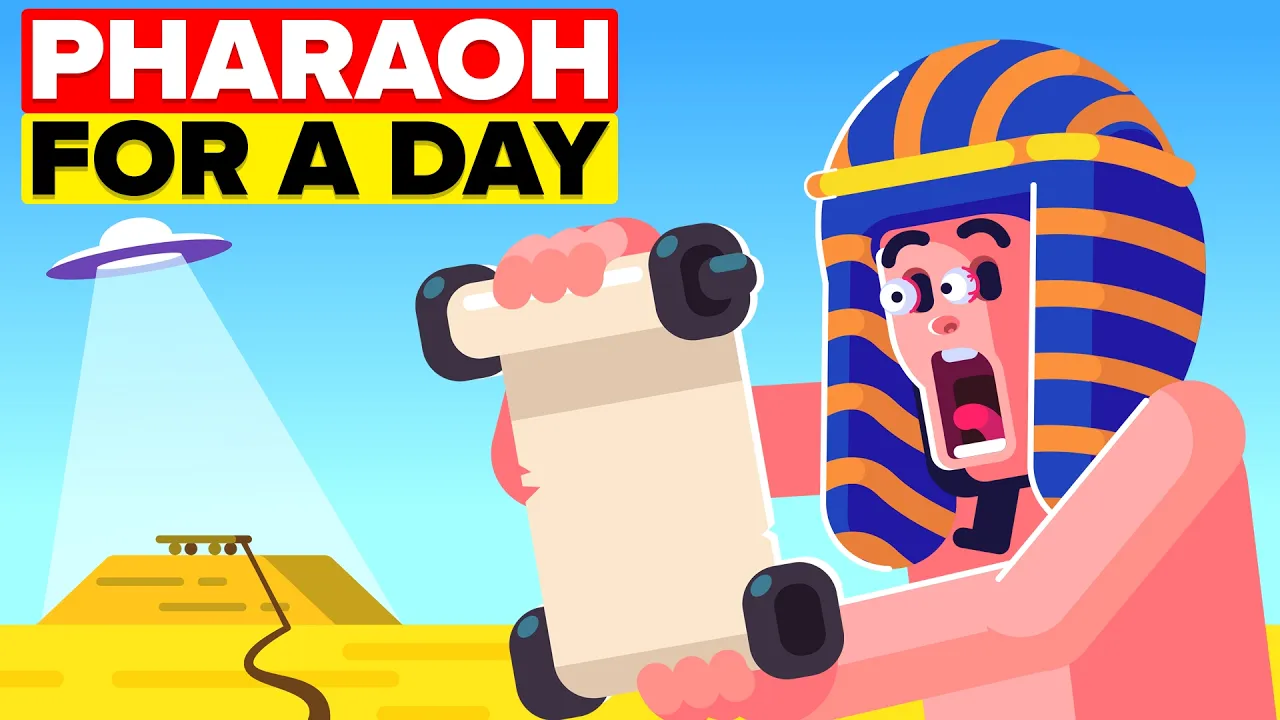
The golden morning sun streams through your window, casting a warm glow over your chamber. A gentle breeze causes the linen curtains to sway gracefully. Outside, your kingdom thrives- laborers toil tirelessly, chipping away at stone blocks to immortalize your image in history.
The river teems with life, its waters the lifeblood of your civilization. Your servants approach, delicately placing a new gold chain around your neck and adorning your head with an ornate headdress that glimmers in the sun's rays. You gaze upon your domain and think, “It’s good to be Pharaoh!
” Or is it? Because anyone who says otherwise is clearly living in “da Nile. ” Join us on today’s episode of The Infographics Show as we walk you through a Day in the Life of an Ancient Egyptian pharaoh.
It’s no surprise that the men and women who rose to the position of pharaoh in Ancient Egypt enjoyed a level of wealth unimaginable to their subjects. But while their lives may have glittered with gold, boredom was the least of their worries. Sure, life as a pharaoh wasn’t as grueling as the backbreaking toil of the workers who built Egypt’s iconic pyramids.
Yet, being perched at the top of society’s pyramid came with its own set of intense pressures and obligations. For all the lavish feasts and treasures they had at their disposal, a flexible social calendar was not one of them. Every hour of a pharaoh’s day was meticulously planned, leaving little room for spontaneity or personal freedom.
And let’s not forget the endless political schemes and ceremonial duties that demanded their constant attention. Disappointing as it sounds, being a pharaoh is an around the clock, twenty four hours a day, seven days a week, type of gig for you. The moment your royal eyes blink open, it’s go time!
Your kingdom needs you, and it waits for no one- not even a living god. Your day typically begins with a regal wake-up call from your loyal and obedient servants, particularly your personal attendants. No alarms or snooze buttons here- just reverent whispers and the sound of sandals shuffling across stone floors.
It certainly beats your mom yelling at you to get up for Pharaoh school. From there, you dive headfirst into the first of your many regal responsibilities: sifting through letters and dispatches from across your vast kingdom. Yes, even pharaohs couldn’t escape the tyranny of paperwork- or rather, papyrus work.
And just like today’s inbox overload, the scrolls keep piling up, each one demanding your divine attention. Important military updates, tax records, disputes over land… it’s enough to make you wonder if being a living god came with a decent assistant. Now, it’s time to get dressed and make an obligation that leans more towards the spiritual.
It’s easy to forget, with all the grandeur of palaces and the looming specter of mummification, that being a pharaoh isn’t just about ruling a kingdom. You’re also Egypt’s most important religious figure- the earthly bridge between gods and mortals. Every move you make carries spiritual weight.
It’s up to you to ensure the gods remain pleased and your kingdom stays blessed. Each morning begins with prayers and incantations, chanted in solemn tones to prepare you for yet another busy day of maintaining the cosmic order of the universe. Or at least, that’s what your high priests tell you.
They insist that every offering and ritual you perform has a direct impact on the balance of the world. No pressure, right? The dawn of each new day isn’t just another sunrise—it’s a celestial event, a moment signifying the natural renewal of life and the continuation of your divine mission as Egypt’s ruler.
Your people depend on you to maintain harmony and balance with the gods. Needless to say, waking up on the wrong side of the bed wouldn’t just ruin your day- it could spell disaster for the entire kingdom. Let’s face it, no one likes a grumpy Pharaoh.
Having started your day- and the cycle of natural renewal- on the right foot, you’re ready to embrace the immense responsibilities ahead. Governance, spirituality, and diplomacy will dominate your hours, each decision weighing heavily on the lives of your subjects and the stability of your kingdom. But first, have you ever had a brilliant idea for a video but felt stuck because you didn’t know where to start?
Meet Invideo AI V3, the tool that'll help you communicate your ideas irrespective of what skill level you're at. Unlike traditional tools that can feel overwhelming, Invideo AI puts you in the director’s seat, making the entire video creation process seamless while it does the heavy-lifting. Just type in your idea, whether it’s a recipe, a commercial, or even a trailer for a movie that doesn’t exist, and watch as Invideo AI transforms it into a full-length video.
With text-based commands, you can customize every detail. Want to add a voiceover or change the language? Just type it in.
You can even clone your own voice for narration! Invideo AI isn’t just a tool, it’s your creative partner, and you can try it right now for free, saving you hundreds of dollars on editing and stock footage. So, what are you waiting for?
Click the link in the description to bring your ideas to life with Invideo AI V3. The first of your judicial duties awaits shortly after your attendants have dressed and prepared you for the day. Today’s look?
A bold and sassy headdress that screams authority. With your morning rituals complete, it’s time to step into the royal court and face the administrative maze of governing a kingdom. From settling disputes to issuing decrees, every word you speak carries the weight of the gods themselves.
Today’s agenda is packed. You’ll administer justice, enforce taxation, and decide how to allocate resources to the far reaches of your empire. Yes, even Ancient Egypt had to grapple with economics- it’s as eternal as the pyramids themselves.
Fortunately, you’re not left to navigate the layers of bureaucracy on your own. After all, anyone who claims it’s easy to manage a complex administration solo probably shouldn’t be trusted to govern. While your word remains absolute, you’re supported by a trusted entourage of high-ranking officials, scribes, and advisers dedicated to helping you shape the destiny of your kingdom.
Of course, these individuals enjoy greater influence than the average citizen, but any aspirations for political power beyond their station? Those must remain buried deep. After all, you’re the one with supreme authority, bestowed by the gods themselves.
Any whispers of defiance wouldn’t just threaten your rule—they would challenge the very divine order of the universe. These monotonous political duties weren’t just a morning chore, they are merely the beginning of your day. Your role as ruler isn’t limited to managing Egypt’s internal affairs- you’re also responsible for maintaining delicate relations with foreign kingdoms, provinces, and neighboring countries.
Sometimes, you’ll hold audiences with ambassadors and dignitaries from distant lands, or meet with provincial governors to smooth over tensions and ensure the stability of your realm. Within the lavish chambers of your palace, you spend countless hours in delicate negotiations, forming crucial alliances, making strategic decisions, and ultimately shaping the very destiny of Egypt. It’s all in a day’s work for a Pharaoh.
Ancient Egypt’s influence extended far beyond its borders, including numerous vassal states like Nuhašše, Qatna, and Ugarit. These states are governed by their own rulers but are bound by a mutual obligation to their superior power- your kingdom. These vassal states have complex and delicate relationships with you.
While their loyalty is crucial to maintaining Egypt’s stability, it comes at a price- frequent requests for resources, protection, or intervention. And as Pharaoh, it’s your duty to grant these requests- a necessary investment to keep their allegiance and secure your empire’s influence. If you think that’s all the work you’ve got for the day, and you can spend the rest of your time lounging around, being fanned, and fed grapes, think again!
Even suggesting such a thing might border on heresy under Ancient Egyptian law. But that’s not a problem for you- after all, you’re not just Pharaoh. You’re also the supreme lawgiver of the land.
Most of the time, this means administrative tasks like enacting new decrees and regulations. However, in more extreme cases, you might find yourself presiding over criminal trials, ensuring justice is served with divine authority. Presiding over criminal cases is reserved for the gravest offenses- acts of treason against the kingdom, or worse, against you.
Your judgement is anything but lenient. Every verdict you pass carries the weight of divine authority, thanks to your direct line to the gods. Nobles and commoners alike fear and respect your rulings without question.
A guilty verdict from you isn’t just a legal sentence. It’s as if the accused has been struck down by the judgement of Ma’at herself, the goddess of law and order. As Pharaoh, your supreme power over the law gives you the ability to grant pardons or impose severe punishments.
Whether you choose exile, corporal punishment, or even execution, your decision is final. Your word is both earthly command and divine decree. But what happens when war comes knocking on the doors of your glorious kingdom?
Suddenly, most of the stately affairs you oversee take a backseat. Great for clearing up your schedule- bad because, well… there’s a war happening. As the ultimate, divinely appointed ruler, you aren’t just the face of your kingdom- you’re also its military commander.
When conflict arises, it’s your duty to deploy and lead your armies. You need to make the tactical decisions that could mean the difference between defending your kingdom or expanding it into new territories. Every move you make on the battlefield doesn’t just shape the fate of your people- it defines your legacy as Pharaoh.
Will you be remembered as the valiant defender of Egypt’s glory, or as the visionary ruler who led the kingdom to unprecedented heights of conquest? When war rages, it’s not uncommon for you to leave the opulence of your palace behind and personally lead your armies into battle. Instead of presiding over courtly and administrative duties, you’ll be out in the field, marching with your troops, weapon in hand.
Your presence isn’t just symbolic- it’s a demonstration of your bravery and prowess as a warrior. Standing shoulder to shoulder with your soldiers, you inspire their loyalty and courage, while reminding Egypt’s enemies that their Pharaoh isn’t merely a political figure. You are a military leader, a force to be reckoned with, whose very appearance on the battlefield can turn the tide of war.
During wartime, you’ll find yourself surrounded by your generals and trusted military advisors, working together to devise strategies, issue commands, and coordinate the movements of your troops. From small tactical decisions to planning lengthy campaigns, every call ultimately rests with you. If you manage to carve out some extra time between strategizing and commanding, you might even choose to oversee the training of your forces.
Watching your soldiers prepare for battle under your watchful eye ensures they’re ready to face the challenges that lie ahead. But what else happens during your day outside of war time. Well, as you’ve probably already gathered, religion is deeply entwined with the governance of Ancient Egypt.
A large portion of your daily life is dedicated to engaging in religious rituals and worshipping the gods. Venerating the gods is your foremost religious duty, requiring you to lead daily prayers and perform ceremonial offerings. These sacred acts take place in the inner sanctums of the grand temples, spaces reserved for the divine and their earthly representative- you.
You have to display your unwavering devotions, seeking divine guidance and favour – and not just from the gods. Performing religious rituals is a good look to the nobility, as well as to your subjects. It wasn’t just these daily rituals that are part of your daily schedule either.
Depending on the time of year, you might have to devote even more of your time to official ceremonies. One of the most significant ceremonies is the Sed festival, a religious event that literally couldn’t go ahead without you. It is a grand jubilee that celebrates your 30 year reign.
It reaffirms your connection to the gods and your legitimacy to hold the throne. It involves various processions, feasts and elaborate rituals in celebration of your authority. Once your religious duties are complete, your day is far from over.
You still have to oversee the latest construction projects or manage the renovation of temples and your magnificent palaces. Temples, in particular, demand your full attention. After all, they’re not just buildings, they’re sacred spaces dedicated to the gods and goddesses of the Ancient Egyptian Ennead.
Ensuring these structures are built to the highest standards is critical, not only to honor the divine but also to secure your legacy. Take inspiration from one of your illustrious ancestors, Pharaoh Ramesses II. During his reign , Ramesses commissioned and oversaw the construction of two breathtaking temples at Abu Simbel.
The larger temple was a monument to the gods Amun-Ra, Ptah, and Ra-Horakhty, adorned with four colossal statues of Ramesses himself, standing as eternal symbols of his greatness. The smaller temple was dedicated to the goddess Hathor and Queen Nefertari, Ramesses’ most beloved wife Mercifully, your schedule does allow for some leisure time, with room for rest and relaxation both between and after all the official duties, both stately and religious. Your downtime takes place in one of your many opulent palaces, where you can retreat to lush, meticulously maintained gardens.
Tended by your loyal servants, these gardens offer an escape from the relentless duties of rulership. Your ‘me time’ isn’t limited to lounging in the gardens- you also enjoy performances from musicians and dancers. On quieter evenings, you might gather your closest advisors and multiple wives for a board game night.
One of your favorites? Senet, a game fit for royalty and one of the oldest known board games in history. The game, played with ten or more pawns on a thirty-square board, is as much about strategy as it is about entertainment.
Even the great Pharaoh Amenhotep III was known to indulge. This doesn’t mean the day has to come screeching to a halt though. You’re a keen sportsman, and like to unwind by showing off your skills at various sports.
Like Ramesses II, you’re an accomplished charioteer, mastering the art of controlling a chariot with both speed and precision. Whether on the battlefield or the racetrack, you often take part in thrilling races to hone your abilities and assert your dominance. You’re also drawn to the thrill of the hunt, just like King Tutankhamun, whose tomb is adorned with striking depictions of him pursuing waterfowl, desert ibexes and even lions.
Speaking of tombs though, the preparation and preservation of bodies in Ancient Egypt is arguably one of the most fascinating parts of this historical culture. From mummification and the use of canopic jars containing organs, to their entire belief system about the afterlife. As Pharaoh, the meticulous preparations for your eventual death began many years ago.
Your tomb, the eternal resting place for your remains, is an architectural masterpiece that must be completed well before the day you pass into the afterlife. But building a tomb is only part of the story. Reflecting on your mortality isn’t a grim task- it’s a fundamental aspect of your life.
Preparing for death means ensuring your legacy, securing your passage to the afterlife. Each decision you make today echoes in eternity and prepares you for your ultimate journey. It’s not uncommon for you to attend rituals associated with death and the afterlife to prepare yourself for the inevitable.
These ceremonies aren’t simply symbolic. They’re an opportunity to secure your place among the gods and ensure your transition to the afterlife is seamless and blessed. Your immortal legacy ensures that even after you pass, the gods’ favor continues to shine upon Egypt, safeguarding its future.
The day is coming to an end, and as the sun begins to set, you retreat into the inner sanctum of your palace, for a few moments of solace and tranquillity. You seek the wisdom of your most trusted confidants, discussing matters of great importance and refining strategic plans that will soon be set into motion. Then, right before heading to sleep at the end of a busy day, you once again take part in further rituals, focusing on cleansing and purification.
This ensures a peaceful transition from the waking world to a night of peaceful dreams. Under symbols of protection and surrounded by guards keeping watch, you settle down to sleep. But tomorrow, it starts all over again.
If you could step into the sandals of a Pharaoh for one day, what would you focus on- expanding the kingdom, worshipping the gods, or just lounging in the palace gardens? Let us know in the comments below. Now go check out the Daily Life Of A North Korean or click on this video instead.