okay folks it's time to do it let's finally answer that question of do muscle fiber types change well I want to start by highlighting some really interesting initial work in this area so a famous study done in 1960 really clever what they did is they took motor units now to explain what that is briefly a motor unit is an alpha motor neuron and all the muscle fibers that it inates so in other words the nerve and how all the fibers that it activates and turns on so what he did is and it's important to sort
of know at the background here all of the muscles all the fibers in a motor unit are of the same fiber type so another way to think about that is the fiber type is determined by which type of neuron activates it okay so if it is a type one or a slow twitch neuron if you will all the fibers in that motor unit are going to be slow twitch fibers and if it's fast twitched going to be fast twitch fibers so what they did in this famous study is they came in and said okay we'll
take a slow uh neuron slow motor unit that has inter that normally inates and activates slow twitch fibers and we'll take some that are fast twitch and we'll cross them so what we'll do here is we'll cut the fast twitch neuron and attach it to the slow twitch fibers and we'll cut the slow twitch neuron and attach it to the fast twitch fibers and then we'll watch to see what happens well it turns out these slow twitch fibers that were attached now to the fast twitch neuron converted and turned themselves into the other into the
neuron fiber type and the same thing happened to the other one and so they converted so we've actually known since 1960 that there are physiological normative mechanisms that allow for muscle fiber types to change so in fact that's not ever really been the question at least not for the last 60 years or so we know that they can change the real question has been okay that's never going to happen in a human we're not going to cut a nerve and attach it to another one so we know mechanisms exist that or in fact we know
them now that are these Mo certain molecules called inats that are excreted from the neurons that actually cause the fiber typic change we've known it actually happens in in without cutting a nerve too so there's a phenomenon called fiber type grouping so normally as I mentioned not only are all the fibers in a motor unit of the same fiber type but they're not necessarily laying directly next to each other so if I have a say motor unit that has five muscle fibers in it those five fibers are not going to be laying directly next to
each other they're probably going to be spread out throughout the muscle this allows control of f motor movements well in pathological situations such as aging or certain diseases we get what we call fiber type grouping so what happens here is the neuron from for whatever reason dies off but the fibers are still viable and so the neighboring neurons are are essentially communicated with or made aware that the neuron is dead and so they grow new dendrites and reach out and attach and inate those previously uninnervated or the now uninnervated muscle fibers and if it happens
to grab say a say imagine it is a slow motor unit and it reaches out and grabs some no some new fast twitch motor fibers and brings it into its motor unit those fibers are then going to change into be slow so what happens here are images like this where normally you have this uh mix and matching of fast twitch slow twitch kind of everywhere spread out evenly throughout the muscle and what happens in the case of grouping is because so many neurons die out you get these big chunks of like fibers so you know
huge chunks of 20 or 30 or 50 fibers that are all the same fiber type in big bundles this is one of the things that leads to lock lack fine tune motor control or motor movement so not only do we know is it physiologically possible to change these fibers we also know that it happens under certain normal if you will certain situations it's not healthy but it is normal so really to clarify the question and I I actually will try not to get on too much of a tangent right here but this is a great
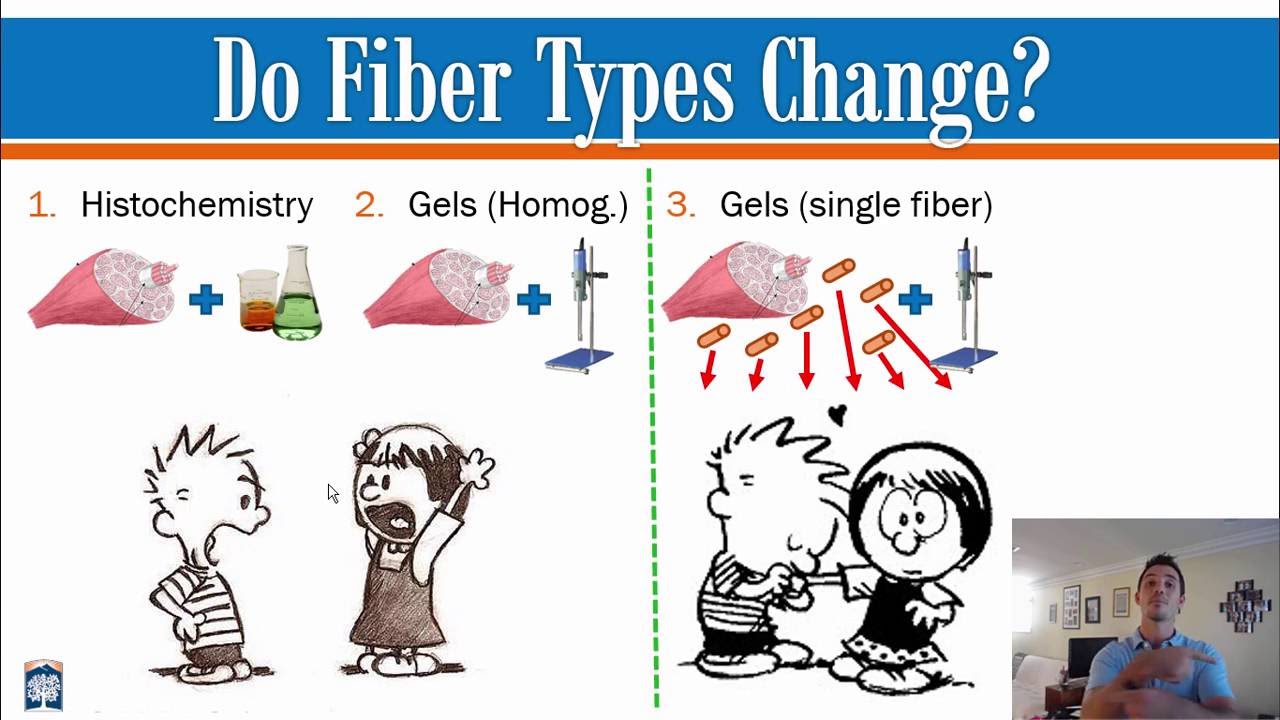
example of a lot of the miscommunication and Science and otherwise simply comes down to asking bad questions so the question of do fiber types change is a terrible question it's not even remotely debatable of course they change the more specific and question that people are generally trying to ask when they ask that is okay well do they change with different types of exercise training this actual question about the plasticity of fiber types with different types of exercise training has been actually around for a very long time in fact in ear early 19 early late 1960s
early 1970s a very famous physiologist muscle physiologist named Dr ederton came up with a beautiful study and he wanted to answer this question so he looked at the animal models and he used histo chemistry and he said okay what if I put these animals through some swim training and so I don't know if this is actually a picture of the actual study although obviously it's not but this is effectivly what happens in fact you could look elsewhere to figure out what it actually takes to swim train a mouse and it's not that great but nonetheless
so he did this first initial study in 1969 and said whether or not fiber types change which exercise train training and then he found essentially nothing so no change at all a couple of years later another extremely famous uh muscle physiologist um Dr gulnick came out with a study that said okay let's just simply compare athletically train people to non-athletic train to see if they have different fiber type profiles so what he's he what he did is is took sedentary individuals and compared their muscle at rest to uh endurance runt trained individuals and what he
found found was a significant difference in fact what he found is those that were highly endurance trrain had way more these slow twitch fibers keep one thing in mind though take a look at that image what do you automatically know about that image this is hiso chemistry right black white so although what this is very very important we have to keep in mind the limitations all this simply told us was one there was more slow twitch now than fast twitch it didn't give us any of that specificity and two we can't necessarily say whether this
was nature or ner because we don't know what either one of these people looked like so in other words the athletes could have simply been born with a more slow switch so they chose to engage in endurance activities because they're pre gentically exposed to being better at them but it was still an awesome paper an amazing study and Prov provided a lot of great information so being the phenomenal scientist Dr gck was he said let me follow that up and actually do a training study so in this time instead of comparing sedentary people to endurance
trained people let's take sedentary people and endurance train them and see what happens over time well unfortunately he found no change at all in either the type ones or the type twos again notice the terminology type type one two hist chemistry right in fact just to summarize a about a decade of research for you up to 1976 here's what we knew about this question number one there were definitely correlations between fiber type profile and perform performance we knew that those that had more slow fibers had better endurance and the inverse had actually been shown several
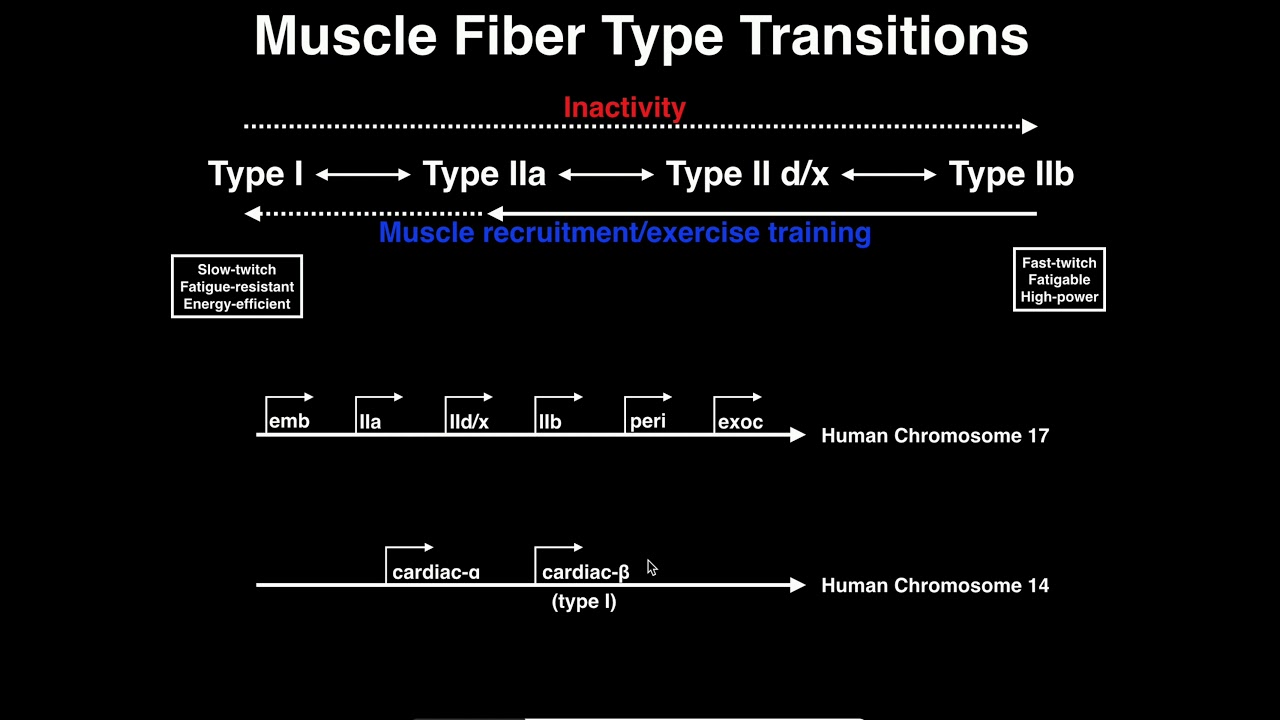
times as well those that were had more fast fibers or faster stronger better at more anerobic Sports so that part was clear in humans at this point we also know that inactivity things like uh nerve cutting or or massive inactivity the stuff that I showed you at the very beginning simulations um all that stuff did cause the fibers to change but fiber types did not change with exercise training in humans so this had been done several times with different endurance training stuff there was also a fantastic paper by Thorson and their group in 1975 that
showed Sprint training didn't either so we know fiber type correlates to Performance it changes in very weird simulations and cross cutting of nerves and and pathologies but it's not changing with exercise training in fact I think most of the people that make comments about this and write chapters and things online I think they must have stopped doing their research at this point because up to this time it was pretty clear answer and it made a lot of sense unfortunately A lot's changed since 1976 in fact just a few L years later a couple of different
groups did a series of really really interesting studies uh these were done in both endurance running and endurance cycling and they just to summarize sort of everything they want wanted to know do the type ones 2 A's and 2 B's change now remember I'm using type 2B not 2x because at the time they were referring them to type 2p we now know them to be 2x but either way we're also using type so we know they used hemistry here so what they found was no change in the type one fibers but an increase in 2
a and a decrease in 2B aha enter the controversy enter you pulling your hair out by by your own threads because people are now having all this evidence for years to suggest they don't change and all of a sudden the next year two different paper show it changed what happened remember the major limitation of hemistry for fiber typing purposes was it lacked specificity this is going to be a major po portion of what we're talking about here we have to split things up into one or 2 B at most to get 2 a and 2
B we have to call them black white and in some level of gray there hold that thought an amazing study in 1978 came out and if you've ever done a study before or think you've had a hard workout picture what it must have been like to be in this study so this was a training study I believe it was eight weeks long what they or sorry much longer than that but what they effectively did is let's try four different training Styles back to back to back and let's take biopsies in between all of them and
see what happens over time and what they noticed was after weeks of jogging training and then a biopsy and then Sprint training and a biopsy and then jogging biopsy Sprint training was a transition from type 2 one to your intermediates when you went from jogging to Sprint training and then from your type two intermediates back to type ones when you did more endurance training so this is initially an an indication that maybe sprinting type training causes us to transition from type one to type 2C which remember earlier we think the hybrids are simply fibers caught
transitioning from in this case a one to a 2 a but then when we started doing the steadystate endurance training again and for the record this is the jogging stuff was probably I can't remember exactly but it was most likely something like 30 to 60 Minutes of of of five to six days a week or somewhere like that at a consistent pace so not intervals sprinting was more of the interval type of stuff but nonetheless when we do the jogging stuff like right here we go from the two C's more towards the type ones indicating
that type of training causes a conversion back to slow twitch well they further elucidated and extrapolated a little bit and suggested what's actually happening is exactly what I alluded to so during the Sprint training we're trying to transition from a one all the way to a 2B 2x right then when we start the jogging training again we actually make our way back from being a 2B or a 2X all the way down to our original type ones this was the first study that really uh in a complex fashion outlined what's possible in that not only
is there a conversion with exercise training but it's happening back and forth so our conclusions are in 1978 are a little bit different than those in 1976 so number one fibers actually quickly change with exercise training but only if typed with high specificity so in this particular study and the one before but in this one even more so when we allow ourselves to identify these hybrid or in between fibers now we start to see change but when we use the paper like the gck study that only allowed us to do say one and two we
don't notice a change so more specific more accurate fiber typing methods are now leading to us are giving us the ability to pick up on the changes in fiber type with exercise number two when we do endurance type of training we it looks like we're seeing a fast to slow twitch trans transition and when we do anerobic training we see the opposite of slow to fast transition we're going to jump all the way up to 1994 so a classic paper by Anderson and their colleagues came out in this day and in fact what's interesting about
this and the reason we're skipping all the way up to now is the answer hasn't really been different since this original 1994 paper the reason I'm making this video in 2016 though is for some reason people still haven't gotten this memo so hasn't really changed since 94 to now in fact almost every study that's used the proper methodology has seen the exact same result for the most part if you adopt a sedentary lifestyle this would be maybe some minimal physical activity but no or very limited structure to exercise whether this is a party lifestyle nutrition
sleeping or not that doesn't really matter and it also doesn't appear to matter what gender age what muscle group we test as you increase or I should say as you decrease your physical activity the amount of hybrid fibers you have increases so your pure type ones or your pure 2a's start being converted into the type one 2as and the type 2 a 2x's or even in theory the 12 a2x all right so if you want a little more science my my colleague Dr Jimmy Bagley published a phenomenal uh literature review on this topic and I
think his graph highlights it quite clearly so what he did is each one of these different colored bars is a different study so you see he's representing eight studies here but he certainly looked at all of them and over the last say almost 25 to 30 years of research in this area whenever we use the single fiber uh electris method this which is the only one that allows us to actually accurately identify these hybrids we always see this pattern when you're physically inactive the peers go down the ones and the two a but at the
same time the total hybrids go up now we don't exactly know why we're totally guessing but the speculation is you've got hybrid or you've got fibers that are sitting there basically saying like what do you want me to do do you want me to be really fatigue resistant or do you want me to be really powerful right both end of our spectrums well if you're not going to tell me what to do I'm going to sort of sit here in the middle I don't want to have any specificity in function because I don't have any
specificity in Direction tell me you want me to be oxidative fatigue resistant tell me to be slow twitch I'll move there tell me to be fast twitch I'll move there but until you tell me what to do probably the most evolutionarily advantageous thing is to sit somewhere in the middle right so to summarize that activity equals spe specific changes and less hybrids so the inverse is actually happening it doesn't necessarily matter whether you pick uh resistance exercise intervals biking running swimming strength training or or any combination in fact very little has been done outside of
those those standard areas of your classic resistance exercise three sets of 10 type of stuff your classic steady state endurance a little bit of stuff on some intervals but not much all the other types of training that we know exist haven't been examined but it seems to really not matter any sort of physical activity any sort of rigorous exercise causes specific changes and a decrease in hybrids endurance type of training looks like it will slightly increase the type amount of type ones you have and and more speed strength power-based exercises seems to increase the type
two ways you have so the changes are specific to the type of training you're doing but regardless of that the hybrids go down all right so again these hybrids provide some level of specificity in your training and this is probably why uh we have them around where it's why it's a little bit advantageous to have the ability to kind of flip-flop I will tell you very very few Laboratories are are are are focusing on this area so we have a ton still to learn but it's really at this point unquestionable whether or not physical activity
or any kind of training can cause a fiber type transformation it's just been shown in every study that's used the accurate fiber typing methods for the last two and a half decades right over 30 studies now probably getting closer to 40 or maybe even 50 in fact to highlight this even even more a figure that Dr Bagley and I are working on perhaps by the time you see this video this will be published but what this really shows is again a a composite of a bunch of different studies and it kind of puts athletes on
different spectrums I'm not going to walk you through this through this entire slide but you can pause it and take a look at it yourself but basically what we're showing here is more or less hybrids right those that are physically trained have less hybrid those are inactive sedentary maybe recreationally active tend to have more those that have more fast switch fire ders competitive sprinters bodybuilders and those over here Runners distance Runners distance Runners have more slow twitch up to this point we have pretty good information on the fiber type qualities of your steady state endurance
athletes swimmers cyclists and Runners we also had a decent amount on powerlifters weightlifters some bodybuilders but we never had any information about people in the middle if you look at the sport of mixed martial arts it's really complicated because of course athletes have to be very fast but at the championship level like this individual athlete you got to be able to prepare to fight for 25 minutes so this is maximal heart rate up and down this is your worst interval workout your 10 seconds on 10 seconds off but you got to do it for 25
minutes so you have to be fast strong of course technically and tactically sound but you have to also have some massive endurance abilities so what's an athlete look like from the type level that has these super high strength and power qualities but at the same time has the ability to repeat maximal effort over and over and over and over again does that mean they just have a lot of fast switch fibers that are really have a lot of endurance quality do they have a lot of slow twitch fibers but generate Force some other way or
is it totally different well it turns out in this particular study you can see the athlete right here in purple most individuals have about 20 to 40 50% of their muscle fibers are slow twitch that would be pretty normal so you can see in the yellow bar here a sedentary gray is untrained white is recreationally active there seems to be a normal number of about 30 or 40% of the individual muscle fibers coming from slow twitch most people again you'll see the your yellow and gray bar and white out here have somewhere between 20 to
30 to 40% of their fibers in any of the hybrid States so that's what total hybrid means and with most people being somewhere between hey 10 to 20% one 12 a 10 to 20% 2 a2x somewhere in there that would leave most people in the yellow gray and white bars again being somewhere between 20 and 40% fast switch this fighter however was almost 70% pure 2A this is incredibly High we almost never see this high and we would certainly never see it in an athlete that has to also simultaneously mean so much of an endurance
performance background right you'll also notice out here the two x's and we'll get to that in a little bit later but this is what made us really started to question these things to start to think about you know what maybe simply studying your swimmers triathlons and endurance Runners comparing those two bodybuilders maybe that's not telling us the whole answer are providing us all the information we need to know about the importance of muscle fiber types right so what about things like weightlifters we still don't have any accurate fiber typing data on competitive weightlifters what about
folks that do things that are more interval based or mixed methods so some people that maybe do a kettle bell or dumbbell workout one day and then do high-intensity intervals uh Sprint uh Hill Sprints one day then maybe go to the pool and swim for an hour the next day heavy deadlifts the last day we don't have any idea what those mixed or or multiple combinations look like we don't have any idea surprising enough you would think this is true but we don't know what the fiber type profile looks up of a professional baseball player
how about a professional basketball no idea these as if actually never been done we've got an complete Darth of information in that area we also can't answer very practical training questions like the one you see down here what if you go to the gym and do three sets of 15 is that going to cause the same fiber type profile as 15 sets of three how about five sets of six I don't have any idea we certainly know that those give different outcome measures right but we don't know if that's actually causing a difference in fiber
trap transformation or not my point all this is although we do know quite a bit and there's almost no way we can question the overall plasticity of muscle fiber types with physical activity we have way more questions about this than we'll ever know answers we have we haven't yet to examine gender almost no information is available on the muscle fiber types of females literally a handful a small couple of Studies have been done on females we also don't know about muscles I would say 90% or more of the studies on fiber type have been done
what's called the vastest lateralis this huge muscle out here on this amazing athlete right the lateral quadricep muscle there's been a little bit done on the gastrock which is this big muscle right here in your calf and the Solus which is a smaller one in your calf a tiny bit of the deltoid which is your shoulder a little bit on the triceps the back of your arm and the biceps but almost minimal in those areas right what about glutes hamstrings right all the other traps lats we have forearms we have almost no information at all
there's some stuff from the 90s and before looking at cadavers but nothing in live humans and nothing at all in this specificity with this specificity and then to make it even worse what about about nutrition what about high carb diets high fat diets high protein low protein fasting diets timing diets eating at night but not at during the day things like this we have absolutely no information at all in those areas so I can't in good faith give you any suggestions about what those types of things do to your fiber type profile so to wrap
this stuff all up in summary do muscle fiber types change well I hope at this point you're pretty convinced that yes of course they do and I don't really think it's even questionable well no I know it's not questionable at all we do see a quite excessive transition into fast so it does seem that your fast twitch fibers are much more appliable uh you'll get bigger changes and'll happen much faster now some people will still tell tell you that you can't transition into slow which is completely bogus but I will admit that it is much
less prevalent it seems to either take a much longer time frame or um much more severe situation so you're you're not necessarily going to transition as easily into slow twitch as you are a fast twitch but it is still possible with exercise training to have that and since you all like details and I this is one of the most common questions I get you want to know how much can it change are we talking a 1% change or 800% change well I don't know right we don't have any long-term studies uh we don't really have
too many things that are more than like 12 weeks to be honest so I'll give you some rough numbers here and these are highly variable but I would say something like if the if the training is less than a year long you're probably looking at 20 to 30% or less of a change so if you're 40% 2A you after a year of training you might be 50 55% I I really don't know we see you more like an 8% change over 12 weeks but that's probably not going to continue on for forever I just don't
know what I do know though is after a year those numbers can become enormous we have situations in fact where some individuals under extreme situations uh these would be things like people with a spinal cord injury where a hamstring or glutes not activated for 10 years or more we see 30 40 50 7 80% changes in fiber type so that's the best I can give you I know that might be a touch frustrating but hey that's the that's where science is at right now you want to do something about it let me know we're trying
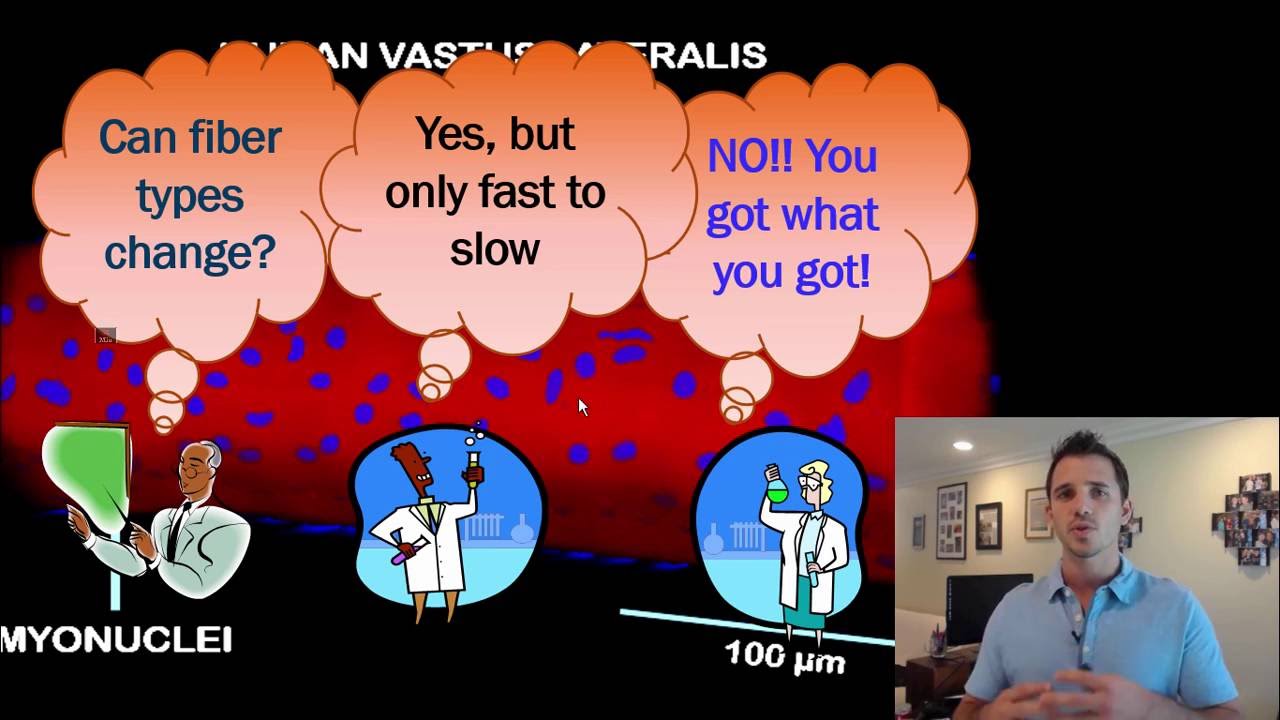
to right but we need some help some really exciting new information in the last couple of years has showed us that in fact maybe there's more to these fast and slow TCH fibers than we originally thought so this is an idea uh called the nuclear domain this is these are beautiful images so take a look at these two fibers over here right one of them is a fast twitch and one of them is a slow twitch fiber what we now know are things like there are differences in the amount of nuclei it it looks like
at this point slow touch fibers have more nuclei remember that from the very beginning the nuclear would hold your DNA tell your s to grow shrink replicate it also looks like your slow twitch fibers have more satellite cells so satellite cells sit on the outside of the of the fiber or the cell and when you need more nuclei they move in get differentiated and become a nuclei right so this is if you're not familiar with satellite cells this is one of the most hottest Topics in all of physiology right now one of the hottest ones
uh because it seems to be like that's one of your major limiters with Plus once you run out of satellite cells you can you can't differentiate into M nuclei you don't have any nuclei you can't grow shrink repair right with all that in mind it seems like the myonuclear Doane size is larger in your fast switch fibers so a myuc the monuclear domain basically says okay how much domain or how much space does each nuclei control a smaller myclear domain appears at this point to be advantageous because that means each nuclei is controlling a smaller
region this just means you're going to have faster replies so imagine you open up a business and you have another office in Vancouver and another one in South Africa well if you have a regional manager set up at every location when a printer goes out or a phone line breaks it's very easy to repair those things but if you only have one Center controlling you know an entire continent it's very slow to make changes right so now we are just uncovering these things you can see this paper just came out in 2015 there's more and
more coming out but it's a really exciting area that in fact we're working on too um but that's about as much as we know at this point we have almost done nothing in the area of humans and so we'll see if this holds true in our space as well or what other things we can uncover so at this point in the video we've had a full discussion what fiber types are and I think we've made it pretty clear that whether or not they change with exercise and of course our answer is yes and in both
directions actions