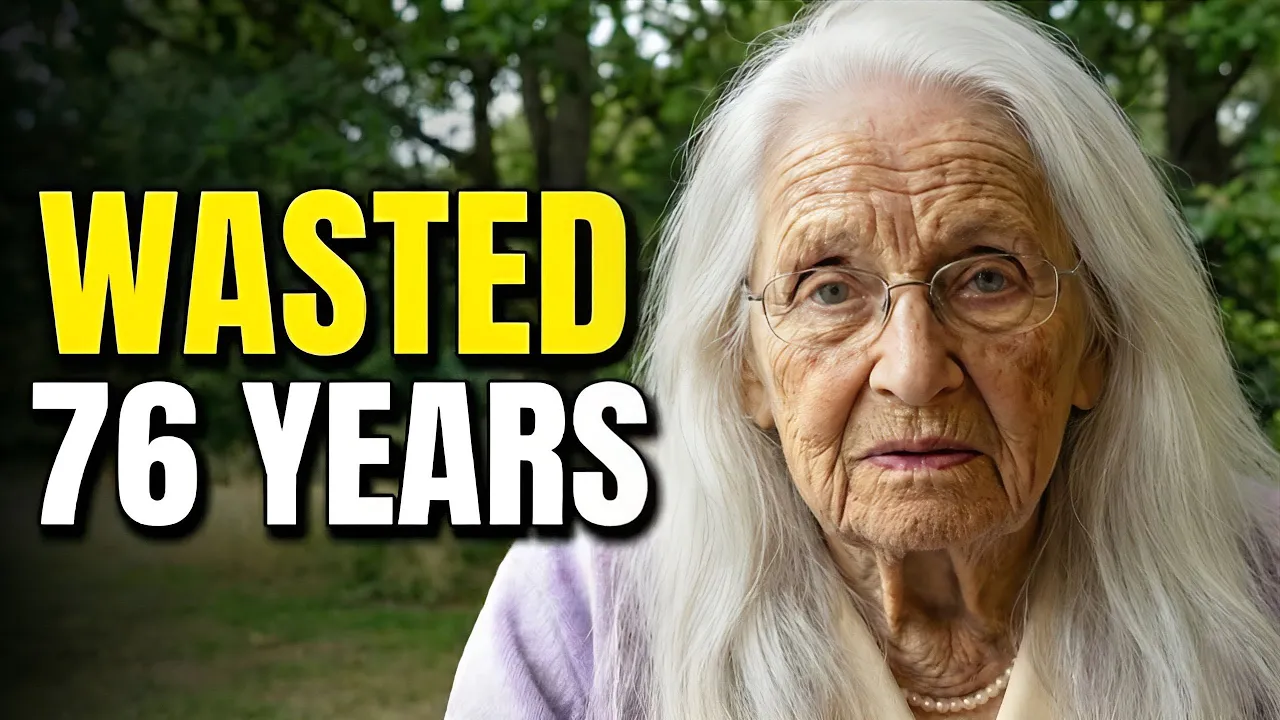
I'm 103 years old and I'm about to tell you something that nobody, not your parents, not your therapist, not your self-help books will ever tell you. And the reason they won't because it's too painful, too stark, too real. I've been alive for over a century.
I've buried three husbands, two children, most of my friends, and every single person I knew before I turned 40. I've watched the world transform four times over. And in all that time, I've learned one truth that haunts me every single day.
We're all living like we have forever when we barely have anything at all. But let me tell you when I actually learned this, [music] not at 90, not at 80, at 33 years old. And it took me 70 years to fully understand what that moment was trying to teach me.
It was 1955, October 14th. I remember [music] because it was a Friday, and I'd been planning to go dancing that weekend with my husband, Robert. We'd been married eight years.
Had two little boys, James and William. Robert worked at the steel mill. good man, steady, the kind who'd kiss my forehead every morning before he left for work and say, "See you tonight, Dorothy.
" Except that Friday, he didn't come home. There was an accident at the mill. They said it was quick.
They said he didn't suffer. But they always say that, don't they? What they didn't say, what nobody tells you is that when someone dies suddenly, they take all your unsaid words with them.
Every I love you, you didn't say. Every fight you didn't apologize for. Every moment you were too busy or too tired or too angry to just be present.
That night, sitting at our kitchen table, I made a promise to myself. I promised I would never waste another day. I promised I would live intentionally, love openly, and never postpone joy again.
And you know what? I broke that promise almost immediately. Oh, I thought I was living better.
I hugged my boys more. I said, "I love you more often. " But then life happens, doesn't it?
I remarried, got busy with work, the boys grew up. I told myself I was doing fine, that I'd learned my lesson. But I hadn't.
Not really. Because here's what I didn't understand at 33. What took me another 70 years to fully grasp.
It's not enough to survive tragedy and tell yourself you've changed. The real lesson isn't that life is short. Every greeting card tells you that.
The real lesson is that you will forget. You will slip back into autopilot. You will start believing you have time again.
[music] And that forgetting, that slow drift back into complacency, that's the real tragedy. I married again in 1958. Charles, sweet man.
We had 42 years together before his heart gave out. And you know, my biggest regret about those 42 years, [music] not the fights we had, not the money troubles or the disagreements. [snorts] My biggest regret is all the ordinary Tuesday nights I spent doing laundry [music] instead of sitting with him.
All the times I said, "Not now. I'm busy. " [music] when he wanted to take a walk.
All the moments I treated like they were guaranteed. [music] Because here's what nobody tells you about living to be my age. You don't just lose the people you love.
You lose them over and over again in your memory. Every time you think about them, you remember another moment you wasted. Another conversation you were too distracted to fully hear.
Another hug you cut short because you had somewhere to be. My son William died in 1987. 45 years old, cancer.
I was 65. I remember sitting by his hospital bed holding his hand and he said to me, "Mom, I'm sorry I didn't call more. " And I wanted to scream.
I wanted to shake him and say, "Why are we apologizing now? Why didn't we call each other every day when we could? But I didn't say that.
I just held his hand and lied. I said we had enough time. We didn't.
My third husband, Frank, died two years ago, 98 years old. We'd been together 21 years. And even after everything I'd learned, everything I'd lost, you know what I still did?
I still sometimes scrolled through my phone while [music] he was talking. I still sometimes sighed when he told the same story for the 10th time. I still sometimes thought, "I'll pay attention tomorrow.
" There wasn't always a tomorrow. [music] You're young. You're sitting there thinking, "This is depressing.
" Thinking, "Well, [music] everyone dies eventually. " But you're missing the point. The point isn't that everyone dies.
[music] The point is that you're acting like you're the exception, like somehow your life [music] will be different, like you'll have time later to live the way you want to live. I'm 103 years old and I can tell you with absolute certainty later never comes. You think you'll travel when you retire.
[music] Your knees will be shot by then. You think you'll reconnect with your sister after this busy period at work. That busy period will last 20 years and then she'll be gone.
>> [music] >> You think you'll start writing that book, learning that language, [music] taking that trip, having that conversation when you have more time, more money, more [music] whatever. You won't. Because here's the cruel joke.
You do have time right now. You just don't value it correctly. [music] You trade it for things that don't matter.
You spend it on people who drain you. You [music] waste it worrying about things that won't matter in 5 years. [music] And then one day, if you're lucky enough to live as long as I have, you'll look back and realize [music] you had all the time you needed.
You just didn't use it. I'm not telling you to quit your job and run off to [music] find yourself. I'm not saying ignore your responsibilities.
I'm saying something much harder. I'm saying pay [music] attention right now, today, to [music] what you're actually doing with your one brief, unre repeatable life. Your grandmother, is she still alive?
Call her today. Not tomorrow, today. Because I'm a grandmother and I can tell you exactly [music] what she's doing right now.
She's sitting somewhere, maybe looking at old photos, maybe just staring out a window and she's thinking about all the people who don't call anymore, all the grandchildren who are too busy. and she's telling herself it's okay, that everyone has their own lives, that she understands. But it breaks her heart a little more each day.
Your parents, if you're lucky enough to still have them, they're not going to be here forever. And when they're gone, you're not going to care about that argument you had 5 years ago. >> [music] >> You're not going to care that they were difficult sometimes [music] or that they didn't understand you.
You're going to care about all the phone calls you didn't make, all the visits you postponed, all the times you could have just sat with them [music] and didn't. I know this because I am that parent [music] now. I had two sons.
[snorts] William died 38 years ago. James [music] is 76 now. He visits every Sunday, rain or shine, every single Sunday.
And you know what? It's not enough. Not because he's not a good son.
He's a wonderful son. but because no amount of time is enough when you truly love someone. Every Sunday when he leaves, [music] I watch him walk to his car and I think, [music] will I see him again?
At my age, every goodbye might be the last one. And that's not morbid. That's just [music] mathematics.
But here's what you need to understand. It's not different for you just because you're young. Every goodbye might be the last one for you, [music] too.
You just don't believe it yet. I have a great [music] great granddaughter. Her name is Sophie.
She's 16. Last month, she came to visit me [music] and she spent the whole time looking at her phone and I didn't say anything because [music] what's the point? She thinks she has forever.
[music] She thinks her friend's texts are urgent. She thinks this moment sitting with her ancient great grandmother will always be available. It won't be.
And someday, probably when she's much older, she'll remember that visit. And she'll remember that she spent it looking at her phone. And it will hurt her in ways she can't imagine yet.
That's what I want to save you [music] from. That pain, that regret. Not the regret of big mistakes.
those you can make peace with. But the regret of simple absence, of being physically present, but mentally somewhere else, of treating the people you love like they'll always be there. They won't always be there.
[music] I'm not going to be here much longer. I can feel it. Not in a scary way, just in a knowing way.
My body is tired. >> [music] >> It's been working for over a century and it's ready to stop. And honestly, I'm okay with that.
I've had a long life, much longer than I deserved or expected. [music] But I'm not okay with the thought that you might waste yours the way I wasted so much of mine. [music] Because here's the truth I learned 70 years too late.
The moments that matter aren't the big ones. They're not your wedding day or your graduation or your promotion. Those are wonderful, but they're not what you'll think about at the end.
You'll think about Tuesday afternoon when your dad tried to show you how to fix [music] the sink and you were patient instead of annoyed. You'll think about that random Saturday morning when you made pancakes with your kids and nobody was in a hurry. You'll think about the walk you took with your husband [music] when you actually listened instead of planning what to say next.
Those moments, the ordinary, unglamorous, utterly unremarkable moments when you were just there, fully there. Those are the ones that matter [music] and they're available to you right now, today, this [music] moment. But you have to choose them.
You have to fight for them. Because everything in our world is designed to pull you away from them. Your phone, your work, your ambitions, your fears, [music] your endless to-do list.
If I could go back to 33year-old Dorothy standing in that kitchen the night Robert died, here's what I would tell her. The promise you're making right now to never waste another day, you're going to break it. You're going to break it over and over again because you're human and humans forget.
But here's your real [music] job. Remember and return. Remember and return.
Every time you forget, every time you drift back [music] into distraction and busyiness and taking people for granted, notice it and [music] return. Return to presence. Return to attention.
Return to love. Not perfectly, but persistently. I'm 103 years old.
I've been alive for 37,595 days. And [music] I can count on two hands the number of days I was fully completely utterly present. That's my real regret.
Not that I didn't achieve more or travel more or make more money, but that I sleepwalked through most of my own life. Don't do what I did. Don't wait 70 years to learn this.
Don't wait until everyone you love is gone to realize you should have loved them better when they were here. Stop reading this [music] and call someone you love. Stop reading this and go sit with someone in silence.
Stop reading this and look, really look at the people in your life while they're still here to be looked at. Because I promise you with everything I have left, later never comes.