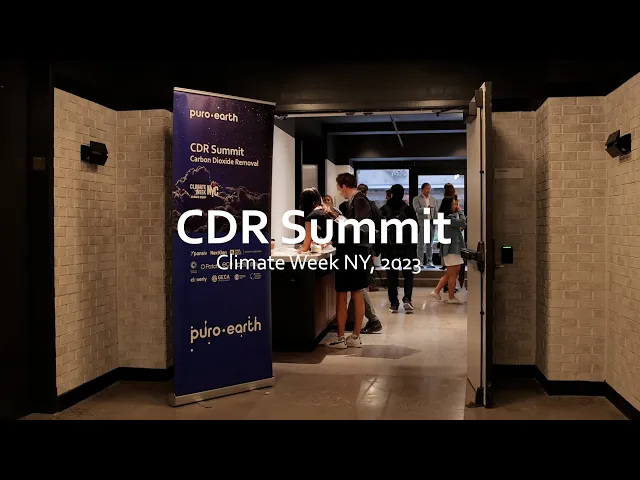
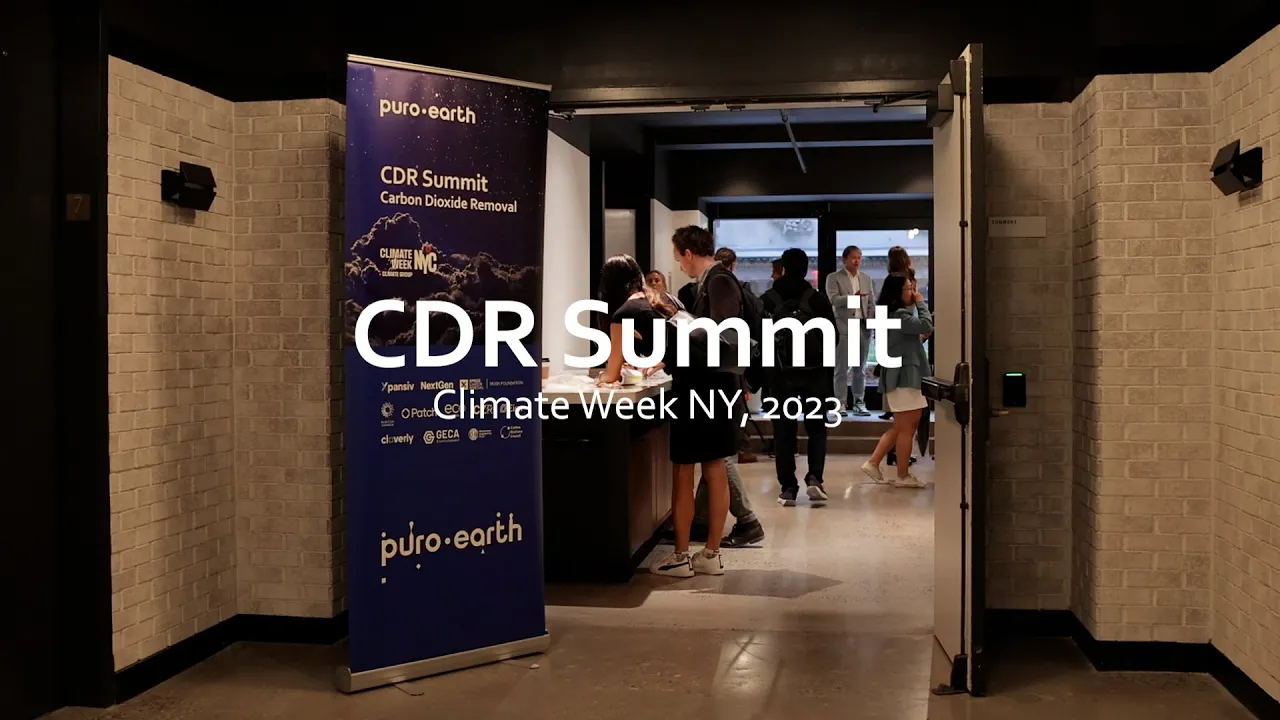
we're here at the Puro CDR Summit um in New York um part of the New York climate week and we've got uh basically every single part of the um CDR ecosystem uh represented over here and uh I think there's a lot of learning and sharing happening right now haror removal is all about collaboration uh there are different kinds of players the investors the certification bodies the verifier the uh marketplaces um various advisers so there needs to be a smooth sort of value generation uh between these uh players and there's been a time when there's been
more Divergence now we're seeing sort of specialization and people concentrating on the areas that they know their best uh that's a very uh encouraging sign it it's interesting I mean you all are here we're all here right uh talking about about CDR in a way that you know certainly a decade ago this wasn't happening and even the fact that we have a CDR team was like Unthinkable like three years ago right and now it's one of the fastest growing segments of our Institute for me it was really exciting to see um not just the number
of companies that were founded but also the breath of solutions and the breath of the types of technologies that are being deployed and I think in particular that thousand ton demonstration scale is really needed to figure out you know which these Technologies actually work in the real world and how can we get to that eventual gigaton scale black and brown low-income individuals came up with a working definition of what they meant by environmental justice and it literally means making a safe place and making sure that the benefits outweigh the harms for people who live work
pray and worship in different areas to the category criteria out of six are about uh environmental justice and climate Justice well your project must have a plan about how you are engaging with the community and it should be designed in a way that is going to be cascading benefits towards marginalized communities what's needed in the space is the whole portfolio even if we planted every surface of the planet with trees it wouldn't be enough so having a balanced portfolio of both engineered durable nature-based high CO benefits is the approach that I've always taken a view
of and I think is what's needed in the space I think we really have to educate um the market in the sense that the time to get in line really is today and also buyers have to start developing the commercial contractual relationships today that they can then tap into and grow over time despite the prolonged economic uh downturn climate technology Investments and private markets have actually tripled since 2019 so between 2019 to 2022 there's a lot of reason for optimism and there's a lot of reason to gain continue gaining investor interest especially in the type
of purchase agreements that we do with really is um agents of change hopefully for large SES of uh regulated Insurance Capital to come in and help you all um because really were enablers in this space uh to really help you do the job that you need to do why did we start our carbon removal program easy we really wanted to kind of change the world in a positive way we saw the need for carbon dioxide removal Technologies to get started and to grow we were very excited about how biochar could pay a major role in
that largely because these Technologies are ready to scale today and they're have some of the lowest price points uh per sequestration of carbon of any other technology out there so we really felt like we could get started quickly and be able to build to very large scale at probably the least cost of any technology out there I've been in the biochar world for 5 years and it was a whole other world before carbon removal we need all of the solutions but we also need to accelerate them because unlike other issues there is a clock ticking
in this challenge that we're facing 90% of carbon removals are in a north and asphere and not in the South so right now we're developing the South and I hope that's kind of followed by other project in the future we hope that with your support you know you the buyers we can only not our project canot only achieve its goals but can also evolve Thrive and create even bigger Milestones because at the end this is not just for bolivians but it's for all of us we couldn't say climate change and so here we are actually
coming forward with real solutions that um it's getting real backing There's real markets and real activity is happening so for me it's uh it's kind of a dream to be here and I really appreciate that we are trying to prove a business model and demonstrate a market that can be replicated many times over throughout the West thank you Puro I don't think this journey would have been possible without you guys we're doing this this for the the first time as far as I know in the world and uh if you haven't heard about us so
far I think you'll you're hear about us in the coming months and years and it's probably the number one question that we get from buyers certainly that you guys get from buyers is like you know wood can be used for stuff why would you put it in a hole and walk away from it um you know one thing that may not be that intuitive to folks on the east coast is that out in the Inner Mountain West where we operate um Deadwood is actually the fast is growing Forest carbon sink out here in California what
we've seen in conversations with experts and you know real world situations is that most of the wood waste from forest thinning is pile bured or shipped and left in the forest so it's non-merchantable the utilization Pathways aren't keeping up with the volume of waste that's being produced we committed to uh being Net Zero in 2030 which means two things basically the first is to reduce our emissions intensity in half by 25 versus 2018 where we started and the second is to transition those carbon crates um half avoidance today half removals to 100% removals in 20
2030 so we have the interim Target to theti 2.2 million tons of CDL by 2030 and this our commitment comes from the sense of the agency because there's a limited remaining carbon budget and we as the industry wish to contribute to scale of the CDL market so that we can ensure the sufficient Supply when we need when we need it in 2050 there's a major Gap in the market for this new type of approach that we need which is CDR carbon dioxide removal using technology um what do we do as a company that's been involved
in the in the carbon markets for 17 years and has really been a promoter of how to incentivize and promote climate action and finance to to advance these these types of activities to scale this industry to Katon scale by 2050 and doing so with the highest trust and the highest quality and we believe we have found in in onto you and and your team at Puro the right partner to to make this goal and this Vision come true we would definitely like to see more Finance years uh supporting CDR projects as well as independent mrv
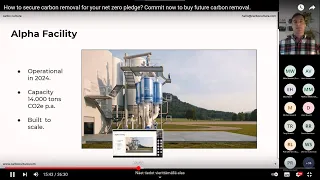
and better ways of measuring the ROV BS we would also like to see more partnership with more buyers as well as more buyers entering the market most importantly I'd like to highlight that our process mineralizes carbon leading to high permanence but unlike other means uh of carbon removal it also scales very quickly so to put it simply with erw you get the all important permanence of a tech based carbon removal approach with the scalability of a nature-based approach essentially what we do is we crush it and mix different types of slags to adjust the chemistry
for different use cases um those are crushed to a size spec transported in trucks to the job site and spread uh to make gravel roads the amazing thing is that these gravel roads start to soak up CO2 on day one no extra energy inputs required uh because of the nature of the steel slag so we really want to bring the carbon dioxide removal space and every technology that we we come across we want to bring it to the next level we want to bring it from a wonderful idea that can potentially uh reach funding we
want to bring this to the legitimacy scale that it's going to take to actually uh grow into a a climate changing uh technology our reason for supporting carbon removal and for venturing into this world had a lot to do with the fact that when we became a publicly traded company we also made a statement that we wanted to be a 100-year company and if you're going to operate on a Time Horizon 100 years from now the world is going to be very different than it is today and one of those things that's going to be
a threat to our business if we don't deal with it is climate change the luxury of being able to help scale the carbon removal market so that we have removals down the road when those Net Zero targets hit and you know we're not just going to be able to turn on all the deck plants that manage just magically appear we have to scale them and support them today so that's why we're focusing our efforts there because we can and the way that I think we think about it internally is where there's a gap in what
needs to happen to meet our climate goals that's a gap that we feel like we can fill um the TRU you know it's true for nature and our work on nature um and it's true for carbon removal it's a space that needs acceleration and we have a lever that we can exercise in order to accelerate that market for my Microsoft I we think of this more of a responsibility not just to the planet but also to our customers those who can move faster and farther should do it and um that kind of tells you what
why Microsoft made the big commitment to go carbon negative by 2030 when we look for projects we kind of use three different lenses of how we're evaluating so we're looking for things that hit our approach criteria um execution and portfolio so uh execution is just a team that can do what they said they're proposing to do portfolio are we building a risk adjusted portfolio of solutions that we think will get us to what we need in 2030 and Beyond thank you to the many many suppliers in this room um you guys are doing the the
really hard work of actually building the thing and and so you know we get to sit up here and tell you how we think about it but you guys are doing the real work so um thank you this level of of standardization and and you know codification of uh of of removal activities this is absolutely critical for us in the market just to make that easier build trust on on standards that you then don't have to diligence individual projects as we look to kind of expand to that next rung right and uh to continue to
find these buyers you know making it easy uh providing them portfolios providing them climate expertise you know things that we've been able to do just to try and crack that ice it's just so important to continue to find those you know efficiencies of skill and get more of those players to the table uh to make those commitments carbon removal offers something that I don't think a lot of other offsets or or carbon credits do which is the potential for really robust additionality and permanence and that has been the downfall of so many other carbon crediting
efforts that have come before it and so if we can show people that these are in fact really permanent really additional and that there's Supply out there that really really gets folks off the fence largely on the risk side but what we hope to do with that purchasing program is to show that this is not just a voluntary corporate effort it's something that governments around the world need to be doing and that we need to expand the set of purchasers in the field a lot we actually have a a very robust portf management system that's
handling billions of environmental credits today with API connectivity which is the technology that the US Financial system runs on connecting the Registries to the markets it won't come just thanks to new it stuff it won't come just thanks to honest project developer or honest clients the reality is really the relation between the clients the corporate and the projects and this is the bridge that we are trying to set up just to make sure that it's not just something happening somewhere else but it's really something that you can get in front of you you can be
part of it carbon removal is not only forecast to be over trillion dollar market it's also what is required in order to meet any of the climate scenarios for hitting 1.5° at a scale that's even bigger than the oil and gas industry is today and right now the Technologies are at their infancy which is why we need all the help we can get building new innovations that are removing carbon in a durable safe transparent and a way that benefit F communities and this is why we focus a lot on investing in the innovations that are
building [Music] it