President Trump ordered this operation. There were multiple explosions in Caracus starting at around 2 am local time. The most criminal military aggression from the US in the history of the country.
The massive escalation coming after a significant US military buildup in the region. Well, that was certainly a distraction. But anyway, back to it.
The team and I have been doing a bit of digging. Two days before his completely unsuspicious death, the alleged finance year Jeffrey Epstein signed an updated last will in testament which roughly detailed assets worth an estimated $577 million. What has remained unclear in the almost 6 years since though is how he actually made all of this money.
Before becoming the center-piece of an ongoing international scandal, Epstein was most publicly described as a high-profile finance guy that made his money by moving other people's money around in creative ways. But even that broad definition still raises some questions. He was supposedly charging tens of millions of dollars in fees for tax advice, even though he was not a tax lawyer or a CPA.
hundreds of millions for wealth management even though he never had a series 7 or a CFA and charged massive sums as a consultant despite not even having a college degree. Now, the financial industry was certainly a lot less competitive back then. But even in the 1980s, ultra-wealthy individuals still weren't giving away money like this for nothing in return.
With very little in the way of verifiable achievements, staff, or actual operations, it's unclear how valuable these services really could be, which ultimately raises the obvious question. Was Epste a successful financeier with a completely separate side hobby in diddling? Or was he a full-time diddler using financial services as a cover to bankroll and launder the proceeds of his crimes?
In either case, the obvious course of action would be to follow the money trail, right? Well, there are actually a few big groups of varying levels of competency who are all trying, but this is easier said than done. A complex web of jurisdictions shell corporations alongside confidential client and banking secrecy laws make a paper trail hard to pin together.
And that is clearly by design. Nobody's investment account should need a multi-jurisdictional flowchart to piece together unless they have something to hide, right? Even without the benefit of hindsight, the whole thing does seem incredibly unusual.
The only problem is that for a lot of high- net worth and high-profile individuals, the only thing abnormal about all of this is just how normal it really is. Tonight, the Justice Department is scrambling to review roughly 5. 2 million documents.
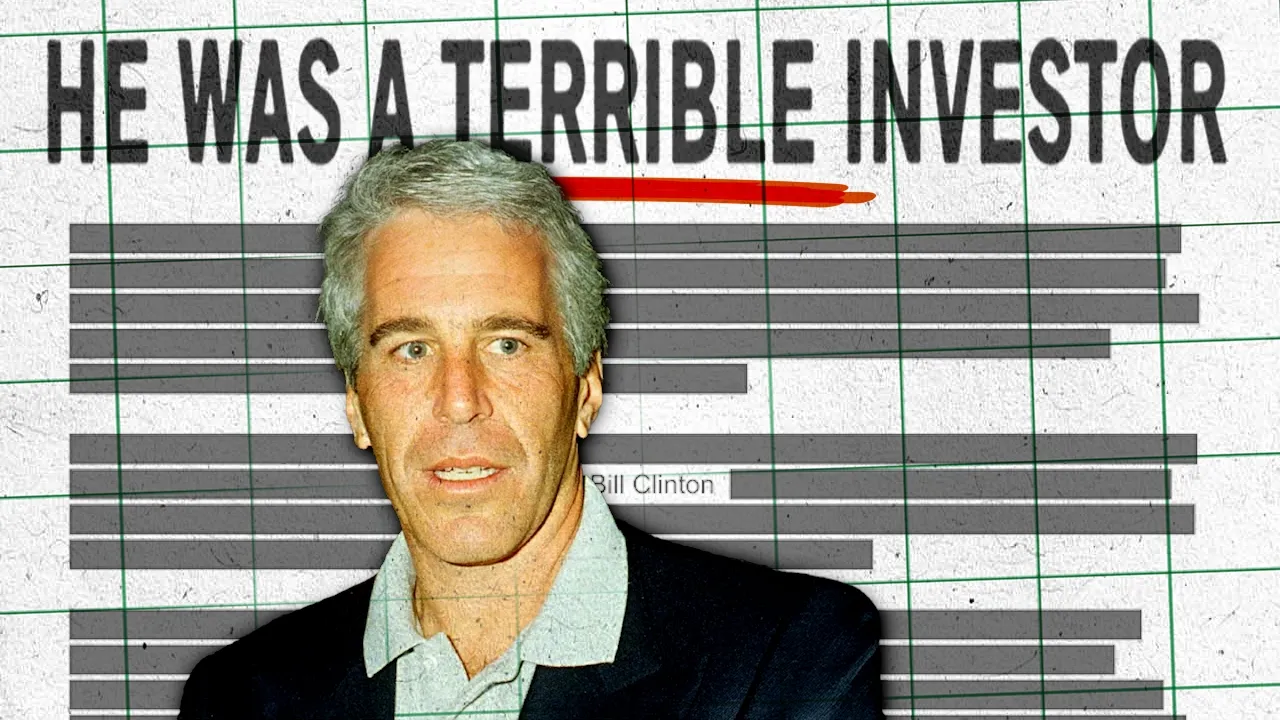
I expect that we're going to release more documents. The key word is redaction. A lot of pages, a lot of lines and paragraphs are blacked out.
And it was signed by Jay Epstein. His firm's operations were opaque. its client list never disclosed and its assets never verified.
I'm going to invoke my fifth amendment right now. Jeff was a high school math teacher until he traded his blackboard for the big board in 1976. But he just couldn't keep out of the classroom.
So purely from the financial side alone, Jeffrey Epstein had a career that could only really be described as unconventional. For almost 50 years, he was seemingly always in the wrong place at the wrong time, but consistently managed to fail upwards. My good friend Patrick Bole made a similar video about 5 months ago that covered some of the same stuff.
But within the time since, there has been a lot of new information made available. Either way, I will leave a link to that below because the rapper formerly known as Little Boil is always worth a watch and it seems like his videos have been quietly censored, which means he is talking about the important stuff. Epstein's first job in finance was given to him after he was fired from the Dalton School in 1976 for poor performance.
Again, working as a teacher without a college degree. He still somehow landed a job at Bear Sterns working as a glorified coffee getter for one of the firm's floor traders. These were the people that actually executed financial transactions back in the day before electronic trading took over by shouting at one another in colorful outfits.
By all accounts, he learned the ins and outs of the industry incredibly quickly and became particularly good at shmoozing the firm's wealthiest clients as he handled their complex financial affairs. By 1980, he had worked his way up to a limited partner at the firm and even scored himself an entry as the Bachelor of the Month in the Cosmopolitan magazine with an entry that read, "Jeffrey Epstein, 27, talks only to people who make over a million dollars a year. If you're a cute Texas girl, write this New York dynamo.
" which is just so gross in so many ways. Although to be fair, in the same year they also awarded that title to Prince Andrew in OJ Simpson. Sometimes you just cannot make this [ __ ] up.
But anyway, for those of you keeping track, this meant that in just 4 years, Epstein had worked his way up from a junior assistant all the way to a limited partner at what was one of the most notorious firms on Wall Street. For a lot of young finance grads with Ivy League degrees doing their four summer internship, this is the most unbelievable part of the story. How was someone without any formal qualifications getting ahead so quickly?
Well, this is partially because finance back then was a lot less competitive than it is today, but it was also far more relationship focused. Someone who could show clients a good night on the town could bring in more value to the firm than some PhD quantitative analyst. Since then, regulatory, cultural, and technological changes as well as just the overall size of the financial industry means that the latter is both higher and there is a lot more technical work to be done on those lower ladders.
But back then, whining and dining powerful and wealthy people was part of the job and it was a skill that Epstein clearly employed later in his career as well. Even still, just from the financial side, at this time, Epstein was receiving a total compensation of $200,000 a year, which in 1980s dollars was a lot. Had he just had a long stable career at the firm and invested his money well like he claimed to be able to do, this alone could have explained his $600 million fortune.
But of course, that didn't happen. He abruptly uh departed Bear Sterns just a year later. And although the exact reason hadn't been made clear, there were a variety of factors at play.
He had reportedly lent money to a friend to buy stocks, which was outside of industry guidelines. He was also reportedly having an affair with one of the office secretaries. and he was also being charged by the SEC for a violation of regulation D, which in plain English meant he was trying to skirt around public investment registration requirements.
On top of this cluster of HR liability, the firm itself was also under investigation for insider trading. In fact, the only reason we know how much Epstein was making at his first big boy job on Wall Street was because he later had to testify as a witness in that insider trading case. Now, I know that this video is going to be long enough as is, but an essential detail that came out of this testimony was actually about Epstein's first ever criminal conviction, which came a lot earlier than what most people think.
He briefly revealed that he was prosecuted in the United Kingdom for unlawful possession of an antique sword. So, you know, had he just continued to study the blade, the world probably could have avoided a lot of pain and suffering. Anyway, after he left bear, he maintained a productive relationship with the firm and its executives.
Those students of history amongst you may be able to see how that will be important later on. Either way, once he was out on his own at the age of 27, he started his own consulting firm, International Asset Group, or I AG, not to be confused with AIG, the insurer. His firm dealt with the same high-profile clients and reportedly acted as something of a high-end debt collector, recovering embezzled funds and recovering assets that had been taken off his clients.
The actual nature of his work at this time was very murky. One of his clients was famously Adnan Kashogi who himself was a middleman in the Iran Contra affair. He also had a fake passport.
And when Florida Attorney General Alexander Aosta was questioned about his later criminal case, he stated on record that I was told Epstein belonged to intelligence and to leave it alone and that Epstein was above his pay grade. You can see why the tinfoil hat really doesn't need to be too tight for all of this to raise a lot of questions. However, just from the business perspective, this kind of work had the potential to be highly lucrative while also giving him an extensive contact list of high-profile people and experience with legal and financial systems in different countries and jurisdictions.
He ran this operation for 6 years in total before being hired by Steven Hoffenberg to work at Towers Financial Corporation, a collection agency that would buy up debt from things like medical debt off hospitals for cheap and try to get people to pay them. According to an interview he later gave to Vanity Fair, as a senior consultant, he was reportedly paid $25,000 a month, which is the equivalent of about $70,000 today. This was extremely good money by almost anybody's standards.
But even in the early '90s, it still wouldn't move the needle on his eventual $600 million net worth. On the surface, this firm eventually transitioned to becoming an investment vehicle targeting hostile takeovers of companies like Panama just a few years before its eventual bankruptcy. Now, I say on the surface because what the firm was actually doing was running a giant Ponzi scheme.
In 1993, the firm eventually imploded, losing an estimated $450 million of its investors money. At the time, this was the biggest Ponzi scheme in American history, only eventually being topped by Bernie Madoff in the late 2000s. Despite being a senior figure in the firm and a self-proclaimed protege to the man in charge, Epstein was never charged in relation to the fraud.
So yeah, at this point in his career, he already had one criminal conviction, been fired from a teaching job he was unqualified for, embroiled in SEC complaints, involved in an insider trading scheme, had links to one of the biggest geopolitical scandals in American history, co-ran massive Ponzi scheme, and even when he was making legit money, it was through squeezing people for their unpaid medical debt. The Gussle would almost be impressive if it wasn't for well, you know. The thing is though, by this point, he still wasn't anywhere close to the levels of wealth he would eventually obtain.
But his solution was to become even more sketchy in his business dealings. So, it's time to learn how many works to find out how someone with no formal qualifications and the worst professional track record imaginable still managed to amass a fortune within the span of a decade. This week's video is sponsored by Brilliant.
Brilliant helps you unlock the problem solver you already are. It is designed to help you excel in math and computer science by guiding you to real understanding. So ideas that used to feel confusing actually start to make sense.
What makes Brilliant different is that you learn by actively solving problems. You are working through visual interactive challenges that push you to reason things out for yourself and build intuition instead of memorizing steps or watching someone else do it. I have been spending time in their coordinate geometry course and what stood out to me was how it changed the way I think about graphs.
Rather than treating equations as a symbol on a page, you are constantly connecting them to movement in space until you start anticipating how things will behave before the answer appears. It also adapts to you as you go. Brilliant adjusts the difficulty, gives you personalized practice and reviews, and helps you move forward with confidence as your understanding deepens.
If you want to become a stronger thinker and problem solver, someone who can break down complex ideas and trust the reasoning, Brilliant is built for that. To learn for free on Brilliant for a full 30 days, go to brilliant. org/howyworks org/hommoneyworks or scan the QR code on screen or click the link in the description.
Brilliant is also giving our viewers 20% off an annual premium subscription which gives you unlimited daily access to everything on Brilliant. The slow drip feed public release of documents related to the Epstein case have given journalists, investigators, and investigative journalists an opportunity to start piecing together a clearer picture of how this man actually operated. Beyond just control F"ing" old celebrities or politicians they don't like from between the redactions, there have been some important details that have come to light about the nature of his businesses, if you could really call it that.
However, given the reality that Epstein operated out of the US Virgin Islands and had shell corporations in other jurisdictions with strict banking secrecy laws, one of the biggest insights actually came from a completely different set of files that were released several years earlier. The Paradise Papers were a series of leaked documents from the offshore law firm Applebee that handled corporate registries through Aruba, the Cook Islands, the Bahamas, Barbados, Malta, NeAs, and Samoa. So, you know, a pretty comprehensive list of the most reputable places to do business.
Anyway, one of those leaked documents involved an offshore hedge fund founded in the year 2000, Liquid Funding, which was registered in Bermuda. According to information pieced together by the International Consortium of Investigative Journalists, the group that published these millions of leaked documents, the chairman of this operation was none other than a Mr Jeffrey Ebstein. Now, we don't actually know who the investors were in this firm because even with these leaks, the offshore entity was in turn owned by a holding company in Delaware under the same name, and that information remained sealed.
There was one exception, though. By using the way back machine in a 2002 annual report to stockholders, Beer Sterns disclosed that they had taken an approximately 40% stake in the holding company that in turn owned the offshore Bermuda registered firm. In that same disclosure, they noted that liquid funding itself had approximately $900 million in assets.
And what those assets were was primarily repurchase agreements on swaps for mortgage back securities, creating a special purpose vehicle that was AAA rated. At the time, this was considered revolutionary financial engineering. But if you know anything about mortgage back securities, derivatives like swaps, beer sterns, or AAA ratings, you will know that none of these fared particularly well in the eventual global financial crisis.
At the same time, in 2007 that Epstein was getting his now infamously light sentence in Florida, his revolutionary new investment firm was imploding on itself under the weight of heavily leveraged derivatives and failing mortgage back securities. Less than a year later, Beer Sterns itself, the firm where Epstein got his start on Wall Street, would also collapse. Now, how much Epstein actually personally had invested in this operation is unclear.
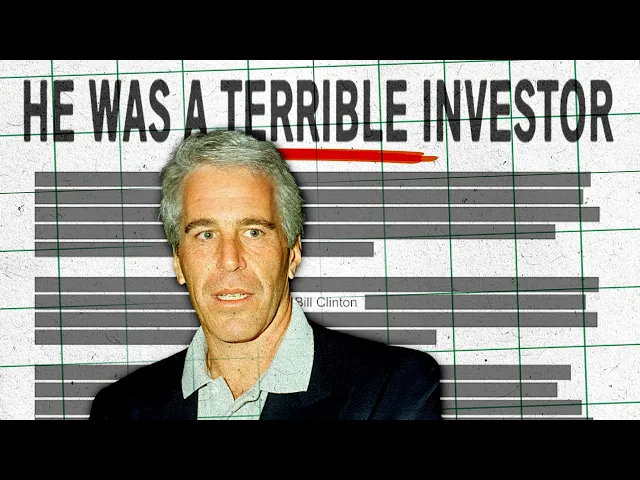
Although, a 2007 report by Dealbook suggests that his firm had a 10% stake in the operation in addition to his chairmanship. This would have represented an investment of over $50 million, representing a significant share of his wealth, even by the most generous estimate. But the important takeaway is that despite what he personally claimed about his skills at playing in the markets, by all available records, he kind of sucked at it.
Just because the financial systems he was employing were highly complicated didn't necessarily mean that they were actually good. So for a while then the primary source of revenue for his businesses were not investment returns but rather fees paid to him by an unconfirmed number of high- net worth clients. After Epstein left Towers Financial Group, the massive Ponzi scheme, he established J.
Epstein and Company, a firm dedicated to managing the assets of clients on the condition that they had billions of dollars in net worth. At the peak of his career running this firm, there have only really been two individuals identified as his primary revenue sources. The first was Leslie or Les Wexner, the multi-billionaire co-founder of Bath & Body Works, as well as a major investor in brands such as Abraham and Fitch, Lenza, and Victoria Secret.
Wexner came on board as a client as soon as Epstein established the firm, and their business relationship did seem unusually close. Over the course of 15 years, Wexner paid Epstein a reported $200 million in fees for tax, estate, and asset management advice. Now, given Epstein's lack of credentials and spotty financial track record, a lot of people have pointed to this amount of money as being highly suspect.
Financial services for people worth billions of dollars can and often do cost this much. For an average of almost $20 million a year, Wexner could have built his own family office to handle his financial affairs and investment in house. Beyond the sheer amount of money that Wexner was paying Epstein, their professional relationship did seem to extend beyond a simple client agent.
Epstein's famous house in New York was actually officially owned by Wexner for more than a decade while Epstein was living in it. Wexner would reportedly come and go since it was his property after all. But yet, the inscribed letters on the door read J.
Additionally and allegedly, Epstein used his relationship with Wexner to present himself as a talent scout for Victoria's Secret, which aided with his criminal activities. These allegations brought attention to the culture at Victoria Secret, who settled with shareholders 2 years later for a reported $90 million for a breach of their fiduciary duty in creating a hostile culture. The second publicly known client that Epstein retained as a major source of revenue was Leon Black.
The multi-billionaire co-founder and former CEO of Apollo Capital Management, one of the largest private equity firms in the world. An interesting but totally irrelevant little connection is that Apollo Capital Management shares the same New York office building with another private equity firm, Sycamore Partners. Sycamore Partners acquired the holding company, The Limited, in 2017, which is the parent company of Victoria Secret.
This means absolutely nothing, but it is a warning that when you start looking at financial documents for 2 months straight, you do start seeing connections everywhere. Anyway, Leon Black similarly was noted as having a close personal relationship with Epstein, even making him one of the trustees of his family foundation as far back as 1997. As far as major financial dealings go, Black allegedly paid at least $158 million to Epstein for financial services between 2012 and 2017, according to an ongoing investigation by the Senate Finance Committee.
That is more than $30 million a year. Black's payments to Epstein potentially raise even more eyebrows because of the simple reality that he himself is a highly sophisticated financier and was the head of a major investment firm. So, what did he need Epstein for?
Now, to play devil's advocate here, this alone isn't actually that unusual. Most major financial figures tend to keep their personal finances somewhere separate from their own firm for privacy, flexibility, and risk mitigation. It's kind of like how doctors don't go for a checkup at their own clinic.
What was unusual, though, is how much Black was paying for seemingly boilerplate financial advice. In the worst case scenario, a clear explanation would be that these were veiled ways to give money to Epstein for quid-pro-quo services that uh went beyond just finance. Now, even if that wasn't true, another explanation is that Epstein's fees were so high because he was pursuing aggressive tax mitigation strategies and was acting as a conduit to the tax havens that he was clearly comfortable working in.
In fact, his firm itself, later were branded from J. Epstein and Company to the Financial Trust Company used his infamous islands as a headquarters to claim economic development tax incentives in the Virgin Islands, meaning that on all of these fees, he was paying an effective tax rate of just 4%. Less than a tenth of what he would be paying if he was similarly set up in New York.
Now, Les Wexner and Leon Black were by far his largest known clients. But despite some early reports, new information has revealed that they weren't his only clients. In total, his firm received an additional $118 million in traceable fees from individuals like Elizabeth Johnson of the Johnson and Johnson family fortune and the hedge fund Highbridge Capital.
A report by Forbes pieced all of these together and found that in total, as far as we know, Epstein's firm brought in over $488 million in fees for questionable financial services. If we were just tracking the source of his wealth, these payments, as suspicious as they were, combined with some modest investment returns, should pretty much explain it, right? Well, not quite.
According to the very will and testament that outlets are basing his estimated net worth off of, only around half of his wealth was actually invested in cash flow generating assets. And this also isn't accounting for the fact that several of his major investments completely imploded, taking out a major share of his fortune with it. He did have some successful private investments such as Carbine, a communications technology company that he was an early investor in alongside other luminaries like Peter Teal.
But this company only saw significant growth after he was already dead, so it didn't contribute significantly to his 2019 net worth. Additionally, his firm had staff and operational expenses. It is still unclear how many people Epstein had working for him, but we do know that in order to qualify for his tax exemptions, he employed 11 full-time staff in the Virgin Islands, which was confirmed by a public audit that is still available online.
Now, that is not a lot of manpower for the type of business he was reportedly doing. But this was in addition to an unknown number of staff in his New York offices. All of these investment losses and business overhead costs money to maintain, which means it isn't as simple as $488 million in fees, equating to $488 million directly landing in Epstein's wallet.
This is also ignoring potentially the biggest unaccounted for variable, which is that his lifestyle was obviously deplorable, but it was also not cheap. frequent private jet travel, property taxes, and upkeep on a hundreds of millions of dollars worth of real estate, and personal expenditures all amounted to several million dollars a year on the low end. On top of this is one of his biggest personal expenses of all, which was lawyers.
According to court records, Epson engaged with more than 75 lawyers over the course of his life, including major names like Alan Dersowitz, who charged several thousand an hour for his services. Adding it all up, it is possible that over the roughly 30 years he was in business for himself, he could have very easily spent as much money as was coming in through these traceable revenue sources, which means to amass this wealth, he was either getting investment returns from somewhere that hasn't been revealed yet, or he had other sources of revenue. This sounds bad, but it potentially gets worse.
Now, this part is verging on potentially conspiratorial, but so far in this video, we've been working off the same number that most news outlets have been working off of, the $577 million detailed in his will. But that was written while he was in prison, and it was done 2 days before his death. It is possible that someone who was comfortable carrying a fake passport and slipping in and out of international deals kept some assets outside of the typical financial system in the event that he had the opportunity to make a run for it.
Now, back to what we know. The Senate Finance Committee has reported that Epstein's company accounts held with several major Western banks had over $1. 9 billion worth of direct transactions flowing between them, well above the $488 million in fees that have already been well documented.
These transactions also linked the currently sanctioned Russian banks, putting further question marks over who Epstein's clients were and what they were really paying for. Unfortunately, until further details are released and or more pressure is put on these banks to hand over information, that is all we do know for now. Offshore financial dealings are already hard to track.
So then add on a man who obviously wanted to keep most of his business a wonderful secret and then add the literal opakqueness of the publicly released information and we may not ever truly know the full extent of even simple stuff like the man's personal finances. Now the comments tell me that I am always a bit too negative about these things. So, if there is some good news that might come from this, it is a demonstration of just how widespread the network of shadowy offshore business deals really is.
A majority of the activity in these places is just from people trying to avoid taxes. But with very little oversight by design, it's not a good look when that is the best possible outcome. But if for some reason you want to set up one of these offshore shell companies for yourself, go and watch one of the first videos I ever made here on YouTube to make sure you're at least going to be doing it right.
And don't forget to like and subscribe to keep on learning how money works.