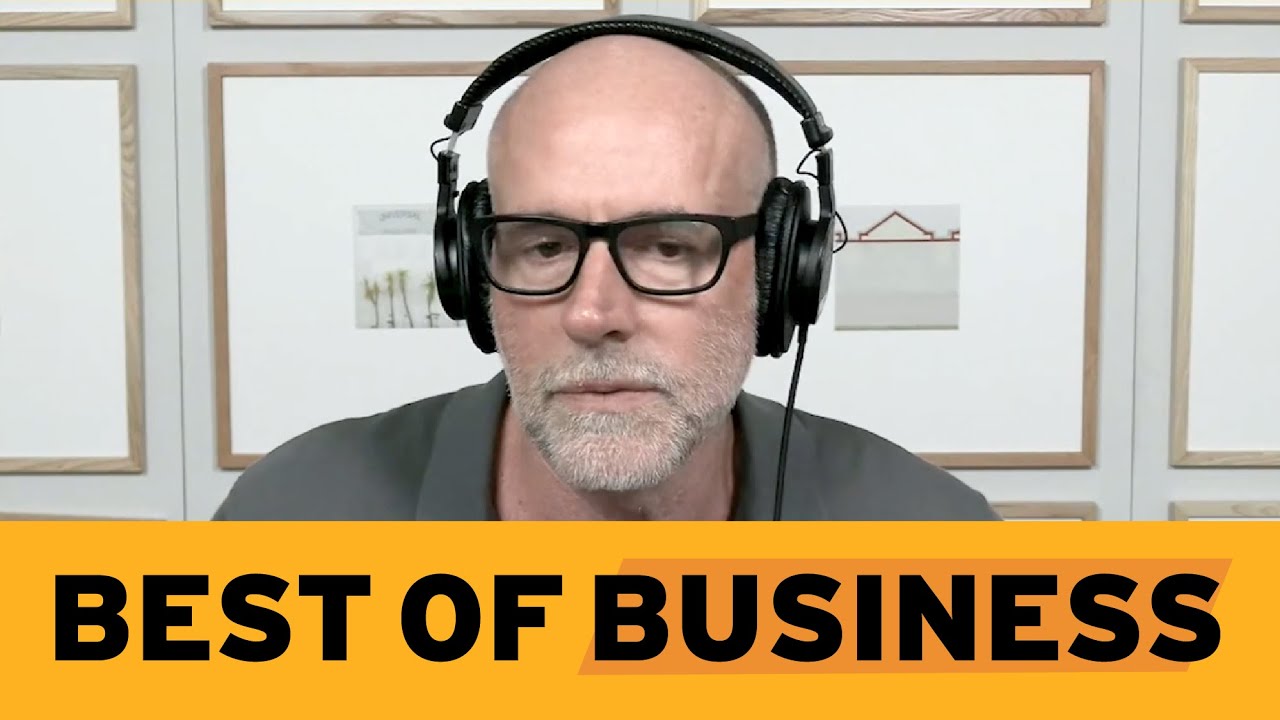
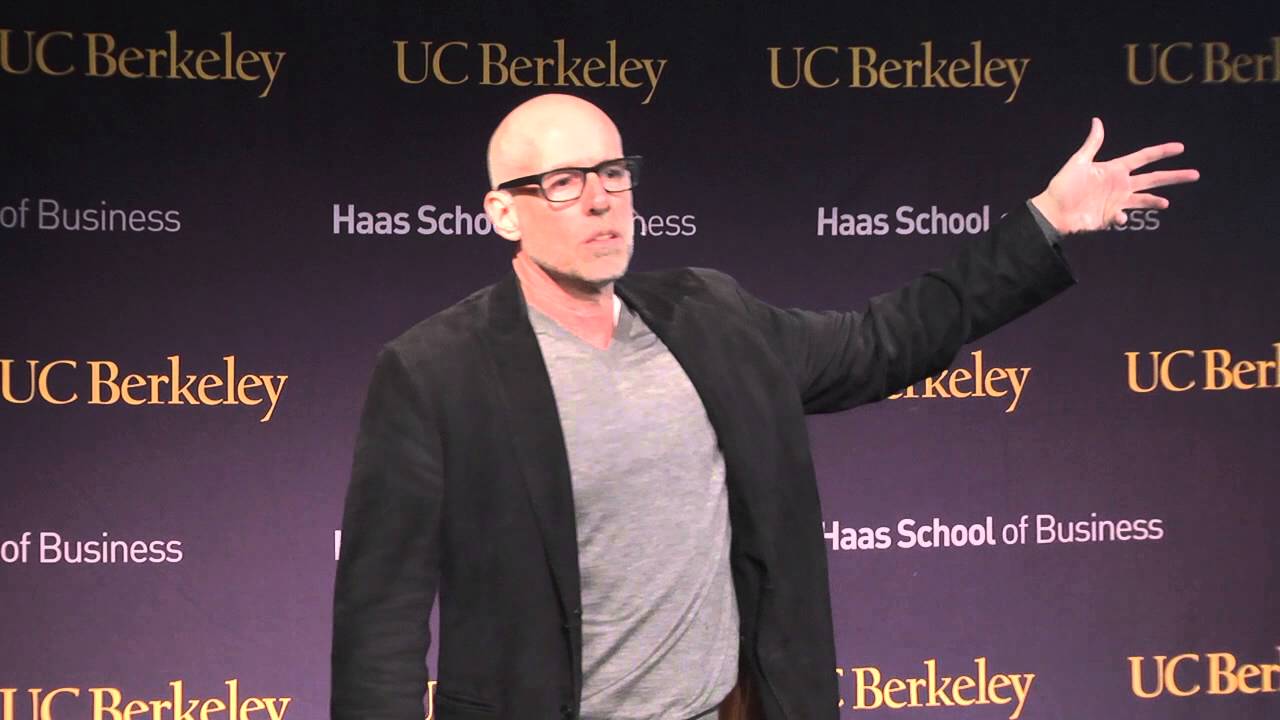
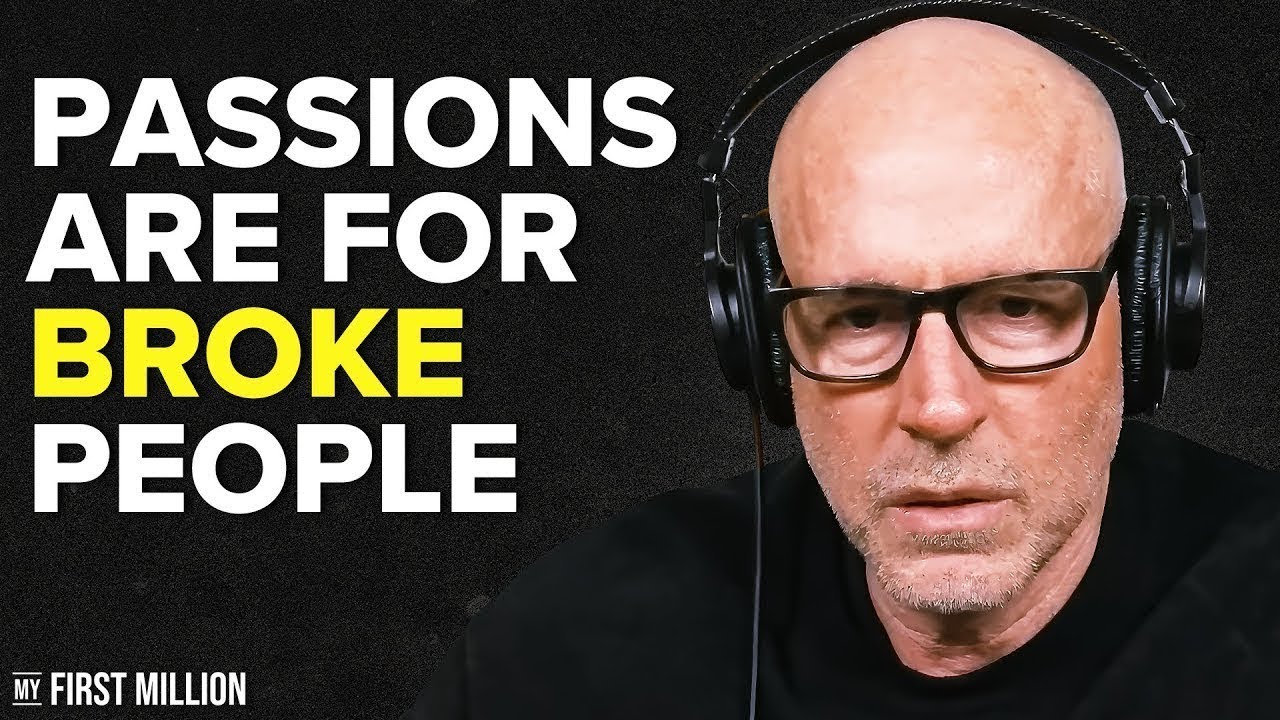
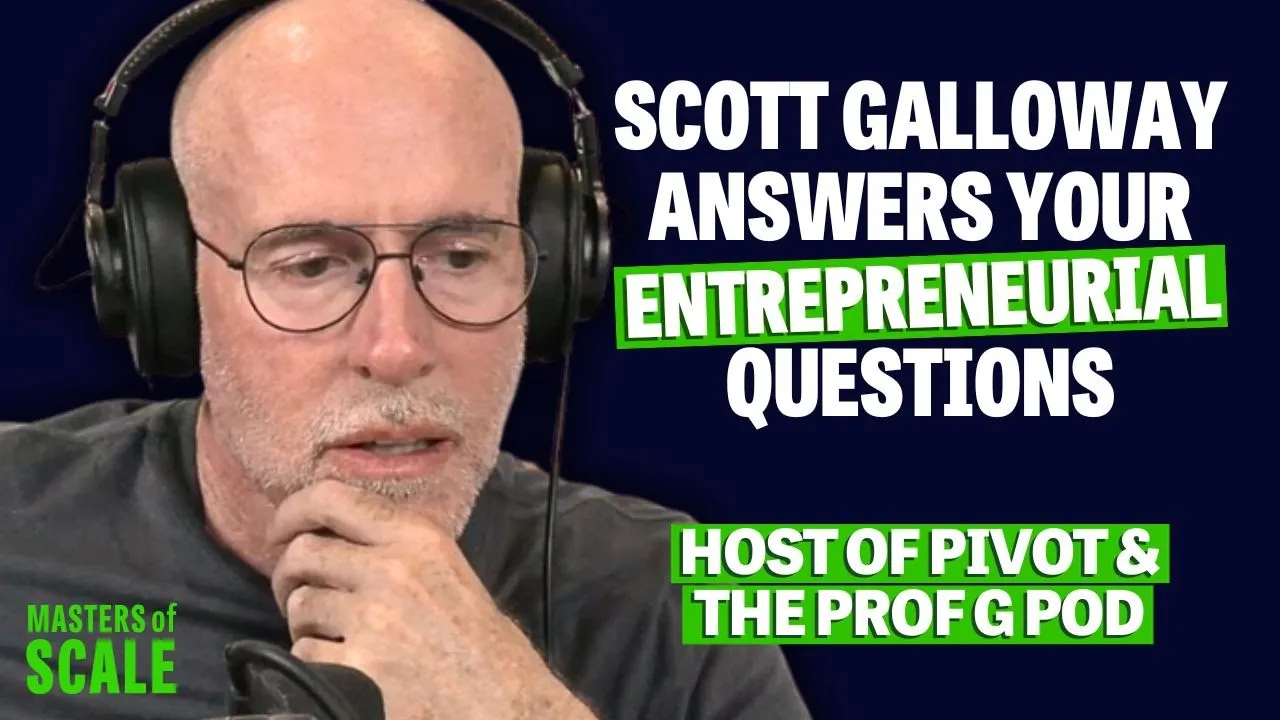
everybody interviewed everybody and we liked each other and we had fun and and you know couldn't pull us off now but we used to all take company trips no spouses allowed consumption of alcohol encouraged it's a pretty good bet you recognize that voice that's business professor bestselling author and prolific podcaster Scott Galloway he's reminiscing about how he built company culture early in his career I had read the study when I was younger saying the number one source of retention in any company is if the person has a friend if they have friends at the company
if they get that dope a hit when they walk off the elevator and they see friends this week on Masters of scale we've asked Scott Galloway to answer your questions think of him as the slightly cbic sharp-witted friend at the office who's not shy about giving advice it's a bit of a different episode for us a great hang with Scott's typically unfiltered takes we think you're going to enjoy this conversation this is masters of scale I'm Jeff Burman your host Scott Galloway is the creator of a popular newsletter and podcasts under the moniker prop G
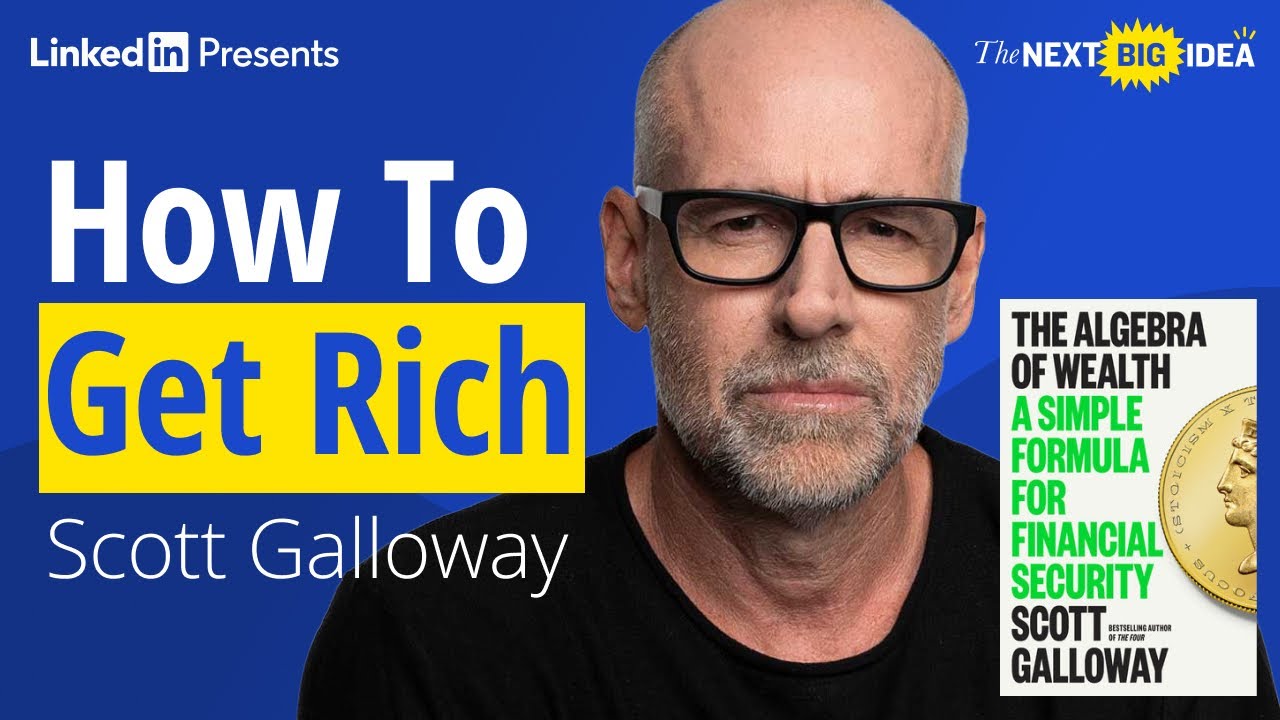
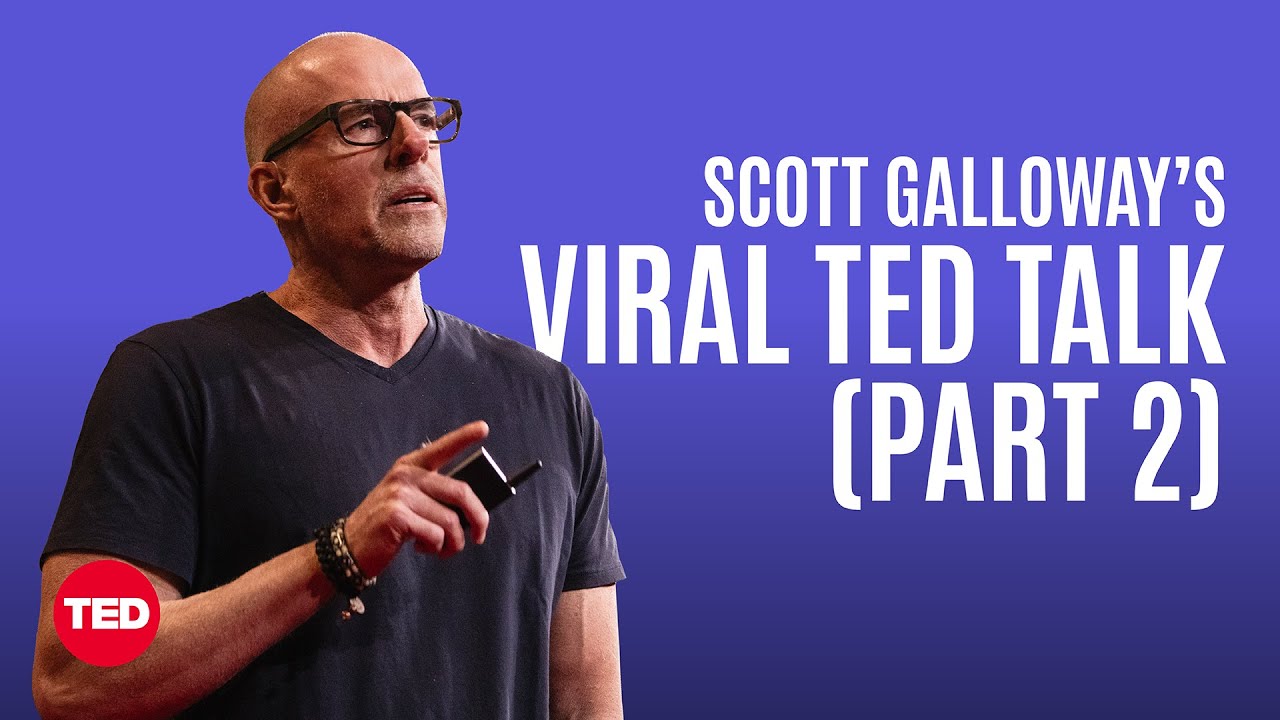
media he's also a business school professor at NYU and the author of bestselling books about our economy and culture Scott agreed to tackle a wide range of topics with us most of them inspired by questions from you we're getting into issues like when CEOs should speak out on politics the disruption caused by artificial intelligence and building company culture first we wanted to hear about Scott's approach to scale in his own life and work Scott welcome to Masters of scale oh thanks for having me je you've done an extraordinary job scaling the distribution of your your
ideas um your worldview um uh what what has worked best for you on that front and what what can our audience take from that as they try to extend uh the reach and and influence that they have people consistently come up to me and say I just think the amount of content you push out is remarkable you must work 8 hours a week I'm fundamentally a lazy person I work 30 to 40 hours a week I'm really outstanding at doing nothing um what I'm pretty good at so my core confidence of Storytelling my my superpower
though attracting and retaining talented people I have 14 people at propy media if you want to scale your content you got to focus on what part of this content am I really good at and hopefully you have the resources to hire talented people to kind of build it out that's the most obvious thing and some people don't have those resources I'm blessed but if you find people who are good you want to hold on to them give them a vested interest in ownership in your success from a qualitative standpoint and then I'll talk about channels
I'm in a very blessed position in that is I have people who love me unconditionally and I have Economic Security which gives me license to say pretty much whatever the I want unfortunately we don't have exactly that same license here we bleep out those F bombs mostly to avoid being blocked by the podcasting apps in certain parts of the world anyway but over the long term your willingness to be kind of unfiltered I think over the long term draws people in so when I write my newsletter I have a newsletter that goes out to half
a million people every Friday I write as if only my sons are going to read it I want them to understand the world and I want them to understand me a little bit better in an entirely unfiltered raw way and I'm very vulnerable I talk about things like you know I talk about sex I talk about how you know my strain relationship with my father I'm a 59y old man that hasn't gotten over the death of his mother 20 years ago I talk about stuff in a very kind of open raw way and from a
marketing standpoint the space I'm trying to fill or the opportunity I saw is that straight white men don't talk about their emotions and people usually in my business are so busy kissing the ass of somebody who they want to invest in their next round or whatever they don't say this company's stupid and the co done a terrible job so if you can be really kind of I hate the word authentic but if you can be a bit raw and unfiltered I'm profane and vulgar it turns off people it turns off advertising but I think people
appreciate it and it's authentic I'm generally a profane and vulgar person it's not an act so I would say try and be if you're in a position of having some economic security and most young people don't but if you do and people who love you unconditionally you have an obligation to speak in an unfiltered Manner and then in terms of channel strategy I was said I always thought how do I get in front of the emerging medium so trying to be as unafraid around content as possible I think that really resonates with people in a
world with they feel as if media and content is so starched and so biased and then I personally am trying to occupy this this space of men my age who don't you know aren't really open or don't really talk a lot about their uh you know their failures or their successes or their Joys or their upsets and a and a in a really honest way yeah and and thank you for doing that I mean there's precious little of that being role modeled by Business Leaders um on the political side of it you know to the
extent there ever was neutral and I'd argue there there never was neutral there's certainly no no more neutral um and we know historically in countries that have faced threats to their democracy Business Leaders are the last bullwark um they're the last line of defense um and yet there remains this extraordinary fear about speaking out um go back to Michael Jordan Republicans by sneakers too um what do you say to Business Leaders who are struggling with when to take that public position um or even internally with their team when to say something about um an issue
that is going to inflame passions on one side or the other if not both so I've been on the board of seven public compan companies I think 17 or 18 private companies and generally speaking I tell them not to and that is for the most part like if you're Ben and Jerry's or you know Hobby Lobby or whatever and in part of your identity or your REI as a political position fine but for the most part I think the American corporation is meant to be a platform to help people Garner Economic Security for them and
their families and I feel like the tech sector got a little out over at skis met as CEO started virtue signal and trying to appeal to their younger employees by emoting and articulating these fairly Progressive values that sometimes are disingenuous and that is that when really push came to shove they weren't just honest I I I'm I like a CEO says I'm here to make money and and create shareholder value that you'll share in and we're going to be good Citizens We're going to be ethical people we're going to be respectful one another but we
don't have to take a political stand on everything and I don't need to weigh in on George Floyd is the CEO of a company just because it happened and I I don't I I like kind of the WAP of trying to unless it's part of your identity stay out of it and at the same time I think government and citizens make the mistake of believing that we've personified companies companies are for-profit they are so good at making money us corporations make more money in a year than you know whatever 150 to 190 nations in the
world making a decade they're so good at making money they shouldn't be trusting to do anything else and unfortunately they've done a great job of personifying themselves and we believe them and we believe that they're actually trying to connect the world you know make the world a better place no they're not they're trying to increase the value of the shares such that the CEO can can exercise his or her options and buy their second Gulf Stream that is their entire focus and to believe anything else is just naive but for 99% of CEOs my suggestion
would be just avoid it at all costs and say we're going to try and create economic for you and your family such that on weekends whatever you want to do politically recreationally if you want to be a DJ or you want to go to a uh you know save the whales rally that's your business and we respect your viewpoint but that's not why we're here masters of scale focuses on the positive lens of scale on how to get there you know uh the entrepreneurial journey to make it happen um but there's a concern that we
don't talk enough about when a company's influence um uh goes beyond what's healthy for Society or for even the business itself long term and you know you talk a lot about the the Quasi monopolistic companies in our universe and um that they're great Investments I'm I'm curious at what point or or how you think that scale is actually bad for society Society is basically economies kind of go through a similar cycle and that is there's a group of talented hardworking and lucky people that Garner a disproportionate amount of wealth they tend to become exceptionally influential
on government and policies and they encourage policy makers to create policies that further enrich them not that they don't love their country but no do away with the import tax on my input whatever it is right give me favorable tax status tax corporations at the lowest rate since 1939 which is where we are with in the US and then income inequality skyrockets and the bottom 99% at some point decide the fastest way to double their income is to either kill or get rid of the 1% and we have a revolution and we start over the
same could be said for companies and that is companies uh scale and in this environment with kind of network effects and access to to Capital being such a weapon that once you get to a certain point if you have relationships with 93% of the global corporate Workforce you know Microsoft if you have 90% of the search Market Google if you have 2third share of all social media globally meta can anyone catch up and then you have so much power and so much wealth and you have a government that with citizens united can take your money
um do you just end up with companies that are sort of impossible to topple impossible to disrupt distinctive the product quality and I think that happens and the reason why Annie trust has been such a power ful we have such a proud Legacy of antitrust until like the last 30 years is it there are a few breakups we look back on and think that we screwed up when we broke up the AT&T into the baby bells all seven of those companies were more valuable than the original uh AT&T on their own within about a decade
and things like fiber and analytics and cell uh and Broadband were all lying phow and Bell Labs because uh AT&T didn't want to disrupt itself so yeah these companies get so big and the the reason that antitrust has been sort of asleep for 20 or 30 years is one because these companies have weaponized or taken advantage of the fact that politic or money can just wash over government to an even greater extent than it ever has I think too big to fail or whatever the term you want to use concentration of power I think the
best thing we could do for inflation would be a series of breaking up everything from big big chicken and big Pharma to Big Tech so yeah I think these companies get too big and whether it's Teddy Roosevelt and trust busting breaking up the aluminum companies oil companies uh I think we have a proud Legacy of an trust that we've sort of shelved and I think we're paying the price for it well and and you know often these companies are getting fined and the fines are just a rounding error when you're talking about trillion dollar companies
paying a billion dollar fine so you know Lena con has come in with a different perspective on how to approach this and has been demonized for it um although I saw this morning even Bill Gurley was was praising her for how she's approaching um some of the the the gaming of the pharmaceu pharmaceutical World um what what's what's the answer well I mean okay so on a macro level I think you Empower Lena con and and Jonathan caner and we need new laws that or not new laws but maybe apply the brand dies test where
it's more on Market Channel power we need to start breaking companies and there's evidence that that's s happening because quite frankly the worm is turned consumers see you know they hear stories about several houses on the Block where their daughters are self-cutting and they think well why is Instagram even allowed for a 14-year-old girl I it's impossible to opt out I'm I'm fairly sophisticated with technology and I've tried to figure out parental control shouldn't it be the other way around shouldn't it be really difficult to figure out a way for Instagram to be on my
14-year-old's phone and so I think consumers are just fed up and so the consumer support has stiffened the backbone of regulators and legislators and lawmakers despite the fact they've had 40 hearings on child safety and social media and pass zero laws it does feel as if we're on the precipice the decision to break up or the decision that Google has found guilty of Monopoly maintenance I think people are getting a little bit sick of thinking that apple is um totally I don't know in no way complicit with this when it would be pretty easy for
them to ageg gate all of their devices and I think consumers are starting to feel it or companies are starting to feel it dealing with these companies they just feel as if okay they're starching all the margin out of the ecosystem here and even in the marketplace when you have seven companies responsible for a quarter the market gains it means 493 of the S&P are actually just not doing that well so these guys are feeling it parents are feeling it and what can we do about it I think the most immediate thing is the antitrust
um and then I would remove section 230 for all algorithmically elevated content I just don't understand why these companies wouldn't be held to the same standards as old media a news courp paid $750 million fine for circulating misinformation around Dominion voting machines that was a dumpster fire compared to the nuclear mushroom cloud that was on meta they're off scott 3 so I would remove section 230 content for all algorithmically elevated content new additional regulation and more aggressive antitrust would probably be I would start we wanted to share with Scott some questions from our masters of
scale community on a wide variety of issues not only is Scott game to tackle pretty much any question in any area of business or life but we also thought lobbing a set of wild cards his way would make this more entertaining both for him and for you you referenced uh the the the dozens of board seats you've held um uh Sally from our audience wanted to know as a board member Scott H how do you assess whether a company has a strong company culture whether it is a healthy company culture um is it something you
you even are caring about and are trying to figure out and is it a forward-looking financial indicator for you when you're sitting on a board yeah but generally it's hard for the board because the board doesn't spend that much time in the company and the the compan everything about the company is filtered through the CEO when you when you terminate a CEO I'm going through this right now one of my boards you find out all the stuff about the CEO because all of a sudden you're forced to speak to the people below that person and
generally when you deal with a CEO of a public company you're generally dealing with the rush chairman or the rush chairwoman and that is the most popular person in his or her fraternity or sority and they become very good friends with the board because the board's in charge of their compensation and they edit and manicure kind of the messaging that the board gets and I demand or I Ask of every board member that at least two or three of his or her reports or other people in the company come in and present something because we
just want to get to know these people generally speaking the way a board kind the board gets very few indications of culture that can go on glass door but generally the way we evaluate culture through a shareholder lens quite frankly is retention and that is you should have 8 to 12% turnover a year and if you have a lot more than that something's wrong with the culture of the compensation we don't know how much we don't know we don't know how in the dark we are and it's also difficult because if you start talking to
too many people in the company it makes the CEO insecure and you have you want to respect their their ability to get it done and so it's difficult I I would I would say that for bigger public companies you have more of an idea because there's more liquidity around messaging and employees bubbling up I know more of it I I feel like I'm better at building a culture as a CEO then I am and I've never built a big company but then I am observing or assessing a culture from a board level you know boards
basically are there for two things they're there to hire and fire the guy or gal running the company they're there also to decide if and when to sell the company that's about it and maybe make sure the chairman of the AUD committee is smart enough to know if there's fraud but other than that we're just kind of heckling from the cheap seats it's the CEO that makes most of these decisions and so for the the board to start making comments about culture what's right and what's wrong with it I don't know that that's that's going
to be an unpr I would say if you're really really having issues with the culture and they bubble up to the board level that means you you should have fired the CEO about 6 months ago what I try and do as a CEO when I used to All Hands especially in small companies I used to try and imprint values from the beginning I used to start off everything all hands with hi I'm Scot go I'm the COO of profit brand strategy we are about a passion for brand and attention to detail and camaraderie and you
know couldn't pull this off now but we used to all take company trips no spouses allowed consumption of alcohol encouraged I mean all the that makes HR people go crazy now cuz I had read this study when I was younger saying the number one source of retention in any company is if the person has a friend if they have friends at the company if they get that dopa hit when they walk off the elevator and they see friends and so I thought and I do that now with prop media which is 14 people I tell
them anytime for of youer together you have my credit card and I'm not exaggerating Jeff they've sent pictures uh to me from Tulum we all got on a plane today and went to tum this like a Tuesday and I've said this to them any four of them together at any time I don't care what they're doing they've got my credit card so I feel better about my ability to create a culture than I do assessing it from a board level Bo board directors I don't Jee have you served on many boards yeah and I mean
I I served on the board of Buddy media which was founded by our mutual friends Mike and C Lazaro and um you know they did an exceptional job managing the board in part by by answering the questions before they got asked they were proactive and messaging to the board and they came up with their own metrics for managing culture and to your point if part you know half of a board's job is to decide when to hire a fire a CEO to be proactively messaging things are good or hey things aren't great but here's what
we're doing to fix what isn't working yeah look the the best cosos are the ones that say this is what I'm worried about um you know they they they signal problems I find boards don't mind bad news what they hate is surprises and that is okay you've had a problem with our operations in China for 9 months and I mean how long have you known about this it's just or you what there 17 lawsuits all around discrimination and the chief legal council is now forcing you to tell us about this I mean so I've always
said is a a good CEO overc communicates during bad times and underc commmunications in good times and I've always tried to practice that as a CEO I always say to people if you don't hear from me it means you're doing really well when you're in my office a lot it means something's wrong and uh I think you know good CEOs uh especially during bad times overcommunication with the board we have a problem here I'm going to look into it this this is what's going on this is my plan this is how we're going to try
and fix it here but you know you should know this quarter is we're probably going to the bet in terms of earnings you you want to you kind of I think good CS tend to over under promise and overd deliver and are very transparent and also willing to make mistakes it's interesting to go to all hands and just look at the body language of everyone you know you can learn a lot if they I love going to all hands if they'll you know say hey I'd love to come to an all hands sometime and I
just think it's really interesting to just you can see the body language in the room of how people are reacting to what they're saying um but it's so important now because there's so much transparency and young people are so mobile now and they change careers so quickly the biggest structural change from Co is probably remote work and it's especially acute in the US 70 to 90% of office space is released in Europe it's like 40 to 60 in the US and so trying to you know trying to create a culture without everyone in the same
place at the same time is especially challenging I think that's kind of that's probably the biggest challenge I think facing these guys right now is how to how to maintain and cement and by the way it's not all sunshine and daisies I mean the culture of Morgan Stanley when I started there it's the only real job I ever had was we own your ass you have no life you're going to be emotionally and mentally taxed uh physically unfit and you're going to make more money than your parents did by the time you're 28 do you
want that I mean if you don't want it if you want if you want balance you want to be a DJ and you want to get in great shapee and you want to work out and make sure you're home for family time and dinner you know go somewhere else that's a culture some people want that and then I worked very Clos to with Levi ston company they would give everyone summer Fridays you know spend time with your kids or you're coaching Little League we're going to give you another four hours a week it was very
it was a very maternal culture so I I think there's all sorts of cultures that work and as long as you're just kind of clear and you can articulate not only who would do well at this company but who it's not for up next I ask Scott how he approaches Talent retention in his own company I want to be the most influential thought leader in the history of business and I want to create a ton of economic value I want to create Economic Security I want to get wealthier but what would what you know I
don't maybe I'm too much virtue signaling but a close second I want to create Economic Security for people I work with when I was younger I wanted to pay people less than markets such that I could grow shareholder value give them options and we'd all get rich now I want to overcompensate people cuz I don't want to take outside capital and my goal is to pay people somewhere between 30 and 80% more than they would get in the you know at a in the market that's one of my goals is and I saw I got
the idea from Netflix they said they wanted to be the best compensated employees in that deck and I thought that's so so unusual to say to purposely say we want to overpay people and I thought I like that I I'm going to try and do the same thing but I think just being very straight very honest what are your objectives because if you're the founder CEO of a company your objectives are going to Bubble up no matter what you know you get to make these decisions and then imprinting that DNA very early in the company
so people you know it's like conceiving a child the the company's going to look smell and feel like you and that's why it's so rewarding and so disappointing because next to having children it's the thing you care most about if you're a driven person my companies before my kids were were literally my children they look smelt and felt like me they disappointed me they enthralled me and I was up late at night worried about them every night as we sit here in now the fall of 2024 I think uh legally we're not allowed to have
a pod business podcast without talking about AI so um a couple of AI questions uh one from Shelly who emailed us um asking us to ask you aside from upskilling up upskilling with AI what should white collar workers be doing to change their approach to both their jobs and the job market I use AI a lot and what I've said is AI is not going to take your job someone who understands AI is going to take your job so I've used AI for every component of my job and I find it can't replace anything when
I first started playing with AI I thought oh I just got a seven figureure book deal for to write a book called the algebra of masculinity I'm going to have I want to write the first chapter and the last chapter and I want the middle 10 chapters written by AI with really thoughtful prompts and it is what it is it comes back very anod it comes back like a GPU wrote it it's just not going to work but I can type in give me 10 uh rights of Passage from Boyhood to manhood across different cultures
and seven of them I knew and but three of them I didn't and then I'll go do a deep dive on the three or um it can't produce a board deck for me to present to a board of a company I'm running but after I do the deck I can feed it into Ai and say pretend you're a tier 1 VC who is a bit of a you know is a bit of a hard ass what and and is very focused on shareholder value through techn technical Innovation what are likely the questions I'm going to
get from this person and you upload so I think of it the way the way I use AI as a thought partner what I would say is just start using it and your your own mind will start figuring out ways you can incorporate it you're the warrior this is a weapon but you're the warrior and so you just want to become masterful with this weapon and you want to be you want to make sure you don't show up on a horseback when everyone else is in Panzer tanks and so but I don't you know I
don't have any blinding Insight around what components of your job it's you know people sure let let it use it to write stupid or fairly in aquous emails um don't get used to it though because it does write like a you know a computer but I would say try to take 15 30 60 minutes a day even if it's spending time with your kids to try and time sneaker drops which I'm doing with my 14-year-old using Ai and you just get confident with it my 14-year-old I 14-year-old and I planned a spring ski trip uh
by asking uh Ani to compare the last 10 years of weather data to the to last year and project where we were likely to have the best skiing conditions in the western half of the United States um I I love that personal example of uh and it worked out it worked out great um uh and I love the the example of doing it with your kids uh getting them comfortable with with the tools when when their schools are largely Banning the use of them um Scott the the other AI question that we wanted to ask
came in from uh an audience member named Julie on LinkedIn who was curious about your take on AI and an agentic future uh for the business of marketing um the challenges and opportunities of using AI agents when it comes to to brands curious for your take on that I I would say the biggest role for amate Hospitality I think that AI the biggest impact AI will have around industry and I guess this has to do with chatbots is going to be around healthc care and when I think about my limus test for evaluating the disruptable
how disruptable an industry is is I look at its price increases relative to inflation and whether there's been the underlying Innovation to support that increase and the the two sectors I think I see are most disruptable by those metrics are Healthcare and education in healthcare 17% of our GDP um mother whose child suffers from diabetes spends five months of her life managing that child's uh health care and it strikes me that Ai and chatbot should be able to help her navigate the health insurance the referrals the prescriptions the delivery of the the medicine you know
if and when she should actually go to the doctor you know home glucose monitoring all that stuff give back two three four months of her life I don't think AI is going to reduce healthcare costs I think what it's going to do is give people back time which I think is probably even more valuable Noah Kagan entrepreneur from Austin um wanted to know as we sit here you and I are talking I believe 43 days out from the election um and roughly half of eligible Americans are not going to vote in this election um how
do you think about leveraging technology to get more Americans both to register to vote and actually to cast a ballot well it's easy put it on phones and Bradley tus just wrote an entire book on this voting on phones but it's not going to happen because it would it would be detrimental it would benefit Democrats uh because when the when the number of people voting goes up it's good for Democratic candidates when the number of people going voting goes down it's good for Republicans because old old people who tend to be more Republican tend to
be very good at voting and so there's too many people that would just find reasons for why you know vote a fraud or whatever it is but if you wanted to get 80 90% of people voting just make it easy and put a have apple design and interface put it on Spotify or whatever and oh you know and and elevate it every day in people's algorithm want to vote just you know click here for yes and so I don't you know make it more make it more accessible uh but I don't I I don't know
if I mean or at the same time is a natural selection are the 50% who aren't voting should they not vote I don't it's like I just it just I find it so weird the media is constantly talking about undecided voters and the media and candidates is a general cardinal rule never say anything negative about voters I think anyone is an undecided vot un to say you're an undecided voter at this point is in my opinion saying I'm a village idiot if at this point you haven't figured out enough to make up a decision between
these two whatever way you're going I just don't get it but do you drink gasoline for breakfast like who on Earth is an un I just can't figure they're so close they're they're so close I can't figure it's so close for me it's it come again so this undecided I just I think it's hilarious or I don't know if it's people these people want attention or or pretending to be more thoughtful than they are I don't know I I can't understand I just can't imagine at this point anyone's an undecided voter I think the majority
of people are like me in my 20s I didn't I wasn't obsessed with politics I didn't think about it till the week before the election and sometimes I voted and sometimes I didn't if it was convenient for me it wasn't yeah and and I've got Bradley's book teed up uh to read so a great recommendation he's a he's a creative thinker um uh Scott last question from from an audience member and and I'm conscious that this may be a hard one to answer with with the amount of information they offered but I think it's an
important one um David emailed and he said I own a fifth generation business we're well established and respected we're over 100 years old um and he's been running it for the last 10 years he's been trying to grow it organically through acquisition broadening services but they've plateaued and and even regressed um there's a lot of long-standing workflow institutional Norms Etc they're making it very hard for them to break through and at times he just wants to replace most of the team and restructure the entire company but he's concerned about doing that in a company this
old with this many loyal employees um I know that there's a they probably have a hundred questions before you could give him you know specific advice but what what steps do you think David should be taking to figure out what to do with his company at this point it's so situational because I just don't know this it could be a group of employees who are very good at what they do and they're they're facing market dynamics are bigger than individual performance and you might be in an industry where there's just headwinds and there's very little
they can do about it other than potentially cut cost he might have a bad culture with a group of employees that have become where he just needs new people that are overpriced and not very good uh What I would suggest is someone like this needs a kitchen cabinet or a really talented board of directors who have a vested interest in their success but are quite frankly a little bit rapacious are just going to look at the numbers just look at the growth rejections look at the value of the company and are going to have enough
experience to know your compensation costs are out of line your vendor relationships are not strong you're too ryant on a small number of consumers you're in an industry that sucks we need to either figure out a way to cut costs or raise the capital to try and you know invest in growth categories in your industry there's just it's so hard to read the label from inside of the bottle and one of the big mistakes I made as a young entrepreneur was feeling that leadership was me figuring it all out that I I needed to understand
I needed to portray this image that I knew it all and made the right right decision and once I made a decision I was more interested in convincing other people that I was right than actually being right and where my companies did much better as I matured as a manager is when I brought in people who just had a lot more experience than me or could look at the company dispassionately and say you've spent too much money here this isn't working kill the product kill the thing it's just not working or yeah you're not investing
enough in technology it's pretty clear here or you're undercompensating your people in this space or why don't you have any salespeople or we're in for a rough ride you need to cut costs and I'll help you figure that out but there's just no getting around this and it's just very hard to do that in isolation of without external voices so I don't want to give I'm worried that if I made any suggestions on what I think might be going on without knowing the industry or the culture that he or she might listen to me what
I would suggest is you need a board of people who are uh uh emotionally or financially invested in the success of the company but have enough distance from it to say boss you're the problem eventually get a bad King you need to bring in a professional CEO right you know William Lauder around Estee Lauder and the family said okay we need to bring in an outsider so uh with a family run business I think it's especially important you have a kinchy cabinet or a board of a board of directors of advisers that can give you
no mercy No Malice advice great last question Scott um uh one book that everyone should read other than one of your own that's boring shrunken white elements of style um you need to be able to write well if you want to be you need to be a great communicator and the basis the underlying operating system for communicating well is the ability to write well and you start with the basics drunk and white um that's not very good um well let me let me ask you a more specific question because you talked about being open and
vulnerable um uh especially as a white man in this world is there something that you've read that has inspired you to to rethink your life or to talk more openly about about what's going on in the in the real stuff you know books so I had there was some seminal books gr I read The Winds of War and I thought about World War II and the Diary of Van Frank and it was the first time I had any sort of connection to my Jewish faith and um but the book The Books the author that is
really kind of I don't know like made me just feel much better about the world was John Irving and he wrote these books about such strange people and it's like wow I'm not as up in the head as I thought I was like everyone's weird and it gave me as a young man I was so insecure about I was so insecure about my attractiveness or I was so insecure about sex I was so insecure about how we weird my family was and then you read about you know a home for unwed mothers that provides abortions
or you read about a guy whose Life Changes because he's hit by a baseball and or this man who has his dog his ear bitten off by a dog and his mother gets assassinated you're like wow I I'm not as weird as I thought that that he you know I should have done this I feel like I should have written him a letter saying you you made me just feel more comfortable in my own skin recognizing my skin is no less or more strange than anybody else's perfect place to WP thank you Scott appreciate you
being on thank you Jeff there's a reason that Scott is one of the most popular podcast hosts and guests in America you may not always agree with him but his unvarnished and deeply researched takes help us expand our own ways of seeing the world Scott is a unique and prolific voice in The Business Media ecosystem and you can find his shows the Prof gpod and pivot wherever you listen to podcasts I'm Jeff Burman thank you for listening [Music]

![Ben Horowitz: Nailing the Hard Things [Entire Talk]](https://img.youtube.com/vi/F2e3RqL4VWs/maxresdefault.jpg)