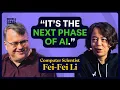
If scientists need to be fearless, I think entrepreneurs need to be more fearless. Um, fearless to me, I love this word and this is part of the way I actually do hiring is look for people, especially young people with that fearlessness. Um, fearlessness.
Um, fear fearless is to be free. is to be to get rid of the shackles that constrain your creativity, your courage, and your ability to just get done. And pardon my language, it's uh it's actually >> it's a technical term.
>> Yes. One thing I feel very strongly is in the AI age, trust cannot be outsourced to machines. Trust is fundamentally human.
It's at the individual level, community level, and societal level. Some of you might be just in the infrastructure, SAS, whatever. Um, you know, application that feels like maybe um that's more removed.
That's not true cuz you're serving people. You're serving businesses. Trust is really important.
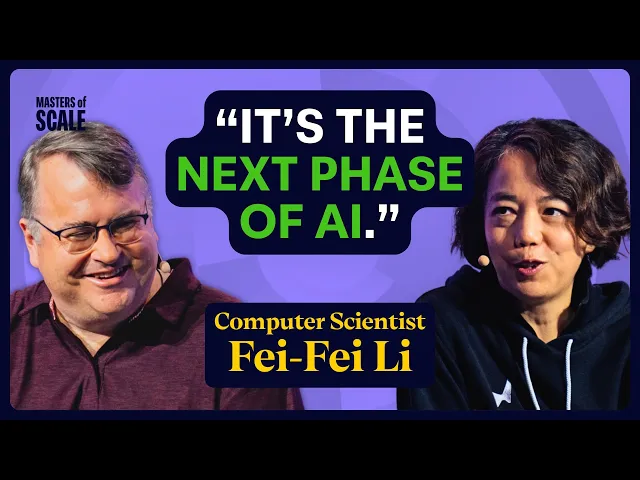
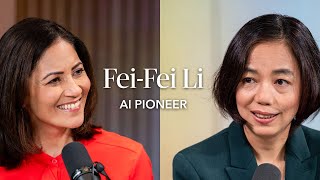
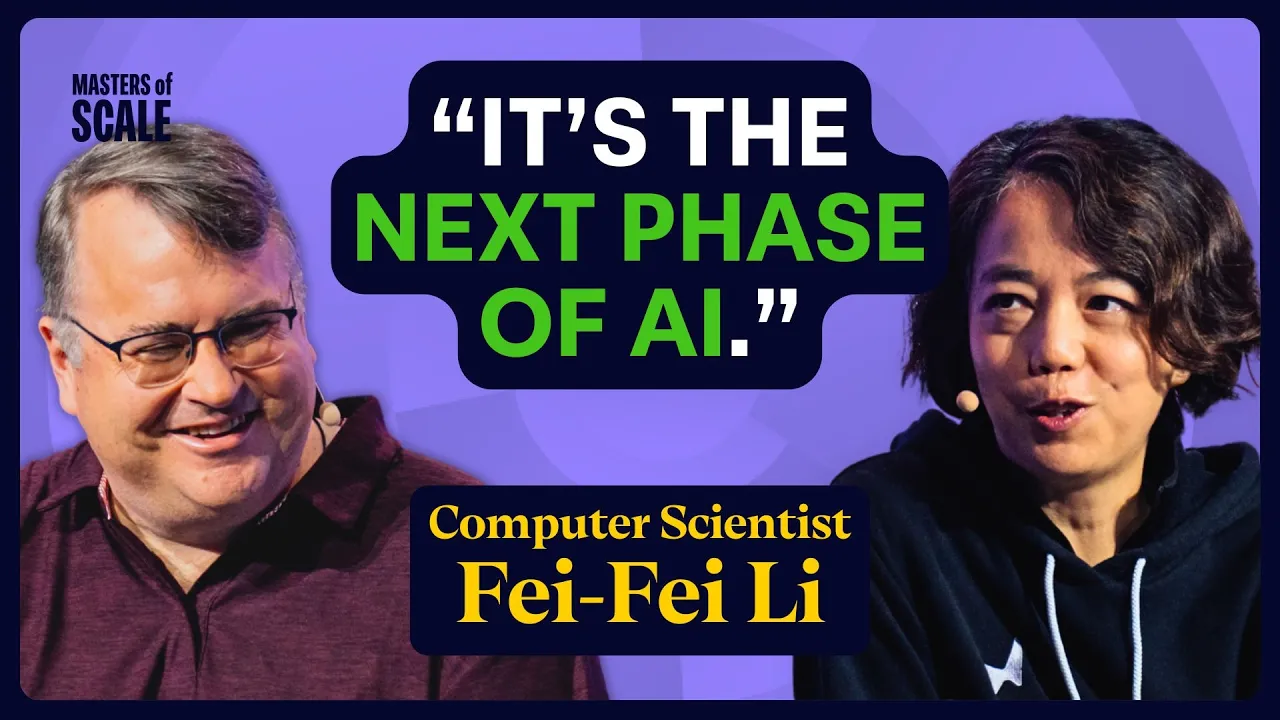
Have that human agency as the as the the the um the source of of the trust. Hey folks, this week on the show we're sharing Reed Hoffman's conversation with Dr Fay Lee from our 2025 Masters of Scale Summit. FE is a brilliant computer scientist and author who has been at the forefront of AI development for decades.
She was a founding director of Stanford's human- centered AI institute and is now the co-founder and CEO of World Labs. She joined Reed on stage for candid reflections on where we are and where we're headed as AI evolves. I think you'll enjoy this.
This is Masters of Scale. I've lost count of the number of times we've done this and it's always awesome and an honor. So, thank you for being here.
>> Thank you. I I've lost count, too. Um, so one of the things that obviously anyone who's following your career knows that you're one of the OG in the in the wave of AI, you know, ImageNet, um, all of these things that are, uh, contributions that are fundamental to where we are today.
So, by the way, thank you for that. Um, and now you're working on spatial intelligence and uh, kind of uh, world building. say a little bit about why you uh you know kind of took a a sbatical from the job you love with you know human- centered AI and and Stanford CS and started building this company and what you're doing >> right uh Reed again thank you for inviting me it's so uh what an honor to be here and I think you're referring to my startup that I'm a co-founder CEO of which is called World Labs so you know Reed you are one of the original uh supporters, investors of open AI.
So when open AI was founded, you and I talked about the dream of AGI, right? As a AI scientist, um I'm torn between the word AI versus AGI because they more or less mean the same thing for me. But language aside, what is >> actually I use AGI for the AI we haven't invented yet.
>> Okay, that's great. Um I think Alan T to actually John McCarthy probably meant the same but um so what is AGI to me? AGI to me is the capability of in intelligence of machines that um are on par with humans and in many cases can be uh superseding humans.
And I think think about this as a door to the future and on this door there are multiple keyholes and language is one of them one of the major ones because language is an essential part of uh intelligence to to the point that I know you are a quasi philosophy major that uh Vigenstein quasi is actually a a positive word at at Stanford I have to say because Reed is an alumni uh there's a very special uh uh major called um Sims uh symbolic symbolic systems. They combine philosophy and cognitive science and computer science. >> By the way, I was the eighth person to declare that major.
>> Oh my god. So many famous people uh come out of that major. Yeah.
So quasi it just means the the the the proportion. So it's it's a good word. Um >> he'll correct me later, but that's all right.
>> I'm digging myself out of a hole. Um Vigenstein says that um uh language defines the limit of world. >> Yes, >> I'm actually not disagreeing with that.
>> Excellent. >> Because I think language um defines a certain level of boundary that the world can be described in symbolic forms but beyond that the world is actually limitless. uh and uh and what is that world?
How do we define that? What does that have to do with intelligence? And how do we use machines to express that?
I lump that whole thing into world modeling. World modeling is is very connected to language. But it's about um expressing, representing and eventually participating in the changes of uh the states of the world.
And that could be virtual, it could be physical. And what does world modeling entail? It does entail language because language is one form of interrogation with the world.
But it also in entails uh the visual, the lights, the semantics, the space, the physical actions. And all of that is still at the dawn and and and in the in the it's the next phase of AI. And that's what world labs is about.
We are trying to do world modeling and we're trying to bring that level of spatial intelligence into the next chapter of AI. >> So two questions with the spatial intelligence one how would you know because there are a few people who will be deep here but a lot of people their primary experience of LLM is like you know chatbt Gemini etc. Um and um so like what what should they understand is different not just in the cognitive capabilities cuz the the our our our world is not just language and then two like what are the what is the the road ahead look like?
What are some of the challenges to overcome in getting there? >> Yeah. What what would it get us when we have world modeling?
Well um we're already seeing budding signs of that. Lots of storytellers are creatives with many media, right? Uh whether it's pixels, movies, um uh uh sculptures, um digital art.
And that is a highly highly creative interactive world that you cannot just use language to express. and uh world modeling. The ability to generate things to generate worlds that you can immerse yourself in, you can interact with is highly uh enticing and and exciting for for creators.
And that's one way you see world modeling could be applied for. This is not just for entertainment and and storytelling. This could be for design.
This is could be for even industrial uses. uh all the way to healthcare, medicine, education. Also, um the the distance between passively being passively entertained and being actively participating in experiences right now has been closing um rapidly.
And the ability to have machines to create world models that would allow that kind of immersive uh experiences is really powerful. and and that also seguates into simulation. Simulation is really important both for human experiences, human learning as well as for embodied AI.
Robots needs to learn from simulation as well as much as it needs to learn from uh uh from the real world. And we can we can really nerd out about the the history of robots including self-driving cars and the the critical roles that simulation has has played. So, so the application and and uh uh it it really is boundless.
Uh what are the challenges? I'll just call out one challenges. Well, there are actually many challenges.
Uh one challenge is data unlike language where data is all over the internet. Um when it comes to world modeling, data is not as uh obvious and and and easily obtainable compared to language. Of course, there are video data that's one of the most uh critical form of data for world modeling.
But the world like I said is very multimodel. It is very spatial. It it has fundamental 3D information, geometry, physics, dynamics and some of those are not easily obtainable.
And so um there's obviously been a lot of discussion around robotics and one of the things I think we should draw the line for everyone is to understand how critical world modeling will be to any kind of robotic ele elevation of work and the human condition. So say a little bit about like why this cognitive set is so important there. >> Yeah great question.
I spent a lot of time thinking about that because uh frankly after image that after the first wave of uh uh computer vision achieving a level of fidelity and quality I actually went into a little bit of a crisis myself and start to soul search what is perception about what is vision for right I thought it would take me aundred years to to work on the problem of uh of object recogn definition, but it it went a little faster than I thought. So, I needed another uh north star. And uh it took me back to uh evolution.
And I I started to read a lot about um evolution and some philos I'm like literally this much of a philosophy uh student compared to Reed. um is that um about 530 million years ago there was an incredible evolutionary event called Cambrian explosion where the the animal speciation just exploded where it's also the beginning of the nervous system uh nervous system the beginning of uh photosensitive uh cells and it really after reading a lot of literature and thinking it really dawned on me the the um the goal the evolutionary reason animals have perception is actually for activity for interactivity. It's active.
It's not percept uh it's not passive and that means perception and the perceptual intelligence is the foundation of movement and the beginning of movement is very uh simple. You just kind of translate your body somewhere. Quickly the movement becomes much more interactive and and you know from fighting for food to mating to nesting to uh rearing offsprings to much deeper.
I mean look at mammals and and humans. Our ability to move is very very complex. The degree of freedom we have between our fingers, toes and body, torso is very high.
And all this requires a fundamental perceptual spatial intelligence of the world we're in so that we know we understand and we can plan for all the movements. So really truly in my opinion that the the level of um nuanced complex spatial world understanding is the brain of embodied intelligence including robots. >> Yeah.
Yeah. And and actually, you know, while the robots give a particular sense where you need that embodied intelligence for them to all be embodied, there will also of course be a little bit like your opening comment on Vickenstein. The question of actual cognitive reasoning capabilities that are not just purely linguistic like this is getting a little philosophical and looking forward.
>> I love that. >> But part of what you get with spatial intelligence is other forms of intelligence that will even be important there. It isn't just in a pure perception action loop cuz you know the the old western perception as a camera and action as separate is clearly wrong.
That was the thing that you were just you know referring to. >> But it will also increase our cognitive capabilities or like the what we how we imagine the world, how we model it in our heads. What are some of the reasoning characteristics you think might come out from when you add spatial intelligence not just to robots but to every AI system?
>> That's wonderful. Reed, this is why I love talking to you. So throughout human civilization, if you look at the milestones of um humans building civilization, there's a lot of milestones that cannot possibly be achieved with just language.
The the the nuance of uh space and spatial re reasoning, world modeling is very very clear. For example, let's just take uh early days the building of pyramid, right? The the the ability to start to abstract geometry, the sense of geometry and and also the construction of large um um bodies.
There is a lot of things that goes on into that uh cognitive spatial um um reasoning that that's not this simplistic transa transactional uh behavior of I see something I want to move it right >> another example I I'll just give two example another example is the deduction of the structure of DNA if you know the history of how DNA was uh uh I've discovered of course many scientists were getting a vibe using today's language that there's something there's something that's going on in this fundamental building block of our uh uh genetics but it took um uh Franklin uh Rosalene Franklin under uh appreciated scientists to take these X-ray I think it was X-ray or some kind of X-ray imagery of the DNA molecules right? X-ray that looks like this on it's a cross on a on a flat uh imagery. >> But then Francis Crick and uh James Watson of course they they were deeply thinking about this.
But to go from this imagery to a 3D double helix intertwined structure >> is deeply spatial. >> Yeah. >> You cannot language your way into this deduction.
I'm sure language participated. I'm not anti- language, you know. I love being >> I speak I am pro language.
>> Exactly. Exactly. Um but that is a a beautiful example of humans using spatial reasoning and cognitive ability uh to to do something or discover something uh we've never done.
So I think that as we empower AI with this ability, this is not just for robots that can, you know, pick up a pick up a glasses or or a cube. This is for uh lifting all of humanity's capability because we can collaborate with machines um having this capability. >> Yeah.
Awesome. And I actually have never heard the DNA answer from you before. So I love asking you questions that you've that I have never asked you before.
It's one of the things that's that's awesome. Um so switching to you know kind of one general thing is obviously there's a lot of discourse around is AI overhyped underhyped. We're obviously here in the valley so everyone in the valley more or less thinks underhyped.
you know, people want to say the um uh you know, kind of the question of like, well, is it um are we going to go through another AI winner? What's your kind of view about this discussion about what's going on with AI? What would you say?
Hey, this is the parts that are underhyped. These are the parts that are maybe a little too soon, right? Versus overhyped.
What should what's the guide to the wise on the current discourse and see uh sorting wheat from chaff a little bit? >> Oh boy, I have to be careful how I answer this question, but I totally appreciate this. Um AI is a civilizational um technology.
I'm I'm not the only one saying this, but I truly believe because uh it is even if you're inspired by humans and evolution, this is the ability to intellectualize and to think to do is fundamental to um to to humans and a piece of technology that can do that is is phenomenal. uh it's in my opinion it's more or less not not overhyped as a intellectual future of the humanity because AI is the new computing if you look at today's world and just recognize where there are chips you know because chips are the physical places where computing happens from a light bulb to a self-driving car to an airplane everywhere there's chips well it's very obvious at this point wherever there is chip there's compute wherever there's compute there will be AI if it's not there so from that point of view both from a business as well as use case point of view a AI is the future obviously um when it comes to hype I do think we have to be uh a bit nuanced for example there are really you know we I think we were just saying backstage. It took more than 20 years to go from um Sebastian Thrum's um um first self-driving car that can drive a car 130 miles in the Nevada desert which has no traffic apparently.
Um to Whimo running in um uh San Francisco, right? Well, you might say, well, because part of it is software it was pre-deep learning age and uh software uh development was slower. You're right.
It's uh definitely deep learning accelerated the brains of self-driving car. But let's also not forget that car industry, the entire supply chain as well as customer use basis has been established for more than 100 years and it's a very very mature business model and very mature infrastructure and and manufacturing and everything. So if it took 20 years to get just cars, which is the simplest form of robot um um on the street, you know, >> Roombas, but you know, >> I I was thinking I knew he's going to say that.
Yes. So yeah. Well, Roombas are mini cars.
>> Yes. So um rumors actually I think cars are you know it's literally a squareish box that moves on 2D surface and the only thing you have to do is not to touch anything right cuz if you touch you're screwed and robots does touch and by and large it's okay. Um but robots the the whole thing about robot is it's a threedimensional machine that that the whole goal is to touch things.
>> Yeah. >> And touch it in the right way. I mean this is huge.
So I think there's still going to be a journey for robotics for sure. Yeah. >> 100%.
So one of the things to realize this uh civilization technology is to build trust and whether it's through technologists companies etc etc. What do you think the things we should be doing as leaders as as companies as entrepreneurs to help build trust because it's obviously we only start realizing the real benefits once we get there. >> Yeah great question.
I know you and I both care about this. One thing I feel very strongly is in the AI age trust cannot be outsourced to machines. Trust is fundamentally human.
It's at the individual level, community level and societal level. And this is why Reed was part of our supporters for the human center AI institute at uh Stanford. We we established that um 2018.
So uh way before the this latest wave of uh uh uh AI u blossoming is because we re recognize that um as machines get more powerful in its computing and reasoning and and eventually even uh actionable uh capabilities. Uh we need to establish a new norm that is needs to be part of the fabric of the society where in within this norm humans continue to have the agency to uh build trust with each other with the newer tools like AI with more powerful product like chat bots and and other things and eventually this trust has to be renewed or or updated into our governance model not just the governance of community and companies but governance of of the society at large. So I do think trust is a very very important uh um element for though this audience is very entrepreneurheavy.
I would just say that care about this from the beginning no matter what product or business you're doing. Some of you might be in healthcare. You know how important it is.
Some of you might be just in the infrastructure SAS whatever um you know application that feels like maybe um that's more removed. That's not true because you're serving people. You're serving businesses.
Trust is really important. have that human agency as the as the the the um the source of of the trust. >> Yep.
Uh 100%. And uh you know part of when Yes. um you know part of the work that you know you and etch were leading with the human- centered AI which came from your uh New York Times column um which is part of the christristening of it is part of the thing that led me to focusing on agency is one of the things that elevation of human agency as one of the key things that we need to do.
Um uh you know one of the things I love talking to you is like we could literally fee and I could go on for hours. We only have a few minutes left. Um, but it's like ambient intelligence, you know, for what does that mean for medical care?
There's just all these things as part of the whole OG thing like and and and on every subject you go deep. So, let's go to kind of the science side of it. >> Um, for perhaps our closing question, which is um you said it's important for scientists to be intellectually fearless.
So um you know kind of have a fearlessness about it. Um what does that mean for how we should think about inventing the future? What does that mean for how science should progress?
What's the what in the terms of the next generation of innovators? Um where should fearlessness play into that? >> Great.
Thanks for asking that question. Well, if scientists need to be fearless, I think entrepreneurs need to be more fearless. Um, fearless to me, I love this word that this is part of the way I actually do hiring is look for people, especially young people with that fearlessness.
>> Um, fearlessness. >> Um, fear fearless is to be free, is to be to get rid of the shackles that constrain your creativity, your courage, and your ability to just get done. And pardon my language, it's uh it's actually >> it's a technical term.
>> Yes. >> It's actually in our core culture of our company. So um is that um you know humans are not exactly the most fastest, strongest, you know, animals on earth, right?
We we were if you look at many of the dimensions, I was just in Africa this summer with my kids. I mean there's there's so many animals that are just so much better than us but but I I do feel that way and >> lots >> yes and uh but there's something that is in our brain in our mind in our soul that can propel us to do incredible things for the world for ourselves for each other and a lot of that come from our fundamental uniqueness of our creativity. ity and our sense of community, our and all this.
And in order to unleash that, especially as technology is moving so fast, to me the the foundational emotional criteria is be be creative, be free. And that translate into be fearless. Run into uncertainties.
Run into bold ideas that no one has make it happen yet. Run into contrarian hypothesis. Run into hard hard tasks.
Um, someone said, I forgot who said that the easy tasks tasks that are so uh certain versus tasks that are uncertain are sometimes equally hard. >> TR's the one that's more uncertain because you know your fre uh your creativity will be working harder and that's where the the magic happens. So, I I love the word fearless because that's where boundaries are broken and creativities are unleashed and uh and magical things happen.
And and with that, you can see why we wanted to open the first fireside with Fay. Let's give her a hand. >> Thank you.
Thank you. >> Thanks to Dr Dr Faith A Lee for joining us at the Masters of Scale Summit. This conversation was recorded on stage at the Presidio Theater in San Francisco.