Hello and welcome to the long shadow. There is an idea developed by a philosopher in the middle of the 20th century that has quietly shaped the way scientists run experiments, the way doctors test treatments, the way courts weigh evidence, and the way democratic governments are supposed to design policy. It is not a complicated idea. In fact, once you hear it, it feels almost obvious. And yet before this philosopher Arrived at it, the entire western tradition of rational inquiry had been moving in precisely the opposite direction for over 2,000 years. The idea is this. A theory
does not become scientific by gathering evidence that confirms it. It becomes scientific only when it is willing to risk being proven wrong. That is it. That single reversal. And the man who built a philosophical career around it was Carl Pauper. Now, most people who encounter Popper's name Hear it attached to the concept of the open society. The phrase itself has become something of a political banner in the 21st century, claimed by foundations, contested by governments, and cited in arguments that Poa himself would have found deeply strange. Others know him as the philosopher who took on
Plato, who dismantled the intellectual foundations of Marxism, who argued that history has no predetermined destination. These things are all true, But they are the public face of a private argument. And the private argument is more interesting because the man who became the 20th century's most rigorous defender of intellectual humility began his life as a true believer. Carl Pupa spent part of his youth as a committed socialist. Drawn to the certainty of a system that promised to explain everything. He was briefly attracted to Marxism, seduced by the same quality that draws Many young people to sweeping
ideologies. The feeling that you have finally at last understood how the world works, that the confusion and the cruelty and the inequality around you are not random, that there is a pattern and a solution and a destination. He did not stay long. What drove him away was not disillusionment in the ordinary sense. It was something sharper, a philosophical realization that arrived as the most important realizations Sometimes do, not in a lecture hall or a library, but on a street corner, in a moment of genuine consequence. And that moment planted a question in him that he
would spend the next seven decades trying to answer. Not what is the right political system, not what is the true nature of the universe, but something prior to all of that. something that had to be settled before any of those larger questions could be approached honestly. How do we know when a theory actually Tells us something about the world rather than simply telling us what we already believe? That question, that single deceptively quiet question, became the engine of one of the most wide-ranging intellectual careers of the modern era. It moved through the philosophy of science,
through political theory, through the history of ideas, through evolutionary epistemology and eventually into the very structure of democratic institutions. It began in Vienna at the beginning of one of Europe's most volatile centuries. And it began, as so many things in Papa's life did, with something going wrong. To understand how a man arrives at a philosophy built entirely on doubt, you have to first understand the world that taught him to want certainty, you have to go back to the city, back to the moment before the question existed. Back to Vienna in the years when the 20th
century was just beginning to show its Teeth. But before any of that, before the philosophy, the exile, the knighthood, the arguments that still echo through university departments and policy rooms and courtrooms today, there is one thing worth sitting with. Popper's most famous idea is that our most important theories must be willing to be proven wrong. And yet his most important idea has never been disproven. That particular irony would not have been lost on him. Vienna at the turn of The 20th century was a city that believed in ideas the way other cities believed in armies.
It was the capital of the Austrohungarian Empire. A place of roughly 2 million people of extraordinary architectural grandeur and equally extraordinary social pressure. The ringstrasa boulevard had been built in the previous decades as a deliberate statement wide enough for imperial processions flanked by opera houses, museums and parliament buildings Designed to announce that this city was the inheritor of Athens and Rome. That civilization in its truest form lived here and in certain ways it did. The Vienna of 1900 was producing minds at a rate that seems in retrospect almost impossible. Ziggman Freud was developing psychoanalysis in
a consulting room on the Burgas. The composer Gustaf Mara was conducting at the court opera. The philosopher Ludvig Vitkinstein was a teenager in one Of the city's grandest private houses already developing the unease with received ideas that would define his life. The architect Ardolf Loose was arguing with great ferocity that ornamentation was a kind of crime against reason. The painter Gustaf Climpmpt was covering women in gold. The painter Egon Sheila was uncovering everything else. There was an energy in the city that felt to those living inside it like standing at the edge of a New
world. As though the accumulated knowledge of the 19th century was finally producing something that could replace the old certainties. Religion was weakening its grip on the educated classes. Science was offering new explanations for the physical world. Political movements, Marxism among them, were promising to replace the accidents of birth with the rationality of planned society. But Vienna had another quality, one less celebrated in the retrospective Accounts. It was frightened. The Austrohungarian Empire was vast and was also fraying. It contained over a dozen distinct ethnic and linguistic groups who wanted with increasing urgency their own states, their
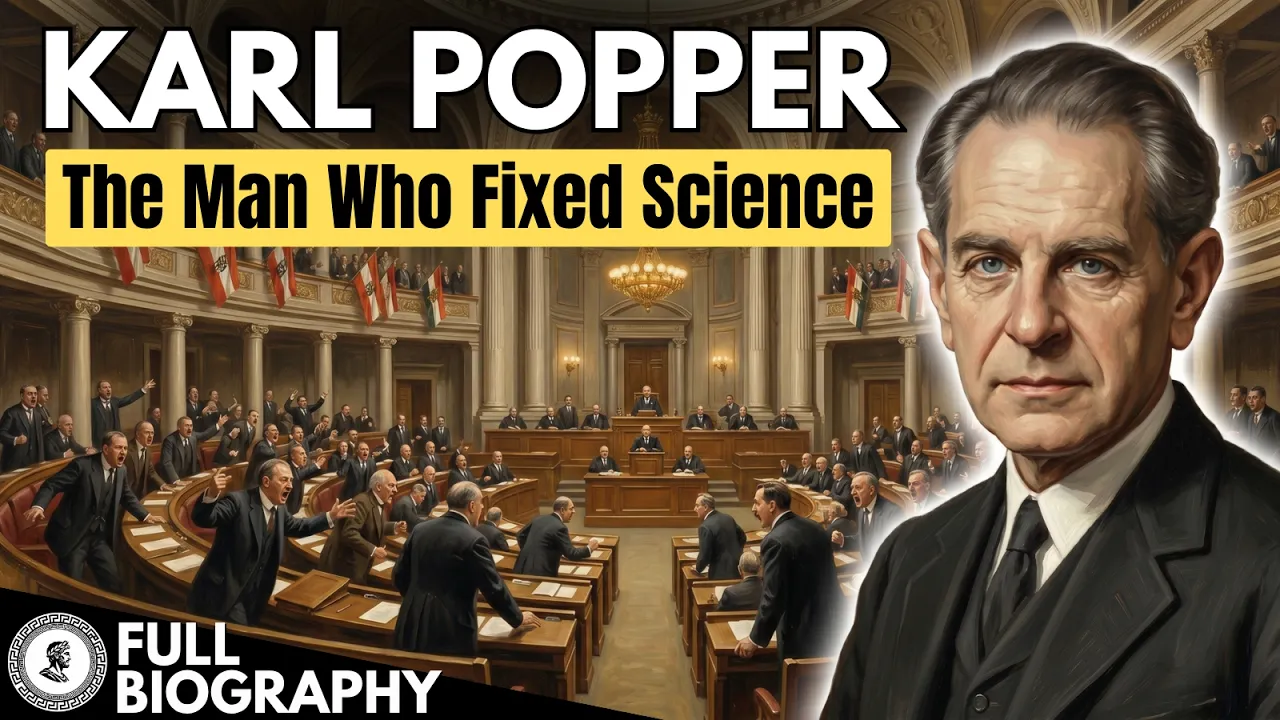
own languages, their own identities. The empire's response to this pressure oscillated between accommodation and repression, and neither worked particularly well. In the parliament building on the ringstrasa, political sessions sometimes descended Into members banging desk lids and shouting in several languages simultaneously so that no one else could be heard. This was the formal political culture of Carl Pa's birthplace. And beneath it all ran something darker still. Anti-semitism in Vienna was not a fringe position. It was a political platform. Carl Luga, the mayor of Vienna from 1897 to 1910, had built his career on it. He was
popular, charismatic, and openly hostile to the city's Jewish Population. Jewish vianese families responded in various ways. Some converted, some assimilated as thoroughly as possible, changing names, abandoning religious practice, emphasizing their Austrianess above every other identity. Some retreated into specifically Jewish intellectual and cultural networks. Some simply left. The Pa family occupied the assimilated middle ground. They were Jewish by heritage and entirely secular in Practice. They lived, thought, and worked as vianese professionals. They spoke German. They read the same literature, attended the same concerts, debated the same philosophical questions as their non-Jewish neighbors, and they carried, like
almost every Jewish family in that city at that time, a particular kind of ambient awareness, the knowledge that their belonging was conditional in ways that could never quite be acknowledged openly. This was the Pressure cooker that KL Popper was born into. A city of extraordinary intellectual productivity built on foundations that were quietly cracking. A place where grand systems of thought were being constructed and celebrated at exactly the moment when the social order those systems were supposed to explain was becoming less and less stable. The philosophies Vienna produced in those decades, psychoanalysis, logical positivism, political marxism,
Austrian Nationalism and its ugliest offspring all shared one quality. They were systems that explained everything. They left no event unaccounted for, no human behavior outside their reach, no exception that could not be incorporated. A young man growing up in that atmosphere would either embrace a system or learn to distrust the very idea of one. Carl Pauper would eventually do both, and the distance between those two positions is the Distance his life would travel. Carl Ryman Pa was born on the 28th of July 1892 in the Pensing District of Vienna. He was the youngest of three
children. His father, Simon Siegman Carl Pauper, was a lawyer. But to describe him only that way is to miss the most important thing about him. Simon Pauper kept somewhere between 12,000 and 30,000 books in his home. The accounts vary, but every account agrees on the scale of it. The family apartment Was arranged around books the way other families arranged their lives around furniture. They were in the study along the hallways in stacked reading piles throughout the rooms. Simon read Greek and Latin for his own pleasure. He worked through philosophy, history, and the natural sciences as
a matter of personal interest, not professional necessity. He was, in the most literal sense, a man who believed that ideas mattered. Carl's mother, Jenny Schiff, Had been trained as a pianist and brought to the household a love of classical music that was, if anything, even more active than her husband's love of books. She played regularly. She encouraged her children to listen and to learn. And it was from her directly and without ambiguity that Carl Pa inherited what would remain one of the great passions of his life. Not philosophy, not science, music. He studied the cello
from childhood and pursued it with the Seriousness of someone who genuinely considered it a possible vocation. As an adolescent, he practiced with the kind of focused attention that he would later bring to philosophical problems. And there is something more than biographical coincidence in this. The discipline of music, the way it demands that you sit with structure and then find the space inside it left a particular imprint on how poa thought. He would later describe mathematical and Musical reasoning in connected terms. The formal beauty of a well- constructed argument meant something to him that was not
entirely separate from the beauty of a well-resolved phrase. And yet, for all the books, for all the music, for all the extraordinary intellectual atmosphere of that household, Carl Pauper was by his own cheerful admission not a remarkable student. This is the detail that complicates the expected story. The philosopher of scientific Rigor struggled through secondary school without distinction. He found the curricula dry and was frustrated by instruction that asked him to memorize rather than to question. He was drawn more to conversations, to arguments with friends, to the street level intellectual life of Vienna's coffee houses than
to the formal requirements of the classroom. When he eventually enrolled partly and irregularly at the University of Vienna, He did so without a specific program of study. He was in the parliaments of the time auditing life. What is clear looking back is that Popper's education in those years was genuinely happening, just not where institutions expected to find it. Vienna in the years after the First World War was alive with political and intellectual energy of a very particular kind. The empire had collapsed. The republic that replaced it was fragile and contested. Unemployment Was severe. And into
this environment, various movements, socialist, nationalist, psychoanalytic, scientific, were all competing for the allegiance of young people who had grown up watching the old certainties dissolve. Carl Pa walked into all of it. He attended lectures across different departments without committing to any. He read voraciously in the somewhat chaotic manner of someone following their curiosity rather than a syllabus. He Played music. He argued. He listened. He was not yet a philosopher. He was not yet certain of anything, but something was building in him. A restlessness, an instinct that the ready-made answers surrounding him in that city did
not quite fit the questions he was actually trying to ask. He just had not found the right question yet. In the spring of 1919, Carl Pa was 26 years old and Vienna was a city in crisis. The First World War had ended 6 months earlier With the collapse of the AustroHungarian Empire. The peace settlement had reduced Austria to a small landlocked republic with an economy that barely functioned. Food was scarce. Unemployment was acute. The political situation shifted week by week with social democrats, Christian conservatives, and more radical factions competing for control of a state that
felt to many of its citizens like it had been built on the ruins of something much larger and was not yet sure what it Was supposed to become. It was in this atmosphere that POA, like a significant number of young vianese intellectuals, was drawn toward Marxism, not to its most doctrinary forms, but to the version circulating in the student discussions and political meetings of the time. The version that presented itself as science, as the rational analysis of history and economics, the version that said, "We can understand why the world is the way it is, and
we Can predict with confidence where it is going." He joined the Association of Socialist School Students. He attended meetings. He read for a period. He participated in the organizational activities of the Communist Youth Movement in Vienna, though he never formally joined the Communist Party. The appeal was real. He was young. He was living in a city where inequality was visible on every street. And here was a system of thought that Claimed to explain all of it and offer a path forward. Then came the demonstration. The precise date is recorded in Poppa's autobiography as sometime in
June of 1919. A march organized by members of the communist youth movement in the vicinity of the Hurdorf area of Vienna was met by police. The confrontation turned violent. Several people were killed. Poa was not present at the moment of the killings, but he was close Enough to understand what had happened. and he knew because the political discussions he had been part of were absolutely clear on this point how the Marxist framework interpreted such events. The deaths were regrettable, yes, but they were also within the theory explicable, even necessary. Historical progress, as Marxism understood it,
moved through conflict. The suffering of individuals in the present was part of a larger Scientifically understood trajectory toward a better future. The theory absorbed the deaths without contradiction, without revision, without any moment of genuine reckoning. And that was the thing that stopped Papaold. Not the violence itself, though the violence disturbed him deeply. What disturbed him more was the realization that nothing, not the deaths of these young people, not any imaginable outcome of any demonstration, not any sequence Of events whatsoever, could constitute evidence against the theory. If the revolution succeeded, that confirmed Marxism. If it was
suppressed, that confirmed Marxism. If people died in its service, that was the necessary cost of historical progress. The theory could not be wrong because it had been constructed in such a way that every possible event became further confirmation of it. Poa walked away from that period of his Life carrying a question that had no easy answer. What exactly is the difference between a theory that explains the world and a theory that merely explains itself? He had seen in the most concrete possible terms that the difference was not academic. A theory that could not be proven
wrong could justify anything, could absorb any atrocity, could look at young people killed in a street and call it progress. He left the communist youth Movement. He returned eventually to his music, to his reading, to the irregular and exploratory education he had been pursuing in the coffee houses and lecture halls of Vienna. But the question did not leave him. It followed him through years of study, through an uncertain early career, through the political catastrophes that were already building on the horizon. He would not find an answer quickly. The working out of that question would take
another Decade and a half. But every idea he would eventually become famous for, every argument in every book, every challenge to every system of thought, traces its origin to that street corner in June of 1919, where a group of young people died, and a theory incorporated their deaths without flinching. He walked away from that corner, no longer a Marxist, but not yet a philosopher. What he had was a question, burning and precise. How can we tell the difference Between a theory that explains the world and one that merely explains itself? That question was about to
become a life's work. Vienna in the early 1920s was not a city that made it easy to become a philosopher. The republic was poor. Inflation had gutted middle-class savings. The university system was overcrowded with young men returned from a war that had consumed four years and left them with credentials worth less than they had hoped. Carl Pa navigated this environment in a way that looked from the outside like aimlessness. He enrolled at the University of Vienna without committing to a single faculty. He studied mathematics and physics alongside psychology and education. He supported himself by working
as a cabinet makers apprentice for a period, then as a paid social worker with at risk children in the city's poorer districts. To those watching, it might have seemed like a Young man who could not decide what he wanted. Looking back, it reads differently. Poa was constructing an education that no single department could have given him. He was moving between the formal precision of mathematics and the messier, more contested claims of the human sciences, and he was doing so at exactly the moment when that contrast became the central question of his intellectual life. The encounter
with Alfred Adler Pushed that question into sharp focus. Adler was one of the most prominent psychologists in Vienna at the time. A former associate of Freud who had developed his own school of individual psychology centered on the concept of the inferiority complex and the human drive for superiority. Papa had some contact with Adleran circles during his social work and what he observed there troubled him in a way he initially struggled to articulate. It Was this. No human behavior seemed to lie outside the theory's reach. A child who acted aggressively was expressing a drive for superiority.
A child who withdrew was equally expressing a drive for superiority but through avoidance. A person who helped others was compensating for feelings of inferiority. A person who dominated others was compensating for feelings of inferiority. Every conceivable action in Every conceivable direction confirmed the theory. And when Poa raised this with an Adleran colleague, describing a case he thought might not fit the framework, the colleague absorbed it without any difficulty at all and explained with complete confidence how it confirmed what Adler had said. Poa was not questioning Adler's clinical insights, some of which he found genuinely interesting.
He was questioning something more fundamental. A theory that could explain every possible human behavior was a theory that explained nothing. It had made itself invulnerable by making itself infinitely flexible. And a theory that cannot be threatened by any evidence is not responding to the world at all. It is merely projecting a story onto it. Around this same period, Poa was reading about the work of Albert Einstein. Specifically, he was following the story of the 1919 solar eclipse expedition in Which the British astronomer Arthur Edington had measured the bending of starlight around the sun during totality.
Einstein's general theory of relativity had predicted this bending. It had predicted a specific angle and Edington's measurements had confirmed it. What struck Poa was not the confirmation. It was what Einstein had been willing to risk. The prediction was precise enough that if the observations had come out Differently, the theory would have been in serious trouble. Einstein had said in effect, "Here is what my theory requires to be true. Go and check. If it is not true, then something is wrong with my theory." Adler had never done anything like that. Freud had never done anything like
that. Marxism had never done anything like that. And the difference Papa was beginning to see was not a matter of complexity or intelligence or mathematical sophistication. It was a Matter of intellectual honesty. A theory that is willing to be proven wrong is doing something that a theory protecting itself from all possible contradiction simply cannot do. It is reaching out and making contact with reality. That was the distinction. And it was not yet a formal philosophical argument. It was still an intuition, still raw. But Einstein's willingness to stake his theory against observation had given Poa something
Adler's explanations never Could, a model of what genuine intellectual courage actually looked like. By the mid 1920s, Vienna had become the unlikely capital of a new movement in philosophy. It gathered around a group of thinkers who met weekly in a seminar room at the university under the leadership of Moritz Schlick, a physicist turned philosopher who had been appointed to the chair of the philosophy of the inductive sciences in 1922. The group included Rudolph Carnap, Ottoath, Herbert Fel, and Friedrich Veman among others. They called themselves eventually the Vienna Circle and what they were building was called
logical positivism. The core commitment was ambitious and in its way beautiful. They wanted to place philosophy on the same secure footing as the natural sciences. They wanted to strip away the centuries of metaphysical speculation that they considered meaningless and Replace it with a rigorous criterion for what could be meaningfully said at all. Their test was verification. A statement was meaningful if and only if it could in principle be confirmed or disisconfirmed by sensory experience. Statements about electrons, about the boiling point of water, about the distance to the moon. These were meaningful because they were verifiable.
Statements about God, about the ultimate nature of being, about the purpose of History. These were not false. They were literally meaningless. They said nothing. It was a powerful program, and it resonated with the broader cultural mood in Vienna, which had grown deeply suspicious of the grand metaphysical claims that seem to keep producing ideological catastrophes. Pa was not a member of the Vienna circle. He was too young for the core group, too argumentative for the collaborative atmosphere Schlick Preferred, and his relationship with several of its members was conducted more through mutual acquaintance than direct participation. But
he engaged intensely with their ideas. He read their papers. He corresponded with some of them. And he disagreed with them at a level so fundamental that the disagreement defined his entire early philosophical project. The problem with verification, as Popper saw it, was that it could not do what the Vienna Circle Needed it to do. Take a universal scientific law, something like all copper conducts electricity. To verify this statement, you would need to test every piece of copper that has ever existed and ever will exist. That is obviously impossible. No finite number of observations, however large,
can logically establish a universal claim. You can collect a million confirmations and still cannot be certain the next case will not be the Exception. This problem had been recognized since the Scottish philosopher David Hume in the 18th century. It was called the problem of induction. The Vienna circle had not solved it. They had built their entire program on top of it. But Pa noticed something asymmetric. While no number of confirming instances can prove a universal statement, a single counter example can disprove it. Find one piece of copper that does not Conduct electricity and the universal
claim is finished. The logical relationship between evidence and theory runs cleanly in one direction, not the other. Falsification is logically possible in a way that verification is not. This was not a minor adjustment to the Vienna circles program. It was a complete inversion of it. Poa was not saying that meaningful statements must be verifiable. He was saying that Scientific statements must be falsifiable. The demarcation criterion as he called it was not between the meaningful and the meaningless. It was between the scientific and the non-scientific. The Vienna Circle was trying to answer a question about language
and meaning. Poa was answering a question about knowledge and method. The two programs sounded similar from a distance. Up close, they were almost opposites. Schlick and some Of his colleagues recognized the originality of what Pa was doing. Carnap engaged with his argument seriously. But the Vienna Circle was a school with a program and Pa was a critic who had identified what he believed was a flaw at its foundation. He was in the language of the group's internal culture, a problem, a welcome one for some, an irritant for others. He was also increasingly a philosopher with
a book to write. The question he had Brought with him from that Vienna street corner, sharpened now against the problem of induction and the failure of verification, had found its formal shape, and he was beginning to understand that the shape of the answer was going to upset a great many people who thought they already knew what science was. In 1934, Carl Pa published a book that changed the way educated people thought about what science actually is. It was called Logic Deforong, the logic of scientific discovery. It appeared first in a series edited by members of
the Vienna Circle, which was itself a small irony given how thoroughly it challenged their foundational assumptions. The book was not long by academic standards. It was dense, carefully argued, and written with the kind of controlled precision that suggested its author had been working toward it for a very long time, which of course he had. The central argument can be stated simply, science does not work by accumulating confirmations of existing theories. It works by constructing bold hypotheses and then attempting as rigorously as possible to destroy them. A hypothesis that survives genuine attempts at falsification gains credibility,
not because it has been proven true, but because it has been shown to withstand the tests we have thrown at it so far. a hypothesis that Cannot in principle be tested that incorporates every possible outcome as a confirmation that has been designed to be safe from reputation. That hypothesis is not science at all. This was falsifiability as a formal criterion and PA was careful to explain what it did and did not mean. It did not mean that a theory must be simple. Einstein's general relativity is extraordinarily complex. It did not mean that a theory must
be immediately testable with Current technology. Some theories make predictions that take decades before the instruments exist to evaluate them. It did not mean that a single failed test should automatically destroy a theory. Scientists are right to examine their apparatus, their assumptions, their methodology before concluding that a reputation is genuine. What falsifiability required was this, that the theory, taken seriously on its own terms, must forbid certain observations, That there must be something which, if it occurred, would count as evidence against it. Poa illustrated the point with the contrast that had been building in his thinking since
his encounter with Adler in his reading of Einstein. A theory that forbids nothing, that can absorb any result without modification, has made itself unfalsifiable. And an unfalsifiable theory, no matter how elaborate, no matter how emotionally satisfying, no matter how many followers It attracts, has placed itself permanently outside the reach of rational correction. The implications ran in two directions simultaneously. The first was about scientific method. If science advances through conjecture and reputation rather than through verification, then the most valuable thing a scientist can do is not to gather more evidence for what they already believe, but
to construct the most severe possible test against it. The scientist's job is to try to prove themselves wrong. This was not how most working scientists in 1934 described their own practice, but it was, Popper argued, what the most successful scientific episodes in history actually looked like when examined carefully. The second implication was about intellectual honesty more broadly. Falsifiability was a criterion that could be applied anywhere to any system of thought claiming to Describe the world. And what it revealed when applied to the systems Pa had grown up surrounded by was bracing. Freudian psychoanalysis forbade nothing.
Adrian psychology forbade nothing. Marxist historical theory in its developed form had been constructed with sufficient flexibility that no political event, no economic failure, no historical reversal could count as decisive evidence against it. This was not a coincidence. These systems had evolved their Unfalsifiability as a feature. A theory that cannot be refuted is from the perspective of its adherence the most secure possible basis for certainty. Poppers book said something different. He said that security purchased by making yourself unfalsifiable is not intellectual security at all. It is intellectual paralysis. You have made yourself impossible to correct. The
book was received with serious attention in Germanspeaking Philosophical circles. The Vienna Circle engaged with it. Carnap reviewed it. Critics raised objections, some of them substantial, and Pa responded to them with a rigorous care that itself demonstrated something about his conception of intellectual exchange. He welcomed reputation of his own ideas. He had, after all, argued that the willingness to be refuted was the only honest posture a thinker could adopt. What PA could not have known in 1934 was That the book would take nearly three decades to reach the English-speaking world, appearing in translation only in 1959.
By then, the world it was written in had been destroyed, and Poa had already written the books that would make him famous for something that went far beyond the philosophy of science. But those books were still ahead. First, there were more pressing questions. questions about whether he and Henny Would still be in Vienna long enough to find out how the philosophy was received. In 1930, Carl Pa married Josephine Anna Henninger. Everyone who knew her called her Henny. She was a school teacher, practical and intellectually serious, with a tolerance for Poa's argumentative intensity that those who
encountered him in professional settings often found difficult to maintain. She had known him through his years of uncertain study and Irregular employment. She had watched him build argument by argument the philosophical position that was now finding its first published form. And she had done something that tends to be under reprepresented in the histories of great thinkers. She had typed it, edited it, organized it, caught the errors and inconsistencies that a mind moving as fast as poppers inevitably left behind. Their marriage was, by every account that survives, a genuine intellectual Partnership. Not the kind where one
partner performs the role of support while the other claims all the intellectual credit, but something more honest than that. Henny understood the ideas. She engaged with them. And Poa, for all the forcefulness of his intellectual persona, appears to have genuinely relied on her judgment in ways that went beyond logistics. She was also in 1930 marrying into a situation of considerable material uncertainty. Poa had obtained a position as a secondary school teacher of mathematics and physics after completing his doctorate in 1928. It was stable enough but it was not the academic career he wanted. He was
writing and publishing. He was making a name in specific vianese intellectual circles. But the transition from a promising local figure to an established academic philosopher was not guaranteed and the world around them was Deteriorating in ways that made professional uncertainty feel by comparison almost minor. By 1933, Adolf Hitler had taken power in Germany. The border between Germany and Austria was not just geographical. It was increasingly a boundary between what had been and what might soon arrive. Austria's own government was moving in an authoritarian direction. Chancellor Engelbert Dolphus suspended parliamentary government in March of 1933 and
ruled by emergency decree. The streets of Vienna carried a new kind of tension. For Jewish families, the calculation had acquired an urgency that was difficult to discuss openly and impossible to ignore. Papa's family background was secular, but it was Jewish, and he understood what that meant in the political atmosphere that was building. Friends and colleagues were beginning to leave. Some went to Britain, some to the United States, some to Palestine. Each departure was a small acknowledgement of something that still felt, to those remaining, slightly unreal. The conversation Popper and Henny had during these years, the
quiet recurring question of whether to stay or go, was a version of the same conversation playing out in tens of thousands of homes across Austria and Germany. What made it specific to them was the complication that Pa had just published the book of His life. He was receiving letters from philosophers across Europe. He was being read, criticized, engaged with. To leave now was to leave at the precise moment when staying seemed professionally to finally make sense. But the professional logic was becoming harder to hold on to as the political logic grew more insistent. Poa was
not naive about what was coming. He had spent a decade analyzing systems of thought that justified everything that Happened within them as necessary. He understood at a level more precise than most exactly what kind of certainty was now organizing itself on the other side of the German border. The question of whether to leave Austria stopped being abstract sometime in the mid 1930s. What remained was only the question of where to go. Before we follow Poer out of Vienna, we need to sit with the full weight of what falsifiability actually claimed. Because the criterion itself is
One thing. What it revealed when applied to the most celebrated intellectual systems of the age is something else entirely. Popper was not working with hypothetical examples. He was working with Sigman Freud, Alfred Adler, Karl Marx, and Albert Einstein. These were not obscure figures. They were between them the dominant intellectual forces shaping the 20th century's understanding of the human mind, of society and history, and of the physical universe. And Popper's criterion applied to each of them in turn produced results that were almost scandalous in their implications. Start with Freud. Psychoanalytic theory held in broad terms that
human behavior is driven by unconscious forces, that childhood experiences shape adult psychology in ways the individual cannot directly observe, and that symptoms of mental disturbance are expressions of repressed conflicts. Now, what human behavior Could this framework not explain? What action, what feeling, what symptom, what dream could a trained analyst not incorporate into the psychoanalytic account? The honest answer was none. Every possible piece of human behavior was within the theory available as confirmation. The man who loved his mother and the man who hated her were both within the framework explicable on precisely the same terms. The
theory had been built to be comprehensive, and Comprehensive in the sense Pa cared about meant unfalsifiable. Adler's individual psychology was even more explicit about this. As Poa described it, with a dry precision that barely concealed his exasperation, the Adleran analyst could explain every case in terms of the inferiority complex, regardless of what the case actually looked like. The theory was, in Poa's phrase, not testable, not refutable, and therefore Not scientific. This was not a comfortable conclusion in Vienna in the 1920s. Psychoanalysis had enormous cultural prestige. Freud was a towering figure. Poa was a young man
with a doctorate and a school teaching job, but he pressed the point anyway because what he was questioning was not Freud's intelligence or the clinical usefulness of specific psychoanalytic concepts. He was questioning the epistemological status of the theory as a whole. Then There was Marx. Historical materialism in its developed form held that the economic base of a society determines its political and cultural superstructure. That class conflict drives historical change and that the movement of capitalism toward its own contradictions and eventual collapse was not a prediction so much as a law. What would count as evidence
against this? What event, what economic development, what political outcome could a committed Marxist not incorporate into the framework? Again, the answer was very little. Capitalist resilience was explained as a temporary adjustment. Reformist progress was explained as a delay before the inevitable. Failed revolutions were explained as premature. The theory had enough flexibility to absorb almost any result and continue making the same predictions. Einstein's general theory of relativity was different in a way that had nothing To do with its mathematical elegance or its revolutionary content. It was different because it made precise specific predictions that could have
gone the other way. The bending of light around massive objects during a solar eclipse, the procession of the perihelion of Mercury, the gravitational red shift of light. These were not vague gestures toward a general tendency. They were numbers, specific angles, specific rates. If Edington's measurements in 1919 had come back differently, Einstein's theory would have faced a genuine challenge. Einstein himself said something to this effect. Asked what he would have concluded if the eclipse observations had failed to match his predictions. He said to have replied that he would have been sorry for God because the theory
was correct. The remark is usually taken as arrogance. Papa read it differently. He read it as the confidence of a man who had actually Staked his theory against the world. This was the heart of Poa's case. A theory earns our trust not by protecting itself from contradiction, but by exposing itself to it and surviving. The bolder the prediction, the more it risks, the more it tells us if it holds. And a theory that risks nothing tells us nothing. The implications of this for how we evaluate expert authority, how we decide which systems of thought to
trust and Which to treat with more caution were substantial. They remain substantial now. Poa had built a criterion that was not kind to the most celebrated intellectual systems of his century. He was about to discover that the century itself was not going to be particularly kind to him. In 1937, Carl and Henny Pa boarded a ship and left Europe. They did not go to Britain where Papa had some connections in the philosophical community. They did not go to the United States where logical positivism was beginning to find an audience through the immigration of Vienna Circle
members. They went to New Zealand to Christ Church, a provincial city on the South Island where Canterbury University College had offered Popper a lecturesship in philosophy. The position had been secured partly through the intervention of colleagues who understood what the political situation in Austria was becoming. Austria would be annexed by Germany in March of 1938, just months after the poppers arrived at the other end of the world. The Anelus, the absorption of Austria into the Third Reich, made the departure look, in retrospect, like an escape by the narrowest of margins. For Poa, the departure carried
a weight that the neutral language of professional relocation cannot fully carry. He was leaving behind a city he had grown up in, an intellectual community that had Shaped him, a language that was still the natural vessel for his most complex thinking, and members of his wider family who would not be leaving. Several of his relatives were subsequently killed in the Holocaust. He carried that knowledge for the rest of his life. Christ Church received him without ceremony. It was a small, quiet Anglican city at the geographic edge of the world. The university was modest. The intellectual
community was limited. The philosophical discussions that had animated his life in Vienna. The arguments with members of the Vienna circle, the exchange of manuscripts and letters with figures across Germany and Austria. All of that contracted to a handful of colleagues in a correspondence that took weeks to travel in either direction. He found it by his own account extraordinarily difficult. Poa was not a man who handled intellectual isolation with equinimity. He was constitutionally argumentative and argument requires someone to argue with. He was driven by engagement, by the friction of competing ideas, by the sense that what
he was working on mattered to people in the room. In Christ Church, the room was very small. The news from Europe arrived slowly, and when it arrived, it was increasingly terrible. And yet in that office, in that provincial university, in that city at the far edge of the inhabited world, Cut off from the intellectual atmosphere that had made him and from the family members he was losing to a catastrophe he could not prevent. Carl Pauper wrote the two books that would make his name, not the book about the philosophy of science that the Vienna circle
had argued about, something larger, more urgent, and more dangerous. He wrote directly about power, about the intellectual foundations of tyranny, about the History of ideas as a history of arguments for and against the right of individuals to hold their governments accountable. The isolation that should have diminished him produced instead a clarity of purpose that his crowded vianese years had not. Whether this is a general truth about creative minds under pressure or whether it reflects something specific about Poa's psychology is not entirely clear. What is clear is that the books he was about to write could
only have been written by someone who had lost something real. They were not the arguments of a philosopher safely embedded in an institution exploring ideas as an academic exercise. They were the arguments of a man who had watched a civilization dismantle itself from the inside, who understood from direct experience what happened when a society decided that its ideological certainty Mattered more than the individual lives it was prepared to sacrifice for it. The darkness gathering over Europe was about to become the subject of his life's most important work. The first of the two books Popper wrote
in New Zealand did not look on its surface like a work of political philosophy. It looked like a philosophy of social science. It asked a technical sounding question. Can the methods of natural science be directly applied to the study of human societies And history? And it offered a precise, sustained, and genuinely consequential answer. The poverty of historicism, which Popper worked on throughout the late 1930s and early 1940s, was eventually published as a series of journal articles in 1944 and 1945, and then as a standalone book in 1957. He dedicated the book to the memory of
the countless men and women who fell victim to fascist and communist belief in the inexraable laws of historical Destiny. That dedication was not rhetorical. The argument of the book was that the idea of inexraable historical laws, the conviction that history moves according to discoverable patterns that allow for confident prediction of its future course was not merely philosophically mistaken. It was directly responsible for the political catastrophes of the 20th century. Poa called this doctrine historicism. The term needs to be handled carefully Because it is used in other senses and other philosophical contexts. In Papa's usage, historicism
referred specifically to the belief that history obeys grand laws, that the future can be predicted from those laws, and that political action should therefore be oriented toward facilitating the historically inevitable outcome, whatever the theory in question identified that outcome to be. The Marxist version held that capitalism Would necessarily collapse under the weight of its own contradictions, that the proletarian revolution was coming and that history was in effect on the side of those who understood this. The nationalist version held that certain peoples were historically destined for greatness and that the task of politics was to clear
the obstacles from that destiny's path. Both versions, Papa argued, were wrong at the level of logic and the proof was not complicated. The Future development of human societies depends among other things on future knowledge. We do not yet know what we will discover and by definition we cannot know in advance what we will come to know. Therefore, we cannot predict in advance what future knowledge will do to future societies. Therefore, the future of human history is in a logically demonstrable sense genuinely open. No law of history can override this. No amount of confidence in an
ideological Framework can make the future more knowable than the nature of knowledge itself allows. This was the argument and its implications were sharp. If the future is open, then the appeal to historical inevitability, whether made by a Marxist theorist or a fascist demagogue, is not a scientific claim. It is a rhetorical device. It is a way of silencing opposition by suggesting that to resist the historically inevitable is not just futile but somehow irrational. If you know where history is going, then those who obstruct its path are not legitimate political opponents. They are enemies of the
future itself. Popper was locating the intellectual machinery that made totalitarian politics psychologically compelling to its adherence. The sense of certainty, the sense of being on the right side of historical necessity, the sense that individual suffering along the way was not tragic but inevitable, not a cost to Be accounted for, but a feature of a process too large to be measured by ordinary human standards. He had felt the appeal of this certainty himself briefly on that Vienna Street corner two decades earlier. He had watched it justify deaths without hesitation. And now writing from the opposite end
of the world while Europe consumed itself, he was dissecting it with the precision of someone who had understood it from the inside. The poverty of historicism was Philosophy as a form of resistance, not the dramatic barricade building kind, the kind that goes deeper, the kind that asks where the arguments for the barricade actually came from and whether they hold. Pa began writing the open society and its enemies in 1938, the year of the anelless. He finished it in 1943. It was by his own account a war effort. Not a book he had planned, but one
he felt he could not avoid writing. The scope of the project was Extraordinary. It was an argument about the philosophical origins of totalitarianism traced back not to the 19th century, not to Hegel or Marx, but to ancient Greece, to Plato, to one of the most revered minds in the entire history of Western thought. The argument of the first volume was not subtle. Plato, Paer contended, was the first systematic theorist of the closed society. The republic that celebrated dialogue in Which Plato laid out his vision of the ideal state was not what its admirers had taken
it to be for 24 centuries. It was not a noble meditation on justice. It was a blueprint for political control and reading it as anything else required a failure of analytical courage. Poa worked through the text with an attention to its actual content rather than its reputation. What does Plato's republic actually propose? A society Governed by philosopher kings whose knowledge of the form of the good qualifies them to rule without democratic accountability. A rigid class hierarchy in which individuals are assigned their social roles by the state. A program of eugenics to maintain the quality of
the guardian class. The regulation of art and poetry to prevent ideas that might destabilize the social order. The noble lie, the deliberate falsehood told by rulers to maintain Social cohesion, presented not as corruption but as responsible governance. Poer acknowledged that Plato was a philosophical genius of the first order. He was not questioning the quality of Plato's mind. He was questioning what that mind had been directed toward. And his answer was that Plato writing in the aftermath of Athens democratic defeat in the Pelpeneisian War had concluded that democracy was the Problem. That the freedom of the
Athenian open society had led to instability to the trial and execution of Socrates to the conditions of its own destruction. And that the solution was a stable hierarchical permanently ordered society in which the wise governed the foolish and change itself was treated as a form of corruption. This was the closed society defined not by its specific political form but by its orientation. A society that treats Stability as the highest value that regards the authority of tradition of the guardians of the historical purpose of the state as prior to the rights and judgments of the individuals
living inside it. The choice of Plato as the first target was in its way deliberately provocative. Popper could have begun with more recent and obviously culpable figures, but he was making a deeper claim. He was arguing that the intellectual foundations of Totalitarianism were ancient, that they had been present in the philosophical tradition that Western universities treated as their proudest inheritance, and that their survival was not a historical accident, but a consequence of the fact that they had never been properly examined. The reaction when the book appeared in 1945 was exactly what you would expect from
a philosophical community that had spent generations venerating Plato. Many classicists were Outraged. Some philosophers rejected the reading as willfully selective. Others argued that Poa had misread Plato's intentions, that the Republic was a thought experiment rather than a political program. Poa had anticipated most of these objections and addressed them in the book's extensive footnotes, which were sometimes longer than the chapters they annotated. He was not presenting a reading of Plato that depended on ignoring inconvenient Passages. He was presenting one that took the text at its word. Whether he was entirely right about Plato remains a matter
of genuine scholarly debate. What he was undeniably right about was that the logic of the closed society, the logic that places the collective order above the individual, that treats the purpose of history as more important than the people living through it, that demands loyalty to the system over honesty about its failures. That logic Had ancient roots, and pulling it up required going that deep. He had dismantled the philosophical grandfather. The next volume would turn to the intellectual heirs. The second volume of the open society and its enemies carried a subtitle that left no room for
ambiguity. The high tide of prophecy Hegel Marx and the aftermath. Poa's argument about Hegel was deliberately compressed and he Acknowledged this. He was not writing a comprehensive critique of Hegelian philosophy in all its dimensions. He was making a specific charge. Hegel had developed a philosophy of history in which the unfolding of the world's spirit through successive historical epochs was both rational and necessary. History had a direction. The direction was knowable to those who understood Hegel's dialectical method. And the existing Prussian state, Hegel argued, Represented a high point in that unfolding. Poa's criticism was not primarily
that Hegel was wrong about the Prussian state, though he was. It was that the style of argument Hegel had introduced was immune to rational evaluation. Hegel's dialectical pros was so constructed that any objection could be incorporated as a moment in the dialectical process. Any counter example could be explained as a necessary stage of contradiction before synthesis. The Method produced conclusions that could not be seriously tested against reality, and it did so in language of such deliberate obscurity that disagreement could always be attributed to the reader's failure of understanding rather than any weakness in the argument.
Poa called this, with undisguised contempt the philosophy, a philosophy that claims insight into the movement of history, that speaks in pronouncements rather than arguments, And that treats the demand for clarity as a failure of philosophical sophistication. He considered it among the most intellectually dishonest traditions in European thought. He also considered it enormously influential. The connection between Hegelian historicism and the intellectual culture of German nationalism was for Paer not incidental. The habit of treating history as a moral force of elevating The nation or the class or the race as the agent of historical destiny derived from
a style of thinking that Hegel had made academically respectable. Then there was Marx. And here Pa's treatment was more complicated and more honest. He had genuine respect for Markx. He acknowledged that Markx had worked within a framework that was, at least in its early versions, more genuinely empirical than Hegel's. Markx had made predictions, the increasing misery of The working class under capitalism. The inevitable collapse of the capitalist system, the concentration of capital in fewer and fewer hands. These were in principle the kinds of claims that could be evaluated against evidence. The problem was what had
happened to Marxism as a living intellectual tradition when those predictions proved partially wrong. When the working class in industrialized societies did not become progressively More emiserated. When capitalism demonstrated a resilience and adaptability that the original theory had not anticipated. When the revolutions came, not in the industrially advanced nations Markx had expected, but in agrarian Russia and China, a genuinely scientific response to these failures would have been to revise or abandon the theory, or at least to identify precisely which elements had failed and why. What Happened instead was that Marxist theorists refined their framework to incorporate
the anomalies. The revisions were not driven by the evidence. They were driven by the need to preserve the theory's predictive authority while explaining away its failures. And the result was a framework that had evolved over decades of modification into something that bore the surface characteristics of scientific thought while having abandoned the essential Commitment to genuine refutability. But Poppa's argument was not merely critical. It carried a positive vision that the second volume made explicit. The alternative to the closed society, the alternative to political programs built on historical inevitability and ideological certainty was not another grand system.
It was not a rival blueprint for the perfect state. It was, Poa argued, a much more modest and much more honest form of political Arrangement, a society organized not around the achievement of a predetermined goal, but around the protection of institutions capable of identifying and correcting their own mistakes. the open society defined not by what it was moving toward but by whether its citizens retained the means to change course. This was Poa's positive contribution to political philosophy and it was in the political atmosphere of 1945 an argument whose Time had arrived. There is a concept
in Popper's political philosophy that receives less attention than the open society or the paradox of tolerance, but which may ultimately be his most practically consequential contribution to democratic thought. He called it peacemeal social engineering and the name unfortunately sounds less interesting than it is. The argument begins with an honest acknowledgement. We do not know enough About how complex social systems work to redesign them from scratch. The interconnections between economic behavior, cultural practice, legal norms, and political institutions are too dense and too dynamic for any theory, however sophisticated, to fully anticipate. Anyone who tells you that
they have a comprehensive blueprint for the ideal social arrangement, and that implementing it requires clearing away the existing structure is not displaying Superior knowledge. They are displaying inferior honesty about the limits of what anyone can know. This was not a conservative argument. Papa was not defending existing arrangements because they were traditional or because change was inherently dangerous. He was making a structural point about how change should proceed if it is to remain correctable. The alternative to utopian social engineering was not no engineering. It was engineering of a Specific kind. Small targeted interventions, changes limited enough
in scope that their consequences could be observed, measured, and evaluated against the intentions that motivated them. And crucially, institutions designed from the outset to allow reversal. Not systems built toward a fixed goal, but systems built with the capacity to detect when something was not working and change course. The connection to falsifiability is direct And deliberate. Peace meal social engineering is falsifiability applied to politics. Just as a scientific hypothesis gains credibility by surviving attempts at reputation, a policy gains credibility by surviving the test of implementation and being open to revision when the evidence demands it. And
just as an unfalsifiable theory has removed itself from the possibility of rational correction, a political program built on ideological Certainty and implemented without the institutional capacity for reversal has made the same move in the domain of governance. What this meant in practice was that Popper was deeply skeptical of two kinds of politics simultaneously. He was skeptical of revolutionary politics which sought to transform society according to a comprehensive vision and regarded intermediate results as necessary stages rather than evaluable outcomes. But he was equally Skeptical of any conservatism that treated existing arrangements as beyond rational criticism as
though institutions inherited from the past were exempt from the same scrutiny applied to any other claim about the world. The open society was not the society that had achieved the right answer. It was the society that had built the right question into its institutions. Not are we moving toward the correct Historical destination, but are we capable of recognizing and correcting our mistakes? In 1945, with Europe rebuilding from the ruins of two competing systems that had each been certain of their historical destination. This was not merely an interesting philosophical position. It was a framework for reconstruction.
It suggested that the relevant measure of a political institution was not its ideological purity but its error Correcting capacity. That the most important feature of a democratic government was not what it believed but whether it could be removed and replaced when it failed. Poa was offering a philosophy of governance built entirely around the possibility of being wrong. And it took a particular kind of intellectual courage in the middle of the 20th century to argue that being wrong was not something to be defended against, but something to be prepared For. The book had been written. The
concept had been articulated. And now, for the first time in nearly a decade, the question of returning to Europe was becoming real. In 1945, the war in Europe ended. In 1946, Carl and Henny Popper left New Zealand. They did not return to Vienna. That city and everything it had contained belonged to a life that could not be resumed. They went instead to London where Papa had been offered a position at the London School of Economics, arranged in significant part through the efforts of Friedrich Hayek, the Austrian economist who was already a prominent figure there and
who had read the Open Society with admiration. This was the turning point, not a quiet professional transition, but a structural transformation in what Poa's life was going to be. Everything before it, the uncertain student years, the school teaching, the New Zealand exile, the writing done in isolation had Been preparation. Everything after it was consequence. The London School of Economics in 1946 was one of the most intellectually alive institutions in the English-speaking world. It was politically engaged, philosophically serious, and home to figures across the ideological spectrum who took ideas as instruments with real stakes attached. Pa,
who had spent 9 years arguing with a small group of colleagues in Christ Church, arrived in an environment built for the kind of high velocity intellectual exchange he had been missing since Vienna. The Open Society had been published in 1945 to considerable attention, not universal praise. There were the classicists who felt Plato had been treated unfairly, the Agelians who considered the second volume a caricature, the Marxists who found the whole project politically motivated. But the book was being read, argued about, and taken seriously in a way that the logic of scientific discovery, still untransated, had
not yet managed in the English-speaking world. Poa was appointed reader in logic and scientific method, and eventually professor. He would remain at the LSE until his retirement in 1969, and in those years, London gave him things that New Zealand never could. Students who engaged him seriously and sometimes challenged him Forcefully. colleagues whose disagreements were intellectually productive rather than merely frustrating. A platform from which his ideas could reach not just the philosophical community but policymakers, scientists, and public intellectuals. It also gave him something he had not anticipated and was not entirely comfortable with, fame. The philosopher
who had spent the 1930s as an obscure Vianese school teacher and the early 1940s writing in near total isolation found himself by the early 1950s among the most publicly visible intellectuals in Britain. His books were being translated. His lectures were attended by students who had read him before arriving. He was being invited into conversations both academic and political that shaped the postwar reconstruction of European liberal thought. This visibility had a cost. It Invited the kind of associative claims that are difficult to control once an intellectual's reputation achieves a certain momentum. Popped argued for open institutions,
for the protection of individual liberty, for skepticism toward grand political programs. These arguments were entirely his own. But they were also from a certain angle arguments that could serve a variety of political purposes. And in the ideologically charged atmosphere of the Early Cold War, a variety of political purposes were looking for philosophical cover. The man who had argued his entire life against ideological capture was about to discover what it felt like to be one of the most sought after intellectual assets in a political environment that ran on ideology. His old friend and professional patron, Friedri
Hayek, was already working on an answer to that question, and Poa was about to become part of it. In April of 1947, 39 intellectuals gathered at the hotel de park on Mont Pelaran above Lake Geneva in Switzerland. They had been brought together by Friedrich Hayek with a specific purpose to develop, defend, and propagate the principles of classical liberalism at a moment when those principles appeared to be losing ground everywhere in the developed world. The participants included economists, philosophers, historians, and journalists from Europe and North America. Among them was Carl Pauper. He was a founding member
of what became the Mont Pelleran Society, one of the most consequential intellectual organizations of the 20th century. To understand what this meant, you have to understand the political atmosphere of 1947. In Britain, a Labor government had just begun constructing the welfare state. Across Europe, social democratic parties were expanding the role of the state in housing, healthcare, and Economic planning. In the United States, the New Deal had fundamentally altered the relationship between government and the economy. And across the Iron Curtain, the Soviet model of comprehensive state control, was being presented not as a political choice, but
as a scientific inevitability. Hayek, whose 1944 book, The Road to Surfdom, had argued that state intervention in the economy was a step on the road toward totalitarianism, Believed that the intellectual foundations of liberalism needed to be rebuilt and reinforced before they eroded entirely. The Mont Pelaran society was his instrument for doing so. Poa's presence at Mont Pelaran made a certain kind of sense. He shared with Hayek a commitment to individual liberty, a deep skepticism toward political programs built on claims of superior historical knowledge, and a conviction that institutional design Mattered enormously for the protection of
freedom. The open society and Hayek's own political philosophy overlapped in significant ways, and both men knew it. But the overlap had limits that would become clearer over time. Poa was not an economist. He did not share Hayek's confidence about the specific policy implications of liberal principles. He was committed to the open society as a framework for institutional design, not To any particular economic doctrine. He believed that peacemeal reform could and should include welfare provisions, that a genuinely open society required a baseline of economic security for its citizens if they were to participate meaningfully in political
life. These were not positions that sat comfortably with every member of the Mont Pelleran Society. More significantly, the Montpeleran Society was not a philosophical discussion group. It was a Network with a mission. It was working to place its members in positions of influence to fund the development of compatible think tanks and to shift the terms of mainstream political debate. Over the following decades, it succeeded in doing this to a remarkable degree. Figures associated with the society in its intellectual orbit would provide the theoretical infrastructure for the economic policies of Margaret Thatcher in Britain and Ronald
Reagan in the United States. Poa never endorsed thatism. He never publicly aligned himself with the political project that claimed his ideas as a foundation. But his name and his concept of the open society appeared frequently in the intellectual genealogies that justified those policies. The philosopher who had built his entire career around the danger of ideological certainty was being incorporated quietly and without his Explicit blessing into one of the most ideologically certain political movements of the late 20th century. A man who had spent his life warning against the unfalsifiable theory was becoming for some of his
admirers an unfalsifiable authority. The irony was not lost on him, but what he said about it and what he chose not to say would become one of the more contested questions about his later years. On the evening of the 25th of October 1946, Carl Pauper walked into a meeting of the Cambridge Moral Science Club and gave a paper that provoked one of the most contested confrontations in the history of modern philosophy. The club met that night in the rooms of Richard Braithweight at King's College. Approximately 30 people were present, most of them philosophers or philosophy
students from Cambridge. The host was Bertrron Russell and also present seated close to the fireplace was Ludvig Vitkinstein. By 1946, Vitkinstein was the most mythologized philosopher in the English-speaking world. His early work, the Tractatus Logico Philosophicus, published in 1921, had been received by the Vienna Circle as a foundational text. His later work, which he had not yet published, but which circulated among his students in Cambridge, was already generating the reverence that surrounds a living legend. He was Intense, unconventional, and notorious for dominating any philosophical gathering he attended. He was also, by multiple accounts, not particularly
tolerant of being challenged. Poa had been invited to present a paper, and had chosen to argue something that placed him in direct opposition to Vitkinstein's most characteristic philosophical commitments. Vitkinstein held in the period following the tractus that philosophical problems were not Genuine puzzles about the nature of reality but confusions generated by the misuse of language. Philosophy's job was not to solve problems but to dissolve them to show that the apparent puzzle disappeared once language was used correctly. There were no deep philosophical questions. There was only muddled thinking. Poa disagreed completely. He titled his paper with
characteristic directness. Are there philosophical problems? His answer was Yes. Emphatically yes. Problems about the nature of knowledge, about the relationship between theories and the world, about the logic of scientific inference. These were not linguistic confusions. They were genuine substantive difficulties that required real philosophical work to address. The confrontation that followed has been reconstructed from the accounts of those present, and those accounts differ in ways that are themselves philosophically Interesting. What is agreed is this. At some point during the discussion, Vitkinstein picked up a fireplace poker. What he did with it, what was said at the
precise moment he held it, and the circumstances under which he left the room are disputed by virtually every witness who recorded the event. Popper's own account given in his autobiography states that Victinstein brandished the poker and demanded an example of a moral rule. Poa replied not to threaten Visiting lecturers with pokers. Vickenstein left. Russell told Vickenstein to put the poker down. Other witnesses remembered the sequence differently. Some recalled Vickenstein leaving before Poppa's reported retort. Some questioned whether Russell's intervention was as described. The philosopher Peter Gech, who was present, disputed Poa's account entirely. David Edmunds and
John Edenau spent years investigating the incident for their Book on the subject and concluded that the full truth of what happened was probably unreoverable. And here is the thing that makes the incident genuinely interesting beyond its anecdotal drama. The dispute about what happened at that meeting is itself a small illustration of a philosophical problem. Multiple intelligent present witnesses, all committed to honesty, produced irreconcilably different accounts of the same event. Memory is Not a recording. Perception is not neutral. What we observe is shaped by what we expect, what we believe, and what we need the story
to mean. Poa would have found this unsurprising. He had spent his career arguing that observation is always theory laden, that there is no such thing as a purely neutral witness. Vitkinstein might have said that the disagreement about the poker was a confusion generated by language, that The question of what really happened was not a genuine philosophical problem at all. What the incident represented, stripped of its contested details, was the collision of two incompatible philosophical temperaments at the center of postwar British philosophy. Vitkinstein believed that the deep questions Pa cared about were illusions. Poa believed that
Vickenstein had made philosophy smaller than it needed to be, that the retreat into language analysis Was a form of intellectual avoidance dressed as rigor. Neither man changed his mind. They never directly engaged again. And in the years that followed, it became increasingly clear that the argument between them was not just about philosophical method. It was about what philosophy was for. By the early 1960s, Carl Pauper had been at the London School of Economics for 15 years. He had supervised a generation of graduate students, built a reputation as One of the most demanding and stimulating philosophical
minds in Britain, and watched his political philosophy travel far beyond the academic contexts in which it had been developed. The logic of scientific discovery had finally appeared in English translation in 1959, 25 years after its original German publication. A new audience, one that had never encountered the Vienna Circle debates from the inside, was Encountering falsifiability for the first time. In 1963, Pa published the work that became his most widely read book on the philosophy of science, conjectures and reputations. The growth of scientific knowledge brought together essays and lectures from across the preceding decade and presented
his mature epistemological position in a form accessible to readers without specialist philosophical training. The title was the argument. Science grows Through conjecture and reputation. We propose a hypothesis. We attempt to destroy it. If it survives, we try harder. If it fails, we learn something, modify our position, and try again. This is not a linear process of accumulation. It is a process of elimination. We do not build knowledge by confirming what we believe. We build it by identifying what we were wrong about. This might sound like a description of ordinary scientific practice. In one sense it
is. But Popper was making a stronger claim than a simple description of laboratory procedure. He was saying that the growth of knowledge in any domain follows this pattern. That the same logic applies to the everyday reasoning of an individual working through a practical problem as to the most sophisticated experimental physics. and that the failure to understand this, the habit of seeking confirmation rather than reputation, the preference for theories that explain Everything over theories that risk being wrong, is not just a methodological error. It is an intellectual vice with consequences that extend into every area of
life where we form beliefs and act on them. conjectures and reputations also gave PA the space to address the problem of induction more directly than the logic of scientific discovery had done. The problem, as David Hume had posed it in the 18th century, was this. No matter How many times we observe a particular pattern, we cannot logically justify the inference that it will continue. The sun has risen every morning of recorded human history. That does not prove it will rise tomorrow. Every swan observed in Europe for centuries was white. That did not prove there were
no black swans, and there were. They were in Australia. In the absence of logical justification for inductive inference, how can we claim that any of our scientific beliefs Constitute genuine knowledge? Poa's answer was that we cannot justify induction because induction is not what we actually do when we reason. Well, we do not collect confirming instances and infer a general law. We propose a general law and test it. When a disisconfirming instance appears, the law fails. This is not a problem for the theory of scientific knowledge. It is how the theory works. The black swan does
not undermine the concept of a Natural law. It reveals that our previous formulation of one particular law was wrong, which is progress. This reframing had a further implication that Poa drew out carefully. It meant that the growth of knowledge was not a smooth continuous process. It was punctuated by failures, by reputations, by moments when something we thought we knew turned out to be false. And the proper response to those moments was not to protect the existing theory by absorbing the counter Example into an increasingly complex system of qualifications. It was to take the reputation seriously
and revise the theory or abandon it accordingly. The book became the introduction to Popper that many scientists encountered before anything else he had written. His ideas about method were circulating in departments of physics, biology, economics, and medicine. His name was being attached to methodological discussions in fields that had no Particular connection to academic philosophy. And it was at precisely this moment that a historian of science published a book that argued with considerable evidence that actual scientists do not behave anything like Poa said they did or should. In the years between conjectures and reputations and his
retirement from the London School of Economics in 1969, Pa was working on a project that went beyond the philosophy of science and the Philosophy of politics into something that felt, even to some of his admirers, more speculative than anything he had attempted before. He was trying to answer a question that his epistemology had raised without fully resolving. If knowledge grows through conjecture and reputation, and if this process is genuinely objective in that the outcome is determined by the world rather than by the preferences of the knower, then where does knowledge reside? It is not In
the world itself, which does not contain propositions. It is not simply in individual minds because knowledge persists and accumulates across generations outlasting the individuals who held it. So what exactly is it and where is it? Popper's answer developed through a series of lectures in the late 1960s and published in 1972 as objective knowledge. An evolutionary approach was the theory of the three worlds. World one was the physical universe, stars, Rocks, neurons, electromagnetic fields, the entire material domain. World two was the realm of subjective mental states, thoughts, feelings, beliefs, perceptions, the inner life of conscious beings.
Everything that happens in a mind when it is engaged with the world. World three was something different and more unexpected. It was the realm of objective knowledge itself. Theories, arguments, scientific problems, works of art, mathematical structures, logical Relationships. These exist independently of any individual mind. They can be engaged with, criticized, developed, and refuted by successive minds across centuries. They have a kind of autonomous existence that is not reducible to either the physical or the subjective. Poa was not making a mystical claim. He was not arguing for platonic forms or any supernatural realm of abstract objects.
He was making a more functional point. A Scientific theory once formulated takes on a life that exceeds its author. It generates implications its creator did not foresee. It invites criticisms that require responses the original thinker never had to give. It interacts with other theories in ways that neither party anticipated. The theory of natural selection, once Darwin formulated it, began doing intellectual work that Darwin himself had no role in directing. This is world three, the domain of Human-made objects of knowledge that can be engaged with objectively, that resist misinterpretation, that push back against inadequate readings, that
generate genuine discoveries through the act of careful attention. The evolutionary dimension of the argument was equally distinctive. Poa proposed that the growth of knowledge followed an evolutionary logic analogous to natural selection. Theories were variance. The critical testing process Was the selective pressure. Theories that survived testing persisted. Those that failed were eliminated. And from this process over time emerged something that could genuinely be called progress because each surviving theory represented a better fit between our models and the structure of reality. The three worlds framework was received with a mixture of genuine interest and philosophical skepticism. Some
found it illuminating. Others thought POA was Simply giving a fancy name to the uncontroversial observation that ideas can be discussed. The philosopher John Eckles, a Nobel neuroscientist, found it extraordinarily generative and collaborated with Popper on a book, The Self and Its Brain, published in 1977 that applied the three worlds framework to questions about consciousness and mind. Critics argued that world three, as Papa described it, was either reducible to world one, physical marks On physical surfaces, or to world two, mental acts of engaging with content, that it did not constitute a genuinely distinct ontological category. Poa
was unpersuaded. He had spent his career arguing that theories were not equivalent to the psychological states of those who held them, that the objective content of an argument was separable from the subjective experience of having it. The three worlds was the fullest elaboration Of that conviction. Whether the framework is ultimately defensible as ontology remains genuinely contested. But it gave Paer something that his earlier work had not quite secured. A positive account of what knowledge is and not just a method for eliminating what it is not. In 1965, Carl Pauper was appointed commander of the British
Empire. In 1973, he was kned. He became Sir Carl Pauper. He had arrived in Britain as a stateless refugee with a Modest teaching position and manuscripts that had been written in a language most of his new colleagues could not read. 27 years later, he held one of the highest civil honors the British state could bestow. He accepted it without apparent awkwardness. This is worth noting not because there is anything wrong with accepting a knighthood but because Pa was a philosopher who had built his entire career on the principle that no institution no authority and no
Established tradition was exempt from rational criticism. He was the man who had taken apart Plato Hegel and Marx. He had argued that the appeal to authority was a substitute for argument rather than a form of it and he accepted with evident pleasure a title conferred by the monarchy. Some of his critics found this contradictory. Poa found it entirely coherent. His critique of authority was a critique of intellectual authority claimed without justification Of the demand for deference to a system of thought or a political program on grounds of its supposed historical necessity or divine sanction. He
had no objection to institutions as such. He had argued in fact that institutions were the essential infrastructure of the open society. A knighthood was an institutional honor, not an ideological commitment. He had not been asked to endorse a theory. He had been asked to accept a distinction. These were Different things. What the knighthood did change was the nature of his public presence. By the early 1970s, Popper was not simply an academic philosopher with a significant reputation. He was a public intellectual of the first rank, one whose name appeared in newspapers and policy discussions alongside his
books. He gave interviews that reached audiences well beyond the university. He wrote essays on political questions of Immediate concern. He appeared on BBC broadcasts. The range of subjects he was willing to address in public was wide. He spoke about the dangers of television which he considered a medium that rewarded passivity over genuine intellectual engagement. He spoke about the responsibilities of scientists in a democratic society arguing that the obligation to communicate uncertainty clearly was as important as the obligation to conduct rigorous research. He spoke about the dangers of specialization, of the way that academic disciplines could
become closed systems that protected themselves from outside criticism by developing insider languages impenetrable to those who had not been trained in them. In each of these public interventions, the same underlying argument was present. The health of a democratic society depends on the quality of its critical culture, not on the correctness of its dominant Ideology, not on the brilliance of its leaders, but on whether ordinary citizens and institutions retain the habit and the practical capacity of examining claims and demanding justification. He was in his public life performing the argument his books had made, and the performance
was by most accounts compelling. He was not a natural broadcaster in the sense of being smooth or accommodating. He was blunt, Impatient with imprecision, and entirely unwilling to simplify his arguments beyond the point at which they remained accurate. Audiences found this refreshing, or they found it exhausting, depending on what they had come for. His students at the LSE found it both simultaneously, often within the same seminar. In 1962, a historian of science named Thomas published the structure of scientific revolutions and the philosophy of science was never Quite the same again. was not a philosopher in
the formal sense. He was trained as a physicist and had moved into the history of science where he had spent years examining how scientific communities actually operated in practice. And what he found when he looked carefully at the historical record was that it did not look very much like Poa's description at all. Popper's account was normative. It described how science should work, the Perpetual testing of bold conjectures against the world. Coon's account was descriptive. It described how science actually did work based on historical evidence. And the two pictures were substantially different. What found was that
most scientific work most of the time was not the heroic falsification of bold hypotheses. It was what he called normal science. Careful, incremental puzzle-solving work conducted within a framework of accepted Assumptions that the practitioners took for granted. Scientists did not typically go to work in the morning determined to falsify their own theories. They went to work to extend and apply a framework they were committed to. Anomalies, results that did not fit were treated not as reputations to be taken seriously, but as puzzles to be resolved within the existing framework, often by attributing the discrepancy to
experimental error or To factors not yet understood rather than to a flaw in the theory itself. Scientific revolutions, Cune argued, did not happen through orderly falsification. They happened when anomalies accumulated to the point where they could no longer be absorbed. when the existing framework broke down under the weight of its own unresolved difficulties and when a new framework emerged that could accommodate the anomalies more successfully. He Called these frameworks paradigms and he called the transition between them a paradigm shift. This was not just an empirical challenge to Poa. It was a conceptual one. If scientists
routinely resist falsification, if they protect their paradigms against anomalies rather than surrendering them to reputation, and if this protective behavior is actually a feature of productive scientific communities rather than a defect, then what becomes a Falsificationism as a normative account of scientific method. Poa responded with characteristic directness. He acknowledged that had accurately described much of what actually goes on in scientific communities. But he argued that describing what scientists do is not the same as justifying it. Normal science in Poa's view was science operating below its own best standards. The fact that scientists frequently protected their
theories Against reputation was not an argument for doing so. It was a description of a human tendency that critical rationalism was specifically designed to counteract. Into this debate stepped Imr, one of Pa's most gifted students, who attempted to reconstruct falsificationism in a form that could accommodate Coon's historical observations without abandoning the normative commitment to rational criticism. Lartos proposed the concept of research programs. Instead of Evaluating individual theories, he suggested evaluating the progressive or degenerative character of an entire research program over time. A program that generated new predictions and successfully accounted for anomalies was progressive. One
that only generated protective modifications without new predictive power was degenerative. And a degenerative program was one that rational scientists should abandon even if they could not point to a single Decisive reputation. Then came Paul Firebend. Firebend had been Poa's student in the 1950s and had absorbed the critical rationalist program more thoroughly than almost anyone. He had also thought harder about its implications than Popper had perhaps intended. His book against method published in 1975 argued that the history of science showed not that any particular method was superior but that virtually every Methodological rule had been violated
at some point by a scientist whose violation had turned out to be productive. Galileo had violated the methodological standards of his time. So had Newton. So had Einstein. The only rule that seemed to apply consistently across the history of productive science was, as Fireben put it, with deliberate provocation, anything goes. Poa found this deeply objectionable. He considered Fireben's Conclusion an act of intellectual nihilism, the use of the tools of critical rationalism to destroy the very possibility of rational criticism. Their relationship, which had been genuinely close, did not recover from the argument. The man who had
built the sharpest critical instrument in the philosophy of science had produced a student who used it to argue that critical instruments were overrated. Josephine Anna Henninger Died in 1985. She and Carl had been married for 55 years. She had known him before the logic of scientific discovery before New Zealand before London before the nighthood. She had known him when he was a school teacher with an unpublished manuscript and a question he could not stop asking. She had typed the manuscripts, organized the correspondence, edited the drafts, and absorbed with a patience that everyone who knew them
remarked upon, the full Force of a personality that was brilliant and demanding in roughly equal measure. Poa was 92 years old when she died. By that point, they had been living in the village of Kennley and Surrey and then in Penn in Buckinghamshire. He had retired from the LSE in 1969, but retirement for POA meant only the sessation of formal teaching. The writing, the correspondence, the interviews, the arguments had continued without Interruption. He was in his late 70s and early 80s still intellectually formidable in ways that surprised those who encountered him expecting an old man
winding down. After Henny's death, something changed. Not in the quality of his thinking, which remained sharp into his final years. not in his willingness to engage, which never entirely left him. What changed was something harder to define, a certain quality of groundedness, an anchor that had been Present so long that its absence revealed how much of what looked like his self-sufficiency had actually been a shared weight. Those who visited him in the years after Henny's death described a man who continued to work with ferocious focus, who remained impatient with intellectual sloppiness, who argued as readily
as he had always done, but also a man who was quieter in ways he had never been before, who sometimes seemed in the pauses between arguments To be somewhere else entirely. He had written in various forms throughout his career about the nature of the individual self and its relationship to the broader structures of knowledge and society. He had argued against what he considered the romantic cult of the individual. The idea that a person was a fully autonomous unit complete in themselves, community, institutions, relationships. These were not constraints on the self but Constitutive parts of it.
You could not remove them and find the real person underneath. you found instead something diminished. He was living that argument now, not as a philosophical position, but as a daily fact. He continued to write. He continued to give interviews, to correspond with former students, to engage with ideas arriving from across the world in envelopes and journals, the work did not stop. But the ease with Which it had always come, the particular kind of confidence that comes from working alongside someone who knows your thinking from the inside, that was gone. Every sentence he produced after 1985
he produced without the first reader whose judgment he had trusted most. Poa had argued that the open society was characterized by its capacity to correct its own mistakes to recognize failures and adjust. He had never applied that framework to Grief because grief is not a mistake to be corrected. It is the weight of a particular kind of knowledge. the knowledge of what has been lost, and no philosophical framework, however rigorous, can reduce that weight to something manageable. He lived nine more years. He worked throughout all of them. But the work of those years had a
different quality, less combative, more reflective, as though the arguments he had spent his life constructing were now Finally being examined from the inside rather than launched outward toward an opponent. In the years after Henny's death, Papa did not retreat. He accelerated. The interviews he gave in the late 1980s and early 1990s, particularly for German and Austrian television, are some of the most striking documents of his intellectual life. He was in his 90s, occasionally frail in the physical details of age, sharp in everything that mattered. He Spoke about falsifiability with the directness of someone who had
been asked the same question for 60 years, and had never found a version of the answer he was prepared to simplify beyond accuracy. He spoke about the open society with a tone that had shifted, not away from commitment, but away from confidence that the argument had been won. In 1994, a year before his death, he published All Life is Problem Solving, a collection of essays and Lectures that served without being presented as such as his own account of what the project of his intellectual life had amounted to. The title was the argument, "Every living organism
from the simplest bacterium navigating a chemical gradient to a physicist revising a theory of quantum mechanics was engaged in the same fundamental activity. It encountered problems. It proposed solutions. It tested them against the environment. Solutions that Failed were eliminated. Solutions that held were retained provisionally until a better problem or a better solution emerged. This was not a new idea for Popper. It had been present in objective knowledge and in the evolutionary epistemology he had been developing since the 1960s. But all life is problem solving presented it in its most accessible form. And it came with
an urgency that the earlier more academic treatments had not quite carried because Embedded in the late essays was a concern that POPA had been voicing since the 1980s. One that surprised some of his admirers and delighted his critics on the political left. He had become deeply worried about television, not about specific programs or specific content, about the medium itself and about what it was doing to the culture of democratic societies. Poa's argument was that television, as it was actually operating in the late 20th century, was Not serving the function that a healthy open society required
of its media. It was not cultivating the habits of critical engagement, careful attention, and tolerance for complexity that democratic life depended on. It was doing the opposite. It was optimizing for passive consumption, for emotional stimulation over rational engagement, for spectacle over substance. He was not making a technological argument. He was making a political one. A democracy in Which the primary medium of public communication rewards pacivity and emotional reaction over argument and evidence is a democracy that is quietly eroding the conditions of its own functioning. Not through censorship, not through the obvious mechanisms of the closed
society, but through the more insidious process of producing citizens who have lost the habit of sustained critical attention. This was Poa at his most Politically uncomfortable. It was an argument that did not map neatly onto any existing political alignment. It was not a conservative argument about cultural decline. It was not a left-wing argument about corporate media. It was a specifically Paparian argument that institutions matter, that the design of our systems of communication shapes the quality of our collective reasoning, and that a medium designed for engagement metrics rather than genuine public Discourse was corroding the infrastructure
of the open society from within. Whether television was the right target, or whether the same logic applied even more forcefully to what came after television, is a question PoA did not live to answer directly. But he had posed it in terms that made the extension to later media environments obvious to anyone paying attention. There is a passage in the open society and its enemies that runs To fewer than three paragraphs in the main text with an extended discussion in the footnotes. In the years since it was written, it has generated more online citations, more political
arguments, and more deliberate misreadings than almost anything else Popper produced. It is called the paradox of tolerance and it deserves considerably more careful attention than it usually receives. The argument begins with a question that any defender of the open society must Eventually face. If the open society is committed to tolerating a wide range of views and ways of life, what does it do about views that are themselves intolerant? What does it do about a movement that seeks openly and as a matter of explicit policy to destroy the very institutions of tolerance that permit it to
exist? Poa's answer was precise. Unlimited tolerance must lead to the disappearance of tolerance. If we extend unlimited Tolerance even to those who are intolerant, if we're not prepared to defend a tolerant society against the onslaught of the intolerant, then the tolerant will be destroyed and tolerance with them. He was not recommending the suppression of intolerant philosophies as such. He believed that rational argument and public exposure were the appropriate responses to most forms of intolerance and that free societies should maintain a strong presumption in Favor of open debate. But if a movement refuses to engage in
rational argument, if it forbids its followers from treating opponents as people whose views might contain some truth, if it denounces all discussion as weakness and works through intimidation rather than persuasion, then a tolerant society is not obliged to extend to that movement the protections designed for participants in rational discourse. To do so is not magnanimity. It is a Failure to understand what tolerance is actually for. Tolerance in PA's framework was not a value held in isolation. It was one of the institutional conditions of the open society designed to allow the free exchange of ideas through
which errors could be identified and corrected. A movement that seeks to destroy that exchange is not exercising tolerance. It is exploiting it. And a society that cannot distinguish between these two Things will not remain tolerant for long. This is a careful limited argument. It does not say that intolerant views should be suppressed. It does not say that views we find repugnant are automatically intolerant in the relevant sense. It does not provide a general license to silence those we disagree with by labeling them intolerant. Poa was explicit about all of this. Which is why the contemporary
deployment of the paradox of tolerance Sometimes produces a situation he could not have entirely anticipated. The argument is regularly cited to justify the suppression of views that are simply unpopular or that challenge a dominant political consensus by categorizing disagreement as intolerance and intolerance as something that forfeits the right to toleration. This is precisely the kind of reasoning the paradox was designed to resist. It turns a careful argument about the structural Conditions of open discourse into a tool for closing discourse down. Popper had written about a society that suppressed intolerant movements to protect rational debate. He
had not written about using the concept of intolerance as a political weapon to avoid rational debate. The distinction is not subtle, but it requires exactly the kind of careful sustained attention to argument that Popper had spent his life arguing was the essential practice Of the open society. The paradox of tolerance read carefully is not an argument for restriction. It is an argument for the conditions under which genuine argument can happen at all. Remove those conditions and you do not get a freer society. You get a society that has traded one form of closure for another.
There is a question that runs underneath Poa's entire philosophical project, one that his critics raised repeatedly and that he Addressed with varying degrees of satisfaction. Did falsifiability accurately describe what made science work? not as a normative ideal but as a genuine account of the engine of scientific progress. The answer assessed honestly is complicated and the complication is itself philosophically interesting. On one side the evidence for PA's direct influence on working scientists is genuine and substantial. Peter Medaware, The Nobel Prize winning immunologist was one of PA's most enthusiastic advocates in the scientific community. He described falsifiability
as the most important contribution to the methodology of science in his lifetime and structured his own account of how good scientific reasoning proceeded in explicitly preparing terms. Medawar's 1969 book induction and intuition in scientific thought drew directly on Poa's framework and brought it to a Scientific audience that had never read the logic of scientific discovery. In physics, the practice of stating experimental predictions in forms that clearly specified what would count as failure, what observations would undermine the hypothesis under test, became increasingly standard from the midentth century onward. Whether this was because physicists had read POA
or because the logic of experimental design independently Converges on the same structure is a question that resists easy resolution. But Popper's vocabulary, falsifiability, severe testing, degrees of corroboration entered the working language of scientific methodology in ways that reflected genuine uptake rather than mere citation. In medicine, the randomized controlled trial, which became the gold standard of clinical research through the second half of the 20th century, embodies aan Logic. It is designed specifically to generate conditions under which the hypothesis being tested that a treatment is effective can be defeated by the evidence. The trial is structured around
the possibility of failure. But there was another side. Practicing scientists regularly violated falsificationism without abandoning productive science. String theory and physics to take a prominent example spent decades making predictions that were not testable with Available technology. Some of its proponents argued that this was a temporary limitation to be resolved by future experimental capacity. Others argued that string theory had other virtues, internal consistency, unifying power, mathematical elegance that justified continued development in the absence of testable predictions. Neither position was obviously. Similarly, in evolutionary biology, the theory of natural selection generates Predictions that are often not falsifiable
in any simple sense because the time scales and population sizes involved are far beyond direct experimental control. Yet, the theory has proved extraordinarily productive. Its success cannot easily be attributed to the severity of the tests it has survived in the narrow Popperan sense because most of those tests were not falsifying tests at all but exercises in theoretical Refinement and application. Poa was aware of these complications. He acknowledged that falsifiability was a criterion of demarcation, a way of distinguishing science from non-science, not a complete account of how any particular field should conduct its research. The criterion
needed to be applied at the level of a research program over time in the way Lartos had suggested rather than to individual hypotheses in isolation. Whether this Acknowledgement was a genuine refinement or a strategic retreat from a position that could not be maintained in its original form was and remains a point of legitimate disagreement. What is not in dispute is that POPA gave working scientists a language for talking about their own practice that they found genuinely useful. Whether that language described what they were doing or what they should have been doing or something in between,
it Changed how they thought about what they were doing. And that by any standard is influence. Vienna awarded Carl Pa its highest civic honor, the Eron Ring or Ring of Honor in 1968. He accepted it in absentia. He visited the city on a small number of occasions after the war, gave lectures, received recognition, engaged with Austrian philosophical and cultural institutions that were by the postwar decades eager to reclaim him as one of their own. He never moved back. The Reasons he gave when asked were practical. He had built his life in England. His professional connections
were there. His home was there. His routine was there. These explanations were true enough. They were also incomplete. Papa had come of age in a city that had produced an intellectual culture of extraordinary vitality and then with considerable speed and relatively little resistance had accommodated itself to a Political movement that destroyed a significant portion of that culture and many of the people who had constituted it. The Vienna circle had dispersed. Its members had died, fled, or been absorbed into institutions that gave little acknowledgement of what had been lost. members of his own family had not
survived. The city had rebuilt itself and moved forward, and the moving forward had been accomplished without a reckoning proportionate to what had Happened. Poa was not the kind of man who dwelt publicly on personal grievance. He did not, in his published writings, or his interviews, produce allergies for what Vienna had been, or laments for what it had done. He was constitutionally oriented toward the future. His philosophy was explicitly anti-nostalgic, skeptical of any politics organized around the recovery of a lost past. He had argued that the closed society was Partly characterized by its orientation toward an
imagined golden age, and he took his own argument seriously enough to refuse that orientation in his personal life. But the refusal to return was itself a kind of statement, a quiet, undramatic one. He had been formed by Vienna, had taken from it the languages and musical culture and philosophical intensity that never fully translated into English, had thought in German for decades while publishing in a language He had adopted by necessity. He carried the city with him in ways that were not chosen and could not be set aside. And yet he made his life elsewhere, in
a country that had taken him in when his own would not have him. in an institution that had valued his ideas on their merits, among people who knew him as a philosopher rather than as a refugee. He had built something real in the gap between what he had lost and where he had arrived, and he was not Inclined to trade it for a symbolic return to an origin that existed more completely in his memory than in any place he could actually visit. His German language interviews from the late years of his life have a particular
quality that his English ones do not. something loosens slightly. The idioms arrive more easily. The humor, which was never absent in English, but was always slightly calibrated for translation, comes through more directly. When he Spoke German, you heard the vianese professor he might have become if the century had arranged itself differently. He was that man, and also the English knight, and the distance between those two versions of himself was a distance he had been living across for 50 years. Vienna had been glad to honor him. he had been gracious in accepting and the city that
had formed him remained to the end of his life a place he visited rather than one he returned to in the 1950s a young Hungarian student named George Soros came to study at the London School of Economics he attended Poa's lectures and read his books with an attention that went beyond academic interest he found in the open society and its enemies an account of the world that mapped with unusual precision onto the experience of growing up in Hungary under first fascist and then communist occupation ation. The idea that closed societies were characterized by their Insistence
on ideological certainty, by their demand that reality conform to the theory, by their willingness to use coercion against those who pointed out the gap between the two. This was not abstract philosophy for Soros. It was a description of what he had lived through. He became by the 1980s one of the most successful financial speculators in the world. And he directed a portion of that wealth toward an explicit project, the building of Institutional infrastructure in support of Poppa's central concept. He named his philanthropic network the Open Society Foundations. He opened offices in Eastern Europe before the
Berlin Wall fell, supporting civil society organizations, independent media, and educational institutions and countries still operating under the constraints of the Soviet system. After 1989, the network expanded dramatically, eventually operating in over a 100 Countries with an endowment in the billions. Poa knew about Soros and corresponded with him. He was, by the accounts of those who witnessed their interactions, genuinely moved by the fact that his ideas had inspired something this substantial in the world beyond academia. He had written a philosophical treatise in a small office in New Zealand during a war. The proposition that it would
eventually lend its name to a global Network of foundations was not something he had anticipated. But the inheritance was not uncomplicated. The Open Society Foundations operated in the real world of real politics, which meant they made choices, formed alliances, and pursued agendas that inevitably exceeded the clean lines of the philosophical framework that had named them. Some of those choices were controversial. The foundations funded initiatives that were politically contested in the countries Where they operated. In Hungary, Poland, and other countries where nationalist governments came to power in the 21st century, the Open Society Foundations became a
specific target of political hostility. Victor Orban's government in Hungary, the country of Soros's birth, passed legislation explicitly designed to force the Central European University, which Soros had founded and which had close ties to the Open Society network, to Relocate from Budapest. The arguments made against the Open Society foundations by their political opponents were various. Some were specific policy criticisms that could be engaged with on their merits. Others were conspiracy theories that had nothing to do with Papa's philosophy and a great deal to do with anti-semitic traditions that Poa had spent his career analyzing and opposing.
But the situation raised a genuine question. When an idea becomes an institution, does it remain the same idea? Papa had defined the open society as a process, not an outcome, as a set of institutional conditions under which error correction could occur rather than a particular political program. The open society foundations were inescapably a particular political program. They had preferences. They had strategies. They had opponents they considered wrong and allies they considered right. This was Inevitable for any organization operating in the real world. But it introduced a specificity that Poa's concept had been deliberately designed to
avoid. Whether Poa would have endorsed the specific choices made in his name is a question without a clean answer. He would certainly have recognized the difficulty, and he would, one suspects, have applied to the organizations built in his honor exactly the criterion he applied to everything Else. Were they willing to be shown they were wrong. Carl Paer died on the 17th of September 1994 in East Cudden, South London. He was 92 years old. The cause was complications arising from kidney failure, pneumonia, and heart problems. He had been in declining health for some months. He died
in the country that had given him shelter when his own had not, in the city that had given him the career he had spent his New Zealand years hoping for, surrounded by the Books and papers that had constituted his working life for seven decades. There was nothing dramatic about the circumstances of his death, no final statement that encapsulated the philosophy, no scene of philosophical completion. He died in the way that most people die with things still unfinished, with questions still open, with the arguments he had spent his life advancing still very much in progress. This
ordinariness was fitting. Popper Had spent his career arguing against the impulse to find grand patterns in human lives against the idea that a life has a shape determined in advance by the forces of history or the will of a providential order. He had argued patiently and at great length that the future was genuinely open. That no theory of history could tell you in advance what was coming. That the only honest response to the openness of the future was to build institutions capable Of responding to what actually arrived rather than ones locked into a response determined
in advance by a theory. He did not live to see the internet. He did not live to see the particular forms of social media that would later demonstrate in ways he had not specifically predicted but might have recognized from first principles exactly the dynamic he had worried about in his late essays on television. The reward structure of attention Economies, the way platforms optimized for emotional reaction rather than rational engagement, the speed of circulation that made reputation arrive too late to counter the damage done by the original claim. the algorithmic amplification of certainty over doubt, of
confirmation over critique. He did not live to see the resurgence of the political dynamics he had spent his life analyzing. The return in multiple democratic Societies of movements organized around historical destiny, national redemption, and the identification of enemies whose removal would restore a corrupted order to its proper form. The style of politics he had described with forensic precision as characteristic of the closed society, the style he had believed in the optimistic years after 1945 that Europe had moved beyond. He had been on that particular point too optimistic. He would have been the first To acknowledge
this and the acknowledgement would have been genuine rather than diplomatic. He had always insisted that being wrong was not a failure of integrity. It was the condition of learning. What he had not been wrong about was the structure of the problem. The open society is not a destination. It is not an achievement that once reached remains secure. It is a practice, an ongoing, effortful, imperfect practice of Maintaining the conditions under which error correction remains possible. It requires citizens who have not entirely surrendered the habit of sustained critical attention. It requires institutions designed to be questioned
rather than venerated. It requires a culture that has preserved against the various pressures that work to erode it. The distinction between a claim that can be examined and one that demands acceptance. These requirements are not natural. They are not automatic consequences of prosperity or education or democratic tradition. They are things that have to be actively maintained through argument, through institutional design, through the individual practice of being willing repeatedly and at real cost to say, "I might be wrong. Let me check." Carl Pa came to that insight not in a library, but on a street corner
in Vienna, watching how an ideology absorbed the Deaths of its followers without flinching. He spent the next 75 years working out what the insight implied. He did not fully resolve it. No one could. He had spent his life arguing that full resolution was not the right goal. The question he posed in 1919 is still being asked. That he would have said is how you know it was the right question. If this story stayed with you, consider subscribing to The Long Shadow. We explore the lives that continue shaping The world we live in. And I'm curious,
what part of KL Pa's story changed how you see him? Let me know in the comments.