I'm Dr Orion Taban and this is Psychax better living through psychology and the topic of today's short talk is you are a parking space. Strange title I know but bear with me please. So the explicit mission of this channel is to reduce the amount of unnecessary suffering in the world.
And I'm going to tell you that the vast majority of unnecessary suffering in this world is due to inappropriate attachment. This is nothing new. The Buddha talked about this thousands of years ago.
However, I'm going to approach this idea more from a psychological perspective than a spiritual one. From a psychological perspective, we can think of inappropriate attachment as the precursor to narcissistic injury. And most unnecessary suffering is a form of narcissistic injury.
What does this mean? As I've said before, you are what is left after everything that can be taken from you is taken from you. I'll let you noodle that one out for a second.
You are what is left after everything that can be taken from you is taken from you. Anything that is not you is simply something that you have. and everything that you have will be taken from you in time as nothing we can possess is enduring.
When people identify with their possessions, that is when they inappropriately attach who they are to what they have, then they suffer unnecessarily when their possessions are taken from them. And of course this suffering is unnecessary because there was absolutely no necessity to identify with these things in that way. And we can call the suffering attendant to inappropriate attachment narcissistic injury because the people in question have overextended the boundaries of their identity.
Overextended the boundaries to include things that they merely have. This is a kind of narcissistic grandiosity. We usually think of narcissistic grandiosity as someone walking around thinking that they're the bee's knees.
But technically, narcissistic grandiosity occurs whenever the boundaries of the identity are overextended to include anything that is not the self, positive or negative. This could really be anything. I am a teacher.
Well, who are you when you can no longer work? I'm a New Yorker. Well, who are you when the New York you know no longer exists?
I'm a victim of abuse. Well, who are you when you've healed from your insult? People can be attached to their children or their bank accounts or their reputations or their vices.
That is, the things people have aren't always or even usually just stuff. Think of it this way. And you can't see who most people are at all.
All you can see is what they've surrounded themselves with. And they want you to believe and treat them as if the things that they have are actually who they are. And they do this in an attempt to stave off the terror that attends the vulnerability of being in the world.
You are probably no different. Now this can be irritating for some people because they don't consciously think to themselves in those terms. That is they don't think I am my net worth or I am my children.
But when we consider the suffering that arises when those things are taken from them or even just merely threatened, we can't help but recognize the existence of an attachment that either they could not recognize or refuse to adequately acknowledge. If you appreciate the insights on this channel, I would highly encourage you to get your hands on a copy of my book, The Value of Others. Over the course of 432 pages, I delve deep into my economic model of relationships and explain the behavior of both men and women in the game of mating and dating.
I also provide a lot of actionable advice on how to get and keep more of what you want in the sexual marketplace. Once you read The Value of Others, you'll never look at relationships the same way again. Now available in ebook, audiobook, and paperback formats.
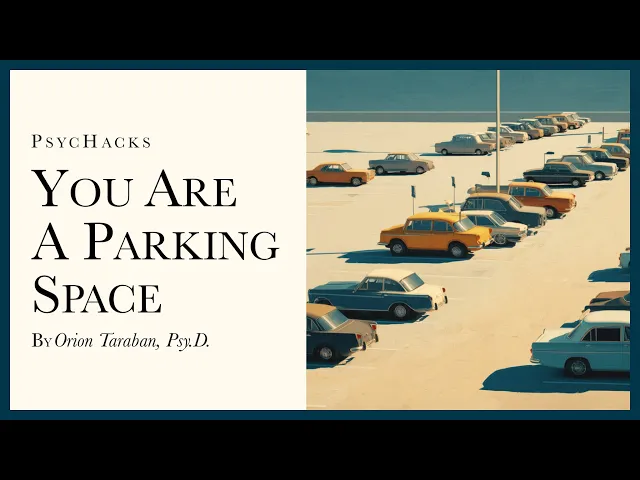
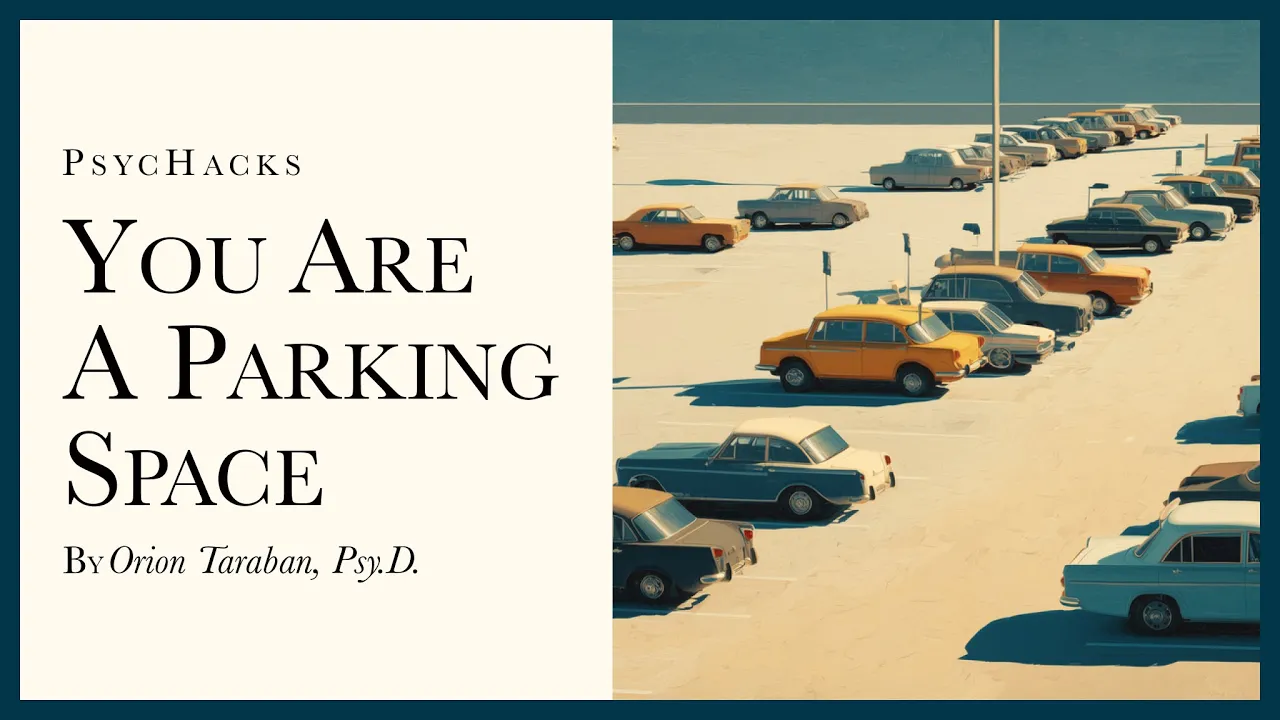
The links are in the description. I'm going to help you with this today. One way to prevent inappropriate attachment and its inevitable narcissistic injury is to think of yourself as a parking space.
You are not the car. Whatever make or model that happens to be parked there at the present moment. You are the place in which the car is parked the container.
You are the space in which what you have temporarily exists. And we know that the having is temporary because all these things came from some other place and can only exist in that space because some other things that were there previously have left. It's kind of how a parking lot works, right?
All right, so let's apply this metaphor to some of the most common inappropriate attachments. Here's a good one. You are not your money.
As Marcus Aurelius reminds us, money is a Everyone uses it and it belongs to no one. And it would have no value otherwise. Money circulates.
That's why we call it currency. Like an ocean current, it has to flow. Otherwise, it's worthless on some level.
And how can you think that you are something that has belonged to countless others and that only deres its value as it leaves your possession? Like, how can you even think of having something like that, let alone being it? And yet, it is one of the most common props against existential vulnerability.
Or maybe it's something more respectable than money, like reputation. But you are not your reputation. How could you be?
Your reputation lies entirely in the minds of other people. You cannot be the minds of other people. You have no direct access to those minds and they all exist outside of your domain of control.
How can you think of identifying with something you can't control? That's just asking for pain. Other people's opinion of you is none of your business.
It's ridiculous to identify with the unknown and ultimately unknowable thoughts of others. Or maybe it's a relationship of some kind. Your girlfriend, your husband, your children.
But it only takes a little thought to realize how ridiculous it would be to identify with these relationships. After all, they might be parking spaces, too. As people in their own right, they are also the spaces in which what they have temporarily exists just like you are.
And if that's true, how can a space exist as an attribute of some other space? That's like 0 divided by 0. The math isn't mathing.
So you are not your relationships. You can even think about it in terms of your physical body in the first place. The vast majority of what constitutes your physical substrate is actually a part of nature and as such as just as much within your domain of control as say the changing of the seasons.
Think about it. Your heartbeat, your bile secretion, your cellular mitosis, you don't know how to do any of those things. So how can you possibly identify with them?
If the concept of I, the subject I means anything, it is that the I has the ability to act upon objects. I do this, I do that, which wouldn't be the case here. And just like your parking space might be temporarily occupied by a car that came from somewhere else because some other car had already left, your body on a physical level only exists because the molecules from which it is constituted were temporarily liberated from use elsewhere in the universe and they will be dissipated once again when their possession is no longer tenable.
Ashes to ashes as it were. So you are not your body. You are the space in which what you have temporarily exists.
And what is that space? It's nothing. It has to be nothing.
If it were something, it wouldn't be a space. Whether or not this is ultimately ontologically true is not the point here. It is useful to consider that you might be the space as this identification will prevent a host of unnecessary suffering.
This is because inappropriate attachment is like touching a hot stove. Identify with what you have and not with who you are and you're asking to be burned. It's also potentially useful because it helps to clarify the only real difference between people, that is between spaces, namely capacity.
The only real way that spaces differ from one another is with respect to how much stuff can fit inside of them. But the stuff itself will fit wherever it can fit. Do you understand?
What a person can have for good or bad is primarily determined by his or her capacity. And this is the ultimate goal of all self-development to increase one's capacity. A capacity to hold all kinds of different things of all kinds of different sizes.
What do you think? Does this fit with your own experience? Let me know in the comments below.
And please send this episode to someone who you think might benefit from its message. I know you know someone who geeks out on this kind of stuff because it's word of mouth referrals like this that really help to make the channel grow. I'm counting on you.
Other value ads. Anyone looking to join my free weekly newsletter for which I write original content or book a paid one-on-one consultation with yours truly can do so on my website. There's also my bestselling book, The Value of Others, in which I explore my economic model of relationships, and my private member community, The Captain's Quarters, where, among other things, I host bimonthly group consultation calls from folks all over the planet.
It's a lot of fun. Check it out if you are so inclined. The links to everything are in the description below.
As always, I appreciate your support and thank you for listening.