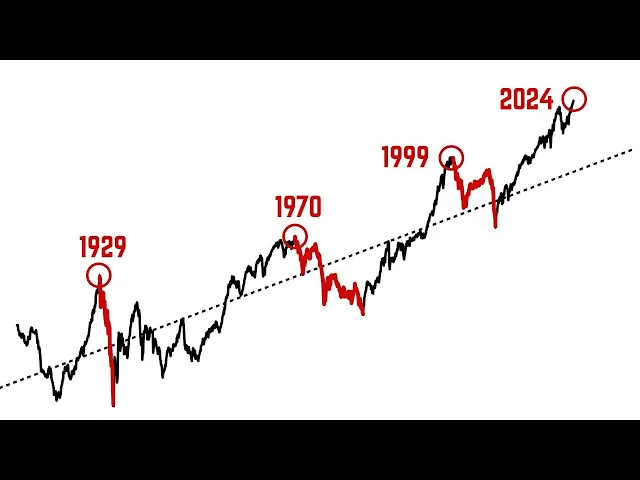
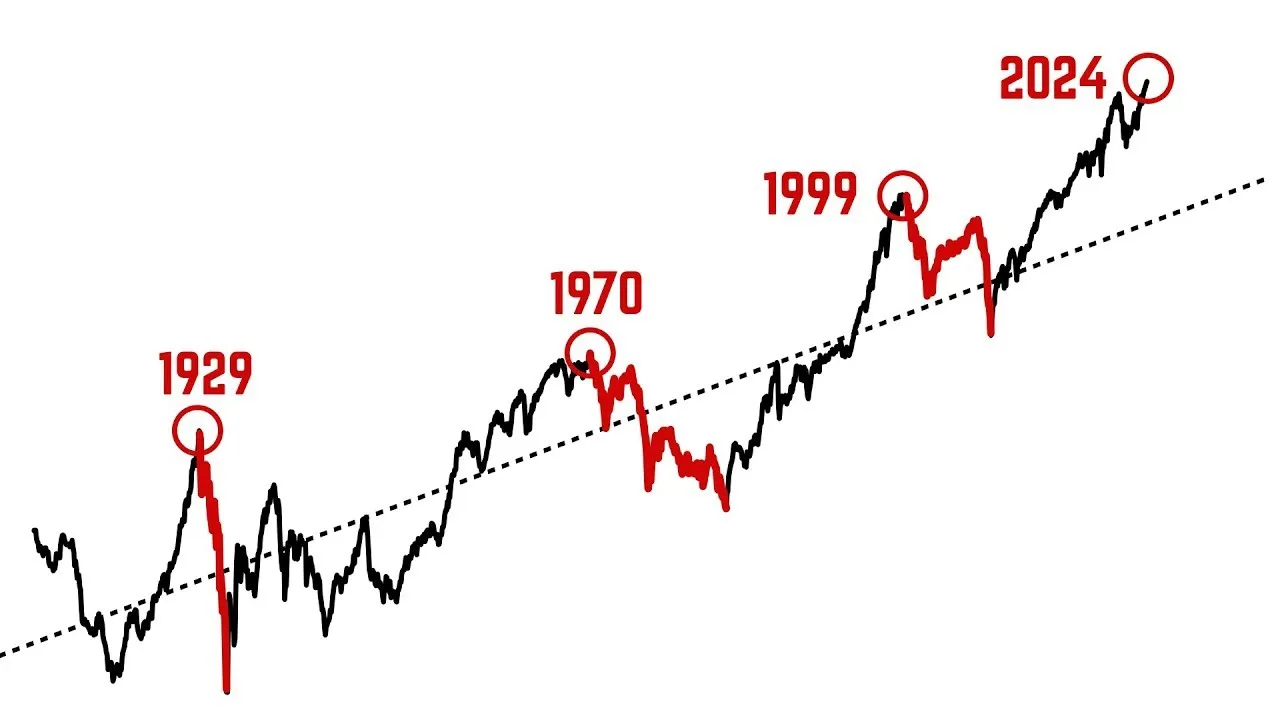
the stock market is melting up yielding a 40% return over the last 12 months and simultaneously making new alltime highs something that happened in the late 1990s during the dotom bubble and in the late 1920s just before the Great Depression two periods where we know that the uptrend was unsustainable and as you can see from this chart of the S&P 500 that's been adjusted for inflation just visually we can tell that the stock market is overextended relative to its longer term Trend in a similar fashion to how overextended right before the four largest market crashes
in the last 110 years of Market data but before we can actually draw conclusions from this chart we need to compare it to a version of the S&P 500 that is not adjusted for inflation and this is what it looks like the stock market's return since 1921 is around 65,000 so in other words $1,000 invested in 19 21 would now be equal to $650,000 but when you look at the stock market's return adjusted for inflation it's only returned 5,000% over the last 100 years so you can immediately see the impact that inflation has on stock
market returns it's absolutely massive especially when you look at it on a longer term Horizon this is where the term stocks only go up comes from but within this very long-term uptrend we do see periods of of incredible pain for investors for example if you had invested $11,000 in March of 2000 it would have been worth $500 10 years later so an extremely poor performance the same thing would have been true if you had invested money in August of 1929 your investment would have been worth half of its original value a decade later that's where
this Shard comes in useful it shows us that over the long run yes the S&P 500 goes up more than inflation but it also shows us that the stock market can decline significantly relative to inflation now as you can see the S&P 500 adjusted for inflation typically moves up and down within a relatively stable range and the moments where it attacked the top of the range include 1913 1929 1965 and 1999 all four of those moments were extremely poor times to be invested in the stock market because the S&P 500 adjusted for inflation eventually moved
back to the lower end of the range on average leading to a 60% decline in the value of the S&P 500 adjusted for inflation although in the case of the crash of the 1930s it was much more than that now while most people will agree with this that the stock market is overextended on an inflation adjusted basis not everybody agrees on what that actually means for the non-inflation adjusted S&P 500 the idea is that just because the S&P 500 is going down down on an inflation adjusted basis doesn't mean that the actual S&P 500 Index
is also necessarily going down this can happen if inflation in the US begins to run out of control and we can use turkey as an extreme example of how this can actually happen this is the Turkish stock market that's been adjusted for Turkish inflation and we see that on an inflation adjusted basis the Turkish stock market has virtually gone nowhere over the last 20 years providing a 0% return since 2006 now when we look at the Turkish stock market that isn't adjusted for inflation it has yielded over a 2,000% return over that same time Horizon
this gap of course can be explained by the hyperinflation that turkey witnessed over the last few years so seeing this chart we can understand how high levels of inflation alone can push the stock market higher many believe this is exactly why the US Stock Market is Rising so aggressively today that investors are anticipating a major wave of inflation possibly even hyperinflation and that the stock market is melting up in anticipation of that which would make today's melt up considerably different to the ones from the late 1920s and the late 1990s because those episodes never saw
inflation go out of control instead the stock market eventually melted back down so can we really expect a hyperinflation melt up today today well when we look at a chart of the inflation rate in the United States we see that it's currently hovering at around 2.5% for a hyperinflation melt up to occur on the stock market we need inflation to be significantly higher than it is today for example if we compare the Turkish inflation rate over the last few years we see it's currently at around 50% so turkey is experiencing about 20 times more inflation
than the United States and at the height of its inflation problem turkey saw an 84% inflation rate in October of 2022 so our opinion is that the argument for a hyperinflation stock market melt up today doesn't really make much sense additionally when we look at every single time in history where the United States saw a spike in inflation we actually see that the stock market declined in these instances that's because higher inflation means higher interest rates and that typically puts downwards pressure on US Stocks that's exactly what happened happed in the 1970s despite high levels
of inflation the stock market actually saw multiple 30 to 50% declines during this period if we come back to our chart of the S&P 500 adjusted for inflation this is what the 1970s look like this is already a much more plausible scenario today that if inflation were to pick back up it would cause interest rates in the United States to rise and pull the stock market lower but again for now there isn't really any signs of inflation picking back up and in the US just look at this downwards trajectory the price of wheat is down
10% since October of last year the price of boneless chicken is down 10% the price of oil is down 20% the price of natural gas is down 30% I think you're starting to get the picture there are some things that are still going up in price like homes but in aggregate inflation has slowed down considerably so what happens to stocks if inflation never picks back up well that's where things could actually start to look more like the late 199 90s and the late 1920s these periods of low and stable inflation provided the conditions for the
stock market to melt up higher we also saw something similar in the 1980s where low inflation led to a stock market melt up that was eventually followed by Black Monday in fact each of these great melt UPS eventually imploded in one way or another and the reality is that today inflation is heading downwards with many key components of inflation like oil that are also heading downwards and this environment is allowing the stock market to melt up higher just like it did in the 1920s and in the 1990s not like it did in turkey or Venezuela
we've been of this view over the last year and we've helped our clients participate in this bull market the entire way through now as you may have seen from our most recent video we did turn a little bit more cautious on the stock market in the short term as we think we could see a pull back towards 5,650 points but overall the lwi inflation environment that's been in place throughout 2024 doesn't look like it's about to kill the stock market just yet you can check out our most recent closed trades on the homepage of our
website our trades are yielding fantastic results for our existing clients making the cost of our membership look completely ridiculous so what are you waiting for sign up to our service