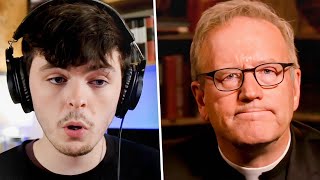
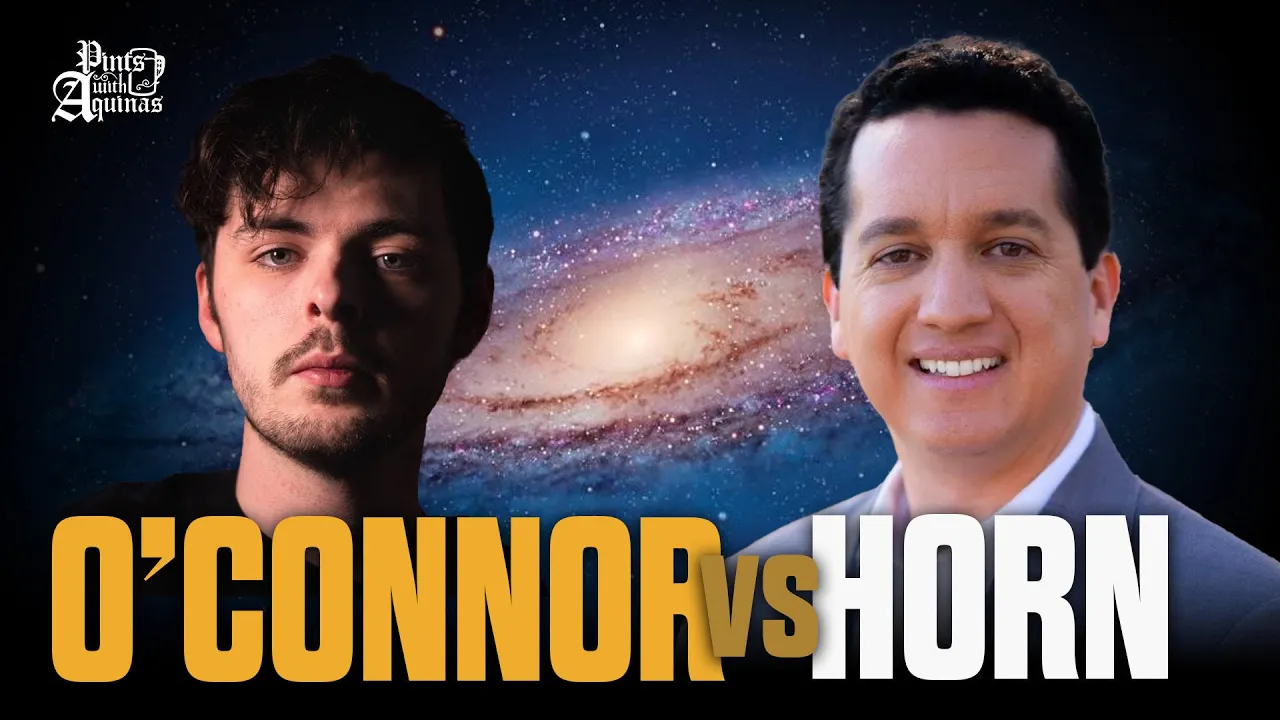
All right, good day. Good day and welcome to Pints with Aquinus. My name is Matt Frad. This is the very first debate we're hosting on this channel. Um, which I'm really excited about. We'd like to actually host monthly debates here like this one between Trent and Alex. So, if you like that idea, do us a favor and support the channel by subscribing. Uh, I just found out that we have our Second debate locked and loaded. And you don't know who that is yet, but at the end of this debate, I'm going to announce what that
is about. Before we pull up Alex and Trent, I want to say um big thank you to uh our the guys over at the Catholic Woodworker for helping to support this show. Um, so if maybe you're out there and you're an atheist and after this debate once you become a Catholic, you can go, that's me being playful, of Course you, but who knows, you can go over to catholicwoodworker.com. Take advantage of these beautiful rosaries. I don't like the rosaries that are too big because they kind of like bruise you when you sit down, but most
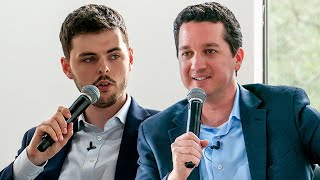
rosaries are super dainty. Uh, but these are just beautiful. Very sacred looking, very manly. So go check him out. The Catholic woodworker. He actually supports me on Patreon. Awesome guy. family business, the Catholicwoodworker.com is a place you want to go to get the best rosaries imaginable. Catholicwoodworker.com. All right, let's pull up Alex and Trent. Hello, Alex and Trent. Hello, Matt. How's it going? It's going well. Why don't we begin? Uh, just I want to have the two of you introduce yourselves, maybe a minute each, and then I'll lay out the format for today's debate. Why
don't you start, Trent? Sure. Well, my name is Trent Horn. I'm a staff apologist at Catholic Answers. I have master's degrees in theology, philosophy, and bioeththics, and I've authored nine books. And at Catholic Answers, I explain and defend the Catholic faith. I also host my own podcast called The Council of Trent. And if you're Catholic, you'll get the pun, or at least if you're well educated, you'll get the pun. Counsel, of course. Uh, if you want to check that out, you can see it on iTunes, Council of Trent, or you can support it at trenhornpodcast.com.
Uh, I'm married to my lovely wife, Laura. I have two wonderful little boys at home and a third on the way in September. Thanks very much, Trent. Alex. Uh, my name is Alex. I'm a YouTuber, as much as I hate that label, but I'm also studying for a degree in philosophy and Theology at St. John's College, Oxford University. Um, I think these days people tend to introduce me more as a vegan advocate than a philosopher of religion, but that's kind of old old hat to me. It's what I've been doing for the longest time and
it's been a while since I've done one of these debates, but um yeah, I'm not married. Uh I don't have any children, but I'm here for the ride and I'm looking forward to it. Uh it's great to have both of you. I I Mean, obviously being a Catholic myself, I you know, agree with Trent, but I admire Trent. I admire you, Alex. Uh you do a great job uh explaining your position. So, it's really an honor to have both of you on the show. All right, why don't we begin? I just want to let everybody
know the format of today's debate and then we'll jump right into it. But we're going to have opening statements 15 minutes each. Then we will have first rebuttals 7 minutes each. Then second rebuttals which will take 4 minutes. Then we'll have crossexamination for 12 minutes. And um then we'll have audience questions. So if you're watching live here on YouTube, be sure to stick around because we're going to be taking your questions. And when we do get a question, each person gets two minutes to answer a question addressed to them and then their opponent will get
one minute to respond and then we will wrap up with closing Statements of five minutes each. I have a timer right here and so I'll be timing them. You're welcome, of course, to time yourself, but why don't we begin with you, Trent? Correct. Sure. You're okay. That's good. We'll start with 15 minutes. I'll let you know. Um, three, two, and go. Sure. Uh, well, Matt, before we start, actually, could you let everyone know that the topic of the debate? Thank you. That's probably a good idea. My understanding is that we'll we are going to be
debating uh veganism. Trent, I don't know if you knew that, but that No, we're going to be debating, I believe, God's existence. So, Trent is going to be making the positive case, and then I believe, and you can correct me if I'm wrong, Alex, that you'll be critiquing that case. Perhaps that's more accurate than saying you'll be making a case for atheism. But feel free To interject. That that that's about right. Although I'm trying to make things a little bit more interesting that. So then we'll see. All right. Yeah. Have I forgotten anything else? I
don't think so. Uh did I mention that I'm vegan? He's a vegan apparently. All right. So how about So Trent, are you ready? I am. Start whenever you like. Okay. Well, I'd like to thank Matt for hosting this debate and Alex for agreeing to participate in it. So in this debate, I want to ask nine yes no questions and then show that the answers to those questions lead to a cause of the universe that has the traditional divine attributes or what most people call God. So let's get started. Number one, does the universe have an
explanation for its existence? We know Some objects in the universe are contingent or their existence must be explained by something else. This debate exists because of computers and internet connections. We pray stay up. The devices you watch it on exist because of factories and power sources. All of these things are contingent or they don't explain their own existence. Instead, they must be explained by something else. So, how do we explain them? One way would be to posit an Infinite chain of contingent things explaining each other. But that doesn't explain why the whole series of things
exists any more than an infinitely long chain could explain how a chandelier is hanging above my head. You could also say that an object's existence doesn't need to be explained, but this violates the principle of sufficient reason or PSR, which says things have a reason for why they exist. We should believe this principle is true because if it were False, we would expect unexplainable events like objects popping into and out of existence without a cause to happen more often, or to put it more accurately, to happen at all. Science relies on PSR being true because
otherwise we could never rule out the conclusion that things we observe simply have no reason for why they exist. Finally, without PSR, we couldn't explain negative states of affairs. For example, it does not make sense to ask At this moment, why isn't Matt Frad's hair on fire? But it would make sense to ask that question if a blowtorrch were hitting his scalp and his hair remained unburned. Both cases presuppose that things which exist must have reasons for why they exist and they don't exist for no reason at all. But the explanation for the contingent things
we observe cannot be another contingent thing. So it must be something beyond the universe or the entire collection of contingent Things that explains why everything exists. Number two, does the universe explain its own existence? No. because that would make the universe a necessary thing or something that has to exist by its very nature. But there are no reasons to believe the universe is necessary and many reasons to believe it is not necessary. For example, the question, why is that triangle black? prompts an intelligible answer. Whereas the question, why does that triangle Have three sides? Merely
deserves the retort because it's a triangle. But the question, why does the universe exist? does not prompt the retort because it's a universe. Since existence is not a necessary property of universes, it's more like the question, why is that triangle black? Which warrants an explanation beyond the thing that needs to be explained. There are two other factors about our universe that count against it having necessary existence. Its property of change and its finite past. So let's start with change. Change occurs when a potential X becomes an actual Y. This can involve intrinsic change like growth
or exttrinsic change like motion. But no potential X can become an actual Y on its own any more than water can freeze itself or a train car could propel itself. Instead, something like a freezer or a locomotive must actualize the potential for change in these objects. But of course, those Actualizers only change because something else actualized their potential for change. Could an infinite series explain this kind of change? No. Just as an infinitely long train of box cars would sit motionless without a locomotive, an infinite number of things that must be actualized by something else
would be changeless unless there was a cause of the series that is just pure actuality and had no potential. Just as a locomotive pulls without being Pulled, this instance of pure actuality would actualize without being actualized by anything else. And since the universe contains a mixture of potential and actual, it is not the purely actual cause we're looking for. What about the universe's finite past? Something is necessary only if it is impossible for it to not exist. But if the universe came into existence, then it can't be necessary. It would instead stand in need of
an explanation for why it Exists. One reason to believe the universe has not always existed is because the past contains causal chains that explain objects and events in the present. However, no past causal series that terminates in the present can be infinitely long because that would lead to a contradiction. Consider Robert Coon's paper passer thought experiment. Imagine beings called paper passers who exist at every January 1st in the past. So there's one at January 1st, 2020, one At January 1st, 2019, and so on into an infinite past. Their job is to receive a piece of
paper from the passer who held it during the year before them, and to see if it's blank. If the paper is blank, then they write a unique number assigned to them on it. If the paper they receive already has a number on it, however, then they just pass the paper along to the next paper passer at the end of the year. Now, here's the question. What number is written on the Paper given to the paper passer at January 1st, 2020, whose year will go downhill very quickly? There has to be some number written on it
because if it were blank, then the 2020 paper passer would write his number on it. But it can't be blank because if it were, the 2019 paper passer would have written his number on it. But the 2019 paper passer could not have written his number on it because if the paper were blank when he got it, the 2018 paper passer would have Written his number on it. If there are an infinite number of paper passers, then we have a paradox. There is a piece of paper that arrives in the present that isn't devoid of numbers,
but also can't have any particular number written on it. And this isn't unique to this scenario. Other thought experiments like Thompson's lamp or the grim reaper paradox show that objects cannot have infinite causal histories. This means causal series must be finite in nature And the first member of the series would have to be uncaused. And since causal chains must be finite, this means the number of events before today must be finite. And so time is finite. If the past is finite, then our universe began to exist and would require an uncaused cause for its existence.
Notice that we are at an important juncture. We've seen the universe has an explanation for its existence. And that explanation is not The universe itself. Instead, this explanation is necessary or it explains its own existence. It is uncaused because it is the source of all causes and it is pure actuality because it is the source of all change and motion in the universe. What else can we know about this cause of the universe? Number three, is this cause changeable? No, for two reasons. First, change only happens when potential is reduced to actual. But this cause
is pure actuality. So, it Can't change. Second, since causal chains can't be infinite, this means there can't be an infinite series of events. Since change is an event, this means the first cause cannot be subject to such an event or it must be changeless. Question four, is the cause temporal? No, because time is how we measure change. And because the cause of the universe is changeless, it follows that it must be timeless as well. Number five, is this cause material? No, for Two reasons. First, we know the cause is changeless and matter is always changing,
at least on the atomic and subatomic levels. Second, if the cause is timeless, then it must also be spaceless or immaterial because to be in space is to be in time. Even if the cause were a simple thing with no proper parts, it would still change in relation to other things or points in space. And so it can't be confined to space, just as it can't be confined to time. Number Six, is the cause limited? No, because that would contradict the cause being pure actuality. To impose a limit on something would be the same as
saying there is a potential for that thing which the thing in question can never actualize. That means the cause's causal power could not be limited. Which is another way of saying the cause is all powerful or there is nothing it can't do. And if the cause can bring something into existence from nothing, then there Really is nothing it can't do if it can accomplish that feat. Number seven, is the cause necessary? Yes, because if it were contingent or if it depended on something else in order to exist, then this cause would need an explanation for
why it exists and our argument would start all over again. Also, because this cause is changeless, it can't go out of existence because going from being existent to non-existent is a temporal and mutable Process. And we know the cause of the universe is timeless and changeless. Moreover, in being pure actuality, this cause would have no potential for non-existence and so it could not fail to exist. Question eight, is the cause personal? Yes. And here are five reasons to think so. One, there are only two kinds of entities that exist. Concrete ones like two toy blocks
and abstract ones like the number two or the shape of a cube. But unlike concrete objects, Abstract objects like numbers and shapes have no causal power. Therefore, the cause of the universe cannot be an abstract object like a number, but must be some kind of concrete object. But we also know this cause must be an immaterial concrete object. And the only immaterial causal reality we know of is some kind of mind, which means the cause must be personal in nature. Two, there are only two kinds of explanations for physical phenomena. Scientific ones and Personal ones.
Scientific explanations consist of physical laws that describe matter energy interactions. For example, the scientific answer to the question, why is that pot boiling? Is that heat is agitating the water molecules and causing evaporation. Uh the personal explanation would involve an intention of an agent like the pot is boiling because I wanted tea. A universe beginning from nothing can't have a scientific explanation because a State of nothingness lacks the matter, energy, and descriptive laws that make up those explanations. Therefore, only a personal explanation of the universe remains. Three, this cause of the universe explains the existence
of not just material objects, but also abstract objects like numbers, mathematical truths, and propositions. But these entities only exist in the mind. And so, if these objects have necessary existence, then they must reside in a Necessarily existing mind that is explanatorily prior to them. Moreover, if this mind has no potentiality, then its knowledge of these truths could not be limited, and so it must be all knowing. Four, many atheists say they believe in God if they saw something like an amputated limb healed through prayer. Uh, but this means that they would pick a divine explanation
for an event over simply saying the event has no cause whatsoever. But if our universe Came into being just as inexplicably as a healed amputated limb, then atheists should be consistent and conclude that the universe is a divine cause as well. Five, our universe contains moral properties that only make sense if they have a transcendent moral source. Now, morality only applies to persons. So, if the cause of the universe is the source of these moral properties, then it must be a supremely good person and not an amoral impersonal force. Which brings us To my last
question number nine. is the cause of the universe good. By good, we mean in both the moral and non-moral sense of that word. A car has a bad timing belt, not because the belt is disobedient, but because it can't fulfill its purpose of synchronizing an engine's valves. It's bad because it lacks something it needs in order to act in accord with its nature. And this is true not just for artificial objects, but also for natural ones like trees and Animals. Now, if the cause of the universe has no potential and is pure actuality, then it
must be good by definition. That's because it wouldn't lack anything and so it cannot be bad in the non-moral sense of that word. But the cause is also morally good because it is the source of objective morality or what I call moral facts. Alex said in his debate with Frank Turk that if objective morality or moral facts existed, then this would be a compelling Argument for God. So, we can make an argument like this. If moral realism is true, then God exists. Moral realism is true, therefore God exists. Moral realism is the view that human
beings discover moral truths and don't create them. Truths like rape is always wrong or all human beings have equal worth do not depend on human beings for their existence. Alex seems to agree with premise one and other famous atheists also agree. For example, JL Mackey said Of moral facts, "They are most unlikely to have arisen in the ordinary course of events without an all powerful God to create them." But why should we believe these moral facts exist? We are well, we are confident the external world is real and that other minds exist simply because those
things seem to be real. If moral truths like rape is always wrong seem just as real, then the burden of proof is on the moral skeptic to show us why we should think otherwise. Now, Alex Has previously said these moral truths are the objective consequences of subjective assumptions like the goodness of increasing well-being. But if that's true, then they aren't objective because they depend on precarious assumptions we can and should challenge. For example, imagine we could genetically engineer human fetuses so they grow up with a desire to be slaves whose source of happiness comes from
blindly obeying other people. that might cohhere with The overall goal of promoting human pleasure or well-being. But many people will rightly say this is wrong because it contradicts a basic moral fact independent of that assumption that that we ought to treat human beings with dignity and respect. So if you believe in moral facts and you should believe an all powerful God created them. Second, human beings are morally responsible for their actions. Alex says all physical events are determined by prior physical Causes. But if that's the case and we lack free will and arsonists and serial
killers are just as determined as lightning bolts and tigers, then it would be nonsensical to blame humans for actions just as it'd be nonsensical to morally blame a hurricane. Moreover, if punishment isn't something that's deserved, but rather something the state meets out for the the good of society, the state could theoretically punish innocent people like a criminal's family Members if such an act reduced crime overall by deterring criminals who at least care for their family members. But it's objectively true human beings are capable of being blamed. And it's objectively wrong to intentionally punish innocent people.
This is something that only a divine foundation of morality could make sense to hold up moral realism. So when all these arguments are seen as a whole, they form a strong case that there is a Changeless, timeless, immaterial, infinite, necessarily existing, all powerful, all- knowing, and all good cause of the universe or what most people refer to as God. Thank you very much, Trent. 4 seconds remaining. That was pretty impressive. Okay, Alex, are you ready for your opening statement? Uh, just about. Let me let me get up the timer as well and I'll Yeah, I'm
pretty much good to go. Uh, I'll just hit go Whenever you All right. Whenever you say go for it. All right. Okay. Well, yeah. Thanks, Matt. And thanks to Trent as well, of course, for agreeing to do this debate. Um, I can't say I was too familiar with Trent's work before I agreed to this, but from what I can tell, I think we'll make a good pairing. Uh, we have a lot more in common than people might think. For a start, we are both technically Catholics. Um, I was baptized. I took communion. I was confirmed.
I used to pray my rosary. I even served a brief stent as an alter boy. So, I think I've had at least some experienced sailing, should we say, before I jumped ship. Um, but to be clear, uh, I didn't jump ship onto another ship. I I I didn't I gave up my belief ultimately in Catholicism and God, but not for some other belief system. I won't even say that there is No God or that I believe there is no God. I just think that the arguments in favor of that proposition remain wanting. Still, I will
offer one argument to suggest that there is reason to think that perhaps God does not exist, for which I do have a burden of proof. But this is something of an overdetermination. My mission here broadly is just to show that there isn't sufficient reason uh to accept the proposition that God does exist, which Basically means responding to Trent's arguments and playing by his rules. Some people might claim this doesn't technically make me an atheist because they think someone who merely lacks belief is not an atheist. But if so, then so be it. My job today
isn't to be an atheist, but to argue against strength assertion that God exists. In the meantime, you can call me whatever you like. Uh so the argument that I mentioned, the one that I just Mentioned, in my view, is not just an interesting consideration, but I think it is the single biggest problem for Christian theism that exists. The biggest reason as well that's preventing me from seriously entertaining theism. And that problem is the problem of animal suffering. Now, since this is an opening statement and not a rebuttal, I'll lay this argument out first, my affirmative
case, before responding to Trent's arguments at a later stage. Okay. So, the problem of evil is famously one of the trickiest issues for theism. But it's almost always as a reflection of our general philosophical considerations, I think, completely anthropocentric. Frequently the problem of evil doesn't just focus on humans at the uh the ex uh instead of nonhumans or not taking into consideration non-humans just as much but it completely neglects any mention of the suffering of non-humans at all. But let's start with humans, right? The problem of evil loosely is this. I I like to discuss
the problem of suffering more than the problem of evil per se, just because some people apparently think it's problematic for an atheist to talk about evil as we've seen. Uh however, Christians and atheists can both agree on the simple fact that suffering exists. And if suffering does exist, then the point is this. Any religion which purports the existence of A loving God must demonstrate why the suffering in the world is justified. And the problem is most difficult, I believe, not on the problem of of moral evil, but so-called natural evil. That is suffering caused not
by human free choice like things like murder or rape but rather by earthly events generally referred to somewhat unfortunately perhaps as acts of God. Earthquakes, tsunamis, natural diseases, etc. The difficulty for the theist in cases such As these is not so much to say that they're justified, but to say that these aren't evil at all, because it results because they result from the natural order which God controls, not human action, and therefore must be justifiably inflicted, making it not evil, but actually a demonstration of either justice or necessity. That is to say, when an earthquake
rips a child from her mother's arms, this isn't something to bemoone, but to celebrate Since all actions of God must be just. And so, we would be witnessing some expression of divine justice, presumably with some great post-mortal reward. Now, Trent has previously, as I've seen, uh, tried to flip the question on the atheist by simply saying that it's possible that God has some morally sufficient reason for allowing suffering to occur and that I have to prove why this can't be the case. Perhaps suffering is required to explain the Existence of human free will. Perhaps some
evil is uh is required for higher order goods, right? Like you can't have uh you can't have bravery without fear, for instance. But analyze this, right? The suggestion is that some level of suffering or evil, however you want to frame it, is necessary in order to achieve some other aim that God has morally sufficient reason to desire. Fine. But then the theist must contend with the idea that if evil is somehow Necessary, we must have exactly the right amount of evil in the world. And this is the most difficult implication for me to accept. If
a loving God may need to allow suffering for reasons of free will or higher order goods or personal development or whatever it may be, this would still not permit God to allow gratuitous suffering. Right? There couldn't be any more suffering in the world than is strictly necessary because then that suffering wouldn't be Necessary for good to prevail. And this is supposedly why suffering exists in the first place. But it must also be accepted that therefore God couldn't have allowed any less suffering to exist. Because if there could be any less suffering in the world, this
would imply that the suffering in the actual world uh as it is isn't in fact necessary and that God therefore does allow specifically unnecessary suffering that is suffering for which there is no Morally sufficient reason or which goes beyond that reason. So I think Trent either has to accept something of a best of all possible worlds approach that exactly the correct amount of evil exists in the world or produce another or supplementary justification for suffering. Now, if we believe in this best of all possible worlds approach, I think we arrive at absurdity. Intuitively, it seems
easy to accept that there could in principle be at Least some less natural suffering in the world. And I don't just mean because the suffering is so great, although this observation does have some force. Uh when Kandid witnesses the great Libson earthquake of 1755 and the horrendous suffering that it entailed, Voltater has him mutter to himself, if this is the best of all possible worlds, then what must the others be like? But I want you to really consider the plight of animals on planet Earth. And not just those Animals that we systematically abuse in those
ignoble torture chambers we call factory farms, but consider a deer whose leg is trapped under a fallen branch and starving to death in in not just fear and agony, but also confusion. Is this a part of the suffering that's necessary to obtain whatever God has morally sufficient reason to desire? Could that deer have not have died 5 minutes earlier? Could its hunger not have been marginally, just marginally reduced? Why Should this proposed sufficient reason require exactly this amount of suffering and no less? Why can't this deer be granted some form of mercy? Why why can't
it being granted some form of mercy be compatible with whatever God apparently desires like free will or higher order goods or whatever it may be. Is it not compatible with the existence of free will for this deer to have died 30 seconds before it did? And what good is this obtaining anyway? Remember, I'm talking about natural evil here, not moral evil. How could this deer's agonizing and unseen death be a necessary requirement for human free will or some higher order good or something? Does it somehow help shape the moral character of those human beings who
aren't even aware that the deer is suffering and never find out that it did? Does it somehow help the animal? And if so, how exactly? At least for humans, the religious expects some Kind of divine compensation in the afterlife for their suffering. But what does the deer get? I imagine this deer, not to mention the 72 billion land animals we slaughter each year, not to mention the sea life we do the same to, not to mention the many, many more animals that are killed by their natural environment. I doubt these animals are going to experience
the bodily resurrection promised to us by Jesus Christ. So what exactly is the reward For their suffering? And why does that suffering need to be exactly so high, exactly so ubiquitous, and exactly so deep and so agonizing? I'll remind you this suffering, this struggle for survival, this natural tragedy is exactly what we would expect if we assume a naturalistic universe with no moral author and supervisor. I have no problem explaining why animals have such a tragic capacity for suffering. But the religious have a harder task on that Point. If the proposed god of the universe
is a god of justice, as Trent suggests, then I want to know what on earth these animals have done to deserve the treatment they receive. So that's the first thing. But we also of course have moral evil to contend with along with natural evil, right? Everything from people cheating on their partner or stealing from a shop to uh the confinement of and forced sterilization of weager Muslims in China or the Billions of animals forced into gas chambers each year to suit our fondness for a bacon sne. Of course, this one is famously easy. God is
a god of love and love must be given freely. For humans to be truly free, they must be capable of committing horrendous evils and inflicting inflicting masses of suffering. That is a removal of suffering by God is metaphysically incompatible with free will. And free will is more important than protection From suffering, especially given the reward of the afterlife. And voila, theodysy. But I would like to pose the same question to Trent as I posed to anyone else who has ever made this free will defense in my presence and to which I've still never received a
sufficient answer. Is there free will in heaven? I would assume so. Unless you think heaven is some kind of moral matrix in which we all robotically tend towards the good Without freedom. But a second question, do people in heaven have free reign to inflict suffering in the same way they do on earth? I would assume not, unless you want to suggest that it's logically possible for someone to commit a racist holocaust or something in heaven, but that they just choose not to. That seems absurd. Clearly in heaven there can't be such suffering. Maybe you think
there can, but that would be an interesting bullet to bite. But if heaven is a place In which there is free will and yet no suffering, then this serves as a counterex example to the claim that free will requires the unrestricted ability of free creatures to inflict suffering. If free will can exist without suffering also existing, the free will defense becomes meaningless because if it can happen in heaven, it can happen on earth. But just to change gears, another problem with the free will defense is a problem with free will more broadly and That's this.
I think that free will violates the principle that Trent relied on so heavily in his opening statement. That is the principle of sufficient reason. Principle of sufficient reason, I'll remind you, is the notion that anything which exists has a reason or explanation for its existence. Right? And the reason this is important is because the contingency argument that we've just heard uh from Trent relies on this principle. Trent says given that The universe exists, there are only three options. Either the universe exists without explanation, it explains its own existence, or it's explained by something outside of
the universe, eg God. Now Trent rejects the first of these options that the universe has no explanation for its existence. Why? Because of the principle of sufficient reason or the PSR as I might call it for short. That is everything has an explanation for its existence or at Least all contingent things. The universe the universe is an an existent thing and so it has an explanation. Right? Now why believe that the PSR is true? Well, Trent argues along with people like Edward Faser and many others that rejecting the principle of sufficient reason can undermine our
basic assumptions of science. Right? Science assumes that unexplained phenomena always have some explanation just waiting to be found. Right? If we Don't accept that everything has an explanation, as Trent has said, we could just assume things occur all the time for no reason and we have no reason to investigate them to discover why they occurred. But if the principle of sufficient reason is true, then it would apply to every thought that exists in the human mind. Anytime you think something, there is an explanation not just for why you thought something, but why you had that
Particular thought and not another one. But okay, maybe the explanation is internal. Maybe me having thought X is explained by the fact that I wanted to have thought X. Fine. But if PSR is true, then there needs to be an explanation for why I wanted to think thought X. Maybe the reason is that I like thought X, but that doesn't necessarily determine me to think it. But if PSR is true, then there must be a reason why it did determine me to think It in that particular case. If every thought we ever have is explained
by a chain of reasons explaining why that particular thought arose when it did, and in the way that it did, then you've kissed goodbye to free will since you've you've essentially adopted determinism. uh and I I find that to be quite an interesting observation, especially given uh the the moral case that's been made that essentially if we accept my view of a universe where everything uh Has essentially a cause that explains why it occurred in the way that it did, that therefore morality can't exist, which we just heard uh Trent say in terms of the
moral argument for God. He says, you know, if if there is if there is if there's this kind of causal chain of explanations for everything that exists, then morality disappears. Well, I think that's exactly what the principle of sufficient reason implies. And so, I think you either have to throw Out the principle of sufficient reason or you have to throw out uh morality on your own account, unless you can find some way to to get out of this objection, which I'll be interested to hear. Now I I've got about two minutes left, but there's one
other thing that I should point out or at least plant a flag in that we could talk about, which is that it's been claimed by by Trent at least once and also by other people uh who who propose the principle of Sufficient reason that to deny the principle of sufficient reason contradicts some basic fundamental ideas in science as I've already said. But interestingly, as recently as 2015, we have good reason to think that actually affirming the principle of sufficient reason is what undermines science. So I can talk about this more in my rebuttal stage, but
the principle of sufficient reason entails that there's no such thing as a random event. Okay, a random Event by definition occurs without an explanation for why it occurred in the way that it did. And so if there is randomness in the universe, then it's false that everything which occurs has a fully sufficient explanation for its existence in the way that it exists. Uh famously, quantum mechanics seems appears to involve true randomness. I don't have time to fully explicate it here, but there's a uh an experiment you can perform. Sending two entangled Subatomic particles to different
detectors and measuring the spin of one seems to instantaneously affect the spin of the other. And uh because I really don't have time now, I'll explain why in in in the rebuttal stage, but in 2015, it was finally conclusively proven that there can't be some hidden variable uh that exists locally to the particles that explains this. Um and there's a there's a principle in quantum mechanics called local realism which Needs to be uh essentially denied on the basis of this experiment. Local localism being the idea that a particle can only be affected by something in
its immediate vicinity and realism being the idea that any result of an experiment has a real world explanation for that uh for that experiment for that result which is essentially the principle of sufficient reason. So we either have to deny locality or we have to deny realism. If we want to keep the Principle of sufficient reason, that is we want to keep realism, we have to deny locality, which the follows from denying locality, things such as causes being able to occur after their effects and a whole other of things which seem to completely undermine science.
And I'll explain why that is the case in my rebuttal stage if that's a line you want to go down. But I just wanted to plant a flag uh there to say that actually if you hold on to the principle of Sufficient reason, the cost might be higher than you think it is. Uh but I think I've just run out of time. Yeah, thank you so much, Alex. Okay, those were our two opening statements and now we're going to move into our first rebuttal period where each debater will get seven minutes. Trent, let me know
when you're ready. All right, go for it. I'm ready. Go for it. Well, thank you, Alex, for that opening statement. You are truly just as smart as you sound. Uh, I wish I had a British accent, too. Uh, so what what points did Alex make saying that God doesn't exist? He didn't show any logical arguments to show that God does not exist. He did offer some probabilistic arguments against the existence of God and some problems with my own case. But we have to remember that probabilistic arguments can't defeat a demonstrative argument For God's existence any
more than circumstantial evidence in a murder case can defeat something like an ironclad alibi that show that shows someone is innocent. Uh but there's also weaknesses in these probabilistic arguments that uh show that they're not insurmountable. When it comes to the principle of sufficient reason, randomness doesn't violate the principle of sufficient reason. Uh quantum events have probabilistic causes rather than Determinant ones. For example, if quantum mechanics did not act in accord with the principle of sufficient reason, then scientists scientists could never perform experiments with regularity to make the very conclusions that Alex brought up. Also,
Alex neglects that there's more than one theory of quantum mechanics. For example, there's the bone de brogley interpretation which shows there are determinate causes in quantum mechanics but through what are called Hidden variables. Uh Alexson offered us a long argument from evil against God. He talked about what I call the why not heaven now objection. So, Alex claims that since it's logically possible for free human beings to not choose evil in heaven, then God is morally obligated to only allow those state of affairs to obtain. And I agree with him. There's going to be no
evil in heaven. Either because God alters our wills somehow or because when we are in the presence of God who is perfect goodness itself, our intellect will never fail to apprehend the good. Well, the answer to the question is that a world where so God can make a world without any evil whatsoever that's like heaven. But a world where free people where people make a free choice to have a heavenly existence has more goods than one where they're merely created in that state. Uh you could analogize this analogy to marriage for example that it would
be Better for someone to marry the perfect spouse than to create someone in the state of being perfectly married like some kind of creepy uh Steepford wife. In other words, a world that journeys from imperfection to perfection has more goods in it than one that is already perfect. Now, Alex might object and say uh that the good of pleasure is all that matters and these other goods that come about in pain aren't important, but that's a highly controversial opinion. Uh, as I noted in my opening statement, if maximizing pleasure or well-being is all that matters,
why not genetically engineer fetuses to grow up to be slaves that only want to improve well-being their whole lives? Or if pleasure is all that matters, why not take them a fetus and put them in a pleasant virtual environment their entire life as they grow up, like the Matrix, so they only know pleasure. I think many people would see that as a harm actually, and that It's better to have a real existence, uh, even if pain is a result from it. Alex also brought up free will. Now, this is not a fatal objection to theism
because you could just be a theist who doesn't believe in free will. You could be a theological determinist, for example, like some Calvinists. Uh, but when it comes to free will, I would say that the Alex claims I can't claim whatever begins to exist happens without a cause because don't people freely Choose to act? What's causing them to make those choices? And I would say that they are causing themselves to make that choice. I reject the view that human beings can't be their own cause for their events by making a rational choice and that if
God exists, he can be capable of allowing them to be able to do that. But here's the thing. Even if we can't fully explain how free will works, we know it does work. In the same way an atheist can say consciousness Emerges from matter, even if he can't say how at this moment. And plus, my argument from moral responsibility shows that we do have free will. Because if free will didn't exist, you couldn't be morally responsible for anything. So if you believe in moral responsibility, I don't see how you can hold that view and also
deny that free will exists. Now going on to evil. Uh Christians do not claim natural evils like tsunamis are good things. Rather, we would say the Pain and death that they inflict are privations of goodness. But since God is infinite in power and knowledge, he can allow these privations to exist in order to create greater goods or prevent greater evils. I what could those reasons be? Well, any finite physical system will have fluctuations in goodness. Uh the fire gets increases in being and uh the brush decreases in being. The lion increases in being. The zebra
decreases when it's eaten. Pain is Necessary for animals to function in the natural world. Uh complex organisms can't last long if they don't feel pain. Goods like courage and compassion cannot exist without evils like danger and suffering. Uh, and it it's possible some theists believe that God will compensate animals in the afterlife. The Bible does talk about the lion laying down with the lamb, for example. Now, Alex said he found it implausible that our world contains the perfect amount of Suffering. And I agree, there is no such value. God could always create a world with
more or less suffering. It would just have more or less goods as a result. But as long as God always brings more good from the evil he tolerates, there's no reason to believe he does not exist. Uh, also Alex also talked about that there's these unjustifiable evils, but I would say what criteria has he offered to show some evils are gratuitous and others aren't? He Actually hasn't done that. How much time do I have, Matt? I'm sorry. 1 minute and 42 seconds. Uh, perfect. There we go. Let's talk about animal suffering. Alex said we should
doubt God's existence because he doesn't see a justification for the suffering of non-human animals. uh but as I said before there could be goods to justify animal pain that exists uh and the existence of animals themselves even if humans are not aware of them may be That good I'll give you a thought experiment imagine all human beings left earth to colonize another planet and Alex is on the last ship leaving earth there's only nonhuman animal life left on the earth and I said to him Alex here's an anti-atter device that will instantly destroy the earth
instantly the animals just flap out of exist phase out of existence uh should we do that or should we let these animals continue existing. If you say that they should Continue existing even though there will be a lot of pain and suffering for those animals, if you think that that is worthwhile, then there can be good reasons to justify the creation of allowing animals to exist even though they may suffer. Otherwise, I think Alex would be committed to the view that if we ever left the earth, we should just vaporize it right after we go.
Finally, atheistic ethics leads to an arbitrary preference of humans either leads to an Arbitrary preference of humans over animals or an unlivable equality that would make factory farmers worse than Hitler. Uh, atheists just can't explain the unique moral duty we have to animals. And if that's an objective moral duty we have, i.e. It's just an objective fact we ought to care for animals, but not in the same way that it's an objective fact we ought to not cause unnecessary suffering for animals, but also a fact that humans are Intrinsically more worth have more worth than
animals. I believe only theism can explain the existence of those moral facts. Okay, thanks Trent. And then we'll move on to Alex's first rebuttal. You ready, Alex? Uh, just about. Yeah. uh there there's a there's a hell of a lot to respond to. I mean so many doors are being opened but um let me let me try and go through the I've tried to Make rough notes about this. Okay. The first thing that you said there Trent was that uh quantum mechanics still acts in accordance with kind of uh probabilistic explanation rather than deterministic explanation.
But this doesn't make much sense because the the very problem with quantum mechanics is that yes, if you fire enough photons, you'll find that 50% of the time they have up spin and 50% of the time they have down spin. But there is no way uh To explain why any particular photon has either up spin or down spin. That's the point, right? I I agree with you that there is an explan that there there's an explanation in the conditions from which the photons emerge perhaps that explains why they statistically exist in a 50-50 correlation but
there is no explanation for why any particular photon has a particular spin and that's what was proven in 2015 uh by Bell's theorem. This was this this is the this is the Point that was proved. It was previously thought look maybe it's the case that there's some kind of hidden variable may maybe that's maybe that's the problem as you say there are multiple interpretations of quantum mechanics but the point that I would have raised or was trying to raise before I ran out of time was that the interpretations of quantum mechanics in which you're allowed
to keep the principle of sufficient reason mean you have to give Up uh you have to give up locality right you have to give up locality which according to general relativity has wacky wacky inter uh uh uh corolleries Right? For instance, the idea that if information can travel faster than the speed of light, which is which is true uh under this interpretation, um then you can you can get because of the way that different uh frames of references affect the the time in which something happens depending on your frame of Reference, a cause could occur
after the effect. So so I don't disagree with you that there are interpretations of quantum mechanics which allow you to keep the principle of sufficient reason, but at what cost? it would be at the cost of a principle like causation or something which would undermine uh not just many other aspects of science but also a great many arguments for the existence uh of God. But the point remains that it's not about explaining Why there's a like sure there could be an explanation to say why 50% of the photons have this spin and 50% have that
spin but we need an explanation for why a particular photon has a particular spin and that's what can't be done and that's why the uh principal efficient reason would be uh false um let me see here uh I've got an interesting question actually you when you mentioned the the why not heaven now objection you said that one of the Reasons Why perhaps uh we want a world of earthly suffering before we we reach heaven is because there's something morally better about freely choosing good than just being kind of good by nature, right? Like sure, God
could create beings in heaven which are just good um because they're in the presence of God and they know to be good and that's just their nature, but it's morally superior to have the opportunity to commit evil, but to choose uh to Choose to commit good uh instead. Right? This is this is what you said of human beings. But if it's morally, if a being which has the capacity to commit evil is uh and chooses not to is better than a being that's good by nature, then I would imagine that your definition of God is
not a maximally good being. Because if God is a maximally good being, then I suppose he's not capable of committing evil. He's perfectly good by nature. But you seem to be suggesting Or maybe he's capable of committing evil by by some kind of roundabout way. But you're saying he you would imagine I would imagine you would say that he's good by nature. But if God is good by nature, you seemed to imply in your discussion of humans that it's actually more moral or better morally speaking to not be good by nature, but to choose to
be good despite not being good by nature. And I'm interested in how that would work out. I'm sure you have an Answer to it, but it's not something I've thought about before. So, I'd be interested to hear what you have uh to say. You also said about evil being the privation of good, which I simply can't accept. I can't imagine that the infliction of a holocaust would just be the lack of uh suffering when trivially like I don't think this is a neutral state of affairs. I think that something like picking up a phone is
a neutral state of affairs. That's a privation of Good and the privation of evil. But the infliction of suffering, I don't think I can count as a privation of good. But perhaps that's just where Catholic and utilitarian intuitions rub against each other. But you did offer a thought experiment about animals saying, "Well, if we were leaving the planet, would I kill every animal on on on on the place of the planet?" Now, that's a difficult question, right? Um because I think you need to take into consideration the Distinction between doing and allowing. Um I'm not
quite sure what I'd do in that situation. Let's just say perhaps, you know, I would kill those animals. Like fine, but that's not the situation God's in. Right? The situation God's in is being offered an opportunity to allow those animals to continue existing with less suffering. And if you gave me that option, I'd choose that option any time. Right? So I think you've presented something of a false dichotomy by Saying, look, we're getting on this spaceship and you have the opportunity to allow these animals to carry on suffering as much as they are. um or
you kill them all immediately. It's like there's a middle option which is to have them experience less suffering. Um then uh what else do we have? You also made what I consider to be something of a bizarre uh a bizarre statement about factory farmers being worse than Hitler on my View. I suppose because you would interpret me as saying that non-human animals are worth the same as as human animals and you think that the only way to justify a distinction there is with theism. I don't think that's true. I think that if you have say
a utilitarian uh worldview, which maybe broadly I do, but it's not quite accurate. But let's just say that you did. You could easily say that because humans are capable of experiencing higher and different kinds Of pleasures to say a pig, that although a human's pleasure is worth the same as a as a pig's pleasure, all other things being equal, the human is worth more than the pig because of that capacity for pleasure. In other words, that that there are ways to say that a human is worth more than a pig. And I think a human
is worth more than the pig. But my position on on animals in this in this instance isn't that animals are worth the same as humans. It's that animals Are worth more than human taste buds. Right? So I wouldn't say that factory farmers are worse than Hitler because you could or at least you're not committed to that view because you could say that if animals are worth less, killing lots of animals for food is really really really bad and killing lots of humans because they're Jews or disabled is worse. Right? That those are perfectly compatible um
in my view. You've also on on the point about free Will, you said, well, look, you could just say the explanation for why a particular thought arises is because, you know, the explanation is within you. Like you are the explanation for your thought. But look, there has to be an explanation for why you had that thought and not another thought, right? We're not just trying to the principle of sufficient reason doesn't just commit you to offering an explanation for why a thought occurred, but why that thought Occurred. Otherwise, you haven't sufficiently explained. Right? To be
a sufficient explanation, it has to explain everything. So the question would become why is it that you had that particular thought right and if there's an explanation for that it either exists within you which requires its own explanation or you get explanatorily far enough back that it goes outside of you external to you in which case you're not in control of it. So I think that that Would undermine free will. Uh that's seven minutes. There's there's there's so there's so many things to to discuss but I think that's about all I can just about kind
of scrape the surface there. Okay. Thank you very much Alex. We're going to now move into our second rebuttals where each of you will get four minutes. Trent, are you ready? Yes. Start whenever you like. All right. All right. Let's let's start. This is really fun. I'm really enjoying this. This is a cheesecake of a debate. Uh you know, we've got a lot of stuff packed in here. I think it's going to be great for people to pour over. So, let me just comment on a few things that Alex brought up. Uh, when it comes
to quantum mechanics, and this goes a little bit to the question about free will, the principle of sufficient reason that I was defending is a limited principle of sufficient reason. I'm not Arguing that any state of affairs or any event requires an explanation. It could be the case that you have something that happens that we can't determine, we can't predict. Uh, you know, if you have a ball on the tip of an infinitely sharp cone, why does it roll right instead of left? There may not be an explanation. or there may be an explanation that's
probabilistic that we can't determine. Uh but when it came to the question of the brogley bomb hidden locality Variables in quantum mechanics, Alex brought up the Bell inequality theorem. But John Bell himself in speaking about this said it is a merit of the debrogley bomb version to bring this non-locality out so explicitly that it can't be ignored. So he actually praised this interpretation of quantum mechanics. But as I said, if you have a limited version of PSR where I'm talking about the reason a thing exists rather than a particular event takes place, then my Argument
from contingency to a necessary being still holds up quite well. Uh when it comes to goods, uh is it better, Alex said, is it better for a being to be able to choose evil and not good? No, it's not better for that being. Uh but it the good is always better than evil. However, beings that have free will, you can draw out more goods in that situation than beings that lack free will. Uh, so beings that have free will, you can have moral free will, you can Have goods like forgiveness, mercy, compassion, courage, and it's
worthwhile to create a world where we have those goods during the imperfect phase of that world's existence and then they cease to exist when the world journeys into its perfect phase of existence. uh so I don't see any contradiction there at all that it's better to I think a world with these kind of virtues and from our own experience we see that that virtues and compassion these are goods and if God Makes a world where those goods exist uh he's perfectly free to do so and when it comes to privation my argument is that a
privation is not nothing uh it's it's a it's not invisible it's not non-existent for example a hole in the ground is a privation but it's real you can fall into it uh So these privations are bad. But once again, if God chooses to make a physical system where goods and privations can exist, as long as he brings more good from that, then there's No moral problem here. When it comes to picking up a phone, for example, that's not a privation of goodness. In fact, the that's nonmoral goodness that occurs there of the ability of a
rational creature to pick up something and make a call. That's actually a good of using your rational powers to reach out and call someone and let them know what whatever's happening. Uh when it comes to utilitarianism, I agree utilitarians can say that there are higher order Pleasures. Uh but at the same time, uh it's interesting. I don't think atheism could justify, I'm sure Alex is say, well, we can justify factory farming right now because we need it to at least feed the world. I've heard him say this before. We might need some factory farming in
order to feed people and it's an evil we tolerate. I wonder if Alex would say the same thing about human slavery or human sex trafficking. I highly doubt he would be willing to make Those similar tolerations which speaks to the view that human beings have an intrinsic kind of worth that animals do not. And I believe that atheism simply can't explain that. But theism can explain that human beings remain the image likeness of God. Also those higher order pleasures by the way not all humans can exercise them. Uh some humans are cognitively similar to or
inferior to pigs like infants or unborn children. Under Alex's view, if those humans are Valuable because they have the capacity for higher order pleasures, that would explain why infanticide is wrong. But I'd say we got an argument against abortion pretty quickly here. Uh, finally, just to summarize everything, what Alex has given us in his reply to this case are puzzles about free will and puzzles about suffering, but they have not disproven my argument for an unactualized actualizer, an uncaused cause who has all the divine attributes. He's offered puzzles that have not refuted demonstrative arguments. Okay.
All right. Thank you, Trent. And now we're going to remove uh move to the sec your second rebuttal for four minutes. Uh just let me know when you begin. I'll just click the timer. Okay. All right. Nice one. Um okay. Some interesting points. Again, I'll try and blast through this as quickly as possible. Uh Trent, you made an interesting claim that your principle of Sufficient reason is a limited one that doesn't necessarily apply to events. Um this to me seems to be a distinction without difference. I'm not sure how you could justify that claim and
why it wouldn't undermine science in the same way about events uh requiring certain explanations. But if I just granted it to you that fine, okay, not all events need an explanation. I could consider the big bang to be an event. And the event of the big bang is the Explanation for why the universe exists. But on your account, the event itself doesn't need an explanation. So the universe can come into existence without an explanation because that's an event and it's the event that caused the existence of the universe and therefore everything's explained and there's no
problem. The only way to avoid this objection I would see is either to find some way to explain why specifically the Big Bang is one of the kinds of events That would require a cause um or to I suppose uh throw out the the principle of sufficient reason. I hope you see what I'm saying there. Um also you said that John Bell praised other interpretations of uh of quantum mechanics. Sure. John Bell's paper came out in 1964, right? The proof that specifically got rid of the hidden variables theorem uh the the hidden variables hypothesis happened
in 2015. I I've got no doubt that uh in the interim Periods there was plenty of good reason to believe either side, but it's only very recently that we've got good substantive evidence to say that the hidden variables the uh hypothesis of explaining um Bell's inequalities is totally bunk. And and again I don't exactly have time to explicate this here and I'm certainly not um a quantum physicist and I presume that you're not. One of the benefits of studying at Oxford is that uh one of my good friends Who I went for coffee with the
other day uh who just received his masters in physics with the best grade in the whole university and I was able to talk to him for a very long time about quantum mechanics and I was beused when I realized because I've been thinking about the principle of sufficient reason in preparation for this debate and when I mentioned it in passing he just blew my mind by showing me exactly how to hold on to the principle of sufficient Reason is what undermines current scientific understanding not the other way around. Um, you also said that I have
elsewhere said that factory farming might sometimes be justified uh in order to sustain human civilizations, but I wouldn't make the same kind of um I wouldn't make same kind of concession for something like human slavery. Um, again, I I fear this is a misunderstanding of my position. I've said that animals need to die in order For us to survive in one way or another because even if you're growing crops, you're killing uh you're killing insects, you're killing rodents and things. Um, like sure, but the difference is like we don't need slavery in order to survive,
but we need to kill animals in order to survive. So like if there's a situation in which you actually need to kill an animal in order to survive, that suffering becomes necessary and you're justified in Inflicting it. Uh there's there's not a situation in which slavery is actually necessary to human survival in the same way. And that's why I think that the two aren't equivocated. If you were in a situation where the only way for you to survive would be to kill another human being, I think that you're probably justified in doing that and it
would be a form of self-defense, right? So, I do think that the analysis would be the same. I think that perhaps we would I Can see from your facial expression that we disagree with uh that you probably disagree with me there. But I think that uh human beings have a have uh uh how can I put this? Um an impossible it's impossible not to have this drive to survive for most people. The people who do have it, they can't help but have it. And I think that like the drive to survive there is a psychological
fact that is true of anybody. Uh and and so essentially the point that I want to Make on that is that in order to say that somebody shouldn't do something that is what is kind of allowing them to survive in order for somebody to completely essentially self-destruct themsself um would be psychologically impossible. And I think because if ought implies can you shouldn't be able to ask them uh to do that. Um, also, uh, well, I mean, let's not open the the the the question of abortion. We've got about four seconds, and that's Definitely not time
to answer it. But I I think I'm I'm I'm pro I'm more pro-life than most pro-choice than most pro choice pro-choices that I know. And I think I'm probably more pro-life than you think I am. But that's not to say I am pro-life. Um, but maybe that's a discussion for another time. Okay. Well, one can hope. All right. So, I just want to let everybody know what what's coming up here. We're about to go into Crossexamination and then we will be taking your questions. Please remember, as I said in the beginning, that at the end
of this debate, I'm going to be announcing the next debate and who those debaters will be on this channel. So, be please be sure to stick around to that. Uh, but before we move into cross-examination, uh, I want to say thank you to our second sponsor, Hello. Hallow is a really fantastic app that will help you Pray and meditate. It's actually the number one Catholic app in the US. It has five-star ratings on the app store. There's really something for everyone there. So, if you're somebody who's just beginning to pray, uh, then that's great. If
you're somebody who prays every day, there's something there for you as well. It's, you know, you can listen to the rosary, the divine mercy chaplet. They have nightly examines, prayer, minute meditations. They even Have, they even have like sleep stories where people read the Bible to you. I don't think anybody wants to hear me reading the Bible. One day there was this guy. Nobody wants that. But Father Mike Schmidz is on this. That's pretty cool. It's free to download and permanently it has permanently free content. But uh if you go to hello.com/mattfrad and we'll be
sure to put that in the show notes below. Um you can get access To the whole thing. 30-day free trial. Hello.com/matfrad. Please check it out. I I actually mean it. It's a really sophisticated app and and just yeah super great. So check it out. Okay. So here's what we're going to do now. We're going to be moving on to cross-examination. And I just want to let uh those viewing know what's how this is going to how this is going to go. First, we're going to begin with the affirmative cross-examine. And so That'll be Trent cross-examining
Alex. He has 12 minutes to do that. And then Alex will cross-examine Trent. Uh but I also want people to know that the cross-examiner is allowed to interrupt and move the flow of the argument as he sees fit. So, if Trent starts cross-examining Alex or Alex Trent and they feel like they're not going anywhere, it's not rude of them to to interrupt or anything like that. Okay. So, Trent, uh, you let me know when You're ready and we'll begin with 12 minutes. Whenever you whenever you start speaking, I'll just click the 12-minute timer. Sure. Yeah.
Let's, um, let's jump into this here. Uh, Alex, I'd like to talk about um uh the the point actually when you you talked about the the raised eyebrows because I do think that the different intrinsic moral worths of human beings as opposed to other animals is a significant problem for atheism That you made the claim that well it's justified to kill animals non-human animals if one needs to do that in order to survive and we would do the same for human beings. Now, I agree in the sense of self-defense where if someone is trying to
kill me, uh my intention is not to kill them. It's to stop their fatal attack even if um I foresee it will kill them. It's the principle of double effect. But I think it's very clear that you cannot kill another Person merely to save your own life. There was a famous British maritime case called RV Dudley versus Stevens in 1884. Uh it was about a group of sailors who were stranded at I was just about to bring this up. Yes. Yeah. Okay, good. you you know about it. They killed the they killed they killed and
ate the cabin boy, Richard Parker, which creepily enough, Edgar Allan Poe wrote a story about a cabin boy named Richard Parker being Eaten 60 years earlier. Uh and the the court said there that no, murder is not necessity is not a defense for murder. So would you agree that in some cases just cuz you need to live, you don't have the right to kill another human being? Well, interestingly, the reason that I was going to bring up that example was uh to to play on the intuition that they were actually justified in doing so, right?
because these were men in a boat Who were all about to die. They were going to die anyway and they would be dead uh had they not committed this action then the the cabin boy was ill. He was going to die anyway. Uh and so they made that sacrifice. Now don't get me wrong, this is not a nice thing to do. It's not like a blasé. Yeah, that's fine. You know, you can spy. But the cabin boy didn't he didn't The point of the case is a cabin boy didn't volunteer himself. Uh that's correct. Yeah.
So he was he was murdered. It's you know even you know so I I guess that that there definition of murder I think depends on your definition of murder because I think crown has said in this case the legal okay so you so you don't see you don't you so even though others may see this as an unjustifiable homicide you just might be the minority view to descent Against that I think it's at the very least a blur case and I think that that we that we can be quick to judge somebody in that situation
um for the action they took but I think that if you're in that situation I think there's I think there's a fair argument to be made that it's a justifiable action to take. Okay. Well, let me change the situation A little bit. Suppose you're dying and you need a heart transplant. And there's someone who is also terminally ill that has a heart, but the problem is they're probably going to live for another 6 or 12 months and you're going to kick the bucket in 3 months. even though that person's going to die anyways, that wouldn't
justify you killing them in order to take their heart so that you can live on for for many decades. Whereas in whereas in almost all cases, We would be able to kill an animal for any reason to be able to live. So it seems to me we still have a big difference between how we treat humans versus how we treat nonhumans. Uh that I don't think can be explained if your criteria for morality is species neutral. Do you see the problem? I I do I do see what you're saying. Um I think the situations are
different and I wouldn't be in favor of people being able to harvest people's organs in that Respect. Um do I mean due at least on first instance one of the differences between these situations is that we don't want terminally ill people being worried that their organs are going to be harvested at a moment's notice. Right? These situations uh these situations are not the same. True. But we might also but also, Alex, we might want passengers on ships to not be worried they'll be eaten in lifeboats. I mean, this is true, but I think we can
agree that this is such a rare occurrence that I don't think this is a this is exactly I mean, in other words, I don't think people are generally afraid that they're going to end up on a boat at sea that isn't going to be rescued and happen to be the person who's ill and about to die anyway. Like, I think that was true now. That's true now, but it wasn't true 150 years ago. That was Quite common for people at that time. Oh, I see. I suppose that's a fair I don't know how common that
would be at the time. I suppose that that that may be fair, but it was kind of a dirty it was a dirty secret of maritime travel that everyone tolerated until the Dudley case. So, I guess let me let's just we'll put that there. I mean, morality is I think when we talk about this, morality is probably one of the most interesting things for People wrap their heads around. So, we'll we'll talk more about it. Uh but let me ask you well morality evil that kind of fits in there. Um your argument from evil it
was a probabilistic one that you saw it doesn't disprove God but it makes them unlikely because there's some evils that I you don't see how they could be justified or they appear to be gratuitous. So is your argument that it's the gratuitous evils that should make us skeptical of God or or all Evils? It's just a subset of the evils. Is that correct? Yeah. Yeah. No, I definitely don't think that the existence of of evil or perhaps I should frame it as suffering to avoid certain complications is a problem in itself. I think it's the
extent and the depth of the suffering and that's the point that I was trying to make by saying that uh I believe that you're that you would be actually committed despite what you said In your rebuttal to the view that we do have exactly the exact right amount of suffering in in in the world. Um because look I mean if you want to and and bear in mind my argument was specifically to respond to a defense of the of the existence of suffering. So people who say that suffering exists because God has morally sufficient reason.
You said a second ago or a moment ago you said that uh God could create uh more suffering or less Suffering. There would just be more or less good. But my understanding of a perfectly moral being is one which maximizes morality, one which maximizes the good wherever it's possible to do so. Now I understand why you'd have a limitation on a maximally perfect being in getting rid of say all suffering. That wouldn't make any sense. As you say, if there are such things as higher order goods or goods which require certain suffering such as free
will, Then it makes perfect sense. Well, I would suffer. Well, Alex, what I would say is I would disagree with that assertion that a perfectly good being must. that you and I would agree there is no such possible world that that has an intrinsic maximum of the maximum good because you could always make more and more people and then you would lead to some kind of contradictions. For example, suppose there was a world with 1 million people and they have uh let's say 99% happiness. Would you say that's a that's a good world? Yeah, I
I I see where you're going at this. Um well, let me just keep going because not everyone will be as clairvoyant as you. Yeah. So then what if we did 2 million people at 98% happiness? Yes. See, I don't know the answer to that question, but that doesn't mean That there isn't an answer, right? Look, I don't for for a start, I don't think that um I don't think that the quantity and quality or or quantity and let's say uh amount of of pleasure, the amount of pleasure that someone receives and the quantity of people
receiving that pleasure are on the same kind of pedestal here. for instance, I think that one person experiencing 2x suffering is worse than two people experiencing X suffering. Um, like I I Don't think they kind of map onto each other in in in the same way. Okay. So, I'm trying to get a handle around what you would say. Now, know what's interesting here though is when we're talking about evil, uh, about the moral duty that God has. So, if God creates a world, I'm trying to get my head around for you. There's two questions here.
What would be the contents of the moral duty? We can put that in quotation marks. And then two Would be the the epistemic foundation, sorry, the onlogical foundations. Like where do these moral duties come from? So like if God makes a world, is it just maximizing pleasure or is it minimizing suffering? Like they could be incompatible. How would they be incompatible? Well, for example, if the goal is just to minimize suffering, then God can make a world with an electron and then there's zero suffering. Right. Yeah, I see what you mean. Um, so I think
that generally speaking for conscious creatures that do exist, the minimization of suffering and the maximization of pleasure are kind of two sides of the same coin. And some people prefer to frame it in terms of maximization of pleasure, some people minimization of suffering. You could just say that you want a balance of both. But look, I I see what you're saying, which is that there can't be Like it's difficult to imagine what the perfectly moral or the worst possible uh world would look like. But my point is just this. My point is that it seems
almost trivial trivially true that there could be at least some less suffering in the universe and if there's no and I agree I I agree with you. I agree with so I I wonder what your what your reasoning would be or what your suggestion would be as to why it's not the case And what I would say to you is does some suffer is suffering can suffering be justified? Yes. Okay. Okay. Let me let me reframe then. I I think that there can be I think that there can be less unjustified suffering in the world
than there is right now. Then what criteria do you use to determine whether a suffering is justified or unjustified? What objective Criteria do you use? Right? So to be clear, I'm I'm talking in terms of your worldview here. So whatever you take to be the criterion of good, I think either and and again you you can reject this claim. So I'll say that whatever your criterion of good is, I'm asking the question, could there be less unjustified suffering? And if the answer is yes, then I think you've run into a problem. If the answer is
no, then I think you've accepted. But Alex, under under my right, but Alex, under my view as a theist, I do not believe unjustified suffering exists at all because I believe any suffering can be justified by greater goods or the prevention of greater evils. So on my view, I don't see that as a problem. But for you, that's precisely my point. I mean, I would say that that that's precisely the point that I made. Maybe maybe we're we're talking past each Other here a little bit, but my point was to say that the theist believes
that any instances of suffering or what people would generally call natural evil are not in fact evil at all. Right? These aren't because they're not unjustified suffering or Okay. No, I I I don't I don't hold that view. My view is that evil is a lack of good. Uh there are intrinsic evils, uh things that one must never do, but evil itself is just an absence of good. There can be Non-moral evil and moral evil. There can be moral evils that we tolerate and moral evils that we must never tolerate or never engage in. So,
it'd be a richer dichotomy here. Matt, how much time do I have? Sorry about that. You have 1 minute and 50 seconds. Okay. Um, well, let's go to the basement then of these about morality and moral duties because my argument was if moral realism is true, God exists. Moral Realism, therefore God. Um, it's a valid argument. And based on your comments in the debates, would you hold to premise one uh what the moral realism is true or that moral realism entails God? If moral realism, then God? I I I I'm not sure about that because
I I I don't think that I I'm not a moralist. I don't think that moral claims can be objectively true. Um, and I think I would hold that that would be The case even if God existed. So, I'm not sure I can accept that claim. And I can explain why if you'd like. Okay. So, you believe moral realism is simply an impossible state of affairs? Depending on exactly what you mean by moral realism. For instance, I think that a claim like you ought not murder doesn't have truth value. Okay. So, it's it's just um an
utterance or or disapproval of certain kinds of killing. Uh I would interpret it slightly differently, but essentially yes. Okay. It's essentially a motiv. a form of emotivism or non-cognitivism I guess you could say but it it's potentially a bit more complicated than that. Mhm. So you would say then when it comes to morality there are the statement rape is always wrong or let's take the most foundational one the statement humans ought to promote human flourishing. Uh You don't believe those statements are true. Uh I think that perhaps a statement of something being good can be
true because that's a des a descriptive claim but an ought claim contains an essence of command and commands can't have truth value. So I don't think that can have truth value. Okay. Okay. I have no I have no problem if there's a if there's a moral author of the universe and that God and that God determines that something is good. I Think that's perfectly I think that's perfectly coherent. Um however I'm not sure uh I would say the same for ought statements which in other words prescriptive if it turn if it turned out though there
let's ask the final question. 12 minutes are up or should we we can switch that's fine. All right. Uh just trying to be fair to both of you here. Okay. Hey, so Alex, as soon as you start, I'll click the 12minute timer and you can cross-examine Trent and you can interrupt him at any time to move move the conversation along. Sure. Well, I'm I'm uh uh I'd be happy to to further that discussion perhaps in another another point because like it it takes 10 minutes just to get it off the ground because we have to
understand exactly what we mean by different moral uh moral terms. Um so I'm interested just to be just to be clear about this Talking about animal suffering. I'm interested, Trent. What? Mhm. Do do you think, for example, um Okay. Well, let me just put the question like this. Why do animals suffer as much as they do in your view? Why do animals suffer the current amount that they suffer? Yeah. Well, I would say animals suffer the current amount that they suffer because our universe has regular, fixed, and predictable laws of nature. and that Animals are
finite physical creatures uh that have to operate in that environment. And so in order to operate uh as complex organisms, the higher order animals will need survive they survive best when they have pain sensors to determine threats to them and it allows their they evolve to have pain sensors to increase their ability to survive and propagate. But so that would be my answer. it's at least possible that those animals could Could have experienced less suffering. Like do do you think it's in other words what I'm asking is am I expected to kind of interpret that
as you think it would would have been logically impossible for God to have created a functional set of natural laws that didn't entail the amount and depth of animal suffering that it currently does. Uh no I don't think it's logically impossible. I mean, you could But the only the reason I asked, sorry, Is because if you say that the reason why this animal suffering exists, or at least one reason, is because of the fact that there are natural laws which entail it. Well, if if those natural laws aren't necessarily the case, then why not have
just made them differently? That that's not really a justification for for the for the problem at hand. Well, you you you didn't ask for justification. You only asked a Descriptive question. Why are things the way that they are? Okay. I suppose uh implicitly I mean to say, why are they that way? uh assuming that there is a morally perfect supervisor of the universe, why would he allow that to occur? Well, for the the same reason as the the theist's overarching defense, which would say that any evil and suffering, whether it's human or non-human, uh an
all powerful being can allow the Existence of evil if that being can bring greater goods from it or prevent greater evils. that for me it seems very clear that if this principle applies to humans uh that we do this all the time where we allow uh you know we we allow evil to exist and suffering among humans and non-humans to secure certain greater goods if we allow humans to do that in limited circumstances I don't see a problem in allowing an omnipotent omnisient creator to have far more Latitude to do it and also the reasons
he would have uh I don't really have epistemic access to all of them because I'm a limited finite creature But given that it does work for humans, uh I don't see why it wouldn't work for God. That was why I brought up that thought experiment about vaporizing the earth when humans leave. I I think many people would would leave the earth as kind of a zoological habitat for those animals even knowing that they would suffer Because there is a goodness just in them existing. Well, unless you could create a system whereby they're existing with less
suffering. Like if you had that option, surely that would be the option to take. Well, um I mean I I in other words, let let me put it this way. If if I gave you that option, we're moving away in this spaceship and say, "Look, you've got three options here. You can either Abolish all life on Earth as we move away from it. You can keep things exactly as they are, or you can create a kind of paradise Earth where animals are existing with at least a lot less suffering, maybe no suffering if if you
like. Which button do you press?" Well, no suffering would be would be different. The terms would be vague. Is it um if there still is suffering even minimal suffering after millions of years that would be an incredible amount Of suffering uh even put it this way then um there's a button which uh which reduces the amount of suffering by 50% overall with with no with no kind of nonbeneficial side effects right with no no kind of mind that my person my personal view my personal view on the matter is that I believe the existence of
animals is a good thing. U so maybe I would push that button, maybe I wouldn't. I might need more data as to What it what it means to reduce the suffering. So for example, by pushing by pushing the button like does it it keeps everything the way it is. I guess my my trouble with this is that uh yeah, it's possible to create a feasible world where it's the exact same but there's less suffering. My concern is that that may not be feasible. It might be like the problem of philosophical zombies like Now, so now
you're toying with the idea that maybe The amount of suffering in the universe is exactly how where it needs to be. And that's what I was that that's what I was putting forward in the first place. That what I think your view commits you to. I think you either have to say that the amount of suffering in the universe cannot be budged one way or the other or you have to we have good reason to say that it should go one way. I think here's how I here's how I would answer that. If I if
I give you those buttons And you refuse to press the button or or at least even can say, "Well, I don't know what I maybe I'll just let them go on suffering. maybe I won't press this button which has no other effect but to give them less suffering. Like I think that would be I think that would be a moral travesty not to press that button. But then you agree though that the button that results in no suffering I'm not I'm not obligated to pick that because it ends the animal's existence And you agree that's
a mis that's a harder case. Well yes that's a harder case. It may be the case that we should press that button if the suffering is bad enough and if the suffering isn't counterbalanced by pleasures, right? But that's just this question. Right. But ultimately what I would say is my choosing to push any of those buttons will be undergurtded by a partic I would say that it's not under your View that morality is about subjective assumptions we have about what the good is. I could just tell you Alex I have a different subjective assumption about
the ultimate foundation of morality. I don't believe it's a utilitarian maximization principle. Uh so I'm not under a moral duty to press any of them because it's your opinion against mine. But my view actually allows there to be universal moral duties saying that it is a fact we ought to act certain ways and And I think that's a huge deficiency on atheism. I I see what you're saying and this is this is just a point about conflicting kind of base worldview beliefs here. I I I want to move on to talk about something else briefly
here. I hope my point has got across. But as I say, I'm happy to uh continue discussing this any time. I should go to London and have one of those delightful backyard conversations With you like you do with um your friend. What's the name? Woodford. Steven. Steven. Yeah, that that would be good. Or on the podcast. Um, sure. I'm, uh, one thing I want to ask about is the principle of sufficient reason. Now, now, it seems to me that you're quite influenced by Ed Faz's arguments. Um, I I may be kind of pulling that out
of thin air, but from what you've said, They seem to have a lot of correlation. Now, I'm interested if if you follow his reasoning in in in one of the ways that I'm thinking about here. Um in the argument from motion or the argument from actualization of potential uh phaser makes the point that uh whatever actualizes you know the thing that actualizes this mic being here on the stand is the stand but the stand only holds that actualization um uh instrumentally because that's actualized By something else and so it's the actual the full explanation for
what actualizes the microphone is not the stand because that only has instrumental um actual actualization via other things in the same way I would say that the should in in my interpretation be true of the principle of sufficient reason that is uh if a contingent fact is explained by another contingent fact that contingent fact is also explained by another contingent fact. So the thing that Explains whatever contingent fact we're looking at is only instrumentally uh explanatory only has instrumental explanatory power for it to be a sufficient explanation is in principle of sufficient reason um to
explain why a contingent thing is the way that it is. Um, you may disagree with my reasoning here, but let me try and let me try and spell this out. Um, we're trying to say that there needs to be a sufficient reason for why something exists, right? But if that if the if the reason or the explanation for that thing also also requires an explanation, then in the same way as actualization, that explanation is only instrumentally explanatory. You see what I'm saying? It's kind of by analogy. It's also only instrumental in its explanation in that
that needs to be explained by something else and that needs to be explained. Well, that's the nature of the nature of contingent things or the nature of Things that are a mixture of act and potency is that if the thing does not explain itself, it's quite capable of explaining other things, but we don't have a complete explanation of the state of affairs because we're stuck at something that still needs explanation. Sure. So when you say that anything has a sufficient reason, that is a reason that's all-encompassing and and explains everything, that to me would imply
that you would need to have all of the Instrumental um e explanations and the base root explanation, be it whatever brute fact you think it goes back to, which to me makes it seem like the the argument for the principle of sufficient reason is begging the question because to say that something has uh sufficient reason is essentially to say that you have an explanation which ultimately terminates in a brute fact. that is to assert the existence of the brute fact before you get off the ground. I don't Know if I'm making sense here. I haven't
explained this very well. Um, no. Well, well, I would say that that when it comes to explaining things, we can have sufficient explanations. You can have a sufficient explanation that is not a complete explanation. For example, when I left the house today, I saw there were a plate of cookies on the table. And so, I would think, well, why is there a plate of cookies? There's a scientific explanation that dough he Heated in the oven to make a confectionary delight. And a reasonable personal explanation my wife Laura made them. But I mean a total one
would be like the bread that was harvested, the cocoa that was made, the oven that was constructed going all the way back to the big bang. I mean that that seems to be what you would need to actually have a fully sufficient explanation of why this contingent thing is as it is. Um but but Also I just want to flag this before we run out of time. Like the distinction you've made there I think is a false one. You make a distinction between scientific and personal explanations like boiling the kettle. say why do you boil
the kettle? Well, there's the explanation involving chemistry and the the explanation involving um what I want. But me wanting a particular type of drink or something is also scientifically explicable, right? By Like like that that is all I don't see why that's different just because it involves a person like the the reasons the neurons that are firing in my brain to make me want a particular thing rather than another is just as easily scientifically explainable as the chemistry of the right. But what I would say is that well what I would say is that endorses
a controversial view of the philosophy of mind that even many atheists don't Accept which is that uh mental int that intentions or mental experiences don't exist. Alex Rosenberg makes this point uh in his book the atheist guide to reality that uh an intention would be having aboutness to something but in my wife's brain uh the neurons the electrons that are firing uh there's no property of aboutness or chocolate chip cookies about chocolate chip cookies in there. So if the only thing that exists are these material objects, we haven't Really explained uh that crucial element of
it. If you try to reduce mental states and intentions just to a materialist explanation, which even many atheistic philosophers of mind don't do, they can be property dualists and other things like that. Yeah. Um well, I think that looking at my timer, I think we've pretty much run out of time on this. 40 seconds. Oh, 40 seconds. Okay. Well, I was just Getting ready to to pipe down. Um, do I have any more abortion? I don't know. But it's quite I I did see someone I I I've been glancing over at the live chat and
I remember when I said, you know, I can't I can't talk about or justify abortion one way or the other in four seconds and someone was like, "Yes, you can." Not not in an intelligible, befitting Way. We'll have to we'll have to save that for another discussion for sure. Yeah. But yeah, I'm happy to move on to audience Q&A if that comes next. Huh? God. Uh, Matt, people are saying they can't hear you. Oh, I'm sorry. Sorry, everybody. Can you hear me now? Um, all right. We're going to move into as 30 minutes of Q&A.
If You direct a question, we'll we'll take one question for Alex, one question for Trent. We'll go back and forth like that. Uh Trent will have two minutes to respond and then you know if he's being asked a question and then Alex will uh get to respond to that. Well, I'm really glad that somebody pointed out that I was muted because that would not have been fun to waste the rest of this time. Okay, so if you have a question, please put it up in the live chat. Man, can you Believe we have 2500 people
right now? That's amazing. I'm pretty sure they can hear me now. People People are still saying you're muted. Um yeah, you know why though? They they might be a little I don't know if they're a little delayed in I thought there was a delay, but they they're still I don't know. Someone's saying fixed. I think it's fine now. Yeah. Yeah, I think it's okay now. Um what's difficult is we've got like how many people right now? 2,415 people watching and they're all asking questions at the same time. So, let me see if I can you
guys can just take a breather. All right, let's see. a question here for I'm going to throw it up on the screen for Alex. So, Alex, I'll ask you the question and as soon as you start answering, I'll Give you two minutes and I'll cut you off and give Trent a minute to respond. Can Alex explain his perception of how consciousness can be realized with only a naturalistic phenomenon? Thanks. Um, well, I mean, the short answer is no. Um, I think I have just as much idea about what consciousness is and how it works as
anybody else. Um, I I'm not entirely sure. I I know it came up, so maybe it is relevant to something I Said, but I I don't see the immediate um relation. But like, no, I I I mean, like to put it bluntly, like I I I don't have a strong opinion on what consciousness is or how it works. But I think that like it's at least plausible that there's a naturalistic explanation for how it uh for for how it comes about. Like I mean you can kind of think of non-concious perception of surroundings as a
very uh as a very kind of minimal um trivial version of Consciousness that the more complex that becomes that's essentially what consciousness is. But I mean really I I I hate to kind of almost refuse the question but I I I just don't know. I I don't know what consciousness is, I wouldn't know how to account for it. Okay. Uh Trent, you have a minute to respond? Uh yes. I'm aware of arguments for the existence of God like this, and I'd recommend listeners to JP Morland's Book, The Argument for God from Consciousness. I think the
listener brought it up because I made the point that for an atheist like Alex, he's justified in believing that he has conscious mental states, even if he cannot give a step-by-step scientific explanation of how it is the case he has those from a physical brain. Much the same way I believe theists and many people are justified in saying they have free will because it's free will is just As seemingly obvious as the fact that I am conscious even if you can't give a step-by-step physical explanation which may be the wrong kind of explanation to give
for this sort of phenomena that as I said before if you're morally responsible which girds the moral realism I defended then I think it shows that you have free will and you can believe in that even if you don't have a step-by-step explanation for it. Okay, thanks very much. Question for Trent. He's this is M. Jordan. He says, "How can we have free will in heaven yet not be sinful? Why didn't God do that from the very beginning? What is his point of testing us if he already knows the outcome?" Go. Well, what I would
say is that it's not about a test. And so this goes back to Alex's argument which is why didn't God just create a world of only moral agents Who only choose the good and God could have made a world like that if he had just made human beings immediately in his presence and gave them uh perfected wills. Uh so that if they have perfect wills and their intellect never fails to achieve grasp the good which is God himself his beatific vision then they would they would um apprehend that. But my point is that God is
justified in allowing evil uh if he can bring about greater goods and that a world that goes From imperfect to perfect has goods that this direct uh heaven creation does not. And so God is justified in making this world that has those kinds of goods. Namely uh the virtues that are inextricably tied to vice like compassion, courage, forgiveness, mercy. Uh these are good things and God is justified in allowing them to exist. Uh and so the other argument I gave was that um I think it's good for God to create rational creatures and to respect
Their freedom to not simply create them into an existence where like many atheists will say God just makes us his slaves. That might be a somewhat of an argument if God made us right in his presence and we just bow down and worship him. But if he gives us the choice whether to follow him or not and he freely respects the decisions we make, then that's a respect of human agency and liberty that I think is a good that should be taken into account That goes against that common caricature of God. Okay, Alex, you have
one minute to respond. Yeah, I mean I I I understand what you're saying, but I think that there are some interesting implications such as the idea that once you get to heaven, the fact that you're kind of fully apprehending God means that you will always choose to do the good because once you're in heaven, you're kind of You're essentially being psychologically coerced into doing it. This is this is one thing that I I think there are some interesting implications about the freedom of conscious creatures when the kind of the argument relies on the idea that
in order to be freely good, you have to be free you have to have the capability of being freely evil as well. But if you're essentially saying that once you get to heaven, the reason evil doesn't exist is because people just They just can't psychologically bring themselves to commit it because they're in the presence of the good, then that's the same thing as saying they're not capable of committing evil. In which case, are they really freely choosing uh to commit the good? If you say something like, well, they do still freely choose to commit the
good. They just I mean, they can still commit evil. They just kind of choose not to, then I I'd be interested to know whether you think That it's logically possible that there would be an event like the Holocaust in heaven. Because to me, my intuition says that that wouldn't be the case. Maybe you think it is, but in order to say that actually no, there is still some kind of free choice going on there, you could say that they don't in practice choose to commit a holocaust, but they could if they wanted to. And I
think that's uh not a great implication. Next question from Manuel. He says, and This is for Alex, why do you think a perfectly good being, God, is obligated to maximize the pleasure or minimize the unnecessary suffering of his creatures in class? And then he says, "Theist goodness in depth of creatures." Okay, so I think you got the gist of the question. Did you? Yeah. I mean, I if I used that language, it was probably just to avoid the complications of trying to use words like good and evil, which people don't Like me using a lot
of the time. Um, the point that I'm trying to make is one on uh is one on the theistic worldview. So, I think if there is such thing as a maximally I'm essentially following JL Mackey here in saying that if there is a perfectly moral being, it will minimize evil wherever it can. Um, people don't like the way that I'm using evil. So, I say whatever you take to be a criterion of evil, just just slot in the word there. But I perhaps more generally just Word it as that. I think that if there is
such thing as objective morality, if there is such thing as a god who's perfectly moral, then I think that he would minimize whatever is objectively evil. Uh, and that's what I'm saying leads to the view that whatever evil exists in the world right now, if there is a perfectly be if there is a perfectly moral god exists necessarily and there couldn't be any more or any less. Now, that's something that Trent Disagreed with, and we kind of danced around the subject a little bit. I don't think we really pinned it down. But I think that's
the implication that you're led to. If you're going to say that there is a perfectly moral being, and a perfectly moral being will minimize evil, that whatever you take to be evil, there necessarily exist exactly the right amount right now because there couldn't be any more or any less. I hope that makes sense. All right, Trent, go for it. Yeah, and I I disagree with Macky's premise that a perfectly moral being will minimize evil. Uh because you could do that. Uh like if I'm a perfectly moral being and I had the antimatter device that could
destroy the whole universe instantaneously, as a perfect being, I should press the button because I'll bring the amount of evil in the universe down to zero. Uh so I just disagree with that premise in Macky's Argument. My view is that if God is perfectly moral, then any evil he allows to exist, evil is not a thing he makes is an absence of good. any evil that he allows to exist uh will be justified because in doing so God either makes he prevents greater evils or he brings about greater goods which as I said is a
principle that uh we justify among humans and it can if that's justified among humans tolerating evil for greater goods like we build roads to other towns Even though there will be people who die from car accidents we allow free speech even though people will say horrid things uh then we can apply that to God and then I I can't help but comment on the last question Oh, there will not be a holocaust in heaven. All right. Ever. Impossible. Next question. Impossible. Next question. Impossible. Impossible. Next question is for Trent. Um, what are your thoughts on
Adam and Eve only eating plants prefall? Does this not offer support for the idea that Christians should aim to be vegan? Go for it. Well, I don't see anything. In the Genesis account, it does talk about how Adam and Eve uh were given every green plant in the garden to eat. Uh the Catechism of the Catholic Church says in Paragraph 390 that the account of the fall in Genesis, I think it's 390, the account of the fall in Genesis 1 through3 affirms a primeval event, but it's written in symbolic language. Uh so, you know, so
it's it's presenting truths, but not necessarily in a literal historical sense. So to derive a universal moral duty from that I think would be unfounded. Uh as as a Christian I would say that we have uh the moral permission to eat animals. Uh but we Also have the moral duty to not cause unnecessary suffering for among animals. Uh obviously that would include directly torturing animals. But I'm extremely sympathetic to Alex's view that much of factory farming uh causes unnecessary suffering. And I've actually been criticized by other Catholics for saying this, that there could come a
point where we say that that it is immoral to eat food that comes from certain kinds of animal meat production that involve Unnecessary suffering. But I don't believe that animals have the same moral status as human beings. Okay. Yeah. I mean, I I I would only have to add that I think um I think if people want to put this bluntly, Jesus would probably have some choice words if you took him on a tour of a modern factory farm. I would just point out that I agree with you there, Trent, that it's not necessarily intrinsically
wrong to kill an animal and eat it or to eat An animal product uh in in any circumstance. What's wrong is committing unnecessary suffering in your words. You say like unnecessary suffering in order to to to produce that food. I would say that because we now live in a situation whereby we don't need animal products to survive. Um, and because killing an animal in most cases, and certainly the production of things like milk and the separation of calves from their mother do cause suffering, by definition, That's unnecessary suffering because we don't need to do it
to survive and therefore you should be giving up milk. That's the only thing that I would have to add if you wanted to. You you say you're sympathetic to the the argument. And people like to say, "Yeah, I'm with you on the factory farming stuff." Well, if you're with me on the factory farming stuff, then stop funding it. All right. Another conversation indeed. Just so you know, Trent and Alex, I'll cut you off after the two minutes, so don't feel like you're you're I'll let you know if you go over your time. So this next
question is for Alex from David John. He says, "Have you become more convinced or more doubting of atheistic principles through talking to the likes of William Lenn Craig, etc. Thanks. Well, I' I'd be I'd be careful to use words like atheistic principles. I'm not so sure such things exist but I Know the I understand the grammar of the question and like yes absolutely no no doubt in my mind whatsoever since studying at university and it's not so much the actual the the the course itself but the people I've met some of my best friends u
most of them are are religious and we have these amazing conversations I've I've had great luck to speak to people like William Lane Craig who I have great respect for um and used to be part of the crowd who Would kind of just chime in and say oh these dishonest apologat I I can't believe that It's so obvious that I knew nothing about what I was talking about and now I I I it so so much more. Um that's why I said in my opening statement that the problem of animal suffering is the main thing
that's stopping me from uh seriously entertaining theism. Uh because if that problem is solved, if I can find a solution for that, then I could very Easily uh see myself becoming religious if if I found, you know, a deductive argument that I thought worked. You know, if you could break the symmetry of planting's onlogical argument, I believe in God like that. It's as simple as that. like I I've become I've come to realize that if the argument is presented and it's and it's presented and it's valid and it's sound like there's just no escape from
that. So I I think I have certainly more respect for The arguments that I've been responding to because of conversations with people like Craig, but also I've I've realized more that um if an argument was out there, it could convince me in a heartbeat. That's right. Sure. Uh and I would say on this answering the question I guess from my perspective hearing it uh I would agree the problem of animal suffering uh is a difficult one for theists to to confront At least at an emotional level. I do think though that once again these probabilistic
arguments that just make God less likely. they'll always be defeated by a demonstrable argument. Like, you know, the example I gave is that if I have ironclad evidence that I'm innocent, like an alibi, even if there's really damning evidence against me, like your fingerprints are on the gun, like, oh yeah, that is hard to explain. But then if I've got this Demonstrable thing to outweigh it, then then the theist still comes out on top. So I think with the evidential arguments, when we do evidential arguments against God, it's only fair to also include all of
the evidence that is uh for God as well to see where the the scales tip. Uh but also for me that the distinction about animal suffering is that u for me the Oh, am I done? Yeah, you can wrap it wrap up your thought if you want. is that the the way To resolve the moral duty we have towards animals without veering into arbitrary human arbitrary human value inequality or an unlivable human nonhuman equality and ethics. Uh that one the difficulty that arises from that pushes me more towards the theistic moral realism and Christian view
on the subject. All right, this next question from Andrew Montetit says, "Science leans on the assumption something has the capacity to be understood." Uh, so Trent, how do the limits of humanity's capacity play into your understanding of seemingly random events? And then I look forward to hearing Alex's response. Well, yeah. So, Alex brought up the idea that there are events that are random that might not have a reason for why they occur, but I I don't believe that that cuts against the idea that there's a principle of sufficient reason to explain why things exist. So,
a famous example of this is a farmer plowing his Field and he comes across buried treasure by chance. Like, it would seem random that he was just plowing in that place and why did he why did he get the the treasure in that place? It doesn't show there's no principle sufficient reason because there is a reason why the treasure exists and why the farmer is plowing. Uh chance and randomness only make sense as being the byproducts of natural predictable laws of of nature and reality. So if a rock falls down a Hill and crushes a
smaller rock by chance, quote unquote, that's only because there are predictable laws and explanations for why rocks exist, why certain forces move them in the way they do, why their potential is actualized. And it's within that framework of predictability and sufficient reasons that we get these random events. That's why going back when when Alex is talking about these experiments that are performed, I really do think that makes The case I'm talking about because if you didn't have PSR, one, you couldn't uniformly do these experiments and get the same result every single time. And without PSR,
you'd have a lot of reason to doubt whether your own sensory uh experiences of these events was trustworthy because you wouldn't know that that it's actually happening with kind of a reliable predictability. For more on that, I would recommend Alex Pruss's book on the principle of Sufficient reason that go Pruss and Coons go into that in more detail. Okay, Alex, feel free to respond and take an extra 30 seconds if you like since Trent took a little longer on that last one. I would I would I would second the second the book recommendation. And I
would also say that like Trent, I think you've just kind of defined randomness out of existence there. Like that the whole point is that yeah, if if a if a Farmer randomly kind of digs up some treasure that that's not actually random. That's that's like the whole argument is that well there is an explanation for why that was there. You you can if you knew all the kind of facts about the universe, if you knew kind of, you know, who buried it there, why the farmer went this way instead of that way, what was going
on in his brain, which way the wind was blowing, you know, how hard how how uh sharp the The tool was that he was digging with, how deep it would go, all these kind of things. Then you could predict and explain, yeah, that's that's why he hit the hit the treasure. So, it's not actually random, right? The the point is um that generally speaking, you know, most scientists from the time of Newton at least thought that the universe acted in accordance with these deterministic uh laws even if there were certain things like you know somebody
randomly Coming across something quote unquote as you say and I think the reason you say quote unquote is because you realize it's not true randomness. Um people thought well even if we can't explain it because there are too many variables there is an explanation. If you flip a coin it's almost impossible to know all the variables to predict exactly which way it would flip. But if you knew all the variables, you could predict with 100% accuracy which way it would flip. That is the only thing that would be truly random is something like which we
observe in quantum mechanics. And if that does hold, which it does, then we have what we would call true randomness, which means not just something that appears to happen randomly but does actually have an explanation. But something that actually occurs and exists with no explanation. Okay. Excellent. Thank you. This next question, we have a super chat. Thank You so much. Uh this is uh Irving Nester. He says, "This is for Alex." Quantum randomness only implies a limitation of knowledge of an outcome. Why can't God ordain this limitation and quantum laws and thus be the explanation
while not having the limitation himself? Uh, sorry, can you repeat it one more time? Yeah, you got it. Quantum randomness only implies a limitation of knowledge of an outcome. Why can't God ordain this Limitation and quantum laws and thus be the explanation while not having the limitation himself? Yeah. Well, look, I I might be misinterpreting what you're saying, but you seem to say that that quantum mechanics implies that we just kind of don't know which way something's going to go. Like the principle is not that. The principle is that we can't know because nothing determines
it. Right? That is what the experiment in 2015 finally proved. And by the way, They've been doing experiments since like the 80s. Um, but they finally actually conclusively proved it without loopholes in 2015. It's not just kind of like, uh, yeah, well, you know, there's there's no way for us to know. There's some hidden variable that we can't see. There's there's something pre-ordained about it that we just can't access. What it proves is that like it cannot be pre-ordained in that in that sense, even in a naturalistic sense, it can't be From the point at
which the photons are released. Um, you could not know even in principle. And that means even if you're the divine creator of the universe, um, unless I I suppose you could think of it in terms of seeing the future, but it would be in the future, there'd be nothing that you could see at that instance, even if you knew all true facts about the universe that would tell you what was going to happen or which way uh that particular Photon was going to spin. That's the point. It's not like a practical limitation. It's a it's
a limitation in principle. Um, so I I think the the kind of the question maybe kind of misunderstands the point that I was making in the first place. Okay, Trent. Mhm. Yeah. I think we've talked past each other a little bit about PSR, but the limited principle sufficient reason that I argued for was just that things which exist have a Reason for why they exist. You don't just come across things that exist for no reason whatsoever. Uh so when we talk for example of quantum mechanics like the reason a beta particle a decaying beta particle
from an atomic nucleus exists is because it was brought about by the atomic decay in that nucleus. So the atomic nucleus is the explanation for why the beta particle exists. Now Alex, I say we'll go deeper. Why does it exist at that time rather than another Time? And we would attribute that to the property of an atomic nucleus uh generating beta particles according to some kind of probabilistic framework. So it's a there's not like there's just um no causes or determinate causes. There can be causes that are indeterminate. And so that and so God can
even know those by various reasons. The timistic view would be that since he upholds everything in existence, he knows everything that will happen including These probabilistic causes. The next question which is directed at Trent, thank you Gina for being one of the super chats here. She says, Trent, have you read Christopher Steek on a Catholic framework for animal theology? And if so, what do you think of it? For your information, Alex, I recommended Trent Doaty to start with on the problem of animal suffering. Go for it, Trent. No, sorry, I have no thoughts on that.
So many books to read. Uh and then then And there are uh different views. Trent Doerty is one. Um uh what's the gentleman who wrote Nature Red Tooth and Claw? Michael Murray I think is his name um has another explanation on that point. Uh but I have not read that particular work. Though I do think that once again the baseline here when it comes to the evidential argument from evil we must not forget is that if the demonstrative arguments for God's existence work then no probabilistic Argument from evil can overcome them. I would appeal to
my courtroom analogy the trial analogy that I made earlier. If it's just probabilistic, it can't be demonstrative. Much the same way if a if a atheist had 100% logical proof God did not exist, no evidential argument for God could beat that either. So when we're comparing So when we're doing these evidential arguments, all of it has to be on the table. Otherwise, it's not a fair assessment of evidence. You Can't look just at one piece of evidence at trial. Got to look at all the evidence. When it comes with God, the evidential argument against evil,
all of it has to be on the table to be weighed. Okay? Go for Alex. Um I would I would just say well thank you for the for the recommendation of Trent's book. I spoke to Trent yesterday. Um and uh we'll definitely be discussing discussing the book with him at some point and I I think yeah it's a Good place to start. I agree with you. Um I I'm not sure exactly what I if I have anything to say on the point. I can't remember what the original question actually was just reading if if I
had read a book. Yeah. Just a book recommendation. Yeah. I'm not sure I really have anything to add in that case. No worries. But although I would perhaps just say That I I think I agree with you, Trent, that um evidential arguments don't, you know, don't hold the same weight as as deductive arguments do. I would say that there, you know, there is a logical form of the problem of evil that could be pulled out of what we're discussing. For instance, if you do accept that a maximally good being would minimize evil, then I think
there is a logical point that can be made there. But if you Reject that, then I would agree with you that yeah, um, back to what was said earlier about, you know, if I'm more sympathetic to these arguments, it's like if you can produce a deductive argument that God exists and that God is perfectly moral and it was valid and sound, then the problem of evil would kind of just dissipate. It would become a problem of explaining it, not trying to kind of discuss whether it means God exists or Not. Right? Next question here comes
from Andrew Connor and this is for Alex. Alex, have you studied Sauron Kagard and could knowledge beyond human discovery exist? And again, if you haven't read that specifically, feel free just to talk about the general topic. I have a a little bit um uh and we studied uh fear and trembling in depth. Um wait, no. Uh look, I I I have not. Sorry, I think I'm getting mixed up There. No. Yeah, that's right. That's correct. Yeah. Yeah. Uh yeah. Uh what was the what was the second part of the question? Um let me see here.
Uh have you Yeah. studied. Uh could knowledge beyond human discovery that's right exist? Um I think that knowledge beyond human discovery I I think not. Uh the reason Being because um although there's not a kind of fully there's not a fully agreed upon analysis of what knowledge is. I think one of the things that that knowledge does require one of the necessary conditions of knowledge is that you believe it's the case. And so if it's kind of beyond human comprehension or beyond human access then I don't think it could count as knowledge. Um, unless I
suppose you could posit something like a divine Intellect, in which case knowledge can exist in the divine intellect, but isn't accessible to human beings. Maybe. Um, but if you tried to use that to prove God's say, that would be begging the question. I think I I I think that if you're talking about human knowledge, um, there there can't be such thing. I I suppose maybe you're trying to kind of talk about there being such thing as as divine knowledge, in which case, sure, if God existed, yeah, there could Be knowledge that's inaccessible to human beings.
And if that's maybe an implication, if that's maybe supposed to have an implication for the problem of evil, um like you know there's some explanation or there's some something that God knows that we can't then then sure fine. Uh it just wouldn't do much for the debates that that we have as human beings in our human capacity. Okay, that's right. Uh yeah, I don't know how Kirkagard Would would fit into this. He was 19th century Christian existentialist uh who has interesting writings though I would prefer the writings of Bla1 Pascal to him. Uh when it
comes to knowledge beyond human discovery, I I would say absolutely because I would say there are infinite amounts of knowledge. We have infinite sets for example in mathematics. Uh knowledge of the universe beyond human comprehension. If knowledge is justified true belief, uh We have many beliefs like I could believe there are uh an odd number of atoms in the universe. Uh I don't know how we're ever going to know whether that's true or false. I don't think human beings could ever reach technological capacity to answer the question. But it's definitely true or it's definitely false.
uh but I do think that the ludes fact an argument I made earlier which is that if these uh truths some of them are necessary like Mathematical truths propositional truths if they are necessary and they exist then they must exist in some kind of necessarily existing mind and that provides more evidence for the kind of the divine intellect that Alex referenced okay thank you yeah sorry I may have misunderstood I think if you mean the truths exist that we couldn't know then yeah absolutely sure All right here's the final question I think this is a
great question to end on and I'll give you both two minutes if you'd like to answer this this comes from one of our patrons Vincent Wise. He says, "I would love to hear each of them comment on the argument they struggle the hardest to answer. It's always interesting to learn how a person deals with their weaker points." So, I guess the question here is I could ask Alex, what do you think is the most formidable Argument for theism? And I could then I'll ask Trent, what's the most formidable argument for atheism? So, Alex, go for
it. H it's a difficult question to answer because it it's like it's impossible to tell what effect an argument is having on me until it actually finally works. Like I don't kind of feel slightly pulled and then fully pull. It's like it either gets me or it doesn't. Um as I briefly mentioned a moment ago, like I think onlogical Arguments are are some of my favorite. I I'm something of a of a I prefer rationalistic thinking to kind of empirical argumentation or something. So like I'm I'm fascinated by onlogical arguments for the existence of God.
And I love the idea of being able to kind of talk about the existence of a necessary being through thought alone. I think that that's where the potential lies to make me believe in a necessary being or something like that. Um I do think Perhaps maybe there's some interesting arguments about consciousness. Um my friend Jonathan Mlache raised a point to me recently that evil is an argument in favor of God. And not for the kind of reasons that someone like yourself would put forward, but he said essentially um in in a basian sense. He was
like well evil presupposes consciousness and because consciousness is so much more likely on theism than atheism, evil is actually kind of By by a kind of long way around. It's actually argument in favor of of God. And I thought that was really fascinating and interesting. Um, I think the mystery of consciousness has a lot to be unpacked, um, and has plenty of potential, but I'm I'm afraid I I I just don't really know until it convinces me, but I think the most potential lies in ontological arguments. Okay, Trent, what's the most formidable argument for atheism
that you find most Difficult to answer? Well, I I think it's going to be the argument from evil. Uh, it does pose uh intellectual problems to overcome. I I do not believe they're insurmountable, but I I do think that as human beings, we're not computers. We're not Vulcans. We don't rationally process everything. Uh, you know, if you if you you know, when Alex was talking about arguments moving him, he almost talked about like saying, "When did you know that you you You loved so and so?" It's like, "Well, it's hard to tell. There's no step-by-step
process. It just kind of hit me." And I think it's it's something similar with uh, you know, these arguments or coming to know people. So I think that evil it impacts us in that non-rational way that many people come to believe in God for rational reasons and also nonrational reasons not irrational but nonrational that just the same you can assert the worthiness of of Having a personal relationship with someone because of the beauty uh that they exude uh and for other nonrational reasons. I think that that works for God. So then of course the ugliness
in the world could make you quite angry with God and understandably so. And sometimes I get angry like God why why is this happening? And and I'm comforted that in the New Testament in 1 Peter 5 it says to cast all your anxieties on him for he cares for you. So sometimes Yeah the horrid evils I see just make me want to throw my hands up. But if I threw God out of the picture all I'd be left with is the horrid evils. It would still be horrible and miserable and awful. But there would be
no possibility for any kind of vindication or compensation. So for me, I don't see the need to do that with God unless someone shows me there's there's ev evidence beyond that that he's either incoherent or that all the arguments simply don't Work. But I I I'm sympathetic to how the argument can pull people, but I believe there are strong ways out of it. Okay. Well, thank you very much, guys. That was really fascinating. Um, we're going to take uh five minutes each for closing statements and we're going to begin with you, Trent. when you're ready
and then we'll move on to Alex. So, just let me know. Well, we covered a lot of ground here in this debate. And what's hard with these Debates, I mean, any limited time format, uh, unless we were Bertrren Russell and Father Coppelston and we just talked for hours and hours and hours on hand. And maybe there'll be a time for that. But I think given the time constraints people have, I think debates like this serve an important purpose. uh they may convince some people God exists. They may convince some people that he doesn't exist. You
might watch and be unmoved in your Feeling about it. At the end of the day though, I hope that debates like these will encourage you to really own your belief on the matter. Whether your belief is that God exists or your belief, even atheists have a positive belief like no arguments prove God exists. I would just say whoever you are watching this, own that belief. We referenced many things tonight. Uh go and read up on that more. visit our YouTube channels uh Alex's and mine and Read the articles we've written to go deeper in that.
And so I would just say that that look for those who are considering atheism or rejecting God I would I would say you can do that but you you pay a high price in choosing atheism. You do because in rejecting the arguments that were proposed tonight as we saw with Alex in our engagement uh an atheist I believe has to be prepared to uh reject many truths about reality that seem quite sensible. truths about Causality, truths about the principle of sufficient reason, that things that exist have explanations. Uh I think that through the course of
this uh debate there was not a fatal objection lodged against my arguments from causal finitism, the arguments for a purely actual actualizer even for the arguments for a necessary being or one that is the full ground of morality. So when you look at morality, I think especially if you follow the morality Alex puts Forward in his particular atheistic worldview, you have to embrace many controversial positions as we saw in tonight's debate about whether is it true that it's always wrong to do some things like murder an innocent person or to rape someone. Uh is morality
objective? I think if you saw tonight's debate, if you embrace Alex's particular atheistic view, it reads it leads to some heavily morally counterintuitive positions. And if you don't want to Embrace those, I would say embrace a theistic view of the world of God being perfect goodness itself who created us in his image. And so regardless of where you move forward, remember that you are made in God's image. You are loved. The only reason you exist is because God wanted you to exist and you are valuable. So as you go and talk and discuss and maybe
go in the comments section below this video, try to remember you and the person you talk to Are valuable. even if you don't believe it, you're valuable because you're made in God's image. You have uh ever an everlasting life and unique uncountable worth. And so, if God does exist, and I think my arguments have shown that, uh then it makes it more likely that maybe God interacted in the world, such as by supernaturally performing a miracle like raising a man from the dead, a topic we unfortunately could not explore in in tonight's debate, but maybe
we'll Explore in a in a future debate or discussion. And I hope you will explore those questions as well. And I'm grateful for all of you who watch the whole debate. And I just encourage you once again, pursue the truth uh no matter the cost. I will yield my time. Thanks. Um I I don't have too much to say either. I would potentially second the essence if not the practicalities of everything Tren just said. I would I Would I would agree on the the the key point I think is that one of the best ways
to investigate uh beliefs that we hold is to investigate what they lead to and other incompatibilities that they might hold with other intuitions or beliefs that we hold. You might not realize uh that that that a that a particular belief about the problem of evil might lead you to think that something that you don't think should be morally permitted is morally permitted. And you might have to explore that as Trent's tried to show. But I also think, you know, it can it can happen the other way too. I think that if you hold something like
the principle of sufficient reason, you might find uh that you're in for a bit of trouble uh when it comes to understanding the implications that quantum mechanics has for that and realizing that you're throwing out uh a lot of other scientific principles too, which I wish We'd have had a bit more time to speak about because I'd love to show exactly how by holding on to the principle of sufficient reason, you essentially kind of throw out our traditional understanding of causation, which I think undermines a lot of what um religious people like to use to
justify their conception of God. I would say just be aware that these kind of things exist and explore them fruitfully because um it's all very well and good Being able to defend each in isolation, but if they're incompatible with each other, then something is wrong. But also remember after all like even if you kind of look at these inconsistencies and you and you and you adapt your worldview accordingly and everything's kind of existing consistently, you can be consistently wrong. So there's kind of another stage of the process there. you know, make sure that everything you
believe consistency is kind of the first Step to take to make sure that something is is coherent. Um, but then kind of test it uh in the second stage of analysis to find out if it's actually true. Um, but yeah, even though I'm not going to justify it in the same way Trent did, I I would also um generally kind of agree with the proposition, be nice to each other in the comments. um remember that that other person is is an animal with maybe not intrinsic worth but some kind of vague extrinsic worth Related to
their capacity for pleasures and pain. So you know be nice. Um but yeah I I think you know because of the amount of stuff that we had to say there doesn't seem like a kind of very good conclusive sentiment that I could kind of put here because there are so many kind of avenues that are left open. But I think it would be interesting to perhaps have that longer form conversation with you trying at some point maybe on a podcast or something. I'm not quite sure when, but I I I feel like, you know, a
debate format is good for opening questions, but it's not always great for answering them fully. So, maybe we should try and do that at another point. But, uh, I just I would just thank you both and thank everyone for listening. Sure. I would enjoy that and I'm grateful you were here. It was a very fruitful exchange and one that I think should be ended with the sign to be Continued. Very good. Very good. Well, I've put both Trent's YouTube channel and Alex's YouTube channel directly below in the description of this video. So the show notes,
so please be sure to click that. But uh why don't we just wrap up real quick? You guys did fantastic. Thank you so much for being so charitable and awesome. So maybe uh just as we wrap up here uh each of you tell our listeners and viewers where they can learn more About you, Alex. Sure. Well, I'll start. Uh uh you can Yeah, you can affirmative. I'll just start. I'll let Alex close. Uh I I would say uh you can go uh to catholic.com. Much of my work is there. Uh my podcast the Council of
Trent Counsel is available on iTunes and Google Play. So Council of Trent and you can support the work that I do. I The Council of Trent is also the YouTube channel. So you can Go Council of Trent YouTube. And if you want to support what I'm doing, feel free to check out trenhornpodcast.com to support everything that's happening there. Alex, I I'm pretty much everythingkeptic because it's such an uh unusual name. And my podcast has a much less interesting and and genius name, which is just the Cosmickeepic podcast. Unfortunately, I I I still can't get over
how great of a name that was uh for For yours. Um yeah, you can you can find me pretty much anywhere online/cosmickeepic except Tik Tok where uh someone took the name Cosmic Skeptic. And you know, it's not like I'm doing dances on there or anything. I'm having discussions about animal ethics. So, if that's your kind of thing, then then you can go on there. Uh you can find me at ask a vegan. Um because I don't know if I mentioned that I'm vegan yet in this debate, but in Case you're interested, I am and it's
something I like to talk about and I do that on there. Uh but yeah, everywhere else is Cosmic Skeptic. Very good. Well, thank you so much, guys. I just want to make three announcements before we wrap up today. Uh the first is the very next debate that we're going to be having on this channel. I'll throw it up on the screen so you can see it. It's going to be a debate between Father Gregory Pine and Ben Watkins from Real Atheology. and that will be happening on September 1st, 8:00 p.m. Eastern Standard Time. So, please
be sure to to to subscribe, click that bell button. It supports the channel and you'll obviously be notified uh when that comes about. And then two more announcements uh that I want to make here is that uh here we go. In October of this year, the 23rd through the 25th, I'm going to be hosting the largest Catholic apologetics conference That's ever happened. We are getting a hundred brilliant uh speakers and uh well, I don't know if they're all brilliant, but they're all pretty bloody articulate and faithful to the church and very good presenters. And we're
hoping to get around 60,000 uh people. Uh what's great about this uh conference is that it's 100% free and you can obviously attend no matter where you are. So, I will put a link in the description as soon as I'm done. Feel Free to put your name, email address, and we'll let you know as soon as the registration page shows up. And then finally, I just want to say thank you to all of my patrons who make these shows possible. What I'm trying to do as we as we progress here is actually like today's episode,
just pay a stipend to our debaters because they obviously have to put a lot of work into this and I thank them for it. So, if you want to become a patron at patreon.com/mattfrad, You get a bunch of free things in return like beersteines and signed books and stickers and all that jazz. So, thank you very much. Uh, thank you to Trent and Alex again and uh see you later. Thank you.
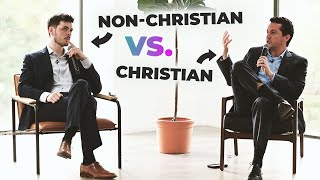


![Does God Exist? William Lane Craig vs. Christopher Hitchens - Full Debate [HD]](https://img.youtube.com/vi/0tYm41hb48o/mqdefault.jpg)