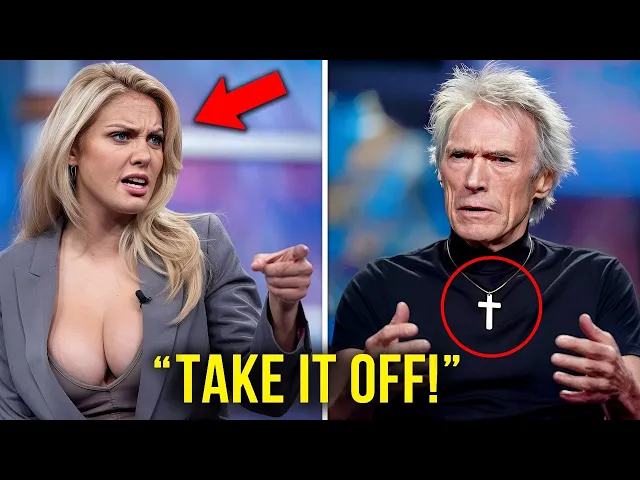
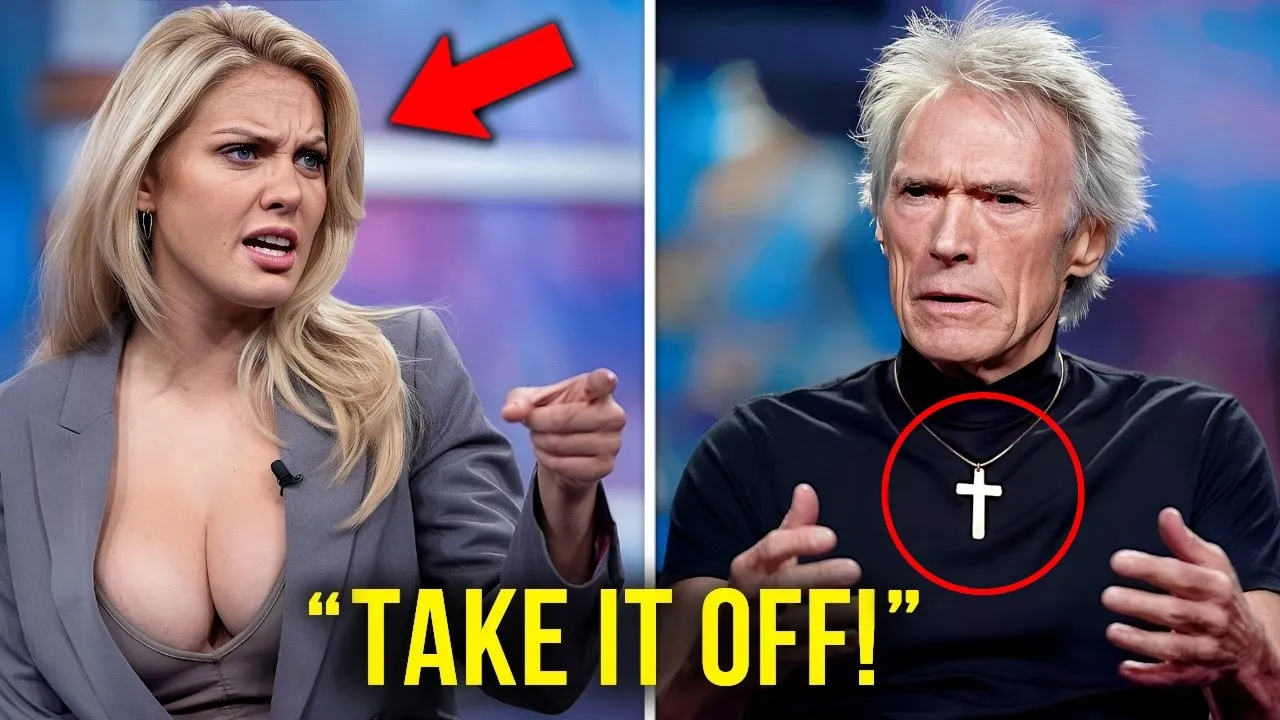
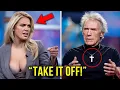
took everyone by surprise. Clint Eastwood leaned forward slightly, his eyes steady and piercing. "You know, Madison," he began, his voice low yet clear, "that cross represents something deeper than just jewelry.
It's a reminder of my faith and convictions, something that’s become increasingly rare in this line of work. " The audience held its breath, caught off guard by the sincerity in his tone. Madison, expecting a typical Hollywood deflection, was momentarily thrown.
She hadn’t anticipated this. She had meant to take him down a notch, to expose what she perceived as outdated beliefs, but instead, he was inviting her into a conversation about the very principles she thought he lacked. "You see," Clint continued, "real strength comes from knowing who you are and what you stand for.
The world has changed, but that doesn’t mean our values need to. " His gaze intensified, and Madison felt the weight of his words. In that moment, the tables began to turn.
Madison was no longer the relentless interviewer; she was engaging with a man who had weathered the storms of decades of criticism and still stood firm in his beliefs. It was a lesson many in the audience had not expected that night. Madison smiled, reconsidering her approach.
It was clear now that this was not just an interview; it was a dialogue about faith, resilience, and the complexities of modern society. The audience, too, could sense the shift—the air was charged with a mix of respect and intrigue. Even the social media team paused, realizing they were witnessing something significant unfold, something more profound than mere entertainment.
As they continued, the conversation took them into unexpected territory—a discussion about the importance of conviction, the role of faith in public life, and the challenges of staying true to oneself in an ever-changing world. The lines between interviewer and interviewee blurred, and for once, it became less about scoring points and more about understanding different points of view. That night on "The Unfiltered Truth," Clint Eastwood, with his calm demeanor and unshakeable presence, taught Madison Steel—and the audience—an invaluable lesson: that sometimes, the strongest message comes not from aggression, but from a quiet, unwavering belief in oneself.
threw her off just a little. He smiled, not a forced, media-trained smile, not a nervous or uncomfortable one. No, it was something else entirely.
It was the kind of smile a man gives when he's heard this all before. The audience wasn't sure what to make of it; the chuckles fizzled out, a few people shifting in their seats. They had seen guests fumble on this show, but Clint Eastwood wasn't fumbling.
He was just watching. Madison caught the hesitation in the air, the energy that wasn't quite going her way. She needed to push further, so she did.
Madison tilted her head, pretending to process his reaction, or rather, his lack of reaction. "Come on, Clint," she said, her voice taking on that honeyed, condescending tone she reserved for guests she was about to dismantle. "You've built an entire career playing the tough guy, the cowboy, the non-nonsense enforcer, the man who doesn't take orders from anyone.
" She let the words settle, letting them paint him into a corner, and then, with perfect timing, she delivered the punch line: "And yet, here you are, wearing a cross like some choir boy! " Laughter erupted, louder this time. Some people in the audience clapped; that was what she wanted, that reaction.
In that moment, she saw the flicker of movement from the producers at the back of the studio, the signal that they had just clipped the sound bite, that it was already being prepped for social media. A slow smirk spread across her lips. She pressed further.
"Come on, Clint, isn't this a little outdated? A little, what's the word—out of touch? " More laughter.
She could already imagine the headlines: "Hollywood Legend Caught in Time Warp: Clint Eastwood Clings to Old-School Religion in a Changing World. " Her eyes gleamed as she studied his face, waiting for him to break, to fumble for an answer, to give her the reaction she needed. But Clint Eastwood didn't fumble; he didn't even blink.
He just lifted his eyes, slowly, deliberately. And in that moment, the air shifted. The laughter died down, but not because the joke was over; it was because everyone in the room suddenly realized the joke was never on him.
It was on her. The room hushed. The air that had been buzzing with laughter just seconds ago now felt thick, unmoving, like the moment before a storm rolls in.
Clint Eastwood sat there, quiet, unmoved, his expression unreadable. He didn't fidget, didn't glance toward the cameras, didn't react the way guests were supposed to on *The Unfiltered Truth*. He just let the silence breathe, and then, in that unmistakable gravelly voice, the kind that carried decades of weight with just a few syllables, he spoke: "You think it's funny?
" His words weren't loud; they weren't sharp, but they cut through the room like a knife anyway. Madison Steel chuckled, but it was different now—forced, uncertain. The confidence in her posture faltered for just a split second, barely noticeable unless you were paying attention.
Clint was paying attention. "No, I just—well, it's a little surprising, that's all," she said, still trying to maintain control. Her tone was lighter now, backpedaling.
"I mean, faith isn't exactly Hollywood's favorite subject these days. " She smiled again, but this time it didn't land the way it usually did because Clint Eastwood wasn't playing the game. His eyes locked onto hers, steady, unreadable.
He wasn't on the defense; he wasn't even bothered. And then, finally, he gave her the answer she wasn't expecting: "That's why I don't care what Hollywood thinks. " The words landed like a hammer: no explanation, no justification, just a fact.
The audience shifted; some of them had been waiting for him to stumble, to scramble for footing, but instead, he had just planted himself like a stone wall. Madison opened her mouth, but for the first time in a long time, she didn't know what to say because Clint Eastwood hadn't just answered her; he had ended the conversation. The studio was so quiet now that you could hear the faint hum of the cameras rolling.
The shift had happened, the same shift that always happened when Clint Eastwood decided to take control of the moment. Slowly, deliberately, Clint lifted the small silver cross necklace between his fingers, holding it up just enough for the camera to catch the way the light flickered against its surface. His thumb ran across the worn edges, a gesture so simple, so absent of theatrics that it somehow made the moment even heavier.
And then he spoke: "This was my father's. " No buildup, no grand reveal, just the truth. "He wore it every day of his life.
When he passed, I kept it. " The audience wasn't chuckling anymore; they were listening. Madison's face had softened just slightly—not enough to show weakness, but enough to show that this wasn't the answer she expected.
Clint didn't look at her as he spoke, didn't try to convince anyone in the room of anything. "Not because I thought it looked good. Not because it's a trend.
" He paused, still turning the cross over in his fingers, "But because it reminds me of who I am. " There it was—the shift in the room, the shift in the energy, the shift in the entire conversation. The people in the audience who had laughed at the joke just minutes ago were now leaning forward, their amusement gone because what Clint had just said wasn't just about him; it was about them.
Then came the final line, the one that cut straight through the air, through the show, through the entire point of this interview. "Some people wear jewelry to show off. " He glanced up, this time locking eyes with Madison Steel.
"Others wear it because it means something. " Silence. Madison sat there, staring, unsure what to say.
The audience had already decided who had won this moment because, once again, Clint Eastwood had. Spoken, and the world was listening. The laughter was gone—not faded, not quieted—gone.
In its place, a heavy, uncomfortable silence hung over the studio like a thick fog. The very audience that had been so eager to laugh along with Madison Steel just moments ago now shifted uneasily in their seats. Some exchanged glances; others stared straight ahead, unsure whether they were still supposed to be entertained or if something real was happening.
And at the center of it all, Clint Eastwood, calm, still unshaken. Across from him, Madison Steel was trying not to squirm. She had been here before—interviews that got tense, moments where a guest pushed back—but this, this was different because Clint wasn't pushing back.
He was just sitting there, letting the weight of his words settle like stones on the studio floor. She forced a laugh, a touch too bright, too rehearsed—the kind of laugh that said, "I still have control of this moment. " "I wasn't trying to be disrespectful," Clint, she said, tilting her head slightly, the warmth in her tone now laced with something else—defensiveness.
"I just think it's an interesting choice for someone like you. " She gestured vaguely at the cross, as if trying to turn the moment back into something light, something playful. But Clint wasn't playing.
His reply came without hesitation: steady and sure. "You wouldn't have mocked it if it was any other symbol. " The audience murmured; some nodded, some whispered because they knew he was right, and Madison knew it too—she just couldn't admit it.
Madison Steel was good at what she did, one of the best. She had spent years refining her technique, knowing exactly how to navigate difficult moments, how to reframe a conversation when it wasn't going her way. And right now, she needed to reframe this.
She leaned back ever so slightly in her chair, adjusting her posture, softening her expression. "Look, I respect faith; I do," she said, her voice gentler now, almost diplomatic. "I just think we've moved past needing things like that.
" A small nod, a slight shrug, as if she was just offering a reasonable perspective. The audience watched, the crew waited, and Clint didn't flinch, didn't blink, didn't lean forward—didn't do anything but hold his ground like he had been doing for nearly a century. Then he spoke, slow, measured, certain: "Moved past needing faith.
" He let the words linger, his gaze never leaving hers. And then, the question that hit like a bullet: "Tell me something, sweetheart: What do you believe in? " The audience leaned in, and for the first time all night, Madison Steel stumbled.
It was subtle—a flicker of hesitation, a fraction of a second where she didn't have the perfectly polished response ready to go. The cameras caught it; the audience felt it, and Clint Eastwood saw it. And then, the knockout line: "Because if you don't stand for something, you'll fall for anything.
" The silence after that was different—not tense, not awkward—just final. The moment that had started as a joke was now etched into history because Madison Steel had walked into this interview thinking she was the one setting the trap, and Clint Eastwood had just closed it. It happened fast, faster than anyone expected.
Before the interview had even wrapped, before Madison Steel had a chance to issue some well-crafted damage control statement, before the network even had time to decide how to spin it, the internet had already spoken. The clip went viral—not just trending, not just getting attention; it was everywhere: Twitter, Facebook, Instagram, TikTok. Within minutes, the sound bite of Clint's final words—"If you don't stand for something, you'll fall for anything"—was being replayed, clipped, and dissected by millions.
Trending hashtags: Clint schools Madison, Faith matters, Respect the cross. And the reactions poured in like a flood. She thought she was going to embarrass Clint; he ended her whole argument: "Hollywood mocks faith until a legend reminds them why it still matters.
" Notice how she had nothing to say after that. Madison tried to spin it, but Clint wasn't playing her game. "This is why old-school values still matter.
People like Eastwood don't need to prove anything; their wisdom speaks for itself. " Madison's usual supporters, the ones who lived for her viral takedowns, weren't laughing this time. Some defended her, desperately trying to shift the narrative: "He was condescending; he dismissed her opinions.
She was just asking questions. Clint Eastwood is out of touch with modern values. " But it wasn't sticking because the moment was too real, too unspin, too powerful.
The media scrambled. Some outlets tried to minimize it, calling it a spirited debate or a generational misunderstanding. Others leaned into it, admitting that Madison Steel had lost control of the interview.
And then the biggest sign that Clint had won: the network pulled the interview from their main page. They didn't want to platform the very moment that had cemented Clint Eastwood as a legend all over again. The dust hadn't even settled when the reporters came looking for him—they wanted a statement, a response, a victory lap.
But Clint, he didn't do victory laps. A week after the interview, a journalist caught up with him outside a café in Carmel, California, his quiet little town by the sea. The morning sun cast long shadows across the cobblestone street as Clint adjusted his jacket, the same worn silver cross resting beneath his collar.
A reporter, mike in hand, rushed toward him. "Mr Eastwood, do you have any response to the viral interview? " Clint paused, took a slow sip of his coffee, and finally smirked—a smirk that said everything.
Then, in that signature gravelly tone, he gave the only response he ever needed: "Nope. " And just like that, he walked away—no explanations. No justifications.
No arguing with people who already lost, because real legends don't explain themselves. They don't fight for approval; they don't try to win internet debates. They just stand for what they believe in, and that's why Clint Eastwood has already won.
Want to hear more of this? Then click on the video on the right-hand side, which is even more insane!