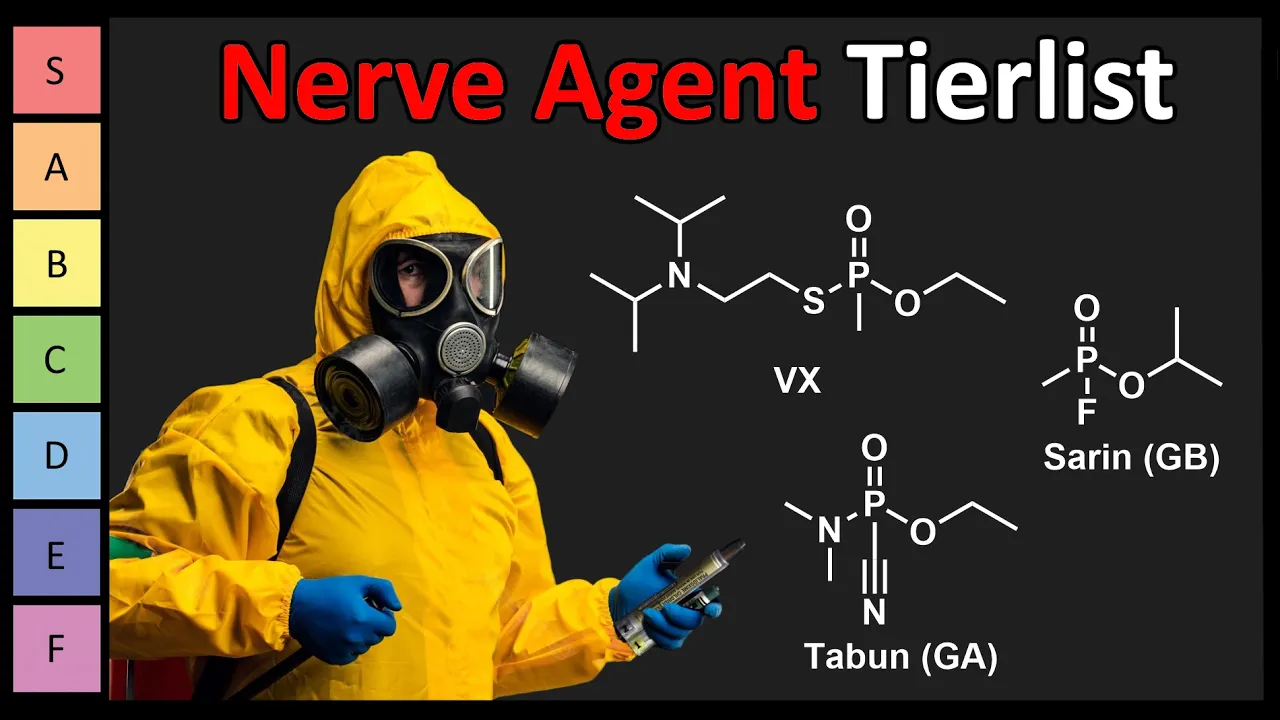
Welcome back. I'm that chemist. And today we're going to be deciding which nerve agent is the most evil.
Muahahahaha! Nerve agents are extremely terrifying, and it wasn't until I started doing the research for this episode that I found out how terrifying they are. Let's start with Tabun.
Tabun is a clear, colorless, tasteless liquid with a faint, fruity odor. This was initially discovered in 1898, but it wasn't discovered to be a nerve agent until December 1936. During the campaign to discover organophosphate insecticides.
While it is an extremely effective insecticide, it's also deadly to people because it's a nerve agent. Now, what is a nerve agent? Well, I'm going to do a bigger video later about nerve agents.
But in the meantime, nerve agents are these things that inhibit this molecule called acetylcholine. And because they inhibit acetylcholine, all of your nerves just fire like crazy. If you want to see what happens when exposed to a nerve agent, I'll include a link to a video in the description, but I'd advise you to use your discretion whether or not to watch it, because it might be upsetting.
So this basically makes all of your nerves fire at once, which makes your nerves send signals over and over and your body effectively spasms, and you eventually will die from asphyxiation, from your diaphragm flexing and then not releasing or eventually from your heart stopping. Additionally, some of these cross the blood brain barrier, and so they do all sorts of things inside of your brain as well. These are terrifying.
Even the F-tier ones in this list are still S-tier-terrifying. So that being said, all of these chemicals are extremely concerning. Even if they get a bad rank.
That doesn't mean that they're not scary. I wouldn't get anywhere near any of these even precursors, for goodness sakes. So Tabun, this is a member of what's known as the G series.
The G series. Nerve agents are volatile and they're also really corrosive. And as a result, they're not great to store long term.
You can see that the G series tend to have G abbreviations after their name, one that doesn't. Here is this methyl cyclosarin. But these G series agents all are somewhat volatile and fairly corrosive.
Now, the downside with these is because they're volatile, the more volatile they are, the faster they dissipate. So if this is a liquid that's volatile, it's going to have a greater chance that someone breathes it in and is exposed to it. But it might dissipate really quickly.
So for some of these, the whole area can be decontaminated really quickly just by waiting. But other ones here will need special decontamination protocols before it's safe that anyone can go there. So Tabun, it's rated a 7.
6 out of ten as a nerve agent. Now, this one doesn't have as favorable properties for storage, so it doesn't make as good of a nerve agent as, like, a weapon. So this one's worse, but it's still pretty terrifying, as I said earlier.
Every single one of these is S-tier terrifying. And you should never mess around with nerve agents. Tabun can go into D-tier because some of the other ones we're going to talk about are just horrendously terrifying.
Let's talk about sarin. Sarin was discovered in 1938 and the Nazis produced tons of this. However, Hitler refused to initiate the use of any of these nerve agents as weapons, although people aren't 100% sure why.
This one's also really terrifying. The one thing that they found is when they have a methyl group here, instead of that di methyl amino group that made it a little bit more potent, which is why you see that trend in the remainder of the G series. However, this P-F is still very corrosive, and that's why these are kind of disfavorable.
Now, in the West, none of these are actively used, although some training has been done with sarin and V. X. Live agent training is done so that service members are able to be prepared for possible situations they can encounter on the field.
Although the West does not actively use these against people in combat situations. Now that reminds me later on I should bring up Edgewood Arsenal, because that's a key point that I really want to highlight here. And it's something that probably could be featured in several videos moving forward.
So sarin, it's a little bit better than tabun in terms of overall concern. That being said, it's only rated seven out of ten as a nerve agent. So we'll put sarin into D-tier as well.
Chlorosarin. Chlorosarin is pretty scary. It's less toxic than sarin, although it can also be a chemical precursor to sarin.
So this is pretty scary. It's almost as bad as sarin, maybe slightly worse. It's rated 6.
9 out of ten as a nerve agent, so I'll put it into E-tier. Now, you might be thinking seven out of ten is pretty bad, but just wait until we get to some of the higher ranked ones. They're way scarier.
Thiosarin. It's less toxic than sarin. However, this sulfur can easily hydrolyze to the corresponding oxygen derivative, and it could also just react with elemental oxygen to form that.
So this is a precursor to sarin, but it's like one that the atmosphere will make into sarin. This is rated a 7. 1 out of ten is a nerve agent and it's about as bad as sarin.
So we'll put this in the same tier of sarin, even though it could probably go in a higher tier. Now, soman - soman is scarier than sarin, even though the structure is really similar. You can see sarin has this isopropyl group.
But here we have this one too, to try methyl group. When this alcohol group is bulkier and bigger, it makes it less volatile. So that means it won't dissipate as quickly in the atmosphere and it'll actually spread further.
So this is more concerning because it can linger and be an issue for longer distances and because it's less volatile, it's going to slowly evaporate off of surfaces and so it can be persistent a little bit longer. So this one's scarier than sarin, for sure. Now, it's also more toxic in terms of relative toxicity.
This is worse, it's more potent. And it was discovered together by Nobel laureate Richard Kuhn with Conrad Henkel at the Kaiser Wilhelm Institute for Medical Research in 1944. This one is rated as a 7.
9 out of ten as a nerve agent. And if you're wondering where I'm getting these ratings out of ten as a nerve agent, I'll include a picture of that book here. This book is terrifying and I can't believe this is on the Internet.
Absolutely terrifying book. Soman is really scary. We can put it into C-tier, maybe this belongs in B tier.
As we're working our way through, we can decide if it belongs it B-tier. Now, cyclosarin. This was synthesized after Soman, I wasn't able to find the exact year.
But unlike sarin, this cyclohexyl group makes it even less volatile and it evaporates relatively slowly. At about 1/69 the rate of sarin, which I thought was kind of scary. This is bulkier than this tri methyl propyl group.
And this one's rated as an 8. 6 out of ten as a potential nerve agent. Absolutely horrifying.
Now, one that's even more horrifying is this methyl cyclo sarin, which is EA 1356 Now, let's talk about the EAs for a minute. Now, there is this program that the U. S.
Army Chemical Corp had called the Edgewood Arsenal Human Experiments. And from 1948 to 1975, they conducted classified human subject research at this facility in Maryland at the Edgewood Arsenal. And they tested several reagents, not just nerve agents, but they tested lots and lots of different chemical agents on volunteers.
And there's a lot more controversy surrounding that. And if that's the type of thing you want to hear more about, make sure you leave a comment down below to let me know, because this is something that should be discussed way more frequently. I had no idea that the U.
S. Army was doing this. And the fact that they were testing chemical warfare agents on American citizens is absolutely horrifying and it is shameful.
So when people say the West is good, we don't use nerve agents on people. The exception here is their own people, in fact, even their own Marines. And this isn't for training purposes.
This is to test what chemicals do to people. So I think this is awful and I can't believe that we have done this as people. Methyl cyclosarin is scarier than cyclosarin.
Why, you might ask? Well, this extra methyl group is problematic, and there's actually not too much I could find about this online. However, it's known that methyl cyclosarin is highly resistant to enzymatic degradation in the body.
And just in 2018, the U. S. Army patented a novel enzyme to help break this down.
So that's pretty scary. The earliest reports of methyl cyclosarin were from 1983, and I'll include a reference to that in the description. Methyl cyclosarin doesn't have a rating.
It's probably scarier. I'm going to go out on a limb and put this into S-tier because it seems to be quite bad. The fact that enzymes don't break it down mean that even if you're trying to treat the person who is exposed to this, their body is not breaking it down.
So if it's not being broken down that quickly, you might not be able to save the person at all. And even if they're saved, they could still have lasting nerve damage. And that's pretty awful.
Terrifying evil reagent, one of the most evil we've talked about so far. One of the most evil on this list. Speaking of evil, let's talk about VX.
VX was first discovered in England in 1952. It's more potent than sarin. It's more persistent because it's less volatile and it's less corrosive because there's no P-F in this molecule.
So when this reacts with your receptor, ethanol is the leaving group (*actually the thio group usually leaves first) and it binds tightly. As I mentioned in the last tier list, which I'll include a link to in the description, this was used in the assassination of Kim Jong Nam. This is rated as ten out of ten as a nerve agent.
We can put this into S-tier as well. Absolutely horrifying. Now, one of the things that VX can do, which is even worse, is as this breaks down in the environment, it can form EA-2192, which you can see ethanol has just left as a leaving group.
Water just comes in here instead. The remaining H of water has gone to form ethanol. When VX was hydrolyzed and EA-2192 again has the EA tag; Edgewood Arsenal and it is still extremely toxic as a nerve agent.
No degradation of this chemical was observed in distilled water after 1000 hours and it's also stable under alkaline environments. It's got microgram per kilogram lethality in mice, rats and rabbits. I'll include a reference in the description for the hydrolysis discussion of this chemical.
Another horrendously terrifying one. We can put this one into A-tier because it's formed through the hydrolysis of VX. Still an extremely scary chemical.
Now here we have a Russian VX, which is also known as VR. This was discovered by the Soviet Union in 1957 after they had obtained some information about the high level of toxicity of this type of motif. It has a similar lethal dose to VX, but because this has a di ethyl group instead of a di isopropyl group, it makes it more prone to decomposition.
This is also claimed to be the first Novichok agent because this is slightly less chemically stable. I would say it's slightly less evil. We can put it into A-tier along with EA 8192.
Much as the Russians had V. X. So too, the Chinese had their own V.
X. I could find basically nothing about this online. So we're going to have to assume that it's about as bad as the Russian V.
X. A scary chemical, to be sure. One that we do know a bit more about is V sub x.
This one was rated in that terrifying book that I mentioned earlier as a 9. 3 out of ten similar to V. X.
This one's a little bit worse in terms of absolute lethality. And because it hasn't ever been weaponized, we can be even harsher and put this into B-tier. Super scary.
Still, everything on this list is absolutely horrifying. If you're wondering what the V stands for, by the way, it stands for Venomous. And I didn't mention earlier, but the G for the G series is named after Gerhard Schroeder (this is incorrect, the G actually stands for 'German').
I wasn't able to find any primary literature referencing this (German Wikipedia says the G stands for German). So if you have a reference for the fact that the G series agents are named after Gerhard, I'd appreciate it if you could leave a comment with a reference down below and I'll pin that comment or I'll put it in the description. So next we have the A-Series.
I don't believe the A-SERIES stands for anything in particular, but these are the Novichoks. So the Novichoks were made by the Soviet Union. They were made between 1971 and 1993.
Let's start with A-230, A-230. It has an estimated lethal dose of less than 0. 1 milligrams.
This is terrifying. It has poor stability in the presence of water however, and it solidifies at low temperatures. So it's a little bit disfavorable because it's not super stable.
We can put it into A-tier, but this is still a super duper lethal chemical. So scary. Absolutely terrifying.
Now, A-234 this was used in the poisoning of Sergei and Yulia Skripa in 2018, and this one is slightly less potent. It's estimated that 0. 2 milligrams would be required, but that's still almost nothing.
Both of these are Schedule One chemical warfare agents and some people have contested the structure of A-234. I'll include what Hoenig claims the actual structure could be, although it isn't entirely confirmed. So A-234.
Similarly scary to A-230; a little bit chemically unstable still. So we'll put it into A-tier as well. A-242.
A-242 is similar in terms of being very potent. I couldn't get any information about the actual toxicity specifics, although it's still a nerve agent, it's still really scary. It isn't very volatile.
So instead of being employed as a volatile liquid, which could affect some space, it would have to be powderized, which makes it a little bit less practical, but still absolutely terrifying. This one can also go into A-tier, which is appropriate because, hey, all of these start with an A. Now a couple other ones.
Here we have C01-A039 and C01-A042. You can see that this one's an ester of phosgene oxime, which is horrendous. This is a derivative of the corresponding P-F compound.
And this group is a binary agent, which means when these are stored, they want to store the two active parts separately, mix it together, and then the active agent is formed. So this is called a binary agent. That's why the 'C0' one is the same for both of these chemicals.
The western portion of these molecules is the same, although the eastern portion varies. So binary agents are easier to store because you can (slightly more) safely store the two half separately first and then mix them right before the nerve agent is needed. Both of these are horrendous.
They both look like some of the most toxic chemicals I've ever seen. And I think both of these belong in S-tier. Absolutely horrendous.
Just look at this. This is an imine-acyl fluoride with a difluoro nitro group. What the heck?
This can go into S-tier as well. I'm going to shrink down V. X.
And methyl cyclosarin here because I think we're going to need a little bit more room as we move to the last couple. Now, let's take a break from the horror and talk about how antagonists for the acetylcholine receptor can actually be useful. So this is neostigmine.
Neostigmine is used as a medication to treat a few different conditions, such as myasthenia gravis, Ogilvie syndrome, and urinary retention. It's given by injection and it doesn't cross the blood brain barrier, which is desirable as a drug to minimize side effects. And it was synthesized originally in 1931.
This is not a very good warfare agent, although slight derivatives of it are, which is pretty scary. One example is this TMTFA. This is almost the exact same, except instead of having this carbamate group, we instead have this trifluoro ketone.
Now this quaternary aniline group is a motif that I am convinced is horrifying. After working on the background for this episode, having almost any quaternary anilinium like this makes compounds so toxic like - so so toxic (emphasis on how toxic it is). This one's even worse because not only does it mimic acetylcholine by having this charged quaternary group, but this ketone because there's this CF3 group makes it really electrophilic and it makes it react with nucleophiles in the body.
So once this goes into that receptor, a serine residue is able to covalently react making a hemi ketal. And this might be the most potent nerve agent that I've come across during my research. This is apparently active in femtomolar levels, which is 10^-15, and that is very, very, very potent.
This one can go right into S-tier. Probably this is the S-est of the S-tiers, horrifying chemical. Some of the other ones that look similar include TL-599, which is also known as SB-8.
T-1123. In this case you have a para substitution instead of a meta substitution. Although in T-1123 you do still have a meta substitution here.
We still have a carbamate with two methyl groups, although for T-1123, we only have one methyl group similar is T-1152 where we have meta substitution but only one methyl group instead of two. So TL-599. I couldn't find any actual information on its use on Wikipedia.
It was initially published in 1941 in JACS (Journal of the American Chemical Society) I'll include a link to that in the description. This seems to be a really potent chemical. Can't really tell how bad it is, so we'll put it into E-tier for good measure.
T-1123. It was investigated as a chemical warfare agent starting in 1940 and it's L. D.
50 is 75 micrograms per kilogram. This is still pretty bad. It's not as bad as the Novichoks, but it's pretty bad.
This one probably belongs in E-tier as well. These don't have volatility because they're quaternary ammonium salts, but they're very, very potent and very deadly. Actually, I think we'll put this one into D-tier, because it is pretty potent.
Now, T-1152. This was patented as a rodenticide in 1932. So it's clearly being used against mammals and the LD50 of this one is 260 micrograms per kilogram.
It's still really scary. But compared to some of the other ones on here, it's not that bad. We're going to put it in E-tier.
Still a very scary chemical, though. Now we have these last three of which I could find almost no information, except they were the scariest compounds in this scary book that I mentioned earlier. These are all rated as perfect tens as being the most scary nerve agents in this whole book.
These are all extreme S-tier molecules. Now, these have quaternary ammonium groups and they also have carbamates. So these are most similar to neostigmine and derivatives.
But you can see each of these has effectively two big groups like that. And that makes these really scary. This first one here with these pyrrolidinium groups, this one was named in a US patent, but it wasn't specifically discussed in terms of its toxicity.
It was mentioned as a perfect ten in the scary book I mentioned earlier. This one's going into S-tier because it's a perfect ten. Now, some of the ones that we do know more about have names.
This one is Agent 1-10. Agent 1-10 was patented in 1967. The patent was approved in 1987 and it has an LD50 of four micrograms per kilogram in rabbits.
This is no joke. These things are super high molecular weight too, so they're going to sit around for a really long time. Very, very potent agents.
Absolutely terrifying. And I'm not sure whether or not these have seen active use or if they've just been researched. Very scary.
Agent 1-8 is similar with an LD50 of four micrograms per kilogram. Almost all of these were initially reported quite some time ago, the latest of which would be the Novichoks in 1990s and in about 20 to 30 years. A lot more research has probably been done, especially since the advent of the Internet.
What chemicals have been prepared by different nations and how they've been researched are not well known because this is all classified documentation, but hopefully in another 20 years or so we'll be able to make another tier list. Talking about this chemistry, I'd like to just take a moment and thank Opossum Supremacist for their help with this episode. They had had some experience in CBRN, so they had a lot of helpful stuff to say, and without their help, it wouldn't have been possible to make this tierlist as informative as it was.
I'm planning on doing another full length video on the topic of nerve agents. And if you have any expertize in the history of nerve agents and you'd like to reach out, I'd really appreciate it if you could contact me on Discord. And if you like the style of video, it would really help out if you share it with people.
Because I spent way more time on this tierlist than I've ever spent on a tierlist before. Thanks for watching and I hope you have a great day. Welcome back.
I'm that chemist. And today we're going to be deciding which nerve agent is the most evil. Muahahahaha!
Nerve agents are extremely terrifying, and it wasn't until I started doing the research for this episode that I found out how terrifying they are. Let's start with Tabun. Tabun is a clear, colorless, tasteless liquid with a faint, fruity odor.
This was initially discovered in 1898, but it wasn't discovered to be a nerve agent until December 1936. During the campaign to discover organophosphate insecticides. While it is an extremely effective insecticide, it's also deadly to people because it's a nerve agent.
Now, what is a nerve agent? Well, I'm going to do a bigger video later about nerve agents. But in the meantime, nerve agents are these things that inhibit this molecule called acetylcholine.
And because they inhibit acetylcholine, all of your nerves just fire like crazy. If you want to see what happens when exposed to a nerve agent, I'll include a link to a video in the description, but I'd advise you to use your discretion whether or not to watch it, because it might be upsetting. So this basically makes all of your nerves fire at once, which makes your nerves send signals over and over and your body effectively spasms, and you eventually will die from asphyxiation, from your diaphragm flexing and then not releasing or eventually from your heart stopping.
Additionally, some of these cross the blood brain barrier, and so they do all sorts of things inside of your brain as well. These are terrifying. Even the F-tier ones in this list are still S-tier-terrifying.
So that being said, all of these chemicals are extremely concerning. Even if they get a bad rank. That doesn't mean that they're not scary.
I wouldn't get anywhere near any of these even precursors, for goodness sakes. So Tabun, this is a member of what's known as the G series. The G series.
Nerve agents are volatile and they're also really corrosive. And as a result, they're not great to store long term. You can see that the G series tend to have G abbreviations after their name, one that doesn't.
Here is this methyl cyclosarin. But these G series agents all are somewhat volatile and fairly corrosive. Now, the downside with these is because they're volatile, the more volatile they are, the faster they dissipate.
So if this is a liquid that's volatile, it's going to have a greater chance that someone breathes it in and is exposed to it. But it might dissipate really quickly. So for some of these, the whole area can be decontaminated really quickly just by waiting.
But other ones here will need special decontamination protocols before it's safe that anyone can go there. So Tabun, it's rated a 7. 6 out of ten as a nerve agent.
Now, this one doesn't have as favorable properties for storage, so it doesn't make as good of a nerve agent as, like, a weapon. So this one's worse, but it's still pretty terrifying, as I said earlier. Every single one of these is S-tier terrifying.
And you should never mess around with nerve agents. Tabun can go into D-tier because some of the other ones we're going to talk about are just horrendously terrifying. Let's talk about sarin.
Sarin was discovered in 1938 and the Nazis produced tons of this. However, Hitler refused to initiate the use of any of these nerve agents as weapons, although people aren't 100% sure why. This one's also really terrifying.
The one thing that they found is when they have a methyl group here, instead of that di methyl amino group that made it a little bit more potent, which is why you see that trend in the remainder of the G series. However, this P-F is still very corrosive, and that's why these are kind of disfavorable. Now, in the West, none of these are actively used, although some training has been done with sarin and V.
X. Live agent training is done so that service members are able to be prepared for possible situations they can encounter on the field. Although the West does not actively use these against people in combat situations.
Now that reminds me later on I should bring up Edgewood Arsenal, because that's a key point that I really want to highlight here. And it's something that probably could be featured in several videos moving forward. So sarin, it's a little bit better than tabun in terms of overall concern.
That being said, it's only rated seven out of ten as a nerve agent. So we'll put sarin into D-tier as well. Chlorosarin.
Chlorosarin is pretty scary. It's less toxic than sarin, although it can also be a chemical precursor to sarin. So this is pretty scary.
It's almost as bad as sarin, maybe slightly worse. It's rated 6. 9 out of ten as a nerve agent, so I'll put it into E-tier.
Now, you might be thinking seven out of ten is pretty bad, but just wait until we get to some of the higher ranked ones. They're way scarier. Thiosarin.
It's less toxic than sarin. However, this sulfur can easily hydrolyze to the corresponding oxygen derivative, and it could also just react with elemental oxygen to form that. So this is a precursor to sarin, but it's like one that the atmosphere will make into sarin.
This is rated a 7. 1 out of ten is a nerve agent and it's about as bad as sarin. So we'll put this in the same tier of sarin, even though it could probably go in a higher tier.
Now, soman - soman is scarier than sarin, even though the structure is really similar. You can see sarin has this isopropyl group. But here we have this one too, to try methyl group.
When this alcohol group is bulkier and bigger, it makes it less volatile. So that means it won't dissipate as quickly in the atmosphere and it'll actually spread further. So this is more concerning because it can linger and be an issue for longer distances and because it's less volatile, it's going to slowly evaporate off of surfaces and so it can be persistent a little bit longer.
So this one's scarier than sarin, for sure. Now, it's also more toxic in terms of relative toxicity. This is worse, it's more potent.
And it was discovered together by Nobel laureate Richard Kuhn with Conrad Henkel at the Kaiser Wilhelm Institute for Medical Research in 1944. This one is rated as a 7. 9 out of ten as a nerve agent.
And if you're wondering where I'm getting these ratings out of ten as a nerve agent, I'll include a picture of that book here. This book is terrifying and I can't believe this is on the Internet. Absolutely terrifying book.
Soman is really scary. We can put it into C-tier, maybe this belongs in B tier. As we're working our way through, we can decide if it belongs it B-tier.
Now, cyclosarin. This was synthesized after Soman, I wasn't able to find the exact year. But unlike sarin, this cyclohexyl group makes it even less volatile and it evaporates relatively slowly.
At about 1/69 the rate of sarin, which I thought was kind of scary. This is bulkier than this tri methyl propyl group. And this one's rated as an 8.
6 out of ten as a potential nerve agent. Absolutely horrifying. Now, one that's even more horrifying is this methyl cyclo sarin, which is EA 1356 Now, let's talk about the EAs for a minute.
Now, there is this program that the U. S. Army Chemical Corp had called the Edgewood Arsenal Human Experiments.
And from 1948 to 1975, they conducted classified human subject research at this facility in Maryland at the Edgewood Arsenal. And they tested several reagents, not just nerve agents, but they tested lots and lots of different chemical agents on volunteers. And there's a lot more controversy surrounding that.
And if that's the type of thing you want to hear more about, make sure you leave a comment down below to let me know, because this is something that should be discussed way more frequently. I had no idea that the U. S.
Army was doing this. And the fact that they were testing chemical warfare agents on American citizens is absolutely horrifying and it is shameful. So when people say the West is good, we don't use nerve agents on people.
The exception here is their own people, in fact, even their own Marines. And this isn't for training purposes. This is to test what chemicals do to people.
So I think this is awful and I can't believe that we have done this as people. Methyl cyclosarin is scarier than cyclosarin. Why, you might ask?
Well, this extra methyl group is problematic, and there's actually not too much I could find about this online. However, it's known that methyl cyclosarin is highly resistant to enzymatic degradation in the body. And just in 2018, the U.
S. Army patented a novel enzyme to help break this down. So that's pretty scary.
The earliest reports of methyl cyclosarin were from 1983, and I'll include a reference to that in the description. Methyl cyclosarin doesn't have a rating. It's probably scarier.
I'm going to go out on a limb and put this into S-tier because it seems to be quite bad. The fact that enzymes don't break it down mean that even if you're trying to treat the person who is exposed to this, their body is not breaking it down. So if it's not being broken down that quickly, you might not be able to save the person at all.
And even if they're saved, they could still have lasting nerve damage. And that's pretty awful. Terrifying evil reagent, one of the most evil we've talked about so far.
One of the most evil on this list. Speaking of evil, let's talk about VX. VX was first discovered in England in 1952.
It's more potent than sarin. It's more persistent because it's less volatile and it's less corrosive because there's no P-F in this molecule. So when this reacts with your receptor, ethanol is the leaving group (*actually the thio group usually leaves first) and it binds tightly.
As I mentioned in the last tier list, which I'll include a link to in the description, this was used in the assassination of Kim Jong Nam. This is rated as ten out of ten as a nerve agent. We can put this into S-tier as well.
Absolutely horrifying. Now, one of the things that VX can do, which is even worse, is as this breaks down in the environment, it can form EA-2192, which you can see ethanol has just left as a leaving group. Water just comes in here instead.
The remaining H of water has gone to form ethanol. When VX was hydrolyzed and EA-2192 again has the EA tag; Edgewood Arsenal and it is still extremely toxic as a nerve agent. No degradation of this chemical was observed in distilled water after 1000 hours and it's also stable under alkaline environments.
It's got microgram per kilogram lethality in mice, rats and rabbits. I'll include a reference in the description for the hydrolysis discussion of this chemical. Another horrendously terrifying one.
We can put this one into A-tier because it's formed through the hydrolysis of VX. Still an extremely scary chemical. Now here we have a Russian VX, which is also known as VR.
This was discovered by the Soviet Union in 1957 after they had obtained some information about the high level of toxicity of this type of motif. It has a similar lethal dose to VX, but because this has a di ethyl group instead of a di isopropyl group, it makes it more prone to decomposition. This is also claimed to be the first Novichok agent because this is slightly less chemically stable.
I would say it's slightly less evil. We can put it into A-tier along with EA 8192. Much as the Russians had V.
X. So too, the Chinese had their own V. X.
I could find basically nothing about this online. So we're going to have to assume that it's about as bad as the Russian V. X.
A scary chemical, to be sure. One that we do know a bit more about is V sub x. This one was rated in that terrifying book that I mentioned earlier as a 9.
3 out of ten similar to V. X. This one's a little bit worse in terms of absolute lethality.
And because it hasn't ever been weaponized, we can be even harsher and put this into B-tier. Super scary. Still, everything on this list is absolutely horrifying.
If you're wondering what the V stands for, by the way, it stands for Venomous. And I didn't mention earlier, but the G for the G series is named after Gerhard Schroeder (this is incorrect, the G actually stands for 'German'). I wasn't able to find any primary literature referencing this (German Wikipedia says the G stands for German).
So if you have a reference for the fact that the G series agents are named after Gerhard, I'd appreciate it if you could leave a comment with a reference down below and I'll pin that comment or I'll put it in the description. So next we have the A-Series. I don't believe the A-SERIES stands for anything in particular, but these are the Novichoks.
So the Novichoks were made by the Soviet Union. They were made between 1971 and 1993. Let's start with A-230, A-230.
It has an estimated lethal dose of less than 0. 1 milligrams. This is terrifying.
It has poor stability in the presence of water however, and it solidifies at low temperatures. So it's a little bit disfavorable because it's not super stable. We can put it into A-tier, but this is still a super duper lethal chemical.
So scary. Absolutely terrifying. Now, A-234 this was used in the poisoning of Sergei and Yulia Skripa in 2018, and this one is slightly less potent.
It's estimated that 0. 2 milligrams would be required, but that's still almost nothing. Both of these are Schedule One chemical warfare agents and some people have contested the structure of A-234.
I'll include what Hoenig claims the actual structure could be, although it isn't entirely confirmed. So A-234. Similarly scary to A-230; a little bit chemically unstable still.
So we'll put it into A-tier as well. A-242. A-242 is similar in terms of being very potent.
I couldn't get any information about the actual toxicity specifics, although it's still a nerve agent, it's still really scary. It isn't very volatile. So instead of being employed as a volatile liquid, which could affect some space, it would have to be powderized, which makes it a little bit less practical, but still absolutely terrifying.
This one can also go into A-tier, which is appropriate because, hey, all of these start with an A. Now a couple other ones. Here we have C01-A039 and C01-A042.
You can see that this one's an ester of phosgene oxime, which is horrendous. This is a derivative of the corresponding P-F compound. And this group is a binary agent, which means when these are stored, they want to store the two active parts separately, mix it together, and then the active agent is formed.
So this is called a binary agent. That's why the 'C0' one is the same for both of these chemicals. The western portion of these molecules is the same, although the eastern portion varies.
So binary agents are easier to store because you can (slightly more) safely store the two half separately first and then mix them right before the nerve agent is needed. Both of these are horrendous. They both look like some of the most toxic chemicals I've ever seen.
And I think both of these belong in S-tier. Absolutely horrendous. Just look at this.
This is an imine-acyl fluoride with a difluoro nitro group. What the heck? This can go into S-tier as well.
I'm going to shrink down V. X. And methyl cyclosarin here because I think we're going to need a little bit more room as we move to the last couple.
Now, let's take a break from the horror and talk about how antagonists for the acetylcholine receptor can actually be useful. So this is neostigmine. Neostigmine is used as a medication to treat a few different conditions, such as myasthenia gravis, Ogilvie syndrome, and urinary retention.
It's given by injection and it doesn't cross the blood brain barrier, which is desirable as a drug to minimize side effects. And it was synthesized originally in 1931. This is not a very good warfare agent, although slight derivatives of it are, which is pretty scary.
One example is this TMTFA. This is almost the exact same, except instead of having this carbamate group, we instead have this trifluoro ketone. Now this quaternary aniline group is a motif that I am convinced is horrifying.
After working on the background for this episode, having almost any quaternary anilinium like this makes compounds so toxic like - so so toxic (emphasis on how toxic it is). This one's even worse because not only does it mimic acetylcholine by having this charged quaternary group, but this ketone because there's this CF3 group makes it really electrophilic and it makes it react with nucleophiles in the body. So once this goes into that receptor, a serine residue is able to covalently react making a hemi ketal.
And this might be the most potent nerve agent that I've come across during my research. This is apparently active in femtomolar levels, which is 10^-15, and that is very, very, very potent. This one can go right into S-tier.
Probably this is the S-est of the S-tiers, horrifying chemical. Some of the other ones that look similar include TL-599, which is also known as SB-8. T-1123.
In this case you have a para substitution instead of a meta substitution. Although in T-1123 you do still have a meta substitution here. We still have a carbamate with two methyl groups, although for T-1123, we only have one methyl group similar is T-1152 where we have meta substitution but only one methyl group instead of two.
So TL-599. I couldn't find any actual information on its use on Wikipedia. It was initially published in 1941 in JACS (Journal of the American Chemical Society) I'll include a link to that in the description.
This seems to be a really potent chemical. Can't really tell how bad it is, so we'll put it into E-tier for good measure. T-1123.
It was investigated as a chemical warfare agent starting in 1940 and it's L. D. 50 is 75 micrograms per kilogram.
This is still pretty bad. It's not as bad as the Novichoks, but it's pretty bad. This one probably belongs in E-tier as well.
These don't have volatility because they're quaternary ammonium salts, but they're very, very potent and very deadly. Actually, I think we'll put this one into D-tier, because it is pretty potent. Now, T-1152.
This was patented as a rodenticide in 1932. So it's clearly being used against mammals and the LD50 of this one is 260 micrograms per kilogram. It's still really scary.
But compared to some of the other ones on here, it's not that bad. We're going to put it in E-tier. Still a very scary chemical, though.
Now we have these last three of which I could find almost no information, except they were the scariest compounds in this scary book that I mentioned earlier. These are all rated as perfect tens as being the most scary nerve agents in this whole book. These are all extreme S-tier molecules.
Now, these have quaternary ammonium groups and they also have carbamates. So these are most similar to neostigmine and derivatives. But you can see each of these has effectively two big groups like that.
And that makes these really scary. This first one here with these pyrrolidinium groups, this one was named in a US patent, but it wasn't specifically discussed in terms of its toxicity. It was mentioned as a perfect ten in the scary book I mentioned earlier.
This one's going into S-tier because it's a perfect ten. Now, some of the ones that we do know more about have names. This one is Agent 1-10.
Agent 1-10 was patented in 1967. The patent was approved in 1987 and it has an LD50 of four micrograms per kilogram in rabbits. This is no joke.
These things are super high molecular weight too, so they're going to sit around for a really long time. Very, very potent agents. Absolutely terrifying.
And I'm not sure whether or not these have seen active use or if they've just been researched. Very scary. Agent 1-8 is similar with an LD50 of four micrograms per kilogram.
Almost all of these were initially reported quite some time ago, the latest of which would be the Novichoks in 1990s and in about 20 to 30 years. A lot more research has probably been done, especially since the advent of the Internet. What chemicals have been prepared by different nations and how they've been researched are not well known because this is all classified documentation, but hopefully in another 20 years or so we'll be able to make another tier list.
Talking about this chemistry, I'd like to just take a moment and thank Opossum Supremacist for their help with this episode. They had had some experience in CBRN, so they had a lot of helpful stuff to say, and without their help, it wouldn't have been possible to make this tierlist as informative as it was. I'm planning on doing another full length video on the topic of nerve agents.
And if you have any expertize in the history of nerve agents and you'd like to reach out, I'd really appreciate it if you could contact me on Discord. And if you like the style of video, it would really help out if you share it with people. Because I spent way more time on this tierlist than I've ever spent on a tierlist before.
Thanks for watching and I hope you have a great day.



![Your Playful Jester Breaks Character When You Like Her Back [ASMR Roleplay] [Jester Speaker]](https://i.ytimg.com/vi/480bVAYdY84/mqdefault.jpg)




![Countdown [F4A] [Hypnosis] [Fdom] [Intense Fractionation] [Counting Down] [Fast]](https://i.ytimg.com/vi/TokGY9yejuY/mqdefault.jpg)