hello everyone hello students thank you for joining us i'd like to welcome you to green talk number three and we can let's welcome emery nalasko and she is a robotics engineer at aqua satellite in santa cruz previously she was an operations engineer at monterey bay aquarium research institute and she handled autonomous underwater robots thus the title of the presentation deep dive with an aud robotics engineer according to her linkedin profile she also has a passion for the environment so why don't we go ahead and turn the virtual stage over to her thank you for joining
us today emory hi thank you thank you so much for having me i'm excited to talk about this i am so my title is a deep dive with an auv operations engineer or engine robotics engineer now um so hi i'm emory i am an underwater robotics engineer and my focus is to use robotics to make data collection more accessible for informed sustainable decisions i graduated with a mechanical engineering degree from uc merced in 2014. i was formerly an auv operations engineer at the monterey bay aquarium research institute from 2018 to 2021 and i currently work
at auto aqua satellite which is an is a autonomous underwater vehicle startup and to talk about my expertise in the field is i lean towards a fabrication in manufacturing during those kind of four years in between i worked on a military drones i worked on ocean sonars and i also worked as a manufacturing engineer in the medical device world and along the way i between my hobbies and my job i picked up fabrication which is super helpful i also have in field operations experience so i my goal was to get the vehicle the robots from
a to b and all of the logistics that goes in between there i did i did used to work go on expeditions and in i also am a volunteer citizen scientist so which is something that everybody can do um you can always record what birds you have in the area or you can volunteer for reef check if you're a scuba diver and or you can also just volunteer doing a restoration for like the coast or for native species so that's who i am and what i'm into and so my goal for this presentation is to
talk about the ocean um and how do ocean robots help science move forward talk more about the robots that are currently working in ocean science and also the background of what goes into it kind of the reasons why why don't we see more of it you know why do we know more about space than we do the ocean and so this is a kind of a common thing that i've heard in my time i don't know if it's it's very common but we know that um that's kind of the saying of like 80 of the
ocean has never been mapped or explored or seen by humans and that we know more about space than we do our oceans um one little tidbit that i always think was interesting is water has more than three times the thermal mass of air and at least half our oxygen comes from the ocean and so it's still interesting that we're just kind of scraping the surface when it comes to it and part of the part of it is because the ocean is difficult to explore it's also difficult to understand the value of and get excited about
something that you can't see you can see space you can see the planets through america's jokes but it's it's very difficult to see what's going on under the ocean most people gotta get this view and to kind of give an example here are two ocean floor maps that are using two different pieces of equipment um the bottom one which is the multibeam which is acoustic sonar it's at a about a two inch resolution and as you can see it's it's not it's not as interesting as one you would think um and the reason why there's
that you don't see any biomass or any organisms is because most organisms are acoustically transparent they're mostly made out of water so the sonar doesn't see them and then on the upper side uh the from the lidar we use lasers about 3 8 of an inch i'm doing the translation because we often use inches instead of the other way around um so we can see another it shows another story we can see that there is biomass there and we can kind of see the diversity and there's with this lighter sled we also take photos so
we can actually see what's going on there and so that kind of raises the question is like if we have this technology why don't we just use it for everything so my goal here is to kind of undercover uncover currently what it takes to learn about the ocean and to kind of start the conversation of what we can learn and what we can do with that knowledge so there is a lot going on in the ocean there are creatures that buy luminesce there are century old sponges and coral there are active volcanoes hydrothermal vents and
creatures that thrive in those environments and all of these are signals kind of telling us the story of what's going on in order to listen to that story we need eyes and ears and more sensors in the ocean and kind of currently what we have now is we were looking through the ocean and blurry glasses with an occasional microscope glance like how could under someone understand the value of like let's say a national park if you were dropped into yosemite and were only given 10 feet of visibility and 30 minutes to look around would you
think yosemite was as valuable as it would is and the goal is not only to understand what's going on in the land but to also understand what's going on spatial temporally like what's going on through space and time in the water column so um something to bring it a little bit more at home of you know this is really cool and it's exciting to see these creatures and volcanoes and all of that but one of the is under reason reasons to understand what's going on in the water column is that there is a great ocean
conveyor belt which moves based off of temperature and salinity of the water and remember how i said that the water has about three times the thermal mass of air so that movement has an effect on the water on our weather sorry as the and the sea states of the ocean and so to kind of bring that a little bit more at home if you've you know bought any electronics in the last year you've probably noticed that our supply chains have been struggling and that's partially due to the changes that are happening in our as our
climate is changing it's becoming a little bit more um less predictable and we have these giant container ships that are shipping or transporting our goods and to kind of save costs sometimes they stack them a little high but if our weather system our maritime weather systems aren't as up to the date as needed they can go through what rough weather and those containers can topple into the ocean which is what it's increased over you know over the past year another part of that is if we're just looking at energy and cost um a giant container
ship like that actually costs more to go through what rough waters than it would be if they went through smooth waters so understanding our weather can help us in just reducing the cost of things that we already do so part of speaking of transportation and making things more sustainable as we move forward and make our technologies more eco-friendly we need more batteries to there's a lot more tesla's out there um and in order to do that one of the proposed ways of getting the materials to make those batteries are deep sea mining and the top
left right there are there's nodules you know they have knicker nickel cobalt manganese copper and those nodules and the current way of of doing it would be to scrape the bottom of the ocean or vacuum it up into a giant plume um but we can use robotics to be more intentional about that and a lot less invasive we can actually map out what they're you know where they are and or use you know robots to extract it and we can also monitor the impact that we have which is something that we can't do now with
what we have so also on that part of monitoring our impact um the ocean if you've ever been out been out to sea it's kind of eerie it's like if you've ever been out in backpacking you all of a sudden realize that you don't have a connection to civilization and so it can kind of be the wild west out there um there's less eyes out in the ocean so there's less that there's less accountability um kind of like the fishing fishing industry for example people go missing and also people get kidnapped and put into fish
like enslaved to work on fishing boats which is something that isn't i don't think that you know general population knows about but it happens and if we can have more eyes in the ocean this is something that we can work on another part of this too is i'm talking about the fishing industry it's really difficult to know how many animals are actually in the ocean so if we have sensors in the ocean that can actually count how how much biomass is in there we can be more we can make better decisions on our fishing regulations
so there's there is a lot so like let's go into ocean what types of ocean robots are out there um i i feel like ocean robotics is kind of a loose term and whenever i think of a robot i think of a vehicle to hold sensors and um the benefits of them is that they are repeatable and they go to places that people can't um you know we have robots we have a lot more robots in space than we have humans same for same for the ocean it's a very harsh environment for people and it's
difficult to build around people for the life support another part of it is people are really good at thinking right we come up with novel and create creative solutions but when it comes to repeal repeatability this is something that robots can be really good at um they can you know they take less people to operate so we can focus on solving other problems they also eliminate the need for boats which are can be really expensive to run and operate and we can oper we can automate routine data logging and i kind of want to clear
up the acronyms there's remotely operated vehicles which are kind of the joystick operations these are the kind of kind of beautiful screens where people actually have videotapes and that's where you get all your national geographic movies and then there's autonomous underwater vehicles which autonomous meaning is that they can collect data and make decisions for themselves which is nice because again we're not using people time on it so while we're talking about robots um i wanted to kind of give an overview of what's out there there's a lot more com there's there's a lot of companies
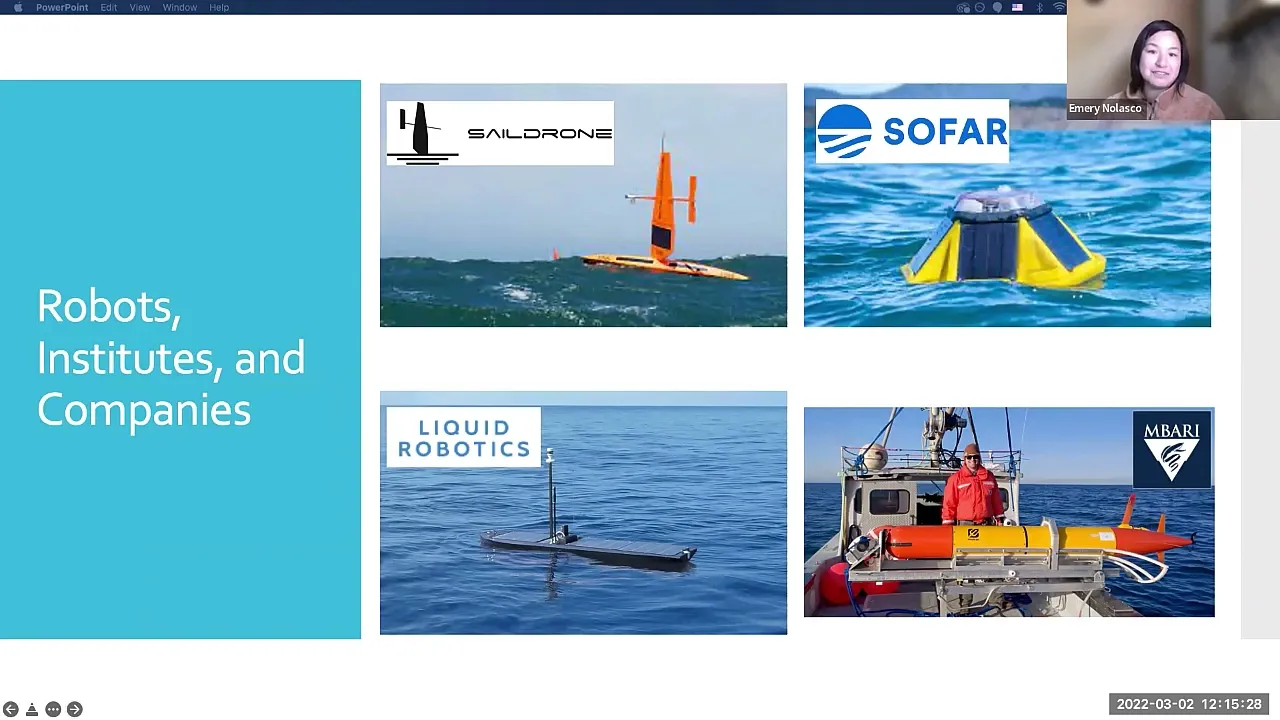
and there's not a lot of company institutes that are working on this but here are some highlights um that i know of so we have two similar ones which are surface water vehicles there's cell drone and liquid robotics both of them typically run for about a year and they're really good uh celdren is good at bathymetry um which is like the 3d mapping of the seafloor and they're both good at just overall data collecting and for weather monitoring and all that the benefit of being able to access the air is that you have gps you
have a satellite you can stream all the data that you want which is something that's unavailable once you get into the ocean which is one of the difficulties um in the far right i have this dewey it's made by so far it's not exactly a robot but i didn't want to highlight it because buoys and moorings are useful when it comes to like weather predictions and having like um kind of building that network and what's nice about so far is that they're building like low cost via um platforms like they can create this network out
in the ocean and they can just kind of float around which is something that we can't do with moorings that are bound in to the bottom of the ocean um another part is so now that now we're diving deeper into the ocean we have uh mbari's tethys robots and these are cool because they have have about uh two thousand co kilometers in range on one single charge and they can gather in situ data so these are used for monitoring like how big algae blooms are or if there's a chemical spill in the ocean they're able
to kind of ha be able to suck in little water samples and kind of store them and sit and when they come back up they can send some of that data out i've also seen a lot of these work together like the liquid robotics on the bottom um left left side and the tethys mbari can has used them both to tether off of each other where the wave glider actually sends a gps signal to the tethy's vehicle so that way the tuffy's knows where it is underwater and then i'm going to go into the rvs
so these are the remotely operated vehicles um i'm going to start with the bottom left and this is sebastian this is this is on the falcore vehicle i think it's it's a oh to the neverending story is that the term the the term um but sebastian is kind of like your typical rov it has a giant camera on it has a bunch of instrument sensors it has a baskets to hold samples and it has interchangeable arm armatures to for whatever the science scientist needs and these are very um very expensive because one they take they
need pilots and a lot of people to kind of have their attention on it and they're more but what they offer is that that you could be more exploratory if you're if a scientist is curious about something or wants something very specific these are very good instruments for that um to do a smaller version of that we have the top right which is mbari's mini rv and having a small rov is helpful because one you don't need a couple giant containers and a whole team of people to support it but you can do this with
a couple people in one container and it also is easier to get onto other boats because when coordinating the operations behind them um it's harder to get larger things on top of a boat it's a lot of real estate or a lot of space so another part of that there's this hybrid which is the top left which is the miso bot which is super exciting because what it is is that it's a combination between an rov and an auv and it's an rv in the sense that it does have an umbilical the tether that goes
to it and the scientists can and the pilot can coordinate together and find a species that they really like and if they and if they want to lock onto it what they do is they drop the tether and now the autonomous part takes over and it follows the animal or of you know subject matter which is really exciting so this one's also in research and development and then another part of it is when i was younger i always thought you know we can learn a lot from the ocean it's just like it's similar to space
high pressure low oxygen and what we can learn from the ocean we can take the space and this bottom right here is actually just that um people looked at europa and they said well europe was smaller than earth but it has ice on it and possibly water underneath it and we're like well we have technology that does that already and so this vehicle was was built with that idea that all it needs to do is be able to operate under ice so exciting robots out in the ocean so i'm gonna dive a little bit deeper
we're still scratching our way down um so these are the vehicles that i am very familiar with when i worked at the monterey bay aquarium research institute we had four vehicles two of them were mapping vehicles one of them was the goldberg and one of them was the itunes map the golfer is a water scientist stream it has 20 of these one liter canis spring-loaded canisters that collect water samples it also has this giant sensor array in the front that does like bioluminescence particle counts nitrates nitrite salinity everything that you would possibly need and what
it does is it does this yo-yo array and it does it like once a month and what that's doing is it's getting spatial temporal data so you can see what's happening along the water column and it's gathering samples and the way that normally these samples would be gathered would be a giant boat or rosette which is a bunch of tubes that have um spring loaded timed unlocking mechanisms that unlock at certain time at certain depths and so this already just eliminates a giant boat and it frees up the scientists from to do their own thing
during the day and they get their samples delivered to them we have the mapping vehicles which do 3d maps and this was very important because we were studying the tectonic plates that are neat on the along the coast of washington oregon and in california we're looking at underwater volcanoes we're discovering hydrothermal vents in baja california which are also interesting to study because like i think i i remember at some point somebody was like there's like a plume off of europa and things that we learn about our ocean and how it's create and what ecosystems we're
around are things that we can take to to our other places i'm learning in space um but yeah so there's a lot a lot to say about the mapping vehicles as well and i can go on but i'm going to keep moving forward and there's also the i2 map vehicle which is one of those one of my favorite vehicles because with this autonomous robust when i had mentioned with the rovs they get all of these screens and it's very national geographic what we see as operations engineers we have like one computer and it's about being
efficient right we can operate multiple vehicles with one computer instead of a whole giant piece of equipment but this one we can actually see the video and it's what its goal is is to uh count do in-situ animal like biomass counts so you can see the jellyfish you can see um all of these creatures and it's gathering a ton of data the only bottleneck right now is that we need machine learning to identify all of these creatures instead of having um you know trained scientists to id these animals it's a lot of data and so
there's video they also use sonar and the reason why they use sonar is kind of going back to the idea of the how counting fish population we need to know what the acoustic signatures are of the animals that we are looking for and so that's why they have sonars in the front and kind of in this whole combination with with the gulper with the i2 map with the wave glider and with the um tuffy's vehicle that i was talking about earlier they actually use all of those vehicles to um here's an example monitor there's like
this great migration and they kind of understand how the animals and the water column move and um throughout the day in the night which is is really cool so that's how it all comes together this is how we can only use these platforms in in to gather in sync um so one another part of it is when we with the rovs like they have they use a lot of you know they have a lot of resources and with the avs as we're advancing in technology and we only had four people on our team to operate
all four of these vehicles and at some point it was like you only needed one person to operate the vehicle and a boat driver to take the people out and how we made it and at the end of the day these robots aren't really aren't too complicated they all come down to you need flotation devices you need lead in there to ballast it to make sure it syncs a little bit because you don't want things to be too buoyant they all have computers they all have sensor packages and they all have batteries um and you
can kind of map that out and on the rvs and the auvs they're all very similar makes it easier and so kind of here goes what goes all into it now that we've talked about the robots um what it takes to go to support these robots so when i was an auv operations engineer i always kind of joke that i am an extreme sensor placer and i just didn't maintain the robots that move sensors where they need to be and i do want to highlight this point because when i was in school exploring the ocean
was something that i was interested in and during that time they didn't have a direct avenue i don't believe there's still a direct avenue i've heard that there's mechatronics programs and so my personal background before mbari was i worked on drones i had sent in my resume to ambari and i said hey how can i get how can i get into underwater vehicles and they told me that i needed ocean experience and so i volunteered where i could with marine biologists and i counted abalone and one of the things that i want to kind of
show is that there's a whole range of skills that can be developed um to fit in this position and right now what's one of the difficulties is is finding people who kind of have more than one skill set it's hard to find a software engineer that can also be out at sea for a month at a time and so one thing one motivation for making these robots advancing this technology is that we can have more onshore people pushing this forward and so if if you if this is something if this kind of field is something
that you're interested in feel free to email me and i can talk more about this um but i just wanted to highlight that there are a lot of positions that are available in like machine learning and all of that and also you know a lot of the times when we see these these ocean exploration videos we see the scientists we see the engineer but what we don't see is there's there's cap that you know there's captains there's boat crew there's pilots there's everybody who goes on in the background people who um get everything where they
need to be and i wanted to highlight that that you know this can be timing this could be expensive in resources i was saying that it's not necessary but saying it's a valuable skilled time and when it comes to supporting an auv um this is kind of the life this is kind of was my weekly routine is that when a um a scientist would give a submission so we'd start at setup these are color coded by the skill sets needed just in case you're interested in um and then what would happen is then we would
go and set up the vehicle for what the scientists need we'd go and launch it the launch would basically take about an hour to set up the vehicle would go in the water for about 20 hours we would cover it gather the data data off of it i mean this is when we would do charging and maintenance and then if we were an expedition this cycle this was a basically a 27 hour cycle rotation until we got back onto shore and so this was with two vehicles it was a 24-hour rotating mission um when we're
on shore we do all the upgrades and we do the maintenance and then we collaborate with scientists to see if we need to modify the vehicle in any way um to meet their their needs and then we'd have to test the vehicle again because one of the things is we're sending these vehicles out for 20 hours that's a lot of time and data to collect so we want to make sure that um everything operates as planned so ballasting is just making sure that it's saying that it floats if something were to happen so this kind
of goes into those challenges as well is unlike in space you know there's not there's not a lot of atmospheric pressure in the ocean we have a lot of pressure and this is kind of a couple noodles to kind of show at i think it was like 3 600 meters what can happen um we also are dealing with a problem that electronics don't mix well with water and so the solutions to these are can be pretty expensive uh we one of the solutions is to use a gloss sphere housing which can go down to six
thousand six thousand meters there's these metal housings that are usually made out of aluminum or titanium depending on how deep you're going again very expensive and there's oil filled housings and what's what's you know they tend to leak but they compensate for the internal and outside pressure so they make them equal they just oil the oil is won't con um is dielectric so won't conduct the electricity in short things this is to say that things can be very instruments can be big and bulky to protect them from the elements again because the vehicles themselves are
multi-million dollar vehicles um and because we're putting a boat out there which is about 12k a day depending on your bow it could be twelve of like five fifty hundred fifty k a day um and we're paying for everybody's time and food on that we need to make sure that everything works as planned and so there's a lot of effort to make sure that that doesn't happen there's a lot of over engineering to ensure that we get the data that we need and so that kind of also shows another thing is if you make something
super expensive you're gonna do you're gonna put more money into it to make sure that it that it works right so the lower cost it is the less that you have to um armor it and you can take more risks and there's also environmental factors that go into this i have a really funny story there's one time we didn't find the vehicle for six hours it hadn't logged in and we got all of our boats out there looking for this vehicle we had we were looking for it via radio because when it comes up it
actually makes a beep in the sound and we finally we we sent an airplane up to try to find it and finally we found it and there was the seagull sitting on the antenna and so that's something that we can't really you know engineer against but it happens we also have kelp there's a lot of biology during when there's a huge jellyfish season we get a lot of jellyfish sucked into our sensors sometimes boats will run into us sometimes we actually don't know what happens but these are some of the challenges of just just operating
in the ocean and so i wanted to kind of go back to those images that we had in the beginning where we talked about the difference between the multi-beam and the lidar so the multi-beam is something that could be used with the auv so an auv can cover a long a large range of um of area but it's not as high resolution it can't carry it can't be as close to the to the ground but we can drop in the ocean and not worry about it as much whereas the lighter it needs a giant rov
sled so it's taking time and attention and the rov needs to be about three like a meter off of the ground so it takes a lot of skill and so that's kind of the difference is the reason why we don't use lidar for everything and pretty photos is because it's a lot more expensive when we can achieve kind of this you know giant map with the multi beam both both important but just kind of showing you the difference between the two and kind of to wrap it up and kind of overview is you know how
come we don't have more vehicles in the ocean is is just it's more expensive it's expensive and the vehi if the vehicles themselves are expensive to develop maintain and operate and because of that less risk is taken um boats take a lot of resources and because of the lack of range that the robots have battery-wise um they have to be launched and recovered from boats and sometimes we don't have the people the skill sets needed so um it takes specific experience skill sets so we're also low on the amount of people that are in the
force and the technology develop is like the ocean technology is driven by the larger industries and it hasn't changed in years and this is kind of to the point of um when things are expensive you know you kind of do the status quo right and so um kind of the hope is if we can kind of if we can push that technology forward that we can make things cheaper and easier and smaller that we wouldn't have that we can make more progress and yes and so that's actually why i went from mbari is i had
a lot of good good time i had a great time at mbar and i learned a lot and i got to work with scientists but i really wanted to make more of an impact and so the startup reached out to me and we're working towards making a fleet of vehicles that are very energy efficient that could be out and hopefully out there for years and we're trying to lower the we're trying to push the technology and kind of go why you know can we improve this is do we need these giant bulky um equipment and
well hopefully we're going to lower the bar our goal is to lower the bar to make to hopefully be a catalyst into making ocean science way more accessible because right now the cost is just too high um but i'm very hopeful and hopefully this inspires you to come join us and be part of the force and it's becoming really relevant these days and yep i also have a video if anybody's interested and if we have time and that's the end of my presentation um yes um yes why don't we show the is the video long
we can we could probably see it yeah i think it's about six minutes okay power off okay so again communication is very important i'm turning off the power power off this is what it's like to be out in the ocean so we're disconnecting the vehicle from the power and these drops is because it's um the boat's moving a lot we have these straps to make sure that the vehicle doesn't move it's it weighs about a ton and so we don't want to yeah we want to make sure that everybody's safe right it's all right there
that was one of my co-workers telling the person one of our other operators inside that we're unplugged and we're ready to go let's start launching vehicle we're going to bring over the crane and set it up and so that head that's on the crane is actually custom-made to hold the vehicle it's it can be pretty dangerous this is this boat is actually outfitted best for this vehicle because what it can do is it it's there's a hook and it sucks it into the crane and that that kind of tire on the bottom holds it in
all directions in other boats we kind of have to do a little bit more thinking about how we're going to rig everything to get it safe so that was one of my co-workers double checking to make sure all the sensors are unplugged you don't want to do a 20 hour mission and then find out that one of the sensors reflects [Music] so what's going on right here is that they're wrapping tape around the hook leaving the clip open they have a rope which is a messenger line that's out that's going to hook into the hook
of the vehicle so when we drop it into potion we can yank the hook out all the smiles everyone's having fun i know my camera is in my i have a [Music] yeah so that that's also part of uh is it possible for the crane to be set up to be moved to other boats yeah um that's part of the coordination when we do do operate on other boats we do coordinate with them and say do you have a crane already what equipment do we need to operate off your phone yes yeah they're often rigged
for this for a specific so this is kind of the part where everybody needs to pay attention because we're going to lift the vehicle out of the cradle again it's a vehicle that weighs about a ton and it's going to swing because the boat's moving and so that's why he made sure that i was behind him and i was going to grab the things that the straps from him so he can get his hands back behind you oh how do we get the vehicles back um it's something similar this is this is where the talent
of the captain is very helpful and this is the talent of the crane operator it's a giant game of uh what is the crane game in the arcade yeah they have to get a tiny hook onto that vehicle but we do it [Music] so there they pulled the hook and unleashed the vehicle and now the captain has to move out of the way of the vehicle because they don't want the vehicle snacking into the side of the boat so after the vehicle is launched we go back and we do another system check to make sure
that everybody's everything's operating and we can then we can have the robot go ahead and dive the ocean um if things aren't working then we bring the vehicle back on the board and we check it again again this is it costs money to do everything correctly you know it costs money to do things so we want to make sure we do everything well thank you um the vehicles stay these are the mapping vehicles and they have an extra battery on the oh sorry this one doesn't have an extra battery on them but they can be
out in the ocean for 20 hours at a time and that's why i was i was talking about how it's like a 27 hour schedule where it takes two hours for the vehicle to get deployed and get to the get to the bottom of the ocean depending on how deep it is runs for 20 hours um then we deploy another robot for another two hours and then we have to bring up the robot again which is another like hour and a half operation so when it comes to waterproofing we kind of look at what is
critical for us to waterproof because for every waterproofing housing um it can be it kind of makes an up it's a risk right like one of those glass spheres they're very helpful but if it cracks or implodes it can actually take out all the other housings um so we only want to protect the things that need to be protected waterproof so that vehicle is actually fully flooded with water except for the electronics housings um stay more um get it may i get that question clarified as for like can we improve can we just add more
battery to the vehicle is that kind of the goal so when one of the i i'm gonna gonna extrapolate this how i can so one part of it it does take a lot of time to put the vehicle in the water and out of out [Music] here's another thing is the vehicle is 18 feet long and that's actually constrained by how long the container can fit in another part of it is it's very difficult to find to have a super long vehicle because of how we have to move it around in the boat like if
it was any longer we wouldn't be able to get it on the boat and there's actually one instance where we actually have to scoot it a little bit um once we lifted it up on a specific boat because the vehicle was too long so we don't want to um oh using water as a battery i don't know if that technology is available yet it possibly can be but i'm not an expert in that area i mean i think they were talking more about the same principles they used to ocean currents to generate electricity oh yes
so or actually you know the like old tradition way to create like you know the energy from the water or air you have like some panel that they turning around and then it's create like electricity that's what i mentioned yeah so there are vehicles that do that are able to tap into things like that like cell drone uses sales uh they're they actually give their employees cell lessons so they understand what's going on for liquid robotics what they they actually what you don't see it just looks like a surfboard with instruments on it but underneath
it kind of has a bunch of foil winged foils that use this kind of the wave energy to move propel it across the ocean and it has a tiny battery with a motor on it just for days that aren't very surgy or swelling and the tuffy's wave glider um what that does is it also uses the energy the motion of the ocean to propel it so it has a battery in this the batteries are usually the heaviest part and it's on a sled that moves back and forth so what it does is it goes up
it moves its sled forward and it uses gravity and this push of the swell to propel it forward so there are energy they do tap into the resources around them for some of these more novel vehicles um any reason why um i'm sorry my name is abdul um a great stuff you got there but uh just wondering why um i mean there's a lot of cost when you're you're taking a big boat into the ocean you said it's 50k an hour it can be a day a day okay what would be a reason to not
create something that we can control from far away and just you like self-driven in some sort of way i mean yeah so that's actually what my the company aqua satellite that i'm working for is working on um part of it is that we need to be way more efficient with our um our batteries to with our energy usage in order to get do that kind of long range and get there um using the boats is more of just for some of the vehicles that we have they it's just cheaper per se to get them out
there can i can i ask something different like uh the before this presentation you and i think miss barbara like mentioned that you work on the military drones uh or something like that it was your previous shop yeah i used to work at our environment and they're the small military drones so they like the puma the raven the ones that are can launched they're mostly used for surveillance of like looking scoping things out so like it's just a question like do you think there is any like conflicts between military drones and ecology and being environmental
and you know create some drones to develop and improve the military system um i'm not that part i'm not sure of i mean i've seen it you like where drones are used like on mars where the rover has a small drone to kind of scope out the area to kind of figure out what direction it's going to go so um and i've also seen drones where they use them for farming to kind of get a better overview of how the crops are doing but as far as military goes i'm unsure it's been years since i've
been working for there thank you excuse me um so you mentioned that all these uh have redundant systems in do you mind giving a couple more examples of when those systems have been used or like hazards that they've encountered redundant systems and inside the vehicle or for the vehicle themselves for the drones themselves when they're out on expedition um you mentioned that they're built with redundant systems is in case something goes wrong so you can still gather the data um do you mind mentioning like what kind of redundance are built in like what kind of
oh hazards happen okay i think i i think i understand your question um so on the operation side we can only bring what we can on the boat so usually we bring a lot of spares so that's just on the boat side of what is more redund what can be like our backup systems if it's in the ocean and something goes wrong and like um at the bare minimum all of the vehicles for them for the embarrassed dorados have a weight in them a weight ballast so it drops the weight so it floats faster to
the surface um there can be there's actually a story where like um you don't necessarily want to be like too neutrally buoyant because if you go into like fresh water like there is fresh water and salt water right and sometimes there's in between and some things are heavier in fresh water than they are in salt water and you don't want to be stuck in the middle the mid water it's better to be stuck on the ground or stuck you know at the top of the ocean but our goal is to make sure that if in
a fail safe the vehicle goes up goes up um let's say if there's no navigation system or let's say the vehicle sinks there is a black box in the vehicle and that it will ping and it's separate it has its own battery in it so if at the bare minimum we should be able to recover the vehicle from that it will take a lot of work we'll have to go with an rv or a boat to kind of search for it but um i you know it can be done for how much it is um
and as far as i think was there like what has i also asked like has ever er any of the sensors been knocked off offline by something in the water yeah so we've had things run into our sonars um we've als we've had things bend our light lights um all of the sensors are kind of buy them kind of stand alone and then all they do is ping there's like a main computer and they just they just tell data to the to the uh vehicle and so some of them have their own independent batteries so
if they get knocked off all it is is just we get we don't get any data or in some cases sometimes the sensors have their own memory chip on them it just kind of depends on what sensors we're using and yeah when that happens is that like the end of the does that get repaired there or do you just keep try going with what you have and then return and fix it in the lab or yeah so we i've had that happen um there's like one time we were on the boat and the vehicle ran
into something it's hard to say because it doesn't have a camera can't tell like go back and say what did it run into um but our the front sensor that was there uh the bracket it got knocked off of it it broke its bracket off and so i used what material was on board to make a new bracket um if that sensor had been you know out of commission i don't think that sensor was like super super expensive so we tend to have spares of everything if we can because we're already out there already costs
money to get out there so we don't want to go back if we're like missing a bolt or something we had like some of these larger expedition boats sometimes they have their own machine shrops and we've had where like one of the handle or one of the lifting hooks that accidentally got ripped off of one of the vehicles and they built us a new lifting hook offshore and this is sometimes this is why like we we build we we're limited to the materials and skill sets that are on the boat when we're out there so
we try to make it we try to think of all the things that could go wrong and if for more complicated systems like the computer uh we just bring a spare computer we we're not gonna be fixing that and wasting time on the boat if like a tren you know a capacitor went out or okay something you um i had a question um first of all this is what i started off saying though uh it's really cool stuff that you're showing uh i was a part of you might have heard of it there's this competition
where a bunch of colleges had to create a auv called robo sub um based in san diego yeah uh so i was a part of that uh we were actually like the only high school team that was participating um but anyways i was wondering because for our aov we used a lot of opencv and stuff like that in order uh to use our for just vision control and everything so i was wondering like what uh things that you've used um in different projects and like what is like industry standard for like that type of stuff
so um this is kind of where i'm going to say that i'm a mechanical engineer i'm also in fabrication i do know i have i have learned how to learn linux and c because again like we have a limited amount of team and if you know if we only can take two people we have to have overlapping skills and so i've had to learn linux and see in order to debug the vehicle because it is a robot and we have to be on that systems level um a lot of these are in research phase still
so they don't have like a standardized at least what i haven't seen they could be a standard and i you know i'm just not aware of but i don't know if there's a standardized platform yet but if you know the general robotics and embedded systems i think you'd be in a good place sure thank you um yeah and i think somebody just said something about machine learning yes this is where like machine learning um visual uh visuals you know software engineers are very much needed in this field um because what it's going to come down
to is we need vehicles that can think for themselves and kind of say hey these are novel things because we can't be out there um like the robots can and so this is what you know it's very important we're gonna need more software engineers when it comes down to it um the name of the company that i work for is aqua satellite and i think we have some job openings uh mbari also does internships over the summer and occasionally they have robotics ones and that i think the deadline is usually in february but it's worth
checking if you're interested so when when i talk about being at sea it this is where this field is weird is because i don't i think the goal is just is more to be a technician and like a pilot of these vehicles and not necessarily be so much somebody who like develops them and so when we say like how much at sea time you need we needed to have more like more skilled people out at sea because the vehicles are still in the research phase um even then like we didn't spend as much time at
sea as an rv pilot would like if you're an rv pilot you're probably out at sea for like three months at a time and on and off um which could be life for somebody right like they that sounds interesting some people have like places in hawaii and they get to travel a lot um and then for what was nice about being at empire is that we would have one-off days and we could you know throw the robot in the ocean and come leave it overnight just monitor it and then come back the next day and
get it so the longest that i've ever been out at sea was a month but majority of the time it's one or two days sometimes a week but it was i think it was like an average of three months out of the year i'd be at sea yeah there's um yeah we're pretty new we actually just launched our website but we're developing pretty quickly and it's a lot of very inspirational very experienced engineers that i'm working with now yeah the the working out in the ocean is a whole other ball game but it's really cool
it's you know if you if you like traveling if you like seeing cool things and um not needing google to develop your expertise i think that's a really great option especially like i think if you're young i think it's it's great opportunity you can take those six months to travel and then come back and you have a place to stay like i think i think it's a great opportunity so students i know that we had some questions early on in the green talk if your question hasn't been answered yet please feel free to unmute and
ask your question yeah and also i would say you know if you are just generally interested in the field feel free to add me on linkedin or you know we're always looking for new people and the the ocean research worlds are pretty small so it's good networking where will we be able to get your um linkedin or like any kind of social media or something where we could like keep in touch follow just keep up with the work you guys are doing yeah um so aqua satellite only has a website right now um my email
is there but if you want to be um i do have my own instagram which is uh i'll write it here um and i'll add my linkedin too give me a second i'm gonna stop sharing thank you so much yeah i know you said that you're a mechanical engineering major but do you think um in the projects you do there's a need for an industrial and systems engineering major industrial systems i am he said industrial and systems yes that's correct yeah i i would see a strength form a systems engineer i have seen people in
ocean engineering i think this is where it's kind of weird because there there isn't like a direct path into how to how to get there um but a systems engineer i think is very helpful in the sense that we need somebody to look at all the all of the components and and orchestrate them together i'm not as familiar with industrial engineering so yeah no it makes sense makes so much sense systems engineering would i i would definitely i see how it could be used on the boats and out there because i am a huge environmentalist
and i'm always out there looking for a way to um incorporate my degree towards marine life and marine biology and marine sciences so i was just looking for any opportunities or internship opportunities or anything that's out there to get an experience because i'm really passionate about this and then i want to find a way to link my career to it yeah yeah definitely email me afterwards and we can talk more about this and um more like i had highlights highlighted some companies earlier there's liquid robotics and cell drone that are in the area um those
are two other companies that work on ocean robotics i there's oceaneering i believe is also in the area which is an rov company so they make those big industrial ones um those are the ones that i have offhand and then yeah institutes there's woods hole there which is in i think massachusetts or maryland um and there's mbari which has internships so there's there's a lot of opportunities so yeah feel free to contact me afterwards okay i'll force your email you thank you so much so do we have any more questions oh i haven't that's funny
i didn't get asked if i got seasick or not this is the first time well we just assumed that since you're spending hours and hours like probably like months on the boat um it would be pretty difficult to do any task if you constantly got seasick unless you were using like a seasickness band yeah there are definitely strategies i think everybody gets seasick at some point especially i always admired the software engineers who are programming while they're on the boat i don't know how how they did it i got maybe an hour tops for me
but yeah i think some of the advice i give is no sweets and no coffee which can be hard for some people so you do get seasick i've i've gotten seasick before um but yeah i mean that's that's kind of the difference too is like i think everybody kind of understood if you're seasick or not um and it is totally dependent on the ocean like sometimes if if you go immediately into bad ocean like bad sea states then people most likely will get sick but if you have time to kind of gradually get into it
yeah the longer you are at sea the the better people are yeah we were out at sea for for a while we at that point um somebody had mentioned yeah well okay it looks um like we have don't have any more questions you do have information that emory has shared with us in addition to her email address so if you think of something you can um she said it's you know to feel free to email her so i just want to thank you all for your questions and your attention and emory thank you so much
for coming and being with us today and like i said hopefully we can get you back for another in another semester and um if we don't have like i said if we don't have any more questions we can go ahead and end our session um so thanks again thanks to everyone and we'll see you next week yes thank you everybody for giving me the opportunity to keep your heart out thank you mary yeah great thanks okay thank you thank you thanks bonnie and claire for monitoring


![Upbeat Lofi - Deep Focus & Energy for Work [R&B, Neo Soul, Lofi Hiphop]](https://img.youtube.com/vi/THh4fT0O7IY/maxresdefault.jpg)