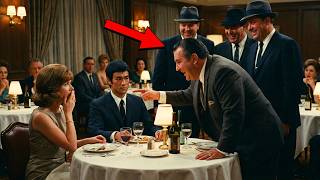
A six feet, five inches heavyweight boxer. A crowded train station. And a man who was barely 135 pounds, standing completely still.
What happened next? Lasted 11 seconds. San Francisco, October 1967.
The fog hadn't lifted yet. It hung low over the bay. Thick and gray.
Pressing down on the city like a held breath. The morning commuters at the fourth Street train platform moved in. Tired clusters, briefcases, coffee cups.
Eyes down. Nobody making eye contact with anyone. It was 742 in the morning.
Bruce Lee was standing near the far end of the platform alone. He wasn't famous yet. Not in the way the world would later know him.
And to the Drgon was still six years away. His name meant something in certain gyms, in certain back rooms where fighters gathered to trade stories. But to the suits and secretaries shuffling past him on that platform, he was just a young Chinese man in a black turtleneck, lean as a whip, watching the fog.
He had a small bag over one shoulder. His hands were relaxed at his sides. He stood the way very few people stand completely still, without fidgeting, without checking his watch.
Like a man who had nothing to prove and nowhere to rush to. But that stillness. It had a quality to it.
Anyone who trained martial arts at a high level would have recognized it immediately. It wasn't the stillness of peace. It was the stillness of a coiled spring.
He was 26 years old. Raymond Kord was 31. Six feet, five inches.
240 pounds. A former amateur heavyweight who'd knocked out 14 opponents before a shoulder injury ended his competitive career and redirected his considerable aggression into real estate. Bar fights and the daily performance of making other people feel small.
Raymond wasn't a villain from a comic book. He was something more unsettling, an ordinary man who had discovered early that his size gave him a kind of social power, and who had spent the better part of a decade exercising that power carelessly. He had grown up in Oakland.
Grew up big. Grew up fast. Coaches had loved him for his reach, his natural power, his chin.
His mother had loved him for the way he used to sit at the kitchen table doing his homework. Still as a mountain, his ex-wife had stopped loving him the night he put his fist through a wall because dinner was late. He wasn't a bad man.
He was an unchallenged one. And there was a particular kind of danger in a man who has never been truly challenged. Because somewhere deep inside, beneath the confidence and the casual swagger, there is always a question.
He has never had to answer, a question that itches. What if someone doesn't back down? Raymond stepped onto the fourth Street platform at 7:44 a.
m. , with a newspaper tucked under his arm and a large coffee in his hand. He scanned the platform the way large men often do not out of threat assessment, but out of habit taking inventory, noting the exits, the faces, the spaces, his eyes landed on Bruce Lee.
There was a young woman on the platform named Elaine Chao. She was 22, fresh out of UC Berkeley. Three weeks into her first real job at an import company in the Financial district, she would later become a writer.
And decades later, she would write about what she witnessed that morning with the kind of precision that only comes from a memory you have never been able to shake. She described Bruce Lee in that moment as follows. He looked like someone had drawn a man in pencil, and then gone back over every line three times.
Everything about him was defined not just physically though. That too, but in some other way. I couldn't name like he had made a decision about himself, a long time ago, and had been living inside that decision ever since.
Elaine was standing about 15ft away when Raymond Cord walked toward Bruce Lee. She said later she almost didn't notice it happening. It started so casually.
Raymond stopped a few feet away. He looked Bruce Lee up and down. The way you look at something you've already decided isn't worth your full attention.
Then he smiled, not a warm smile. The kind of smile that is actually a statement. You're Chinese, he said.
Bruce Lee turned his head slowly, looked at him, said nothing. I'm asking, Raymond said, because I can never tell. He said it pleasantly, conversationally, like he was making small talk.
A few people nearby glanced over, then looked away. Because this is what people do. They look away from the thing that's coming.
Bruce Lee's expression didn't change. You look like you haven't eaten in a month. Raymond continued, warming to himself.
Now. The way bullies always do when they sense no resistance. All skin and bones, man.
You are right. He said the last part with exaggerated concern. Almost friendly.
He glanced sideways, checking as they always check that someone was watching. Elaine was watching. So were three other men near the ticket booth, though they had all found reasons to look slightly sideways.
Slightly away, Bruce Lee looked at Raymond Cord for a long moment. When he finally spoke, his voice was quiet, measured completely without anger. Are you finished?
He said. Raymond blinked. That wasn't the response he'd expected.
He'd expected embarrassment, deflection, a nervous laugh. The usual menu finished. Raymond repeated.
He laughed. Man, I'm just being friendly. You're the one standing here looking like the wind might blow you away.
He stepped forward, not aggressively, but deliberately, closing the space between them. Six feet, five inches. A former heavyweight stepping into the personal space of a man.
Eight inches shorter and 100 pounds lighter. It was a move Raymond had made many times before. It had always worked.
Bruce Lee didn't step back. He didn't tense up. He didn't shift his weight or widen his stance, or do any of the things that people do when they are preparing for a physical confrontation.
He simply didn't move, and somehow that was more alarming than anything else he could have done. Elaine later wrote the Big man step toward him, and I held my breath, waiting for the small man to step back. He didn't.
And in that moment, something shifted. I couldn't tell you exactly what, but the big man felt it, too. I could see it in his face just for a second.
Something he wasn't used to feeling. Raymond could look down at this lean, still, utterly unmoved young man. And somewhere in his chest, something cold moved through him.
He didn't know what it was. He would understand it later. He pushed it aside.
You deaf, he said. And now the friendliness was gone from his voice. Now it was something else.
He reached out and put one large hand on Bruce Lee's shoulder. What happened in the next 11 seconds would be described in three different ways by the four people who witnessed it, clearly. But on one detail, every single one of them agreed it was over before any of them understood it had begun.
The hand landed on Bruce Lee's shoulder at 7:46 a. m. , heavy, deliberate, the kind of touch that wasn't just contact, but a message.
I'm bigger than you. I'm stronger than you. And I want you to know it.
Raymond Cord had used this touch before on men in bars, on men who owed him money, on men who had looked at him the wrong way. It was a grip that said, recognize me each time the man who received it had recognized him. Bruce Lee looked down at the hand on his shoulder.
Then he looked up at Raymond. His gaze was calm, not the calm of someone suppressing fear, not the calm of someone calculating his escape. It was something rarer and more unsettling.
The calm of someone who had already been where this moment was leading him, who had stood in this place so many times that it had become familiar to him, and who felt nothing but calm and total readiness. He said one more thing before it happened three words. Softly, almost kindly.
Take it off. Raymond clenched his jaw. He did not take it off.
What happened next has been pieced together from three eyewitness accounts the written recollections of Elaine Chao, a brief statement made years later by a railway employee named Thomas Beal, who was sweeping the other end of the platform, and a fragmentary account by a retired teacher named Harold Park, who was waiting for the 750 train to Millbrae. Their accounts differ in the details. Memory is imperfect.
Shock compresses time and distorts the sequence of events, but in essence, this is what happened. Bruce Lee raised his left hand and removed Raymond's hand from his shoulder. Not violently.
Not with a slap or a grab. He simply took the wrist, two fingers and the thumb and lifted it. The movement was so fluid, so slow, that Raymond later said it took him a full second to realize what had just happened.
Then everything sped up. Before Raymond could understand that his wrist had been removed. Before he could recalibrate, before the signal from his brain reached his body to react.
Bruce Lee had already moved. Not backwards, not sideways, forward. One step explosive, reducing the distance to zero in a fraction of a second.
Thomas Beal, the railway worker, described it this way when asked about it years later. It was like watching someone flip a switch one second. The big fellow was there.
The next second he was not in the same position. What Bruce Lee accomplished in a matter of seconds was not a fight. It was not a street brawl.
It was something more akin to a precise mechanical event, the application of force, leverage and timing so perfectly calibrated that size and weight became, for those 11 seconds, completely irrelevant. A low right kick to Raymond's front knee. Not enough to injure him, but enough to destabilize him.
To briefly shake the mountain of his own foundations. Raymond tilted forward involuntarily, and by the time he did, Bruce Lee had already left. His position was already beside him, already inside his guard.
An elbow strike to the side of the neck, controlled, measured. Not a fatal blow, but one that sent a very clear message to Raymond's nervous system. I know exactly where you are.
Vulnerable. Raymond's coffee hit the floor of the platform. No one heard it fall.
Then came the final move. The one that Harold Park, the schoolteacher, could never quite describe without falling silent. Bruce Lee simultaneously grabbed Raymond's right elbow and wrist, applied pressure in two opposite directions, and with a fluid almost gentle movement, redirected the former heavyweight boxer's 109kg towards the metal railing at the edge of the platform.
Raymond hit the railing with his back. He did not go over it. Bruce Lee had controlled the force with enough precision to prevent that from happening, but he had hit him hard enough for him to understand.
Raymond Cord stood against the railing. Breathless, disoriented, one knee still unsteady beneath him, and looked at the man standing a meter away from him. Bruce Lee hadn't broken a sweat.
His turtleneck wasn't wrinkled. His bag was still slung over his shoulder. His hands were relaxed at his sides again, just as they had been before it all started.
He looked at Raymond with the same expression he'd had throughout the fight. No triumph, no anger, no theatrics, just those calm, dark eyes. 11 seconds.
Elaine Chao said she hadn't breathed during that time. She said it was the sound of Raymond's back hitting the railing that broke the spell. A dull, metallic thud that echoed onto the platform ceiling and sent three pigeons flying somewhere above them into the fog.
She looked around. The other passengers nearby had remained motionless. A woman in a red coat had her hand pressed over her mouth.
The two men near the ticket office stared at him with an expression she described as that of men who had just seen something they couldn't categorize. No one moved to intervene. No one screamed.
The whole world had simply frozen. Raymond Kord was breathing heavily. His hand was clutching the handrail.
He was a man trying to pull himself together, trying to find somewhere in his body the version of himself that had existed 30s earlier. The tall, unquestioned, confident version. It was no longer there.
He looked at Bruce Lee and opened his mouth. Nothing came out. Bruce Lee tilted his head slightly.
When he spoke. His voice was as calm and composed as it had always been. As if the tone of the entire conversation had not changed for him.
You're not hurt, he said. I made sure of that. He paused.
But you felt it. That's enough. Thomas Beale, the railway worker, said he was sweeping the end of the platform and saw everything from a distance of about 12m.
He said that afterwards he put down his broom and stood there for a moment, motionless. I've seen fights before, he said. I grew up in Filmore.
I know what a fight looks like. This wasn't a fight. I don't know what it was.
It was like watching water flow around a rock. Except the rock was the big man. And the water was that.
He made a vague gesture as he said this, as if the word to describe it had not yet been invented. The 750 to Millbrae was announced over the platform speaker. People began to move again.
The spell broke. The ordinary world resumed its ordinary rhythm. Briefcases and coffee cups and eyes down.
Raymond Cord pushed himself off the railing. He straightened his jacket. He picked up his newspaper from the floor.
He did not look at Bruce Lee again. He walked to the far end of the platform and stood there alone until the train came. Bruce Lee watched him go.
Then he turned back to the fog over the bay, put his hands in his jacket pockets, and waited for his own train. Elaine Chao stood 15ft away. Her heart still hammering.
She almost didn't do it, but something made her take two steps forward. Excuse me, she said. Bruce Lee turned.
She didn't know what she'd been planning to say. Something came out anyway. Why didn't you just walk away?
He considered the question seriously, like it deserved a real answer. I did, he said. Everything I did that was walking away.
She didn't understand it then. She would spend years understanding it. The train was 12 minutes away.
Elaine Chao would later say those 12 minutes changed the way she thought about almost everything. She didn't know who he was. Not yet.
She hadn't recognized the name when he offered it. Bruce Lee. The way you don't recognize a name that hasn't yet been written into history.
She just knew she was standing on a cold platform in the San Francisco fog, talking to a man who had just done something she couldn't explain, and who was now speaking to her with the same unhurried calm he'd had throughout, as if the last 15 minutes had been no more remarkable than waiting for weather to pass. She asked him how long he had been training. He smiled slightly at the word training, not dismissively, more like a man who finds a familiar word slightly too small for what he means.
Since I was a child, he said, but training isn't quite it. Training is what you do to your body. What I do is closer to conversation between what I am and what I could be.
She didn't know what to say to that. So she asked the question that was actually bothering her. Weren't you afraid?
He looked out at the bay. The fog was beginning to thin at its edges, pale light pressing through from somewhere above it. There's a difference, he said slowly, between being afraid and being aware.
I was aware. Fear would have made me slow. Awareness made me ready.
He said it's simply not like a man delivering a lecture, like a man telling her something he had learned the hard way, something that had cost him something to learn. Most people tighten up when they feel danger coming, he continued. They brace, they hold their breath, and the moment they do that, they're already behind.
The body knows what to do if you let it. The problem is the mind gets in the way the mind wants to plan. The mind wants to be certain before it acts.
But by the time the mind is certain, the moment is already gone. Elaine was quiet for a moment. So you just don't think.
He laughed. A real laugh. Brief and warm.
Surprising her? No. You think before.
You think after. In the middle. You have to become the moment, not observe it.
Become it. Harold Park, the teacher, had not left the platform. He was 58 years old.
He had taught history at the secondary school for 31 years in the Richmond neighborhood. He had witnessed many human behaviors over the years. Cruelty, kindness, courage, cowardice, and had developed the calm and measured judgment of a man who had spent decades watching young people decide who they would become.
He stood near the ticket office, pretending to look at his watch, listening. He would write about that morning in his diary that evening. The diary was discovered by his daughter after his death in 1989.
She shared excerpts from it with his permission in a small publication 20 years later. Here is what he wrote. I have seen many men try to appear fearless in difficult situations.
I know what that looks like. I know their behavior. The clenched jaw, the overly deliberate movements, the slightly too deep voice.
What I observed that morning was nothing like that. This young man wasn't pretending to be calm. He was calm like a fish in water.
Effortlessly. Unconsciously. Without feeling that he could be any other way.
I have never seen anything like it in a human being. I'm not sure I expected it. At the other end of the platform.
Raymond Cord stood alone, his back still hurt where he had hit the railing. Not badly. He had taken harder blows in the ring, but the pain was there.
A dull, persistent reminder. His neck tingled slightly where his forearm had landed. But that wasn't what bothered him.
What bothered him was the question that kept running through his head. He had put his hand on that man's shoulder. He had done what he always did.
Used his size, his presence, the sheer fact of his weight to make someone else feel small. And it hadn't worked. Not because the other man was as strong as him physically.
Raymond knew his own body well enough to understand that by all conventional standards, he had every advantage. Weight. Height.
Reach. Power. It hadn't worked because the other man hadn't accepted the principle.
Raymond had built his entire social architecture on a single unspoken agreement that size equaled authority. That physical dominance gave one the right to occupy space at the expense of others. And in 31 years, no one had ever refused to sign that agreement until this morning.
He stood by the railing, looking at the fog, and felt something stirring inside him, something he couldn't name. It wasn't shame. Not quite.
It was something more fundamental, as if the wall he had been leaning on all his life had turned out to be painted on a curtain, and someone had just pulled that curtain. He thought of his son, eight years old, small for his age. Quiet as little boys sometimes are, when the world seems too big and too noisy.
Raymond had always told himself that he was teaching his son to be strong, to stand up for himself, not to let anyone walk all over him. He stood at the railing, looking out of the fog, and wondered for the first time if what he had really taught his son was something else entirely near the center of the platform. Elaine had asked one last question.
She had been mulling it over since the moment he had spoken. It was the question that underpinned all her other questions. That man, he wasn't going to stop.
You could see that he was going to keep pushing until something happened. So why did you wait so long? Why didn't you just end it all sooner?
Bruce Lee was silent for a moment. When he answered, there was something in his voice she had never heard before. Something older and heavier, like a stone that had been carried for a long time.
Because I've learned to be very careful with what I'm capable of, he said. When you know what you can do, when you really know it, you don't use it lightly. You only use it when there's no other way out.
And even then, you only use what's necessary to get through that door. He paused. A man who uses all his strength when half his strength would suffice.
That man is not controlling himself. He is controlling others. That's different.
And it leads to a place I don't want to go. She looked at him. Have you been there before?
She asked. That place you don't want to go? The question hung in the cold air between them.
He didn't answer immediately. He looked back at the bay where the fog was still lifting. The pale morning light finally beginning to reach the water below.
Yes, he said softly. Once when I was very young, and I promised myself something afterwards. What did you promise yourself?
He looked her straight in the eye, and there was something in his gaze that she had never seen before. Not exactly sadness. More like the memory of a burden he had chosen to continue carrying.
Not because he had to, but because he believed that carrying it kept him honest. That I would spend the rest of my life becoming someone worth being. He said not someone worth fearing.
The 750 to Millbrae pulled into the station doors opened the platform filled with movement. People pressed forward the ordinary urgency of ordinary mornings, reasserting itself over everything that had happened. Elaine stepped toward the doors.
She stopped, turned back. Bruce Lee was still standing where he'd been. His train wasn't here yet.
Will I see you again? She asked. She wasn't sure why she asked it.
It just came out. He smiled. That same brief, genuine smile.
San Francisco is a small city, he said. She got on the train. The doors closed as the train pulled away.
She pressed her face briefly against the cold glass and looked back at the platform. He was still standing there, still. Still hands in his pockets, watching the fog finish clearing over the bay, getting smaller as the train moved away and then gone.
But the story wasn't over because Raymond Cord was still on that platform, and he hadn't gotten on his train either. Raymond Cord stood on the empty platform for a long time after the 750 left. His train had come and gone.
He hadn't moved. A maintenance worker had asked him twice if he was all right. He had nodded both times without looking up.
The fog had almost completely cleared. Now the bay was visible, gray green water catching the first real light of the morning. The kind of light that makes everything look newly made.
Bridges and water and pale sky. San Francisco waking up slowly, indifferently, the way cities do. Raymond was not looking at any of it.
He was looking at his hands. Large hands, heavy knuckled hands that had thrown thousands of punches in his life. In gyms, in rings, in parking lots, in the kitchen of a house.
He no longer lived in hands he had always thought of as his most honest feature, his most reliable argument. He was thinking about his son, Daniel, eight years old. Small and quiet and careful in the way of boys who have learned early that the world has edges.
Raymond had told himself for years that he was preparing Daniel for the world. Toughening him, teaching him not to flinch, but standing on this platform in this pale morning light, with his back still aching from a railing and his neck still tingling from a controlled forearm strike. He was hearing all of that very differently.
He had been teaching Daniel to be afraid of him, not tough afraid. There is a difference. He understood that difference.
Now, with the clarity of a man who has just had something very obvious shown to him very plainly, he sat down on a platform bench, put his elbows on his knees, put his face in his hands. A passing commuter glanced at him. A large man sitting alone on a bench, bent forward very still, and looked away quickly.
The way people look away from grief, they don't know how to approach. Raymond wasn't crying. Not quite.
But he was somewhere in the territory just before it. He didn't know how long he sat there. Long enough for the platform to empty and fill twice over.
Long enough for the morning to fully arrive. The fog gone, the light hard and clear, the bay sparkling with cold indifference. He became aware of footsteps stopping near him.
He looked up. Bruce Lee was standing there, not looming, not confronting, just standing the way he always seemed to stand. Balanced.
Unhurried. Taking up exactly as much space as he needed, and not a fraction more. His bag was still over his shoulder.
He looked like a man who had missed his own train and was entirely at peace with that fact. He looked at Raymond for a moment. Then he sat down on the bench.
Not close. Not far. Just present.
Raymond stared at him. Why are you still here? He said.
His voice came out rougher than he intended. My train was delayed, Bruce Lee said simply, and then after a pause. And I saw you sitting here.
Raymond laughed. A short, hollow sound. Come to finish the job, there was no job, Bruce Lee said.
There was never a job. Silence. The bay glittered.
A gull crossed the pale sky above the platform, crying once, and was gone. I have a son, Raymond said. He didn't know why he said it.
It just came out the way things come out. When a wall inside you is cracked and the pressure behind it has been building for years. Bruce Lee said nothing.
Just listened. Eight years old. Smart kid.
Good kid. Raymond's voice was low.