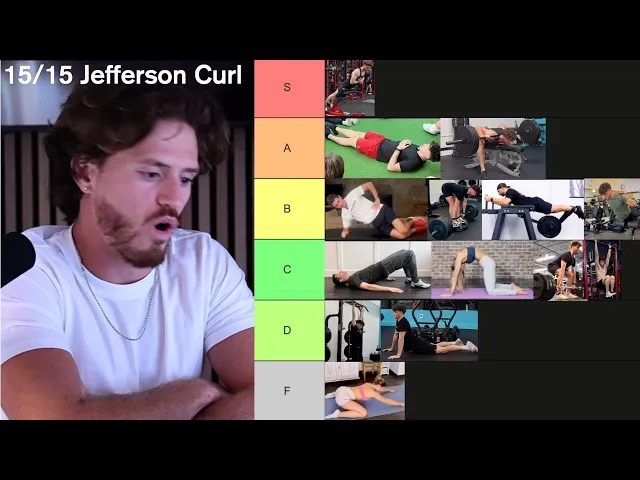
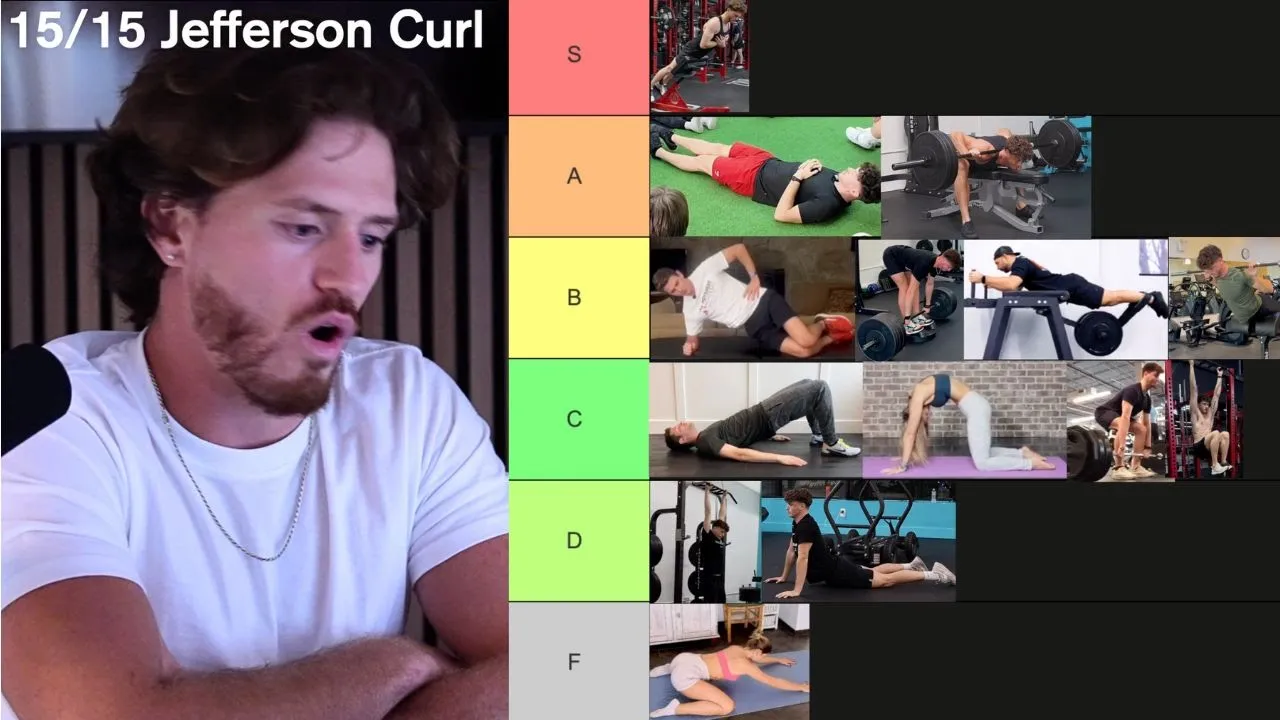
Today we're going to rank the top back pain exercises. [music] We have 14 on the list and we have seven categories and we're going to give a final score for each. I have lived through the years of chronic back pain in a loop, stuck trying these different exercises [music] and I never fully understood why some worked and some kept me in the same vulnerable sensitive state of [music] chronic issues in my back.
We are going to cover the seven categories for each. First category, [music] ease of entry. How accessible is it to start training when you're at a sensitive place of pain?
Two, what is the shortterm value? How fast does it work to give you relief? Three, long-term value.
How well does it help you rebuild and proliferate tissue to actually [music] change your spinal structure? Four, scalability. How much of a route is it [music] to concurrent next steps, or is it just a dead-end drill?
Five, the potency. How relevant is it actually to most cases of back pain? Does [music] it have the potential to heal or the potential to harm?
[music] I thought that would sound smoother. It's very relevant to the problem area, which is why it [music] could actually help rebuild the weakest part of your body. Category six, safety.
How easy is it to mess up? How easy is it to cause a flare up in back pain? Category seven is simplicity.
How difficult is it to execute these exercises on form? What kind of equipment do you need? And then we're using those seven categories to give an overall ranking.
[music] We have from tears F which is really bad and S. So F D C B A [music] S. It is in my humble opinion I am a back expert but in the sense that I was so good at having back pain.
I [music] became an expert of having back pain. My credibility is through lived experience of trial and error and being stuck [music] with all of these. I can reflect on why some of them didn't progress me to now being painfree to take my back [music] from reinjuring in a sneeze to now being able to put my body weight in my elbows and fold like a pancake.
I had to build myself slowly using a mix of these exercises and I wish I knew back then the order of [music] how it actually progressed and which ones were worth the time and which ones were not. Let's start with the worst quick fix YouTube instant relief stretches. The sort of stuff you see where people show you a 30 second reel of how to flop your knees up and twist your legs like a scorpion airplane and try to get that one pop that's going to let go of all the tension of years.
Okay, let's take it through the categories. One, ease of entry. I guess you could find a gentle way to stretch.
Two, what's the short-term value? Any relief based stretches, any of them where you plop your leg up, you twist, you do a little crack back, and you're trying to snap your spine back into place. It's never going to work.
So, the short-term value is maybe you feel relief something lets go. Third category, long-term value. None.
Zero failed. Fourth category is scalability. All of those airplanes, windshield wiper, kick, scorpions, dead end drills, which don't lead to anywhere.
Five, the potency. How direct do they get to the spine? Passive flopping around of your limbs and just twisting joints of your spine.
And that's probably the least productive way to do it. So, it's potent, but it's not done well. Six category, safety.
You'll probably feel nothing. You might feel relief. The risk of reinjury is there, though.
Last one, simplicity. It's not very simple with all of those. There's no point of form.
No one's going to cue you, feel this, feel that. That's not even the goal. It's just to move stuff and feel something.
So, the overall rating for any of these reliefbased easy stretches, this one's going to the F tier. It's never going to fix your problem and it's it's just never going to heal you. So, that one's done.
Exercise one and the whole bucket of instant relief based stretching. I wouldn't even bother. Second one, decompression.
Naturally, the desire comes to start hanging from a bar and feeling the relief of your spine opening up. Ease of entry. Most people can get into it.
It's not a hard demanding exercise that you need a lot of strength for. Category two, what's the short-term value? Probably high if you had history of disc injuries and anything significant along the spinal canal.
So, you're going to feel the relief of that increased space and it's opening up pressure and that's what's going to make you hooked on it. Three, what's the long-term value? I don't think there's that much.
Actually, I think there's actual risk of using it overly. Decompression feels really good because it opens up all the space along the disc and any compressed nerve probably gets less. It gets alleviation from that issue.
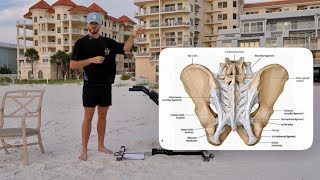
But what prevents the spine from just ripping apart. When you hang from a bar and the discs are being opened up, why does it alleviate and open but nothing gets injured and rips? Is because there's other connective tissue all along the spine like anterior longitudinal ligament.
You got posterior longitudinal ligament. You have ligaments that run both sides all the way up and down the spine, not to mention all the small parispinal muscles. So, it's not completely passive like you think.
You're hanging, your spine's not working with conscious strength, but connective tissue is working to keep it from tearing and separating too much. So, it's the equivalent of going into a passive joint stretch all the time. And when you do that, you can form laxity issues and get too much instability at those vertebrae and actually strain the ligaments.
And then so what used to give you relief can actually become aggravating and you grow an intolerance to decompression. Four, scalability doesn't really scale much. Five, the potency.
Decompression is very potent to give relief and it can also tweak you. We got six, safety. Pretty safe.
And then last one, simplicity. Very simple. So hanging overall, I'mma put it a D.
Not terrible for you. Not a complete waste of time. It's valuable in the beginning.
It's going to become less valuable over time. It's a diminishing reward. Third exercise, McKenzie cobras.
Pushing your spine passively into extension. So the idea is you hyper extend and that gives you relief. One, what's the ease of entry?
Very accessible. Anyone can lay on the ground and you start with your elbows and you can just hold there. If you're very sensitive, you just literally lay on your stomach and build tolerance.
Two, what's the short-term value? It can be very rewarding in the short term. Physical therapists use it to literally try to immediately localize nerve pain, whether it's prolonged holds or reps.
Short-term value, very responsive. It can do a lot. Long-term value, not much.
It's the same thing as decompression. What's missing with both of these is that you are passively manipulating joints. With the press up, you are passively moving your spine into extension.
You're not using the strength of your spinal tissue to move you there. You're using your arms and you get a tricep burn by doing them so much. And so, when you form this addiction of doing hundreds of press ups a day because it gave you relief in the past, it's the same thing as you just cracked your knuckles every day over and over and over and just manipulated joints without actual strength.
So decompression, you're not active with any muscle tissue, so you're overrelying on connective tissue. Cobra pressups, you're not active with any muscular tissue. So you're overrelying on connective tissue, which is why it can then become straining, especially on the facet joints.
Myself included with many other people form actual facet joint issues later on because they spent years spamming cobras. Very diminishing rewards. It doesn't proliferate and change any of the tissue for the better in the way you need it.
Scalability, does it lead to something else? No, it's a dead end. You do that and that's it.
You don't load it. You don't make it harder. That's it.
Potency. It's pretty potent, kind of relevant. You can affect nerve pain.
You're not changing a whole lot though of your spinal position. Safety, pretty safe. Very hard to hurt yourself with that one.
So, pushing into extension, the most you're probably going to do is irritate something. And then simplicity, it's very simple. Overall score is a D.
Just like the decompression, they both have shortterm use case. If the Cobras help you, you can use it to try to guide yourself to know where your herniation is currently at, but that's about it. It's a relief tool.
All right, next one. We got the McGill Big Three. So, it's a bundle of exercises that's mainly about lumb pelvic stabilization.
We got the curl up, we got side plank or sideline clamshell, depending the variation, and then we have bird dog. So, one, ease of entry. How beginner friendly is it for someone in pain?
It's a very good starting point. If you are fresh out of the injury within two weeks and you've been walking around and out of the acute injury stage, then this is where they start you almost all the time. Second category, short-term value.
It's very valuable in the short term. It's going to help you get out of the hyper sensitive state. It's going to help with micro movement being tolerable.
Now, long-term value, it's not enough. It's better than spamming the band-aids and stretches every day like we talked about. These are actual corrective exercises, not just drills.
You can build up some fatigue. You can build some small strength there, but nowhere near what's going to be needed to get back to lifting and sports and real demands of unpredictable life. And we have the scalability.
It's not very scalable. None of the exercises really progress to further and further levels. Potency.
How relevant is it to the problem area? So, I think this stuff is pretty potent. I think you could overdo it.
Safety. How safe is it? It's very safe.
Very hard to hurt yourself if you're actually intentional. Simplicity. How hard is it to get the form right?
How easy is it to do correctly? It's pretty easy. There's only a few things to to think about.
So, the overall score, B minus. I'm going to throw a minus in there. I can't give it C because it really does have a role.
the value it has early on to really get someone healthy enough to handle more valuable training to the spine. That's where it's it's up there. So, we have glute bridges.
Ease of entry, it's very easy to begin. Even in pain, it's very sensitive friendly. Two short-term value to fixing the back.
Not much. Long-term value, is it going to protect your spine? I really don't think so.
It is testing your back strength. I don't think it's building your back strength. I think you can hurt your back on glute bridges.
I think you can do hip thrusts really heavy and you could hurt your back. I'm counting that as glute bridges. But is there any amount of heavy hip thrusts that are going to build your low back to be strong and protected?
No. Yeah, I don't even think there's long-term value to fix your back. Good exercise.
Back pain, I don't think it's really doing much. Scalability. Does the exercise go from really easy to hard?
Yep. You could take it body weight super easy on the ground. You do 400 lb and use as a very heavy builder.
Potency. How relevant and potent is it to the back pain? Not potent much at all.
It's testing the spine, but it's not building it. Safety. How safe is it for back issues?
At easy levels, it's pretty safe. It's not the safest if you have back pain and you're going to take it heavy. Simplicity.
How simple is it? It's very simple. It's hard to mess up the form.
The only thing get wrong is the pelvic tilt. That can assist in injuring the back. So, the overall rating, a C.
helpful early on just for the fact of it's safe enough to do and it feels good to train the glutes roughly. Cat cow actively pushing into flexion ranges and then actively pushing into extension. So pushing yourself through the mobility of the spine.
Ease of entry. Most people can get in that position on the hands and knees and feet and be able to move their spine somewhat. What is the short-term value?
Passive mobilization. It's not aggressive. you're moving joints, which is better than not, but in the short term, I I don't think it's going to make a night and day difference if you have real injury and pain.
Long-term value, I actually think long term, it can probably add up and be a good practice if you kept it. I don't think it would be a dangerous thing to do over the long term. As long as you work within a range that doesn't cause you issues, scalability, does it lead to anywhere?
I don't really think so. It's not super scalable. The potency is not building that tissue that you need to build.
It's not testing any muscles to a real meaningful amount. So, the potency isn't very high. Safety, not super dangerous, like it'll reinjure something massive most likely, but not safe enough that you could be worry-f free and not flare up and have a bad episode.
And then simplicity, how simple is it? It's very simple. Can't mess up the form.
Overall rating of cat cow, I would give it a C. I like spine movement. I think that's a good fact of it, but it's not active and it's not really going to change the game for how your spine performs.
Nerve gliding. Nerve gliding is a very small motion just involving the movement of your chin or your toes. Specifically for nerve gliding, the sciatic nerve and the idea is just gently moving the fascia with the nerves running along it.
So that way you keep things from getting too stuck and you help glide and get movement back in the fascia. Ease of entry. It's very easy to start nerve gliding even when you're in a sensitive place post injury because the movement is so micro and you get such immediate feedback whether something is off limits or not.
Short-term value it can help. I think nerve gliding in the short term people can find relief immediately. I think they can feel things subside with nerve pain.
Long-term value. I think there's long-term value too. I think it's a daily practice that you stack.
I think it can follow the time frame of tissue remodeling at fascia. It might take months for the tissue to come back and remodel in through that process, but along the way it's like watering the seed so that way it grows in healthier. Your fascia will keep remodeling in with adhesions and stuck in the same positions and pinned and compressed along different structures of your body if you never move it.
It'll just remodel that way. Scalability. It's scalable in the sense that the more you increase the stretch while you do it, the tighter the floss is along the grooves of things.
Potency. How relevant is it to the issue? It's not potent to fixing structural damage and giving real support, but it can be a huge potent stimulus to the connective tissue that affects the nerves being irritated.
The safety of it, I think it's very safe. If you overdo it, I think it can irritate you for sure and go to easier level. Make it so easy it doesn't even feel like it it matters.
Lie all the way down and I think it's very safe. Simplicity, it's extremely simple it's hard to mess up the form. Overall rating, I want to give it an A.
Feels like it's earned. It's so low risk for most people if you're smart about it. And it's so potentially lifealtering if you're really stuck with nerve pain that it's just a thing that I wouldn't ever fear doing.
The next exercise, deadlifts. I think that's 385 I did. So, it's after I herniated discs by deadlifting.
I rebuilt over years. It's training the back. You can hurt yourself in it, so it's very relevant.
Obviously, it's a hip hinge movement involving the low back and glutes. This one has probably one of the worst wraps ever. It's just so controversial.
There's variations, key details of how people deadlift. So, we're going to get into all that, but let's just first talk conventional barbell deadlifts for healing back pain. Ease of entry.
If you are hurt, you're a beginner and sensitive off of an injury, it's not the easiest to start when you're injured. Short-term value. How immediately could it alleviate or help with the sensations and symptoms of back pain?
I've never really trained someone or heard from someone that walked in the gym feeling a really bad flare up of their back, did some deadlifts, and walked out like, "Wow, I'm fixed. " I've just never heard of it. I don't think you're getting a short-term breakthrough.
For long-term value, you have to deadlift probably far below your max. You have to prioritize form over everything. And you have to be able to do it for years and not get injured.
So that way the returns keep coming. Because as soon as you get injured and deadlifts get a little bit off and now you're changing your form and you have a little bit of pain during it and you're relying on the belt and you're de loing and load managing and trying to deadlift and you're in this in between, it's no longer building you up. Now you're just keep irritating a scab and it's not even building you.
So the long-term value of traditional deadlifts, pick up the weight, drop it for your back pain, uh it's not great. scalability. You could beginner it, you could go really light, and you can go the worldass feet of strength.
The ultimate test of strength is probably a one rep max deadlift. So, it's very scalable. It's not a dead-end drill.
It's a it's a route of step to step safety. How safe is a deadlift when you have back pain? The way you were probably deadlifting in the past, not safe at all.
The new way you may learn how to deadlift where it's it's just a hip hinge. How safe is hip hinging? It's crucial.
It's probably extremely safe if you go through the steps of learning how to brace, learning how to actually load properly on your feet and get your butt back how you should and keep a posture that's solid. Open up the hamstring so you get some hinge back and you're not too tight. So, it's safe if you're maniacally slow and careful.
But, let's just be real. Let's not pretend like that's how people are deadlifting. How safe are normal deadlifts for back pain?
They're not. I'm not saying don't deadlift. I'm not saying it's dangerous.
I'm not hating on it before the react channels come at me and call me a dweeb. It's always the weak guys who say don't deadlift. I'm just saying if you're in the chronic back pain loop, don't blame it as in exercise being wrong.
The way we're doing it like that, not the best potency. Did I talk about potency? It's very potent to the spine.
It's training the small stuff, too, because the small stuff breaks during it. It's not controlled enough to be able to really trust rebuilding your back with it, but it's very potent to the area. So, it's kind of survivorship bias.
I think it's a test. Simplicity. How simple is it to get good deadlift form?
I don't think it's that simple. I'm not going to lie. Like actually care about form and make sure your positioning is right the whole movement.
I see some really shitty deadlifts in the gym, so I don't think it's actually that simple to get it down right. I'm going to give the deadlift the overall score of a C. It's the same as a glute bridge.
They test low back strength. You can injure yourself on it. However, they do have roles that can really support back health if you get it right.
The RDL, similar movement, very different execution to the deadlift. So, the RDL is a hinge just like the deadlift. Usually, people start from the top.
And me personally, I like to pause and go slow and hold it at the bottom and really own it where it's toughest. You only pick up what you know you can lower. If you can't slowly lower it, you don't even pick it up.
So, it's always keeping you from hitting the gas pedal harder than the brakes can handle. If you can't break at 300 mph, you shouldn't have a car that can go 300 mph. But that's what a deadlift is.
Pick it up and drop it. The lowering phase of an RDL is true confidence of, "Oh [ __ ] my back is strong and protected. " Ease of entry.
I would argue a hinge starting from the top essentially is an easier thing to start when you're injured and sensitive than a deadlift where you're starting from the bottom and picking something off the ground. The short-term value, it might feel good to get some time under tension on the spinal erectors and the hamstrings. You're going to get some warmth and blood flow to the big muscles in the back probably.
Long-term value, I think a pretty good amount. I think if you always work at the weight that's true to you and you never sacrifice just for the sake of heavier weight on the bar and just lose your positioning and start rushing it and dropping crazy fast. I think you do a slow controlled lowering tempo and you maybe pause at the bottom.
You'll always own it. That's just confidence stacked on confidence. Confidence of your spine and stronger strength to resist breaking into flexion.
That's a very important quality. Scalability. It's very scalable.
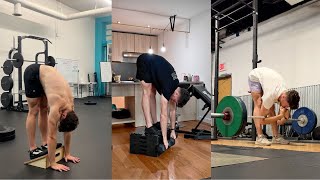
It would start body weight hinge and RDL. You just simply stand up straight, slide your arms down, put your butt back, feel a stretch in the hamstrings, come back up all the way to probably the most extreme version I showed. Toes up, elevated.
So, it's pretty scalable. Potency. How relevant is it to your [ __ ] back?
The RDL is going to help a good mix of the larger spinal erectors and then some of the parispinal. You're not getting a ton of the muscles that are in the grooves of the spine. It's hitting a lot of the big muscles and getting a good pump that way.
Is it potent to disc injuries? Is it going to like really transform vertebrae? I don't think so.
Because it's testing the back as a complete structure, as a board working together. How strong is your back from the cervical spine to your tailbone? The whole thing from breaking.
So if you have a weak point at L3, L4, you had disc injuries there, you maybe had some fragment, some fracture, some kind of misalignment, your body will tense up and contract all the other vertebrae and large muscles to kind of guard against that vulnerability and you'll see how strong your whole back is versus how strong is that part of your spine. So it's potent to the big stuff, but it's not to the nitty-gritty and the real spine work you need. Safety.
Usually when people RDL, they have a better mentality and a better focus than deadlifts. RDL is dangerous. If you start loading for real, you can herniate disc, you can fracture things, you can injure things.
So, I would say the nature of how we RDL is is usually safer, but it's some serious stuff. There's danger there for sure. Simplicity.
How simple is it? A little more simple than deadlifts. You're not starting from the ground.
There's no starting position. The depth is up to you. It's simple in theory, but it's not actually that easy to coach.
So, it's a mids simplicity. It's kind of complicated for the form. It takes practice.
So, the overall score though, I'm going to give it a B. I don't think you're going to truly heal your back with RDL's alone. I think you can gain a whole lot of confidence and strength through it that will help with a lot of things, but you're not going to restore vertebrae health to the same degree.
You're not going to restore mobility in the spine. It still will transform your back and how it feels. Six-pack ab work, the whole umbrella of them.
Crunches, leg lifts, Russian twists, spinal flexionbased ab training, specifically curling, crunching. One example is garhammer raise. Tucking the knees up, slightly curling from the low abs, building the front of the abs for back pain.
What's the ease of access? How easy is it when you're injured to start doing curling, crunching, ab work? You might be hurt.
It might not feel that good to flex the spine. It's probably not going to be a good time for you. I guess you could find some variation that doesn't irritate you, maybe.
What's the short-term value? There's no amount of ab work that is immediately going to help how your spine feels. We're not talking about core.
I'm talking about six-pack rectus abdominis abs. It's so far from the problem area and it's not actually providing pressure and bracing and stability the same way other tissue is. So short-term, not much at all.
Long-term health, I think getting your low ab wall and it'll be some hip flexors which will help you with other things that will help with the back. But even the long-term value of hitting your abs hard to try to fix your back pain, I don't think it's going to add up to really fix that for you. No.
scalability. Not really the same route. We're talking crunches and sit-ups.
The scalability of those. Maybe you add a plate, but that's about it. You can't go from your grandma to like some intense level and new variations.
Potency. How potent and relevant to your spine injuries is it? I don't think much at all.
If there's one thing most people who have even frivolously trained in their life, anything, who have exercised, gone through fizzed, has had any interest of any physical goal, even when a teenager, they probably looked up an ab workout. I bet every human has tried a push-up and has done some sit-ups. So, if there is one area of the body that's probably not undertrained compared to other areas of the body, it's going to be the six-pack abs.
So, I still teach people to train it just because as a general concept, don't skip anything around your core. What's the safety of training sit-ups, crunches? You could injure yourself.
Just that flexion position becomes very sensitive and sketchy for people when they're fresh out of the injuries. Simplicity, pretty simple. There's no like great form, bad form on a crunch or a garham hammer.
It's a easy form. Our overall rating, I'm going to give it a C. If done safe to the right level where you're currently at, it may not hurt your progress, but I think you could do without it and most people would be fine.
The reverse hyper. This one has a huge reverence and respect to its effectiveness to help with back pain. It's helped a lot of people and you can really feel the difference when you train it.
The ease of entry. How easy is it for someone who's injured and sensitive and fragile to start the reverse hyper in the way you normally see it? When you're starting out and you're really hurt and you're probably fresh off conservative physical therapy, the normal variation in way to perform reverse hypers doesn't feel inviting and it it's not really all that easy to start with.
The short-term value, you'll probably get a real good pump if you can get a good healthy set in and not be hurt. You'll get that low back pump that I tal about. You'll feel the tie-in of the glutes to the low back immediately.
the long-term potential of it. I think you really do get a good mix of large strength and protection through spinal erectors and glutes and that tie-in right there really get protected at the SI joint and you get some spinal flexion and some range in the spine that will help the smaller paraspinal tissue. The scalability is kind of the issue with the reverse hyper.
There's no levels of variation typically in the way you would use it with the machine. I'm seeing new stuff of how people teach body weight and you could hold at the top. I think that's what you would have to do to make this one work.
Maybe single leg like I teach it on the bench. I think that's probably the best regression because that machine of just swinging the legs with your weight and all the momentum that's taxing as hell on your back and that's something you should build up to handling. safety.
Not the craziest danger, but I think you could really hurt yourself for sure. You shouldn't be touching that exercise if you're not already good at iso holds on the back extension and you're already really good with moving your spine without weight. Simplicity, it's very simple.
Can't really have bad form. I would say we could have higher standards of the tempo and trying to pause at certain points, but it's really hard with weight. The overall rating, I'm giving it a B.
For back pain for me, so important is the accessibility part. How easy is it to start and how scalable? When a back exercise is great for a lot of people, but there really is no way to change it or make it even more gentle or there's no micro deposit for it.
It's hard to do that. It loses a lot of its evergreen universal application for me. Seated good morning.
Hinging at the hips, maintaining a flat back. It's also called the seated deadlift, some people have called it. Ease of entry.
How easy is it? I would argue it's actually the most accessible way to start training your spine because not everyone can even stand, but just about everyone can sit. What I have even the most fragile people do is sit at the edge of a chair and just simply move their shoulders in front of their hips even an inch.
Boom. You're loading spinal tissue. Two, what's the short-term value?
I think pretty good, too. I think you can give someone an immediate aha little feeling. It may not get their pain all the way, but um yeah, I think there's some relief potential.
Long-term value, I think there's a lot, too. I think you take it to higher levels and it's great. ISO holds and reps, I think both are really important.
I still do both. Scalability, very scalable, the easiest to start and it can go to the most extreme. I think it's also some of the most scalable.
Potency. How potent is it to your problem? It's still a flat back test.
It's getting into the hips more. It's getting to the glutes and training that a lot. It's pretty potent to the spine.
It's going to build you up. It's going to build your spine. You're going to feel better in the chair.
You're going to feel better sitting, standing. You're going to build endurance. However, still no spine range.
Still no flexion, extension, lateral flexion, twisting. So, that's the caveat. Safety.
You got to be smart. That's the thing I'll say. It can be extremely dangerous.
If you go too heavy, you'll be able to get it up. It's just going to look ugly and you don't want you don't want to do that. You could reinjure yourself, but it looks like you might decapitate yourself.
However, how risky is the iso holes here? Not all that risky. So, it's safe if you know where you should be and you work within that.
How simple is it? It's not the craziest form. I think it's easier than RDL.
The only thing is it's very honest and exposing about hip mobility. So overall score, I'm gonna give it an A just because you have the fact of how accessible it is as an entrance to low back training. It's actually the trial we do for the LBA website on lowbackability.
com. We have the world's biggest program and community. If someone wants to just try it, we have a button on there in the top right.
I think the fact that it's so accessible, can be body weight, can add weight, and you can still feel some, I would put it up there. But it's not rounding the spine yet. you would be still leaving a lot to chance if you only train seated good morning to fix your back in my opinion.
90deree back extension. I get this question all the time. Hey Brendon, my gym doesn't have the 45 degree back extension.
It has the 90. Is that okay? And I would say probably not.
Ease of entry. If you're injured, how easy is it to start with this? Not the easiest to get into that machine.
If you're hobbling on, you're kind of injured. Imagine your grandma getting on this machine. It's not a a site you would really imagine.
That's probably my biggest gripe with it. The levels are hard, harder, and impossible on this exercise. The first level of just do holds is damn near impossible.
Then just reps, really hard. Weighted reps impossible. Every inch the shoulders in front of the hips is more weight on the spinal erector, right?
Well, the 45°ree your shoulders are a bit in front of your hips. They're a lot in front of your hips. The 90° your shoulders are as far away from your hips as they could be.
They're as far in front. So, it's the longest lever possible. It's just so hard.
It's literally so hard. Even with such little weight, what's the short-term effect? If you can find a way to do a right level with an iso hold on it, you can get a pump.
You can feel some alleviation. You can feel some warmth and an activation that might feel okay. Long-term effect.
If you built yourself to handling training this, it's good spinal flexion. You get more decompression at the bottom. It seems you're getting less range in your spine though as a 45°ree scalability harder impossible potency.
How potent is it to your spine problem? It's pretty up there. You're training large muscles.
When you get down and start lowering and rounding the back, you're now training smaller muscles, paraspinal muscles. You're getting really decompressed at the bottom and then you're recompressing with strength, which is a very important quality to be able to do for rebuilding the spine over time. The safety of it.
You could tweak yourself. You could flare up. It's not the safest.
Simplicity. How simple is it? It's pretty simple form.
You just need to make sure your control and tempo is there and you're not flopping up with momentum. It's more of a how you execute the rep versus your technique and form and positioning. Yeah, I'm going to give this one a B.
The fact that it has that decompression at the bottom and recompression. It has spinal range. You in theory could do the scale of iso holds and reps.
You're testing vertebrae, parispinal strength of the small muscles. That's a lot of potent important factors that test the spine enough to really change it. It's risky enough it could hurt you, which also means it's it's potent enough to potentially heal you on a deep level over time.
It's just lacking on that accessibility factor. It's not the place I would start people. And that's why I have an issue teaching it for people.
The 45 degree back extension. This one is the foundation of the program I've teach people through. This is the one that I've spent the most time on trying to give a step-by-step route on.
So, I'm very biased. Ease of entry. This one is probably, aside from nerve gliding, this one is the easiest to enter for most people.
There's always a level that's somewhat doable. But if you do really high pad, step out of it, assist 20 second hold, most people can start with that short-term effect, you can get a real desensitization and a real warm up for your day, for your workout. ISO holds or even just one set of a pump if you were further along.
They can give you an immediate desensitization and a good activation feeling and things can feel protected. The long-term effect is extreme. It is the most fruitful in my opinion.
There's so many levels to work at and there's so much importance to the qualities that you gain. One way to build really good stability within joints is to do iso holds to higher and higher levels and really test your ability to resist movement. When you do reps, this is helping you.
I'm decompress at the bottom. Coming back up, I use strength to recompress. So, the spine opens up and separates at the bottom and then it comes together and realines.
The long-term effect is you can completely transform even deep parts, deep layers of spinal tissue because it just gets that close. Scalability. You can go so easy with the iso hold high pad foot out assisted hold 20 seconds.
It starts as a neurological exposure tool and then turns into a subtle training element and then you start getting the blood flow and the pump and then you can get into the further levels. Think about all the scale I'm describing here. You got body weight reps.
Then you get to dumbbell loaded and you can go weighted. You can do single legs and then you go maniac over years and you can really load up. Potency.
How relevant is this to what you have issues with? It's very relevant. This is why you can herniate discs on this.
If you jump to levels you shouldn't do, it can wreck you. But it's so potent. It will work at the tendons.
It will work at the ligaments. It will help support the bones better. It will work to the smallest muscle tissues in there.
It'll help with decompression and spacing. It'll help build tolerance to compress. High potential to harm, high potential to heal, which makes it valuable.
Safety, it can be very safe if you take it serious with the progressions and not outpace yourself. You can completely throw yourself out the game for a year. Simplicity.
How easy is it to do? It's pretty simple. Hold the static posture, keep a good neutral spine position, and then slowly work to range and get down there and get back up.
I'm giving it the big S. It just checks every box. I leave the S tier for the thing of like if someone asked what's the one exercise, that's the only answer I'll give that I feel confident.
Like if you don't care about time frames, if you truly are okay with a painful first year, rocky second year, things got better, got worse. If you really were giving it as much time as it need, don't do any other exercise, just do back extension. I would have faith telling someone that.
Jefferson curl. So you're told not to round your back. I do want to say the Jefferson curl is not what you start to do when you're trying to fix your back because the old conventional wisdom against loaded spinal flexion has a point.
However, it's missing a lot of nuance. The ease of entry Jefferson curl is not the easiest, most gentle ease to entry. It is the most risky getting deep into flexion.
Short-term value, maybe you feel good opening up body weight and just like really flexing, but maybe that's actually relief and it can irritate you more by doing it. long-term value, I think, stacked on top of something more structured and tension controlled and constant like the back extension with holds and reps and doing that progression first. I think Jefferson curl after longterm can really hit stuff that you don't get on back extension as much.
The scalability, start with elephant walk, then you can go body weight Jefferson curl, then you can go into the loaded. So, it's pretty scalable. It's extremely potent.
so much that it can paralyze you. If you were to go stupid crazy, stupid injured, sensitive, get a ton of weight. But if you slowly built up and really learn to trust the process of multi-year progression, then the Jefferson curl is going to call on things that no other exercise is going to call on to that degree.
The safety, it's very dangerous if you're not ready for it. And when you build up to that and you know you can handle it, it's a different level of confidence and freedom. It's extremely dangerous.
And that's why you don't see me talk about it that much. The overall tier of Jefferson Curl for healing back pain, I'm going to throw it at a B because the risk is there. The necessity may not even really be there for most people.
Takes a high level of skill. I would only be comfortable coaching someone that in person, not online, not through a program to the masses. By the time you can do Jefferson curls, your back is no longer an issue.
Just so you know, I stopped having back pain and then I did Jefferson Girls. If you really follow the process and trust yourself and like you trust the time and you really are smart and in tune and have discretion with your body, maybe you could give it an A. But I just don't think you need it.
And if would I ever say that's the one exercise, if you just do that, you'll be safe. No, no, no, no, no, no. It's missing levels.
You got to build that flat back strength and that deep rounding. So it's like a specialty quality. I'll say that.
That is my expert opinion as an expert of back pain, expert of knowing pain. I was in pain so much I became an expert of what it's like to live in pain. I just know what it's like to bump your head and to try things on the internet and hear all these different approaches of exercises.
And you're not sure why some of them kind of work and some of them kind of don't. I think having this process of knowing, okay, is it a route? Does it take me from an easy level to a hard level with many steps?
Is it even relevant to the problem? Is it at least close to the spine, close to the deep layers, or is it affecting a relevant imbalance, maybe? Or is it really arbitrary?
Is it easy to get started? Can I do it when I'm sensitive? Is it okay for someone who's fresh out of injury or not?
Is that even smart for me to try? What is the demands of form? Is it crazy intense for you to even get the right technique right?
Could I just be doing it wrong? All these things are to understand what the time and place is for these exercises. It's not just about rating them as better or worse, but there's a time and place.
And sometimes there's barely a time and place for some of these exercises. And for some of them, there's always a time and place for some exercises. So, I hope this kind of helps declutter from all the noise if you're sitting navigating trying to figure out your process back to health.
If I can help, we do have the world's most comprehensive, most complete community of back pain members working through the same program together. We have a fulllaidout blueprint at lowbackility. com.
It's pay what you want community. You could sign up for $23. You can sign up for a hundred.
I let people choose the price that they want. Cancel whenever. I completely despise the high ticket sales and closing sales calls and people doing funnels and weird sales marketing to people in the rock bottom of pain because I was the person stuck in pain for years getting on those calls and then getting lousy exercises.
D tier D tier. maybe a CT or exercise on those programs and didn't even fix my back. So, that's just my personal experience.
But even if you don't go through the LBA program, I hope this video and the other content kind of helps you sort out to make your own plan for long-term progression, for real solutions of building and not just chasing relief in all the [ __ ] weird stuff that you'll find in search results. So play long game.