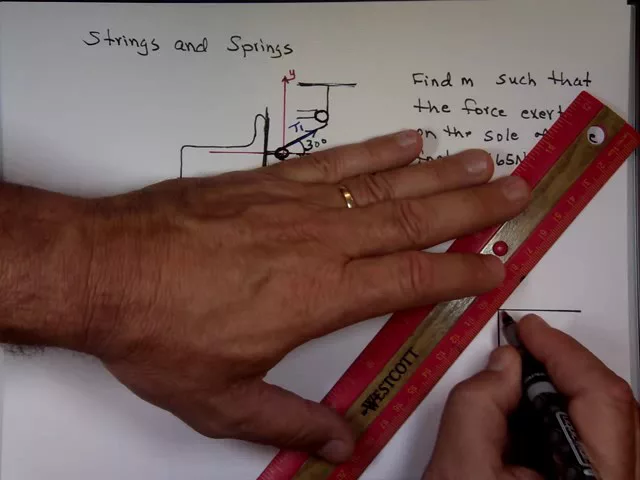
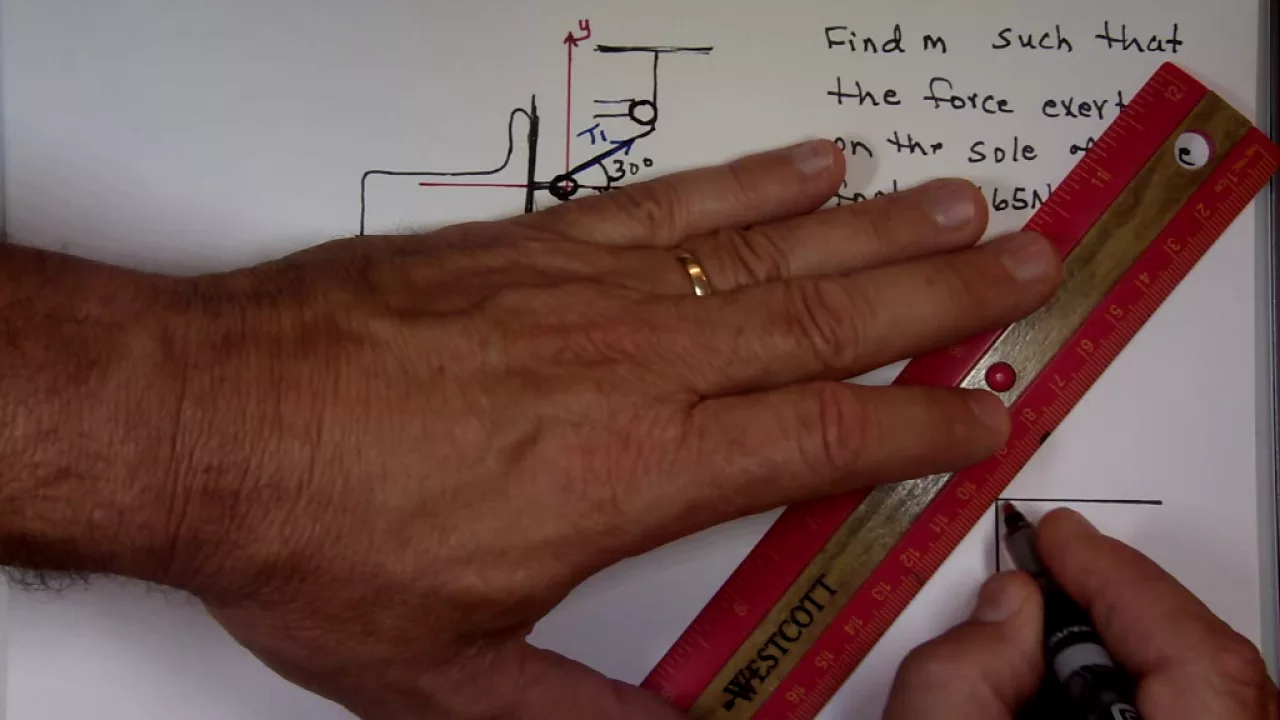
we'll start with strings again this actually a good picture you have a box tied here by a rope they're called string there if we neglect the mass of it and that string is holding that box there well the reason that box is not falling done because the string is pulling up on it for sometimes you want to lift something up there you have a pulley like this one you start pulling in this direction t here means tension you're pulling on it notice this picture I just kind of neat there because the box if you look at this box this box has a weight and the rate of the box will be which way straight down well if this box is not moving why's in the box falling down because the tension in the string that rope is actually keeping it from falling is pulling upward on it with the value of T and if they're all posed with the value of T for every action there's an equal and opposite reaction so if this one is pushing this way coming down like this way if you follow that path for it it looks like it's coming this way it has to be canceled by another force in this direction for every action there's an equal and opposite reaction and where is that T coming from because the person is pulling in this direction with the value of T then the Rope is pulling on that person backward with the value of T these tees actually have to be equal to each other because if they're not equal to each other that rope will snap or something will move so that's how strings actually intentions work so we're going to look at it where we use them well you know you see in that picture will do some examples like that but a common place sometimes in a hospital there somebody will break a leg and when they break their leg you'll see them laying in a bed this is the foot let go my art now I forget if I'm recording or not yes I am so this is their foot is broken foot and they take actually at the attach a plate here 2xu the foot there might be cast on it and they take that picture and they'll pull it through a pulley there so have like a low poly here and we have a rope that's pulling in this direction it might be another polar here and this is attached to the ceiling then we have another rope that goes like this will be a pulley here again and we dangle some way down and that way it's supposed to take the pressure off the foot when people break their neck too paralyzed to attach that the opponent so there's no pressure on their head so you see that in the hospital all the time and the question is what's the mass M you how much should I pledge their to make sure something is number because if you put too much weight it's going to pull that foot in and if you put a little bit of weight is not doing anything so these William want to put certain amount of weight so we'll feel like there's not much pressure on your foot so the question for this one we have this contraption whatever you want to call it there someone broke their leg so the middle pulley here is attached to the foot the mass em down here is actually pulling down find the value of the mass M that's what we need to know such that the force actually on the foot the force on the foot is 165 Newton so find em such that the force or is it if the force exerted on their foot on the soil on this one on that pulley their sole of the foot equals 1 165 Newton so let's look right here let's pull out x and y-axes right here and look and see what we have here started out don't you have to give you some angles you're otherwise I'm in trouble can do the problem and for this example I'll make them equal to each other they don't have to be makes the metal bit easier 40 degrees each one so if i do a free body diagram if I make this my water access right there bless you and this is my x-axis if you look right here what we see away three force is acting on that the question is there's this rope pulling up in this direction there's this rope pulling down in this direction are they equal to each other do I know not really the fact the angles are the same there will be equal but the angles are not the same didn't want you know what let's make the angles different I'll try to make the math easy but let's make this angle thirty degrees so since i have no idea i'm going to call the tension this cable is pulling up i have no idea call it t1 tension cable one and call this one with T too now why isn't that pulley move in that direction why isn't sliding they're just sitting under these two what's keeping from sliding down there because the foot of that person is pulling back on it that's why it's not moving so my free body diagram when I do that I see three forces acting on that what are the three forces are they go i get t one in this direction what angle 30 degree angle I got T 2 in this direction what's this angle 40 degree you want to use negative 40 that's fine but it's 40 degree below that x axis and I got the foot pulling back in this direction and how much of that force well that was given to us 165 Newton the question is how much mass what's em should be to get these numbers for me to work out to give me a force of 165 fear at that angle at this angle that's attached to the ceiling how much weight should i dangle here the mass Shepherd 2 kilogram 5 kilogram 12 kilogram what is it well if I know what t2 is to respond this way that means there's t2 pulling in that direction I can tell you what that value is for every action there's an equal opposite reaction so if this force is pushing this way then there's one pulling up on it to cancel it and if I know what that 22 is I can tell you what the mass is so my goal now is to figure out what t2 is now hopefully that foot is now moving you don't that patient their fourth is jerk and moving all the time they'll be screaming in pain you want to make sure that stationary nothing is moving well if nothing is moving that means the forces in the x-direction here the net force must be zero and the net force in the y-direction must be zero if nothing is moving well let's see let's take any force that's not on the X or Y axes and break it down to its components so how do we go again another free body diagram we're going to simplify that one that you see there so 41 I'm going to break it down to have 2 components 1 in the X Direction 1 in the Y direction and 40 again and 42 is the same thing let's look at t1 this is t1 the top one the fact is going up like this that means you have to go to the right and go up that's why one component to the right one component up everyone see that the direction of them to go from here to here you have to go to the right and go up X component Y component notice the angle with respect to up to the x axis so the x component is what T 1 cosine 30 and the y component T 1 sine 30 sign of 30s point 5 that's point 5 T 1 sine cosine 30s point 8 7 t 1 let's look at t2 t to notice to go from here to there you have to go to the right and go down that's why one component to the right and one component down in this direction the angle with respect to X again t2 cosine the 40 degrees t to sign of 40 you might be saying why don't you put negative 40 well if you put negative for it tells you this is done well I already know it's down so I already put that and if you put negative 40 this will be positive so it doesn t matter so you could have put negative 40 instead of plus 40 your answers still going to be the same but don't use a negative value here once you draw the arrow down because the negative tells you is pointing down what's cosine of 40 degrees point 77 t2 and what sign of 40 degrees point six for t2 now the fact that the leg is not moving if the leg is not moving we have what we call equilibrium balance system the net force in the X Direction is zero and the net force in the Y Direction is 0 and the net force in the Y Direction is also equal to 0 and easier way of saying that because that looks like a lot of writing there if you take all the forces pointing to the right if you add them all in the X direction there should equal all the force is pointing to the left and in the Y direction wise up and down if you take all the force is pointing upward add them they should equal all the forces pointing which way down well let's see let's look at right here I'll do the right side first no reason what is pointing up what's what pointing down when you look at this diagram pointing up is what point five times t1 and what's pointing down point six four times T tool that's one equation how many unknowns in that equation too good let's look at the X direction what is pointing to the right get point eight seven times t1 what else Alyssa plus to the right we have one more yep point 772 where we have pointing to the left hip what do you have now you have two equations by two unknowns I should be able to solve for T 1 and T 2 you notice if you solve for T 1 from this equation divide both sides by point 5 t 1 is what one point two eight times T 2. 64 / 0 point five remember that solving two equations by two unknowns substitution method now you come back to this and every time you see t1 you take it out and put that value so point eight seven and place of T 1 i'm going to write what one point two eight times t2 plus point 772 equals 165 so point eight seven times 1. 28 1 point 1 1 T 2 plus point 772 equals 165 1.
88 t2 equals 168 can we get T to 168 / 1. 8 889 if I know t2 can I now find T 1 T 1 is 1 point 2 8 times t2 which is 89 yes one wasn't that 168 or 65 165 from my sleep I guess my own numbers I like my numbers better 165 / 1. 8 888 instead of 89 okay let's put 88 here so one point two eight times the 88 which is roughly 113 Newton notice the tension in the rope is not the same because the angles are not the same if the angles were the same these numbers t1 will equal T tool in this equation everything else stays the same but that wasn't the question the question here is how much weight what's the mass yeah I need to put there to make sure I give the 165 pulling this way and nothing is moving but I needed to get what t2 is to get that mess so now let's look back at the picture I drew that picture like this and i said if this is t2 for every action there is an equal and opposite reaction envelope it has to be a t2 pulling in that direction it has to be equal to that number because if it's not that hope is not lost their if one is bigger than the other things going to move or the Rope is going to snap well I don't want they don't want anything moving here not on one the rope to snap that means these two must be equal to each other so this is actually t2 so let's look at this picture here and do a free body diagram on it we have the mass which we not sure what that is we got t2 pointing upward and now we know the value of T to what was t 2 equal to 88 and this is not moving any other forces that you see there does anyone see any other forces how about the weight of this if you take a blocker varnum await a 10-pound weight you're in the gym you hold it how come it hurts ordinate 10 is not going to hurt probably but you take like a 50 pounds you hold a good odds heavy why because the weight is pulling down and you have to hold up keep pulling on it to make sure it doesn't fall to the ground so is the way pushing down which equal to the mass times gravity and if this is not moving again will want anything moving if this is not moving the reason is not moving because if you add all the force is pointing upward here this should equal all the forces pointing down we have equilibrium balance what is pointing upward 88 what's pointing down mass times gravity which is 9.
8 what's am equal to 88 / 9. 8 which is eight point nine eight kilogram so they have to attach almost nine kilogram there to make sure that force on that foot is about 165 Newton and nothing is moving I know were you thinking do it really nurses do all that stuff before they figure that out no but somebody else figured that for them it might be a chart there that somebody went through it for this much force you attach that much because they know what these contraption redesign it already made they know what the angles so somebody can figure that if you want 165 this how much weight you want 175 that's how much weight 185 that's how much weight so somebody had a chart there might be attached to the door of the cabinet there we need how much weight you want 185 okay 185 it says hang 11 pounds or 11 kilograms long boom boom boom done but somebody had to go through that calculation for them and figure that stuff for them just like when you go to the dentist they give you an injection your mouth going to pull a cavity out its base at you on your weight but somebody did a chart for them because then almost people not going to sit down kelp it how much you weigh you weigh 180 pound 180-pound here says give them four cartridges the cars really small give them four of these deployment that syringe pump done you weigh 200 pounds or give them five of them but there's an equation for that and somebody figure that out I'll do another one with strings then I'll do Springs I'm actually covering two sections in one this is called equilibrium balance let's see it's scenario what we're going to give you you have a tree here there's your tree very similar to what we did so we have a tree here and you have your house on this end what service is grandma grandma is like to have birds and all the stuff as a chimney rest of the house and windows here that's grandma's house this is the door you know and grandma it likes to watch birds so she had a bird feeder she asked her if you can do one for her so you took the real pair a string a rope over you want to use you want like this flat but on this end to talk to the tree you had to go on an angle like this way this angle is 30 degree angle so you tied one rope to the tree put a nail they're tied a string to it this one attached to the house and this is your bird feeder and this one is are you with the food Nicholas a 3 kilogram the question is the tension in the string what's the tension each one what's the tension and this one in that one again the angles are different so I know the tension is going to be different now normally if you're designing these of you're putting our bird feeder there you want to plan for skunk you skunk skunk what I mean what is it squirrels climbing they're trying to steal the food so it might be a square on that we want to make sure that string actually can hold the weight of that plus the square on top of it because if you use a cheap string there the square gets on top of this that thing will snap it's on the ground you'll be going back and forth every day so you have to get a heavy rope to hold it so when a squirrel or to get on it it's not going to break so again I'm going to put my x and y-axes right smack in the middle right there this is the x axis that's the y-axis so when you look at that here's what we see and we hoping that this is not moving the bird lands on it the bird source mall is not going to make any damage they're not going to make it move you know maybe just a hair down will neglect that so we have t1 Rama nope otay my clothes nemesis remind me of the movie The Jungle Book drama mann cup gotta go home you get the way down there which is with mass times gravity and what's the mass of that birth year three and what's gravity 9. 8 is that 29.
4 and what we have here also is what T 2 at 30 degree angle this is my free body diagram so if you see a promises to a free body diagram that's your free body diagram graph in all the forces acting on that little junction right there on that spot on the string we can take this force and break it down to x and y component any fourth that's not on the x or y axis i'm always going to break it down to its x and y component what do we have here t one unknown we have the way down here which is 29. 4 now i'm going to take this one break it down to notice to go from here to here I gotta go left and go up so the x component is going to be to the left the y component is going to be up going to go left and go up now to the left left the x component that's t2 cosine 30 which is point 872 the y value T 2 sine 30 which is point five t2 now that bird feeders hanging out there is not moving just sitting there stationery if it's stationary says in the x-direction what's the net force both in the X direction the Y direction f net has to be 0 if it's not moving the net force has to be 0 which means what if you take all the forces pointing in the X direction to the right this should be equal all the forces add them all the ones pointing to the left and in the right direction all the force is pointing upward should equal all the forces pointing down so let's look at the X direction what is pointing to the right t1 and what's pointing to the left point eight seven times what t2 that's one equation by how many unknowns to welcome back to it later in the Y direction what is pointing upward point five t2 and what's pointing down 29. 4 what do you know I can actually solve for t2 right there right what's t 2 equal to 59.
2 is it / 0 point five if I know t2 can i come back and so 41 now what point eight seven times T 59-point 2. 87 x 59. 2 51.
5 so now come back here t1 equals 51. 5 so when you buy these strings these robes make sure the strength on them tensile is actually more than 59. 2 more than fifty one point to them otherwise they're going to snap them need to put them in so that's how we handle strings we use T 1 T for tension what about Springs the topic of the video was strings and springs well let's talk about spring moments done with this video yes yes you have the tension this frame mounted correct correct because I want to know if that I need to go to home depot or lowes and by ropes that can hold that imagine if this you want to pick up the engine of a car you better make sure that rope can hold way more than this otherwise going to snap you can do exactly you can i can give you one of these i can give you what this or that and you can solve for that just applying the same thing or i can give you attention one tension to and ask you for the angle and ask for that so two things you can solve for two things actually now what about springs instead of strings now let's look at spring if you take spring a coil there I don't have one with me and you lay it flat the spring will look like this right but what's going to happen if you compress that spring if you take that spring and you compress it now you make it go like this so we compressed it by this bless you we compressed it by this distance will call that Delta X or X and if the spring you attach something to it and you will let it go which way is going to push that object if you compress it that's what we did in the left we can we push on that ball Los lab compress that spring and once you Father which where the ball went backward so when you compress it this way the spring is really pushing which direction in that direction that's where the force is so notice this one I compress that I'm going to take the air out of this I compressed it to the left and actually the spring was pushing the force was pushing to the right what will happen if I stretch take that string and I stretch it I go like this so in this case where we go again help not this one the original length of that was this but now I stretched it I pulled in that direction and if this is free to move where is it pulling on which direction if you let this one go is it going to go left or right left so the force is going to be pointing which way to the left so the first thing I noticed about the force and Delta X is always backward and direction if you compress it the force wants to push it forward if you stretch it the force is going to be backward and what's that force equal to the force of a spring it's always equal to negative the negative it says opposite direction to X K times X or Delta X what's k K's arches spring constant that's what care is is spring constant sometimes you have a chart with all the spring constants in it it says if you have this spring you get that spring but really that doesn't work because by playing with these Springs the value changes again if you have a spring you keep playing with it playing with it playing with it it's not as stiff as it used to be take your car when your car was new when you hit a bump you didn't feel anything now your car is 58 years old you hit a bump off what happened because they're bottom out that spring from bouncing all the time its weak now so how do we figure what care for this spring is how do we figure that value we got we can do that in the lab actually that's straightforward how do we figure it is i'm going to figure care let's say i have a spring with me I attach it to like a nail on the wall and will be dangling like this nothing attached to it it'll be dangling this is it there's a hook on it now I'll take that spring again and that attach your way to it and it's next let's say this is the wait here I put in one kilogram and notice that spring gets stretch actually from here to there that's the gap when it wasn't stretched when it was just normal it was like that will stretch a little bit because if its weight now you attack that extra weight to is going to stretch more you measure that distance from here to here and if you know that distance you can find what k for that spring is so I'll take my ruler and measure that list so that's point three meters 30 centimeters so by putting one kilogram we structured this much hmm let's take this picture why isn't still moving when you attach the one kilogram whatever the force is acting on it or there are two forces on that right here on that Junction we have one pulling upward and that's the spring pulling up and the value of that wet k times x the negative indicate the direction the minus going is going upward because you stretched it down the force is pulling upwards so the minus sign just tell me the direction of it and what else we get the weight of this one kilogram the weight is mass times gravity the mass is one gravity is 9.
8 and if it's not moving anymore if a stuck there and just sitting there that means we have balance we have equilibrium we have net forces of zero so f net in the Y direction there is no X direction here is zero that means if you add all the forces pointing upward this should equal to all the forces pointing down what is pointing upward k times x what's pointing down is the weight k is unknown i'm trying to find what care for that spring is x is point three equals nine point eight can you get what K is 9. 8 / point three 32. 7 newton per meter that means if you attach 32.