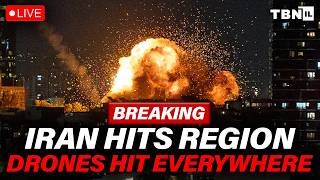
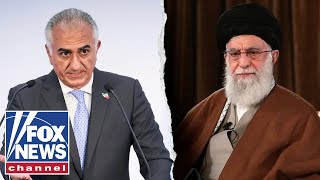
David, the president announcing Kmeni's death in a lengthy social media post just now. I want to read through you to you what the president is saying. He says Kamani, one of the most evil people in history, is dead.
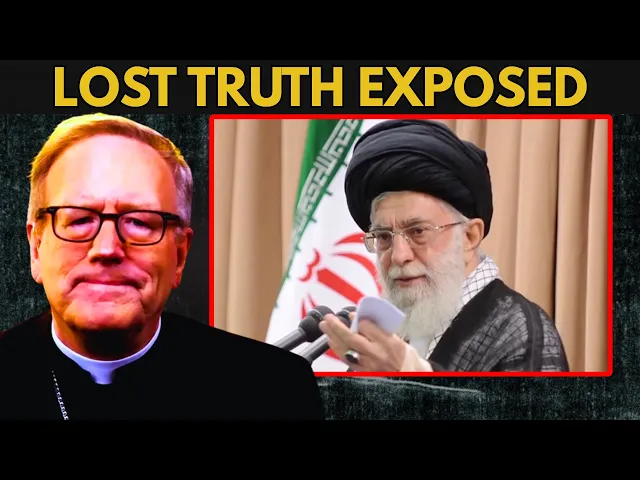
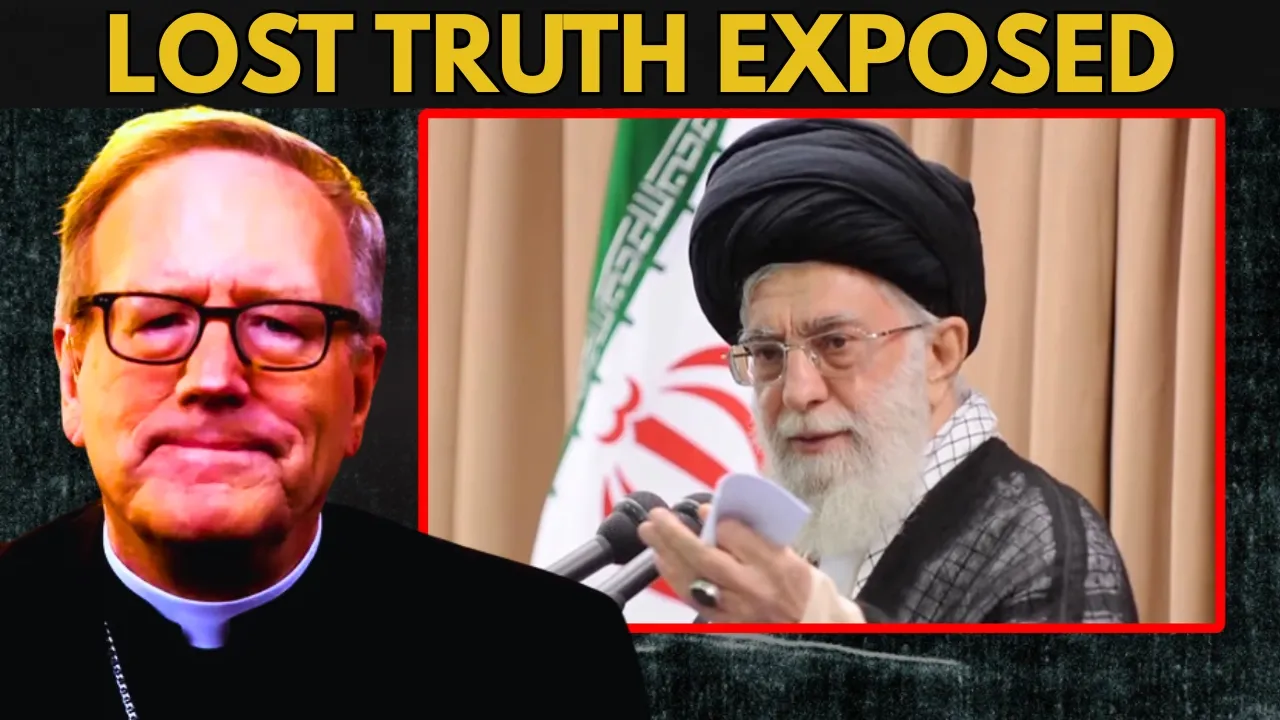
This is not only justice for the people of Iran, but for all great Americans and those people from many countries throughout the world that have been killed or mutilated by Kmeni and his gang of bloodthirsty thugs. >> Hello everybody and welcome back to the channel. I was watching a clip of Bishop Baron the other day and I think that he said something in this clip that perfectly connects to a forgotten detail, a truth that needs to be exposed that many people in our country are skipping over when we think about what's going on in Iran.
So in this clip, it's important that when Bishop Baron makes reference to our culture, he's really talking about us. But when he's talking about us, I think it shines a perfect light of what is actually transpiring in Iran. So keep this in mind, too.
There was conflicting data about the death of many of the leaders in this diabolical regime. This led to this reflection in the first place. They were lying about how everybody was alive when in fact as we know now they were all dead.
So this was totalitarian censorship of the highest level. So just be thinking about some of these things and as we watch this clip I think the puzzle will fall into place. Let's go.
>> I'm currently making my way through DC Schindler's wonderful book called The Politics of the Real. uh for anyone interested in the relation between religion and politics. It's a marvelous, very rich book.
But I want to draw attention to the epig that he chose really for his entire book. A kind of motto that's meant, I think, to haunt the mind of the reader as he or she makes their way through the various arguments. And I'll confess it, it haunted my mind.
It stayed very much in my uh imagination. It's a quote from the um 20th century philosopher, the German Jewish philosopher Hannah Erand, whom I've admired for a long time, her great book, The Human Condition, but she's probably best known for her meditations on the issue of totalitarianism, especially as it manifested itself in the 20th century. So, here's the quote.
I want to read it to you, and I want this now to to sink in. She said the ideal subject of totalitarian rule is not the convinced Nazi or the convinced communist. But people for whom the distinction between fact and fiction that is the reality of experience and the distinction between the true and the false that is standards of thought no longer exist.
Okay. Who's the subject of totalitarianism? Don't look right away to the convinced Nazi or communists, but rather the people for whom the distinction between fact and fiction, the distinction between the true and the false have evenested.
They've ceased to exist. Now, why should this be true? Well, think about totalitarianism for a second.
You might define it as the, you know, dominating control of all aspects of life by the will, the arbitrary will of an individual or a group. It's the dominance of the entire society. It's the imposition of an authority of a group or individuals on the whole of society.
In classical philosophy, the true and the good in their objectivity have a kind of intrinsic authority. They command the attention of the mind and the will. They if you want impose themselves on the receptive mind and the receptive will.
Think for example of someone discovering a great mathematical truth or being convinced by a philosophical argument or taking in clear scientific data. What's happening? Well, the mind isn't inventing its own truth.
Rather, it's accepting the authority of the objective truth which is imposing itself, mind you, in a liberating way upon the receptive mind. Or consider um ethical and moral values. When the ethically good and objective moral value appears before the will, the will rejoices in its acquiescence to the authority of that objective good.
The will is not imposing itself. It's not inventing its own values. It's accepting the authority of the objectivity of the good.
Now, I've talked a lot about this. I think the primary problem in our culture today in the west is what I've called this culture of self-invention. our tendency now to say no no no I mean don't don't impose any truth or value on me don't appeal to objectivities rather I in the depth of my freedom I invent my own truth my mind makes up their own truth my my will invents moral value and you say well that's that's good isn't it it's sort of tolerant and it respects people's integrity and and it gives them their own proper authority in point of fact everybody This is an enslaving move.
This is a finally denigrating move. Our culture believes, if I can borrow from that famous movie title, in the shape of water, in other words, that has no shape except the one that I impose upon it. What's being denied there, do you see, is the authority of the objectively true and the objectively valuable.
Now, why should this worry us so much? Well, because as Hannah Erand intuited long ago, it opens the door toward totalitarianism. Why?
Well, if the objectively true and good have even asked, they've disappeared. There's no objective criterion to which we can appeal together, to which together we can submit ourselves. All that's left is the struggle of will against will.
Am I right? I mean, look anywhere in the culture today and you'll see evidence of it. What we're left with is, well, look, I got my truth, you got your truth.
No, no, this is my value. That's your value. A will tolerate each other.
But what's going to happen is since no appeal to the objective is possible, the wills will clash inevitably. And at the end, what the most powerful will will assert itself. Now go right back if you want to the 19th century and Friedri Nze, one of the most important philosophers who is influencing our culture today.
What do you find? The uba mench, the o the the superman expressing his great will to power. That's the fundamental thing.
Don't give me these these objective truths and and moral values. No, no. I invent my values.
I invent my truth. And it's the one who has the greatest will to power who will emerge. I wonder if any of that sounds familiar.
Let's look at the 20th century when some of the worst totalitarianisms in human history obtained. Notice something too, please. What's one of the marks of the totalitarianisms of the 20th century?
A strict censorship of ideas, a strict limitation in what could be said or written publicly. How come? How come?
Because any appeal to the objectivity of truth and value is a threat to tyrants. It always has been. Whenever you appeal to an authority outside the will of the most powerful, you are limiting that totalitarian instinct.
And that is where I want to end this reflection today. It it was precisely this clip of Bishop Baron that got me thinking about what was going on in Iran. kind of that missing detail is that Iran was trying to censor the truth about the the the death of their leader.
And of course, this has come out. Obviously, it's been confirmed by Iranian state media. It's been confirmed by the United States and others that Ayotala, if I'm saying his name correctly, has in fact died.
But this is the point. Every time Bishop Baron uses the word culture here and he's obviously reflecting on us, it's true of Iran. We see a totalitarian regime that infiltrated that tried to censor things through uh Islam, a very staunch view of Islam.
Um a very zealous view of Islam. And this led to a conflict of wills, right? It was no longer about objectivity that everybody submits to.
No, that objectivity, that true seeking, that goodness, that beauty had even est. And now it was a struggle of wills. And that's what we saw unfold in Iran.
And this is the point that I want to get back to as Bishop Baron is making the case. It can be true of us. If we do not abide in objectivity, seeking after the truth, knowing that there is something beyond us, namely the God uh the triune God of Christianity.
What will happen in Iran is only a matter of time before our relativistic society. It's only a matter of time before our relativistic society looks like Iran. Which means much in the same way that um Iran's government needs to be overthrowed.
The little governing voice within our souls that says that we can live any way that we want to, that there isn't an objectivity that we have to submit to, that we have to ground our lives in and strive into that ideal. If we don't live into that reality, we are like a little iota in our souls. We are like a little tyrant that refuses to live into Christianity, fus refuses to live into objectivity.
And I guess what I'm trying to say much in the same way that the apostle Paul talks about in Romans, when you look out into the world and you see what's going on in Iran or Iran, however you say it, in the Middle East, that is a mirror into our own souls if we do not submit to Christ, if we do not submit to God. Just something to be thinking about.