If you want better local SEO results, you need to win on Google. But in 2026, you can't ignore other platforms that influence visibility. That's why the real play now is search everywhere optimization.
My name is Nathan Gotch, and I've led hundreds of successful SEO and local SEO campaigns since 2013, and my systems are used by thousands of SEO professionals and agencies worldwide. Let's get right into it. I'm going to be building a local SEO strategy from scratch in less than 30 minutes.
So, I picked a random business in Bowwin, Missouri. Right away, when we look at this particular Google business profile, it's got some good stuff going for it, but it has some there's a glaring opportunity that we're looking at right here. As you can tell, they service the city of Bowwin, but when we look at their preferred location, they're actually preferring Chesterfield.
This is a big mistake. And you can see their address is actually in Bowwin. They they are situated in the city of Bowwin, but yet the Google business profile is optimized for Chesterfield.
So this is as simple as literally going to the Google business profile, just switching it to Bowwin, and boom, performance will probably jump five five to seven spots in the Google business profile in the local pack. And plus, they have a lot of reviews, right? Nearly 700 reviews.
So just a simple switch on that can just like immediately improve their performance. Aside from that, everything else looks pretty solid. I think they could add maybe more visual depth and enhance the profile a little bit, but at the end of the day, just make sure you're targeting Ballwin and that's going to do most of the heavy lifting there in the Google business profile and continue to drive reviews consistently.
Now, going back to that, whenever you start one of these campaigns, what you don't want to do is start taking action right away. If you see something you're like, I'm just going to go fix this right away. I would hold off on doing that.
Especially if you're working with, let's say, this was my client, it's smart to go and get a benchmark report. go and benchmark the information and the performance before you start acting. So at least you can see the performance gains over time.
So what I do is I set up tracking and you go into your preferred tracking software. But the key thing here is no matter what you're tracking, you have to track multiple surfaces, multiple search surfaces, especially for local. The first one that matters the most is local pack.
Okay, so you can see here we're tracking dentists in Bowwin, Missouri. Okay, so they're number 20 for dentist Bowwin, Missouri. They literally have a location in Bowwin and they're still losing dramatically and they actually have more reviews than a lot of the top competitors.
That location switch, I hate to use the word guarantee when it comes to SEO, but I've just seen this so many times and how effective this will be. Changing a location to the correct location or changing a category to the correct category. Sometimes you can see a lift of five, sometimes even 10 spots just for one second of work.
Okay? So, I'm telling you, if they just change this, boom, they're going to pop up probably top 10 at least in the local pack, okay? And then they just got to keep shipping away there.
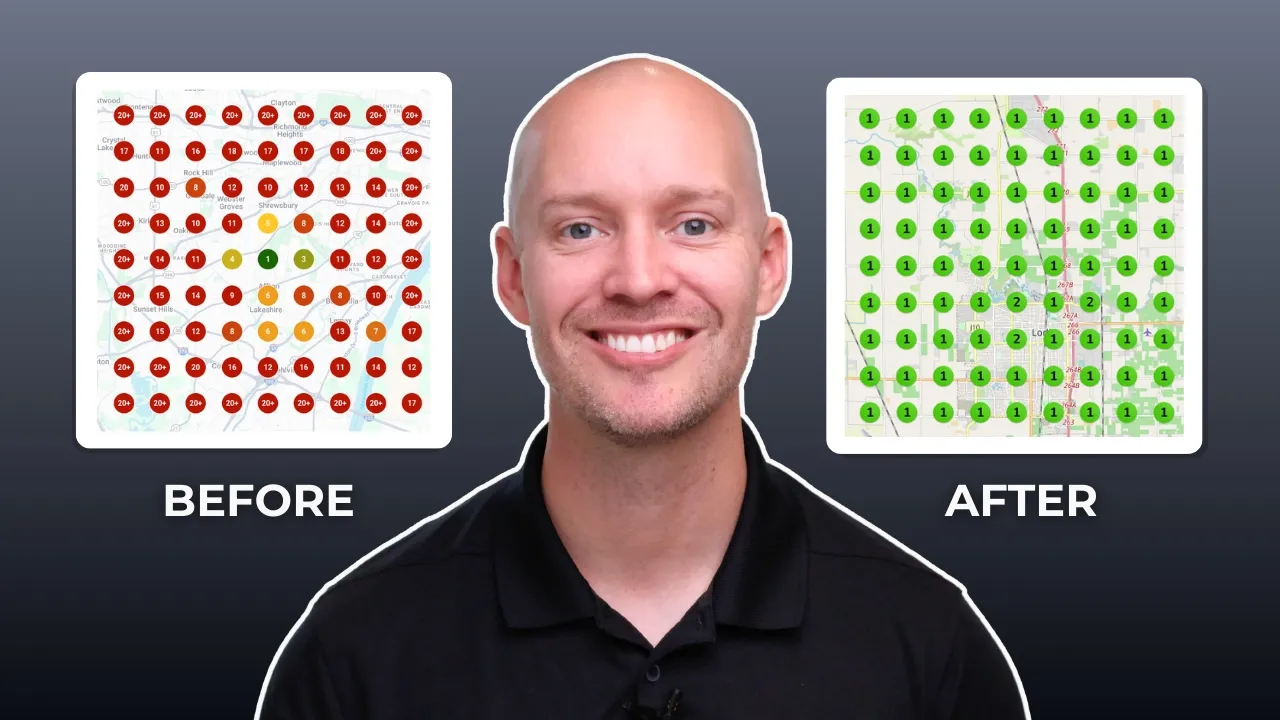
But that's a very simple thing. And then you can even see in the grid here, it's causing a lot of problems for them because they've optimized for Chesterfield. So, they're just not doing really well in the location that they're actually servicing.
And then aside from that, we'll go and check their category. So, they got the right category, dentist. So, they're good to go on that.
All right. Now, in addition to the local pack, we know that to influence local pack, we are going to focus just on the Google business profile, right? That's one of the key things.
Now, there's a bunch of other secondary variables that we should consider outside of the Google business profile, but we'll be talking about here in a second. But we also want to be tracking traditional search, right? How are they doing in traditional search?
And we see here there's opportunity, right? Like they they have competitors that are beating them across multiple search engines and they're doing okay, but there's room to improve. And I'll show you some of the gaps that exist in the traditional search results.
But remember, on the local level, you really want to be thinking about just dominating the first page and trying to occupy as much SER real estate as you possibly can. So you want to hit that local pack. You want to rank in the traditional search results.
And you also want to rank on other websites in the search results as well, not just your website. We'll talk about that here in a second. And then the AI answers.
Okay, this is absolutely critical. If you've been doing SEO the way you should be over the last 2 to 3 years, you should be thinking about your brand or your client's visibility inside of AI answers. So, you can see here they're actually doing really well.
They're visible across four different AI platforms. They're not visible across chat GBT, which is the one that really matters the most here. But you can see they're doing quite well, right?
Like Gemini, Perplexi, Claude, Grock, they're doing well. All right, there's room to improve, but they're doing pretty well. And that's a good sign.
All right. Then we also want to see AI citations. All right.
This is a big one here because first of all, we want to be one of the sided sources. So you want to try to your own website try to be one of those citation sources, one of those sources of retrieval, but we also want to be looking at the opportunities. Okay?
What opportunities exist here? Now, some of these are competitors, but some of them are not. We have HealthGrades, and then we also have Delta Dental.
So these are two obvious citation opportunities that we're going to want to pursue. Now, I'm going to show you how to take this to the next level. Okay, now actually before I get into that, make sure you have Google Search Console installed and make sure you have Google Analytics 4 installed and make sure you have call tracking.
Okay, those are the three additional tracking things that you need to do for local. This is pretty much all you need. You need to be tracking across all of these search surfaces and you can see like just with some slight tweaks or the things I'm going be showing here in a second can see dramatic lifts in visibility here.
Now, the one thing I really want to show you is the citation sources. So for many years you would on the local level we would just go and build citations and it'd be like a oneanddone activity like let's go build our citations and then move on to some other stuff because honestly they weren't that important but they have become important again and but not in the way that you think. So this is not a game of volume.
The way you want to think about citations is simply just to look at what citations are popping up in for this particular industry, this niche, this particular scenario. Okay? And then those are your you should put all your focus and all your energy on those because we know that they're being used in the AI platforms.
So from there it becomes quite simple. So like in in this case we only got about three, right? We got health grades, we got Delta Dental, and we've got Yelp.
So we've got basically three citation sources that we need to get hyperfocused on and do a really good job there. And also ADA. org as well.
So we actually got four. Okay, so four total citation sources based on most local industries that we've seen, four to seven give or take citations that you're going to spend your time on. The rest are probably not worth your time at all.
Okay, so what does that mean though to spend your time here? You want to be thinking about how do we actually do SEO on this citation source? Okay, so when we're looking at health grades, how do I actually get this particular dentist to show up higher on this particular directory?
Okay. And so when we're looking at this, clearly we've got 1 2 3. We've got three sponsored listings here.
Maybe worth considering being a sponsored listing. Here's the thing. The AI platforms don't care if it's sponsored or not.
So, it's going to come in here and it's going to see these three brands popping up here and it's going to give it weight just because it's here, just because it's the the most retrievable. And then also improve the organic performance in this list. Okay.
And we can see the particular dentist that we're looking at here. They're not actually showing up anywhere super high on this list. They're all the way down here.
So the question is, what should Brandon in this case do? He needs to go to his profile and he needs to start driving reviews to this profile. Okay, start driving reviews here.
This is what I would call a secondary review surface where Google is 90% of your effort for your reviews. The other 10% should be going to these secondary citation sources as a way to ultimately improve the visibility in the AI platforms. Okay, so start with the reviews.
The next thing is just looking at the profile itself, it's very thin, right? When we look at this stuff, not a lot of information. You got a couple reviews in there, but it's pretty pretty light.
So, we need to actually optimize this profile just like we would a web page on our own website. Very simply run it through a content optimization tool. Okay, so I did an extraction of this particular profile just to show you this.
And you can see like it's pulling a bunch of stuff that's not relevant to him, which naturally would happen on a directory based website. But if you were to get rid of all this other fluff stuff, you'd basically be left with a sentence about what he does, right? Okay.
So, what this tells me is I would want to reoptimize this particular profile. And so you could just regenerate the draft and it's going to use all of these keyword opportunities to build something incredibly relevant, right? And we're looking at a target of maybe 500 words.
This will vary depending on the type of platform that you're using. We don't know the restrictions as far as how deep you can go on content on healthgrades, but you can still use that original asset that's been generated by the AI. And then you could even take it and throw it into chat GPT and say, "Okay, I need you to compress this down to 150 words or 300 words, whatever the limitation is.
But this will greatly improve performance on this particular profile. It may actually allow you to even maybe even rank this profile in traditional search, right? That's a secondary thing that you can do to occupy more real estate.
So that's what you should be thinking about. I need to actually optimize my profiles, right? " So you optimize your website, then you optimize your profiles.
And you can see in about couple seconds here we can already see great improvement as far as covering the appropriate topics much better right a lot quicker a lot better like dental veneers you just click on this and it will the AI will find a place to cover that topic in a natural way and you can see perfectly covers that topic no problem at all so this is just what you can do you keep adding more and more to make it more relevant and you repeat this process for all your critical profiles next thing we're going to be doing here is we're going to focus on the brand itself. Come up here and I'm going to show you two different techniques. The first technique is using chat GBT and this is a prompt that you can use and basically what it's going to do is it's going to it's going to scour the internet and look for inconsistencies about this brand.
Okay, that's what you want. Identify those inconsistencies and then go and attack them. And so you can see here I just used GBT 5.
4 to do this. But regardless, you have two options here. You can use GBT 5.
4 thinking and you'll still get a really comprehensive analysis. And you can see this apparently this practice was taken over by the current dentist. So it actually made it transitioned and there's a bunch of old baggage left over from the previous dentists still floating around the internet.
So this is something you want to go and start cleaning up and and improving all of the accuracy for this particular dental practice or any business that you're working on. Okay? And this is just barely any work to do, but you get a massive report, tons of work that you can execute on.
You can also use deep research. Okay, honestly, I've been I haven't really been using deep research as much as I used to because I have found that 5. 4 or even 5.
2 prior to this. It uses web search anyway and it does pretty much the same thing and it takes way less time. So, I would just my preference is I just use the 5.
4 thinking and I let it just run and it's way quicker. Okay, so that's what you do. Then now we're going to move into technical SEO.
Okay, so from here I'm just doing a very simple screaming frog crawl. If I had access to Google Analytics and Google Search Console, I would integrate those as well. Okay, but in this case, I don't.
So, couple key things we're looking at here. This site is actually not in that bad a shape. There's just some kind of broader level things that we need to go after.
So, the first one is is title tag optimization is quite aggressive. Okay, I would not be this aggressive with title tags. And you can see right here, for example, we have dental bonding in Bowwin, Missouri, which is great.
This is a fine title tag. But then we've got dental bonding plus the zip code. And now we're just getting over optimized.
So you would just get rid of this and just keep it like this. All right. And this would be totally fine.
This would work perfectly well. Okay, that should be the style. You could even just use the the actual dentist name here.
So you like Brandon Cousins DDS. Maybe if you don't want to use the dental practice name, it could just be like this. But either way, you don't need to include these secondary variations in here plus a zip code because LLMs are incredibly smart and they know those are the same thing.
So, you do not need to do that and it will not actually improve your performance. Actually, probably hurt you more than anything. And then meta description.
When we look at this couple key things here, we got the boilerplate metad descriptions here. Now that we have LLM, there's just no good reason not to have unique metadescriptions. Like every single description you write can be unique now with barely any effort.
So I would highly recommend rewriting every metad description. Make sure it's unique. I don't recommend putting the phone number in the metad description.
The reason is because organic CTR is critical and we know it's a proven ranking factor. So when you put that phone number in there, you're greatly increasing the odds that someone is not going to click. We need them to click.
That is absolutely critical. So, I would avoid putting the phone number in the title or the metad description. This does not apply to the Google business profile.
I'm just purely talking about your traditional search results. Okay? So, you I would be careful doing that.
And then aside from that, I think everything else is pretty solid. The only thing I would avoid doing is like thisformational stuff. This is not the type of content you want to be creating on the local level.
This is all just generic stuff that AI could easily produce. How long do dental implants last? Okay, that's a general question on the national level.
It's not going to serve this website that only focuses on Bowwin. So, you want to focus just on your core location. Don't focus on topics that are generally b in the practice itself.
That's not a good idea. You want to focus specifically on the location and the subject matter exp. So, how do you do that?
Very easy. Go into chat GBT and I'll run a couple examples. So, the first one here is linkbait.
Okay? So you can run this prompt and come up with different statistics driven ideas. There's like endless amounts of ideas that you can run.
There's no shortage of ideas now. You come up with the ideas, then you just need to go and execute these. Some of good, some are not.
But the point is, you can see this is much better because it's focused specifically on Ballwin. And that is the key. You want to build that proper relevance and localized relevance for this site.
Then we go down. We can run the same thing here. Similar concept.
And you can see these are additional local content ideas as well. So once again, just use these prompts and just make them applicable to any business that you're currently working on. Okay.
And then we can actually go over here and this is the last piece of this equation, which is some additional off-site work. So with one simple oneshot prompt like this, you can basically be done with all of your link prospecting. Okay, you can see right here within about took about 4 minutes, we've got all kinds of link prospects that we can pursue specifically in Bowwin.
Okay. And this will help us build proper topic relevance and topic authority the way that we really should be doing it. Okay.
And then the last piece of this is the page level as well. So we I showed you the the different dedicated pages here. So they have Invisalign in Bowwin, Missouri.
This is actually a proper structure. I think this is actually good right here. So, we have the service, then we have the core location.
This is actually a very good setup. I would stick to doing this. That's good.
But it's really about the optimization of those pages. So, you can see here like this is the homepage and it has probably too many words. It's a little aggressive.
It's not actually optimized particularly well. And so, you'd really want something more like this, right? Which is like you've got a word count that's more within range of the competitors in that median word count range.
and then you are properly covering all of the critical topics and entities. Okay, that's what a good page is going to look like for SEO purposes. It's going to be perfectly optimized for the location and that primary topic.
Okay, and you can see this is for cosmetic dentist involvement, Missouri. Took about 3 minutes to build this. Okay.
And then you can just literally go in here and export and whatever CMS you're using, you can literally just click this HTML, hand this off to the AI, and boom, it will go and just format this exactly how you want. And of course, you'll need to design it and work on that. But you can do it that way.
You can also go and just export a classic markdown file. Once again, very useful for AI platforms. They understand markdown it exceptionally well.
And then if you're using WordPress, obviously you're going to have to work with whatever builder you have. So that is a full local SEO strategy in less than 30 minutes. Told you I would do it.
So that's those are all the kind of component pieces you need to go through. You get your tracking set up. You attack the core citations that tend to show up, right?
Want to go after the common citations. We want to go and we can continue to acquire links around the local area to build localized topic authority. And then we need to just fill in all the topic gaps.
So focus on your service pages first and you know build relevant content for all of your service pages. Cosmetic dentists and all your secondary services. Do that first.
Then once you've got all those knocked out, then just move into building topic support with properformational content orformational assets that focus on the local area.