Guillotine blades are angled supposedly because that makes them better but why would that make them better and actually are they the best design that's out there let's take a look at a real historic Guillotine blade and make some measurements then I'll tell you a little bit about the theory of cutting after which we will build a fullsize guillotine with the help of yon from proper printing to actually test blades with different designs so what's an actual gutin blade like what angles and size are we even talking about historically well we got the opportunity to go
to the storage of the the hake Historical Museum and measure up an actual real Guillotine blade from 1810 so big thanks to them the people from the museum have been amazing it's a bit of strange blade but it would be mounted something like this and I know you're just as curious as I was it has probably been used but it's not verified anyway it's angled at 45 de which is much steeper than some popular depictions show it's sharpened from one side only like a chisel but at a very low angle so low in fact that
we couldn't get a good reading on it with the tools we had at hand but probably around 13 deg it's between 4.8 and 7 mm thick which is surprisingly inconsistent but on the other hand it was 1810 making sheet metal was probably really hard it's 70 CM wide it weighs a little over 5 kilos we guessed for just the blade with the wood that holds it in place the carriage it would have probably come in at around 10 kilos which is about the weight of two bold Eagles for my American friends and here at the
prisoners gate Museum in the hake which is a subsidiary of the the hake Historical Museum we can see that the knife Falls for about 180 cm sadly we couldn't get into the enclosure but the blade angle of this complete Guillotine was roughly 49° so for us that's close enough to 45 so now for the theory cutting takes place on a spectrum on one side we have crack propagation and on the other is smooshing on this footage where we cut a watermelon you can see that the blade cracks the watermelon and that in fact the bottom
of the blade the sharp bit is often not even in contact with the material that's being cut it just pushes the watermelon apart and crack formation does what we usually think of as cutting but one glaring question remains how does the crack start on the other side of the spectrum is smooshing which is exactly what it sounds like if we zoom into the sharpest Chef's knives so that their Apex their very edge is as big as a log atoms would still be the size of sand it really knives are just pushing their way through like
a stick through butter the pressure that's put on the material locally is higher than its strength and it just kind of moves out of the way and if the material can crack it will eventually do so this happens over and over again in most materials as the crack wonders of course and a new one has to be initiated you can see this too on the watermelon one important part of cutting is how small you can make the very edge because that will focus the total pressure on a smaller surface area but another important part is
what you need behind the edge in order to push it into the material basically the bevel angle of the blade this blade might be very sharp in the sense that it has a small Cutting Edge but it's obviously not going to cut most materials because the bevel angle is just too high as a fun little side note for soft sticky materials like cheese it's common to use a steel wire instead of a knife because you just want the edge and you don't want all the material behind the edge it takes up too much space it
generates too much friction while the edge itself doesn't have to be all that sharp anyway as you might have noticed for something to crack or to smoosh it has to move apart that's very hard to do when it's pushed together but much easier when it's pulled apart already you can notice this very well when you prune a tree if you cut from the underside of a branch it's very hard to cut because it's compressed by the weight of the branch but if you cut from the top and maybe even pull the branch down more you
can cut right through so for our gear team blade there's a few few things we want we want to have a sharp blade to reduce the forces we need to pierce the material we want a low bevel angle so that the material doesn't have to move apart very far and we want to put the material in tension so that it wants to move apart on itself before we even start cutting well slanting the blade won't make it sharper of course there might be an argument to be made that you have a longer blade which means
that every part of the blade Cuts less material and therefore that it will stay sharper for longer but I don't think that's relevant in the case of guillotine because these they were used occasionally and not all day every day but by slanting the blade however the bevel angle does become smaller in a way driving straight down a mountain is way too steep right which is why mountain roads are always windy and angled well the same happens when a material encounters the knife at an angle but I'm not sure if this matters you see if we
take a cucumber that's cut halfway through it doesn't matter if I hold it at an angle the material is still pushed apart in exactly the same way the blade needs to travel further to get to this halfway point so it would presumably take less energy for every centimet the blade travels but it feels like it should take the same total amount of energy to cut through the material here's a fun little tangent for you different blade shapes cutting through something feels a little bit like a similar problem to a ball rolling from A to B
a straight line is the shortest path but it isn't actually the fastest if you go straight down first and then change direction that's faster already but the fastest way is actually a specific curve called a brachistochrone so just to be sure we will include a blade in that shape okay back to cutting as you probably know from experience slicing works much better than cutting straight down that's because by just pressing down you compress the material but by adding horizontal movement along the edge of the blade you will pull the material along to create tension right
under the blade and believe it or not moving your knife diagonally or having a diagonal blade is the same thing when it comes to cutting a round object I'm pretty sure that this is theoretically sound but it just feels wrong holding a blade in a slightly different orientation shouldn't suddenly put the material in tension so let's actually just build a guillotine and test the difference between the blades I've asked yon from proper printing to help you should go over to his channel if you want to see the video in which we design and build it
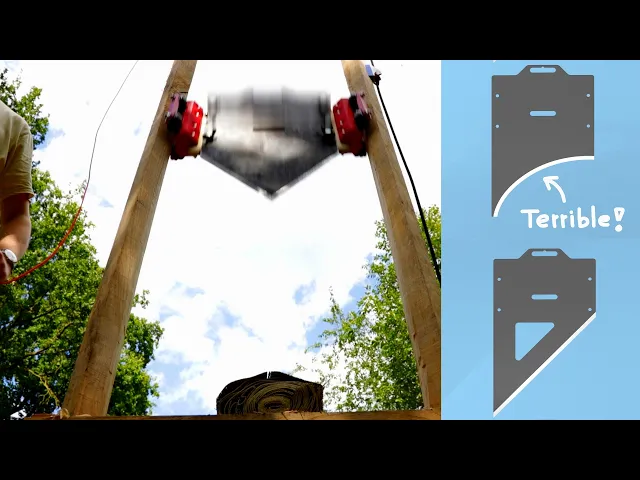
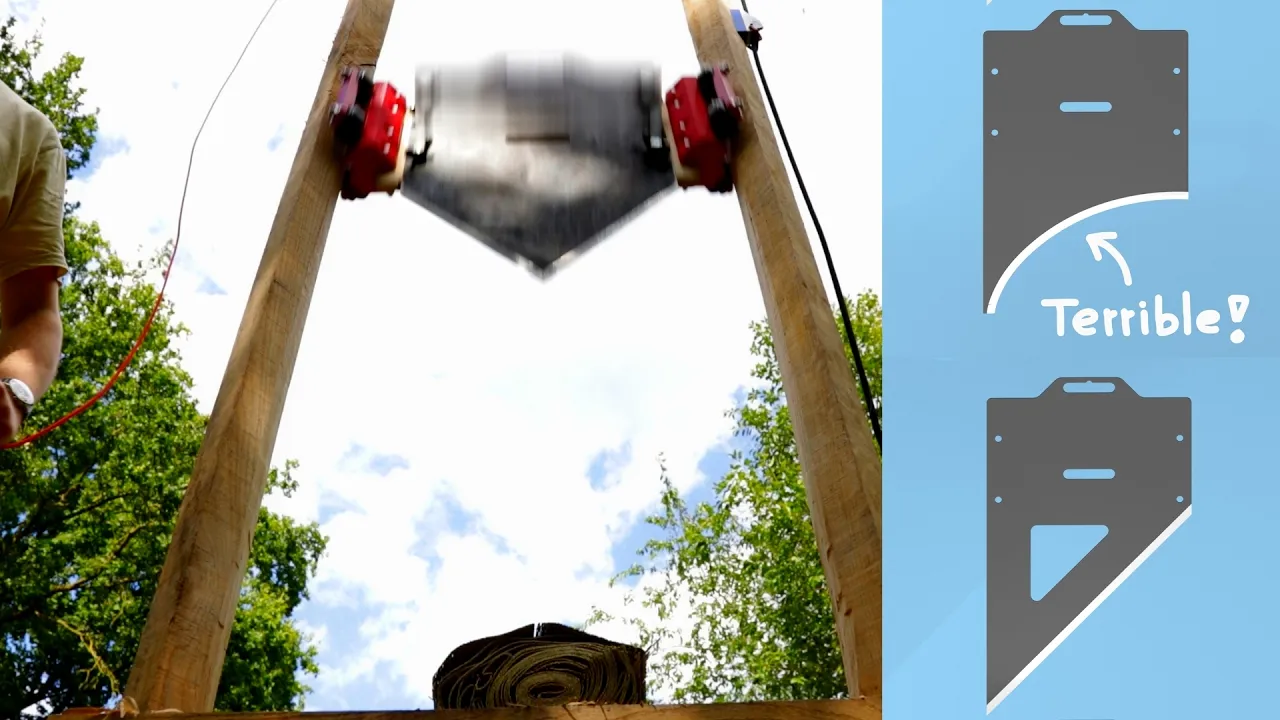
all the way from some bug infested locks and if you want to hear the hilarious story about how we decided to go for a full-size Guillotine instead of a small scale model here's the setup that we ended up with we have five blades a flat blade a blade angled at 30° a blade angled at 45° a pointy Blade with sides of 45° and a blade in the shape of a bista ground the bevels of the blades are all ground to roughly the same angle and sharpened with the same font the guillotine itself is a little
over 3 m tall and the bottom of the blade falls about 2 m before it hits the material as a testing medium we have these mats that are also used for Katana practice the idea is to see how many mats each blade can get through we have mounted a telephone on the guillotine to measure the g-forces hopefully that gives us some interesting information about timing Max forces and maybe even a nice little curve you can say that we've brought Guillotine into the modern era because now we have to install an app and create an account
in order to use it it might even want to know our location I hate that kind of stuff so much in fact let me tell you how location checks have cost me thousands of dollars while we test the guillotine I created my Instagram and Tik Tok account in the Netherlands because that's where I live but that means that I cannot enter into any creative programs because neither platform offers those here for some reason this brings me to the sponsor of this video nordvpn If I Had nordvpn running and I would have shown up in basically
any other country when I made those accounts I could have made a couple cents per thousand views with about 300 million views on those platforms that would have been quite a lot of money how much exactly is besides the point which is to say that it's not anyone's business where you are unless you give out that information willingly while knowing the consequences companies often use your general location in order to extract more money from you or in my case so I cannot extract money from them and the biggest problem is that it happened when it
didn't even occur to me that they would look at it or that it mattered with nordvpn you have an encrypted connection with a server and from that server to the rest of the internet simple automatic location checks will only see the location of the server instead of your location and you can choose one of their servers in over 100 countries on top of that nordvpn has threat protection Pro which automatically blocks sides that are fake or malicious and annoying ads so if you want that especially at the times when you don't expect to need it
use nordvpn.com noart for four extra months on a 2-year plan they also have a 30-day moneyb guarantee so you can try it [Music] out the watermelon was strangely anticlimactic just but it seems to work great let's go for one mat just as if it's not even there when analyzing the accelerometer data from the phone we sadly noticed that it clipped even on the bounces and that the sample rate turned out to be too low to really see what happened at this short moment it happens yeah new three sticks nothing so at this point we started
to suspect that our methodology would not pan out as we've hoped because we only have six mats in total four no change at all five yes six for all the marbles straight through [Music] that's all the mats we have and we expect that the flat blade is the worst so we have to find another technique which we thought of at this moment oh yeah instead of having a fixed height and seeing how many mats we can go through we will have a fixed amount of mats and we'll just lower the height for each blade until
it doesn't go through anymore and the lowest blade wins after measuring we found that the Rope didn't stretch any significant amount so we can measure the height from the Rope which makes things a lot safer this is also a good moment to say that we measure the height from the point at which the blade rests on the material because each blade has a slightly different length so let's try the flat blade at 1 meter okay let's [Music] go nothing but at 50 cm okay okay don't yes hey hey finally all right and at 75 yeah
Y and go not quite and 85 yes with a small bounce even so let's try 80 not quite so 85 is the number to beat we switched to the 30° blade and dropped it from 80 cm because we expect it to do a little bit better and did not go through we were surprised to say the least when noticed that it didn't hang perfectly straight because the knife is heavy on one side so we fixed that and dropped it from 90 CM top all the Camas yeah is eh nope but basically yes we forgot to
weigh this knife and as it turns out it's 2% lighter so we taped a piece of wood to it and try it again from no however we noticed another thing namely that because of the angled Blade the carriage was turning upon impact that can cost a ton of energy because as one side slows down the carrage turns and becomes wider and pushes harder into the wood which only makes it worse so we took the power plane to the corner and Tred again from 85 nice look at this oh is marous just like it stops and
then it goes back so anyway basically it's the same as the flat blade okay onto the 45° blade okay it [Music] off y huh h Coler as surprised at 95 CM it did have a perfect good but that's still worse then the pointy blade from 85 we have high hopes for this one in fact we expect this to be the best by quite a margin but what no however in the moment we were so focused on the turning the carrage that we totally forgot to think of the fact that the blade might just be hitting
the wood in fact I believe that the blad is just stuck in the wood here so much so that we can barely get it out and it's clearly not super crooked but still we expect the problem to be the carriage that got stuck instead of the blade just hitting the wood so we tried the blade from 95 which again seems to hit the wood and it doesn't go through at all and we still don't know what's going on because our incredible tunnel vision so we decide to drop the blade from 1 and2 m 150 CM
which of course goes straight through even if it would have hit wood and then we decide to go back down again to to search for the actual number to 110 which goes through to 100 which goes through back to 85 which goes through of course because now it's not hitting the wood for some reason and so we go even lower which go through an even 65 but that's too L and luckily I tried to push it through so we know that it didn't hit the wood so now the new record is 75 on to the
Last Blade the Rissa Crown the weight was close enough only at this point do we really see that the blade can move a lot and that some blades might have been hitting the side to be clear the damage you can see is from the cars and not the blades we decide to move forward because it's the end of the day the Sun is setting and this is the last blade we put the mats on the side to give to Bist Chrome its best shot because otherwise it would just be like one of the angled blades
falling from 85 CM it did not go through and you can see in a slow-mo that the blade is turning the carriage a lot of course having the mats on the side did not help and from 95 it did not go too but it sounded like a tip from 100 it still doesn't go through and now we actually see a piece of wood missing although with hindsight it's only a small piece and on the high speed you don't see the blade struggling at all until it hit the mats and starts rotating so I actually think
that hitting the wood in this case wasn't necessarily the reason the curve blade did so badly I think it's because we put the material on the side which makes the carriage turn a lot more than the other blades so the results what can we say well we had two problems one is that we hit the wood sometimes which makes some of the results questionable and others completely invalid but the more interesting problem we had is that the carriage rotates when we use slanted blades and this is a problem that the people back in the day
also would have had it's possible that they had a fix for it but it's also possible that they didn't and that flat Blaze would have given them more consistent results the pointy blade has the benefit that it focuses all its energy on a tiny part to start with making it start to cut already when we just let it rest on the material to get done behind but it also has the benefit of being symmetrical so it doesn't turn the carriage like the true scientists always do we have to conclude that more research is needed which
is exactly what we will be doing in part two so make sure you subscribe I will do some research on this rotating problem was this a problem that they had back in the day too and if so they have a solution and we will do some upgrades to our Guillotine and to our testing methodology to get clearer better more better results in this case the pointy blade one with 75 cm instead of 85 but I'm not betting the farm on these results because it's just a little bit too messy to my liking if you have
ideas to make the next test go smoothly please let us know in the comments I hope to see you in the next video want to do another one sure look