foreign [Music] [Music] [Music] [Applause] foreign [Music] [Applause] [Music] the third paper to be presented for this morning planning recession is complete genome sequencing and identification of transmission routes of the h5n6 San Luis 2017. thank you well I hope everyone was able to stretch a bit and have loaded more caffeine before I introduce our third speaker let me thank Drtablante for that short but thorough presentation on how Avian Influenza can disrupt the supply of poultry and how it can be controlled and prevented unfortunately since Drtablante is also based in the U. S he won't be able to join us during the Q a but we will be sending him those questions that you have and we will send you back his answers thank you all right so now our third speaker earned his doctor of veterinary medicine and master's degree in the University of the Philippines Los Banos Laguna he completed his doctor of philosophy in veterinary science in Yamaguchi University in Japan he is currently a up scientist at the department of Veterinary clinical Sciences College of veterinary medicine at up Los Banos Philippines in addition to his current post he also holds other positions outside up and this include director of international operations in Japan poultry industry Science and Technology research Association molecular epidemiologists at research and diagnostic division Poulter products and quality control also in Japan he's also a visiting researcher at Osaka prefecture University until now independent livestock and poultry consultant and attended postdoctoral training and research fellow poultry products quality control he is currently the world Veterinary education in production animal health oie program for for postgraduate certificate in poultry production ladies and Gentlemen please welcome pcpp's very on DrDennis V Umali thank you hey everyone first and foremost we would like to congratulate the Philippine College of poultry practitioners especially to Dresmi San Pedro to DrNoel lumbo and all the members of the organizing committee especially to Madame President Joy literato for organizing this wonderful and very successful event it is a great privilege to give this presentation entitled complete genome sequencing of the first H5 and 6 hpai from Pampanga Philippines in 2017.
now without much further Ado let us begin our lecture outline for this morning will be as follows first you will have a brief review of HPA outbreaks in the Philippines then we will have an overview of H5 and 6 HPI then we will be discussing the molecular characteristics of Pampanga San Luis 2017 H5 and 6. and then we will have a discussion on the phylogenetic analysis and potential transmission routes of our local isolate and then we will have an open forum now this study will not be possible without the overwhelming support of all our collaborators namely Drhiromit's cattle or ppqc Japan as well as DrToshi rohito Drhiroshito of Drry University also in Japan and of course our very own DrRonnie Domingo DrArlene ditiaco DrEdna Felipe DrDaphne jorca and DrAmado Antonio from the Bureau of animal industry Department of Agriculture as well as DrAngeles DrDel Bali and Drkamba from uplb now let us have a brief review on the HPA outbreaks in the Philippines and as we all know the first official case of HPA in the Philippines was reported in 2017 in San Luis Pampanga after several days this was Then followed by HPI cases in hayen whereby Sia and also in San Ysidro Nueva is here based on the timeline of events the case in San Luis was initially reported to the lgu in Late July 2017 laboratory confirmation was made at the regional animal disease diagnosis laboratory region 3. and at the national Reference Lab at the Bureau of animal industry in Quezon City in the first week of August after lab confirmation that the case was indeed an H5 influenza Mass calling and quarantine and surveillance protocols were immediately performed in accordance with the manual of procedures of the Avian Influenza Protection Program no but based on traceback information it was reported that prior to the San Luis case unusual mortalities were actually reported in the region as early as in April 20 17 based on the traceback information and usual mortalities were observed in a 15 000 Quail farm near the area which resulted 200 percent mortalities in the span of two weeks and it interestingly it was noted that under the quail Farm are ducks that scavenges on wasted feeds and feces and take note seducts no mortalities of 71 percent were observed then starting around May to July 2017 unusual mortalities and morbidities were observing layer Farms six layer farms in the area characterized by facial swelling respiratory signs and variable mortalities samples were submitted to a regional animal disease Diagnostic lab regentry at San Fernando and also at the national Reference Lab in Bai and in several private and University lab for parallel testing based on the Hawaii protocols samples were then sent to the Australian Animal Health laboratory for virus isolation and characterization this is one of the affected Farm in 2017 and based on the aapp manual the population was conducted within one kilometer radius of the bird flow outbreak indicated by the red and the Pink Zone and movement control was implemented within seven kilometer radius which is in the yellow zone after the case in San Luis and in a hand in San Ysidro several HP cases were also noted in Fabiano in November 11 in layers and in 2020 also in hyena Basia on March 17 in quails in July 6 in San Luis Pampanga also and there's no this farm and this Farm are basically the same so the loan business number two and uh official report was in August 10.
in Thai Thai Rizal involving native chickens and most could be ducks now based on this table since almost all cases in the Philippines is age five and six so let us have a brief review on h5n6 aib as we all know a via an influencer or AI is a very very old disease since late 1800s and early 1900s engineering Avian Influenza no but at that time um I foul playing and uh mainly young circulating strains during those times was over each one H2 and H3 resulting to several pandemics such as the Spanish Flu the Asian flu and the Hong Kong flu among others but unfortunately in 1997 an H5 no uh in the name of a goose 196 was able to cross the species barrier infected humans in Hong Kong now this is a great concern at that time because as mentioned all along exposure and humans H1 H2 and h3s even influenza and suddenly meron tayong H5 promagus and if and if this H5 will gain the capability for human to human transmission then uh it is possible that another human pandemic might occur and pass forward uh by 30 years now despite the Intensive the population protocols mandated by the Hawaii in cases of hypothei these are all the countries that reported the detection of uh the virus now take note aside from the geographic spread something happened to the virus no basically hit the mutated from the original indicated this genotype zero to the present No so at least there are 19 major plagues or lineages and at present uh right now it's a 2021. 2. 3.
4. 4 and we didn't play 2. 3.
4. 49 groups B Group C and Group D foliage five and eight are basically from group a and Group B and all group all H5 and 6 HPI basically from Group C and Group D but some age five and six now especially your recent page 5. 6 so these are the H5 and 8 derived H5 and 6.
now based on the trajectory of plate 2. 3. 4.
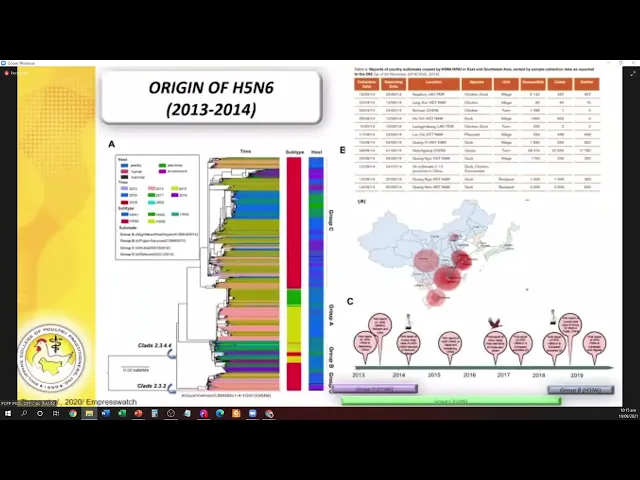
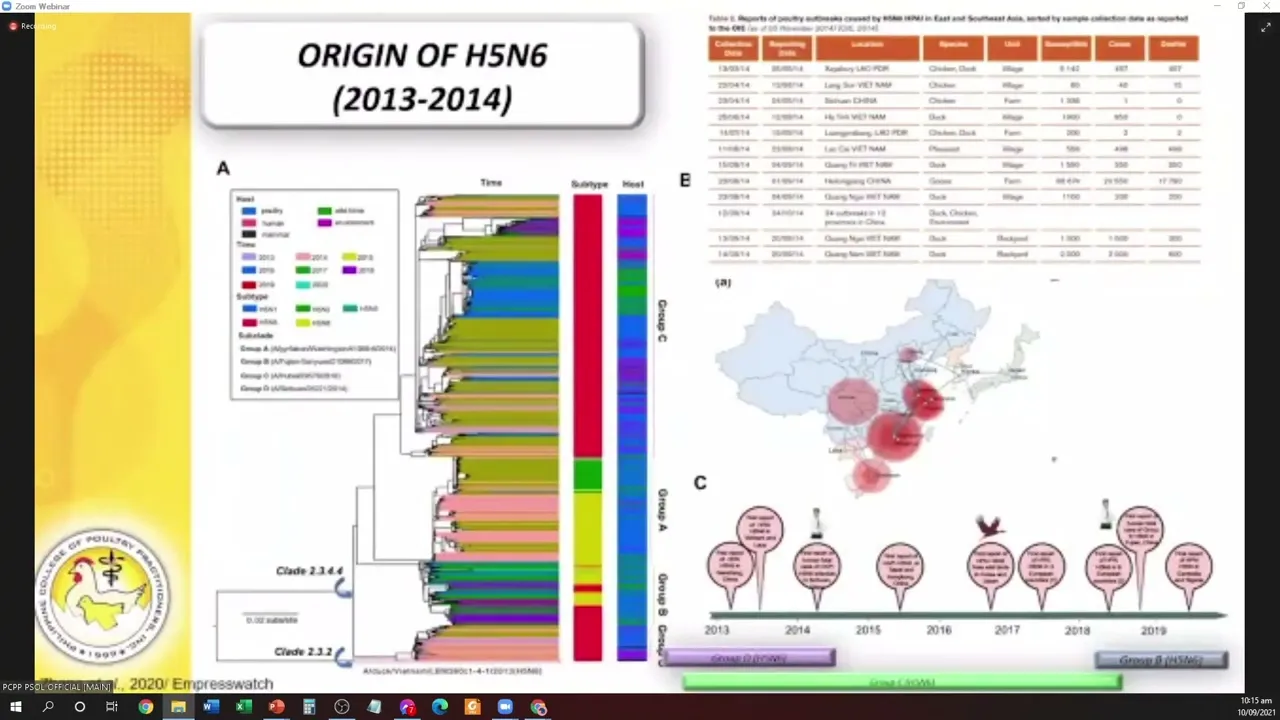
4 it is forecasted that the tongue and Group B companion trajectories from China papuntang Siberia to Europe and parts of America h5n6 and their groups and group they know forecast trajectory is from China East Asia and basically to Southeast Asia including the Philippines now let's discuss the origin of page five and six no so the first h5n6 was detected in Laos then in Vietnam look at this table no but tapan Trace back so pantries the chickens and ducks that were positive in Vietnam and Laos were actually imported from China so originally the uh origin of page 506 is still in China so played uh uh with a certain grade 2. 3. 4 in the literature somewhere here based on genetic sequences so these viruses were under Group D H five and six and after this case there were several detection in China afterwards the first human case was reported in 2014 and then h5n6 was detected in Taiwan Japan and Korea and the Philippines and other European countries in 2017 under groups here no and more recently to my group php6 was reported starting in 2010 2018 Europe original h5n6 [Music] or in recent classification a genotype 2.
foreign now from uh 2013 2014 to present there are at least 46 genotypes of page five and six reported all over the world so from the original G1 in Guangdong and G2 in situan China through a series of recombination resource producing at least 46 genotypes main detection in domestic poultry was in 2014 to 2016 and you picked detection while Birds was actually in 2017. now let us proceed with our case in the Philippines and we will be discussing the molecular characteristics of the first HPI in the Philippines designated as a Pampanga San Luis 2017 h5n6 and Performing complete genome sequencing and phylogenetic analysis for HPI is quite complicated as compared to other viruses primarily because as we can see in this diagram the Genome of AI is segmented into eight different segments whereas other viruses such as for example Corona companies and especially with linear genome modeling Mass sequence of Interest such as the spiking we can easily make conclusions on the genetic origin and properties of the virus in case there will be mutations the mutations are straightforward no because antigenic trip so basically combination of mutations over time assortment wherein to fully elucidate the origin of the virus you have to sequence all the eight genomes because or uh uh two or more viruses combined so straightforward as a whole now these are the row sequence data for San Luis Medio Mahaba and it's composed of several thousands of nucleotides but to interpret this now so there are different ways so basically you have to convert them into amino acid and based on the amino acid sequence we can look for genetic markers such as this one and each marker corresponding phenotypic function and effects so these are the markers and these are the actual sequences okay San Luis and these are the findings so we observed that San Luis is indeed an hpai with this particular cleavage site and this cleavage site is quite conservatively 2. 3.
4 viruses confirming from grade 2. 3. 4.
4 and uh other than that the Higgin of San Luis as preference for avian-like receptors and there's absence of human type receptor binding so in this town but it has a potential transmissibility in parrots and for the energy we found that San Luis is susceptible to seltama beer however based on the pb2 uh San Luis 2017 as markers that may indicate that it has enhanced activity also in outside transference is a mice for the emojin it was shown that San Luis is susceptible to mantadine and remantadine and similar with the previous Gene it has increased virulence in chickens and mice so in summary based on the molecular features so San Luis 2017 is susceptible to Common antiviral drugs such as amantadine remanthadine and saltama beer it has a absent young human type receptor binding so the zoonotic potential of San Luis 2017 is quite low however potential transmissibility to parents and mice small mammals based on the nucleotide sequence of each gene it was observed that San Luis belongs to the genotype 1. 21 point B genotype and for the specific segment no so basically combination G 1. 1.
9 NG 1. 1 genomics opinion so what is genotype H5 and 6 genotype 1. 1 point B now in our previous presentations in HPI we discussed that H5 and 6 is a triple Resort and virus and we use several pictures to demonstrate how H5 n6 was performed among previous lectures nothing we started with the picture of this adorable person and let us just call him the classic h5n1 which emerged in 1997.
which then recombined with an H5 N2 in the version of Drcore Occidental resulting to the generation of the progenitor h5n6 and finally the progenitor strain recombined with an h6n6 from a duck in the person of Doc Rooney resulting to the generation of the h5n6 uh prototype strain or the genotype one strain complete pathogenic pathogenic take note that this process uh is this one you know and major some master tulis genotype one and as mentioned previously no it will combined with a lot of other H5 B6 from different countries such as in China resorting to the generation of the Chinese h5n6 in Korea for the Korean age five in six and Japan for the Japanese H5 and 6. foreign to describe the process on how sean Lewis 2017 was generated let us Focus the strenato and let us just call him genotype 1. 1 now genotype 1.
1 is basically a recombinant of you know type one with an n6 Avian Influenza from a duck in China and uh in explaining the genetic constellation of San Luis so on the left side we have the genotype 1. 1 and on the right side you will be using this picture so shall see Christine crook and this is uh genotype 1. 1.
9 which is a recombinant of G1 with the Eurasian H6 also promo Darkness so Eurasian see she's a Eurasian Pedro no so what will happen one point one I might rather combined kg 1. 1. 9 so basically we will generate the genotype h-pipe band 6 G 1.
1 point B and ladies and gentlemen I present to you the genetic constellation of San Luis 2017. so from pathogenic and G1 B now moving on let us discuss the nucleotide sequence similarity and phylogenetic analysis of our local strain to infer on the potential neological Roots so we compared it with the different uh H5 and 6 from all over the world in genbank process you know but in summary the external genes and almost all the internal genes except the M gene because they see empty neg 1. 1 uh these are 90 200 similar to H5 basic strange from China Hong Kong Japan Korea and Vietnam in 2016 to 2017 however the mg 999.
2 to 99. 73 similar to H5 and 6 trains from Vietnam Hong Kong Korean Japan in 2014 to 2017. take note that prior to 2017 at home uh genotype 1.
1 point B I detected by Marilyn Ducks wild birds and environmental samples however in 2017 detects the chickens in Vietnam and in the Philippines in San Luis now uh based on the pylogenetic analysis of each gene of San Luis mahabaparing processor let me just confirm our earlier findings that the H the ha Gene of San Luis 2017 belongs to the clade 2. 3. 4.
4 Group C particularly in group Cena mainly isolated Samara white birds genotype 1. 1 . 9 and the mg is genotype 1.
1 The Strain or the San Luis strain is closely related to each pipe and six from Ducks wild birds environmental samples and chickens in China Hong Kong Japan Korea and Vietnam from 2014 to 2017. now let us in discuss the possible potential transmission routes of our local isolate in molecular epidemiology no so we have a technique called molecular clock which is basically a technique that uses the mutation rate of biomolecules to reduce or to reduce the time in prehistory when two or more life forms diverge so basically comparison on uh different nucleotide sequence we can estimate the most probable time of emergence and for uh San Luis tmcra or time to most recent common ancestor and estimate is basically around the late 2015 to early 2016. so at three my individual genes supporting everything in perspective this is what probably occurred or what happened so we have the genotype one that emerged in 2014 then we have the Italian Laos Vietnam then we have the genotype 1.
1 and genotype 1. 1. 9 that emerge in early 2015 and 2016.
now during this time period no so late 2015 to 2016 a recombine resulting to the generation of our genotype 1. 1 point B and this genotype was then detected in the Philippines in 2017. take note majority before 2017 was detected in Wild Birds first standard attacks Pilipinas but in commercial chickens as well as in Vietnam in commercial chickens now how it arrived exactly to the Philippines is quite difficult to say but based on the sequence data in the genbank what we know about G 1.
1 point B I am Kanye epicenter was in Guangdong and uh from gandong in December 2015 2016 emergency the virus was then detected in Japan in 2016. and then in South Korea in 2016 also so from Japan up into South Korea and also in 2017 that it takes uh Vietnam 2017 is quite difficult to say due to limited data but based on the available resources it could be any of the following Korea or Japan but any of these three but one thing is highly probable data the virus probably arrived in the Philippines through migratory Birds now as we all know wild birds are the natural reservo of abian influenza and the Philippines is part of the East Asian australasian Flyway and within the isization oscillation which is a major hotspot migratory birds actually around 10 to 20 kilometers [Music] especially in wild birds although in Europe and East Asia especially as a commercial poultry my Peak detection AI is during the wintering months but in the context and wild birds at the breeding site no big detectional AI is actually during July and August when there is an increase in numbers immunologically naive juveniles take note that San Luis 2017 was reported in August 2017. seasonal prevalence now going back to the candaba swamp migratory Birds but suddenly starting 2010 and specifically in 2016 notable new bird species were reported in kandaba particularly Tundra bingus one and also in 2016.
so interestingly closely related so I think Pampanga San Luis strange one and also till 99. 60 percent uh similarity so although circumstantial evidence no but based on the sequence data it is highly likely that San Luis 2017 uh may have bound its way to the Philippines through the overshooting of migratory Birds from their regular wintering areas probably due to inclement weather conditions and changing climatic patterns and it could also be the reason Kombat 1997 reporting H5 because probably starting in 2010 especially in 2016 migratory birds that are known to carry the virus and starting to arrive in the Philippines one possible reason and the overshooting of wild birds is a potential risk factor that may result to the introduction and transmission of AI to local wild aquatic Birds domestic poultry and the environment now in summary San Luis belongs to genotype 1.