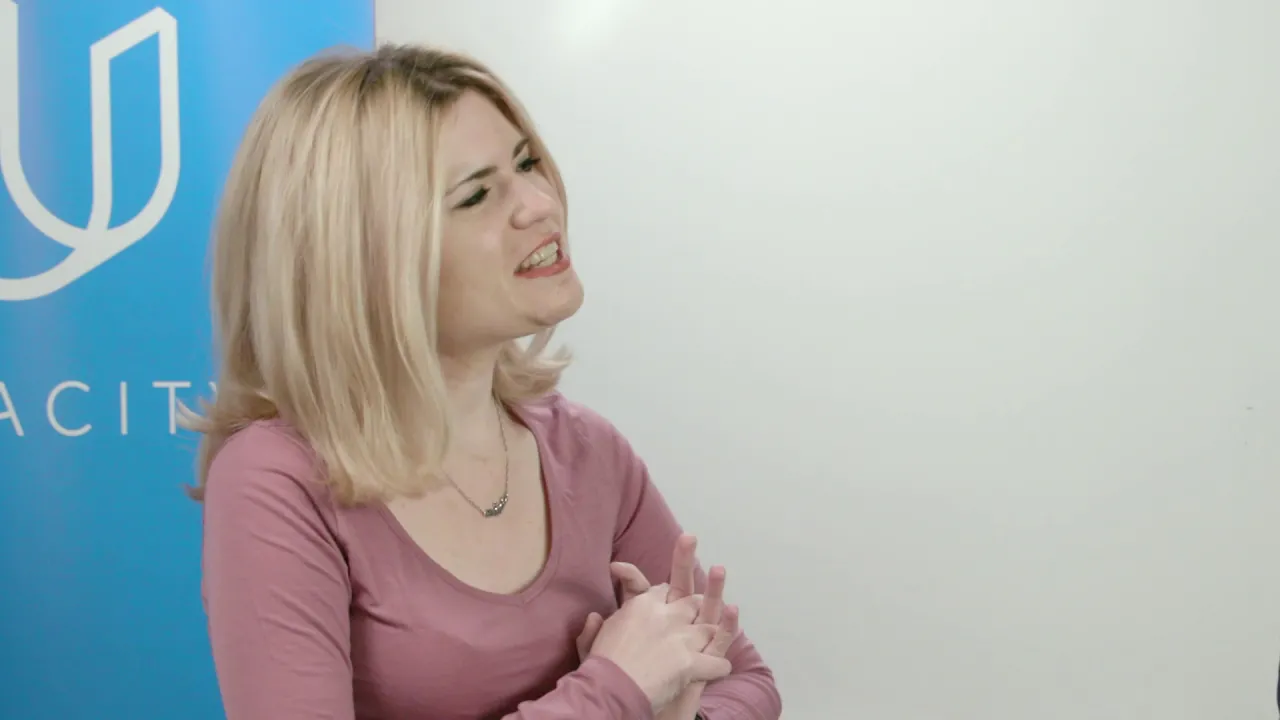
so we're back again for our third segment with Sebastian now Sebastian I know that you've done a lot of research with convolutional neural networks can you tell us a little bit more about what they are and I know our students are excited to hear about this too because they're about to learn how to implement them yes so convolutional neural networks are a very smart way to structure in network and built-in this was called an invariance so for example if you take the idea of a scene recognition you know an image in front of you and
what I understand is Sebastian in the image it doesn't really matter whether my head is up here or down here or over there the recognition of my head my face is the same no matter where you are that invariance this kind of location invariance is hard coded using convolutional neural networks so we have a repetition in a networked instruction that really makes sure whatever you learn for the quarter billion image works up here excellent and so can you tell us a little bit about some of the applications that you can see for CNN people have
used them massively for anything image and video including medical imaging they are also being used now for language technologies where people use deep learning for understanding and replicating language and the applications are you limitless they can use them in finance in many other fields I used them for satellite imagery nice yep that's a very common imagery yes yep and then I guess another question I have would be CNN's have been so important in your work and you said that they have applications across all kinds of fields are they the last thing that we can expect
to see out of deep learning like the last big advance or is there still I've learned never to say never always gonna find something interesting there's all this fun fascinating work at Missouri all deep learning and I'm very certain that as we invent faster computers you're gonna find better I was so there's still work to be done always excellent and we are training the next the next iteration of pioneers so is there any final send-off that you want to give them before they start learning how to build their own CNN's he has an interesting facts
or convolutional networks were invented in 1989 that's a long time ago most of your program even porn at that time which means it's not the cleverness of your eye Gordon that makes the big difference it's the data that makes a difference now we live in a world with are plentiful they're very very large and we can now emulate human intelligence functions using data we have so when you work on this focus on finding the right data and applying it and see if we can make magic happen the same way we made magic happen when we
solved skin cancer excellence so let's go make some magic happen










![Chill Summer Lofi [chill lo-fi hip hop beats]](https://img.youtube.com/vi/kyqpSycLASY/maxresdefault.jpg)