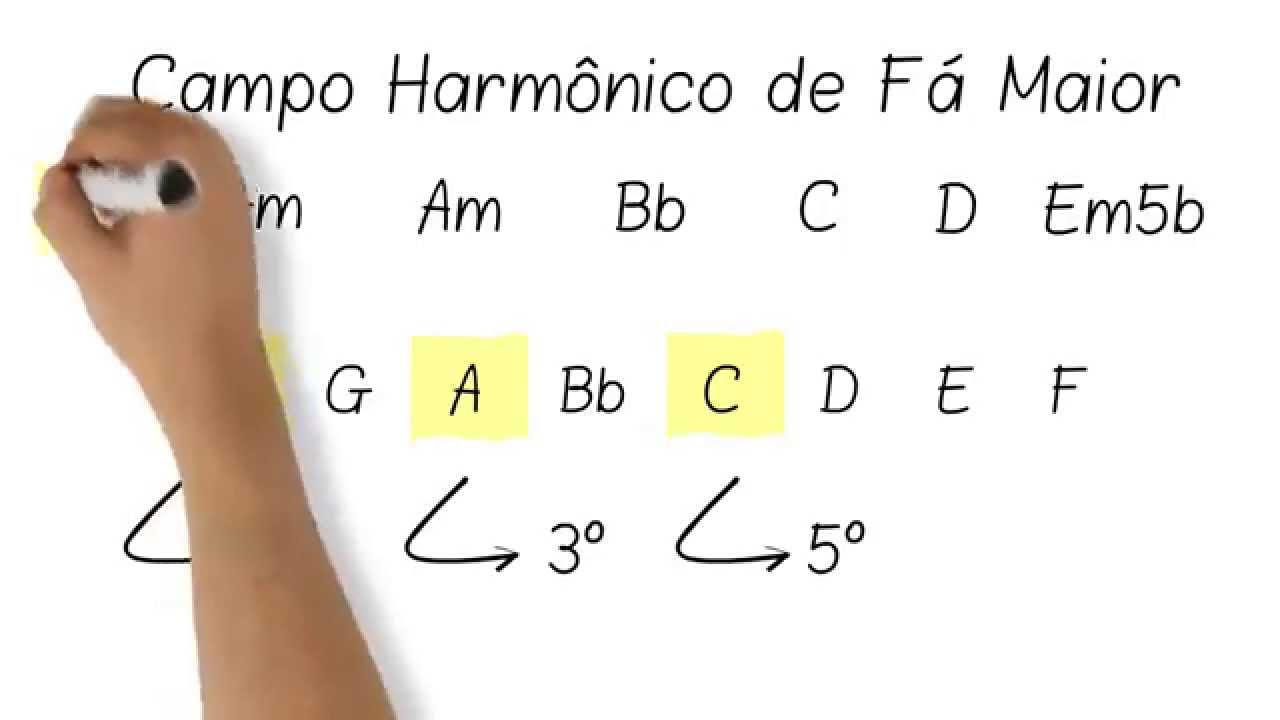
Hey guys from Cifra Club, I'm Felipe Lobo and in this class we're going to continue our course on the harmonic field of the natural major scale. We will now see what the harmonic field formed with triple chords looks like. This is the second class of our course and we also have a booklet here with all the content of the class, plus some texts and exercises for you to download by clicking on the link in the video description.
So let's better understand how the harmonic field of the natural major scale works using tetris chords, which are those chords that have the basic atria plus the seventh. Let's go. Now that we know how to find the tracks in a larger harmonic field, it's easier to bake the tetrids too.
We just need to follow the same process and add one more note separated by the tense interval of the fifth of each string. but always using only the notes of the scale in question. Thus, our chords will have a root, third, fifth and seventh, which can be major or minor in the case of the natural major scale.
That's right. So, we follow the key of C major as a model. Let's find the tetrar chords here in this harmonic field.
As we saw, in the first degree we have a major chord. C major. To locate the seventh of this chord, we will first remember which is the fifth D.
It is the note G. A third above the note G, which in the C major scale we find the seventh of the C chord. Which will be precisely the note B.
So we will have a chord with C, G, C. Which is C with the major seventh. So, in the first degree, we always have a major seventh theta, ok?
Now, there's a cool seven that I'm going to remember here so we can quickly find out whether the seventh is major or minor. You see, the major seventh is always just a half step away from the octave, while the minor seventh is a whole step away from that note. Beauty?
So, we just need to think forward instead of thinking backwards. How long will it take to reach the next note? Is it a tone or half tone?
Then we identify the type of seventh. Now let's go to second grade. As we saw, we have a minor atria here in second grade.
D minor. To find the seventh of this chord, we take the note A, which is the fifth of the chord, and find where it is a third higher here in the scale. It's precisely the note C.
So we'll have D minor with a seventh, because C is the minor seventh In the third degree, we will have E minor. Where the fifth is perfect, it is the note C and taking a third above C, we have the note D. So, the chord looks like this.
E, G, B and D. E minor with seventh. Then, on the third degree, a minor seventh chord.
Come on, in the fourth degree we also have a major triad, it's F major. The fifth of this chord is the note C. And a third above it we have the note E, which will be the major seventh of F, which is just half a tone away from the fundamental.
So, our chord has F, A, C and E. Fa with major seventh. In the fourth degree, we have a major chord with a major seventh.
Let's go to the fifth degree, the major sounding string. Well, to find the seventh of this string, we take the fifth that will be the note D and find the one that is a third above it in the scale. It is the Fa note.
So you see, between the Fa and the root of the chord, which is the G, we still have a whole tone of distance. In other words, this is a minor seventh. Look how interesting.
This fifth degree chord is the only case within our harmonic field, where we have a major chord with a minor seventh. This is interesting because it will define a function talk a little more about this function in a moment, ok? So, on the fifth degree, major chord with minor seventh.
Sun with seventh. Another very interesting thing about this chord is the characteristic interval called tritanus. See, if we take here the resulting interval between the third of the chord, which is the note B, and the seventh of it, which is the note F, We have this dissonant interval that carries a lot of tension.
It is a fifth minute interval, also known as a Triton. Well, the Triton is characteristic precisely because of this sound tension it carries. When we hear this gap, we have an expectation that it needs to be resolved.
This tension cannot stay like this. Well, this interval is also acting to give the special function that we mentioned to this chord. Because what he asks for is a resolution of tension through a semitone movement.
That is, as we saw, the note C within the harmonic field of A major is considered sensitive precisely because it wants to go up half a step and reach C again. Now, the note F in turn is the other note within this scale, which also has only the semitone interval with its neighbor, only with its neighbor behind, which is the note E. So, when we hear these two notes at the same time, what they want to do is move as little as possible to resolve this issue.
I mean, the C will go up to C, the F will go down to E. So, this is the effect of the tritanus, it is to create this tension of a sensitive pair, one that wants to resolve it by going up and the other that wants to resolve it by going down. This is what makes a fifth degree chord an especially dissonant chord, with a specific function within the harmonic field.
In the sixth degree, we have A minor here. The fifth of this chord is the note E. And a third above it we have the note G.
which is one tone away from A. In other words, we have an A minor with a seventh. The sixth degree chord will always be a minor seventh chord as well.
And the seventh degree chord we will see that that chord is also more different from the harmonic field. As we saw, in C major we have C minor with a fifth of a minute. Well, the fifth minute of this chord is the note F.
a third above it, we have the note A, always thinking within the reference scale, which here is the C major scale. Well, the A in relation to the C is a minor seventh too, it is one tone away from the note B. So we have a minor chord with a minor seventh and a diminished fifth.
This is also a chord called half diminished. Which is different from the diminutive tetra, which is the one that is sephred with the little ball. The diminished tetra needs a diminished seventh.
It's a special type of interval that this chord has. In the case of half diminished, it is a minor seventh. It is a more common range.
So, on the seventh degree of the harmonic field of the major scale, we will always have a minor seventh chord and a diminished fifth chord. OK? I'm going to play for you the sequence with these 7 tetrad chords that we built as part of the C major scale.
Let's listen to see how it goes. The second exercise in our postila will work precisely on all this information that we just learned. So it's a good idea to take a break now and do the exercise to capture this content well.
Well, it's time for us to know an example of a song made only with chords from the harmonic field of the natural major scale, using tetrads. We will first listen to a little bit of the song, which is a big hit by Tim Maia. Note that the harmony is simple at the same time, because it will only use chords from the same harmonic field.
However, there is something sophisticated about it because it uses tetrad chords. See how the presence of the seventh in the chords causes this effect of sophistication. Let's listen to a little bit of the song.
I liked you so much, Tim Maia. I know why you were there How much I missed you gave meaning And I will live with sadness That atheist couldn't give You marked my life You lived, you died in my story I liked you so much I liked you so much Well, then let's look at the song part by part and understand the role of each chord. We start with the introduction of the song with two chords.
The first is A major seventh. Well, this is the easiest, right? It is the tonic chord, the first degree of the harmonic field.
It's important that whenever we put the seventh in the first degree chord, it's a major seventh, ok? So, A with major seventh. And then comes the B minor seventh.
Cm is the second degree in the harmonic field of A, but here we will use the minor seventh, because in minor chords, within the context of the major harmonic field, we will always use minor sevenths. Cm7. Then we go to the first part of the song that will repeat these two chords.
And then in the sequence we do the C tenido minor with a seventh, it will be the third degree chord, which is a minor chord also with a minor seventh. Okay, because the song returns again to C minor with a seventh and repeats But when we go back to Cm7 it will share the measure with another chord, which is E7. This will be the fifth degree chord of our harmonic field.
If we remember the triads class, we also used a song in the key of A major, which also used the fifth degree, E major. But here it comes with the minor seventh. This is important for us to try to memorize.
In the fifth degree chord we have an exception within the harmonic field. It is the only major chord that will use a minor seventh. This will give it a special sound, because it helps it to be a more tense, more dissonant chord, which gives it the power to attract the first degree chord back.
We're going to talk a little more about this power of attraction that the fifth degree has in the next class, cool? Then comes the chorus of the song, right? The chorus will basically use the same sequence that we have already seen, only instead of going to the sweet tenido it goes back to the first degree, A major.
And then the song repeats exactly the same sequence. So, we saw a good example of how to use the harmonic field of the natural major scale with tetrad chords. We will see this type of harmonic context there, a lot in MPB, Bossa Nova, Jazz also has tetrad chords, even agreements with more notes, which is very common in these styles.
Nice. So, here's some advice for you to look for songs in your repertoire so you can understand the application of chords in the harmonic field of the major scale with tetrads. Well guys, this was our second class on the harmonic field of the natural major scale, where we saw the use of tetra chords with major internalities.
Now that you know the theory and have seen how it applies in practice, the cool thing is that you analyze the songs in your repertoire and try to understand the meaning of each string within the context of the song's tonality. In other words, this knowledge will only really assimilate for you as you make use of it, pulling out the songs you like to play and even making your own songs with this issue in mind. Cool?
If you have any questions, criticisms or suggestions, just write to us here. A hug to everyone, good sound and see you next time.









![[segredo] ESCALA FINGERTYLE - Como tocar a melodia e os acordes em fingerstyle!](https://img.youtube.com/vi/8uCGDqF-dT8/maxresdefault.jpg)


![[aprenda] Como usar o Campo harmônico na Pratica!](https://img.youtube.com/vi/kRhA3SQcFmY/maxresdefault.jpg)