[Music] today's show is brought to you by nasdaq asset owner solutions nasdaq asset owner solutions is a technology powered ecosystem that delivers transparency and decision support throughout the investment life cycle by uniting e-vestment the industry's most comprehensive institutional data with solovus which delivers true multi-asset class Portfolio analytics see why over a thousand asset owners and allocators around the world from the world's largest sovereign wealth funds to single-family offices and everything in between rely on nasdaq's comprehensive data award-winning technology and expert services for managing their portfolios visit nasdaq.com asset owner solutions for more information Today's show
is also sponsored by third bridge third bridge is a widely used provider of expert interview transcripts whose clients include past guests on the show their content covers both public and private companies in any sector across all the major geographies around the world to give you a sense last year over 16 000 investment professionals from a thousand firms across private equity public equity and credit downloaded Approximately 500 000 interview transcripts from third bridge forum each of those transcripts covers a one-hour in-depth interview between an unbiased sector analyst and an industry executive i've seen the platform and
the coverage is incredible ranging from mature mega caps to leading edge innovators like stripe and spacex to thematic topics like crypto exchanges and alternative energy in china to just about everything In between third bridge created this category of research and has by far the largest content platform available if you're an asset manager or capital allocator looking to better understand your manager's positioning visit thirdbridge.com capital for a try [Music] hello i'm ted sides and this is capital allocators this show is an open Exploration of the people and process behind capital allocation through conversations with leaders in
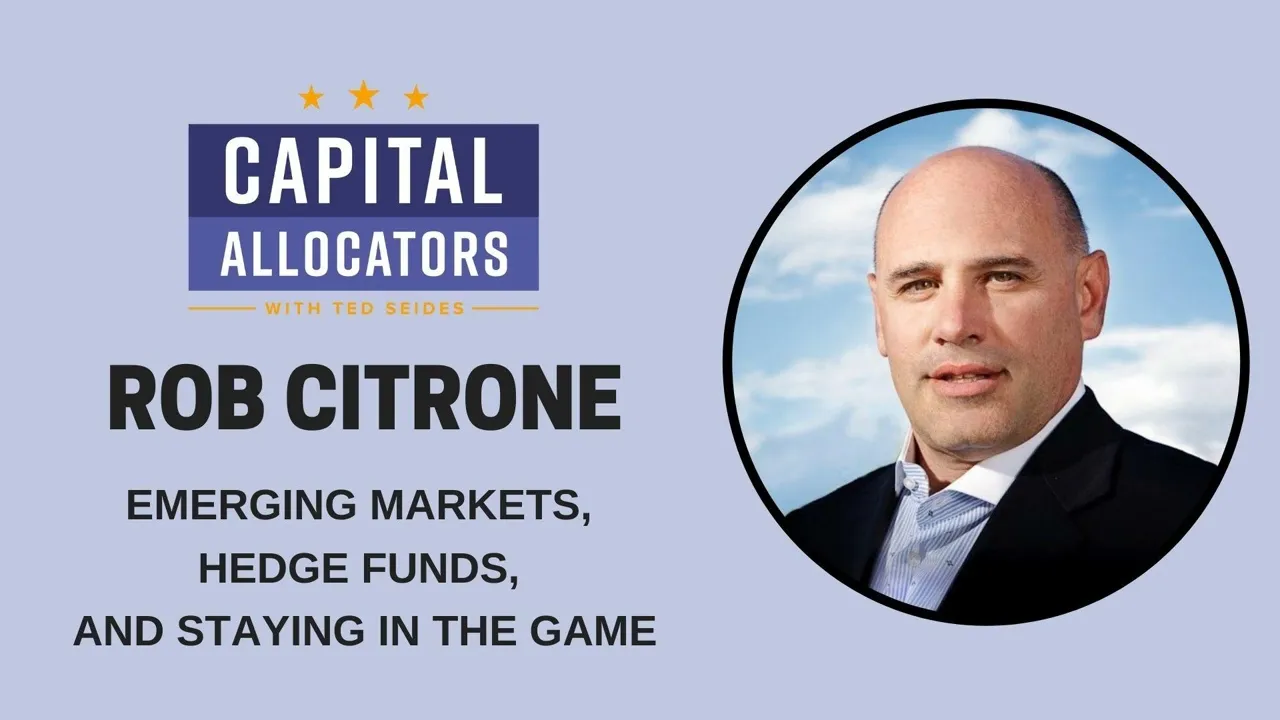
the money game we learn how these holders of the keys to the kingdom allocate their time and their capital you can join our mailing list and access premium content at capitalallocators.com all opinions expressed by ted and podcast guests are solely their own opinions and do not reflect the opinion of capital allocators or their firms This podcast is for informational purposes only and should not be relied upon as a basis for investment decisions clients of capital allocators or podcast guests may maintain positions and securities discussed on this podcast my guest on today's show is rob citron
the founder of discovery capital management a 2 billion global hedge fund investing across equities fixed income currencies and rates with a focus on emerging markets Rob is one of the longest standing managers in the space and the largest investor in his fund he trained under julian robertson in the heyday of tiger management in the mid-90s before launching discovery in 1999. since then the firm grew to a peak of 15 billion dollars in assets and despite the subsequent reduction in aum he and his team of 42 are still going strong our conversation dives into robb's Background
lessons he learned from fidelity julian robertson and george soros and the launch of discovery we discuss his investment strategy research process perspective on markets around the world ups and downs in the business and managing an organization through change rob doesn't often share his insights in the public forum so it was a real treat to get inside the mind of one of the best in the business I'd like to invite you to attend a special boot camp on decision making i'll be teaching on july 20th at 11 a.m eastern i'll share actionable frameworks with special clips
from annie duke the legendary decision-making expert best-selling author and former professional poker player the one-hour webinar is one of the most popular classes of capital allocators university and is chock full of insights To take back to your team in the investment office the cost to attend is 250 and capital allocators premium members will receive a 50 discount if you're interested in attending and are not yet a premium member you may want to consider subscribing first and receiving our library of transcripts weekly email and a whole bunch more for effectively half off the first year of
membership Log on to capitalallocators.com and click university to register for the bootcamp before you do that click on premium and sign up hope to see you on july 20th please enjoy my conversation with rob citron rob thanks so much for joining me oh really a pleasure ted thank you for having me why don't we go back prior to your launching discovery i know that was a while ago but would love to hear your Investing background how you first got the business as a little kid growing up i wasn't really familiar with investing very modest routes
but i had a lot of odd jobs and started mowing grass on 12 years old for like a buck and a quarter an hour saved my money just put it in the bank and then of course that was in the late 70s then and all of a sudden interest rates got double digits so i put my money into money market funds and Then after a few years those went to 15 16 yields and then yield started to fall and so i started to take my money and put into mutual funds and then i started picking
initial stocks and i'm just doing this on my own and i really loved it so i knew i want to get in the investment field i didn't really know anything about it i did very well in school i was about my high school and my college class by the time i was senior in high school i knew this what i wanted To do so i went and got a math and economics degree at hampden city college and knew i'd get my mba at some point after that but went to work for wall street for a
year at what was then first boston it was a very interesting year because the crash of 87 happened we had the latin american debt crisis i was doing a lot of stuff on latin american debt issues for first boston so that's how i got into emerging markets from there i went To got my mba at the university of virginia i was the second youngest kid in the class i had just a year of experience and then went to work for fidel investments up in boston to head up their emerging market fixed incoming currency group to
start that what an entree into the field at the time they were restructuring a lot of the latin american debt in the brady bonds and we got involved in buying some of this debt and the yields were 25 in Dollars these things performed incredibly well the countries were in kind of a boom time in latin america in the early 90s so i moved up to start managing some funds there i managed part of magellan fund for a while launched our own emerging market fixed income funds and then there was a fellow that worked with fidelity
names james lyle who worked at tiger julian was looking for somebody to emerging markets so james i got the perfect guy for you so It was about a six-month interview process with tiger was a pretty thorough process for sure i had to talk to julian a number of times talked to him about the markets what i thought and then i joined in jan 95 after almost five years at fidelity so starting in 87 getting going after the latin debt crisis both of those times markets crashed to some extent came right back and i'm curious what
you took away from those experiences Well i can remember the crash in 87 and i can remember it was one of the longest days that i ever experienced i mean i think we just stared at the screens and we just were in shock that the equity mark was down 20 some percent in a day you were like frozen but then the fed came in and just eased liquidity massively it was an interesting time to buy obviously and we could see that and feel that that's why things recovered very quickly the amount of liquidity They pumped
into the system had a huge impact i think that's very different than today because today the problem is we can't do that we've already done that now we have to go the other way i actually take liquidity out of the market even if the market will crash there's not much the fed can do because of the inflation issue so they're really caught in a difficult buying i think we're moving to the second phase of the market correction where the first phase Was inflation and the fed having to get more aggressive and way behind the curve
just to catch up and they still haven't caught up yet but they're in the process of catching up but i think the second phase is the significant withdrawal liquidity i mean if qe had a major impact on asset prices rising we've done six trillion of it and three trillion of it in a very quick period of time during the pandemic as we take three trillion out it has to have a significant impact On asset prices in my view and we haven't even started this is so different than in 87 the other thing is back in
87 the number of investors in the market the breadth of the market in the us in terms of people in 401ks it was tiny today so many people have huge amounts of their wealth in the market especially united states and so i think this is going to have a much bigger impact on the economy with the correction we're seeing than most think I think we're in a real substantial slowdown at the same time we have to tighten policy and got to keep tightening because we have an inflation problem any parallels with all the different crises
you've seen over time in emerging markets the one big difference for the us is that we're the reserve currency of the world even during times of crisis we have strengthening in our currency as a result our interest rates don't have to Go as high as they otherwise would or inflation doesn't get as high so i actually think inflation is rolling over it's just going to take longer to come down to the acceptable levels but it's rolling over it's peaked in our view the real risk on the headline is energy prices and maybe food prices i
mean maybe headline a little bit higher but core is definitely peaked it's already three months in a row year over year it's come down and even month over month Come down so we think core inflation's peaked we think it's going to come down but unfortunately it's not going to come down fast enough where the fed can stop the us we have a huge advantage in the em a lot of these currency crisis then would lead to debt crisis because the currency would devalue so much they then couldn't pay their debt it was denominated another currency
we have all our debt in our own currency so we can actually print the money which we've Done in the past and we're actually inflating our debt away right now so debt is not a big problem in the us at the moment inflation's the big issue we circle back to your background there are two legendary organizations fidelity magellan peter lynch back in the day was the number one fund in the country what was it like being part of that team well when i had joined he was just leaving moving on from managing magellan every Day
a gentleman named morris smith was managing it incredibly talented guy i got a chance to work closely with him he wanted part of the fun to be invested in em debt and it was a huge fund at the time so i was a very small part of the assets but i did that for a lot of funds in fidelity so it was a great experience i mean it was a very entrepreneurial place when i was there really came up with ideas we were very early on in the em debt and currency space when i was
There and i was kind of head of research and also managed some of the funds we had seven billion of assets in the market and at the time i think the next biggest competitor had a billion so we were very large it was a great experience for me because i got a chance of what it was like to manage large sums of money and there's some difficulties with that it makes it a bit more challenging but i also got access to all the key people in all these countries We're investing in whether it be sometimes
the president or the head of the central bank or finance ministers congress did a lot of trips over those years i've done 33 years of this now in em and i've been to argentina brazil over 52 times each for instance and china 12 times and even russia six times turkey 12 times so i've traveled the world and it's been an amazing experience and it gives me a really interesting context when we're investing In these countries going forward because i've been there i've grown up with some of those countries as they've developed over the years and
the changes were immense i can remember going to china the first time i went there in shanghai i was at the hyatt and i remember getting woken up at 3 o'clock in the morning i look out and it is like a traffic jam of bicycles i've never seen like in my life it was incredible and then you go back three years later and There's tons of cars in shanghai when they had poo dong which just weeds it was just fields and then they said this would be one of the biggest economic developments in the history
of the world and i kind of didn't believe it and then when i saw the buildings they built it was like a ghost town of highrises i was like man it was maybe the biggest development in the history of the world but it's going to be the biggest disaster and the losses are going to be Enormous and then a year later it's completely populated they were able to bring the people in force them in but it was an interesting place to be and that was just incredible so i've seen things that you never could imagine
and it gives me some pretty good perspective so i feel very fortunate to have done that over the years what was that six-month interview process with julian like back in the day it was barely legendary for his test and All these things he did in the interview process we had intelligence tests to take personality tests we had to talk to dr stern a psychologist and it was fascinating i love the investment part of it because julie and i used to talk about different investment ideas and a lot of things that he was interested in he
was always interested in brazil because we had a lot of investors from brazil at tiger he was interested in what was happening around the world back Then in the 90s the big trade the tiger had and where julian made tons of money was a macro trade he did it through individual stocks but we were short japan along the us and that was a massive macro trade it was one of the most brilliant macro trades ever and it was for a decade in the late 80s everybody thought japan was taking over the world the nikkei was
over 40 000. it went down to like 9 000. it was one way trained down while the us market in the 90s was just a fantastic upward movement so that was the key i give julian credit because we used to always mark down every quarter we'd lose 10 in japanese equities because they would always ramp the equities into the end of the quarter at their fiscal year end of march but he stuck with it i think we got a little smarter towards the end where he would lighten up in the first quarter on the short
side and then put it back on towards the end of the month but man he Stuck with that through thick and thin it was the bedrock of tigers returns in the 90s which were really the spectacular returns that julian had when you think back to the time from 95 to roughly 2000 when julian folded up the talent inside of the old tiger became fairly legendary in the hedge fund business all these people spun out what was that internal culture like i think that we were all hard workers we were all dedicated what we were doing
we All wanted to succeed but i think julian did a great job of putting people together who worked together as a team we really supported each other we helped each other we had these friday lunches where we had to come in with an idea that we wanted to present and also an idea we want to take out of the portfolio so we had to be prepared and we had to go up against one of our colleagues in a different area but it was done in a very cordial manner but in A way that people did
their homework no doubt i think the hiring process because it was so meticulous i think they hired the best people and i think that's why it was so successful and that's why i think a lot of people who've gone on from tiger have become great investors but we also learned a lot from julian you know i thought you could say two great institutions i was working with tiger but i also managed a lot of money for the soros family for over 20 years And i used to speak to george very frequently the first five years
or so almost every day and i ran what he called part of the back book for sword was whatever i could convince him to put in the portfolio he'd put in and he's huge compared to the size of the fun back then but man what a master trader george was he just had a feel for the market he knew when things were going to change and he was always so good at picking up what are the key issues one Or two things you have to really focus on he didn't focus on everything it just trade
idea he's got the key thing right didn't matter about the other things so i really feel like i've worked with one of the best stock pickers and fundamental bottoms up guy in julian robertson of all time who also had a good macro feel and then a master trader in george soros they were totally different in how they approach things but they're two things i learned from Them that they did the same the first thing is when they lost conviction and idea they got out they didn't wait around they didn't get half the position out they
just got out of the position and they took whatever the market price was they didn't i'm going to wait for a better product no because what happens it tends to go against you and you never get out of the position to get out a much worse level and the second thing they did is they always cross reference Their ideas so if i'd go to julian with an idea and he'd say okay he's on brazil let's say i want to own the brazilian real he would say well what do other investors or partners think about that
or who else can i talk to about that we'd always cross-reference and george said the same thing and the rolodexes both of them had were incredible i mean during the crisis in 07 it was in the fall and tarp had just fallen and the market was a mess and lehman had gone Down george said what do you think it's a big next problem and i said georgia's a big problem in eastern europe and if eastern europe comes down then western european bank's going to go down and then it's just going to cascade this crisis everywhere
and he said well what can we do about that i said western europe has a lot of money that they can actually lend to the eastern european countries western european banks could say they would have a standstill where They won't take the money out and the imf can do a big program for them and he says that's a great idea let's get gordon brown on the line 10 seconds later gordon brown's on the line and next day i see in the paper gordon brown has a big plan to save eastern europe and that's what transpired
so his rolodex was incredible but he would always cross-reference his ideas as many people he thought that knew something about it I learned that i try to do the same thing and it's not easy you lose conviction to get out it's not an easy thing you think it sounds easy but i think learning those two things from those two gentlemen and having that experience for those years is incredible and then the fidelity experience was fantastic as well so i'm very blessed with all that what was the impetus for you leaving tiger to set up your
own job when i was Leaving fidelity i almost went and did my own thing and then i thought you know i need some more experience an opportunity to work with tiger and julian would be a great opportunity and so let me do that i think what i really learned at tiger the biggest thing was how to short i hadn't done much shorting in fidelity that's a skill that is really a lost art these days and there aren't very many people who can short securities and do them effectively and i Think i learned a lot from
julian in that i had always wanted to go out and start my own thing and then at tiger i missed managing the actual money at fidelity i had portfolios to actually manage the portfolio pulling the trigger and making the decision that's a key thing it's something i really enjoy and something that motivates me at tiger i didn't have that i mean you're really an analyst to julian in the end that julian ultimately makes the final decision you Just have to convince them have a portfolio of your longs and shorts but you don't determine exactly when
to buy and sell them you have to convince julian to do that so i missed that so i knew that at some point i would go out and launch my own fund i left a year before tiger shut down i didn't know tiger was going to shut down but it was just a perfect time for me and it's been four and a half years there and it was a great four and a half years What were those key lessons in shorting that you earned your time there one is you've got to be incredibly careful because
there's unlimited loss in shorts you don't want to ever have any of the shorts too large but you also want to have shorts that the skew is so much in your favor like if you're long you lose 10 or 15 if you're right you make 75 or 80. and those were the best shorts i mean the best short i ever had a tiger was the thai bot we shorted a Huge amount of thai bot before the 97 crisis in thailand i can remember they moved the band stronger against us so at one point we're losing
225 million dollars on the position julian said you still have conviction this and i said julia i have tremendous conviction this is just completely unsustainable interest rates where they are the whole banking system will just collapse they can't keep it there they have no reserves left it's going to go and but About a month later about 40 percent there is where sku was really in our favor and even though we took some losses we had a huge skew in that direction the other thing is is shorts are working it's tough but you need to keep
the position on let's say you start with a three percent short it has it's only one half percent now so julian would always say well the best shorts go down ninety percent they don't get them 40 or 50 they go down 90 If you have that conviction you have the thesis especially a broken stock or a broken situation like thailand those corrections were enormous i can remember we were shorting the red chips in china in 97 98 these were companies that were in china but listed in hong kong and they had these big parents in
china they did something called ass injection they kept shifting assets into the listed entity and the chinese were going crazy about it i was like this doesn't make Any sense julian these things are overvalued by a mile i think we're down 40 on the position at one time overall and he said rob make sure you're on top of this i said julian these things are just crazy as this is going to have to stop and by the way nobody talks about the debt that they had taken to take on these assets because they buy them
from the parent company he said rob they're not going to go down 40 rob they're going to go down 90 They went down 90 and i can remember the first short i ever put on at tiger it was during the mexican tequila crisis in 95 in january and we shorted two construction companies in mexico at one point we were down pretty large on the shorts in april with the package that the treasury put together from mexico these things squeezed against us but we kept them but i remember when i left we were still short both
of those companies that were Basically bankrupt five years later julian calls me and says rob can you find any of those trebasa certificates i can't get any of these certificates and you know i need to close this short somebody's gotta have him somewhere's wallpaper or something please find me some of these certificates the first two shorts i ever put on tiger the day i left they were still there and they were essentially bankrupt companies so i'm curious how you bring those two things Together so on the one hand you've got this asymmetric risk and you've
got to be careful when you're shorting stocks on the other you're saying things as they're going down you want to keep the position on if you have conviction and i imagine if something's going to go down 90 it goes down 80 and then it gets cut in half but when these things get small they can also rip against you so how do you balance that desire to monitor your risk with the conviction that you need To press shorts i think the best shorts are ones where there's either a fundamental flaw in the business model or
is ultimately going to go bankrupt those are really the best shorts if you could find all those shorts to be fantastic a lot of shorts you can't find there can be catalysts you can correct them 30 or 40 and those you just have to know the difference between the two that's why the conviction level is so high so normally As the stock goes down conviction level might go down in terms of you said at the lower price it may not be as attractive to be short and that's true and you just have to know which
ones could have financial distress and which ones might not it's really an art it's a lost art these days you don't see as many people shorting individual stocks but i think now it's a time to be sure that individual stocks has been for the last few months and i think that's going To continue for a while so when you brought all this together discovery say 20 years ago even today you mentioned stock experience you mentioned emerging debt experience and then currencies as well and i'm curious how you brought it all together into what your investment
strategy has been we use a top-down and a bottom-up strategy where we have macro analysts looking at the macro situation and then Bottom-up individual stock analysts that help us pick the securities and i would say that we generate probably 80 of our ideas from our macro side of things but then we can populate them with securities that are much more efficient using the bottom up analysis we learned a lot from our bottom up analysis as well on the macro so they kind of feed each other and they play in beautifully one area we've always had
analysts in is in technology i think if you don't Understand what's going on in technology in this world you're at a big disadvantage even if you're just a macro investor and just doing macros so i think it's always helped us quite a bit also i find that in a lot of these marks especially in emerging markets the equity markets are really the most inefficient markets they tend not to react as quickly as the currency or the debt so a lot of times we can take advantage of that and in some of the Equity positions we
will have we will be like a basket approach in a certain country or want to be short financials or something in a particular country and we'll pick the five or six best banks to be short as an example it's important i think to do both and tiger did both i think was influenced a lot by what tiger did and how they did it and how julian did it i think it's a great model and we've replicated that for 23 years how do you think about Covering the world across asset classes in a competitive landscape and
everything that you're doing is something i know you've done for a long time i've always marveled at your ability to stay on top of everything that's happening i think a couple things one is you've been doing for 33 years you have a great context and a lot of experience and the other thing is just the network i mentioned julian and george's rolodex i think that My rolodex into these local key players and a lot of cases policymakers a lot of these countries is very important and so there's a lot of times that things aren't interesting
like for instance latin america toss has been interesting for the last decade to a large degree there's been not a lot much to do and we actually think now going forward it might be very interesting so i can easily pick up the phone or go and travel and meet people that i've known For years and kept in touch with they can get me up to speed very quickly and what's happening either in argentina or brazil or mexico and my analysts have also been following it on a continuous basis so it's a huge advantage to be
able to have more tools in the toolbox and then be able to go to that toolbox when it's interesting either long or short so we'll then hone in once we find a few things like for instance we think maybe the best short in the world is Turkey right now um turkey cds has gone from about 400 overnight to 800 over we think it's going well over a thousand the country is gonna experience a traditional currency and credit crisis as we've seen in em with really bad policy if minus fifty billion in reserves they've spent the
entire deposits in the banking system for the individual it's been spent people in turkey don't understand that their dollars aren't there anymore the market Isn't fully aware of how difficult the situation is inflation's now running away in turkey 70 80 percent they still intervene in the currency at some point it's just going to blow up so that's a great example where we're spending a lot of time on turkey where six seven years ago we were doing nothing in turkey but having been to turkey have a lot of contacts there and it gives us a big
advantage myself plus my team my team's been around for a long time and a lot of Experience in these markets so we're going to take a quick break from the conversation to tell you about visible alpha visible alpha built a platform in partnership with 160 brokers to analyze consensus data and financial metrics on over 6 000 publicly traded companies globally visible alpha extracts data from every line item across sell side models so you can better understand expectations on Metrics beyond just revenue and earnings without having to dig through models one by one try visible alpha
for free by visiting visible visiblealpha.com ted and now back to the show how do you think about constructing a portfolio across all these markets and different asset classes i start by thinking about what do i think overall about the markets and risk in general what do i think direction of equity Markets is what i think directing the dollars what's the direction of interest rates from there i begin to populate the positions by where i think the weaknesses are or the strengths are over my investing lifetime the us has definitely been the main place to have
your capital it's been an incredible place to have it beyond any others by far china rivaled it for a little while i think that's really changing today what i see happening in china is very Concerning to me i see a leader that is all about power i think the economy is secondary and he doesn't understand that he may be destroying the long-term growth prospects for the country if he stays in power which he looks like he's going to and he's got the same people around them the same advisors i think china is going to ultimately
become uninvestable market there's a lot of private equity money global money stuck there and they're the largest component Of the em emerging market equity index over 30 so there's tons of foreign money in china and i think this is a big big risk and i think the whole key will become what happens in the leadership decision at the people's congress later this fall two things i'd love to know about the rest of the year one is what happened to ukraine russian war which i still think remain a quagmire unfortunately but there's a resolution there that's
a big event for the world And for markets and the second thing who is going to lead china and what does the standing committee and the advisors look like going forward i think those are the two most important questions to know from an investment perspective for the remainder of the year given that view on china pretty bearish what positions do you take well we think the currency in china is a great short so it's one of our larger positions we're short the cnh we do have Some individual equity shorts there we've been short china since
august last year but we have tempered it at the moment because there is a chance that g doesn't get the second term which we think is maybe a 15 chance and also a chance that he does get it but with a lot of reformers around him and in that case i wouldn't be bearish on china i think it actually could be positive but if the current situation continues and we have the same kind of advisors and Same kind of standing committee and the reformers really aren't there then i think china's in serious serious trouble if
your views on china play out over the next period of time what does that mean for the rest of the world markets i really think that we're in a process of moving to a massive cold war of the west against china and russia i think that's terrible for returns and nasa prices and it's really bad obviously for chinese assets obviously russian assets already Decimated that's not going to change but the interesting thing is if something were to change in russia if there would be a regime change or a big shift in what they're doing there's
an opportunity investment of a lifetime in russian assets these things are so depressed and i saw it happen in 98 a lot of the oligarchs around today and a lot of wealth generated happened after the 98 crisis they bought their companies for a song they're even Cheaper today and i saw some stocks trading right before they froze them in london and the us some of these adrs and gdrs trading at valuations that you don't want to support that regime but these things were trading at 199th of where they traded six months ago they're dominant companies
in their country and some of them are dominant companies in the world in terms of energy just a small amount of investment in those stocks that some people can retire on it Because you're going to make 50 times your money on any regime change in a very quick period of time so there's some tremendous opportunities going to come out of this but it really is a problem for the world and a problem for this globalization which was so prosperous for so many countries and so many people for so many years i think is now unfortunately
going to reverse and i think this is going to be lower growth higher inflation and just a really tough Environment if things don't change we'll have to see what happens in october november but i'm very nervous about the continuation of the current regime and i think it's really a disaster are there countries around the world where you're bullish today yeah we're certainly bullish on the u.s long term we're bullish on india we think india will be the new growth country of the world they've done a lot of reforms over a long period of time there's
some Political risk if something happens to modi i think he's been great but i think it's ingrained now in the country i don't think they're going to go backwards and it's a big market the english language is a very helpful thing the rule of law there is very good that's the country that we have huge long-term interest in as i mentioned before i think latin america is going to recover dramatically i think brazil's been in a 10-year recession first time i Can ever remember in my 30 years of an election in brazil where the political
risk really isn't rising very much in fact it's pretty stable because both candidates are known and more towards the center ones on the left little bit ones on the right but they're not that far from center brazil i think has a great opportunity with commodity prices where they are with a very responsible congress we've seen in place in brazil now for a number of years and i think at Least a reasonable either continuation of bolsonaro or lula coming back probably lulu one night with a two in our view and he wants to be the candidate
of the mark and he's mentioned that privately to people that we know we think brazil can be a fantastic opportunity and we think there's very depressed asset prices there you want to make money on rates coming down ultimately inflation is peaking well you can try in the u.s at three and a half Percent rates or you can go to brazil where they're 14 instead of 100 basis points you can make 800 basis points so that's something we're pretty excited about in the future and the equities there as well and the currency is incredibly competitive and
you get 12 net yield down the brazilian currency as an example even argentina which is a basket case right now gonna have an election next year we think they get a real significant change to Market-oriented policies and we think the country can recover very quickly next year might be the best performing market in the world on the back of that election how about africa it's so difficult to invest because there's been so much political uncertainty and political chaos in the countries you would think with commodities strong in that there would be some great opportunities there
but it's just very difficult to find those And i think you can play them through western companies that have operations in africa and that's probably the best way to play it i just think the stability of the government suggests has been so poor and south africa had some bad leadership and they're trying to come out of a real hole that the past president put them in but i think they're really behind the eight ball ones not very constructive on that we don't really see much in africa Unfortunately with all the stimulus we've seen around the
world over the last bunch of years curious your views on sovereign debt markets for a while we've felt that any developed bond market didn't make any sense in fact they were generally good shorts and we were short most of them unfortunately covered a little bit too early i don't really like any of the developed sovereign yields here in fact i think one of the best opportunities in The world quite frankly is in japan where they have the ycc program where they have 10-year rates pegged to 25 basis points 0-25 there's no way that's going to
hold in this environment that's one of the best fixed income shorts in the world today we may not make 100 basis points but it's 50 or 75 base points being made in the long end on the short side there 10 years beyond you mentioned earlier the importance of paying close attention to Technology i know it's something you've been involved with for a while it's certainly changing a lot in the current markets and would love your perspective on different technology investments today technology is still a fantastic area to invest in going forward but i still think
that multiples are still too high for most companies anytime a company's still being priced to sales or they're talking about the tam i want nothing to Do with that company probably a short so i think there's still a lot of pain to go in that area and i think qt and the recession and i think it's been all moderate sessions interesting recession where it's not a service recession actually things like trial will do very well usually travel is terrible in a recession i think it's going to do very well because there's so much pent-up demand
there i think it'll be a mild recession i think we'll be there very Quickly by the end of the early next year in the u.s but also it's going to be somewhat of a global recession i mean maybe china if we get an okay outcome at the people's congress and china will recover some next year from an economic perspective because of what they've had with the coven i think technology is going to be one of the areas in the next year is going to be very very challenged probably a lot of good shorts are coming
out of there so we don't really find Much in technology on the long side at the moment but i think long term we have to be there i think it's it's really just a fantastic long-term opportunity i'd love to hear your views on developed europe well i think europe is in serious trouble and this ukraine russian situation has just made it worse i think europe is if not in recession now being recession within a few months the fact that you got 14 different countries in The euro and they all want different policies and just makes
it so difficult and i think it's going to be very difficult as they have to hike interest rates here and you're going to see also protect it but it's not that easy because of the rules and the laws so i think we might see an accident in europe in the next 18 months or two years as they try to come out of this big problem with the russians and this energy problem is huge their natural gas prices Are six times what they are in the united states the manufacturing facilities they're not competitive they need to
shut them down how this gonna work i don't know they need some resolution to the ukraine russian situation as fast as possible otherwise i think europe is in really serious trouble what's your favorite way to play it i think ultimately there's gonna be a fantastic short in italian debt i don't think it's yet next year is a very Important election in italy i think you could have a real blow out and spreads there and something could crack in europe so that's something we're watching very closely we're currently short the dax there's no energy companies there
and a lot of big industrial companies and as i said the energy situation is very difficult for them i think you're going to see significant misses in the earnings the dax as a whole right now the dax we Think is the best way to play the situation in europe i'm really curious to ask you about portfolio management around all these different ideas and themes that you have how many positions do you typically have on at any point in time we have probably about 10 themes on at a time and then each of those themes may
have 10 to 15 positions so we're between 120 to 150 positions actual individual securities may be larger than that because we'll Take baskets for instance if i'm short banks and turkey i count that as one position and maybe five different banks and it sounds like you've got a pretty bearish view overall i'm curious how much you'll tilt your portfolio on a net basis either long or short well we'll get to 20 25 net short if we really get incredibly concerned and that's in equities air credit currencies or rates could be significantly more short they're just
not as volatile we think of It equities of all is the highest and then credit is about half of that and the currency is about a third of equity of all generally speaking i'd love to take a step back from the portfolio and talk about your views on the hedge fund business you've had a really interesting evolution over these 20 years share your experience on the ups and the downs and everything in between i think it's a unique experience i launched the fund at 99 right after russia tremendous Opportunity to invest at that point in
fact the turkish equity market in the month of december in our fifth month doubled the market doubled the whole market doubled we made 22 that month on a net basis but nobody want to invest because they were like oh i just put the money in the nasdaq that was right before 2000 just goes up every year by 25 or more we started the fund with five million dollars with one million fee pay money four of it was mine you can't Start a hedge fund today with five million dollars then we grew with a lot of
performance but also brought in assets and i think at our peak we're about 15 billion so a little bit too large grew too fast too many people i diluted our ideas and due to my time i'm very cognizant of that so we now have a much smaller team very experienced we only have our best ideas i'll never get back to that kind of size it's just too large in these markets and quite frankly Liquidity is worse today than it was 15 years ago 10 years ago even it's a great business it's a wonderful challenge get
some of the most talented people in the world doing this the fees are lower they're going to be lower but i think hopefully in these tough markets in the next couple years that people will see that hedge funds have a place that it's a great investment vehicle we've gone through ups and downs and i love the business i love what i do every day i Feel like i have a front row seat to the world the amount of contacts and insight and things that i have whether it be ukraine russia or china or the u.s
even argentina brazil turkey it's pretty phenomenal i love it and i think you have to love it to do this business well and to stick with it i'd love to hear a bit more about the things you've learned along the way and how you operate the problems i had too many people to communicate with and i had a lot of People who would communicate with me when i should be communicating with others so that was the hard part the other thing is that as i mentioned before with george and julian used to cross-reference all ideas
outside the firm so when you have too many people at the firm you don't have enough time to do that what we've lost for a few years was i didn't communicate enough with all my other outside contacts and so i need that time to be able to do that so the Smaller team helps me with that my team's incredibly valuable in putting the ideas together and helping me come up with the ideas and refine the ideas but then i need to verify them outside as much as i can i really work quite a bit we
do things globally obviously so we have a 24-hour trading desk i get woken up at three o'clock in the morning every night and half for 23 years i see the close of europe i see the open of age it really gives me an edge i can Feel what the markets are doing a little bit we do some trading around that in a fair amount it's been very helpful over the years but i'll communicate with my analysts mostly verbally i like to see them in person when i'm in the office or do a zoom if i'm
not but i'll also text and email technology is so much better today it's so much easier to communicate with your analysts on a frequent basis if you need to but again i think it's really important to try to not get group Think within the organization to be thinking and talking to people outside the organization that also look at these markets in these positions and see what they think what's their view and how are we different why are we different and what is our competitive edge and do we have an edge who are your favorite people
to talk to on the outside cross-referencing i like to speak to a lot of the senior people in some of these leadership roles Whether it be economic ministers in certain countries or central bankers very very thoughtful central banks talk a lot to each other i never really understood how much they do speak to each other especially now through the bis they meet quite frequently and they do share ideas and thoughts that's always very helpful to me i have a lot of outside consultants people i think over the years that have been very thoughtful on different
countries or Regions or topics like i have from the fidelity day some i have from the tiger days and some we've developed a discovery a lot of them are paid consultants some of them are friends and then i like to talk to other managers a lot of my ex tiger guys that i worked with people i've worked with the fidelity and people i've met along the way i like to talk to people who are actually in the markets and looking at different things and some of them do Individual stocks some are macro people some of
them are currency but people that i respect for that i think do a good job and have been in the business for a long time how do you go about balancing your own independent views with the views and positions of other people that you respect when you're doing that cross-referencing and i'm particularly thinking about crowding for example on equities in the hedge fund side i think That was a bigger issue when we were larger and needed really big ideas now when i look at my portfolio our ideas are so different than other people's ideas i've
went through my top 10 longs very few hedge funds would have any of the names i have in the top ten the same thing on the short side so i don't really think it's an issue anymore maybe in 2013 14 15 that period of time is a bigger issue but today we're doing so many independent things so many Interesting things because we do a lot in em and other places a lot of the managers that i speak just don't do much there or if they do it if i'll talk to a currency guy he may
have one or two currencies that i have on it's a very eclectic portfolio in a way and an eclectic group of people that i speak with so that crowding issues not anything that i see is an issue anymore what's been the difference between the analysts that are still with you today In their talent and abilities compared to the ones that you decided to cull when you had to they've proven to be able to make money in different environments it's also a dedication there is a high correlation between hard work and success those who work the
hardest put everything into it into massive priority for them these are the ones that tend to do the best and they're never satisfied they're always searching for the next best idea and the Thing that julian always used to say and something that we try to do with discovery and emulate that is we have good ideas but we want to replace the good ideas and better ideas so we're constantly looking for better ideas to replace the good ideas that we have so the ones that can do that effectively and also a good analysis has been to
change his mind the worst analyst is the one who just gets dug in his position and just says okay no no no even though The facts have changed my view hasn't changed that's the dangerous analyst being able to change your mind is a very valuable thing in this business you have to be able to do it so with this 24 7 trading around the world in markets that are open all the time for 20 30 years how have you gone about sustaining your energy to do this on such a difficult schedule i have some diversions
outside of the business that i love i'm a huge sports fan um big fan Of pittsburgh teams i'm a pittsburgh steeler fan that's a great outlet for me i also enjoy my kids and my family playing golf make sure i go out and do that on the weekends i think that's important i try to stay very healthy stay fit i eat better now than i used to eat i get my blood tested every quarter and have different supplements and things like that that i take to make sure that everything's in balance and so i actually
feel better with more energy Than i've ever felt so using medical technology to be better and to be more fit and healthy have you been able to sleep i think you develop that i mean i can sleep anywhere at any time i can sleep on planes i can sleep anywhere no problem and then when i wake up i'm very alert and i can operate for 10 or 20 30 minutes and then go right back to sleep i think i've been able to develop that over the years the key is the first Three and a half
hours that you sleep so i always try to get to bed before 11 30 because you need that first three and a half hour rim sleep if you get that three and a half hour rem sleep studies have shown that you'll be much more rested and sometimes if you're not disturbed in that first three and a half hours that's better sleep than seven hours disturbed in the first three and a half hours they can call me during that time but not very often and it's only if It's something really big happening we've seen a lot
recently maybe we saw a little bit no 9 and increasingly hedge fund managers that had great success assets were large and then had a contraction assets and as you said folded up to go from where you were at the peak some years ago 14 15 billion to still real money but say 2 billion today what was that like in terms of what you had to do to the organization to keep going we had the right size organization But we did it in a very thoughtful way we didn't just cut people across the board anybody that
we had to let go we tried to help them any way that we could and find something new and i think we did a really great job of that i'm very proud of that what we did is just go to the key people that i felt were the most important in the lifeblood for discovery and give them packages that would be attractive enough for them to stay and the opportunity going forward i think We're very successful in doing that i had to take a lot of money out of my own pocket to support the organization
for the last couple years but i'm glad i've done it and i think we're in a great position going forward from there i see a lot of these funds i don't want to pick on anyone fun but there's a couple of them that have had a bad year about two years after like you said strong performance and they just close it up in fact want to close it up and start it Again and get rid of the high water mark and support the organization my own resources but the other thing we did in 19 we
thought we had a really bad year we get back our fees to our investors i basically said look i think we just did the lousy job i feel terrible about that i don't feel like earn any of my fees anybody who stays i'm going to give credit back your management fees instead of closing down i think we distinguished ourselves by sticking with our investors We made their money all back and more in less than a two-year period i'm very proud of that that's the way we operate and we cherish and value our investors tremendously when
we lose money and don't do well i really feel for my investors that's the hardest part of the business so as an investor in hedge funds what do you think those innate characteristics are that you have that some of these other people that haven't chosen to continue when they're down That you might be able to anticipate ahead of time like i said you have to love what you do you have to do it for the right reasons you do it because you love doing it not for the money all of us are highly competitive but
i really value the track record the integrity and the trust that investors have placed with me for so many years i just think that would be so disappointing to photo shop during difficult times the other thing is i was a big wrestler in junior High in high school and there's a lot of tough times in your wrestle and you're also some really pretty good wrestlers that are more experienced you're a lot stronger and you always battle back that experience has been fantastic for me i came from very humble beginnings my grandfather was a coal miner
outside of pittsburgh and he went black young when i was born so we had to move in with them and he couldn't obviously work in the mines anymore and so they baked Italian bread my dad helped distribute it to the town and get the clients and that and we didn't have enough money for a crib so i slept in a drawer you come from that this other stuff is not so difficult i feel so blessed so excited for what i do every day i think that's what you need tenacity you got to feel really responsible
for your investors you got to feel like it really is on your shoulders and you really want to do well by them curious what you think your Business looks like over the next couple of years well i think it's going to depend on how well we perform as i said i think it's going to be tough markets it's possible the markets may bottom the next six or seven months but probably much lower levels than here so how we can navigate that next 18 months to two years i think would go a long way to determine
what the business looks like two years from now rob can't let you go without asking a couple of fun closing Questions so what's your favorite hobby or activity outside of work and family probably playing golf with my friends we play a game called wolf which adds a little bit of wagering into it maybe sometimes it's a little wagering a little golf along the way what's your biggest personal pet peeve i guess people that are really full of themselves that kind of bothers me i think it's one of the reasons that we live in disney we
live in disney you're Pretty down to earth i want to enjoy life and want to do good things for others so i think those who are fool themselves and don't help others i think this might be my biggest pet peeve how about on the investment side your biggest investment pet peeve short term focus i'll get tons of questions like how come the last three weeks this or that or what happened three months ago in april time to me is a continuum and i don't think about it In short-term months or days or weeks we give
weekly performance i mean i think that's kind of crazy but we do it because our investors require it and want it and so we want to provide as much transparency and everything we can to our investors that they require but i think it's the short-term miss of people's views it's impossible to manage money on a short-term basis which two people have had the biggest impact on your professional life George soros and julian robertson what's the biggest mistake you made and what did you learn from it in 2019 we had two large positions that were required
regulatory issues in the us and the us government to make certain issues and under the trump administration things changed dramatically and they were never consistent so we had two ideas i think were great ideas well researched i think we knew as much about them as possible but the regulatory things changed and They changed the rules of the game on us and we lost a fair amount of money and they were big positions positions were too big we're betting on regulatory things the size in terms of liquidity we want to change our mind it made it
very difficult to reduce the position so i learned a ton from that how big was too big in terms of position size between 10 and 15 what teaching from your parents has most stayed with you Always do the best job you can do no matter what and treat everyone doesn't matter who it is like you want to treat yourself last one what life lesson have you learned that you wish you knew a lot earlier in life change is really a positive thing sometimes we all are afraid of change when i've made changes they've generally been
very positive things we should never be afraid of Change from change comes growth i think it's a great way for one to grow i think i would have made more changes along the way always insightful always a pleasure thanks so much for taking the time my pleasure ted thanks a lot thanks for listening to the show if you like what you heard hop on our website at capitalallocators.com where you can access past shows join our mailing list and sign up for premium content have a good one and see you next Time [Music]