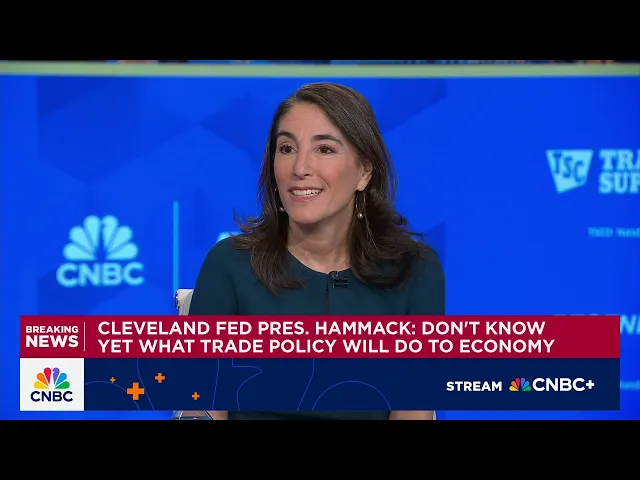
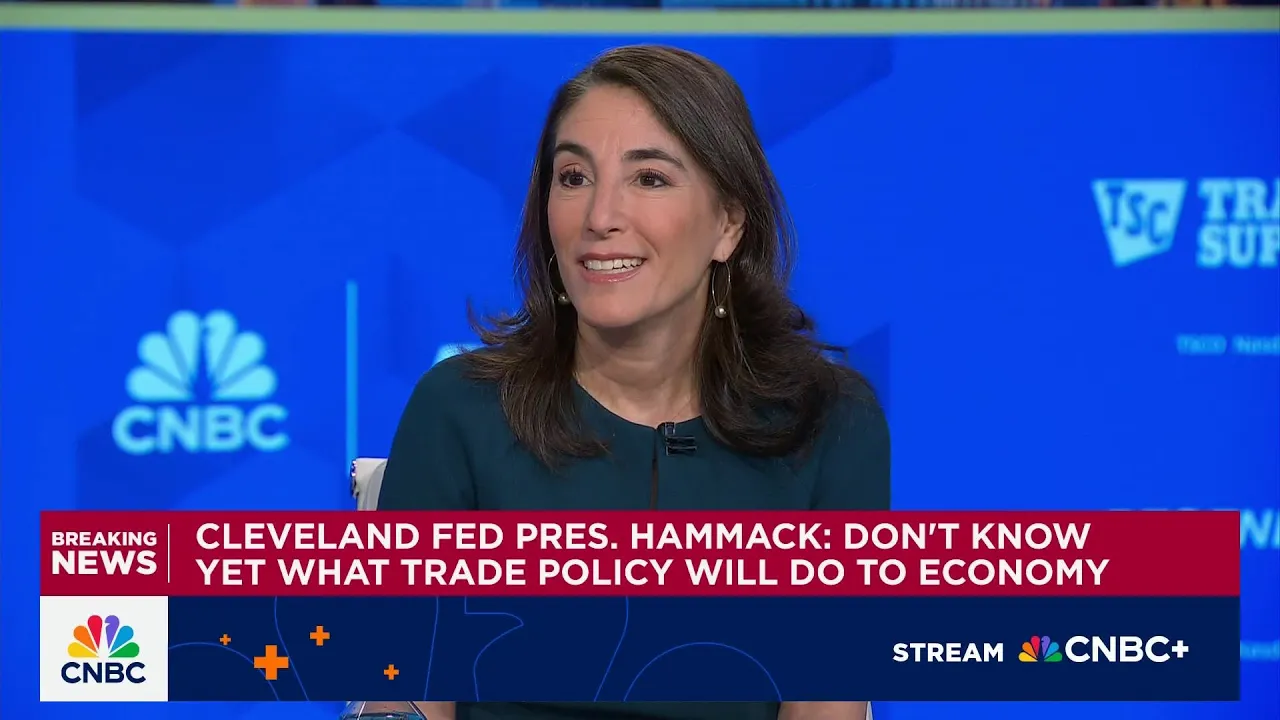
we are pleased this morning Becky to be joined by Beth Hammock the new Cleveland Federal Reserve Bank president uh ex of Goldman and all kinds of fun things welcome your first television interview welcome to the conversation I'd like to say thanks for having me so let's start right away let's get into it the morning the durable goods number came out um up 0.1% on the investment side what are you hearing about how the change of policy is affecting the companies in the context you're talking to well thanks for having me Steve it's great to be
here one of my favorite parts of the job of being Cleveland Fed President is going out in the district and talking to companies talking to businesses and understanding how they're thinking about things what we're hearing right now is that the uncertainty is really weighing on businesses and it's creating uh issues for them in terms of planning in terms of thinking about where they're going to go and so some of them have put pauses on whether they're going to make bigger investments whether they're going to invest in new facilities new capital plans um and then they're
thinking about their hiring plans are thinking about their labor force and do they have the people they need how many people are they going to be able to keep on for what length of time given what these changes might do for their businesses what what is the macro effect of this if if people hold back now what does that mean for the economy now and what does it mean for the economy in the future it's a great question we don't know the answer to that i wish I had a crystal ball we don't have one
um I think everyone is trying to work through what the implications of these tariffs and these policies are going to be how significant the tariffs are going to be how long they're going to stay in place and if you're looking at building a new facility building a new plant because you want to bring back production into the US you need to have confidence that those policies are going to be in place for a long period of time can't just be two or four years it's got to be 10 20 30 years to get that capital
investment to make sense when you put it all together there are people torched slack from Apollo other uh uh uh JP Morgan as well they say if these policies stay in place there are 60 70 80 torsion even 90% chance of recession what's your outlook i'm not really operating with a base case right now i think the cone of possibilities is so wide when you say base case that means you have no sort of uh odds on bet in in what you've I have I'm looking at scenarios trying to I'm trying to break the world
into different scenarios of what could happen if we see businesses really start taking um the tariffs and start it impacts their import their input costs and they have to raise prices significantly if we see pricing going up a lot but we don't see an impact on growth or labor then that could be you know inflationary but it could be like one of my colleagues says that the tariffs could be just a change in the price level and that it's not going to be persistent and it could be that we see actual you know weakening in
the labor force weakening in growth and that would require a different set of policies and it could be that we have the two sides of our mandate in conflict um which is the most challenging for monetary policy if we see higher inflation and lower employment that's where we that's where things get really complicated h how long do you think it will take you to kind of sus out which one is the more important because my guess would be that you'll have someone in the Oval Office who is watching very closely when you all meet next
month to see what happens is it is it crazy to think that it's too soon or is it crazy to think that that decision could be made by that point that you will say okay we know enough about what's happening here so I I think it's too soon i think we need to be patient i think this is a time when we want to make sure we're moving in the right direction than moving too quickly in the wrong direction and so I would rather take our time make sure we're looking at the data the hard
data that we've come into this quarter with are actually really good you've got unemployment right around 4.2% that's right around full employment inflation's continuing to come down right around 2 and a.5% on PCE so we've seen good things in the hard data the soft data is more concerning a lot of the surveys have shown more worrisome more uh you know more struggling with you know exactly what things are going to mean we're seeing that in the Beebook that came out yesterday you're hearing a lot of focus on tariffs and uncertainty and so to me this
is a good moment for us to take our time and make sure we're moving in the right direction you've seen that this is not a Fed that's afraid of moving quickly if we need to move quickly and so if we have clear and convincing evidence by June July September afraid to move preemptively that's the thing and I know how hard it is but but saying I want to wait and see let's say the tariffs and we've seen when the market stock market acts a certain way it seems like the tariffs are become less certain that
they're going to be here for a long time so on the one hand you say that the you might not get to the second derivative it might be a oneshot deal we might not even get the oneshot deal we might not even get that but we do seem to have a lot of uncertainty i I think I I can already say I think the risk has shifted much more to to a grow growth risk than inflation where we had some really soft inflation numbers already if you really want to be preemptive and be the greatest
Fed in history to actually anticipate something instead of reacting to it you would cut soon um did I convince you you you're going to vote for I'm not voting this year so it's an easy next year next year we're voting again um look I think the Fed has proven that it can be preemptive and it will be preemptive when it's clear what the right action is when did they prove that in 2020 i think in 2020 when you saw the onset of the pandmic though oh okay when you saw the onset of the pandemic take
too long perhaps that that is a viewpoint but I think when it's clear which way the economy is going that's a good moment for the Fed to be what would be the flashing red signals what what would you look to is it the stock market is it or what are the the indicators that you watch most closely to think okay here's telling me what the real heartbeat of the of the country is yeah it's really in the real data i mean the stock market I I grew up in the markets so I pay attention to
the markets but I pay attention to the markets now because of what the impact they're going to have on individuals and businesses and those signals that they're going to take so as a policy maker it's really more about how does how do the markets impact the real economy rather than the markets themselves so but what what real e economic numbers are the hard data that you're watching what like what's what's one or two or three numbers that would be the most flashy unemployment we look at the PCE numbers the CP i mean all the big
indicators are ones that we look at but those take a while those take a while you can look at other things like um shipments that are coming in that are kind of faster more real-time indicators there are a few of those that we can try to track one of the things I know that you watch are what's happening inside the financial plumbing and that was one of the things that I guess that's how I I first got to know you was in the middle of the great financial crisis as you stewarded Goldman uh through some
of that or helped steward Goldman through some of that uh craziness what did the last couple weeks look like to you so again I'm a policy maker i'm not a market participant but I did have a number of conversations you know my staff and I we we tried to reach there were things you couldn't help from looking at at the time yeah i mean how did it look did it look like there were issues out there in terms of the plumbing were were things clearing in a way that that that or not clearing in a
way that made you nervous um it looked like there was a lot of volatility in the markets and anytime you have a lot of volatility position sizes need to come down because if you have a position of this size with this kind of volatility when you have this kind of volatility all of a sudden the risk that's in that position is so much greater and so you need to adjust your position so again not a market participant but from what I saw at the time what was happening was people trying to reduce their positions trying
to pair things back to get to a more reasonable level given the volatility in the market and things were things were moving things were transferring and that's what you want to see in a healthy market is you want to see that risk transfer can happen and I think we did see that i think it felt you know it it felt like a big shift from where it had been a few weeks before but I think in line with the level of volatility we were seeing that was that was solid market people are still arguing we're
we're restrictive some pretty well thought of people based on where the two-year is um I used to think we were restrictive and then we'd get a Friday jobs report and it's like oh my god it it was just the little engine that could we are a very resilient economy is it still like that do you think that that all this hand ringing with with growth worries every first Friday of the month we're going to say not yet not yet and and then we wouldn't be too restrictive we'd probably be just right it's again this is
this is why I'm thinking in scenarios rather than in a base case because I think there are a lot of different ways that we can go from here one of the things that we hear about the labor market from people that we talk to in the districts is there is this hangover from the pandemic where businesses really don't want to let their employees go because they were so hard to find it took them so long to train them and develop them that they are really holding on to them as much as they can and that
may help support the labor market as we're moving forward when you think about having the clarity you need to make a decision on policy today was a really good example you had this massive surge in aircraft parts it was up like 139% which tells you this month's data is not telling you what's happening in the economy next month's data will probably be a snapback from that but thinking through the inflation numbers we haven't really seen it show up the tar any tariffs show up in the inflation numbers yet they may not it the market is
priced for a June rate cut do you feel like you could have the clarity on the inflation outlook in June to make a decision i think we'll be watching the data carefully and I enter every meeting with an open mind about whether it's a time that we should be continuing to be patient or a time that we should take action and so if we have clear and convincing data by June then I think you'll see the committee move if we know which way is the right way to move at that point in time i I
like you i like how you answer your questions i like how you're coming at this you don't have a set perspective you're going to be watching the data you are data dependent it sounds like I think that's our jobs right my job when I walk in that room is to make sure that we're doing our best for the American people that we're looking to really try to support maximum employment and price stability that that's the goal that's what every one of us who walks in and sits around that possible well it's impossible but it's a
good goal one thing you said last night I think is important you talked about this idea the Fed's job is not to set the term premium so let's turn that into English for people which I think tell me if I'm wrong it means the bond market's going to go where the bond market's going to go we take care of the inflation component of that it takes care of how much it wants to place on the cost of duration was that wasn't even better was it is that is that fair to say explain what that means
though for people and how that that really uh animates Fed policy well what I was trying to what I was trying to focus on is our job is to focus on setting the level of easiness or restrictiveness of monetary policy so that we're steering the economy in the way the markets are this other force and they tend to be very forward-looking very reactive very quick in terms of how they're responding to things and they want to factor in you know what's the net technicals of buyers and sellers what are um what are some of the
broader flows what's the risk premium as you said on these longer rates and that's what that's bringing into it this idea of of sell America that that the dollar was weaker the bonds were weaker and stocks sold off at the same time it it's certainly an unusual pattern of movements to have altogether and so it is something that bears watching i think what you have to remember um is that when I again when I talk to market participants they tell me that many funds have been well overweight the US relative to where they would have
been and so what what some of this could be is more bringing just things in line rather than a broader theme but but these are things that are working slightly different like Fed independence question which is you know the president's back down on on firing Jay for now but he's still making these comments it wouldn't shock me if you start to hear rumblings in the fall or I don't know when about whoever his next Fed chair is and Scott Besson before the election talked about having this shadow Fed chair and this idea that the market
is somehow going to disregard whatever the Fed is actually doing and look through that because of this new person who would emerge i'm curious if you would just react to that and how you think that plays out in practice if it does again that's a great question for a market participant as a policy maker we're going to focus on the data we're going to focus on what's happening in the real economy and we're going to try to keep our noise cancelling headphones in and stay focused on the underlying um realities of what's going on and
try to keep you know try to ignore to the best that we can to some degree I imagine the noise you are having to react to the noise is part of the data i mean that's so if it flows into the data then yes we need to react to that well I guess my question I know you're not a market participant do you think it could flow into the data that's the question right it it's entirely possible that it could flow into the data i think you've seen in the markets recently that depending on what
the president has been saying about the chair and how he's positioning it that's having an impact on markets um and so it could be that if there was some other scenario that could have an impact on markets but again our job is not to focus on what the markets are doing our job is to focus on how that's going to impact households and businesses and what that's going to mean in the real economy so we're not steering the markets we're steering the real economy when you join the Fed do they give you a pair of
noise cancelling headphones is that part of standard issue i mean maybe it should be i don't know that would be good but but actually seriously um when you saw the market react to that issue what did it tell you about what the market thinks about the importance of Fed independence i mean again I I'm I'm really trying not to channel my market participant days because I really am a policy maker now and that's how I'm approaching things um and I think what you see and there is a huge body of literatur huge body of literature
that says independent countries with independent central banks tend to have better economic outcomes for their communities they have lower inflation they have more stable employment and I think that's what you're seeing in the markets is is that view that's backed up by the literature that says independent central banks are are good for economies beth I want to thank you for coming in today and for joining our conversation here about all this