[Music] so welcome everybody to being in the way with Alan Watts this is the Alan Watts podcast with Mark Watts so far in this podcast we've listened to workshops that were recorded at elen Institute on the Big Sir Coast starting with some recordings on dosm that I made in the late 60s and early' 70s then we went on to his big Hall public lectures these are talks that were given in front of large audiences some of them at major universities and now we're going to go back in the direction of the more intimate talks with
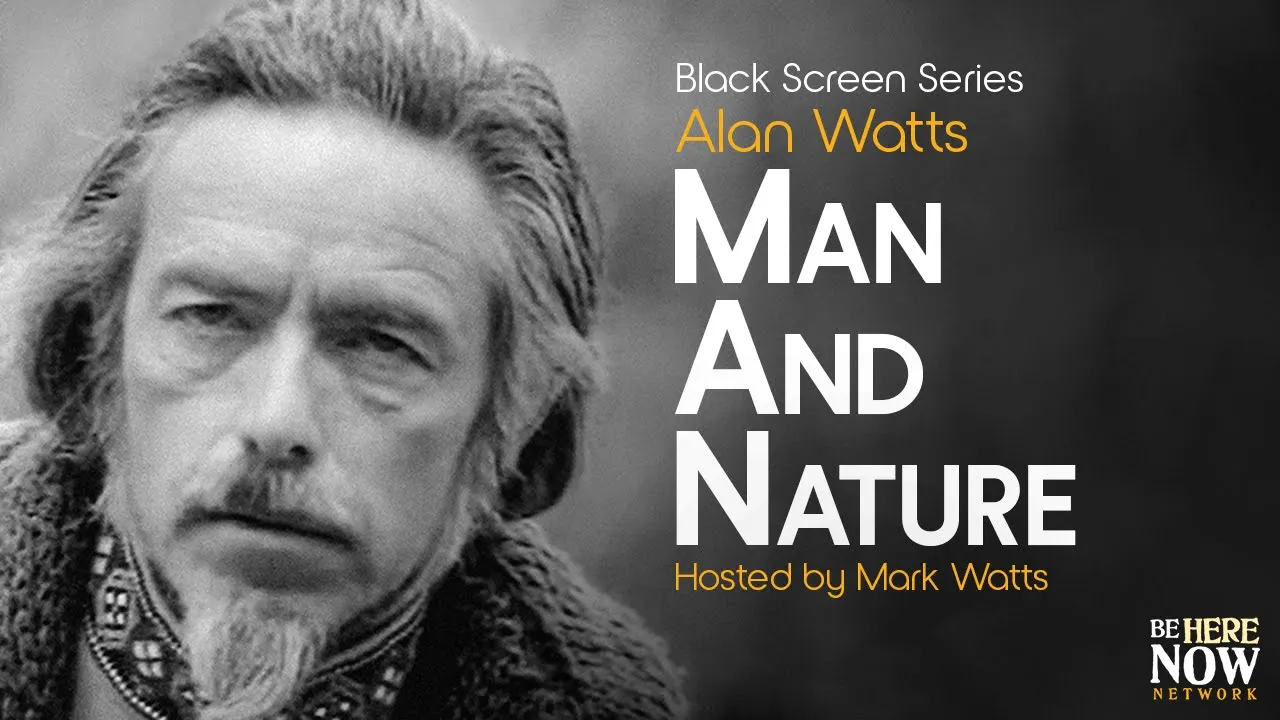
some seminar sessions starting with one in 1965 this was a two-day seminar at SMU and the first day was myself a case of mistaken identity and the second day in front of a smaller crowd was man and nature the recording that we're going to hear today this is one of the most engaging talks that he ever gave on ecology and is a wonderfully reaffirming and reassuring look at our relationship with with the natural world and the ecosphere in which we find ourselves and it's probably one of the most charismatic interesting and positive talks you'll ever
hear on the ecology something else new for today is that we have a new sponsor eaten hemp and they are a new york-based farm that produces CBD products from seed to final product and I've been sampling some of their calming tinctures and snacks and uh in the coming weeks and months we'll talk a little bit more about their their goodies uh but they have come on board to help sponsor this podcast and carry us forward into the new year this podcast series was made possible by the Romos be here Now podcast Network work our theme
music is by Zakir Hussein courtesy of moment records and today's talk comes from the Dow philosophy album which is part of the Electronic University album collection known as the essential alen wats and it is one of 200 talks downloadable through the alen Watts org website thank you again and now here's alen watts in man and nature in my talk last night I was discussing the disparity between the way in which most human beings experience their own existence and the way man's being and nature is described in The Sciences I was pointing out that in such
Sciences as ecology and biology ecology for example describes and studies the relationship between all organisms and their environments the way in which they describe human animal and insect behavior is in flat contradiction with the way in which most of us experience our thinking and our action and our existence we have been brought up to experience ourselves as isolated centers of awareness and action placed in a world that is not us that is foreign alien other which we confront whereas in fact the way an ecologist describes human behavior is as an action what you do is
what the whole universe is doing at the place you call here and now you are something the whole universe is doing in the same way that a wave is something that the whole ocean is doing this is not what you might call a fatalistic or deterministic idea you see you might be a fatalist if you think that you are a sort of puppet which life pushes around you are separate from life but life dominates you that's fatalism but in the point of view I'm expressing the real you is not a puppet which life pushes around
the real deep down you is the whole universe and it's doing your living organism and all its Behavior it's expressing it as a singer sings a song we've been hoodwinked into the feeling that we exist only inside our skins and I was showing last night that that is a hallucination it's just as nutty as anybody could be like a fruit cake you know who thinks he's Napoleon or something or other thinks he's a poached egg and goes around finding a piece of toast to sit on it's just like that a hallucination and I was showing
how we need to experience ourselves in such a way that we could say that our real body is not just what's inside the skin but our whole total external environment because if we don't experience ourselves that way we mistreat our environment we treat it as an enemy we try to beat it into submission and if we do that comes disaster we exploit the world we live in we don't treat it with love and gentleness and respect we cut down millions of Acres of forests to turn it into newspaper of all things lovely trees turned into
information about nothing and we don't replace them properly we kick the world around in Revenge for feeling that really we are puppets which the world kicks around so my main point last night was then that we need a new kind of Consciousness in which every individual becomes aware that his real self is not just his conscious ego you know let's take a headlight of a car the headlight Shines on the road in front the headlight does not shine on The Wire which connects it with its own battery so in a way the headlight is unaware
of how it shines and in the same way we are unaware of the sources of our Consciousness we don't know how we know there was a young man who said though it seems that I know that I know what I would like to see is the eye that knows me when I know that I know that I know and so we are ignorant of we ignore it doesn't come within the scope of our attention how it is that we manage to be conscious how it is that we manage to grow our hair to shape our
bones to beat our heart and to secrete all the necessary fluids that we need from our glands we do it but we don't know know how we do it because you see underneath the superficial self which pays attention to this and that there is another self more really us than I and if you become aware of that unknown self the more you become aware of it the more you realize that it is inseparably connected with everything else that there is that you are a function of this total Galaxy bounded by the Milky Way and that
furthermore this galaxy is a function of all other galaxies and that vast thing that you see far off far off far off with telescopes and you look and look and look one day you're going to wake up and say why that's me and in knowing that know you see that you never die that you are the Eternal thing that comes and goes it appears now as Jon Jones now as Mary Smith now as Betty Brown and so it goes forever and ever and ever now then why I made this point as an introduction to what
I want to say tonight is the problem of the relationship of man and nature do you know in the history of philosophy there are really three theories of nature incidentally what do you mean when you use the word nature what is nature study Natural History the Museum of Natural History what do you expect to find there well for many people nature means the birds the bees and the flowers it means everything that is not artificial people think for example a building like this is not natural it's artificial the natural state of the human being is
to be naked but we wear clothes and that's artificial we build houses is there any difference between a human house and a wasp's nest or a bird's nest not really but we do have in our minds you see the idea that nature is somehow outside us we've got some nature in us we say there's a thing called human nature and mostly bad human nature uh according to Dr Freud is motivated by the libido and you know what that is and you can't trust it in the old days they used to beat it with whips but
Freud said don't do it that way you have to treat it as a good horse trainer trains a horse by giving it lump of sugar every now and then and get it controlled that way be kind to it respect it even though it's really very very disrespectable well now there are as I said in the history of mankind three theories of nature the first theory is the Western Theory which is that nature is a machine or an artifact we inherit this from the Hebrews who believed that nature was made by God in somewhat the same
way as a Potter makes a pot out of clay or a carpenter makes a table out of wood it is not insignificant that Jesus is the son of the carpenter our tradition has been to look upon the world as a construct and somebody knows how it was put together somebody understands and that is the Constructor the architect the Lord God but it so happened that in the 18th century Western thought began to change they became increasingly doubtful as to whether there was a maker whether there was a God but they continued to look upon the
creation as an artifact as a machine and by the time of Newton people were explaining the world in terms of mechanism and we are still under the influence of that idea because after all in things like Life magazine and so on when they give you an article on human physiology they usually make drawings which show the human being as a kind of mechanism as a sort of factory and they show how the peristaltic action carries the food in and how it's processed by this organ and that organ as just as if uh a certain product
is fed into a factory cow at one end and it comes out canned corn beef at the other just in such a way the human is Illustrated and so too in uh some kinds of rather degraded medicine that is now practiced when you go to the hospital for a medical examination you are treated as a machine they process you you're not a person you're put in a wheelchair immediately even if you are perfectly healthy and can walk nevertheless they have to have you in this wheelchair and they put you through a process and the heart
specialist looks only at your heart because he can't understand anything else the uto rhinologist which means an ear nose and throat man looks at that section of you and he doesn't know about anything else and maybe a psychiatrist takes a look at you and uh goodness knows what happens there and so on and so on everybody looks at you from their specialized point of view as if they were a bunch of mechanics examining your automobile because as I said last night we we just asked for this because most of us consider ourselves as chauffeurs inside
our bodies which we own in the same way as you own a car and when it goes wrong you take it to the mechanic to fix it you don't really identify with your body just as you don't really identify with your car so here is the whole theory of nature which has grown up in the west as an artifact something made now let me take a second theory of nature this is an Indian Theory East Indian nature not as an artifact but as drama basic to all Hindu thought is the idea that the world is
my y that is a Sanskrit word which means many things it means magic illusion art play all the worlds a stage and in the Hindu idea there is the Ultimate Reality of the universe is the self which they call Brahman or Atman that's what there is the self Universal Eternal boundless Indescribable and everything that happens happens on the self like you say it's on me the drinks tonight are on me uh or like we say uh when you hear the radio it's on the speaker you see everything you hear on the radio flutes drums human
voices traffic noises any imaginable sound all those sounds are vibrations of the diaphragm in the speaker but the radio doesn't tell you that the announcer doesn't come on and say every morning good morning ladies and gentlemen this is KQED the following sounds that you are going to hear Are vibrations of your the diaphragm in your speaker and they are not really uh human voices or musical instruments but just that they never let you in on that and in exactly the same way the universe doesn't let you in on the truth that all sense experiences are
vibrations of the self not just yourself but the self and all of us share this self in common because it is pretending to be all of us Brahman the ultimate principle plays hide and seek eternally and he does it for unspeakably long periods of time the Hindus measure time in what is called a kalpa k a l PA a that's 4, 320,000 years don't take this seriously it's not meant to be taken literally but just for an unspeakably long time the Brahman the self pretends that it's lost and is us and all our adventures and
all our troubles and all our agonies and tragedies it gets mixed up in them then after the period of 4, 320,000 years has elapsed there is a catastrophe the universe is destroyed in Fire and after that the Brahman wakes up and says well good crazy what a what an adventure that was he wipes the sweat off his brow and says let's rest a while so for another 4, 320,000 years the Divine self rests and knows who it is it's me then it says well this is rather boring let's get going again let's get mixed up
and it does it in a very strange way because uh the way the Hindus time it the first period of getting mixed up getting lost is beautiful that's the longest period everything's right it's just life is glorious then it has the next period in which things get a little wonky something is vaguely out of order that doesn't last so long then the next period the third is when good and evil are equally balanced and that's still not so long finally comes the shortest period when everything bad triumphs and the whole thing blows up and we
begin all over again we're supposed to be living in that now it's What's called the Kali Yuga the age of darkness and it began on Friday February the 23rd 3,123 BC and it has 5,000 years to run but as it goes on time gets faster so don't worry so you see that's a theory of nature as a drama it's a play now there's a third theory of nature which is Chinese and this is very interesting the Chinese word for nature they call Zan and this expression means of itself so what happens of itself or we
might say spontaneity it almost means automatic because automatic is what is self-moving only we associate the word automatic with Machinery but Zan what is of so of itself is associated in the Chinese mind not with Machinery but with Biology your hair grows by itself you don't have to think how to grow it your heart beats by itself you don't have to make up your mind how to beat it that's what they mean by Nature the poem says sitting quietly doing nothing spring comes and Grass Grows of itself so their principle of nature is called the
da ta AO pronounced Dao in the Mandarin dialect Tao in the changhai dialect to in the Cantonese dialect take your choice da means the ca of nature and laer who was a philosopher who lived a little later than 400 BC wrote a book about the da and he said the da which can be spoken is not the Eternal da you can't describe it he said the principle of The Da is spontaneity he said the great da flows everywhere both to the left and to the right it loves and nourishes all things but does not Lord
it over them it accomplishes merits and lays no claim to them so there is a very great difference between the Chinese idea of Dao as the informing principle of Nature and the judeo-christian idea of God as Nature's Lord and Master because the da does not act as a boss in the Chinese philosophy of Nature Nature has no boss there is no principle that forces things to behave the way they do it is a completely democratic theory of nature correspondingly you see most westerners whether they be Christians or non-christians don't trust nature of all things nature
is the thing least to be trusted you must manage it you must watch out for it it will always go wrong if you don't watch out you know the Goblins will get you if you don't watch out so we're always feeling that you you can't trust it see we are absolutely instilled with the idea of original sin you can't trust nature because it comes out with weeds and insects and above all you can't trust human nature because if you don't hold a club over yourself you'll go out and rape your grandmother now the Chinese would
say if you can't trust yourself you can't trust anything because if you can't trust yourself can you trust your mistrust of yourself is that well founded see you if you can't trust yourself you are totally mixed up you haven't a leg to stand on you haven't a Point of Departure for anything and in this respect the Dost philosophy and the confusion philosophy are in agreement in confucious philosophy the fundamental virtue of a human being is called Yan spelled Jen for reasons best known to Chinese Scholars uh I don't know what they are but it's pronounced
R and it's a character Chinese character that confucious placed as the highest of all virtues higher than righteousness higher than benevolence and it means approximately human heartedness now confucious once said that goody goodies are the thieves of virtue virtue in Chinese is the we romanize it as T du and it means virtue not in the sense of moral propriety but virtue in the sense of magic as when we speak of the healing Virtues Of A Certain plant a man of true virtue is therefore a human hearted man and the meaning of this is that one
should above all trust human nature in the full recognition that it's both good and bad that it's both loving and selfish now let me give an illustration of the wisdom of this when people fight Wars uh I trust them if the reason for which they fight a war is to expropriate somebody else's possessions and women because they will fight a merciful War they will not destroy the possessions and the women that they want to capture they want to enjoy them and that's a war based on simple ordinary everyday human greed the most awful Wars that
are waged are the wars waged for moral principles you are a lousy communist you have a philosophy that is destructive to religion and to everything that we love and value and reverence and therefore we will exterminate you to the last man unless you surrender unconditionally such Wars are ruthless beyond belief we can blow up whole cities wipe people out because we are not greedy we are righteous that is why the goody goodies are the thieves of virtue if you are going to do something evil do it for a plain honest selfish motive don't do it
in the name of God because if you do it turns you into a monster who is no longer human a sadist a pure Destroyer so an inflexibly righteous person is not human and that is why in Chinese ideas of Justice a good judge is not somebody who abides by the book their idea of justice is for God's sake keep the case out of court let us have a consultation behind the scenes and let's arrange a compromise because we know our opponent is a rascal I know I am a pasal and therefore there can be a
mutual Arrangement between thieves so we Su and H and we talk about it and we call the judge in in an unofficial capacity and the judge hums and HS and if he's a good judge he has a sense of what is called Lee I'm going to talk to you about another meaning of a word pronounced Lee later on but it's quite a different word Lee is justice but you can't write it down there is another word for justice or law in Chinese Z and this word represents in its Chinese character form a cauldron for cooking
sacrifices and a knife then the high and far off times of Chinese history there was an emperor who when the people brought their sacrifices of meat and so on to be put in the cauldrons he also scratched with a knife on the side of the cauldrons the laws of the state so that all the people could read them and understand what they were but the sages who advised this Emperor said that was a very bad thing to do because the moment people see the law written down they develop a Lous spirit that is to say
they think out ways of wangling around it and that's what we do all the time don't we moment Congress passes a law tax law especially all the lawyers get together and they think they think they fill it full of holes they say well it didn't Define this and it didn't say that and some of those confusions wanted to put the language in order and to make all the words mean just so but the daoists laughed at them and said if you define the words with what words are you going to define the words that define
the words so they said therefore the emperor should not have written the laws down because a sense of justice is not something you can put in words it's what our lawyers call Equity and you talk to any lawyer and he in discussing various judges is around town he will say well judge so and so is pretty much a stickler for the letter of the law but on the other hand judge so and so has a sense of equity he knows when the law the letter of the law just doesn't apply to this particular case and
he just has an innate sense of fair play that's the man to be trusted as a judge so this is what the Chinese mean by a judge who has the sense of Lee of real Justice it can't be written down it can't be explained because every case is individual but what such a man has fundamentally in his heart he trusts the good and bad of human nature human beings are complex we don't know ourselves at all really consider your nervous system neurologists haven't even begun to figure it out and yet all your conscious decisions are
based on this thing that you don't understand you are unbelievably more wise in your nature than you ever will be in your conscious thoughts because behind your conscious thoughts lies your nervous system and if you say well my nervous system is unreliable it is just a bunch of of strange weird biological chances that have got mixed up somehow then this very opinion that you're expressing you see is a function of that nervous system so you're saying that you are a total hoax you can't trust yourself at all so that is a a a a set
of game rules that don't lead anywhere it's totally self- frustrating so you see what the Chinese have developed here is a theory of nature I said there are three theories the Western mechanical Theory nature as an artifact the Hindu dramatic Theory and the Chinese organic Theory nature human nature included is an organism and an organism is a system of orderly Anarchy there is no no boss in it but it gets along by being left alone and being allowed to do it stuff that's what the Chinese DST philosophy calls wo way which means not doing nothing
but not interfering with the course of events not acting Against the Grain now this is the time to introduce the second word Lee in chin the first Lee meant Justice the second Lee is a character which had the original meaning of the markings in Jade the Grain in wood and the fiber in muscle and it's usually translated reason or the principle of things these are not very good translations the best translation of Lee is organic pattern now look here when you look at the clouds they aren't symmetrical they don't form fores they don't come along
in Cubes but you know at once that they're not a mess a dirty old ashtray full of junk may be a mess but clouds don't look like that when you look at the patterns of foam on water they never make an artistic mistake and they're not mess they are Wiggly but in a way orderly and it's difficult for us to describe that kind of order now take a look at yourselves you're all Wiggly we think you know we are pretty ordinary because there are a lot of us that look approximately the same so when we
he see a human being we think well that's pretty much in order and kind of regular and it's okay but we don't realize how Wiggly we are we're just like clouds rocks and stars look at the way the stars are arranged do you criticize the way the stars are arranged would you like them to form fours would you like them to be uh sort of set out like uh needle point on the canvas of the Skies there was somebody in the 18th century in the days when they built formal Gardens of clipped Hedges and made
all the Tulips stand together like soldiers who criticize the stars for being irregularly arranged but today we don't feel that way we love the way the stars are scattered and they never make a mistake in their Arrangement what about mountain ranges do you criticize The Valleys for being low and praise the Peaks for being high you just say it's it's great it's the way it is now that kind of order the artist pays a tribute to it by painting a landscape people you know in in every National Park there's a place called Inspiration Point point
and people go there and they say oh it's just like a picture and nobody knew this 400 years ago it took the artists to paint landscape and then people realized how beautiful it is nowadays artists are painting uh pictures of damp stained walls and Floors where people are dropped a lot of paint and one day people will walk into a room where there's a lot of paint been scattered on the floor and a general thing and they'll say my goodness it's just like a Jackson Pollock oh ain't it just like a picture see it always
takes the artist to show us the vision but of course in the meantime it is difficult you go to an exhibition of contemporary non-objective painting and a kind of square fellow walks in there and he say that's not what I call a picture because he it's against his prejudices but I say to people now uh excuse me wait a minute take a look at that again I'm going to tell you something that painting is a photograph of guess what and he looks at it in astonishment and entirely new eyes what could that be a photograph
of he begins to see it might be a photograph through a microscope of globules of germs floating in liquid might be anything but there it is it suddenly comes at him goodness knows whether that was what the artist intended but that's a method of giving people a shock of seeing things in a new way you know a GI visited Picasso in Paris during the war and said I can't understand your paintings they they're absurd life doesn't look like that Picasso said do you have a girlfriend he said yes have you a picture he said yes
show it to me so he drew out his billfold and there was a little colored photograph of his girlfriend and Picasso looked at it and said is she so small as [Music] that now then the the the idea of Lee the idea of natural order is like this patterns on foam patterns in Jade the shapes of the clouds the shapes of trees and mountains they are orderly but we cannot put our finger on the order we know it's orderly but we don't know why and we know it's completely different from a mess from a mess
the order of nature is in that way then indefinable we when St Augustine was asked what is time he said I know what it is but when you ask me I don't and so in the same way the Chinese would say we know what the order of nature is but if you ask us we don't the poet says picking chrysanthemums along the eastern fence gazing in silence at the Southern Hills the birds fly home through the soft Mountain Air of dusk in all these things there is a deep meaning but when we are about to
express it we suddenly forget the words that's Lee nature as a self-ordering principle but it doesn't really know how it does it another poem says if you want to know where the flowers come from even the god of spring doesn't know this is a very remarkable attitude to Nature politically you see if you translate this into politics it is a high philosophical Anarchy and there's a lot to be said for this as a political point of view that in other words government is always a mess because the state opposes itself to the people we live
under a constitution where we are supposed to be governed by ourselves as somebody once said down with democracy when we get it because the state always the government always creates itself as a business in competition ition with all the other businesses and it wins because it's the biggest one of the bunch the the daoists said of the state that it should be as Anonymous and as unobtrusive as possible that is to say that the emperor instead of going around in processions and being heralded and flags waved should be as unobtrusive as the uh head of
the sanitation Department you know he's a man just a guy who goes around in a plain ordinary suit and uh really attends to his job and the sanit the head of the sanitation of the city of Dallas uh goes around you don't have a police escort and Sirens blowing and flags waving he simply does his job and the feeling of laer is that the president or the emperor should have the same kind of attit ude that he should simply help the people and retire and not claim any merits for it always withdraw himself always be
behind the scenes not striving for power but simply to help things along govern a great state he said as he would cook a small fish now you know when you got a small fish in the frying pan don't keep tossing it around and fidgeting with the spatula otherwise it'll fall apart do it gently softly softly catchy monkey so then here is a conception of nature as something you must trust outside nature the birds the bees the flowers the mountains the clouds and inside nature nature now nature isn't trustworthy completely it'll sometimes let you down with
a but that's the risk you take that's the risk of Life what's the alternative I do not trust nature at all it's got to be watched you know what that leads to it leads to 1984 and Big Brother it leads to the totalitarian state where everybody is his brother's policeman and where everybody is watching everybody else to report them to the authorities where you can't trust your own motivations where you have to have a psychoanalyst in charge of you all the time to think to be sure that you don't think dangerous thoughts or peculiar thoughts
and you report all peculiar thoughts to your analyst and your analyst keeps a record of them and reports them to the government and everybody is busy keeping records of everything it's much more important to record what happens than what happens this is already eating us up it's much more important that you have your books right than that you conduct your business in in a good way in universities it's it's much more important that the registrar's records be in order than that the library be well stocked after all do you know your grades are all locked
up in safes and they're protected from thievery and pilfering and they are the most valuable property that the university has the library can go hang then furthermore the main function of a university is what any sensible person would imagine of to teach students and to do research so the faculty should be the most important thing in the university on the contrary the administration is the most important thing the people who keep the Records who make the game rules up and so the faculty are always being obstructed by the administration and being forced to attend irrelevant
meetings and uh to do everything but scholarship do you know what scholarship means what a school means the original meaning of a scholar Leisure we talked of a scholar and a gentleman because a gentleman was a person who had a private income and he could afford to be a scholar he didn't have to earn a living therefore he could study the classics and poetry and things like that today nothing is more busy than a school they make you work work work work work as you get got through on schedule they have expedited courses and you
you you go to school so as to get a card with PhD or something so you can earn a living so that's a whole contradiction of scholarship scholarship is to study everything that's unimportant not necessary for survival all the Charming irrelevances of life but you see the thing is this if you don't have a room in your life for the playful life's not worth living all work and no play makes Jack a Dull Boy but if the only reason for which Jack plays is that he can work better afterwards he's not really playing he's playing
because it's good for him he's not playing at all you have to be able to be a true scholar you have to cultivate an attitude to life where you're not trying to get anything out of it you pick up a pebble on the beach look at it beautiful don't try and get a sermon out of it sermons in stones and God in everything be damned just enjoy it don't feel that you've got to Salve your conscience by saying that this is for the advancement of your aesthetic understanding enjoy the pebble if you do that you
become healthy you become able to be a loving helpful human being but if you can't do that if you can only do things because they are somehow you're going to get something out of it you're a vulture so we have to learn we don't have to you know you don't have to do anything you don't have to go on living but it's a great idea it's great thing if you can learn what the Chinese call purposelessness they think nature is purposeless when we say something's purposeless that's put down there's no future in it it's a
wash out but when they hear the word purposeless they think that's just great it's like the waves washing against the shore going on and on and on forever with no meaning a great zen master said as his death poem just before he died from from the bathtub to the bathtub I have uttered stuff and nonsense the bathtub in which the baby is washed at Birth the bathtub in which the corpse is washed before burial all this time I have said many nonsenses like the birds in the trees go Twee twe twe twe what's it all
about everybody tries to say oh it's a mating call it's purposeful trying to get their mate you know attract them with a song it's why they have colors butterflies have eyes on them self- protection engineering view of the universe why do that they say well it's because they need to survive or why survive what's that for well to survive see human beings really a lot of tubes and U all living creatures just tubes and the tubes have to put things in at one end and let it out at the other then they get clever about
it and they develop nerve ganglia on one end of the tube the eating end called a head and that's got eyes in it it's got ears in it it's got little organs antenna and things like this and that helps you to find things to put in one end so you can let them out the other well while you're doing this you see the stuff going through wears the tube out and so that the show can go on the tubes have complicated ways of making other tubes who will go on doing the same thing in at
one end out the other and they say well that's terribly serious that's awfully important we've got to keep on doing [Laughter] [Music] this but when Chinese say nature is purposeless this is a compliment it's like the idea of the Japanese have a a word uh yugen and they describe yugen as watching wild geese fly and be hidden in the clouds as watching a ship vanish behind a distant Island as wandering on and on in a great forest with no thought of return haven't you done this haven't you gone on a walk with no particular purpose
in mind carry a stick with you and you occasionally hit at Old stumps and wander along and sometimes twiddle your thumbs it's at that moment that you are a perfectly rational human being you've learned purposelessness all music is purposeless is music getting somewhere if it were I mean if the aim of Music were of a symphony were to get to the final bar the best conductor would be the one who got there fastest see dancing when you dance do you aim to arrive at a particular place on the floor is that the idea of [Music]
dancing the aim of dancing is to dance is the present well it's exactly the same with our life we think life has a purpose I remember the preachers used to say when I was a small boy I'd always hear it we must follow God's purpose his purpose for you and his purpose for me when I asked these cats what the purpose was they never never knew they didn't know what it was they had a hymn God is working his purpose out as year succeeds the year God is working his purpose out and the time is
drawing [Music] near the time when the Earth shall be full of the glory of God as the waters cover the sea what's the glory of God well they weren't quite sure I tell you what it is in heaven all those angels are gathered around the glory of God that is to say the witch than which there is no Witcher Catholics call it the beautific vision the Jews call it the shikina they're all those angels and they're standing around it and they're saying Allelujah Allelujah Allelujah Allelujah means nothing they're just having a ball see that's what
happened in the beginning when God created the universe it was created like all stars all planets all galaxies they're vaguely spherical he created this and he said have a ball but before before he said that he said you must draw the line somewhere that was the real thing he said first before let there be light that came later first thing was you must draw the line somewhere otherwise nothing will happen you know you got to have the good guys the bad guys you got to have this you got to have that black and white light
and darkness must draw the line somewhere now here's the choice then are you going to trust it or not if you do trust it you may get let down and this it is yourself your own nature and all nature around you there going to be mistakes but if you don't trust it at all you're going to strangle yourself you're going to fence yourself round with rules and regulations and laws and prescriptions and policemen and guards and who's going to guard the gods and who's going to look after big brother to be sure that he doesn't
do something stupid no go to live I must have faith I must trust myself to the totally unknown I must trust myself to a nature which doesn't have a boss because a boss is a system of mistrust that is why L as da loves and nourishes all things but does not lorded over them you've been listening to man and nature from the Alan Watts series da of philosophy one of hundreds of recordings available on the alen Watts organization website this one again is Dao of philosophy the man and nature talk and that's part of the
essential lectures album today's podcast was brought to you by Eaton hemp and the rust be here Now podcast Network thanks for tuning [Music] [Applause] in [Music]

![Ram Dass | Methods to Consciousness Part 3 [Black Screen/No Music]](https://img.youtube.com/vi/DfkN34xfnvI/maxresdefault.jpg)