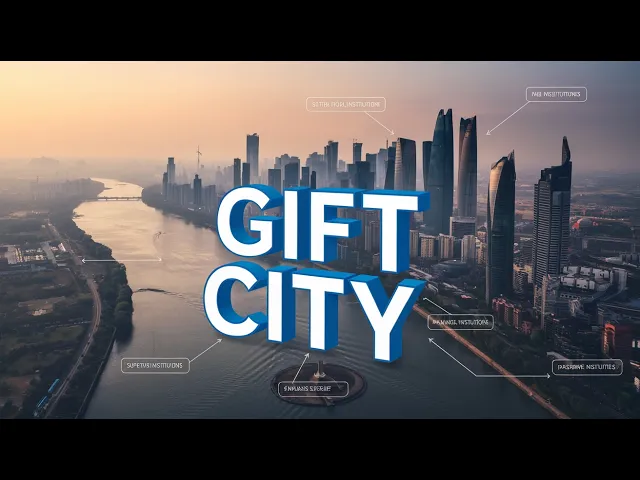
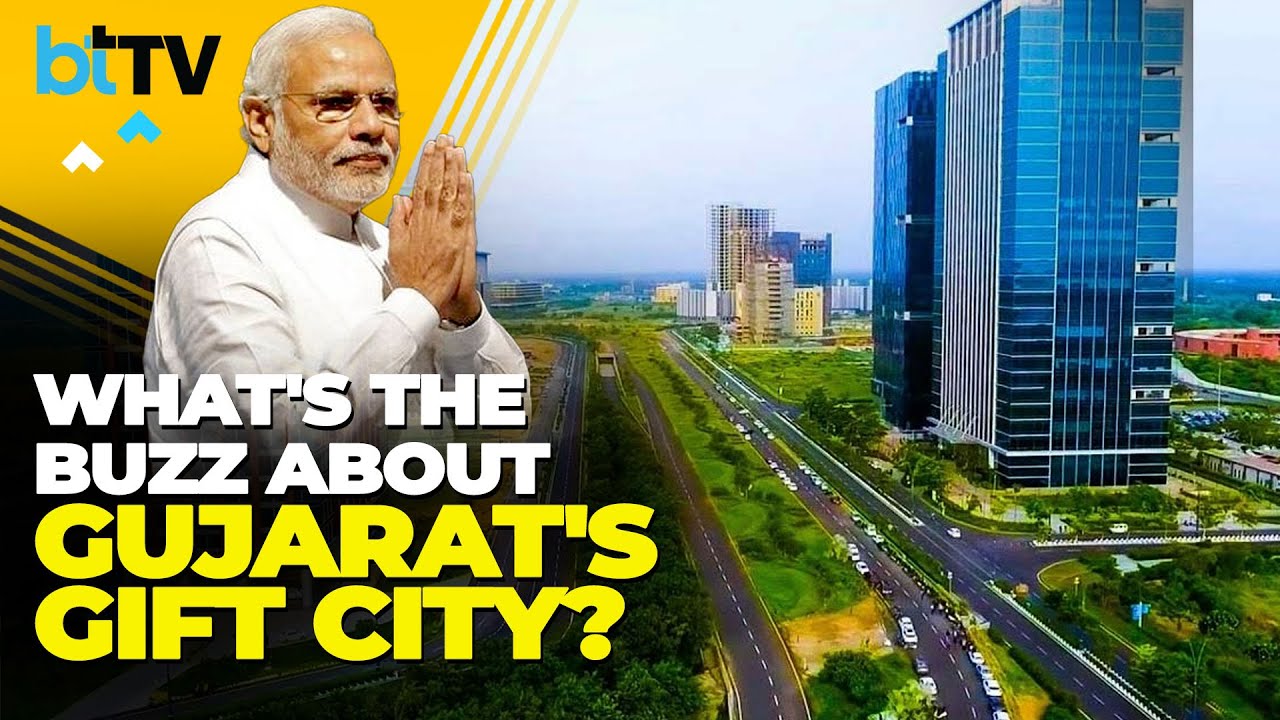
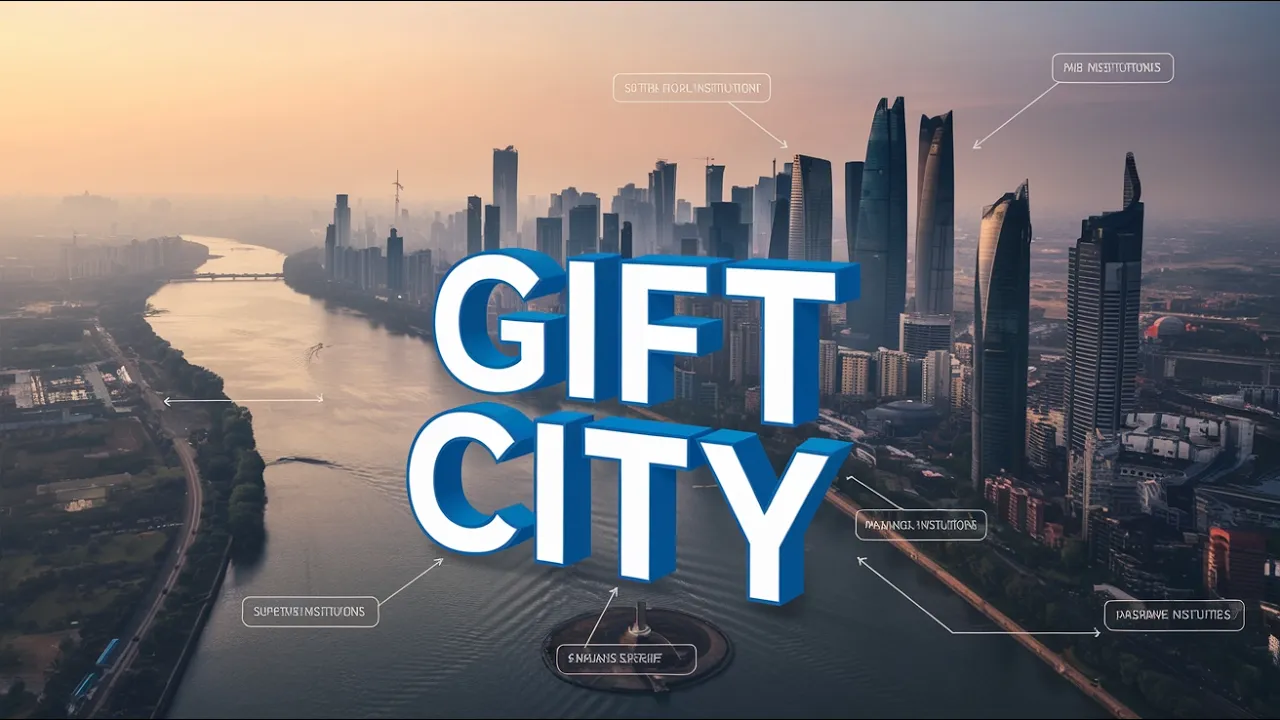
A new smart city is being built named Gujarat International Finance Tech City or GIFT City. It is being developed as a Central Business District near Ahmedabad. Some part of the 15/5 sq km area is already operational.
A Special Economic Zone. Inside which is named International Financial Services Center IFSC is the country's first greenfield smart city and IFSC and the country's first district wide water cooling system and automated waste collection system has also been installed. Today, offices of 23 multinational banks, 35 fintech companies and two stock exchanges.
Why is GIFT City being built when there are Ahmedabad and Gandhinagar nearby which can be expanded? How will the future of GIFT City look like in the future? Will modern technologies be used?
How will it be made more productive and efficient? To know more, watch the video till the end. GIFT IFSC is a financial center spread over 1.
06 sq km which was established in 2015 as a joint venture between Gujarat State Government and Infrastructure Leasing and Financial Services Limited i. e. LFS.
Through this, many tax benefits and incentives are given to the companies coming here like tax holidays for specific sectors in which no tax is taken from them for the first few years. In the case of IFSC, this holiday will be there for 10 years in SEZ. Free services are available with state subsidies like some companies will not have to pay health and education cess and no tax will have to be paid for the transactions and services received under this area, no GST, land lease is given at cheap rate and registration The process is also made easier.
All this is done to attract new companies so that they can generate employment and bring growth in the local economy. Some of the sectors which are being attracted here are Banking Capital Markets, Insurance, Shipping etc. Banking in India And foreign banks can set up IFSC Banking Unit i.
e. IBU for International Banking Services under which they will be treated like a foreign branch of a bank with less regulations in which they can invest and give loans to more businesses and companies to get funding more easily. It will be made easier to set up capital markets like hedge funds, VCs etc.
to get access to it. Apart from this, India's first International Bullion Exchange has also been established here which participates in domestic and international trading of valuable metals like gold and silver, India International Bullion Exchange IIB. This is the third such exchange in the world which is being managed by the Union Ministry of Finance.
Talking about aviation industry, India comes third in the world after USA and China. Due to the increasing demand, leasing of planes has become more necessary due to which Aircraft leasing companies will be set up here. Similarly, ship leasing sector will also contribute here.
Similarly, India's trade is 95% by volume and 70% by value in water, so ships and barges will be required in large quantities for that, which will be available in GIFT City. All these leasing companies will be given special tax incentives. The government is also encouraging them to open their own offices and campuses of foreign universities here so that more and more people can enroll in it to better connect these office spaces.
New transport projects have also been started like metro buses and flyovers on roads, underpasses for vehicles, petrol pumps and charging stations for EVs are also being built at various places for intercity connections. GIFT City is at a very good location. It is located near Ahmedabad because the country's biggest highway NH48 passes through here.
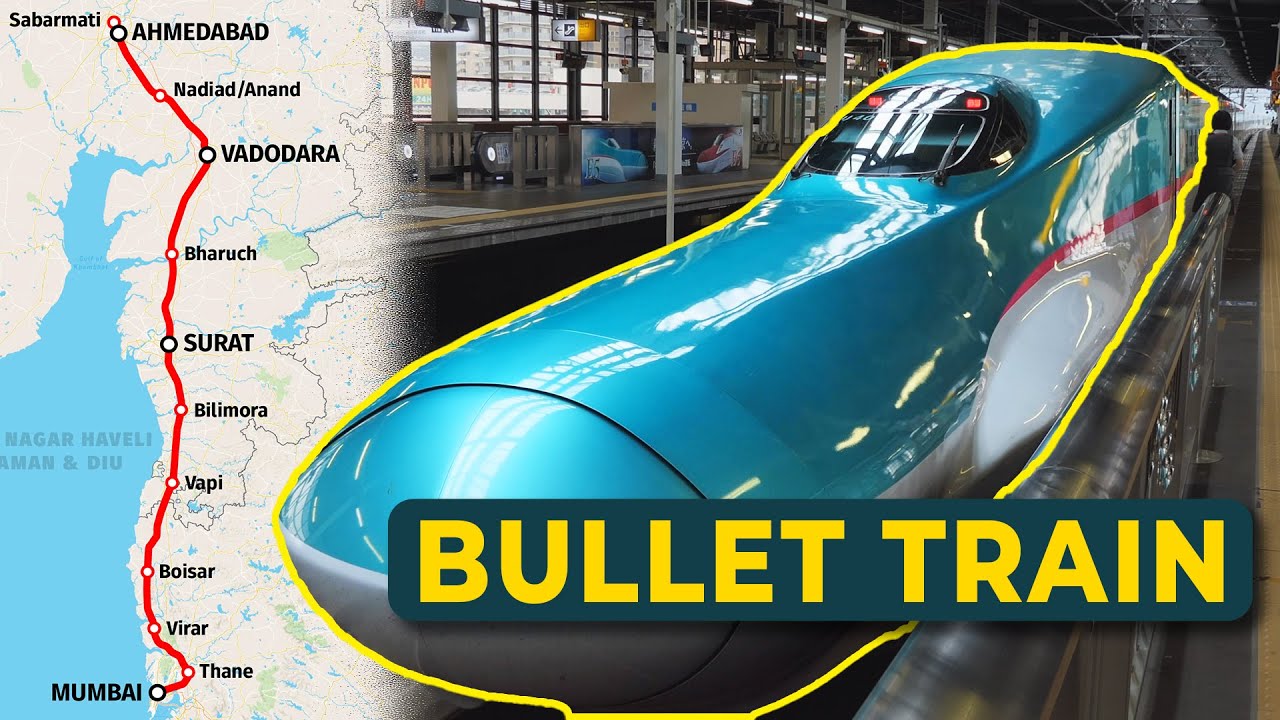
The airport is also nearby Ahmedabad, just 20 minutes away and the Sabarmati terminal of the under construction bullet train is also just 15 minutes away. Apart from this, the Red Line of Ahmedabad Metro is being extended to Gift City, which will lie on the way. A branch line of Gandhinagar will connect to a different Gift City.
Being situated on the banks of Sabarmati river, water base transport is also accessible here like ferries which connect Ahmedabad and Gandhinagar. Some modern buildings which have started emerging here have already started getting a notable status like Gift One and Two Towers are two office buildings built in the central area, both 123 meters high with 28 floors, have been built according to mixed use. But there will be mostly office space on the upper floors.
There is also a World Trade Center under construction which is known as World Trade Center Association WTC. It will also be mixed use. Wide utility tunnel for commercial, financial and technical firms is also being built, which will make it a digital free city.
Authorities will not have to dig again and again to fix water pipes or wires. All the utilities will be in one tunnel but will be kept separate from each other so that there is no interference. Power cables, water pipelines, raw and treated sewage pipes, automated waste collection systems etc.
will all be here and this will make it easier for the workers to work. Due to the presence of lighting, drainage, ventilation and fire systems, this is done in many cities across the world and in India too, its need is felt when digging is done repeatedly on all the roads. Apart from this, the country's first automated waste disposal system is also here.
A collection system was installed which can handle 150 tonnes of waste every day. The waste that people throw is collected through vacuum chute and sent to a building where all this happens. Workers also come in less direct contact with the waste, which makes them safe.
More hygienic and safe working conditions are created and efficiency also increases. Smart water infrastructure for waste collection has also been created . The power system for water supply, distribution, collection, treatment, recycling and use is also similar in which there is 24 hours electricity to avoid grid failure.
Centralized backup systems are maintained for AC. Along with this, the country's first district cooling system has also been created to supply district wide air conditioning and chilled water. It will be able to save 30% more electricity than the traditional AC system and the chilled water will be used by the utility.
From the tunnel to the distributor, people have already talked about the buildings, but we will know about when and why the plan to build the GIFT City was made. Its proposal was first put forward in 2007 when a world class International Financial Services Center was established in Gujarat. After 2 years, Gift City Company Limited was incorporated and its foundation stone was laid.
Then the Finance Minister of the country and the Chief Minister of Gujarat started construction of its first few buildings. Meanwhile, international companies also started showing their interest. In 2019, Bank of America opened its Global Business Services center here.
Next year, French multinational hospitality company Aker SA also opened its international hotel. Following them in 2022, JPMorgan Chase Deutsche Bank and mits. ac.
in are here first. There was also a capital, but in 1970, a new city, Gandhinagar, was built a little north of it , where a proper planned city emerged with all the administrative buildings, which was made the capital. Later, since then, all the power of the state is concentrated here.
Most famous about Ahmedabad It was first written in the 12th century when Karna Chalukya defeated the Bhil king Asaka and established the city of Karnavati. Since then this place became politically important. Then in the 15th century, the founder of Gujarat Sultanate, Muzaffar Dynasty, made Ahmedabad his capital and its Old City.
Gujarat was established by Sultan Ahmed Khan in 1411, which included the construction of Badr Fort. Ahmed Khan also named this city. After becoming the capital, this city became quite prosperous because more trade was seen from here.
In 1484, Gujarat Sultanate established it. The capital was shifted from the geopolitical region to Champ Neyre, but the financial importance of Ahmedabad still remained. Between Bhadra Fort and Jama Masjid, many merchants, especially arms dealers and luxury goods manufacturers, set up their businesses.
In the 16th century, Ahmedabad and the rest of Gujarat gradually became Mughals. Came under the rule and after some time, Dutch and British traders also reached Ahmedabad for the first time, after which revenue concessions were given to European traders. Rulers' songs were iron, silver and gold.
By the 18th century, many political and religious disturbances started increasing in Ahmedabad. Mughals The rule had also declined significantly from its peak and Ahmedabad suffered a lot in the wars with the Marathas. Political stability and economic prosperity gradually started coming back in the 19th century when the British rule started.
The textile mills of Ahmedabad also started here only then. Due to the American Civil War, Britain started producing cotton in India instead of the American Colony, of which Ahmedabad also became the hub. Unlike most other Indian cities, the mercantile class in Ahmedabad bought British machinery on a large scale and established its own manufacturing plants.
At the same time, Ahmedabad Westford was expanded across Sabarmati, making it Old City and New City. It was divided into portions. To connect them, nine bridges were built over Sabarmati, the first of which was Ellis Bridge, opened in 1992.
The growth of the city continued like this and after independence, many big educational and research institutes were also established here and these Higher education also became a center of science and technology. During this time, its economic base also started increasing with the formation of heavy and chemical industries. Due to these developments, by 1960, the population of Ahmedabad had touched 5 lakhs and it became a highly industrialized city.
Although Ahmedabad had become an important city , but after the division of Bombay State, the new Gujarat State needed a capital city. Although Ahmedabad had been the capital of some historic kingdoms, there was not much space left to build modern administrative buildings. Therefore , while keeping Ahmedabad as the business capital, a new political capital was established 23 km away from Gandhinagar.
The entire city road network and buildings were built in a well-planned manner on a relatively empty place. Its designers were HK Mewada and Prakash M Apte, who had developed the city of Chandigarh. Had taken training under architect Lok Bujar.
Where Gandhinagar is situated today, there used to be a small settlement named Shertha in the 13th century which was established by King Peda Sin of Pethapur Kingdom. Later it came under the Gujarat Sultanate and for many years thereafter. Not much notable events or development were seen here.
In 1960, the foundation stone of Gandhinagar was laid here and construction started and by the next decade, its basic infrastructure was almost ready. Due to being very close, connectivity between Ahmedabad and Gandhinagar is very good . Since then, both the roads are well connected to each other through Sabarmati River.
Now, if the new S-Jet was to be built then it could have been built only in Gandhinagar or Ahmedabad. Why did a special gift city have to be built? The reason for this was that land was not available for such a facility in both the cities.
There would have been more difficulties and the pressure on their supporting infrastructure would have increased a lot. Similarly, Ahmedabad was very difficult to expand and Gandhinagar was mainly established as an administrative city. Apart from this, if SZ was made in it and the population would increase uncontrollably.
Without planning, that too would have become a problem, hence the idea was to create a dedicated SZ where administration, tax regime, infrastructure and all other facilities could be properly planned. GIFT City was strategically placed between Ahmedabad and Gandhinagar so that it could be It is well connected to both of them and also to the airport, in such a situation, new residential buildings do not have to be built so much and there is less pressure on these cities, hence this was the best spot. It is so close that the people working in GIFT City and their families go to Ahmedabad and You can travel daily by staying in Gandhinagar, so that there will be no sudden population change in these cities.
Many steps have been taken to facilitate this daily travel, one of which is Ahmedabad Metro, its Red Line extended till Gandhinagar and a branch line extended till Gift City. Construction of Ahmedabad Metro started in 2015 and the first line opened in 4 years. Blue Line is 6 km long.
Today its two lines are operational. Total length is 57 km and Along with 48 stations, water base transport is also available here as it lies on the banks of Sabarmati river. A green field industrial area like GIF City has many advantages.
The first was that it can be planned and developed well, which will lead to more growth in the future. Problems do not arise and unplanned development can be stopped. Special utilities can be made more efficient by using advanced technologies.
Developing countries like India also need more such new cities so that the pressure is reduced from already constructed cities like Mumbai and Bangalore. By reducing the population burden, benefits will also be seen in a new local economy when people start settling here in search of employment. Economic, financial and administrative policies can be set up according to such areas without affecting any assisting policies.
Tax regime, investment policies, education etc. can also be specifically modified. These are the benefits but it also has some problems like it requires more initial investment because the area has to be developed from scratch, hence it also costs a lot of money.
To make it a suitable area, the entire utility transportation infrastructure has to be built from scratch, which also involves huge expenses and environmental clearance. It is more difficult to achieve because it also causes more damage to the environment in comparison to already developed areas and ultimately if this SZ fails or fails to attract that much investment then all the hard work and money that could have been better used will be wasted. Had it been done at any other place, we have to think about all these things and start working on it by doing proper planning and research to see whether there is proper demand at that place or not.
Commercial Business District CBDs have been being built in the country for a long time, which are quite useful. Something can be learned to implement in GIFT City like the southern most part of Mumbai is the wealthiest urban area of the country which was mostly developed during the British period. Even today there are many buildings present here which reflect the architecture of that period and Now many of them have even received the status of heritage site by UNESCO, such as CSMT and other Victorian and Art Deco buildings have been declared as World Heritage Sites.
One of the first CBDs of the country was stubbed here which houses a variety of trades. It was seen that everything from cotton exports to silk imports were being operated from here and as Mumbai grew, financial institutions also succeeded in making their place here and today the country's biggest stock market and banks are all located here in Ballad State. Bombay Port Trust was formed in 1940 to handle this growing trade, where officers of all the big shipping companies are located.
Even today, Nariman Point was established by reclaiming land to the south of the Church Gate in 1940 and within 60 years, it became one of the most famous ports in the world. Became the seventh most expensive office location, although it has seen a slight downfall after the financial crisis of 2008, but even today there are big office suites like Air India building, Triden Oberoi Hotels, Bra Kurla Complex BKC, a new CBD has also been established which is called Mumbai Metropolitan Region. Development authority MMRDA built it to reduce the pressure on South Mumbai.
Today about 4 lakh people work in BKC and the biggest commercial spaces are also present here. Some notable buildings located here are SEBI OGC t India Ambani Cultural Center III Bank India Diamond Bose ab amazonflex. in is a modern CBD, instead of being in Delhi city, it has now started coming in Gurgaon and Noida.
Taking inspiration from these CBDs of Delhi and Mumbai, Ramakrishna Balaga also had a vision of creating a SEZ named Electronic City in Bangalore as Establishment Valley, which was then He was the chairman of Kionix, the state's electronics department. He established Electronic City with the support of its Chief Minister D Devraj Urs. Its success was unprecedented and exceeded all expectations, becoming the country's largest IT industry.
Today, these are the offices of all the big companies in the world. In which the city will be made smart and smart by using advanced technologies and AI, the data collected will help in better equipping the traffic and transportation system, power plants, utilities, water supply, waste disposal, criminal investigation, school, hospital etc. like if If there is traffic all the time at an intersection at any one time, then with the help of AI, its traffic signals can be timed in such a way that the wait time is minimal, which will reduce the traffic.
This is one such example. If this is done for every intersection and every service, then the wait times will reduce so much that hundreds of hours of people will be saved which are wasted just in waiting and they will be able to make the city better by relaxing their work and spending more money. National Smart Cities The mission, which was launched in 2015, puts forward a plan to create 100 such smart cities in the country.
To implement it in many existing and some new cities, the Ministry of Housing and Urban Affairs is giving some policies and cash incentives to companies and citizens. Let's see how long they are made and how successful they are. Click on the video card to know about the country's first semiconductor factory.
To see more such videos, subscribe. Thank you.