First MOLOCH, horrid King besmear'd with blood Of human sacrifice, and parents tears, Though, for the noyse of Drms and Timbrels loud, Their children's cries unheard that passed through fire to his grim idol Such are the words of John Milton’s Paradise Lost, where the abominable being known as Moloch, or Molek appears as a fearsome warrior of the fallen angels. Milton describes Moloch as a pro-war devil - a being who as the fiercest fighter in the war on Heaven was keen to re-engage God and his angels after Satan’s first failed attempt. He implores Satan to equip them all with the weapons forged in hell and and dictates that they must destroy God, for if they fail or if they choose not to fight given that they’d already been thwarted, then the punishment that God had in store for them would be egregious.
With this, they have nothing left to lose and so, Moloch deemed it imperative to take the fight to God… though, this was likely because he himself enjoyed the thrill of war so much. In the end though, he is ultimately overruled, likely on the account that Satan recognised Moloch was more brawn, than brains. In the Salammbo by Gustave Flaubert - a historical novel about Carthage from the mid 19th century, Moloch is referred to as a god of the Carthaginians who accepted the offerings of children as worship.
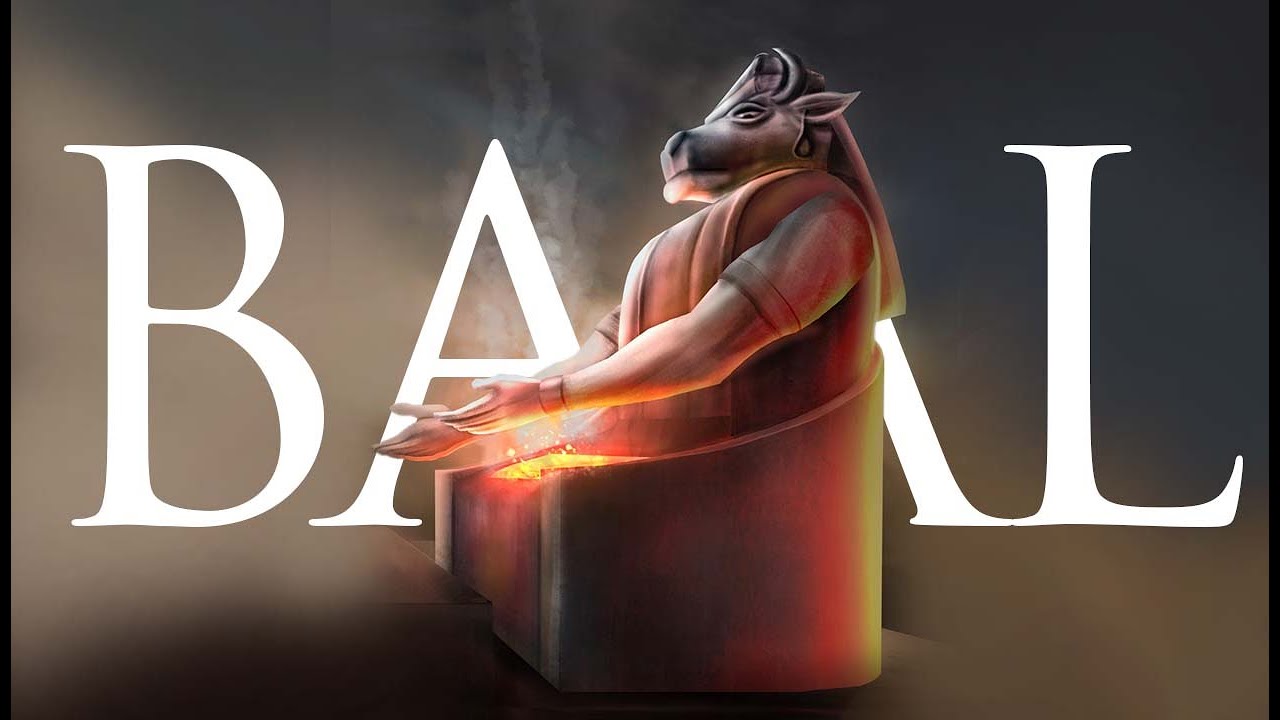
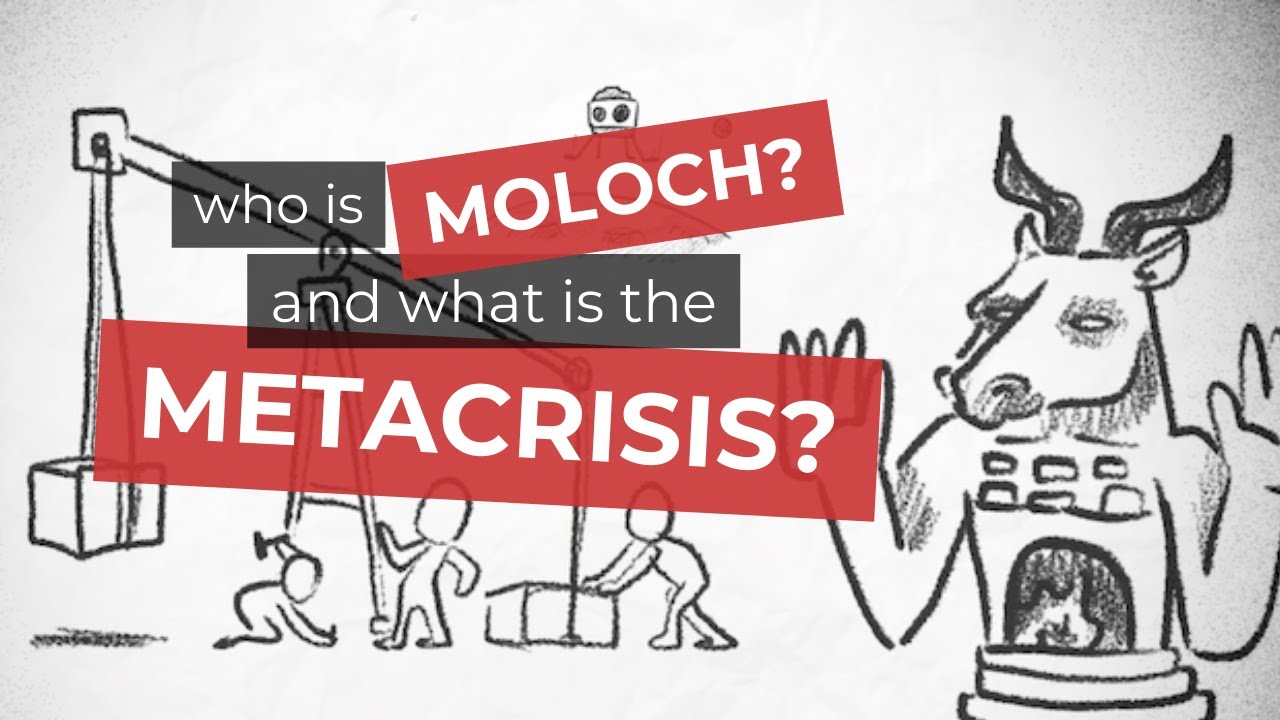
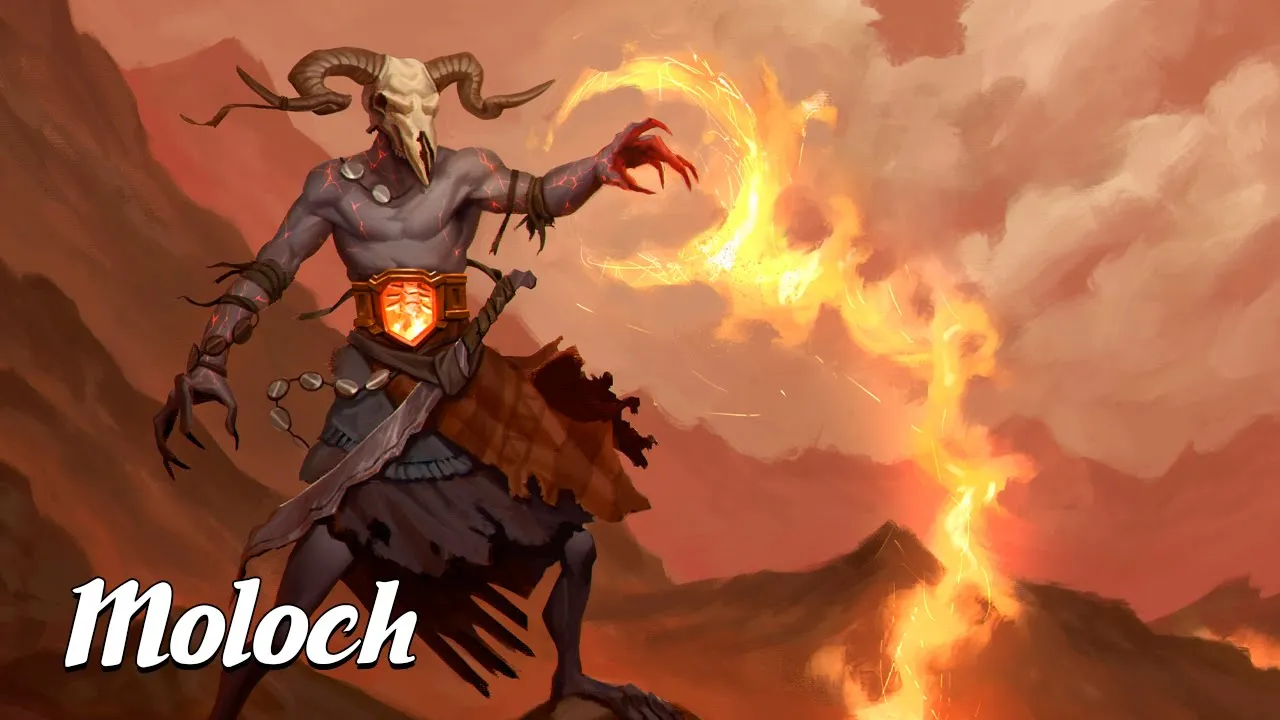
Flaubert describes a statue of Moloch as being made of iron and that he possessed a pair of outspread swings. His arms were so long that they reached the ground and he had three eyes positioned on his brow. He also maintained the traditional bull’s head as frequently seen in medieval art and his head was raised as if he meant to go about barking terrible orders.
He also explains later in the novel that another statue was brought into the city centre of Carthage and that it was used in an attempt to calm down a storm that had brought pouring rain. Sacrifices were made before the statue; first grain and animals which were placed inside the statue but when that did not silence the rain, children were offered next. Flaubert writes, “The victims, when scarcely at the edge of the opening, disappeared like a drop of water on a red-hot plate, and white smoke rose amid the great scarlet colour.
Nevertheless, the appetite of the god was not appeased. He ever wished for more. ” But Moloch’s appearance in John Milton’s Paradise Lost and Gustave Flaubert’s Salammbo are perhaps more fanciful takes on a being who is mentioned only a handful of times in the bible - primarily in the book of Leviticus where he is associated with child sacrifice.
Some have determined Moloch as a demon - which is debatable when considering the likes of the Moloch from John Milton or the medieval portrayal of Moloch that saw him depicted as a bull-headed humanoid creature. The very image of this medieval portrayal does connote a typical demon-esque vibe, where we see him frequently stretched over fire with his hands ominously raised, before a sacrificial child. But a more traditionally biblical approach treats Moloch as not so much a demon but more of a false God - perhaps one of the Canaanite gods.
But this idea has since been debated with some scholars arguing that Moloch was never actually a deity, but instead a ritual known as ‘mlk’, which essentially meant ‘sacrifice’ in the Punic language and the surrounding Canaanite areas. Other scholars propose that the root word ‘mlk’ also meant ‘to rule’ and that this formed the basis of Moloch’s creation, though neither of these ideas are particularly substantiated. Amongst these ideas, it has also been proposed by various scholars that ‘mlk’ translated as ‘to present’ or ‘to gift’, though there is little evidence to support these ideas.
Moloch has also been connected to the Mesopotamian deity Mlk - or better known as Malik, he who was associated with the Underworld as an Underworld god. The terms molk or mulk were also considered to be a type of sacrifice that were again closely related to the Canaanites, but yet again there is little in the way of substance to fully comprehend these terms or assign them to Moloch. But as far the bible goes, Moloch or Molek is most certainly identified as a deity.
We see this quite clearly in chapter 11 of the first book of kings where Solomon is cautioned by God not to mingle with the women of the Moabites, the Ammonites, the Edomites, the Sidonians and the Hittites, for they all worshipped different gods and they would corrupt any man who spent enough time with them. The passage reads, “They were from nations about which the Lord had told the Israelites, “You must not intermarry with them, because they will surely turn your hearts after their gods. ” Nevertheless, Solomon held fast to them in love.
He had seven hundred wives of royal birth and three hundred concubines, and his wives led him astray. As Solomon grew old, his wives turned his heart after other gods, and his heart was not fully devoted to the Lord his God, as the heart of David his father had been. He followed Ashtoreth the goddess of the Sidonians, and Molek the detestable god of the Ammonites.
So Solomon did evil in the eyes of the Lord; he did not follow the Lord completely, as David his father had done. (1 Kings 11:2-6) So here we see that despite hearing God’s warning, Solomon could not resist marrying many of these women and making many others his concubines. Amongst them, he also married women of the Ammonites, who the bible tells us worshipped Molek,- a detestable god, and that Solomon ended up worshipping him too.
We understand that by worshipping these other gods, including the god Molek, Solomon did evil in the eyes of the lord and for those of you who’ve been following the Biblical Stories Explained series, you’ll know that the biblical god takes polytheism as a serious slight against him. But in any case, we are able to pinpoint the region in which Molek was worshipped; that being the region of Ammon. However, some have disputed the use of Molek here in the bible as a scribal error, where the god Milcom is proposed instead - Milcom being recognised as the region’s national god.
In any case, the bible does continue that Solomon went on to build a temple in honour of Molek. We are told, “On a hill east of Jerusalem, Solomon built a high place for Chemosh the detestable god of Moab, and for Molek the detestable god of the Ammonites. ” (1 Kings 11:7) But these temples do not remain standing forever, for by the time Josiah comes on the scene in the chapter 23 of the second book of kings, we see him destroy the buildings that Solomon had made for Molek.
The bible tells us “The king also desecrated the high places that were east of Jerusalem on the south of the Hill of Corruption—the ones Solomon king of Israel had built for Ashtoreth the vile goddess of the Sidonians, for Chemosh the vile god of Moab, and for Molek the detestable god of the people of Ammon. Josiah smashed the sacred stones and cut down the Asherah poles and covered the sites with human bones. ” (2 Kings 23:13-14) We also previously see Josiah proceed to destroy the Topheth in the valley of Ben Hinnom which was used by the worshippers of Molek to sacrifice children.
This appears to be confirmation from the bible that Molek was indeed a deity who required child sacrifice - something that the biblical God had always detested and condemned. The use of fire is also mentioned here in the bible and this links in with the medieval portrayal of Molek who as mentioned is usually seen before a burning fire and a child. The bible tells us, “Josiah desecrated Topheth, which was in the Valley of Ben Hinnom, so no one could use it to sacrifice their son or daughter in the fire to Molek.
” In chapter 32 of the Book of Jeremiah, we learn of God’s disgust towards the people of Israel and Judah who have engaged with both Baal and Moloch. God not only expresses his frustrations with Israel, to the point that he wants to remove it from his sight entirely, but also condemns them for worshipping other deities over him. He states, “They turned their backs to me and not their faces; though I taught them again and again, they would not listen or respond to discipline.
They set up their vile images in the house that bears my Name and defiled it. They built high places for Baal in the Valley of Ben Hinnom to sacrifice their sons and daughters to Molek, though I never commanded—nor did it enter my mind—that they should do such a detestable thing. ” (Jeremiah 32:33-34) So here, we see that even God is surprised by the fact that the people of Judah had even bought into the ideas of the Ammonites and that instead of turning to him for prayer, worship, guidance or strength, they had instead turned to the likes of Molek.
They had sacrificed their children to him and paid homage to a god who demanded a heavy toll in the form of their offspring’s lives. The bible yet again paints Molek as this devourer of children, though it is interesting that God does not put the blame on this other deity, but instead puts the blame on those who chose to adhere to him. It is in Leviticus that we see the most frequent use of Moloch and the most frequent condemnation of him where he is yet again associated with child sacrifice.
We are told in chapter 18 of Leviticus “You shall not give any of your children to offer them to Molech, and so profane the name of your God: I am the Lord. ” (Leviticus 18:21) Here, readers are cautioned against giving their children to Molech and that to do so would sully their relationship with God and serve as a great disrespect to him. Whilst still in Leviticus, we see God explaining to Moses of what will happen to any man who sacrifices his child to Molech and that the man in question will surely be put to death - via stoning.
In fact, God declares that he will cut the man off from his people himself - thus showing us the magnitude of this transgression, that God himself will personally see to the man’s punishment. He also explains that if this man is not stoned and if he is allowed to walk free, then God will take vengeance upon his entire family and reckon upon those that absolved him of his sins. We are told, “The Lord spoke to Moses, saying, “Say to the people of Israel, Any one of the people of Israel or of the strangers who sojourn in Israel who gives any of his children to Molech shall surely be put to death.
The people of the land shall stone him with stones. I myself will set my face against that man and will cut him off from among his people, because he has given one of his children to Molech, to make my sanctuary unclean and to profane my holy name. And if the people of the land do at all close their eyes to that man when he gives one of his children to Molech, and do not put him to death, then I will set my face against that man and against his clan and will cut them off from among their people, him and all who follow him in whoring after Molech.
” (Leviticus 20:1-5) Going by what the bible tells us, Moloch can certainly be viewed as pagan deity, a deity who demanded his followers to sacrifice their children to him. But according to medieval rabbinical traditions, Moloch could also have been connected to an ancient Phoenician and Cathaginian deity - a view which later evolved into viewing Molek as the ancient semeitc and or mesopotamian gods Adrammelek and Anamelech. As previously mentioned, Molek in the bible may also have been a misinterpretation for the Ammonite God Milcom.
Indeed, as we’ve discussed in today’s episode, Moloch’s place as a specific deity or a particular practice as a sacrificial ritual is often contested. One of the main reasons for this is because Moloch only appears a handful of times in the bible and whilst his description is consistent and the notion of child sacrifice is consistently associated with him, he does not appear to have any relevance outside of the bible. He cannot be pinpointed to a specific group of people and whilst some may try to link him with various Mesopotamian gods or Canaanite deities, none appear to be absolutely certain.
![The Seven Sisters of the Underworld [Testament of Solomon] (Angels & Demons Explained)](https://img.youtube.com/vi/y-agd9kAfv0/maxresdefault.jpg)
![Azazel: The Angel Who Corrupted Man [Book of Enoch] (Angels & Demons Explained)](https://img.youtube.com/vi/BX87Nrdz4rg/maxresdefault.jpg)
![The Demon Onoskelis [The Testament of Solomon] (Angels & Demons Explained)](https://img.youtube.com/vi/D_h-UFgD26M/maxresdefault.jpg)