Hi everyone. Unfortunately, I've had to re-record this revision seminar, but I'll be covering the exact same content as we went through on Friday. So, I'll just get started. So, first I wish to acknowledge the people of the cooler nations on whose land I join online today, and I pay my respects to their elders, past and present. A word on academic integrity. The MESH LSS strictly condemns academic misconduct and has a zero zero tolerance policy for people who are found to have breached their academic integrity by misusing our educational services. Please consult the LSS website for
more information regarding our commitment to academic integrity. These tutorials are a purely supplementary resource and are not to be used as a substitute for faculty run classes and I'd also like to thank our Sponsors Gilbert and Tobin Cers Chambers Weskar Clayton Utes and King of Melisons. Right. So we are going through the 2019 exam. Um it's 60 marks in total and comprises of three questions each with a few sub questions. So we'll start with question one which is 22 marks in total. So green's limited. Oh, just also a note. Um, every time I've I've bolded
um some words in the questions, just um things That I think are important because I think it helps um illustrate my thinking uh and how I might annotate a question. It's it's very rudimentary, but I thought it would help to see nonetheless. So, Greens Limited was a large manufacturer of green consumer products. At its peak, Greens employed 300 people and had annual revenue in excess of going to say 250 million. In early 2018, Marsha Klene, who is the managing director, invited a finance Expert called Daisy to join the board as a non-executive director. Daisy did
accept this invitation and was officially appointed in September 2018. Marsha was considered a dynamic and innovative leader within the industry and she had seen the company through a number of political and social challenges during a time when eco-friendly businesses were regarded with suspicion. Because of this, she held sway over the board and was Considered the company's chief strategic thinker. Uh Daisy, on the other hand, uh she's an experienced public accountant, has worked for a number of other large organizations. And Marsha believed that with its increase its increasing market exposure, the company needed Daisy's um financial
expertise to help the rest of the board with its oversight functions. So at the first board meeting, Daisy was asked to conduct a review of the company's Financial affairs. Daisy undertook the review and was shocked to discover that although the company had reported a small profit for the 2016 and 2017 financial years, these years had been disastrous for the company. The profit recorded was only due to the substantial capital gains obtained for the from the sale of a number of the company's most significant assets. In turn, these major assets were leased back to Greens from
their new Owners at commercial rates. Although Daisy searched through the minutes of the previous director's meetings to see why these decisions had been made, she could only she could see only limited analysis for the financial aspects of the decision-making process. Rather peculiarly, Daisy noticed that two of the company's display homes with a combined value of four million have been transferred to Mike Klein, who was Marsha's son and a creditor of Greens in June 2017 in return for consultancy services offered at a part-time basis for 3 months. Operational losses continued in 2018 and as a result,
the company took out a number of large loans. Green struggled to repay these loans as the company's fortunes continued to deteriorate. Daisy's review indicated that the company had accumulated operating losses of approximately $155 million. Daisy circulated this report to the board and They discussed it at the next board meeting. When addressing the board, Daisy emphasized the potential for liquidation if things did not approve. She suggested that the best way forward would be to immediately appoint a voluntary administrator. Sorry, it's long question. It's the last bit. So Marca had not read Daisy's report but opposed the
appointment of a voluntary administrator and she gave a powerful Speech pointing to her previous navigation of the company through difficult times. Marca put forward her own report that did not address um the precarious financial position but instead outlined new product rage and who which she thought would return the company to profitability. Marcher con concluded her speech with a call for loyalty and courage in the face of difficulties and asked the other directors to think of their obligation To the company's employees and the need to trade out of its difficulties. She believed that it was the
duty of all directors to make bold business decisions even though there was risk involved. The board members, apart from Daisy, voted in support of Marsha's plan. Uh Tim Klein, who is Marsha's husband and a non-executive director, did not attend the meeting because he claimed to be ill. He was feeling unwell and planned to travel to a meditation Retreat in Asia to recuperate. On a number of occasions, Tim had emphasized his lack of understanding of financial matters, and as a result, he usually followed Marsha's lead when finances were discussed. He did therefore not feel the need
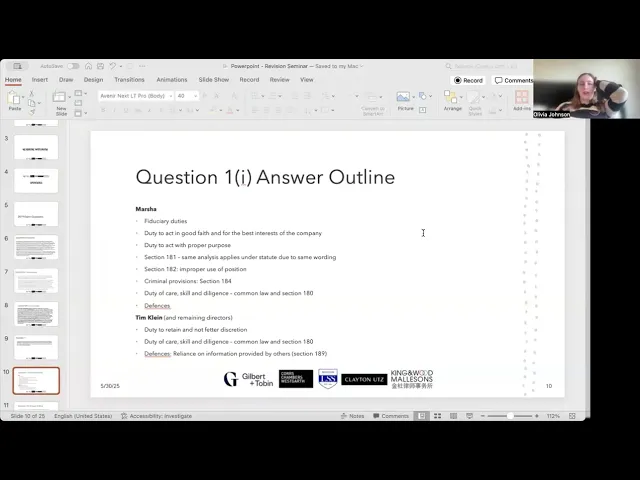
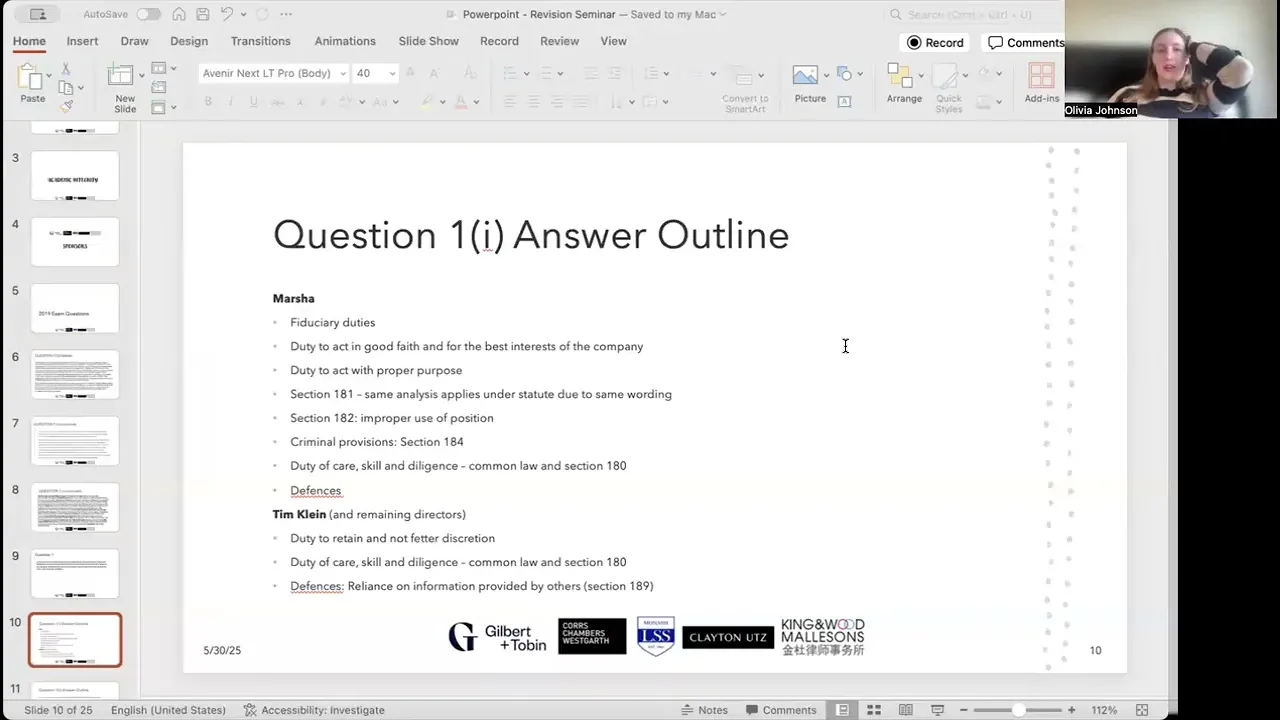
to participate in the meeting. Um, and the following month, Greens went into liquidation with $180 million in losses. So, question 1 A. Um, oh, it's all sorry, it's all Combined. Yeah. Question 1 A. Daisy is concerned about her personal liability for the company's losses. So, she seeks legal advice. Um I whether any of the directors may have breached their duties to the company and I I whether any of the directors may be personally liable for the debts of the company. So I broke this down um by each director as you can see on the slide.
I've only kept Maru and Tim Klein on there but I do I would quickly discuss Daisy um as well. So we'll start with Marsha. So I decided to begin with fiduciary duties as I think it's the easiest way to get kick started. So um first way you can breach a fidiciary duty as a director of company is by um putting yourself into a position of conflict. That's the conflicts rule. And I think she has done so by transferring properties worth $4 million to her son in exchange for consulting service services. Now because um Greens is
a Public company, it means we can um start talking about related party transactions um section 2082829 of the Corporations Act. That's why it's important to always make sure you know whether your company is public or private because it um different parts of the legislation will apply. So, uh the related party transactions provisions apply because Greens is a public company. Marsha gave a financial benefit to her son. So, it's a financial Benefit because it falls within the definition of financial benefit in section 2293A cuz she's passed the property to her son and her son is uh
defined as a related party in section 228 because um he's her child. And there are no exceptions for arms length terms in section 210 because um the consulting contract would have never ordinarily existed as a matter of commercial reality because there's no way you could receive $4 million worth in properties Um in exchange for 3 months of consulting contract work. So, it's definitely not um an arms length um term exception. And uh for similar reasons, it's also not reasonable remuneration for an employee. And that comes from that's an exception in uh section 211. And of
course, because this remuneration is it's a lot of money or a lot of value. It's definitely not reasonable. And um she did not um she did not Um stop voting at decisions that were related to this and she did not disclose her um related party interest. So that is a breach for Marsha and tech. You could also quickly mention the prophet's rule as well, but because she herself hasn't made a prophet, it's her son, I wouldn't spend too much time on that. The conflicts rule is more relevant here. Um, and the next duty we'll look
at is a duty at um both common law and Statute. So, it's the duty to act in good faith for the best interest of the company. In an exam, I just put a sentence um where some duties have common law and statutory equivalence. If they are substantially the same and they have the same case law discussing them, then I would um I would put a sentence at the start just saying um the test for blah blah blah is substantially the same at common law as in statute. So, I'm going to discuss it through common law
For example. So for this duty to act in good faith and for the best interest of the company, the specific breaches that could have occurred are the transfer of the properties, the decision not to appoint an administrator and not reading Daisy's financial report. So those were some breaches I identified. Um this is a subjective test with an objective underpinning and that comes from the case of Hutton and West Cork. And so we're looking at um what Did Masha actually think but was she reasonable for thinking that way? So the what are the best interests of
the company? So they are the shareholders financial interests and that's from Mills and Mills um because there's no familiar character of familial character of the company and Marsha makes a statement saying that um the best kind of the best interests are related to the employees interests but that um isn't true and that's Substantiated by the case of park and daily news. So I would say that definitely the transfer of the property she has not acted in good faith and that's also not for the best interest of the company and um the other two breaches not
appointing an administrator and not reading Daisy's financial report I think they both um while they may have been undertaken in good faith they were not for the best interests of the company. So, Um, because of that, if it were a subjective test, maybe she'd be let off the hook, but given it has that objective underpinning, I think she would definitely be caught out by this rule. So, the next um, uh, director's duty we'll look at is the duty to act with to act for a proper purpose. And a breach I found here would be um
the transfer of the properties because of um this duty. It's talking about impropriety and the purpose which you Make decisions. I don't think that the decision to appoint an administrator or not reading the financial report. I don't think um those were made for an improper purpose. It may have been silly or negligent but I don't think it amounts to an improper purpose. So we'll look at the transfer of the properties only. So we're looking at the substantial purpose test from Howard Smith which says that um if the substantial purpose was um an improper Purpose even
if there was partially another purpose then that will be um the improper purpose. So the substantial purpose of this transfer was to benefit her son. Even though he it's true he does deserve some reasonable remuneration for his work. Um and because he is a creditor that still isn't enough to render this action um proper. So I think this duty is breached. And uh statute just have a look at section 181. And the next one I'll look at is um now a statutory provision which is the improper use of her position in section 182. So Marsha
improperly used her position to gain an advantage for her son um through transferring the properties and this also caused a detriment to the corporation as she used her influence to get the board to make a um let's say negligent poor stupid financial decision. So um I she used her position just as a Director or managing director to transfer the property and then she also used her position as someone with a lot of influence um to influence the board. So the what's required in section 182 is either gaining an advantage or um causing detriment to the
corporation. And I think both different acts um bring up those two points um in section 182. And this is an objective test um from Chu and um the queen. So I think this is definitely um a breach of this section Given I think objectively what she's done is not um is not right and she's used her position to do so. And we'll note from section 184 that um the certain breaches will be um criminal. So um one when Marsha was dishonest and did not exercise her duties in good faith and the best interest of the
corporation that is a criminal offense provision. And when she used her position to gain an advantage Or cause detriment that's also u a criminal provision. So the next duty I'll look at now is the duty of care, skill and diligence which again is at common law um and it's also found in section 180 subsection one. So the breaches um of this duty is not reading the financial report prepared by Daisy. Second one would be not considering um adequately whether an administrator is needed. um making bold business decisions. Um and you could probably also extend that
to like over the past two years not um not knowing how far in um how how their losses were up to $155 million. So I think there's a lot of different facts you can point to because care, skill, and diligence. This is more it's not the same as negligence, but it the language is more similar to that um versus the um duties we spoke about earlier which a lot of them are more about intention and impropriy. So this is a little bit Different. Um so from Daniels and Anderson this is an objective test and that
case also said that all directors need basic business understanding which will come um in more strongly with the discussion with Tim Klein and um from Daniels and Anderson as well because she's an executive director a slightly higher standard um may apply to her. She might be held to a higher standard um than a non-executive director. So just have a look at Daniel And Anderson for those principles. So I think that she has definitely breached his duty because she has not um applied she has not met that duty of care that she owes by um knowing
financially what's going on. So I mentioned this before, but just from section 191 when we were talking about um the transfer of the properties. So from section 191, Marsha had a duty to notify the other directors of a material Personal interest where the conflict arose by transferring the properties to her son. And these details needed to be recorded in the minutes of the board meeting. And we know that Daisy was not able to find that in there. So she has definitely breached section 191. We'll have a look at defenses for her. So there was no
disclosure of her interests occurred. No disclosure of her interests occurred. Um so there was no consent. It's from Regal Hastings. And the statutory business judgment rule in section 180 subsection 2 um would allow Marsha to be um not essentially pardoned for what she's done if she um has tried to make a decision that um maybe it doesn't work out but she's made a business judgment trying to get the company back on its feet. and she would definitely argue this because she's come up with a new product line and she thinks it's going to do really
well. However, um a prerequisite for this defense is um being reasonably informed about the company's circumstances. And because she hasn't, um read, um Daisy's report at all, she doesn't know how much trouble the company is, Marca cannot rely on this defense because she hasn't reasonably informed herself um because she hasn't read the report. So, I would say that there is no defense available um to Marsha. Excuse Me. So, the next one we'll look at is Tim Klein. So, everything about him is just being kind of incompetent, not diligent and not just not being available and
present. So the first duty I looked out for him um was the the duty to retain and not fed discretion common law duty. So the breach of this duty could be him always following Marsha's lead and not attending the meeting and the duty to retain feta discretion um provides an Obligation to give adequate consideration to decisions in which you should be involved. And um so the board itself must retain discretions and not give them to others. So because he has always followed Marsha's lead, he doesn't really understand financial matters. He and he didn't attend the
meeting. He did not give adequate consideration um to a decision he to a decision. He has not voted at all. So I think that he Definitely has not retained his discretion at all. he's essentially almost delegated it or completely um let it dissipate because he's not even there. He's not um voting in these decisions. So I think that's a breach there. And the next one that's also relevant for Tim that was also relevant for Marsha was the duty of care, skill and diligence under common law in section 180 subsection one. Um, but for Tim, the
breaches of this could be not Understanding financial matters. Um, not not voting and um, just kind of listening to what his wife says and not really knowing what's going on. This is an objective test from Daniels and Anderson. And that case said that all directors, even though he's a non-executive director, he needs a basic business understanding and understanding of the financial state of the company. like that's the lowest um standard that they're expected to uphold. So the fact That he cannot uphold that standard, it's kind of primacy a breach of this duty given his position
in the company. Um and that's also backed up by Azac and Rich and um Azac and Healey that case specifically said that he needs to be able to read financial statements. So I think that also comes into his lack of understanding for financial matters. So um Tim Klein may try to argue a defense in his favor. Um for example, the defense in section 189 Which allows um exoneration where you've relied on information provided by others. Um, so he'd say he's relied on Marsha because he believes she is competent and has managed through difficult times. Um,
but it's not like even though he may think maybe the company's doing well, the fact that I think the fact that he's breached that duty of care, skill, and diligence by not having a basic business Understanding, breaching that duty and saying that I'm relying on someone else because I'm incompetent, I that doesn't really cut it for the purposes of section 189. Um and there's also likely no reasonable grounds um for his belief. So that's part of section 189 needs to need the belief needs to have reasonable grounds. And even though subjectively he believed that Marsh
is competent because um in terms of objective reality the company she probably isn't competent Because the company has been um operating at a loss for a long time. there are no reasonable grounds for his his belief and um arguably he's also um relied too much on the information provided by Marsha because he has essentially fully feted his own discretion delegated his duties and that's from Azac and Healey. So I think they've um both Tim and Masha are in trouble. Um Daisy herself um she Cannot be the first point to make is she cannot be held
accountable for anything that happened before when she started as a director and she started in September 2018. So that's Sheen and Vero that case for that principal. I said there are likely no breaches. She's, you know, she's been diligent. She's done her job. No breaches of fidiciary duties, anything like that. She none of her activity has been a problem. Um, I also noted quickly that um, so Daisy is a Finance expert or like an accountant, so she probably has some special skills. And from gold ribbon, it implies that if you have special skills as a
director, you should be using them and you're held to that higher standard um in terms of your duties and meeting the standard for your duties. And I think that she's done everything she's been told to do. Um she's looked through the financial statements and um found what's been going on. She's definitely utilized her Special skills adequately. There's no issue there. So, I think Daisy is 100% fine. And um the other unnamed directors, because the question implies that it's not just the three of them on the board, there's other directors there. I think they're guilty of
similar things to Tim Tim Klene. Um he they have always followed Marsha's lead. They're very gullible to her um influence. So, I think they've probably breached the duty to retain and not fed discretion. the Duty of care, skill and diligence. Um, and they aren't able to rely on any defenses as well. So, this is the second part of the question asking whether any directors would be personally liable. So, um, I've put in any directors personally liable under the insolvent trading provisions. So that isn't in the question, but um you'll know from your notes that um
you can be personally liable um that so when It's speaking about personally liable for things and there's insolveny then your head should automatically be thinking insolvent trading cuz that's where the corporate veil will be lifted and directors will be um liable personally. So that's what that question is getting at. So um we'll have to go to section 588G and that states that directors will be personally liable if they are the director of a company when the company Incurs a debt. So that's the first thing we need to figure out. The company is insolvent at the
time or becomes insolvent by incurring their debt or um incurring multiple debts including that debt. So we'll have to make sure that's true as well. and C at the time there must be reasonable grounds for suspecting that the company is insolvent or would so become insolvent. So we also need to have a look at that. So we need to break down each of those three Elements for um the directors. So um the directors here I'm not considering them separately until um each step will cause us to treat them differently based on their behavior. So um
all the directors we're looking at are Marsha, Tim, Daisy, and then the other unnamed directors. Um the directors is defined by section 9. So the first um point we'll look at is um whether the company incurred a debt. So PAL and Frier that case says a debt is an obligation by one person to Pay a sum of money to the other. And uh from Hawkins and Bank of China, a debt is incurred when a company so acts to expose itself contractually to an obligation to make a future payment of a sum of money as a
debt. So um what I initially thought about as incurring the debt would be entering into um those loans. Let's go back to the facts. Where is it? Yes. So, um, the company took out a number of large loans and they struggled To repay them. So, I would say that that definitely meets the definition of incurring a debt. And even if it isn't the debt that pushes them into insolveny, um, section 5 588G says that um, incurring a debt can mean incurring debts including that certain debt. So given we've got one, we're we're happy. So the
next thing we need to look at is the meaning of insolveny cuz company needed to be insolvent or became insolvent. Section 95A says that a company will be insolvent if it's unable to pay its debts when they fall due. Um but a case called Barb Buddhist and the C Center Proprietary Limited says that if a company uses financial aid to pay its debts for example a loan that um will be okay they won't be insolvent as long as there is a genuine and realistic availability of funds as a matter of commercial reality. So at this
point um given that they've they have been Experiencing losses for 2 years they um the only profits they have gotten is due to capital gains um through the sale of its major assets. They are struggling to repay a loan. Um I would say that's pretty close to insolveny if not insolveny. We probably need a little bit more to get it over the edge because this insolveny um or pushing into insolveny needs to occur at the time um the debt was incurred even though we know eventually Does go into liquidation. Uh we need to be able
to point to a cause causitive element between incurring a debt and becoming insolvent or being insolvent. However, um there's a useful presumption we can use here. So section 588E subsection 4 um sets out a presumption of insolveny where the company has for a time contravened either section 2861 or two by failing to keep or retain For seven years financial records that were sufficient to enable the company to correctly record and explain the company's transactions, financial position and performance. So this presumption is essentially saying where um a company has not been keeping financial records that actually
explain what's been going on in the company, there is a presumption of insolveny for that time. And we know from the facts that Daisy wasn't able to Find any um financial like adequate minutes of the director's meetings that explained why certain decisions were made and they also didn't have financial records that explained the financial position of the company. I think that this is definitely being breached and because of that we have a presumption of insolveny and I think that is definitely enough to get them over the line um at the at the same time as
when the loans were taken out and when the debt was Incurred. So the next requirement is the director's knowledge. So there needs to be reasonable grounds for suspecting insolveny. So the first person I'm going to start with is Daisy. So she definitely has reasonable grounds for suspecting insolveny. She knows there's a big problem because she's actually done the work and is diligent enough to know what's going on. Um the other directors will try and argue that oh you know we Knew there's a problem but we thought we could trade out of it. We didn't um
know that we didn't suspect insolveny. But the f the requirement in 588G is reasonable. There needs to be reasonable grounds for suspecting insolveny. It's not subjectively whether they did suspect um insolveny. So the fact that all of the um indicia of insolvency that Daisy has found those constitute reasonable grounds for the other Directors even if they don't listen to her they ignore everything and they're incompetent. The fact the reasons why Daisy knew constitute reasonable grounds. So because of that all of the directors did have reasonable grounds for suspecting insolveny. Definitely. The next element is a
failure to prevent incurring a debt. I'm just seeing where is Yep. So, yeah, failure to prevent incurring a Debt. So, this is where we'll have to treat the different directors differently. Um um so we I don't know if we can fully um get Daisy out here. We might have to look at it more in defenses, but Daisy did vote against the decisions. She did what she could. Um, but she, you know, I I don't know if that's enough because the technically she did fail to prevent incurring a debt, but so I'm going to look at
this what she has done right more in defenses. So um the other directors Marsha Tim and the others they've definitely failed to prevent incurring that debt and as a compliment says that inactivity by directors will also count as a failure to prevent incurring a debt. So Tim being away and not knowing what's going on that he's included in this. So now we'll look at defenses. So um I'll look at Daisy first. So she's Taken reasonable steps to prevent the debt being incurred and that's from section 588H subsection 5. So right off the bat because of
what she's done, she's completely exonerated here. She has done everything she can to um prevent um the debt being incurred. Ashley, was she here when they took out? No, she wasn't actually in 2018. They took out loans, so it's unclear whether she was there for that, but um she has, if we also Look at debts, including um taking on more liability and contracts and things like that to get the new product line up and going, she's definitely um taken reasonable steps to prevent that being incurred. um the others. So they might have um so Tim
specifically, we'll start with him. So he is absent from management. He might try to rely on the defense in section 588 H4. Um, so this needs like a really good Reason and given that he's on a wellness retreat in Asia to recuperate that his illness is likely a fast and it's probably not as serious to excuse the absence from management. Um, the case of deputy commissioner of taxation in Clark says that directors must be present and competent and cannot rely on just not being there and cannot just defer to his wife. So it's very similar
situation to that case. So um Tim is not able to rely On the absence of management defense. Um Marsha might try to rely on safe harbor section 588 GA. However, because she has not properly informed herself of the financial position of the company and she hasn't taken steps to ensure that proper financial records are taken, which is from subsection two of that section, she will not be able to rely on that defense. So, I think the only person um who is won't be personally liable for the insolveny is Daisy, unfortunately. And there was a quick
form question at the end of that and it just says Daisy would like advice regarding assets the liquidator might might try to claw back as part of the winding up process. So this is speaking about um so we're looking at assets not money. So um this will be the two display homes that were um given to Marsha's son in breach of her fidiciary duties and because of that maj's breach of duty breach of duty and The third party receipt of the property by her son will likely give rise to a constructive trust. um which would
mean that her son would hold the 4 million properties on trust for the benefit of um the creditors to the company. So um but also note that her son is technically also a creditor of the company. So he you know he should get his money back if there's 4 million um that the liquidator can call back. So that for that look at the case of Westpak and Bell Group that's essentially what happened in that case and just gives authority to the fact that a um when there's knowing receipt by a third party. Yep. So knowing
third party receipt and we assume he did know um a constructive trust can arise um for the benefit of the creditors allowing the liquidator to call back those assets or the value of those assets. So now we'll start with question two and that is um total of 18 marks. So Bernard Black operates Blackbooks Limited, which is a retail book seller um with a share capital of a million dollars. So 700,000 of them are ordinary shares um each $1, and 300,000 of them are preference shares, each worth $1. It's all fully paid. Bernard's family, whose members
are a majority of the company's directors, own the majority of the ordinary shares. There's a family friend called Fran Katson who is also a director and owns all 300,000 of the Preference shares. And under the constitution, each share carries one vote irrespective of its class. The difference is that um any preference shareholding shareholder owning at least 25% of the company's issued capital is entitled to be appointed as a director. That makes sense by Fran's a director because um she holds 30% Um so Bernard and Fran start to argue about the director of the company because
Fran wants to do online um books But Bernard is a traditionalist and only wants paper books. So he convinces the majority of the board to um turn against her. And then later Fran receives a notice for an upcoming board meeting which calls for a vote on the following proposal to issue shares for the company. And the proposal says that the company offer a further 1 million preference shares with a $1 issue price to existing ordinary shareholders. The preference shares would rank equally With existing existing preference shares. Um so the question question 2 a says that
Fran is seeking advice on whether the company can vote on this proposal and if so what procedure they would need to follow. So is this something that can happen? Um the first thing to note there there are a lot of different topics in the course that talk a little bit about shares constitution things like that and Cases that are kind of similar to this. So it's important to know specifically what avenue you're looking at this at. So the first thing I want to say is that this is a proposal a proposal to raise new shares.
it isn't um a change to the constitution. So, we're not going to be looking at um whether a change to the constitution is fraud on the minority. That isn't relevant here, unfortunately, because I sure we all spend a lot of time studying for that specific Question. Um, but here we're more looking at whether this amounts to a variation of class rights or whether it's just a variation of the enjoyment of those rights because that gives Fran um different um different options. So section 246b says that if a class rights are varied, it will um require
a special resolution of 75%. So that is a different um voting procedure and Fran would definitely Argue it changes her rights because um she used to be the a director by virtue of her um 30% shareholding in the company. Um let me just check that. Yeah. So any preference shareholder earning at least 25% of the capital is entitled to be appointed as director. So with this share issue, she's no longer going to have that um that um benefit which comes from the constitution but is not changed in the constitution. So um Fran would also need
To consent if it's a variation of class rights because she is the only one in the class right now. So that's from section 246D. So the two case, the case I first looked at was White and Bristol Airplane Co. and they in that case they found that an issue of new preference shares constituted a variation of the enjoyment of rights only because the rights attaching to the original preference shares did not change. And that's the Same as in our case because um the preference shareholders still have the exact same rights. If you own 25% of
the company, you'll be a director. They're all a dollar. It's all everything ranks equally. That's what it says in the proposal. So, um, common law is not looking good for Fran. However, we'll have a look at section 246 C subsection 6. What it says is if a company issues new preference shares that rank equally with existing preference shares. So tick That's what's going on here. The issue is taken to vary the rights attached to the existing preference shares unless um the issue is authorized by the constitution or like the terms. Um there are no facts
to indicate that this was pre-authorized. So something brand new is going to happen new could happen. And because of that um that it's taken to be a variation of rights, not a variation of enjoyment of rights. So because of that, as we stated Before, it'll now need France's consent as the only person of the preference shareholder class and a 75% um resolution. So company can vote on this but the procedure they have to follow is um a lot more restrictive so it probably wouldn't work out and um I also just mentioned that if this goes
ahead under section 254X they will have to give notice to Azac of the share issue. So next question. So after Discussing the proposal, Fran and Bernard agree that it would be best for Fran to leave the company and a group of investors has impro approached her to buy her out. However, the investors require a loan to purchases. So Bernarda obtains the approval of the remainder of the board to offer a low interest loan to the group of investors to purchase the shares. Manny Black, who is one of the other family members and a shareholder, is
worried about the Proposal and he believes that the loan is being made at a bad time because they need to pay a number of creditors in the upcoming months and he's worried that they won't be able to make these repayments um if they offer these loans at low interest. So, are there any issues with this approach? So here what we're looking at is financial assistance to buy shares. Um no buybacks because the company isn't buying back um the shares itself. No Issue with capital maintenance anything like that. Looking solely at financial assistance to buy shares.
So um at common law so from the Canara and ENQ group case it says that financial assistance to buy shares is permitted if it does not materially prejudice the company's ability to pay its creditors. Um so I'll just go through this statutory provision as well because um they're quite similar. So section 260A says that a company can financially Assist a person to acquire shares in the company if giving the financial assistance does not materially prejudice the interests of the company, its shareholders or the company's ability to pay its creditors. Um or the assistance is approved
by shareholders under section 260b or the assistance is exempted under section 260 C. So that includes um ordinary commercial transactions on ordinary commercial terms. So um Subsection A of section 260. So giving the financial assistance does materially prejudice the interest um the company's ability to pay its creditors as is stated in the facts. They probably won't be able to pay off creditors in the upcoming months. um and they there is no approval by the shareholders yet. It's only um the directors that have done it and the assistance isn't exempted. So um based on that this
financial assistance would Not be permitted and this also does bring up a point with insolvent trading um if they're not able to pay their debts as they full due arguably um the directors will be personally liable for that. But given we've um had a question on in so trading previously in the exam, it's not going to be um worth many marks here. So maybe just mention it. Okay. So question 2 C. Assume that the investors buy out Fran and Bernard Is right. the paper book market booms again um which raises interest from multinational companies which
want to take over local book sellers and move their um stock online. So one retailer called Vald Divian has been aggressive in Australia and has approached a number of investors in Blackbooks to purchase their shares and um the investors have lobbyed their fellow investors to sell as a block to valian and extract a higher price. So Bernard and the remainder of the black family are worried about these takeover attempts. They would like to issue ordinary shares to black family members who would oppose any takeover attempt. Raising further capital would enable the company to expand into
new markets and ensure that the company can continue to operate successfully. And it would also ensure that the black family retain their position within the company and avoid the need to work with shareholders That have um very different long-term goals to the family. vise Bernard whether there are any legal problems with um the share issue six marks. So here we're looking at um the purpose of issuing more shares um and the purpose is to protect their voting power and to protect from a takeover. But then there's also a little ancillary purpose of enabling the company
to expand into new markets and operating successfully. So um while again this is about shares, it isn't a capital maintenance issue because it's not being reduced. Um it isn't share buybacks or financial assistance or anything. So instead, um it's a little bit uh I found this a little bit tricky when I did the subject, but this is something that comes up when we're looking at director's duties because um we look at cases very similar to this where there are share issues to attempt to defeat a Takeover and they are relevant um to the duty to
act in the best interest of the company and the duty to act for a proper purpose. So sorry just go to yes this slide. So um for the duty to act in the best interest of the company it might not be the best interest of the company to oppose this takeover if um Valdivian's got a lot of money a lot of resources. Um so it's similar to the case of Glovenics and Bunningous in um Australia where there was like a family run company and um there were negotiations about buying out people and takeovers and things
like that. And um I think the interesting point from this question is because um the Vald Divian would want to move everyone or like everything online but the paper um book business is booming. arguably um the duty opposing the takeover and Therefore opposing the uh movement to online books could actually be in the best interest of the company because the best interest of the company is the shareholders's interest. So what drives the most profit? Um so I would say it's arguable either way whether this specific duty is breached um by the potential share issue. However,
the next duty is probably the one where the directors will fall down. So, this is a duty to act for a proper Purpose and there are um two specific cases we look at here which are very relevant. So, while Carlson Hotel proprietary limited so if um even if it's for the best interest of the company, it can still be for an improper purpose. Um and that improper purpose will be trying to dilute the voting power of Vivian when once the investors have sold to them. Um and to try to defeat this takeover even if it's
for the best interest of the company. Um so this is also discussed in Howard Smith. So where the substantial purpose was found to be like the defeat of a takeover. So even though they have that um ancillary purpose of trying to you know expand it to new areas and keep the company all good given that the substantial purpose is to defeat the takeover keep it in the family etc. Um keep keep the direction of the company what they want. um they have probably therefore breached The duty to act for a proper purpose because um they
may be doing it um for the best interest of the company but they are trying to dilute voting power so that is an improper purpose. Okay. So going to question three. So uh Felicity Porter and Nel Crane are directors and majority shareholders of Nanny Match Proprietary Limited. So um proprietary company not public. So the company has helped clients. So they book Last minute childcare services. They've done it for the past 15 years but they want to expand their business and want to apply for a government contract to run uh public childare centers. Um and they
want to improve their chances of being awarded the contract. So they ask Ben Cington who's Felicity's high school acquaintance to join Nanny Match as a director. Um and so Ben has a qualification in early childare services and has been part of that industry for Over a dec decade. Um so Ben joins the company as an executive direct director and Denny Match then puts in a bid for the contract and Ben is the lead negotiator. Um, Ben gives a presentation to the government and Julie Emerick, who is a friend of Ben's and one of the government
leads in relation to the contract, approaches Ben to tell him how impressive his presentation was. Um, Julie wonders, however, whether Nanny Match is suited to this type of work because Ben is the only one with the experience in running a childare center. Ben takes this to mean that Nanny Match is unlikely to be awarded the contract. So he comes back at the next director's meeting and he um raises the discussion with Julie and suggests that maybe it's best if Ben sets up his own company with former colleagues to apply for the contract um keep his
position on the board of Nanny Match and then if they Were successful they would enter into an agreement with Nanny Match to be the exclusive provider of the matching services. So Felicity and Null which two directors agree that this is the best way forward. um they see little advantage in proceeding. So, Nanny Match withdraws his bid and Ben sets up his new company and is awarded the contract. However, one of the minority shareholders called Megan who owns 4% of the shares is concerned that the company Has missed out on a good opportunity to expand into
government services and she wants your advice on whether there is any problem with the contract and any remedies that may be available. and that's eight marks. So, for there to be a problem with the contract, we're going to need to find a breach of director's duties by um Ben. So, um, is there a breach of the conflicts rule and the profits rule by Ben? Cuz he Has gone out and, um, put him like entered into a new company, put himself into conflict cuz they're both going for the same contract. Um, suggested something that benefits him
and arguably made a profit cuz he's, um, been awarded the contract. And I would note that the case of Baker and Palm Bay Island Resort says that um this this breach cannot arise where there's a mere uninforcable expectation. And the reason why I Brought that up is because initially he only applied he only tended for that government contract which is a mere uninforceable expectation. There's no guarantee he'd be successful. They were ultimately successful. So at that point it is um an enforceable contract but initially it was an uninforcable expectation. So um he generally could not
enter into competition for the company for whom he acts and um however the issue here is That the has a company given fully informed consent. Um let's so look at Regal Hastings for that. So the issues here there seems to be a bit of it could be misunderstandings, miscommunications. Um he goes to a presentation and he takes this to mean from his friend at the government that Nanny Match isn't going to get the contract. Whilst that isn't what he she said to him at all, she he may have interpreted it wrong or kind of Maliciously
interpreted it wrong um and didn't try to convince her other ways otherwise. Um but um when he he did go and speak to the two directors about it and um even though he it doesn't say the facts that he said, "Oh, there's no way you're getting this contract. Just give up." Like it doesn't say that he said that, but what he said was more, "Oh, it might actually work better this other way." So, because of how it's worded, I'm not going to assume that he has directly gone and said gone and lied to them and
said, "Oh, you're definitely not getting this contract." I feel like there's a bit more nuance than that and they had a more open discussion. That's what I take from the facts, but you could probably take it either way. And because of that, I think that the directors probably had fully informed consent. And now the next issue is where must that consent come From to um allow the breach without consequence. So um the cases of Regal Hastings and Tom Keys and Furs Limited held that the consent must come from the general meeting of shareholders. So this
hasn't happened. It's come from the board. But um the case of Queensland Minds and Hudson um in that case it was the board and the chair that gave ascent to a decision or ratified a decision and the court accepted it in that case. So um Because of that case I think you should discuss the possibility that fully informed consent was given and um maybe a possible discussion about whether there's been a material personal interest in terms of Ben but we haven't seen any evidence of whether he voted or not so I wouldn't spend too much
time on that. So, say that um consent wasn't given and so he doesn't make it over the line there. Are There any remedies for specifically? Well, it doesn't say who the remedies for. So, I'm just going to um speak about remedies for the company. And the reason I'm doing that is because when you see the next question, it's talking about members remedies. So, um just a tip for exams, if you read the whole exam, um before you start writing or planning, you know specifically what each question is getting at, you might You won't have a
fully fleshed out answer and you won't have picked up everything, but you know generally what it's asking. So it's not going to ask you for detailed corporate contracting discussion in two different questions because they don't need to test that twice. They want to, you know, test you on the the broadest range of issues possible. So because of that and I know um when I ran through this practice exam, I knew that the next question Spoke about members remedies. I didn't speak about it here. So um the certain remedies that can come from um breach of
fidiciary duties include an account of profits from the profits made by Ben as part of his enterprise or an injunction to stop him having the contract. That probably we don't need to go into a deep discussion about that but that injunction probably isn't going to stand. Um I did mention stash tree derivative actions for the shareholder but I didn't go um into depth there because we'll go into depth next time. Um possible um oppressive conduct um but it's not contrary to the interest of the company as a whole. So I think we'll more be looking
at the general remedies rather than the statutory remedies. Um but we might also look at the right to inspect books from section 247A. So um next last Question. So where are we? There we go. Megan raises raises her concerns regarding the government contract with Felicity and Null. She tells him that um she thinks they didn't put in a good enough bid and they should have known to include more personnel with childcare experience and um queries whether the directors breached their duties to the company when they allowed Ben to set up a new company and bid
for the contract. They reject her concerns and they say that they did the best for the company. Um so as a result they think they've complied with their duties. um later on. So Ben has actually stepped down from the board eight months after his new company was awarded the contract because he was too busy. So he has actually breached his promise there. But he did keep his other promise which ensured that Nanny Match was the new company's exclusive provider for matching Services. Um so they all meet up to discuss the concerns. Um, Ben believes that
Megan is really worried because his company was awarded the government contract and her partner called Sally who um missed out and Sally also applied. So Megan finds Felicity and Nel's response unsatisfactory. She would like advice on two potential avenues to resolve this matter um in her favor. So, first Megan wants to call a general meeting to force the company to proceed With litigation in relation to any breaches of director's duties. Um, so Megan would like you to explain what she would need to do to call such a meeting. And secondly, she would like to know
if she could proceed with litigation if she doesn't get support through the meeting. That's 12 months in total. So first I just looked up the procedures she needs to be able to call the meeting in the first place. So um a meeting generally can be called by the board of Directors. Um an individual director, the court or by members. So section 249F of the corporations act says that members of at least 5% of the votes that may be cast at a general meeting may call and arrange to hold the general meeting themselves and members will
incur the costs of that meeting. Um so the issue here is that Megan only has 4% of the votes not five. So she does not meet this requirement. So if she wants to call a meeting, she Will need to team up with someone else. Um, and if they do manage to call this meeting, they can't direct duties direct the directors as to their role. That's some M R M R MA and Parker. Um, I also noted the notice requirements. Um, so they'll need to provide 21 days notice from in section 249h because they're a proprietary
company and um they yeah there needs to be the content of the notice like what's going On. They can't she can't can't lie about what they'll be voting on etc. needs to be held at a reasonable time and place. Um so that's yeah that's what I discussed for um calling the meeting. So next if she's unsuccessful in getting support she has the option of statutory derivative action. This is why I didn't speak about it in the previous question because it's relevant here. So um statutory derivative action allows her to stand in The company shoes and
bring an action where the company won't. Um so um the requirements are in section 237. So the first one is that the company um needs to not it's probable that the company will not bring proceedings itself or take responsibility for them. And that's easily made out because if um the directors definitely won't cuz they don't think they've done anything wrong. And if the if she doesn't get support at The meeting, well then it's obvious the members will not um bring proceedings. So I think that's definitely um satisfied. The second requirement is that the applicant must
be acting in good faith. So this is the first contentious element here. Um she kind of couple things she said she may have a point. There could be some breaches of duties there. Duty of care, skill and diligence. Um maybe they should have done other things because you know Ultimately he broke his promise by not remaining on the board but he kept his promise to you know make them the sole provider. So there's she does kind of have a bit of a claim, but the issue is that according to Ben, she has an ulterior interest
because she's a bit upset that her partner was not successful instead. Um, so the case of Swanson and Pratt says that the applicant must honestly and reasonly believe a good Cause of action exists and has a reasonable prospect of success. I think that's satisfied for her. However, the applicant must also not be bringing the action for a collateral purpose, which would amount to an abusive process. So, she's um if what Ben says is true, she's definitely bringing the action for a collateral collateral purpose. Whether that um is amounting to an abusive process is a separate
issue. I don't think um It's I don't think it's truly strong enough just her personal feelings um to imagine abusive pro process given that there is some merit to what she's saying. If there was no merit to anything else and she was purely acting out of jealousy or spite that would be an abusive process because um it's abusing the court's time hearing frivolous claims. But given that um there kind of she kind of does have a point even if she's ultimately I don't Think she'd ultimately be successful because she has a point to bring I
don't think it would fully amount to an abusive process having the collateral purpose there. Um the next point of discussion is the third element which is that it must be in the best interest of the company that the applicant be granted leave. So the case of Ragless and IPA holdings sets out some um criteria as to the best interest of the company. So if The company character is small like a family company, the litigation will impact the family members who are shareholders disproportionately. Um whilst they are a proprietary company, um the nature of the company
is not like that. Um so I think that's fine there. They um the second element is the nature of the business and um where there's a more appropriate means of red address there may be a more appropriate means of red Address through negotiation and things like that. um you know what benefit does Megan really get um if she's successful here and um can um the directors be are they able to pay like any settlement amount that's ordered that doesn't really come up in the facts so it's uncertain so I'd say it's unclear whether it's in
the best interest of the company given she's such a small shareholder that cares about This um I'd say you can kind of go either way on this and um the section 2372D says that there must be a serious question to be tried. I think that there is that swam and um she also needs to give notice um to the company or it's appropriate even though notice wasn't given. So that's the last requirement. So um that's the practice exam done. I got some questions submitted on the form Um by people who attended and I'll just quickly
go through some of those. Um the first question I only have one question on content which is um directors being liable for negligence and the relationship between director's breach of duty and the requirement for causation um in claims of negligence under the corporation's act. So negligence wasn't um taught specifically in like the to the torsious sense um in this class. It Was mentioned briefly um in terms of well specific specifically the duty of care skill and diligence that specifically says duty of care um and it isn't exactly it's not the same as negligence in tort
but the wording of the section and the common law test is it does invoke a little bit of a discussion of negligent behavior. So I think in an exam you're able to if you're speaking specifically about that duty I think that's the most relevant One you can um definitely use language like this person was negligent and it caused the you know the a loss or damage. So, but given that the specific um breach of duty doesn't require um a the causing of damage, it just what it just says is that um they haven't fulfilled that
standard of care, skill, and diligence. Even if it doesn't cause detriment to the company, they still will be in breach of that duty, which is Different to negligence. So, um I think you can use similar wording for that, but it's not like its own point of discussion or I wouldn't bring it up as its own like director's duty. If you get a long long question in the exam about that, I wouldn't have it as its own heading or something like that. So, um now I'll just move on to more um revision, exam prep, exam tips.
um kind of content because that's what most of the questions that I got. So Um the first Oh, I I'll just quickly address this. I actually also got a question about whether there'll be potential policy questions and what they would be. I would uh recommend that you check with the chief examiner or your lecturers, but I would say you're probably very safe. I have never heard of any um policy questions on a corporation's law exam before. I'm sure, you Know, maybe it could happen one day, but the way that the unit is taught, we're not
really ever taught about um you know, developments in the law where whether we consider if like we don't look in depth at certain judgments and whether judges have considered something the right way or they need to or they should be, you know, coming to a different conclusion. I just like in other subjects where policy questions will come up in the exam. I just don't Think um it's really relevant here. So, I'd say you're probably safe, but if you can check with your chief examiner. So, uh first I'll talk about I think I might just talk
about the entire revision process. So, I'll go from notes to um preparation to um actually sitting the exam. So I personally think the structure of your notes is really important. So you first need to ensure that um you've got everything from the reading guide on there because Especially in this subject there are so many sections of the corporations act that are in there. There are so many sections um and I know that if I had neglected to include a few of my notes and when I say include I um put the like I copy and
paste the entire section into my notes. I I don't um I don't like I annotate it, but I don't, you know, put it in shorthand or anything cuz I think being able to see the actual wording of the legislation is So helpful and it makes you not second guess yourself like if you summarized it. So, it's make sure you've got everything in there because you might get questions that um kind of throw you off a little bit and you think, "Oh, I haven't really thought of that. That's not a question I'd expect." But if you've
got every single provision you need to know in there, it means that you can find a way to work out a question that's difficult. So that's the first Thing. The second thing about notes, I recommend um if you want to do your own exam scripts and things like that, that's fine. I would recommend if you want to do that have that as one document and that's like a short document you can quickly go through and then having your more extensive notes as well. But um the way I prefer to do it is kind of a
combination of both. I have my full extensive notes um ready. But the way It's set up it's set up with subheadings such that I can see kind of a flowchart of what each next step is. So, for example, with director's duties, I'll have a um subheading for each duty, I'll have subheadings under that. If um one is a common law test and one's statutory um and then subheadings under each of those if there's cases interpreting a specific word, for example, like that. So, you can just go through and you can really get to the heart
of each Discussion. You're done. And then you can go to the next question. you know, you won't have gotten anything because it's all um kind of in chronological order and an order that makes sense when you're writing your answers. So, that's what I'd recommend for the structure of notes. Then um once you've got your notes done, that's the most important part because then you're able to um start doing the revision I think is Most helpful, which is practice exams. It doesn't ma I have never been a person who can go and get a practice exam
and write out a full answer to the thing timed. I I'm sure like it's great for some people. I it's not for me. I find it just honestly a little bit dystopian. Like I if I'm studying that's I'm already at my wits and I just the thought of writing a full exam is just horrifying to me. But the good news is For me if you read through an exam question and you just practice issue spotting. You highlight, you bold, you underline whatever um you write notes. So you practice issue spotting. Then you do a quick
mockup plan um of just what you think. That practice of issue spotting and making sure you get everything. You might not have it's because then if your notes are good, you can go from that skill and apply your notes to it in the real thing. Um but What I think the main skill to practice is actually issue spotting and you do it with your notes beside you. So then you can look through um but you just don't have to go through all the pain of like writing a full answer. So I think just issue spotting
and planning on practice exams preferably practice exams that have answers to them because if they don't it's just you don't know if you've completely messed something up. So I know it's not they aren't always Provided but if they have answers it's um really good. So that is definitely the best form of revision once you've got your notes done and you know you kind of understand everything. Um so yep and um when you're in the exam some people prefer I know people approach it different ways. Some people prefer to just um spend half an hour fully
planning the entire exam and then start writing. Some people um prefer to Do one question at a time. And as I alluded to when we were going through the practice exam, my preferred way of doing it is initially reading through the entire exam. It might actually be a bit of a skim read, but I'm more reading what the questions are. Um, not so much the facts because um, it tells you what each question is targeting. For example, you might have question one is a corporate contracting Question. So, you know, okay, corporate contracting is now I'm
probably not going to need to worry about it later on. So, if I start thinking about corporate contracting, I might be getting confused. So first question is corporate contracting. Then you read the next one. Okay. Director's duties in the solvent trading. Okay great that's covered. The third one um could be like capital red maintenance rule or capital um or like Improper share issue things like that and then um members remedies or something like that. So then you know okay these are the topics split up by question. that means that if I feel like there's any
overlap, but I know a large question later on is talking about that. I'm not going to spend too much time on it there. So, it really helps you not get overwhelmed and discuss irrelevant things. Um, and it also helps you know kind of like, okay, I'm really going to Need to get this first question done quickly because I understand corporate contracting and I might have more trouble with the last question. Um, so I would definitely recommend reading the whole thing first and then you go back to question you want to start with question one, read
that properly, plan that properly and then go through it in the order you prefer. Um, and another tip I have is definitely when you're writing a question, there would Definitely be moments where you have gone over time for the time you've allotted yourself for that question. And um you need if you're a person who struggles going over time, struggles finishing exams, I really recommend getting used to just if you've started going 2, three, four, five minutes over the a lot of time for one question, just biting the bullet, finishing the sentence, spending no more than
30 more seconds on it, saying I need to move on, And immediately moving on to the next question, even if you haven't fully finished because the amount of time you can spend trying to weed out an extra one or two marks at the end of a question um versus the all the marks you can get just by setting up the issue and the rule um um of the next question. I'm just saying that the benefit of spending an extra 10 minutes on a at the end of a question, you the amount of marks you're going
to get is probably going to be way Less than um starting up the next question. So, I think it's really important to just force yourself to move on. It's very unpleasant. Um, but if you're stuck with time, it's just better to get something in every question because I think that really maximizes your marks. Um, that kind of comes into the common common content on exams. I think well, every semester it's going to be a bit different, but I think that so much Of the course is taken up by director's duties. Um, and that comes right
into the insolvent training as well. So, I think those will probably always be on there. Um, corporate contract contracting, it wasn't on the practice exam there. I think that's rare. I think most of the ones I've done have have always had corporate contracting. So, I think definitely expect that. Um, in terms of kind of the shares and procedure and things like that, I think Procedure like you know calling a meeting those kind of things I don't think they and would necessarily be the most likely to come up. They could they might be a small question
but I wouldn't you know spend all my time worrying about that. Um, what else is the most common? Definitely you will definitely have to talk about remedies. It's not going to be the largest question, but it's going To be part of it. But I think you'll definitely have definitely have something about um shares, whether it's capital reduction, buyback, financial assistance. I think there's going to be part of that on there. So, it's important to be able to recognize from the facts which one you're talking about and what um makes them different. So, yeah, I think
that's the most common content on exams. Um, and then issue spotting, that's more What I was speaking about earlier. It's really good to be able to practice that on practice exams like this one. Um, like hope like even just listening to what we did today, it would I think that would be really helpful. Each time you have exposure to a fact pattern, it really helps with issue spotting. Then of course part of issue spotting is you need to have enough awareness of what's going has gone on in the course and what um what you've learned
to be able to Actually pick up on that. So yes, you do need to have enough of understanding just in your brain away from your notes to be able to spot potential issues on the page and to know what little facts are speaking to you. And I guess that I think that's my probably my last tip is if you're reading a question and all the facts are in there for a reason. I'm not going to lie and say sometimes the facts might be red herrings or they might mislead you the Other way or they might
not actually be relevant cuz that does happen depends on the um teacher. I've definitely had that in subjects where I' I think things have purposely been put in there to make you second guess yourself. But overall, each factor is in there for a reason. Each um you know, each little tidbit is in there for a reason. Um, so if you can try and find why each one's in there and what is relevant to, That can really help because that's also um really strengthening your application um to of the law to the facts and that's where
most of your marks come from. So I hope that's been helpful for everyone. Thank you for this semester watching my tutorials. I hope you've gotten a little bit of benefit out of them and feel free to email me if you have any questions. So, thank you.