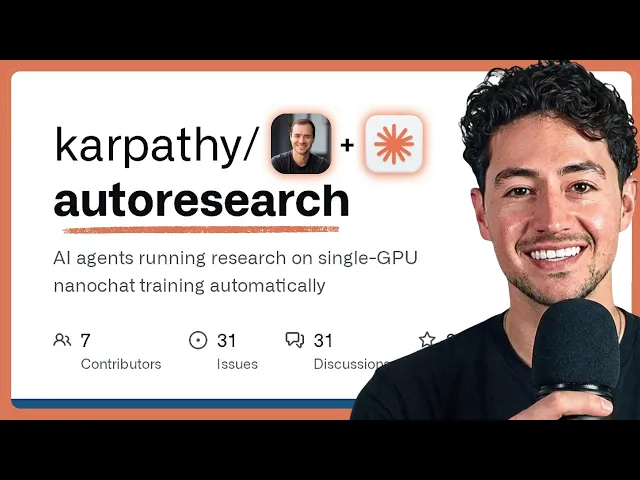
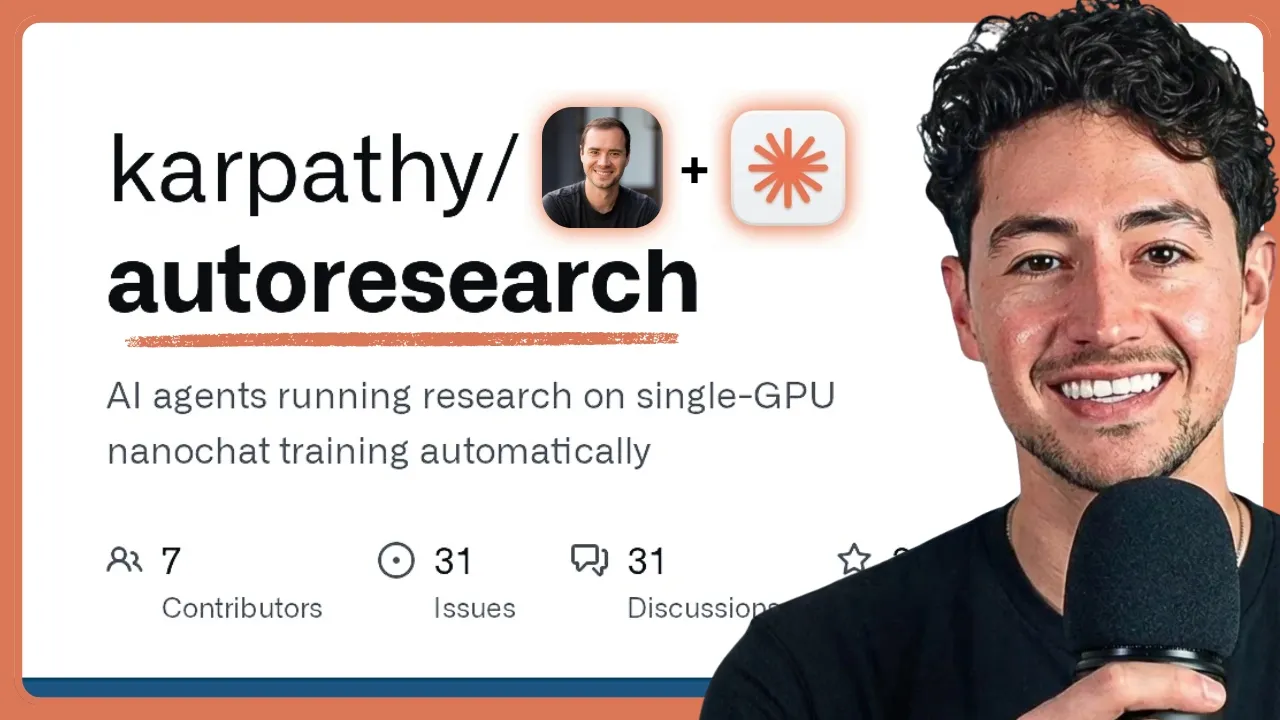
An open source project just dropped that when you combine it with claude code literally becomes self-improving AI. This is not engagement farming or hype bait. This is a real repo that was just released by Andre Karpathy who is widely renowned as one of the foremost voices in AI and machine learning research.
And basically what he did was while training his model he thought why don't I just have my models train my models instead. He built an elegant pipeline which he's calling auto research and essentially completely and fully automates the process of experimentation. He says it right here.
The idea is to give an AI agent a small but real LLM training setup and just let it experiment autonomously overnight. It'll modify the code, train for 5 minutes, check if the results improved, keep or discard, and then just repeat. You wake up in the morning to a log of experiments and hopefully a better model.
Now, I'm not in machine learning training. I don't help make models more intelligent. What I do is I take models that other people have made and then I use them for the purposes of making money.
And so immediately when this dropped, I started thinking about ways that I could apply this principle of auto research into my own life to improve obviously my own economic outcomes. And there are so many it's not even funny. So what I'm going to do is I'm going to run through some real practical examples in a moment, things that I'm actually doing in my own business that you can implement inside of Cloud Code.
Then I'm going to show you how to actually do it. So go through the step by step of setting up the repo and building some experimentation done totally autonomously for you. And at the end you will have a fully automated self-improving pipeline just like Andre Krypathy here has done for his own machine learning training.
So here's one of many examples. I do a lot of cold email in my own business and then for clients. And cold email in case you didn't know is where you package up a really nice sexy sounding offer and then you send it to people you've never met with the hopes that they take you up on it and then maybe convert.
So jump on a call with you, fill out a form, whatever. Now the key metric in cold email is usually reply rate. specifically positive reply rate, but reply rate's easier for our purposes, so that's what I'm going to go with.
And as you can see, most cold email software tracks this for you out of the box. So 2. 4% of people replied to this campaign.
2. 5% of people replied to this campaign and so on. Well, turns out that's all you need in order to build an automatic experimentation pipeline.
You need some metric that you want to improve and then you need some way factor, some thing you can modify to improve it. And so what I have is my metric is reply, right? And then what I have is the thing that I can adjust is my cold email copy.
So what this looks like in practice for me is a folder called email optimizer. There are a bunch of additional code files here, configs, places where I'm storing the results of my data and so on and so forth that aren't super important. What is important is this file right over here called orchestrator.
py. And this contains all of the prompt that I'm feeding into my orchestrator agent who essentially is responsible for spinning up new cold email campaigns and then testing them against each other until I get better and better results. And it was as simple for me as literally copying the repo and making some slight adjustments.
What I do is I tell it that it's inspired by Carpathy's auto research pattern. The core idea is an AI agent that runs experiments autonomously in a tight loop using an objective metric as a feedback signal. I have the architecture over here.
I run the loop every 4 hours and at the end of every 4 hours I actually have better copy that's self-evolving over time based on the results from my previous test. And you can see some of the examples right over here. Anything with C is what we call a challenger.
Anything with B is what's called baseline. And so the model starts with a baseline type of copy, which we could see right over here. And then it makes slight modifications based off of what it knows to perform really well in cold email copy before testing it out.
It runs the two side by side and then automatically harvests based off of the results, aka the number of replies and so on and so forth for both campaigns. Now, that part isn't the important bit. I mean, we've been optimizing cold emails for for many years at this point.
The important bit is it then creates new copy based off of the learnings from previous experiments. As the models get better and better and better, they log all of their learnings to a resource. m MD that significantly improves future models abilities to make changes.
And so here's a big list of things that this is essentially figured out. Move reply rate up. And so in that way, we get to push towards that direction over time.
Now, this has only been running for a few days now. Imagine this running for a year. And instead of optimizing on a basis of once every 4 hours, imagine if this optimized on a basis of once every 5 minutes.
Well, that's what my next leg of testing is going to do. We're going to be significantly improving the volume, pumping all this stuff out at 10x the level, and then optimizing and iterating our results again fully autonomously. So, that's just one example.
I'm going to run you guys through a bunch of other use cases that you can apply auto research to, whether you're in machine learning engineering or whether you're just trying to improve the profitability of, let's say, a paperclick ad campaign. But first, let's make sure we all know how to actually use this thing. So the way that auto research works to make a long story short is we start with an experiment and just like in science everything begins with some sort of hypothesis.
Okay. So my hypothesis might be hey if I make a slight adjustment to the copy of this campaign so that it's a little bit punchier. I think it's going to go well.
You insert that using this little test. md. It's your goal metric and some highle instructions.
From there, the auto research agent will go through employ the experiment usually using API calls. In my case, in the example we just saw um to instantly in Karpathy's specific example we saw, he's doing it through adjusting what are called hyperparameters and then after that we measure the results. Now, in order for us to make sure that this works, you know, the hypothesis isn't enough.
We need some sort of metric that we're tracking. Now, in my case, the metric was obviously pretty simple. It was reply rate.
In Karpathy's case, it was pretty simple. It was something called validation loss. As long as you have that, you can then just pick the winner and then make a slight change before looping back.
And depending on how tight this feedback loop is, you could theoretically do this in a minute or two. I mean, if he had more infrastructure when he's training his models, he could probably do in 5 minutes what he does in one. And then in that way, you know, progress really, really quickly over to some, you know, desired goal.
In my case, if I had more cold email infrastructure, I could do the same thing. So, at this point, scale is more or less all you need. This allows you to run hundreds of tests with literally zero human involvement.
I mean, I'm not even in the loop anymore. And to be clear, like, if I was in the loop, would I be making better decisions than the AI model? Like, probably.
I'd be a much more efficient optimizer, but that doesn't really matter because the reality is I take a lot more time to optimize than a model does. I also eat, sleep, have to go to the washroom, and do a variety of other things with my day. AI agents don't.
you could very quickly and easily set this up on again an hourly loop and have this run 24 times a day whereas realistically if you were to try and do it all yourself you could only do it a couple times and so in that way whatever metric that you're tracking goes up over time right in my case reply rates significantly go up you know test one I might be at a 1. 5% test 12 I might be at a 2. 7% before you know it I reach literally like the optimal quality possible for my set of cold emails and then their audiences and you can apply this has mentioned to a bunch of other strategies.
So what are those strategies? The requirement that you need is anything that has an objective metric you can track and an API or application programming interface that you can send a request to to get. Okay, so some brief examples of this cold email copy obviously fantastic.
Why? Well, because in our case we have the instantly API. The Instantly API allows us to query metrics and so I can give the agent the ability to call a quick tool, call up the Instantly API, see how the performance was relative to um, you know, the the challenger in the base campaign.
At the same time, you know, I have a very clear metric, which in my case is reply rate. Okay, how about landing pages? Let's say you're doing some form of CRO, which is conversion rate optimization, and you want to test to see how you can make your landing page as efficient as humanly possible.
Well, you can now completely automate it with auto research. What you do is you pick the metric that you want, which in our case would literally just be conversion rate. Okay?
And then if your website is hosted locally or it's hosted using some API or something like that, let's say a website builder like Wix or or or or WordPress or Web Flow, what you can do is you could give it access to the API and then you could say, "Hey, change this according to this resource of best practices that other agents have done. Make your change. test that for I don't know a day depending on how much volume you have and at the end consolidate the winner and then get rid of the loser.
You can do the exact same thing for ad creatives. Okay, what's the main thing that you want for ad creatives? Obviously, it's going to be some form of conversion rate as well.
Whatever specific type of conversion rate is, that's up to you. Okay, but all you need to do is query some sort of API. Now, you know, a lot of these ad platforms like Facebook and Google basically already do this for you.
minded grant you granted I don't think they do it anywhere near as effectively as you can with modern models like Opus 4. 6 or GPT 5. 4 for what you can do is you could give it the API to call a specific ad resource and then you could also just give it the metric to optimize for which is CVR and then it'll crush.
How about some form of customer satisfaction for chatbot scripts? Maybe use some sort of customer satisfaction score and then you know now you just adjust the main template, okay, that all customer service agents, whether human or AI are are going off of. That's super simple and easy to do.
How about product descriptions for some sort of ecom if you have like, I don't know, Amazon FBA or something like that? you know, maybe they don't necessarily have APIs, but maybe now you set up um what's called Chrome DevTools MCP, give it a very tightly scoped list of steps it has to do to update the actual body of the landing page, and then based off of metrics like uh I don't know, how many freaking dollars you've sold in the last little while, you can very quickly optimize and make your product landing page better and better and better. You know, in my case, I make a lot of YouTube content these days.
I could do this automatically with YouTube titles and the YouTube data analytics v3 API. You know, you could optimize subject lines for your newsletters in the same way. You could optimize pricing pages the same way.
You could optimize literally whatever you want. And so hopefully it's clear that at least for, you know, uh most sales and marketing purposes, and we're not even going into the back end here, Auto Research allows you to build a consolidated set of knowledge on what works, what doesn't, and then have that running in the background for you 24/7 with no human involvement. But how the heck does this actually work?
Well, three simple steps. The first is we're going to clone the repo. I'll show you how to do that in a moment.
We're then going to write some sort of test. Okay? And you can call it tests that I'm you can call it whatever you want.
But this only needs to include a goal, a metric, and a test method. And then you just give the agent the ability to run this on autopilot. In my case, I'm using a service called GitHub actions, which allows me to store this in the cloud and then run this on regular intervals like 4 hours.
You can use GitHub actions, you could use modal, you could use a billion other providers, and I'll show you how to do all of that right now. So the first thing you need to do is you just need to get the auto research repo. Now I have a link.
it's the uh top one or top two in the description. So, click on that. You'll head over to this page.
This will include all the information including the Python training scripts, the project description, a bunch of other scripts, and then what he's calling program. md where you provide the model everything that it needs in order to manage this whole research process. So, you see in his case, he says this is an experiment where you're going to do your own research, work with the user to agree on this, create this, read that, verify this exists, and so on and so forth.
And I want you to know this stuff is not super important. He's actually explicitly said that his prompt is probably pretty crappy and that it'd be very easy to make a better one. So with all that in mind, now we need to go over to our agent.
Next, head over to an integrated development environment or some sort of tool that allows you to run clawed code. In my case, I'm using what's called anti-gravity. You guys could use Visual Studio Code.
You guys could use like a 100 different apps to be honest. Um, by the way, if this seems like magic to you, you don't know what any of the buttons on the page are. I literally run through all of it in an extensive 4-hour cloud code course that even teaches you like what the different icons are and so on and so forth.
Really holds your hand through it. So just head to the top uh right hand corner of the video for that. Anyway, assuming you have all this stuff open, we're going to want to create a new folder.
So I'm going to go here to open folder and then I'm going to go new. I'm going to say Carpathy auto research demo. And then I'll click create.
Then I'm going to open this folder. Okay. Okay.
And now in order to open up cla code, I'm just going to double click anywhere in here, click on my little claude code button, and then what I want to do is I basically want to clone this. So I'll say, hey, clone this in the current working directory. What this is going to do is it's going to make an HTTP request over to GitHub, and then clone this service, store that down below in a folder called auto research.
And the reason why we're doing this is because we just want all of the context of this whole repo before we go ahead and actually define, you know, what it is that we're going to do on this. And so what I want to do just for demonstration sake is I'm just going to reproduce my cold email example. After that, I'm going to give myself a little bit of space.
And now, because I have access to a voice dictation tool called Whisper Flow down over here, I'm just going to hold my Fn key and then tell it what I want. Hey, I want you to use the context in the auto research folder to help me build a very similar idea, except instead of testing for validation loss and iterating on a machine learning model. I want you to do all of this, but for cold email.
The metric I'm interested in optimizing for is my reply rate. The platform I'm going to be doing all this stuff on is instantly, and I'll give you the API credentials and everything that you need in a moment. And finally, the thing that you're going to change between one experiment and the other is going to be the copy of the cold emails.
Finally, I want you to take all this and then put this on the cloud using GitHub actions. So, it runs once every hour and it has everything it needs to work on autopilot. Once I've pasted that in, I'll press enter.
Now, it's going to go through all of the auto research documentation. You know, it has a few things here that's probably not super important, like this image, which shows uh I don't know, the progress on Carpathy's side. You can see here his baseline was validation BPB.
It's some form of basically accuracy how good the model is. Started up here and then after just a few runs it got all the way down over here by adjusting various parameters. This is more or less everything that's going to occur except with our cold email.
So it'll be like um you know invert this graph reply rate will start here and then the idea is the reply rate will go up over time. Anyway, I'm going to let it run for however long it needs to before it does everything that it has to. And then at the end of it, we're going to have a fully functional autoresearch campaign.
It's now asking me some questions. How should the system generate new email copy variants? So, I'll say Claude, do you already have campaigns running and instantly or will this create everything from scratch?
So, I'm going to say from scratch. Then click submit answers. And it's now going through and building the email optimizer.
For simplicity, I'm naming it similar to the other one just so you guys could see what's going on. Now it's actually building an instantly client which will contain all of the API calls that it needs to make to instantly to get the information. We also have the orchestrator.
Now orchestrator just for anybody that doesn't uh isn't inherently familiar with the language is basically almost always going to be like your top top level agent. And the idea is it's the orchestrator which orchestrates okay kind of like a conductor in a symphony or something the function of a bunch of lower level agents or tools. And so in this case, what this orchestrator is doing, I'm going to try and draw a little blue cloud code logo.
Didn't do a very good job there. But basically what's occurring is this is orchestrating any sub aents that we'll need for maybe the purposes of writing copy. Um it'll orchestrate the calling of like the instantly API.
It'll orchestrate the I don't know storing of documents and uh I don't know JSON results and obviously you could build in a database. You could do whatever the heck you want there. And so this is what is essentially going to be us just speaking to the orchestrator saying, "Hey man, here's what you are.
You're an email optimizer orchestrator and you have access to all this stuff. Next, the utility scripts are just little one-off API calls like tools that allow it to do things like purge old leads, deploy and batch, test my parsers, and so on. the config files here like baseline resource and in this case I fed it some additional documentation from a big course I did inside of Maker School that teaches people how to write good quality cold emails.
This is just things that I have the ability to change. So I can change my baseline test. That's the first test the cold email optimizer will ever test against.
I could change what's in resources, although obviously that's going to be added to. And then I also have little tokens over here so it can access the um APIs. And then finally, the GitHub actions workflow.
All right. And I'm scrolling through here. It's doing the vast majority of the work, which is pretty nice.
And in in this case, it's actually creating some sub agents to do it for me. And if I open this up, you can see we actually have a bunch of data. So this is av.
example. So um I'm going to ask it to basically set this up as a demo, meaning you guys can just pump in whatever the heck you want. And then also I'm going to add a Slack web hook.
The reason why I'm doing that is because I basically just want it to be able to tell me how it's doing whenever it makes the changes. Now that it's doing some testing, we can basically go ahead. So just for demonstration purposes, I'll say great create a baseline and a challenger and show me dry run.
This is a demo. You can see what it's written over here as well. The way it works is it runs every hour via GitHub actions cron.
That's just a scheduling tool that triggers once per hour. There's three steps. It's going to harvest by collecting results from the previous experiment.
It'll generate by creating a new challenger and then it'll deploy by creating the campaigns, drawing the leads from a pre-existing pool or database that I've given it and then finally activating everything. So you see the leads are over here. We have uh the usage then obviously we have like the big fat long script as well.
I didn't have to write any of it. And this all follows very similar logic to what Carpathy was doing. It's just instead of doing this for like machine learning purposes, we're obviously doing this for financial purposes, better reply rates.
Now, because so much of this stuff occurs completely autonomously, I would recommend you always have a way to visualize or at least keep track of things as they go. And so what I've done is I've set up a little Slack ping via web hook that notifies me every time a new challenger or a baseline variant test is created. And so what happened is the other day we actually tested three different ones.
You can see some of these tests were pretty small and pretty minor. We just made adjustments to the subject line and so on and so forth. But it stores things like the baseline and the challenger.
And then whenever a harvest occurs, it tells us more or less which one won. Okay. And we now have the baseline which is a subject of quick question.
Gives me a bunch of uh baseline copy here. So I actually wrote this initial first email. And then it's generating the challenger.
The hypothesis is the baseline is too long. It buries the offer and it also lacks a specific CTA time. So it's going to try rewriting it to sub 75 words leading with relevance frontloading the risk reversal and ending with a concrete time ask.
You'd see it's quite the significant change here. Hey, first name. My drive PPC leads for a 2 mill a year dental marketing firm in Calgary.
I've sold over 10 million business agencies like yours through cold outdown alone. Got a backlog of people wanting PPC right now variety of verticals. I'd send you booked appointments and only charge if we hit a number you and I agree on beforehand.
Zero risk on your end. Is this worth a quick call? It even then gives a specific time.
So I mean it remains to be seen whether the challenger is going to be better than the the baseline, of course, but that's just part of the game. And you can see this has now actually been deployed. We have uh that same copy over here.
And then if we go over to our baseline, we also have the baseline copy over here, which is that old cold email. And basically what's going to occur now is they're just going to test against each other until we figure out which one is better. Now on net, because this is an AI model we're working with, in my experience, most challengers are not up to the task of the baseline.
Usually the baseline is better because I wrote it, but eventually the challengers do become better and you start seeing significant improvements in the reply rate relative to the original. um which then you know makes them higher and higher and higher and higher over time. Then the challenger becomes the new baseline and then you just repeat.
And so basically what this is to be honest is like the automation of like scientific experiments. Um you know this is something where right now there's just so much logistical overhead and friction involved in like running any sort of experiment whether you're a marketer, a salesperson, somebody doing some backend functionary business or whatever. And this just eliminates all that friction.
I no longer have to like copy and paste the leads. I no longer have to like do anything manually. Um, it's all done via simple API calls.
And now that we can put this thing on a loop, even though every time I run the orchestrator, it's technically like a different agent. It has all the context from all of the previous runs, which allows it to grow more intelligent over time. I anticipate that eventually after something like 500 to maybe a,000 runs.
You'll probably have to consolidate some of the previous learnings so that that document doesn't get super long. But whatever you're using this for, whether landing pages, PPC, uh newsletter copy, whatever the heck, you know, SEO pages, hopefully you guys understand that as things get better, the new challengers are just going to be millions upon millions of times more profitable and e efficacious than um what your initial baseline was. Now, I should note there's some other things that you have to do in order to set this up completely.
Like for instance, I actually had to go grab my API keys. The way you do this on Instantly is pretty straightforward. Settings, then you go integrations, then you go API keys down here.
Then you create an API key, say whatever the heck you want, select scopes all, and then actually copy it over. Um, you obviously need to do that as well with whatever AI model you're using to do the orchestration. In my case, I was using Claude Opus 4.
6, so I just went over to anthropic, got their API key. Um, and then, you know, if you have any other other services you want to use like GitHub, for instance, or whatever, you also have to push that up. But agents will handle all that stuff for you.
Just ask them, hey, you know, where do I go to get my API key? Okay, can you sign me in? And so on and so forth, and you'll be good to go.
The final thing I want to talk about are use cases that I would consider not ideal for some form of auto optimization. Um, in general, things that work really well are things that have fast feedback loops. Okay, so why did Carpathy's um AI agent or like nano GPT loop work so well?
Because it was literally a fiveinut loop. You know, if you have a five-minute loop, technically speaking, that means that in 60 minutes you could run 12 experiments. And so obviously 12 experiments is a lot of data.
And assuming that you know you're running it on your own servers or whatever, you can just have that thing churn. But basically that means that your your iteration loop will be much faster because you'll be able to kind of draw it like this as opposed to like this. You know, it's going to take a lot longer to figure out what works and what doesn't.
If you're all the way down here, another good thing to keep in mind is you need a clear metric. So in my case, reply rate was a fantastic metric. Why?
That's objective. How many people actually replied to my email campaigns? Click-through rate.
It's very very objective because you know obviously this is people clicking through an email all the stuff is automatically tracked but if you had something that was way fuzzier in addition to way slower you know the probability of you actually making this work uh is is much lower because how do you subjectively measure like warmth you know you can't it's like happiness it's like you can't what you have to do is you have to find proxies for all these things which are usually like scales and metrics and analytics and so on and so forth and then the third thing is you need some sort of API I access to change the inputs. Um, and if you don't have the API access, you could build some sort of Chrome dev tools or CLI based flow, but like you need to have that because if you don't, how the heck is the agent supposed to make any changes? What are they going to do?
Just give you a list of changes to manually go in. You can do that, but that sort of defeats the whole purpose. Anyway, so what I'm going to do with this is I'm going to provide everything that you guys need, including the email optimizer repo, uh, the Carpathy, um, auto research, GitHub repo, and everything else down below.
Feel free to take a look at it, give it a click, explore it, and use it for your own use case. I'd be really interested to hear what you guys end up using this on. Um, this is what all major labs that are working on machine learning models around the world are currently doing, by the way, in case it wasn't clear.
They're constantly running many, many, many experiments behind the scenes overnight to like make their models better and so on and so forth. So, the fact that we're able to democratize that and now do that for ourselves, for our own businesses, and for our own uh own models is now like incredible. But I'd be really curious to hear what sort of use cases you guys have with this.
And you know, if it makes sense, I could compile a list of these use cases and then I could make another follow-up video that just goes through every single one and then even gives like real examples of them. Um, because that'd be really dope. Aside from that, if you guys do me a big solid, something like 73% of you are not subscribed to the channel, which really hurts cuz I try and make high-quality content for both subscribers and non-subscribers.
But YouTube pushes my content way more heavily when that ratio improves. So, if I give you any value today whatsoever, please do click the subscribe button. I hate asking for it, but it just makes a difference on YouTube, so I'll do what works.
If you guys want more on cloud code and so on and so forth, definitely check that out. And yeah, I mean, I will catch all y'all in the next video. Thanks so much for watching, as per usual.
See you.