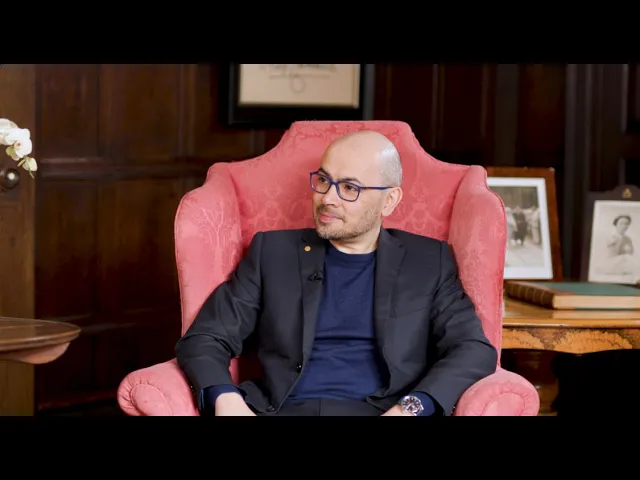
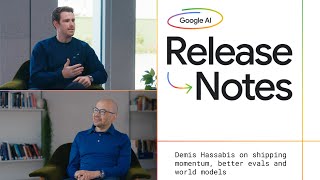
So it's wonderful to welcome you back to Cambridge and have the opportunity to talk with you today about your career and your thoughts on the future of technology in society. So I asked our current undergraduate and postgraduate students for questions that they would like me to put to you. And of course, we had far too many of them to possibly include.
However, seven themes did emerge from their responses, which I've used to sort of synthesize some questions. Mm-hmm. So the first area was on teaching and education.
So, of course, you studied Computer Science here in Cambridge as an undergraduate. And after a period working in the games industry, you completed a PhD in Cognitive Neuroscience at UCL. So what was your experience of the Cambridge Supervision System as an undergraduate?
And as both an undergraduate and a research student, how did you balance your studies with your broader interests? Mm-hmm. Uh, I think the, the whole supervision system at Cambridge, one of the things that makes Cambridge special, and I think it was an incredible opportunity for us as students to learn.
We actually had supervisions not just here at Queens', I had some with some of my friends at other Colleges as well, with, depending on the professor that was teaching the, the course. And I think it's a integral part of, of intellectual life here at Cambridge. And I think a critical reason why it's so stimulating to be here is you get that individual kind of attention.
And I actually found them more useful than the lectures. So I think it's, it's, it's an amazing thing. And of course, you know, as a researcher, you are trying to balance learning with doing your own research.
And that's something that I learned to do very well at UCL. And I think it is an important part of what I do now today, is having done the PhD, it's not just, learning what you've, what you, the subject matter, but also learning how to do high quality research and the process behind that. Great.
So the next theme was games. Mm-hmm. And so, games, of course, have been a big theme throughout your life and, you know, as a child and young adult, you played a lot of chess, and you also worked in the computer games industry, before and after your time in Cambridge.
So, how has the time spent studying board games and also working in the computer games industry influenced your later career? Well, actually games is the common thread running through my life, I would say. I, I love games.
I've been passionate about it since, um, since I can remember. And I think I've used games actually in three different ways during my career. So first of all, to train my own mind as a chess player playing for the England Junior Teams and so on as I was growing up.
I think it's a great training for the mind. That's why I encourage, you know, schools and, and, to kind of include chess as part of the curriculum. I think it's just as useful as maths and computer science and things like that for training the mind in logic and visualization and planning.
Then, second time was my professional career. That's what got me into AI. I was programming AI for computer games, and making big simulation games like Theme Park.
So that's what got me sort of excited about AI in the first place, I would say. And then finally, at DeepMind, using games to train the AI systems. So starting with really simple games like Atari games all the way up to very complicated games like Go with our program AlphaGo.
So, maybe there'll be a fourth chapter and using AI to make new types of computer games. That'll be exciting. And do you have any favourite games at the moment that you enjoy?
Well, my favourite game of all time is probably Civilization II. So, uh, I've actually recently started playing Civilization VI with my two kids. Alright.
No, Civilization II was one of my favourites as well as a kid. Yeah. So the next area is entrepreneurship in science.
So after you graduated from Cambridge, you worked at a new game startup and then started your own games company. And after your PhD you also went on to form a new AI startup DeepMind. So given this experience, what do you think startups and entrepreneurship should, what role do you think startups and entrepreneurship should play in contributing towards scientific research?
Well, look, I think that startups are fantastic vehicles to get a lot done in a short amount of time, and also get a lot of resources, potentially if the startup's going well towards whatever you're working on. So, initially, I've always been quite entrepreneurial. You know, I like putting teams together and, and going after difficult problems.
So obviously with my games company, that was firstly to do with combining creative ideas with technical ideas, right? That's what I think the pinnacle of computer games is about, actually, it's why I love the industry so much. And then with DeepMind, I guess what we were trying to do is show that it was like a modern day, Bell Labs is what we were after, and that you could really do proper cutting edge research in an, in a, in a startup setting.
And it was maybe get like the best of both worlds. So, the kind of blue sky ambitious thinking that you sometimes get, you know, in, in the best academic places like Cambridge, but combined with the top engineering and the kind of intensity and pace that you get at the best startups. And I didn't see any reason why those two things couldn't be blended together.
And it seems to have been pretty successful with DeepMind. And hopefully it's a bit of a blueprint for, you know, other, I guess they call it deep tech, startups, where you're actually approaching something really hard. Maybe it's fusion or quantum computing or something like that, but you can actually get a lot more resources to bear if you do it in a startup.
So I think there should be a little bit more of a fluid kind of two-way system between academia and, and startups when ideas are mature enough, maybe from the pure research point of view, you know, they can be spun out easily and maybe people can transfer between the two back and forth. And it's quite common in the US and Stanford and MIT and maybe it would be great for Cambridge and, and Oxford and other top places in the UK to, to have a bit more of that, I think. Yeah.
Great. So next topic area is people and careers. And as you might imagine, our students are very interested in what their next step is after graduation, and the job market today looks significantly different from what it did, when both of us were looking for our first jobs.
So, how do you think careers in the tech industry might be affected by AI? And what advice would you give to Cambridge students in order to thrive in this environment? Well, I think Cambridge gives you, and the Cambridge course, especially in Computer Science, gives you this incredible foundation, if you like, almost timeless.
You know, I remember my favourite topics were things like computation theory and information theory, you know, studying things like Turing machines, you know, those that stayed with me for my whole career, really. So, I like the kind of mathematical underpinnings and a lot of the traditional, I guess, foundational work that Cambridge courses tend to favour, rather than the latest fad or the latest programming language, something like that which could easily be in fashion today, but out of fashion tomorrow. And so I think that's important.
And I think really understanding, using the time you have as an undergraduate to understand yourself better and how you learn best and how to learn, learning to learn. So you know, how to pick up new material really quickly and getting adept at that. Because I think the only thing that any of us can predict from here is that the next five, 10 years there's gonna be incredible amount of disruption and change, due to technology, obviously, I would say especially AI, but also VR, AR, you know, quantum computing.
All of these things are sort of looking like they're gonna be promising in the next five to 10 years. Crypto. And so there's huge opportunity anytime there's also disruption and change.
And I think we're about to enter a period like that, perhaps like in the nineties when we were graduating is like, you know, it was the internet and yeah, mobile and gaming. I think we were in another one of those eras. So they're very exciting, but you've gotta be very nimble and embrace the, the new technologies that are coming down the line.
So I think, learn the foundational stuff at, in the courses at Cambridge and other places. But then, in your spare time, you should be probably experimenting with whatever your passionate area is. In my case, it would be AI with all the tools that are coming out so that you are, and a lot of it's very accessible and open source and so on.
Yeah. So that you are really up to speed with the absolute latest when you graduate, and then you sort of combine the best of that with the, the best foundational knowledge. Sure.
So we couldn't miss out, of course, talking about artificial intelligence. Yes. And you and your colleagues at Google DeepMind have made several seminal contributions to science, including AlphaFold, for which you were recently awarded a share of the Nobel Prize in Chemistry.
One of our students also highlighted AlphaProof, which recently achieved a silver medal in the International Mathematical Olympiad. So how do you envisage AI or change the future research in mathematics, science and technology? Yeah.
Well, I mean, that's my actual passion and why I, the whole motivation for me of why I started, and spent most of my career working on AI is I think ultimately, you know, it could be the best tool ever for accelerating scientific discovery. So I think we're about to enter a new golden age of, of discovery helped by and powered by AI tools, and I think AlphaFold, you know, that's the best example so far of that. But I hope we look back in 10 years time, and it will be the first of many examples of tools like that, that change areas of science and accelerate it massively.
You know, more than 2 million researchers around the world now make use of AlphaFold. I think pretty much every biologist and medical researcher in the world make some use of AlphaFold, and we're incredibly proud of that impact. But I think it's just the beginning and, and in mathematics, AlphaProof is an amazing new project that we started, and system that we started.
And I think mathematics is another area that's gonna be changed quite a lot by AI. I think first of all, we're focusing the moment on proving things, either by counter example or, you know, other proof methods, but eventually the question is, can AI systems come up with new conjectures, interesting conjectures themselves? Mm-hmm.
I think we're quite close to being able to solve some really important conjectures in mathematics with the help of AI, maybe a Millennium Prize Problem, something like that. Obviously, you know, already a silver medal IMO is quite difficult already. I took a look at those questions, they're pretty hard!
And, you know, I think we're gonna be gold level soon. And then beyond that is, are these sort of open questions in mathematics, but there's still a big leap from that to even solving a conjecture, to actually proposing an interesting new hypothesis. Mm.
So that's the, that's the part where no one knows yet how, whether AI can do it or how to make AI do that. Great. And then another topic was research strategy.
So, several of our postgraduate students who are interested in how they should formulate a research strategy in order to maximise the chance of making a significant breakthrough. Yeah. So, how do you decide where to focus your own research effort and how do you balance sort of intuition and empiricism against formalism in your thinking?
Yeah. Well, look, there's a few, I think things that I can advise on that, one is that, you know, I feel like multidisciplinary research is really gonna come to the fore in the next sort of decade. Where you combine, you know, get expert at at least two different areas.
One of those could be AI or machine learning. But then I think a lot of the advances are gonna be working out how to apply that in a really fundamental way to another area, biology, chemistry, you know, mathematics as we just discussed. And I think there's gonna be a lot of low-hanging fruit in the combinations of those subject areas.
So, that's something I've always tried to do is, is be multidisciplinary, even in my own academic work with neuroscience and machine learning and computer science, you know, it's all, was all very important with the foundation of DeepMind. And the, and the initial work that we did was partially inspired by, you know, the way the brain works Yeah. As well as by algorithmic ideas.
So I think there's a lot of potential for that almost, and with AI, I think it can be applied to almost any subject, but the question is, it's not just a silver bullet solution. You have to really understand this other subject area deeply whether that's economics or biology to really apply, understand what are the right questions that this, these types of new techniques, you can think of it as, you know, a new type of statistics or something. It's applicable very widely, but, but what's the right question?
And then picking the question is about having this sort of taste or smell, if you like, of, you know, intuition of what is the right problem? Is it the right time to tackle that problem as well? Because timing can be really difficult.
You don't want to really be 50 years ahead of your time. I always say you want to be five years ahead of where the field is, but not 50 years. Yeah.
And so, uh, that's also difficult and that I think you probably can't train. You just have to experience it and learn from mentors and, and just be very open-minded, I think, in your own research work and alert for those types of opportunities. And, you know, and they can come up from anywhere.
So that kind of goes with being multidisciplinary, exposing yourself to a wide range of ideas. Great. Thank you.
And then the final area is policy and society. So many people are concerned about the rapid integration of AI into societal infrastructure, including civil, medical or educational spaces. And yet, governments commonly lack a cohesive plan on how to handle this change.
So what steps do you think government, us as scientists, or indeed society more broadly should take to try and protect and enhance the world that we live in? Yeah, this is a great question, and it's a very complicated one that I'm mull on all the time, is that we, you know, I think AI is gonna be, and already is one of the most transformative technologies maybe humanity will ever invent. I think it can be applied to nearly every area.
It's gonna affect every corner of the world, every part of society. So, and of course I'm working on it, and I, and, and, those of us researching it for many, many decades have been working on it because we think it's gonna be one of the most beneficial technologies ever invented. You know, applying, I've tried to apply it and applying it to things like medical research, biology and sciences.
I think there's gonna be enormous benefit to society from these advances. But on the other hand, it is a dual-purpose technology. Mm-hmm.
The same technology can also be repurposed by bad actors for harmful ends. And so that's one of the big problems is how do we enable access to all the good actors that want to do amazing things with these technologies like cure diseases, but at the same time, restrict access to would be bad actors, right? So it's very difficult in, especially with digital technology.
So that's one big problem. I think another issue is the risk that's inherent in the AI systems themselves as they get more sophisticated. So not really today's models, but maybe in 2, 3, 4 years time as these models become more agent like and able to achieve things more autonomously than they do today, that's gonna bring, again, more capable systems, but they'll also, have, carry more, potential for risk.
And I think the way to address that is, we gotta have, I think first of all, international dialogue, and ideally international cooperation, although that seems quite hard in today's world. But I think it's needed because, you know, AI is going to, as a digital technology, won't be just restricted to any borders or it's gonna affect, you know, every corner of the globe. So I think the international community has to come together to agree standards about what we should deploy it for and what we shouldn't, what we should use it for, and how we should build it.
So that would be the ideal. And then also every corner of society, not just the technologists, so social scientists, but governments, academia, as well as industry and the people building these systems, need to all come together. And I think what's been pleasing is the beginning of these international summits.
First one was held in the UK a couple of years ago at Bletchley Park. And the last one was just in Paris. And I think we need more of those kinds of dialogues across all these different areas so everyone can input onto, you know, how this should go.
Great. Well, thank you so much for all of your responses, and I'm sure the students will be really interested to hear your thoughts in answer to their questions. Well, thank you very much.
It's always fantastic to be back here at Cambridge and at Queens'. Thank you.