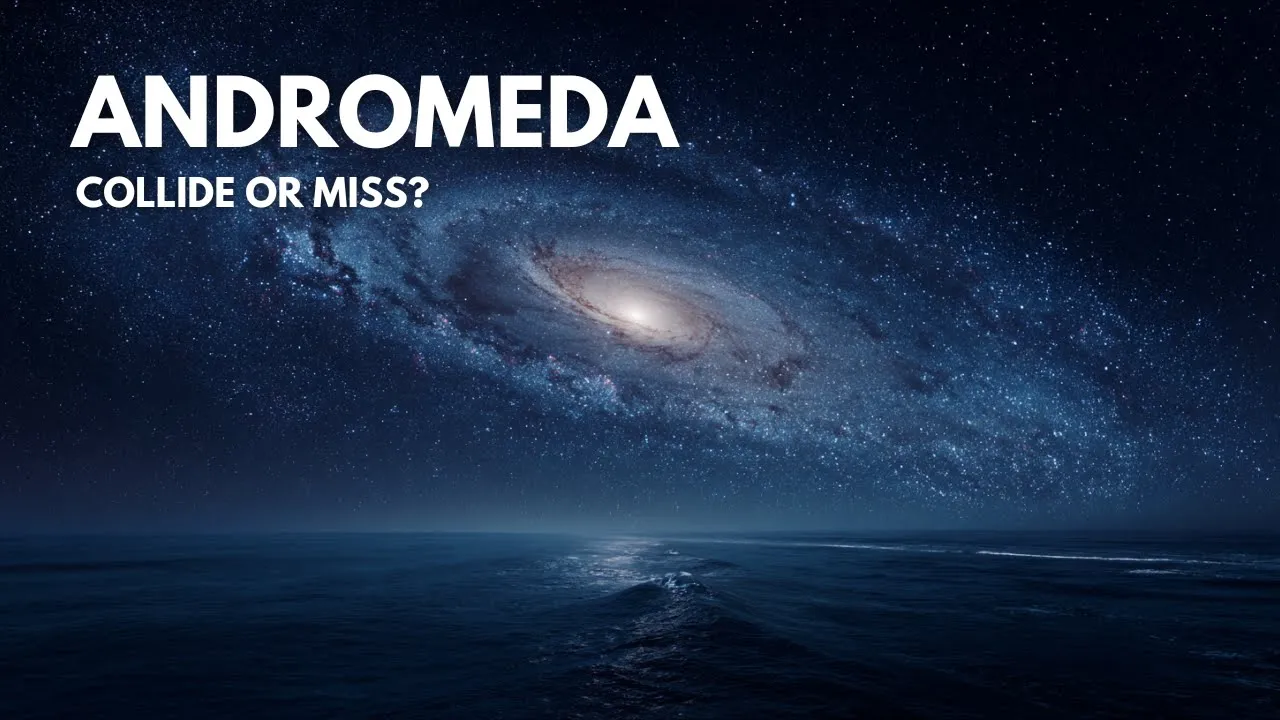
Right now, somewhere in the night sky, there's a galaxy moving toward us. 110 km/s, coming closer. In about 5 billion years, it might collide with the Milky Way or it might miss.
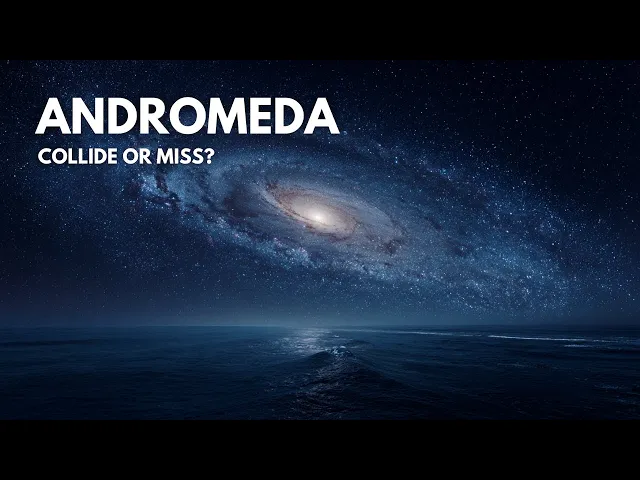
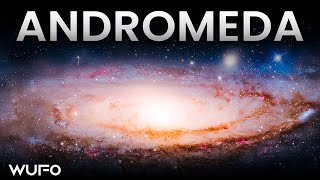
We don't know which, but you can see it coming tonight with your naked eyes. On a clear, dark night away from city lights, look toward the constellation Andromeda. There's a faint smudge of light, easy to miss.
Looks like a small cloud. That's Andromeda. 1 trillion stars 2.
5 million light years away. And it's moving toward us. Tonight we are watching the slow motion fate of the Milky Way.
Let's begin. Ancient astronomers noticed the smudge in Andromeda. A small patch of light, faint, permanent.
In 964 AD, the Persian astronomer Abdul Rahman al-Sufi described it in his book of fixed stars. He called it a small cloud. In 1612, the German astronomer Simon Marius turned his telescope toward it.
He described what he saw as looking like a candle flame seen through horn. Diffuse glowing, strange, but no one knew what it was. For centuries, astronomers debated, was it a nebula, a cloud of gas inside the Milky Way, or was it something farther away?
The question wasn't settled until the 1920s. Edwin Hubble used the 100in telescope at Mount Wilson Observatory to observe Andromeda. He identified seied variable stars.
Stars that pulse at predictable intervals. By measuring their brightness and period, he could calculate distance. And the distance was staggering.
Andromeda wasn't inside the Milky Way. It was 2. 5 million light years away.
It wasn't a nebula. It was a galaxy. An entire galaxy separate from ours.
Vast, distant. But there was something else. In 1913, before Hubble's measurements, astronomer Vesto Slifer had analyzed Andromeda's light.
Most galaxies show red shift, their light stretched toward longer wavelengths because they're moving away from us as the universe expands. But Andromeda showed blue shift. Its light was compressed, shifted toward shorter wavelengths, which meant only one thing.
Andromeda was moving toward us. the closest large galaxy to us. And it's coming closer.
2. 5 million light years. That's the distance light travels in 2.
5 million years. When the light we see from Andromeda left that galaxy, the first humans in our genus were only just beginning to appear on Earth. Homo sapiens, modern humans, were still a distant future.
Early stone tools, small bands of hunter gatherers in Africa. That light has been traveling through space ever since for 2. 5 million years across the void until it reached our telescopes.
Andromeda contains roughly 1 trillion stars. The Milky Way has between 200 and 400 billion stars. Andromeda has more than twice as many.
Its disc stretches over 200,000 lightyear across. The Milky Way's disc is roughly 100,000 lighty years across. Andromeda is more than twice as wide.
And here's something most people don't realize. If you could see the full extent of Andromeda with your naked eyes, if your eyes were sensitive enough to detect all its faint outer light, it would appear about six times wider than the full moon in the night sky. Six full moons side by side.
That's how large Andromeda actually is in our sky. We just can't see most of it. The outer regions are too faint.
What we see is only the bright core, a tiny fraction of the whole structure. But it's there in our sky every night. vast, massive, approaching, and visible.
But it's 2. 5 million light years away. Even at that speed, crossing that distance takes an incomprehensible amount of time.
Current predictions place the first close pass if it happens in roughly 4 to 5 billion years. Can we stop it? No.
Gravity doesn't negotiate. Both galaxies are massive. The Milky Way 200 to 400 billion stars.
Andromeda about 1 trillion stars. Both have enormous gravitational fields pulling on each other. This has been happening for billions of years.
Gravity has been pulling them together since they formed. We're just now noticing. The approach is patient, slow, inevitable, and the entire time it's in our sky, approaching, visible, something you can point to and say that's coming toward us.
Every second closing the distance. Every year, every million years, the gap shrinks. For billions of years, the distance closes and then contact.
When you hear galactic collision, you might picture violence, explosions, stars smashing into each other. destruction. That's not what happens.
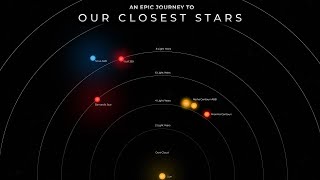
Galaxies are mostly empty space. The distances between stars are enormous. The sun to the nearest star, Proxima Centuri, is 4.
2 light years, mostly void. If Andromeda and the Milky Way collide, most stars will pass through the gaps between other stars. The chance of any two stars actually colliding nearly zero.
But that doesn't mean nothing happens. The gravitational fields interact. Stars get pulled off their orbits.
Some are flung outward, ejected into intergalactic space. no longer part of any galaxy. Others are pulled inward toward the new merged center.
The spiral structures of both galaxies, the beautiful arms we see in photographs will be destroyed, torn apart by tidal forces, reformed into something else. Gas clouds collide. When gas clouds from two galaxies meet, they compress.
Compression triggers star formation. Massive bursts of new stars, thousands, millions, igniting across the merged structure, a starburst phase. And if you could watch this from Earth, if anyone were still there to watch, the night sky would transform.
Andromeda would no longer be a faint smud. It would fill half the sky. A vast spiral structure close enough that individual stars would be visible.
Bright blue stars from the starburst phase scattered across the darkness. The Milky Way's own structure warping, distorting as gravity pulls it apart. Two galaxies interpenetrating, streams of stars flowing between them.
The sky ablaze with new light. Spectacular and terrifying. And the process isn't quick.
First pass, the two galaxies sweep through each other. Gravity pulls stars off course, distorts the spiral arms. But the galaxies remain somewhat intact.
Then gravity pulls them back. Second pass, closer, more violent, more stars disrupted. The structures begin to blend.
Third pass. Fourth pass. Over and over, the galaxies swing through each other.
each time coming closer, losing more structure, merging more completely. The entire process takes about 2 billion years from first contact to final merger. And what emerges isn't the Milky Way anymore.
And it isn't Andromeda. It's something new. If they merge, the resulting galaxy has been called Milomeda or Milkdromeda, a new name for a new structure.
It would no longer be a spiral galaxy. The collision disrupts the orderly spiral structure. What forms instead is an elliptical galaxy, a vast roughly spherical or oval cloud of stars, larger than either the Milky Way or Andromeda were alone, more massive, different structure entirely.
The spiral arms we know, gone. The galactic plane, the flat disc where most stars orbit, disrupted, reformed, or gone. The Milky Way, as we understand it, will cease to exist.
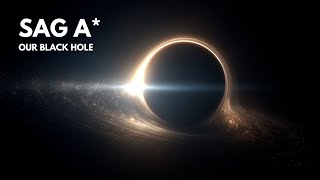
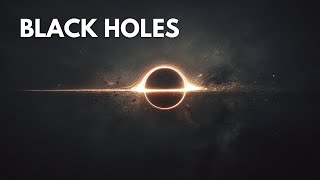
And at the center of this new galaxy, something else happens. Sagittarius A star, the super massive black hole at the center of the Milky Way, has a mass of about 4 million suns. Andromeda's central black hole is much larger, around 100 million solar masses.
When the galaxies merge, the black holes don't immediately collide. At first, they're separated by thousands of light years, but gravity pulls them together. They begin to orbit each other, a binary system.
Two super massive black holes spiraling inward. As they orbit, they lose energy to gravitational waves, ripples in spaceime itself. The orbits decay, shrink, the black holes get closer, and as they get closer, they orbit faster.
This death spiral takes millions of years. But eventually, they are orbiting at a significant fraction of the speed of light. relativistic speeds, enormous masses, warping spaceime violently, and then they merge.
When two super massive black holes merge, for a brief instant, the power carried away by gravitational waves can exceed the combined light of all the stars in the observable universe. More power than 100 million galaxies released as ripples in spaceime detectable across the universe. The merged black hole, roughly 100 million solar masses, will ring like a struck bell as it settles into its new shape.
The ring down the final stage and then it's still the new center of Mil Comeda. And the stars, most will survive, scattered into new orbits, different positions, different neighborhoods. Some stars will be flung out entirely.
rogue stars drifting through the void between galaxies, but most remain gravitationally bound to the new merged structure. Our sun, it will probably survive, but it will be in a completely different part of the galaxy. Different neighbors, different sky, different everything.
The Milky Way, our home for billions of years, will cease to exist, replaced by something we'd barely recognize. The close encounter, whatever form it takes, happens in roughly 4 to 5 billion years. The sun is about 4.
6 billion years old now. It has roughly 5 billion years of stable life remaining before it begins to die, expanding into a red giant, eventually shedding its outer layers. So, the encounter happens before the sun dies, while the sun is still shining, while Earth, if it still exists, is still orbiting.
During a collision, Earth would likely survive. Star collisions are extremely rare. The chance of another star passing close enough to disrupt Earth's orbit is small, but everything around us changes.
Our position in the galaxy completely different. The sun might be flung toward the outer regions of the merged galaxy or pulled inward toward the center. We don't know.
The night sky unrecognizable. Stars move. Constellations drift apart.
New stars appear. The familiar patterns. Orion, Ursa, Major, Cassopia.
gone. The galactic environment might become more dangerous if we're pulled into a denser region. There might be more supernovi nearby, more radiation, more cosmic hazards, or it might become safer if we're flung into a quieter region.
We don't know. But here's the thing. 4 to 5 billion years is an incomprehensibly long time.
It's longer than Earth has had complex life. Multisellular life appeared on Earth about 600 million years ago. 4 billion years is more than six times that span.
By the time the encounter happens, humanity, if we still exist, will be unrecognizable. We might have spread across the galaxy. We might have evolved into something entirely different.
We might be gone. 4 billion years ago, Earth was young. Life was only beginning, if it existed at all.
4 billion years from now, we can't even imagine what will exist. Galactic collisions aren't rare. They happen across the universe.
We can see them right now. The antenna galaxies, the mice galaxies, galaxies in midmer merger. And the Milky Way has done this before.
The Sagittarius dwarf elliptical galaxy is being consumed by us right now, slowly absorbed over hundreds of millions of years. This is how galaxies grow. The encounter won't affect us, but it will affect whatever comes after us.
Right now, Andromeda is almost invisible, a dim glow you could cover with your thumbnail. But it's getting closer. In 1 billion years, it will be noticeably larger, brighter, no longer easy to miss.
In 2 billion years, Andromeda will dominate the night sky. No longer a smudge, a vast spiral structure filling the darkness. The spiral arms visible, the core blazing, impossible to ignore.
In 3 billion years, it will stretch across half the sky. Individual stars in Andromeda visible from Earth. Two galaxies side by side in the heavens, one familiar, one approaching.
At first, Andromeda grows slowly. For hundreds of millions of years, the change is barely perceptible. But then somewhere around 2 billion years from now, the growth becomes obvious.
Andromeda no longer fits in the corner of your vision. It stretches, expands. The spiral arms resolve into visible structure.
You can see the dust lanes, the star clusters, the bright core blazing at its center. And the Milky Way itself begins to change. The familiar band of light across the sky, the plane of our own galaxy, starts to warp.
Tidal forces from Andromeda pull at the outer stars. The disc begins to show distortions, ripples, signs of the coming disruption. By 3 billion years, Andromeda fills half the sky.
And you look up at night, you're not looking at distant space anymore. You're looking at another galaxy right there, close enough to see individual stars, millions of them. The blue white light of young stars in Andromeda's spiral arms.
The reddish glow of older stars in its core. All of it visible. All of it approaching.
Constellations that existed for billions of years begin to drift apart as the gravitational fields interact. The sky your ancestors knew becomes unrecognizable and Andromeda keeps growing. Every night slightly larger.
Every century more dominant. Every generation watching it grow. Knowing something is coming, unable to do anything but witness.
And whatever exists then, whatever life, whatever intelligence, whatever civilization, we'll watch for billions of years, generation after generation. We'll look up and see Andromeda growing larger, century after century, millennium after millennium. Unable to stop it, unable to escape, only able to watch as it comes closer.
And in 4 to 5 billion years, contact the structures begin to interact. Stars streaming between galaxies. The sky transforms as gravity reshapes everything.
You can't look away because it's not happening somewhere distant. It's happening in your sky above you around you. The slow, patient approach of one trillion stars, visible, inevitable, unstoppable.
Here's what we don't know. The exact trajectory, the precise timing, whether it's a direct collision or a near miss that sends both galaxies into a long gravitational dance. The newest simulations using data from Gaia from Hubble suggest the odds aren't as certain as we thought.
collision, merger, or a close pass that disrupts both galaxies without a full merger. You won't know until it happens. But we know this.
Andromeda is approaching. The sky will change. The Milky Way will be transformed whether by collision or by gravitational chaos.
Home will not remain home. The uncertainty doesn't change the stakes. It just means we're watching a story whose ending we can't predict right now.
On a clear dark night, you can see Andromeda. Just a faint smudge. Easy to miss, but it's there.
One trillion stars moving toward us. every second, every year, every millennium, closing the distance. In billions of years, it arrives.
The Milky Way and Andromeda will meet. It won't be violent, no explosions, just gravity doing what gravity does slowly, inevitably. Absolutely.
And what emerges will be different larger, transformed, unrecognizable. Not the Milky Way, not Andromeda, something new. You can see it right now if you know where to look.
That faint light in the constellation Andromeda. Our neighbor coming closer. Slowly, inevitably for billions of years, and then home stops being home.