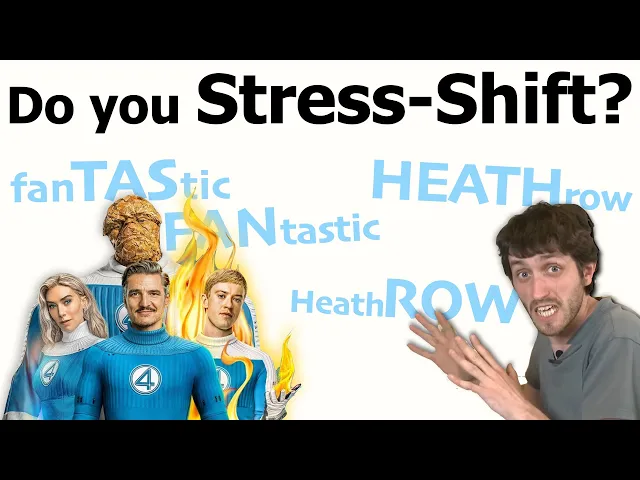
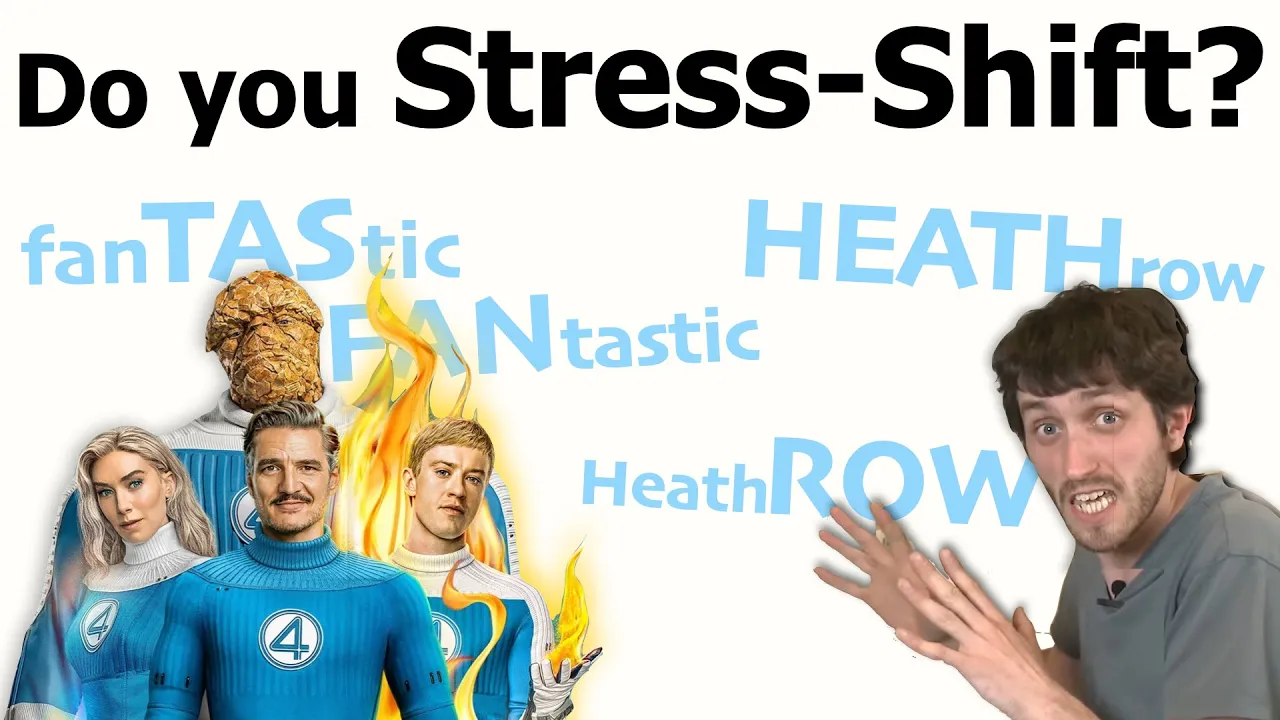
The theme song of the new Marvel film puts strong notes most of the time on fanTAStic FOUR, but this trailer ends with big thuds on FAN and four. To understand why, we’ll first have to explore three related but different things: word stresses, pitch-accents, and rhythmic beats. And along the way you may be surprised to learn about the history of some familiar words, and you’ll find out what I’m doing here!
Bagpipes! I can feel it in my genes. I’m impatient to learn about my own history via the results of my DNA test.
I’ve partnered again with MyHeritage, who as you know are a leading global family history and DNA service, and who are currently offering the test to you my viewers at the VERY low price of 29 dollars, more later. I already use MyHeritage for building my family tree, and animating old family photos, and I decided to go deeper and take the DNA test. It only took me two minutes to do the cheek swab thing, and in less than 3 weeks I’ve got this email: view ethnicity estimate Ready to explore your ethnicity?
Let’s go. I am… 41% English. Ok, only 41%.
So what else? Bagpipes! I can feel it in my genes.
39 percent! Danish? Okay.
So now I’m wondering, where’s the Irish? Breton! Now I’ve got to learn the fiddle.
And 9% other stuff. View full Ethnicity Estimate. Ah, different confidence levels.
Let’s stick to high confidence. Genetic group England #13. English and some Scottish and Irish, there we go.
Using MyHeritage I’ve tracked my Lindsey great-grandparents to Belfast to Armagh, but Lindsey’s a Scots name and a lot of people there have Scottish ancestry. Let’s try medium confidence. Northwestern England.
Well that’s spot-on. What next? DNA Matches.
Thousands of possible distant relatives… extended family. One close family member? Really?
Who can that be? Yes, that is a cousin I’ve lost touch with. So they’re on MyHeritage too and I can contact them.
What else? DNA tools… Ancient Origins. Explore your origins across different populations in history.
So this is the Bronze Age. 41% Western Steppe. They clearly had advanced cosmetics on the Western Steppe.
Research links… Takes me directly to Nature. Massive migration from the steppe was a source for Indo-European languages in Europe. Over 1100 citations.
Didn’t know what to expect but real stuff there and lots of genetic rabbit holes to go down. And MyHeritage has committed in its privacy policy never to sell or license my genetic data. Overall, impressed.
Now this special promotion, 29 dollars, is I think way lower than you’ll get anywhere else, and you get it via the QR code or the link in the description with my coupon code. Recommended. Let's start with the standard story of Stress Shift.
Here I am in Piccadilly. Dictionaries will tell you that this name has two stresses: watch my hand, Piccadilly. And most dictionaries will say that the second one, on Dilly, is a primary stress, while the previous stress, on Picca, is only secondary.
Sounds reasonable: Dilly stands out as more prominent, right? PiccaDILLY. Well now come with me.
. . This is world-famous Piccadilly Circus.
Piccadilly Circus… Adding 'Circus' has changed 'Piccadilly'. Piccadilly Circus. Dilly is now less prominent than Picca.
And a lot of people would say that the primary stress has SHIFTED from Dilly to Picca, hence the term 'Stress Shift'. Or, that the primary and secondary stresses have switched places, hence an alternative name, 'Iambic Reversal'. Why has this happened?
Some would say it's to avoid a stress clash, that is to avoid having a big stress on Dilly so close to a big stress on Circus, as in piccaDilly Circus. However you analyze it, the phenomenon is incredibly widespread in English. It turns up constantly when you put words together to make bigger utterances -- which is what languages tend to do.
So we get Hyde Park but Hyde Park Corner. Classic textbook examples include THIR-TEEN but THIRteen MEN, with primary stress supposedly shifting from 'teen' to 'thir' so as to avoid the stress clash of 'thirTEEN MEN'. Now this change doesn’t have to happen.
In my recent video on the word 'covert', I mentioned that THAT word, like ‘overt’ has VARIABLE stress. In fact I offered to make a video about it, and lots of commenters said 'Yes please', so here we are again. The word 'overt' has two stresses, O-VERT.
And it's an adjective, so it's often going to be followed by a stressed noun. Which means we can get the overt conflicts But this doesn't always happen, and so we can still get examples with a clear stress clash an overt symbol Now the OLD pronunciation of this word, 'cuvvert', only had one stress, but it was re-modelled on the pattern of 'overt' (I argued in my video that that was a by-product of the Cold War). The re-modelling turned it into a two-stressed word (and for non-rhotic accents like mine, it meant changing schwa into the long NURSE vowel, 'uh’).
And, like 'overt', the new pronunciation has variable stress, and you can get for example coVERT ACtion or COvert ACtion. But if a particular combination of words is used so often that it becomes a fixed thing, the "shifted" stress pattern can also get fixed. THIS phrase, for example, is I think fairly fixed as COvert OPs.
It's the same with Piccadilly Circus, it’s pretty much fixed. By the way, the same thing happens with initialisms. The names of letters are stressed, like UK, EU.
And military intelligence, or Mission Impossible, is M. I. But then add another digit.
This behind me is M. i. SIX.
It’s the same with U. S. but U.
s. A. And the shifted pattern can become the fixed stress pattern of a word, the one you use even when the word’s not followed by anything else.
I don't think I'm giving away state secrets when I tell you that MI6 is located here at Vauxhall. You may have wondered where this rather strange name came from. It's been traced back to the THIRteenth CENtury, when there was a big house or hall here, belonging to a guy called Faulkes or something like that.
By the mid-17th century it was the location of well-known pleasure gardens. They were frequented by the diarist Samuel Pepys, who wrote the name like this. So he may well have put the main stress on Hall, like Toad Hall or Carnegie Hall.
That's certainly what we have in the early 20th century Oxford English Dictionary, vox HALL. The space before the L tells you where the main stress is. And in 1918, phonetician Daniel Jones, in his Outline of English Phonetics, actually gave this name as an example of shifting stress.
Here it is, right after Piccadilly Circus. His examples are near Vaux HALL, but VAUXhall BRIDGE, which I’ve just walked over. Earlier than that, it would have been common to refer to VAUXhall GARDens, more recently VAUXhall MOtors etc.
And the shifted form VAUXhall has now stuck (with or without the aitch), even when there's no following Bridge or Gardens or Motors. I don’t think I know anyone who says VauxHALL. Changes like this can happen for some speakers or accents, but not others.
Right now I'm in an idyllic rural location called Heathrow. Or at least that's what it was until they built an international airport on it. Now I think for most people around the world, this place is HEATHrow, because they only know it through HEATHrow AIRport.
But here in Britain, a lot of people still say HEATH ROW Britain's new airport, Heathrow at least some of the time, and not all of them are old people. Heathrow Of course if it's followed by a word like 'airport', then even they are likely to say HEATHrow. Heathrow's future Heathrow So why have I been talking about 'so-called' stress shift?
I use the term myself a lot, as a convenient shorthand for the phenomenon I've been describing, but in fact I'm not sure that anything is really 'shifting', and I'm not sure that the thing that's changing is even stress. You see, when you move from the dictionary into the real world of spoken phrases, you have to start talking about intonation and rhythm. The key intonation concept here is the pitch-accent.
We often call them just accents, but to avoid confusion in this video, I'll use the full term pitch-accent. This means a noticeable pitch movement that you associate with a stressed syllable. Now every spoken intonation phrase has to have at least one main pitch-accent, which we call the nuclear or tonic pitch-accent.
This goes on the last accentable syllable in the phrase. When you see this primary stress mark in a dictionary, it means that if, and pay close attention to the word if, IF you put a nuclear pitch-accent on this word, this is where it goes. And that’s what you hear when you play a dictionary audio clip, because in each of those the word is being said as a short intonation phrase with a nuclear pitch-accent on the word.
Also, dictionary audio clips always use a falling nuclear pitch-accent, which isn't the only pitch pattern, there are also rises and others, but it’s the default in standard accents of English. The nuclear pitch fall goes on or immediately after the syllable with the primary stress mark. Like action, today, imagination, autobiographical.
To be consistent, one-syllable content words should also have a stress mark, as they do in the Merriam-Webster dictionary, because of course they get the nuclear pitch-accent: day, fly, etc. A lot of people around the world think that these audio clips simply ARE how words are pronounced. But no, they just tell you how the word is pronounced IF it gets a nuclear pitch-accent (in fact a FALLING nuclear pitch-accent).
Phrases of course can have more than one word. The nuclear pitch-accent by default goes on the last content word. But phrases very very often contain more than one word, and if a word isn't the last content word in the phrase, by default it won't get the nuclear pitch-accent, so it won't sound the way it does in a dictionary audio clip.
And THIS is the FUN-damental REASon that there’s a difference between this word in Piccadilly and Piccadilly Circus. Now if a phrase contains one or more stresses before the nucleus, the first of them typically gets what we call an ONSET pitch-accent. A common type of onset pitch-accent is a simple step up in pitch onto that syllable.
Like Picca… And here's the thing, really the main point of the video. Phrases very often have no more than these two accents, the onset and the nucleus. Syllables between them, even syllables marked in the dictionary as stressed, very often have no pitch-accent, that is they don’t stand out in the pitch contour.
We say they have no pitch prominence. If we say THIS phrase with a high onset pitch-accent on the first stressed syllable, and a falling nuclear pitch-accent on the last stressed syllable, which is a super-common combination used in countless dictionary audio clips, we get ‘Piccadilly Circus. And poor Dilly doesn’t stand out at all.
‘Piccadilly Circus. A longer example would be ‘University College London. Now, if you ask me where all the stresses are in examples like these, I’d say they’re back in the dictionary where they belong.
The difference between Piccadilly and Piccadilly Circus, the difference between University, University College, and University College London, is essentially one of intonation… Or rather, intonation and rhythm. Some people might consider rhythm to be a component of intonation, but intonation is primarily about pitch, and rhythm is crucially about timing. The timing of what I prefer to call rhythmic beats.
So far I’ve been talking mostly about pitch, but in producing my examples I’ve inevitably been using rhythm too, and I’ve often been moving my hand on the beats. As with pitch-accents, there’s a relationship between rhythmic beats and the stresses you see indicated in dictionaries. We saw that when words are taken out of the dictionary and put into actual spoken phrases, the stressed syllables may, or may not, get pitch-accents.
Likewise, they may, or may not, get rhythmic beats. Remember, rhythm is about timing. Think of a metronome ticking out the beats: beat.
. beat… beat. This pub is the Jack Horner, named after the nursery rhyme character who, using only his thumb, managed to extract a plum from a Christmas pie.
The words Jack and Horner are both content words and both have stresses. Putting rhythmic beats on both, we get Jack Horner, Jack Horner, Jack Horner. But this character’s FULL name in the nursery rhyme is, of course, LITTLE Jack Horner.
He sat in a corner, eating his Christmas ‘Pie. Note that it isn’t Little Jack Horner, Little Jack Horner. No, it’s Little Jack Horner, Little Jack Horner.
No beat on Jack. And this is extremely common in English: when you get three dictionary stresses in some chunk like this noun phrase, to skip a rhythmic beat on the middle one. And look what that does to the timing.
‘Little Jack’ is now squeezed into one tick of the metronome. Little Jack Horner, Little jack Horner. There are lots of examples in nursery rhymes of this skipping the middle beat.
Humpty Dumpty didn’t have a great fall. He had a great fall, had a great fall: no beat on the word ‘great’. And remember All the Kings Horses and All the Kings Men?
No, the King in the middle didn't get a beat. All the King's Horses and All the King's Men. In normal speech, putting rhythmic beats on every syllable that’s marked in the dictionary as stressed quickly starts to sound very emphatic.
If I say Piccadilly Circus, even if there’s no distinctive pitch-accent on -dilly, it still sounds weighty and measured. Likewise University College London. It’s like talking in all caps.
Far more natural-sounding to skip some of the beats. Piccadilly Circus, Piccadilly Circus, Piccadilly Circus, even though it means scrunching four syllables into one tick of the metronome. We can if we really want put three rhythmic beats on covert ops and MI6 More naturally we lose the middle one.
Covert ops, covert ops, MI6, MI6 When there are more syllables in a phrase, it may not be obvious which beats can or should be skipped. But for fun you can try scrunching seven syllables into one tick in University College London, University College London. English rhythm is sometimes described as stress-timed, which supposedly means that stresses tend to be spaced equally in time.
But it’s beats that tend towards this even timing, many of them of course being skipped, and, let’s be honest, in normal running speech it can be a lot harder to hear the beats than in nursery rhymes. So these two tendencies, the tendency of intonational phrases to have just two pitch-accents, an onset and a nucleus, and the tendency when you have three potential rhythmic beats to skip the middle one, reinforce each other and fill English speech with apPArent SHIFTS of STRESS, apPArent shifts of STRESS. Dictionaries get quite confused in this area.
And let me just say that I'll have to leave to another video the whole question of whether there are stresses after the primary, and if there are, why you can't put pitch accents on them. As we've seen so often in my videos, dictionaries are often out of date. The two most influential pronouncing dictionaries, in their latest editions, still list final stressed VauxHALL as an option.
Several dictionaries tell you that in Britain heathROW is still the main or ONLY pronunciation of that name, just like Brits supposedly still say cuvvert rather than covert. And, perhaps not surprisingly , dictionaries are very inconsistent with words that in real speech vary in the way I’ve been discussing in this video, that is, the many many words with two stresses, where the later stress is more prominent when the word has a nuclear pitch-accent, but less prominent when it doesn’t. How should you show them in a dictionary?
Of course, the common option is to put a secondary stress mark on the earlier stress, and a primary stress mark on the later one. That’s what the online Oxford Learners Dictionary does with Piccadilly. That’s what it also does with ‘thirteen’, even though much or most of the time thir- will be more prominent than -teen.
The online Cambridge dictionary doesn’t show any stress on thir-. Merriam-Webster has a secondary stress mark on thir- and a primary on -teen and then shows an alternative pronunciation with a primary stress mark on thir-. And with Piccadilly, Merriam-Webster covers all bases and puts both primary and second marks on both syllables.
In the dictionary I co-edit, with words like these we just put acute accent marks on both syllables, meaning you can put pitch-accents on either or both of them, depending on the intonational context. Problem solved, right. Well… things are still messy, especially when you look at syllables that come immediately before the primary, that is right before the syllable that gets the nuclear pitch-accent when you say the word on its own.
We can call these pre-tonic syllables. Some of these pre-tonic syllables are definitely unstressed and never get a pitch-accent, like in today, begin, support, America. But in a lot of words it’s not clear whether the pre-tonic syllable can get a pitch-accent or not.
Take ‘unique’. For some speakers and accents, it seems unaccentable. u-NIQUE FORmula.
But some speakers can put a pitch accent and a rhythmic beat on that first syllable, U-nique FORmula, U-nique FORmula How about volcanic? Can you say VOLcanic ASH? It certainly isn’t common.
From volcanic dust to rocket thrust I myself can’t put a pitch-accent on the pretonic syllable of ‘entire’. I say the EnTIRE COUNtry But many Americans can say the EN-tire COUNtry, and so can some Brits. And it's been ranked recently as the fifth worst town in the entire country Many pretonic syllables like the one in 'entire' have a split-personality, and seem torn between on the one hand weakening, and on the other getting a full-blown pitch accent and rhythmic beat.
Like in this word. We saw in my covert video that it's possible for fan- to get a pitch accent and beat. This is former US President Dwight Eisenhower.
The quick changes from fantastic charge to covert retreat. Fantastic charge But in this name most Americans don’t accentuate fan-, and can even weaken it to fən, with schwa. Superman or the fanTAStic FOUR I love Ben Grimm from the fənTAStic FOUR But the potential to put a pitch accent and a beat on fan- is definitely there.
The FANtastic FOUR You do not need like a two hour forty minute Fantastic Four movie, that's just going to be way too much. TWO hour FORty minute FANtastic FOUR movie The movie rights to the X Men and Fantastic Four franchises FANtastic four FRANchises The first FANtastic FOUR movie sucked. And don't forget to click the link in the description or scan the QR code and use my coupon code to get your DNA kit for just $29 plus a 30 day free trial of MyHeritage.