In this last segment of the lecture, we'll examine the copyright implications of employment relationships broadly defined. The United States is more likely than most countries to confer copyrights on the people who hire or commission artists and authors instead of on the artists and authors themselves. The main legal tool that enables employers and hirers to obtain copyrights is known in the United States as the work for hire doctrine.
This is a very important doctrine. Roughly half of the registered copyrights in the United States, which is a rough proxy for commercially valuable works, are works for hire. The designation of a particular copyrighted work as a work for hire has several implications, which are summarized in the map.
First and foremost, the employer or other person for whom the work for hire was prepared, is consider the author for copyright purposes. Not the assignee of the true author's copyright, but the author himself or itself. Next, the modest set of moral rights that, in the United States, are provided by the Visual Artists Rights Act do not apply to works for hire.
We've discussed moral rights in rough terms a couple of times already. In the eighth week of this course, we'll consider the Visual Artists Rights Act, which implements some of those rights in the United States. For the time being, you need to know only that works for hire are entirely exempt from that portion of the copyright statute.
So, to repeat, roughly half of the registered copyrights in the United States do not give rise to any moral rights. The rules that we'll discuss in detail next week concerning the termination of assignments of copyrights are likewise inapplicable to works for hire. In addition, works for hire are governed by different rules pertaining to duration.
Regular copyrights, as you now know, last for the life of the author plus 70 years. By contrast, works for hire last for 95 years from the date they are first published, or 120 years from the date they are created, whichever is shorter. Sometimes this will result in a longer term, sometimes a shorter term than a regular copyright, but it's certainly different.
So that's enough for now. The main point is that it makes a big difference whether a copyrighted work falls into this special category. So how does a copyright end up in this special zone?
There are two routes which are summarized in the map. First, work can become a work for hire if it's prepared by an employee within the scope of his employment. In such cases, as we've seen, the employer-- not the employee-- owns the copyright from its inception.
Second, a work can become a work for hire if it falls into one of these nine categories and if the creators of the work and the person commissioning it agree in writing that it shall be considered a work for hire. Here's a key point-- these two paths are exclusive. There's no other way that a work can become a work for hire.
So if a work is not created by an employee within the scope of his employment and does not fall into one of these nine categories, it cannot become a work for hire even if the parties expressly provide as much in a contract. That exclusivity probably strikes you as odd. Why should the law deny access to this particular legal form to some sets of parties?
We'll come back to that question after we've examined these two paths in more detail. The first of the two paths likely strikes you as the more intuitively plausible. Suppose you run a company, you hire someone, part of that person's job is to create copyrightable works.
It's not shocking, at least to most US residents, that you the employer would own the copyright in those works. Millions of copyrighted works are born as works for hire in this way. Their legal status rarely gives rise to litigation both because it's clear and to most observers it seems both fair and efficient.
When litigation concerning this first path does arise, it's usually because the person who created the work can plausibly claim that he's not really an employee. If he's a traditional salaried employee, he has no chance of prevailing. But if his relationship with the putative employer is more attenuated, he might.
Until 1989, the legal standards used to determine whether a creator was truly an employee for these purposes were murky. Different courts adopted different rules. Finally the Supreme Court attempted to settle the matter.
The case the Supreme Court chose to clarify the law involved interesting facts. A nonprofit company called CCNV commissioned a sculptor, named James Earl Reid, to prepare a sculpture commemorating homelessness. CCNV wanted to display the sculpture on the mall in the center of Washington DC during the holiday season to sensitize visitors to the plight of the homeless.
CCNV gave Reid a fair amount of instruction concerning what it wanted. For example, the sculpture should be a modern nativity scene in which the Holy Family is replaced by three homeless people, they should be African American, they should be depicted lying down, not sitting up or standing, and so forth. But CCNV left most of the artistic decisions in Reid's hands.
CCNV paid Reid $15,000 for his services, but provided him no other compensation, employment benefits, or so forth. Things went well for awhile. Reid created the sculpture shown in your screen.
It was indeed displayed on the mall and seems to have been well received by critics and the public. But the relationship between CCNV and Reid frayed when CCNV planned to take the sculpture on tour in other US cities in an effort to raise more money for the homeless. Reid objected on the grounds that to say CCNV money, he had fabricated the sculpture in a material that could not hold up to such a travel schedule and thus the sculpture would deteriorate which would be offensive to him.
This sentiment should remind you of the stances of Von Gerkan and Snow who sought to protect their creations from desecration. At the time the dispute arose, the sculpture was back in Reid's workshop for some minor repairs. Reid refused to turn it over to CCNV.
In response, CCNV brought a copyright infringement suit. Now at the threshold you should notice that this is an odd lawsuit. There's no question that CCNV owns the sculpture itself, the physical object.
CCNV commissioned it and paid for it. CCNV now owns it just as the person who commissions a portrait owns the portrait once it's delivered. So why didn't CCNV simply demand that Reid to CCNV the sculpture itself?
Why did it seek to establish that in addition it owned the copyright in the sculpture? It's not entirely clear but probably because CCNV wanted to do things with the sculpture other than show it to people, perhaps make additional copies of it. As you know by now, only the copyright owner is permitted to make copies of the copyrighted work.
In any event, CCNV initiated litigation and carried it all the way to the Supreme Court. Because Reid actually made the sculpture, he was in a strong position in this lawsuit. He would seem to be the author and thus, as we've seen, the copyright owner.
CCNV might have overcome Reid's presumptive claim to the copyright in any of three ways. First, CCNV could have argued that one of its trustees, a man named Mitch Snyder, supervised Reid's work sufficiently closely that-- like Mr Lindsey in the Titanic case-- Snyder, acting on behalf of CCNV, should be deemed the author. But as you now know, to win on this theory, you need to exercise very tight control over the activities of your assistants, and Snyder's level of supervision of Reid didn't come close.
So this wouldn't work. Second, CCNV might have admitted that Reid was an independent contractor but asserted that the sculpture was a work for hire because it had been commissioned by CCNV. But this strategy wouldn't work for two independent reasons.
First, you'll notice that sculpture is not among the nine types of works that can become works for hire through this path. Second, in any event, the parties had not agreed in writing that the sculpture would be a work for hire, thus CCNV was doubly blocked. The upshot was that CCNV's only plausible theory was that Reid had been an employee, not an independent contractor.
If CCNV could classify Reid as an employee, it could win under path one because the sculpture was surely within the scope of his employment. The hard part was to show that he had been an employee. The trial court agreed with CCNV on this crucial point, but the Court of Appeals and eventually the Supreme Court did not.
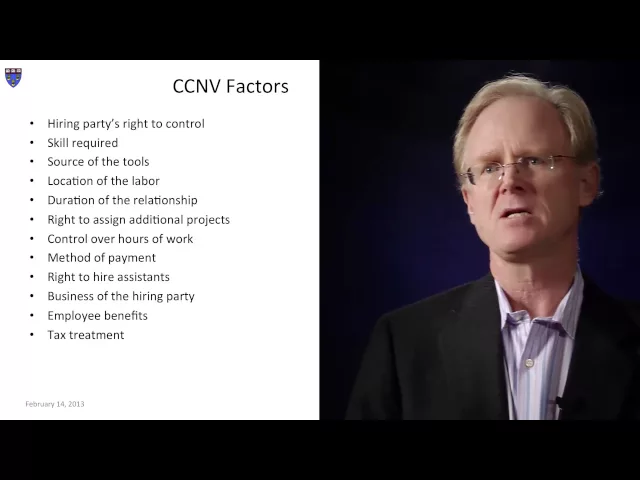
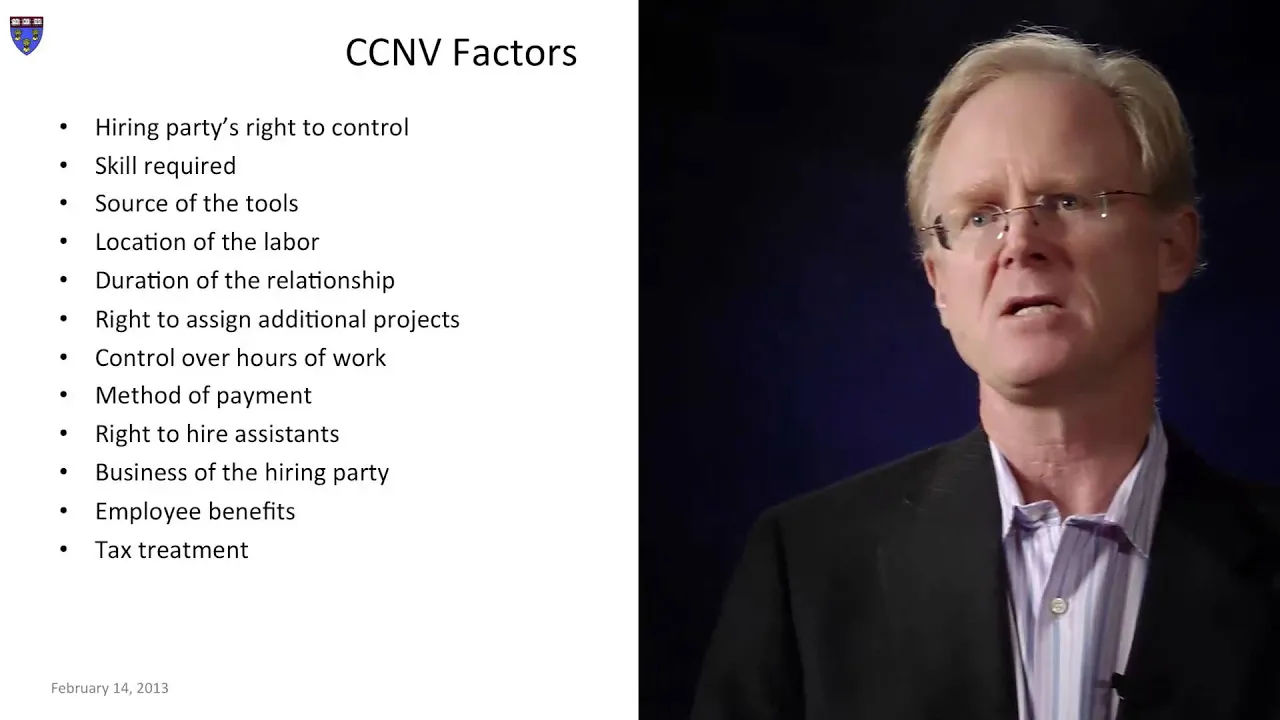
In the course of rejecting CCNV's position, Justice Marshall writing for the Supreme Court announced a new, or at least a clarified, test for determining when a person should be considered an employee. It's distilled on this slide. I'll read the key passage in the court's opinion.
"In determining whether a hired party is an employee under the general common law of agency, we consider the hiring party's right to control the manner and means by which the product is accomplished. Among the other factors relevant to this inquiry are the skill required, the source of the instrumentalities and tools, the location of the work, the duration of the relationship between the parties, whether the hiring party has the right to assign additional projects to the hired party, the extent of the hired party's discretion over when and how long to work, the method of payment, the hired party's role in hiring and paying assistants, whether the work is part of the regular business of the hiring party, whether the hiring party is in business, the provision of employee benefits, and the tax treatment of the hired party. No one of these factors is determinative.
" Closed quote. The Supreme Court then applied this multi-factor test to the facts of the case. All but one of these variables they concluded tilted in favor of Reid.
Here again is Justice Marshall's language. Quote, "True CCNV members directed enough of Reid's work to ensure that he produced a sculpture that met their specifications, but the extent of control the hiring party exercises over the details of the product is not dispositive. Indeed, all the other circumstances weigh heavily against finding an employment relationship.
Reid is a sculptor, a skilled occupation. Reid supplied his own tools. He worked in his own studio in Baltimore, making daily supervision of his activities from Washington practically impossible.
Reid was retained for less than two months, a relatively short period of time. During and after this time, CCNV had no right to assign additional projects to Reid. Apart from the deadline for completing the sculpture, Reid had absolute freedom to decide when and how long to work.
CCNV paid Reid $15,000, a sum dependent upon completion of a specific job, a method by which independent contractors are often compensated. Reid had total discretion in hiring and paying assistants. Creating sculpture was hardly regular business for CCNV.
Indeed, CCNV is not a business at all. Finally, CCNV did not pay payroll or Social Security taxes, provide any employee benefits, or contribute to unemployment insurance or workers' compensation funds. " Closed quote.
Since 1989, courts confronted with analogous disputes have relied on this list of factors to determine whether an artist in an ambiguous position should be considered an employee. A few lower courts have tinkered with the test. For example, in one case the Court of Appeals for the Second Circuit announced that a subset of the factors-- specifically those highlighted in red on this chart-- are especially important and should be given extra weight.
But most courts just apply the CCNV list as the Supreme Court formulated it. Disputes of this sort have not arisen terribly often in the past, but they're likely to become more common in the future. The reason is that in many modern economies, certainly including that of the US, companies are decreasing their reliance on formal salaried employees and increasing their reliance on people whose relationship to the company is more attenuated.
People hired for short periods of time not given traditional employment benefits and so forth. In most respects, this trend is bad for the workers. But in one respect it's potentially good for the workers and dangerous for the companies.
Namely it increases the chances that copyrighted works created by these workers will not be classified as works for hire. Indeed, copyrights in these works will belong to the workers. Unless and until tell the workers assign those copyrights to the companies, their legal position will be stronger.
Companies, for their part, should look out for this legal hazard. The second path to work for hire status seems more clearly marked. As I've already mentioned, if a work falls into one of these nine categories and if the commissioning party secures a signed written agreement acknowledging that it shall be deemed a work for hire, that's the end of the matter.
One industry that relies heavily and effectively on this mechanism in the United States is the film industry. You'll recall, I hope, this chart showing the legal relationships among the principal participants in the making and distribution of a typical film. As I discussed in lecture number three, the creative contributions of many people-- screenwriters, actors, directors, and so forth-- are pooled into a single copyrighted work, namely the audio visual work corresponding to the finished film.
Ordinarily that copyright is held by a producer which then enters into a distribution agreement with a studio, which then issues licenses to the various players listed at the bottom of this diagram. There's a risk lurking in this structure which is probably apparent to you now that we've seen how the Rent case ended up. The risk is that some of the contributors to the film listed at the top of the diagram might argue, plausibly, that they own the copyrights in the separate things they contributed to the final product and thus that the theaters, TV stations, and so forth shown at the bottom of the diagram can't publicly perform the film, in other words, the film containing their copyrighted works, without getting separate licenses from them.
To avoid this outcome, the producer almost always obtains a contract from each of the contributors designating his or her contribution as a work for hire. The result, the producer owns the copyrights in those contributions from their inception. The legal provision that makes all this possible and now indeed routine is shown on the chart.
Notice that one of the nine categories of works for which signed work for hire agreements are effective consists of quote, "a part of a motion picture or other audiovisual work. " Another industry that purports to rely on work for hire agreements is the recording industry. You'll also recall this slide, I hope.
It outlines the legal relationships among the principal participants in the making and marketing of a musical composition and an associated sound recording. You'll recall from lecture number three that the composer acquires the copyright in the composition, typically assigns that copyright to a music publisher, who then issues licenses to many licensees collecting fees from all of them, which the publisher then shares with the composer. The place in this complex industry where work for hire agreements become relevant is the relationship between the performer who makes a recording of the composition and the record company.
This relationship appears in the bottom right of the diagram. You'll recall that since 1972 the recording has given rise to a second, separate copyright in the sound recording. Who does that second copyright belong to?
If the performer were an employee of the record company, the copyright would, of course, belong to the record company for the reasons we've just reviewed. But that's rare. Nowadays record companies rarely employ performers.
Rather the performers are independent contractors. That means that presumptively the performer acquires the copyright. The record company though doesn't want to leave the copyright in the hands of the performer.
Typically the record company wants to control all aspects of the marketing of the recording and wants to collect all the fees. The cleanest way for the record company to achieve that is to hold the copyright. As a result, as the chart indicates, virtually all recording contracts provide that the performer assigns his or her copyright to the record company.
From the standpoint of the record companies, that's pretty good, but not ideal. The reason it's not ideal is that in the United States an assignment of a copyright is not permanent. As we'll see in lecture number six, the assignor holds a non-waivable right to terminate the assignment after a prescribed interval of time.
How exactly that termination right works we'll discuss next week. For the time being, the key fact is that, as I say, it's non-waivable. The result is that even if in the recording contract the performer purports to surrender his or her right to terminate the assignment at a future date, that surrender is ineffective.
The record companies, for obvious reasons, don't want the performers to hold this power of termination. The record companies want to hold the copyrights in the recordings permanently. How could they do so?
By ensuring that the recordings are classified as works for hire. The large majority of record contracts purport to do just that. In addition to the provisions assigning the performance copyrights to the record companies, those contracts contain provisions indicating that the recordings generated pursuant to the contract constitute works for hire and thus that the copyrights in them belong to the record company from their inception.
If effective, these provisions would trump the performer's termination rights. The problem from the standpoint of the record companies is that it's far from clear that these provisions, these contractual provisions, are indeed effective. Recall that signed work for hire agreements entered into by independent contractors are valid only if the works to which they pertain fall into this list.
Sound recordings, as you'll notice, don't appear in this list. Now the lawyers for the record companies contend that the game is not up. Specifically they argue that the individual songs recorded as parts of the albums or CDs generated under these contracts constitute quote, "contributions to collective works," and thus qualify under the first item in the list.
But even the record company lawyers realize that that argument is shaky. Some copyright scholars have testified on their behalf when the issue has been presented to Congress while others equally strongly disagree. Aware of the precariousness of their position on this issue, the record companies sought to strengthen it.
Through shrewd lobbying, they were able to slip into a seemingly unrelated 1999 statute what was called a quote, "technical amendment," closed quote, that added sound recordings to the list on your screen prospectively. Representatives of the musicians were not consulted when this change was made. When they learned of the change, there was, as you might expect, an explosion.
The furor resulted in congressional hearings, a report from the Copyright Office, angry letters from musicians, and so forth. In response, Congress removed the quote, "technical amendment," closed quote, thus restoring the original list. The record company lobbyists were able to secure only one concession, an agreement that the repeal should not be construed as a rejection of their original shaky characterization of sound recordings as works for hire because they might be considered contributions to a collective work.
The net result of this elaborate maneuvering is the very odd language shown on your screen. As you can see, the current state of affairs is as if the technical ammendment-- the 1999 technical amendment-- never happened. So are sound recordings works for hire or not?
We don't know yet and won't until the first of the termination rights start to take hold. For the reasons I'll discuss next week, that, as it turns out, will begin this year-- 2013. If in the inevitable litigation sound recordings are not deemed works for hire, then older musicians, like Bruce Springsteen and Eric Clapton, will soon begin to reclaim their copyrights in their early albums and will probably be able to make more money off them.
Conversely, if sound recordings are deemed works for hire, then Springsteen and Clapton will remain bound by their original recording contracts. So a great deal hinges on this highly technical and still unresolved issue. Two general lessons can be distilled from this story.
The first is that adjustments in copyright law are often achieved through lobbying by the representatives of the affected interest groups. When two or more powerful groups are opposed, the usual result is stalemate. Only when the relevant groups are aligned does the law move.
The technical amendment, so-called, secured by the recording industry in 1999 is a rare exception to that generalization. But note that it was very short lived. Once the representatives of the musicians were alerted, the amendment was rolled back restoring the statutory stalemate.
As Jessica Litman has shown, this dynamic in which copyright law changes if and only if the relevant interest groups want it to is common in the United States and not quite so common but still frequently seen in other countries. The second of the general lessons is that in some industries artists are vulnerable. Their bargaining power is, in most instances, inferior to that of the intermediaries with whom they have to deal.
As a result if they're allowed to sign away their rights, they will. Occasionally the law seeks to mitigate their vulnerability ironically by restricting their contractual freedom. In other words, by preventing them from signing away their rights.
The limitations on the set of works that can constitute works for hire when prepared by independent contractors is an example of that approach. We'll see some other examples next week. Whether these efforts to protect artists or their families from exploitation are effective is far from clear.
We'll see.