I analyzed Google's AMO strategy. And here's what you must do now. Rankings don't matter anymore.
Traffic is dying. And everything you learned about SEO, that's no longer enough. I spent the last 25 years helping companies drive billions in revenue through search.
I've seen Google kill entire industries with algorithm updates. But this shift, this is different. Google's AI mode just flipped the entire playbook from traffic to trust.
And most marketers are still playing the old game where their competitors figure out the new one. So here's exactly what changed, why it matters, and what you need to do about it right now. Chapter one, the citation economy.
Stop optimizing for traffic. Start optimizing to get cited because Google's not in the traffic business anymore. They're in the answer business.
And here's what most people don't understand about Google's AI mode. When someone searches now, Google doesn't just try to show them 10 blue links anymore. They show them an AI generated answer right there at the top with sources cited underneath.
And here's a brutal part. If you're not one of those cited sources, you're invisible. Think about what that actually means.
Traditional SEO was about ranking number one to get clicks. The new game, it's about being credible enough that AI mode references you when it synthesizes the answer. You're not competing for position anymore.
You're competing for attribution. And attribution requires something completely different than what got you ranked in the past. It requires recognized authority.
Brand mentions from trusted publishers, structured data that AI can parse, a digital footprint that signals this source knows what they're talking about. The data backs this up. 72% of people now want exact answers, not links.
76% want conversational search experiences. They're not browsing anymore. They're asking questions and expecting AI to synthesize the answer.
So, here's what you need to understand. The brands that win aren't the ones with the best SEO. They're the ones with the most recognized expertise.
Because AI mode doesn't just scrape content. It weighs credibility. But if you're creating content just to rank, you're creating content that won't get seen.
The new strategy is building authority that AI systems recognize and site. Chapter 2, the complexity mode. Simple questions get answered by AI directly.
Complex questions still need sources and that's where the entire game is moving. Let me show you something that reveals where the opportunity actually is. This chart is everything.
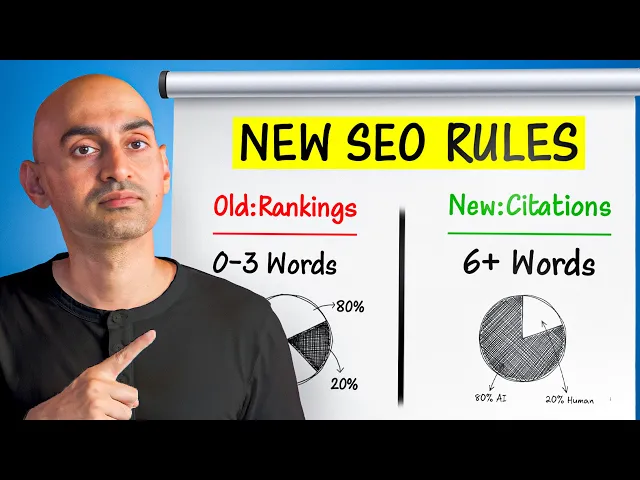
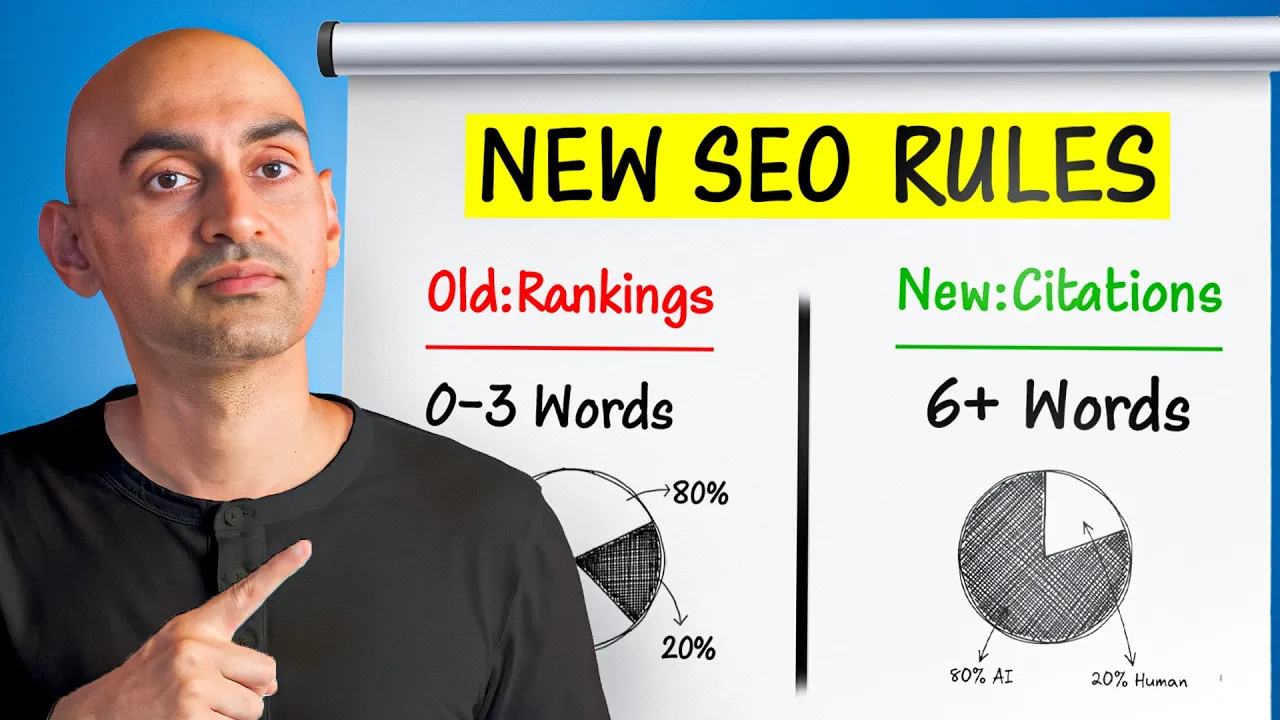
Look at those numbers. Short queries 0 to3 words trigger AI overviews 23% of the time. Medium queries 3 to 5 words trigger them 48%.
But long complex queries six words or more 77%. You know what that tells you? Complexity is the moat.
When someone searches best CRM, a mode just tells them no citations needed. But when someone searches best CRM for enterprise SAS companies managing remote sales teams across three continents, a mode has to site sources because that's nuance that requires context. That requires expertise.
And this is a shift most businesses are missing. The value isn't answering simple questions anymore. It's owning the complex, multi-layer topics that AI can't fully synthesize without expert sources.
And here's what that means for your content strategy. Stop trying to rank for broad keywords. Start building comprehensive resources around specific nuance problems.
The kind of content that requires depth, real world experience, and proprietary insight because [music] that's what AI mode sites. Not generic blog posts, not shallow listicles, deep authoritative content that demonstrates genuine expertise. The opportunity right now is massive because most businesses are still chasing high volume simple keywords while smart ones are building moes around complexity.
Chapter 3, the zeroclick reality. Google is willing [music] to kill 40% of website traffic to avoid becoming irrelevant. And they're doing it on purpose.
Clicks are dying. And if you're measuring sales by traffic, you're measuring the wrong thing. Let me show you the data that should terrify every content marketer.
Before AI mode rolled out more broadly, 57% of searches were already zero click. After the roll out, 59%. That doesn't sound like much, but here's what that actually means.
Google is gaining 1 to 2% points in zeroclick searches every single year. And according to industry forecast, they're going to drive more to websites each year. But they're doing it by growing total search volume, not by maintaining clickthrough rates.
Translation: The pie is getting bigger, but your slice is getting smaller. Why is Google doing this? because they watched chat gvt explode.
They saw people stop googling things and start asking AI instead. And they realized that if they don't become the answer destination, someone else will. So they made a calculated decision.
Kill some traffic now to [music] avoid getting disrupted later. And here's a part most marketers don't want to accept. This isn't reversing.
Google's not going back to 10 blue links. They're going all in on AI mode because their entire business depends on it. Which means your strategy can't depend on clicks anymore.
It has to depend on something else. And what's that something else? It's trust.
It's authority. It's being the source AM mode references when people search for topics in your domain. You can't stop the zero click trend, but you can position yourself to win in a world where citations matter more than clicks.
Chapter four, the authority tax. Traditional SEO is not just table stakes. The real game is building brand authority that AI systems recognize.
Everything that used to get you to number one, that's just baseline now. And here's your truth about the new SEO game. All those tactics that used to work, keyword optimization, backlinks, technical SEO, structured data, they still matter, but now they're just the price of entry.
Because AI mode just doesn't look at your onpage SEO. It looks at your brand. And brand takes time.
Look at this data. It takes 10 years to build a recognizable brand within your industry. 10 years of consistent marketing to get [music] 18% brand awareness.
Most people don't want to hear that. They want a growth hack. They want a shortcut, a tactic [music] that works in 30 days.
But a mode is exposing a hard reality. Authority can't be gained. It has to be built.
And here's why that matters right now. The businesses who started building authority 3, 5, 10 years ago, they're about to win big because AI mode favors established sources, publications with track records, brands that have been cited before. And if you want a company to help you with your citations and get out there more, check out my ad agency, NP Digital, where we do this for hundreds of companies all around the world.
And if you haven't started building that authority yet, you're already behind. But the good news, most of your competitors haven't [music] either. So here's what to do.
Start posting consistently on platforms where buyers live. Get mentioned in publications that AI trusts. Build schema markup so AI can parse your expertise.
Create content that demonstrates depth, not coverage. This is authority tax. You can't skip it.
You can't hack it. You have to pay it consistently over years. The businesses who accept that reality today will dominate search 5 years from now.
Chapter 5, the search everywhere shift. Google's not the only place people search anymore. And if you're only optimizing for Google, you're invisible everywhere else.
Here's what most marketers are missing about AI search. Google still dominates with 13. 7 billion daily searches.
But look at the rest of the list. Instagram 6 and a half billion. Amazon 3.
5 billion. Tik Tok, YouTube, Facebook, all processing billions of searches each and every single day. People aren't just googling anymore.
[music] They're searching everywhere. Even the Apple App Store gets 500 million daily searches. This is why we acquired Yodel, a mobile app marketing company, just because of the popularity of the Google Play and Apple App Store.
And each [music] platform has its own version of AI powered discovery, which means your content strategy can't just be rank on Google. It has to be be discoverable everywhere your buyers are looking. [music] And here's your strategic shift.
AI mode on Google, AI recommendations on Tik Tok, AI powered feeds on LinkedIn. They're all rewarding the same thing. Authority, consistency, depth.
So the brands that win aren't playing specific games anymore. They're building omni channel authority that works across every AI system. That means showing up consistently, creating content in multiple formats, getting mentioned across platforms, building a brand that AI recognizes no matter where someone is searching.
Because the future of search isn't one destination, it's everywhere. And the businesses who understand that today will own visibility tomorrow. [music] The rules just change.
Traditional SEO is dead. The new game is authority. And most businesses don't even know they're playing it yet.
I analyzed Google's AMO strategy. And here's what you must do now. Rankings don't matter anymore.
Traffic is dying. And everything you learned about SEO, that's no longer enough. I spent the last 25 years helping companies drive billions in revenue through search.
I've seen Google kill entire industries with algorithm updates. But this shift, this is different. Google's AI mode just flipped the entire playbook from traffic to trust.
And most marketers are still playing the old game where their competitors figure out the new one. So here's exactly what changed, why it matters, and what you need to do about it right now. Chapter one, the citation economy.
Stop optimizing for traffic. Start optimizing to get cited because Google's not in the traffic business anymore. They're in the answer business.
And here's what most people don't understand about Google's AI mode. When someone searches now, Google doesn't just try to show them 10 blue links anymore. They show them an AI generated answer right there at the top with sources cited underneath.
And here's a brutal part. If you're not one of those cited sources, you're invisible. Think about what that actually means.
Traditional SEO was about ranking number one to get clicks. The new game, it's about being credible enough that AI mode references you when it synthesizes the answer. You're not competing for position anymore.
You're competing for attribution. And attribution requires something completely different than what got you ranked in the past. It requires recognized authority.
Brand mentions from trusted publishers, structured data that AI can parse, a digital footprint that signals this source knows what they're talking about. The data backs this up. 72% of people now want exact answers, not links.
76% want conversational search experiences. They're not browsing anymore. They're asking questions and expecting AI to synthesize the answer.
So, here's what you need to understand. The brands that win aren't the ones with the best SEO. They're the ones with the most recognized expertise.
Because AI mode doesn't just scrape content. It weighs credibility. But if you're creating content just to rank, you're creating content that won't get seen.
The new strategy is building authority that AI systems recognize and site. Chapter 2, the complexity mode. Simple questions get answered by AI directly.
Complex questions still need sources and that's where the entire game is moving. Let me show you something that reveals where the opportunity actually is. This chart is everything.
Look at those numbers. Short queries 0 to3 words trigger AI overviews 23% of the time. Medium queries 3 to 5 words trigger them 48%.
But long complex queries six words or more 77%. You know what that tells you? Complexity is the moat.
When someone searches best CRM, a mode just tells them no citations needed. But when someone searches best CRM for enterprise SAS companies managing remote sales teams across three continents, a mode has to site sources because that's nuance that requires context. That requires expertise.
And this is a shift most businesses are missing. The value isn't answering simple questions anymore. It's owning the complex, multi-layer topics that AI can't fully synthesize without expert sources.
And here's what that means for your content strategy. Stop trying to rank for broad keywords. Start building comprehensive resources around specific nuance problems.
The kind of content that requires depth, real world experience, and proprietary insight because [music] that's what AI mode sites. Not generic blog posts, not shallow listicles, deep authoritative content that demonstrates genuine expertise. The opportunity right now is massive because most businesses are still chasing high volume simple keywords while smart ones are building moes around complexity.
Chapter 3, the zeroclick reality. Google is willing [music] to kill 40% of website traffic to avoid becoming irrelevant. And they're doing it on purpose.
Clicks are dying. And if you're measuring sales by traffic, you're measuring the wrong thing. Let me show you the data that should terrify every content marketer.
Before AI mode rolled out more broadly, 57% of searches were already zero click. After the roll out, 59%. That doesn't sound like much, but here's what that actually means.
Google is gaining 1 to 2% points in zeroclick searches every single year. And according to industry forecast, they're going to drive more to websites each year. But they're doing it by growing total search volume, not by maintaining clickthrough rates.
Translation: The pie is getting bigger, but your slice is getting smaller. Why is Google doing this? because they watched chat gvt explode.
They saw people stop googling things and start asking AI instead. And they realized that if they don't become the answer destination, someone else will. So they made a calculated decision.
Kill some traffic now to [music] avoid getting disrupted later. And here's a part most marketers don't want to accept. This isn't reversing.
Google's not going back to 10 blue links. They're going all in on AI mode because their entire business depends on it. Which means your strategy can't depend on clicks anymore.
It has to depend on something else. And what's that something else? It's trust.
It's authority. It's being the source AM mode references when people search for topics in your domain. You can't stop the zero click trend, but you can position yourself to win in a world where citations matter more than clicks.
Chapter four, the authority tax. Traditional SEO is not just table stakes. The real game is building brand authority that AI systems recognize.
Everything that used to get you to number one, that's just baseline now. And here's your truth about the new SEO game. All those tactics that used to work, keyword optimization, backlinks, technical SEO, structured data, they still matter, but now they're just the price of entry.
Because AI mode just doesn't look at your onpage SEO. It looks at your brand. And brand takes time.
Look at this data. It takes 10 years to build a recognizable brand within your industry. 10 years of consistent marketing to get [music] 18% brand awareness.
Most people don't want to hear that. They want a growth hack. They want a shortcut, a tactic [music] that works in 30 days.
But a mode is exposing a hard reality. Authority can't be gained. It has to be built.
And here's why that matters right now. The businesses who started building authority 3, 5, 10 years ago, they're about to win big because AI mode favors established sources, publications with track records, brands that have been cited before. And if you want a company to help you with your citations and get out there more, check out my ad agency, NP Digital, where we do this for hundreds of companies all around the world.
And if you haven't started building that authority yet, you're already behind. But the good news, most of your competitors haven't [music] either. So here's what to do.
Start posting consistently on platforms where buyers live. Get mentioned in publications that AI trusts. Build schema markup so AI can parse your expertise.
Create content that demonstrates depth, not coverage. This is authority tax. You can't skip it.
You can't hack it. You have to pay it consistently over years. The businesses who accept that reality today will dominate search 5 years from now.
Chapter 5, the search everywhere shift. Google's not the only place people search anymore. And if you're only optimizing for Google, you're invisible everywhere else.
Here's what most marketers are missing about AI search. Google still dominates with 13. 7 billion daily searches.
But look at the rest of the list. Instagram 6 and a half billion. Amazon 3.
5 billion. Tik Tok, YouTube, Facebook, all processing billions of searches each and every single day. People aren't just googling anymore.
[music] They're searching everywhere. Even the Apple App Store gets 500 million daily searches. This is why we acquired Yodel, a mobile app marketing company, just because of the popularity of the Google Play and Apple App Store.
And each [music] platform has its own version of AI powered discovery, which means your content strategy can't just be rank on Google. It has to be be discoverable everywhere your buyers are looking. [music] And here's your strategic shift.
AI mode on Google, AI recommendations on Tik Tok, AI powered feeds on LinkedIn. They're all rewarding the same thing. Authority, consistency, depth.
So the brands that win aren't playing specific games anymore. They're building omni channel authority that works across every AI system. That means showing up consistently, creating content in multiple formats, getting mentioned across platforms, building a brand that AI recognizes no matter where someone is searching.
Because the future of search isn't one destination, it's everywhere. And the businesses who understand that today will own visibility tomorrow. [music] The rules just change.
Traditional SEO is dead. The new game is authority. And most businesses don't even know they're playing it yet.