welcome everyone to the third proformance webinar in the series we've got Mike Young with us this evening to deliver the second part of his motor learning concept all coaches should know and understand if you were with us for the first one you'll know that there'll be some some great content they'll be coming up and excited to have Mike with us again to present and just quick quick mention to some of our sponsors eccentric the creators of the Kay box three if you've got chance go and check out their website for some awesome content on their
about the Kay box and the options that it can give you in terms of and some some cool methods of eccentric training so tonight whilst the webinars on like to just encourage you guys to get involved in the chat and the Q&A there is a live chat function that you'll be able to see in your in a web browser there'll also be a couple of polls that that pop up and that you can get involved in and give us your opinion and also at the end of the webinar we'll have an exclusive offer to the
guys that are logged in on the on the webinar so if you hang around for that hopefully that you'll you'll benefit from so I'm not going to hold on any further I'm gonna hand it over to Mike and get on to the webinar so welcome Mike thank you James good afternoon if you are in north america and good evening for everyone else this is the second part to my motor learning discussion if you were with us for the first lecture there will be a little bit of overlap and that's intentional I think both to pick
those who were not able to make it to the first up to speed and also because some of this stuff is worth worth noting on more than one occasion so this lecture is very much geared towards some real-world strategies for enhancing skill and what I'll do today as I like to do most of the time is give a little bit of a road map for this presentation before we even get started the first thing we're going to talk about is skill and define it because while it's a very commonly used term if you were to
ask a coach what skin'll actually is many couldn't define it we know we want to be skilled but we don't necessarily know how to define what that is and that that can be problematic we're going to talk about best guidelines or best practices for enhancing learning some feedback strategies that will enhance learning will then look at something called practice schedules and variability we'll move on and look at how we can create a learning environment which will help your athletes learn new skills without you having to do anything in particular for coaching and then we'll wrap
things up try to bring together all these points with some take on ones so let's start off by looking at skill and clearly defining that a skill as we will discuss it moving forward here is an action or a task involving voluntary movement of the limbs and body in a coordinated manner this is this is done to accomplish a goal obviously inherent in this definition is that you can be more or less skilled and having a higher skill level will benefit performance so as coaches what we want to try to do is enhance the skill
level of our athletes this is going to take learning we want them to learn new skills and become more efficient in the skills that they already have which brings us to our next point and that's this idea of practice and performance most of us as coaches I'm guessing that many of you are S&C coaches are primarily involved with dislike scenarios and not often with game-like scenarios and the problem with that is that it oftentimes leads us down the wrong path for true skill acquisition we are blindly led into believing that when an athlete performs more
proficiently in practice that it will lead to more proficient performance in a game or a test scenario but the reality is that these two things are not the same and in fact what it takes to perform well in a practice setting is in many cases the opposite of what you would want to do in practice to perform well on a test like scenario or a game in this case so we're gonna move forward and see why this is the case this discussion again is focused on the idea of motor learning and skill acquisition most of
us are familiar with cognitive learning we've all gone through school where we have studied studied a topic and tried to get that information into our brain some of you have probably crammed for a test right you have cram for a test the night before perhaps you studied all night you took the test the next day and if you're anything like me on the times that I've done that you have forgotten that information 24 to 36 hours later that is not true learning that was cramming for a test you jammed that information into your short-term memory
true learning is assessed by retention how much of that information we learn and this is true for both cognitive learning as well as motor skill learning this is really important distinction to make because in this in this battle between practice performance and test performance we want to improve someone's test or game performance I would be willing as a coach to sacrifice what someone looks like in a practice scenario or practice environment if it meant that they would be better prepared in a test or game scenario so we'll talk about this again moving forward here now
one of the goals for us as coaches is to prepare an athlete for the test for the game it doesn't really matter other than stroking our ego and appeasing the psychology of the athlete if they perform well in a practice but can't do it in a game what work most concern about where we are actually tested on our ability to coach someone to better performance is in a game game-like setting it is in a test scenario so keeping that in mind the real goal of practice is to prepare us for the test the assessment or
the competition we can't lose sight of this we can't be short-sighted and think that the real goal of practice is to be better at practice and as I said before there is a discrepancy between being good at practice and being good in performance and the things that you do well to be good in a practice scenario may very well be the opposite of what it would take to be good in a test assessment or competition scenario there's a very famous American football coach named Vince Lombardi who famously said practice does not make perfect perfect practice
makes perfect and this is frequently used by very well-intentioned coaches many of whom are pointing to the fact that you can't be sloppy in practice you must be mindful we don't ever want to practice something incorrectly the problem with this although it's romantic and it sounds really nice to say it and it's well-meaning is that it isn't actually true and it's refuted by the research perfect practice does not make perfect in assessments tests or competitions the notion of perfect practice is flawed because mistakes are an important part of learning think back to when you first
learn to ride a bike you did learn to ride a bike by just getting on the seat pedaling and everything was perfect you learned by paddling falling peddling falling maybe having some training wheels on initially those mistakes that you made early on in the process we're absolutely critical for you become becoming proficient at the task of bicycling the other problem with this idea of perfect practice is that it ignores the reality of performance specifically the variability of games tests and so forth in games tests and competitions nothing is perfect nothing is perfect nothing is predictable
so focusing on perfect practice is soli technique oriented it doesn't take into account the fact that when I'm on the pitch there's ten other people who have minds of their own doing different things it doesn't take into a account the temperature and the compliancy of the ground or what my opponent is doing perfect practice can only really be done in a very closed closed environment so we don't want to focus on this idea of perfect practice because perfect practice tends to be just oriented on improving technique or skill in this very closed environment in the
real world what athletes are actually asked to do is read then plan and then do the problem with perfect practice is that it only focuses on the doing part in the real world in a game scenario in a competition in an actual assessment of their performance they have to first read what are the other players doing where is the ball coming from where am I on the field or court they have to plan their action do I need to run at a certain speed do I need to be in a certain position then once they
have planned that then they do it think about this in terms of basketball you read the defense you plan accordingly based off of where the offensive players are perhaps you have a plan play you you move into position ready to receive a pass now you take the shot the shot is what most people would consider the skill but that does not occur outside of the reading and planning so we want to prepare athletes to do all of those things read plan and then do rather than create some artificial environment where we're only focusing on the
doing or the technical oriented side of skill so let's move on and talk about some basic guidelines for enhancing learning one of the things that I'd like you to do is move away from this idea of thinking that practice has to be perfect a perfect practice scenario is like a caged lion or a caged tiger I went to LSU Louisiana State University for my doctoral studies and right on campus about a quarter of a mile away from where my office was we had a caged tiger cage tiger look very similar to this and this caged
tiger while it had a great cage it was several hundred meter square cake with rocks and a river and a waterfall this caged tiger while it appeared to be living the life was having a very simple and basic basic life if we if we were trying to put this same tiger that had lived its life being fed fed slabs of meat that had had readily available water that didn't have to compete with other Tigers for its food source or for its territory Mike the tiger the caged tiger at LSU if we put him out in
the wild he would not fare very well now this despite recognizing this this is this is pretty easy for most of to comprehend what we frequently do as coaches is kage our athletes we put them in these very closed environments where they work really well in the closed environments we feed them their slab of meat we provided them fresh running water there's no competition for them in terms of their territory or their meals they're never at risk for their safety this works really well if they can stay in the cage the entire time but the
reality is that practices are not the same as games in games and true assessments it's more like this if I want my food if I want my mate I need to maybe kill four I need to be prepared to do things that a cage life would not ready me for so what we want to do is move away push away this idea of perfect practice and actually embrace ugliness we want to be prepared for our prior practices to look bad we want to set up environments we want to set up practice schedules so that the
athlete will be moving outside of this cage in a practice environment so that when they go into the wild the games or the assessment they're better prepared now again this takes this takes some confidence on your part as a coach it will take you some convincing of your athlete because initially their performance is going to drop so this isn't just you embracing ugly practice this is also them embracing ugly practice let's talk about some ways that we can do that now and we'll start off by looking at feedback with regards to feedback there's a handful
of things that we want to consider here the first of which is the frequency of the feedback how much feedback how often do we give it the quantity of the feedback here we give ten different points or do we just give one point or maybe not even one point and then best practices for feedback in queueing now let's look at each one of these in a little greater detail and what's going to be interesting here and this was really eye-opening to me the first time I started to learn this information here was that many of
the things that we think make sense are often the opposite of what we actually want to do to prepare our athletes for game-like scenarios now you see the questions here on the on the live chat guys that keep those coming I will address them at the end here if there's something that is particularly pertinent on a slide or doesn't make sense I may try to answer it while I'm going but feel free to to keep the conversation going on the side here so let's look at feedback frequency as a coach I remember in my early
early years as a coach as a young coach feeling like I needed to prove my value to athletes by providing feedback every single timing in a trial whether that was in the weight room whether that was on a sprint rep whether that was putting on the golf course I thought that I needed to provide feedback every single time and that makes sense right that's our job so shouldn't doing more of our job be beneficial to athletes well as I said a lot of the a lot of the research on motor learning is actually contrary the
findings are contrary to what we might actually think this is one study here one of the more seminal studies looking at frequent augmented feedback and this is by Richard Schmidt one of the foremost motor learning experts in the world this particular study and this was a this was a meta-analysis found that less frequent feedback may actually be beneficial less frequent so if we provide less feedback to our athletes they will improve more frequent feedback may actually generate maladaptive short-term Corrections I'll talk about what that is in just a moment and it may create dependence on
feedback now anytime you look at motor learning research you have to keep it into the in the context of how we defined learning previously remember true learning is assessed by retention typically in motor learning research what we do is we have a initial test period initial practice period and we see what happens to skill during that initial practice period and then 24 to 48 hours later those seem to be the norms and a lot of the motor learning research some times you look at it in a longer span of time later we come back and
we assess whether that person actually learned the skill so when we talk about this being less beneficial more free more feedback being less beneficial that's what we're looking at here if you provide more feedback in a practice when we come back and we test that person 24 to 48 hours later they will actually have less a lesser performance and they this may be because of this maladaptive short-term Corrections they become very much dependent on the feedback and if you were to remove that feedback they don't know how to handle it they never actually they never
actually work out in their head come to being able to come to solutions for a task problem this is a very generalized slide I put put up here but it is very much in line with the body of research on motor learning so let's go through this quickly here you'll pretty much find this on every single motor learning study that looks at the effect of feedback and on skill acquisition if we take two groups in one group we give 100% feedback every single trial whatever the skill is we give them feedback and another group we
only give them feedback some of the time the group that receives 100% feedback is actually going to perform better in the practice the reduced feedback group will have lesser performance in the practice this is very misleading though because this misleads us to think that 100% feedback is better when in fact if we look at what actually happens when we test 24 to 48 hours later the hundred-percent feedback group in the absence of feedback will have significant decrement in skill acquisition significant they will drop below the practice performance of the reduced fee Beckert meanwhile the reduced
feedback group will actually improve on performance 24 to 48 hours later so now you can see why thinking that more feedback in practice while it may seem to make sense it is a short-term gain for a long-term loss we also want to consider quality versus quantity of feedback and with regards to these two variables here one thing that I like to keep in mind is that we always always always want to focus on quality and not quantity you want to focus on quality and not quantity don't say five things when you can say three and
if you're really good say it in one or two words or we'll talk about moving forward here are using external cues or perhaps analogies or looking at different ways of providing feedback so that we don't have to say a lot of information the more information that you give someone while it may make you look smart will actually reduce the athletes performance come test assessment or competition period so let's now look at best practice strategies for feedback and cueing how do we put this these points into play here we have five different senses five different senses
now as coaches we're not really going to be involved in providing sent feedback people do receive this in the real world if you smell gas perhaps you know to get away or you need to know to check to turn off the gas we are likewise not going to be providing taste feedback but as coaches that leaves three of five different areas where we can still provide feedback don't get misguidedly caught into only providing verbal feedback verbal feedback is great but we do find that some people learn better through tactile feedback or through visual feedback so
you could actually place someone puts put your hands on someone put them into the correct position or you could show them most most coaches have smartphones now put up a video and show them either what it's supposed to look like or if you have an expert performer maybe even show them what it's not supposed to look like expert performers Heist highly skilled performers actually do very well they perhaps benefit even more by showing them what something shouldn't look like because they are able to figure it out one other thing that I like to say about
feedback is that we want to follow the three C's we want our feedback to be assessed by its clarity its conciseness and its concreteness it should be clear concise and concrete in terms of clarity we don't want there to be any miscommunication between what I am intending to communicate to my athlete and the information that they are receiving if you have told an athlete or use the same feedback or same cue accuse a dozen times in a row and you're not seeing the change that you want check on the clarity ask them if they understand
what you are trying to have them do sometimes they don't driving the chest up might mean different things to different people I know as an early coach I had some decathletes and they went into a competition running the 100-meter dash and they ran the hundred meter dash and somewhere around the 50 or 60 meter mark of this hundred meter dash I yell knees up knees up and right around that same point in time this athlete is leading the race and starts to put on the brakes he starts to back off in the decathlon you don't
get points for winning a place and you only get points for how fast you run so you would never really want to do that after the race I asked asked him why he he backed off like that and what he heard was ease up ease up not knees up I was giving him a mechanical cue and in that moment he thought I was telling him to back off on the effort probably a poor word selection on my point my part but I was lacking in clarity so we want to make sure that what we are
trying to communicate is conveyed to the athlete we also want to be as concise as possible my general rule is don't use five words when you can use four don't use four when you can use three you don't use three when you can use two and so on if you can say a single word and it communicates what you want to that athlete that's fantastic that's actually better you have reached the Holy Grail we also want to be concrete in our feedback and when I say concrete I want it to be very specific we want
it to be specific and not wishy-washy in any fashion so if someone performs a task a skill and the feedback that I provide them is that was very good they don't know what was very good was the entire thing very good was what you last told me about to work on very good surely everything wasn't very good so we want to be very specific we want to be concrete tell them what was good or what was bad one other thing we need to consider is the I this idea of internal and external queuing internal cues
relate to the athlete's body inside the athlete's body for example keep your arm at 90 degrees position your head directly on top of your your neck an external cue tends to be a cue that is positioning the body or orienting the body with respect to the environment now from what I have observed and what I frequently catch myself doing is that I will oftentimes use internal cues but the problem is that research evidence shows that athletes learn better if we provide them with external cues it will both improve their performance and it will improve their
skill those two things go hand in hand but there is a little bit of a difference between them so for example if we provided external feedback on an activity like a standing long jump and the external cue might be jump to that line in the sand they would jump further than if we just told them some mechanical cues or extend your arms out in front of you that wouldn't be as effective as if we gave them some external cue alternatively we might say push the ground away we're pushing the ground away from the body that's
an external cute as opposed to saying when you take off I want your your hip and your knee joint to be at 180 degrees at full extension that's an internal cue which doesn't make a lot of sense to an athlete they are going to do much better perform better have a higher skill acquisition if we use external cues one other strategy that I like to use are analogies and analogies work well because they help our rain to make connections and if our brain can make connections the likelihood for retention will go up if any of
you have ever learned a different language before sometimes you made it might even see this in some of the sciences if you can start to make connections between your native tongue and another language or you can start to put together silly phrases in your head or silly environmental connections that's when things start to click the same thing holds true for motor skill acquisition as it does for cognitive learning so let's look at a couple examples here we have five seemingly disparate things all you know somewhat humorous but different things I would I would use each
one of these things or I can use each one of these things as a platform for learning if for example we take the plane we look at the plane and every athlete whether they have been on a plane or not has seen a plane whether it's on TV or in real life takeoff from the ground when a plane takes off from the ground the nose rises up then the body comes up and then somewhere when the plane is far out of sight 10,000 feet or so it levels off we have all seen that gradual progression
in the body angle of the plane and if you've ever been on a plane when they receive you're a poor landing or a poor takeoff we know that a rapid change in that body angle of the plane would not be something that is desirable we want to tell our athletes if we're working on something like sprinting or acceleration mechanics to accelerate like a plane taking off we don't stay low and then all of a sudden pop up we want to see a gradual progression of body angles on every single step pushing us to a more
vertical and vertical position let's take a look now at mini-me how can we use mini-me in an analogy if we're trying to work on the arm action in sprinting we might tell the athlete to elbow a short person we don't want to say put your arm at 90 degrees that's an internal cue that is not going to be very effective if we want them to drive their arms down and back hard we could give them the visual graphic to elbow a short short person in the head as hard as they can looking at a sledgehammer
everyone knows the action of a sledgehammer it's used to apply a lot of force into a nail into a tire if we use that visual of a sledgehammer and apply it to what we want that athlete to do when they strike the ground on every single step we might tell them to hit the ground like a sledgehammer and now a hamster a hamster and a treaded spinning wheel if an athlete is just turning their feet over super quick and they're not going anywhere you could tell them you look like a hamster in a spinning wheel
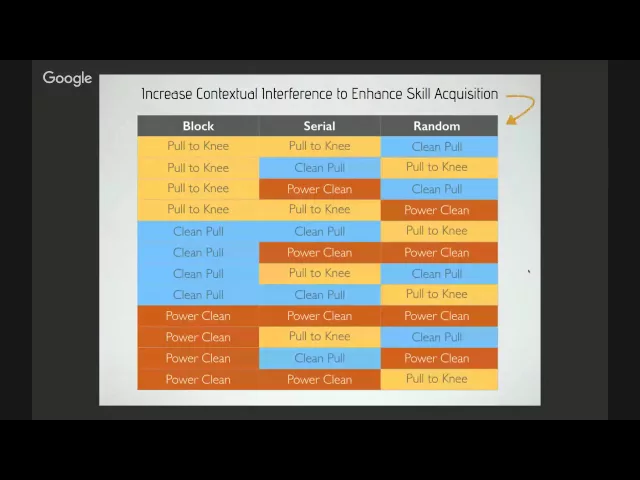
your legs are moving really fast but you're not going anywhere and then finally Pistons if we want the legs the leg action during acceleration to be piston like we might tell the athlete to drive their legs like Pistons back and forth not like we're riding a bicycle but back and forth like Pistons all right let's move forward now and talk about how we can incorporate practice schedules and movement variability to enhance performance I'm going to give you three different types of practice scenarios or practice schedules the first one is called block practice in block practice
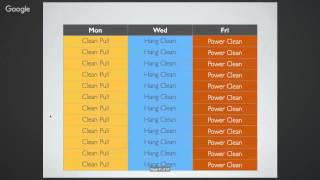
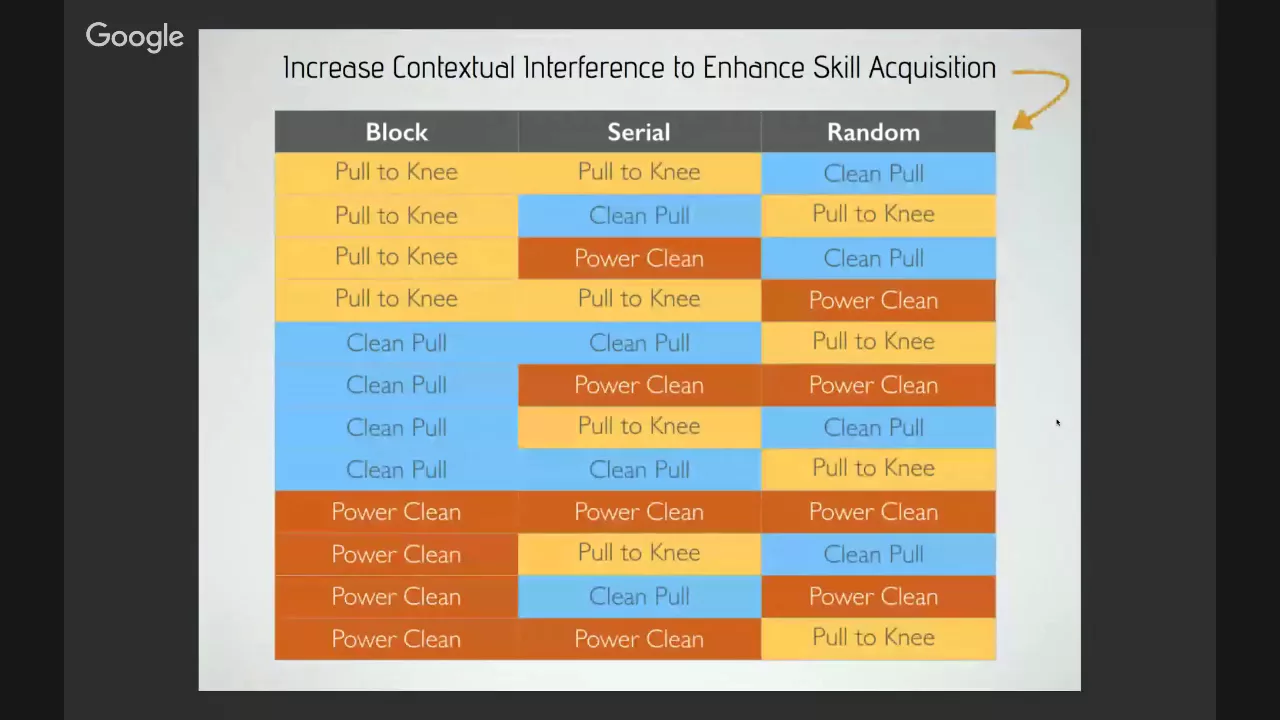
we might perform the same task repeatedly okay so if for example I'm trying to teach the Olympic lifts I might do a pull to the knee or the first pull of an Olympic lifts for multiple sets consecutive reps then maybe on another day I might do clean pulls and then on the final day I might do power cleans that's blocked practice in serial practice we're mixing things up a little bit we are doing pulls to the knee first then we're doing clean pulls then we're doing power cleans then maybe we do pulls to the knee
again maybe that's one day and then our next day is clean pull power clean pulled a knee clean pull and then in our last day or maybe this is sets I don't care how you look at this power clean pull Danny clean pull power clean our last practice type and this is a continuum here these are just examples on a continuum is random practice in random practice we take those three different skills that were practicing and we put them in randomly they occur with a frequency that is not predictable now if we look at these
three types of practice schedule one thing I want to point out here is that we have the same frequency of each skill in each type of practice so in block practice we're doing four of each serial we're doing four of each random we do four of each the only thing is chain that is changing is the order of those different trial types okay now which do you think would lead to the best performance in practice which which would lead to the best performance in practice most people and this is what most coaches do would say
blocked practice blocked practice and they're correct this leads to the best performance in the practice session now the problem with this is that performing better in practice does not necessarily you're going to perform better in the test competition or assessment if we looked at random practice we would actually see that that performer probably got quite frustrated during the practice session because they couldn't string together multiple trials a lot of times a complaint you will hear is that athletes who are not able to do consecutive trials are the same thing repeatedly now say they can't get
into a rhythm now what getting into a rhythm is is not having to figure something out if you do serial or random practice you're forced to make you're forced to be mindful first and foremost because you have to be mindful to change the task but you also have to figure out what the difference is between each of these skills this forces our brain to start to make connections and although it might cause us to struggle in the short term in practice what it actually does is lead us to perform better in a test or assessment
remember we need to be willing to practice ugly so that we can perform perfectly perform perfectly when it actually matters again think back to a game scenario we don't know what that a fleet is going to experience it's safe to say that there is no single shot in soccer no single shot in basketball no single putt in the engulfed in the history of the games that was exactly identical to one that had ever occurred it was in a slightly different place on the court or the field or the green it was the past that came
in was harder or softer or this much ball spin the defender was in this place the pitch was harder or softer now if all we do is prepare someone to perform in a very robotic fashion they're not going to be prepared for when that ball comes at an angle that they have never prepared for we want to prepare athletes to be ready for the unexpected and this is going to require us to be willing to practice ugly besides let me back up here this idea of practice scheduling and the variability between one trial in the
next is called contextual interference contextual interferes with contextual interference what we're doing is making that athlete think perhaps at a subconscious level they have to think and that thinking will cause a decrement in short-term practice performance but will improve skill acquisition as assessed by 24 to 48 hour retention let's look at movement variability now and movement variability is again something a lot of coaches well minded coaches misguidedly misguidedly make the wrong decisions on what we want to try to do with movement variability is enhance the variability the tendency for most coaches that I have seen
and I'm guilty of this as well is to attempt to reduce variability as much as possible if we are attempting to teach someone how to squat for example you're teaching a new person how to squat we could introduce variability that would change the motor pattern just slightly enough that it would challenge them so that when they were placed in different environments they would be able to perform at a higher level even if they have never seen that skill never seen that specific practice skill in the past so for example we can have them do it
shoes and without shoes we could have them put their hands on their head or out in front or perhaps holding a kettlebell we could have them go very fast and very slow we could have them do it alone or with a partner we maybe even want to have them do it on a very hard surface and then a softer surface that is maybe a little bit less stable even in sports like running changing the variability changing the surface compliancy can help to enhance skill acquisition of mechanics now most of us as SN c-- coaches work
with athletes over a broad range of skill skill levels and one thing that I do want to point out here if you missed the first part of this lecture is that just because you are and just because you are very good at performing something especially on a physical side the physical performance of something does not necessarily mean that you are highly skilled at that activity for example just because I can run really fast doesn't mean that I can perform the the mechanics of running in a very skilled fashion I might just have the right Lynn
length ratios I might have a great fiber type distribution I might have a very long Achilles tendon all of which allow me to run very fast despite having a low skill level so performance alone is not in some activities physically assess activities like strength and jumping and sprinting is not is not always a direct indication of the skill level of your athlete so keep that in mind as a practitioner now if if we're trying to bring these two concepts of movement and task variability and contextual interference together and span it across the developmental timeline beginners
to experts what we're going to find is that it will be - to our benefit and to the athletes if we keep the practice variability and contextual interference relatively low when they are beginners and as they get more advanced in their skill level then we introduce more and more movement test variability and more and more contextual interference and when they are experts this is when we then when we take the lid off and really allow things to get ugly we want to always provide a test a practice scenario that will challenge the athletes we don't
want practice to be easy we want practice to be hard and I don't mean that referring to the physical demands of that practice we want to challenge them from a motor skill acquisition standpoint every single practice so that might mean not doing consecutive attempts of the same exact movement every now and then throw in a different movement pattern that might mean changing up the environment or having them respond to a different stimulus especially as they get more and more advanced in their skill level we want to always be pushing the limits of what that person
can handle now we we don't want to make the mistake though of delivering too high of a practice variability or too high of contextual interference to someone that isn't ready for it that will beat them down that will make them have a defeatist attitude because they will never achieve any level of success we don't want to take away an athlete being successful but we want to keep in mind that they need to have a level of challenging practice that is just palatable enough that they can maintain confidence improve improvement practice and really have a great
transfer of that skill acquisition and retention of that skill acquisition when it actually comes to competition and assessment now let's look at creating a learning environment and this is something that we can do as coaches to teach without teaching one thing that we want to try to do is as I say coach without coaching by creating an environment that facilitates motor learning we can do this by using tools and specific environments to make motor patterns idiot-proof for example looking at some tools and environments that will facilitate learning we might use sprints with a resistant harness
to teach appropriate body angles and timing of pushes almost everyone when attached to a resistant device whether it is a sled that they're pulling sled that they're pushing some form of harness whether they're pushing down a broken car will almost always exhibit appropriate and optimal acceleration mechanics this is because our body is oftentimes smarter than our brain and if we get the brain out of the way fireman or a tool that forces them to do it correctly the body will do it correctly likewise you could have someone sprint up a hill if you sprint up
a hill it will allow that athlete to do the ideal acceleration mechanics pushing through the long axis of the body getting those knees up and in front long complete pushes of the leg to full extension even when they are not able to exhibit those same motor skill characteristics on flat ground maybe the athlete is not very competent at sprinting well in an upright fashion you don't have great upright sprinting mechanics or downfield sprinting mechanics we might tell them to sprint as if they are running on wet grass or perhaps even actually have them sprint on
wet grass now if you've ever tried to walk on what grass or ice you know that if you're foot has too much horizontal excursion either in front or behind you that you're going to fall over you will lose stability and fall over so we want to try to teach that athlete either through this analogy spurning on wet grass or actually putting him in an environment where that stability would be compromised and it would force them it would force them into doing what we want getting that foot down right underneath their hips having a relatively short
ground stroke and then getting back into into flight relatively quickly in an action like squatting a lot of times I will take my beginner athletes my beginners my newbie athletes in the weight room and have them do a goblet squat with a goblet squat we hold a kettlebell or some weight in the front side of the body we don't even have to teach the front squat front squat front rack position everyone can hold a kettlebell by the horns like that and the placement of that weight with respect to their center of mass allows them to
sit back and down a lot easier if almost idiot proves the action of a squat you know often times find if you gobble at squat an athlete they will be able to perform the skill of squatting proficiently even when they can't do it with their body weight alone and then lastly if we're trying to teach an athlete to squat to a certain depth we might actually have them squat to a box so we are giving them some external external feedback through the environment where they will the only way that they can achieve it is by
feeling a tactile sensation of the Box under their legs so it's idiot these are examples of idiot proofing the environment and using tools to enhance motor skill acquisition alright let's wrap up now and start to connect some dots here let's look at the take-home points one of the first things we need to do is keep the goal the goal and if you recall I think I can speak safely for all coaches in saying that the our real goal is to improve someone's performance when it matters the most in a game in a test in any
actual competition assessment so keep that in mind if we keep that in mind we won't become fooled by practice scenarios or cueing and feedback strategies that improve our practice performance but actually hurt our performance in a test or competition so keep the goal the goal embrace ugly practice by embracing ugly practice you give yourself some leeway you provide confidence to your athlete that it's okay to make these mistakes and these mistakes are really an important part of learning it's not an indication that you are not learning it's an indication that you are learning we want
to follow best practices for feedback and cueing meaning we'll use analogies whenever we can we're gonna provide external feedback rather than internal feedback that we are going to be clear and concise and concrete with everything that we say that we are going to focus on the quality of the information that we provide and not the quantity of the feedback that we provide and finally that we are going to only give as much feedback as is necessary we're not going to necessarily give them feedback every single time one strategy that I have used successfully in the
past is a bandwidth bandwidth Pro criterion meaning that if my athlete is performing the task acceptable but not perfect I won't I won't provide feedback if they perform the task and it is outside of my acceptable bandwidth only then will I provide feedback this is a this way of throttling back your feedback frequency and creating a nice criterion of when you should and when you shouldn't provide feedback we want to try to incorporate contextual interference and movement variability as appropriate remember with less skilled athletes we're going to be providing less less contextual interference and less
movement variability but as they become more and more skilled we want to challenge them in practice don't take your cage lion if they've been a cage lie in their whole life don't take they're kicking your cage line and throw them into the wild take your cage lion and put him into a wildlife preserve where it is a little bit easier for him maybe he has to hunt his own meat a little bit or maybe he has to find some water but there's no competitors for him then once he has transitioned there with in this example
a little higher CI contextual interference a little higher movement variability then you allow him to go into the wild with random practice with higher movement variability and then we want to try to create a learning environment and we can do this in a handful of ways but remember that the goal is to try to coach without coaching by using tools and specific environments that can make the movement patterns idiot-proof thank you very much guys I know you have some questions here some some really good questions this is my contact information on the side here I'm
fairly active on on Twitter that's my handle there if you ever are stateside or in the North Carolina area I welcome you to take a visit over to athletic lab we are hosting a proformance seminar in at the end of March at athletic lab and then those last two sites there are my informational sites free content nothing no no charge or anything like that so a couple questions that we did have here is commenting on the difference for clothes sports does this apply to clothes sports and this is a clothes port for those of you
that don't aren't familiar would be something like cycling like track-and-field like gymnastics where the environment is very much constrained and where the competition arena is very much constrained in those scenarios it's much more predictable than say for soccer or rugby where obeys the research though is still relatively clear in that these rules will still apply even in those situations the difference being that if you if you are in an environment where you can always coach an athlete you can always coach that athlete then it might be okay to give more feedback so for example in
some sports like gymnastics perhaps the coach is always going to be right there but even in a sport like track and field you can coach right beside them in practice but if they should happen to make it to the Olympic Games you're going to be if you're lucky a hundred rows up far removed from the action and you probably haven't seen your athlete for two hours because they were shuttled away on to the warm-up track so even in those environments we want to have them be prepared for for anything really they we want them to
become smart we want them to be able to handle any environment that is that is thrown at them and I can even see situations in activities like swimming or gymnastics where we want the athlete to be able to figure out what to do when something unpredictable happens because even in closed sport environments unpredictable does happen whether it is someone shouting from the stands or you getting into an off balance position that you've never been in before it's seeing these unpredictable ugly practice scenarios in practice that will help prepare you for handling that well in a
competition so there is certainly a difference but even in those scenarios I and I primarily work right now in close sports I coach them higher level weight lifters in the sport of weightlifting higher level track and field athletes and and slide sport athletes bobsleigh and skeleton and these are all closed for closed environment sports and even then I'm still not providing feedback every single time I'm still using analogies I'm still trying to set up perhaps different environments with various levels of contextual interference and movement variability so all of these things will still apply just like
we talked about there being differences between beginners and advanced athletes and how we use these different strategies there will also be some differences between athletes who compete in highly unpredictable competitive arenas and those that are competing and very closed environments like swimming track and field gymnastics and so forth but the rules still pretty much apply so the another question here from Sami about what are the best possible group sizes for one coach two coaches three coaches for me personally and this I manage a group of coaches at my training center as a general rule we
don't take more than 12 athletes per coach if we work with large teams we're not going to we're not going to violate that ratio what we found is that it is almost impossible unless you have some very advanced athletes to go beyond that ratio and still be able to coach effectively it becomes more like babysitting so we try to keep it at you know one to twelve at the most ratio and some of this depends a little bit on the sport like I have had a elite track and field group that I work with and
sometimes I would take 15 to 20 people in that group depending on the pending on the event groups and I could handle it quite well because in a sport like that you might have one athlete doing a repetition and everyone else is resting and it's easy to keep an eye on every single for every single person but if you're in an act in a sport or an activity where you're constantly being forced to watch everyone out there 12 would be at least personally for me about the max I would ever consider going any other questions
guys well thank you for the thank you for hosting the webinar James if you did have any questions as a follow up I open to answering them on my Twitter feed I believe this will be open for you to view if you wanted to review any of this material on YouTube James can follow up about that yeah for sure Mike cheers again for a for another fantastic webinar closing the series on on motor learning and it's it's great to get the practical application to some of the theories that were discussed in the in the first
webinar thanks everyone for taking the time to out there evening to be with us to check out the webinar as Mike Mike mentioned we've got some exciting some exciting opportunities coming up and particularly the workshop I mentioned in the US we've got a really exciting line of coaches they're not quite sure we're able to fully announce who they are just yet but we've also got a really exciting conference in the UK which is going to be focused around and the whole developmental spectrum of long term athlete development and we're looking forward to bringing Mike back
to the UK in April and to present at that conference and we've also got dr. Ian Jeffries and dr. rugby lloyd who were on board to deliver some some fantastic talks around the applications of plyometric training as well as some task-based approaches to to movement development we've also got another couple of coaches in the pipeline for that which we're really excited about so that would be a our facility in Gloucester on the the ninth and 10th of April and the exclusive offer that we mentioned earlier on will be for for the guys that have registered
here and being with with us for the for the webinar series you will all have a chance to access tickets before they're on general sales so that often will be emailed through to you and it will mean that you can get guarantee yourself a ticket if you're able to get if you're local to either the UK or the u.s. workshops that will be up and running soon so keep an eye on your email you'll be able to access that if if you're not able to get to the UK or Mike's facility in the US and
don't worry we've still got some more webinars on the way really excited to have Nick Grantham signed up to deliver a live webinar Nick works with their West Bromwich Albion in the EP out the English Premier League and he's going to join us on the 25th of February for another like live webinar at 8:30 p.m. you can check Nicky he's very active on Twitter at coach Nick G or his website www.rinaldin.com but as I said thank you very much for joining us tonight we'll look forward to hopefully seeing you at the next webinar and hopefully
we'll get to meet a few of you in in person at these live workshops which the details would be through to your emails as as soon as we can get them out we'll see you soon