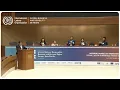
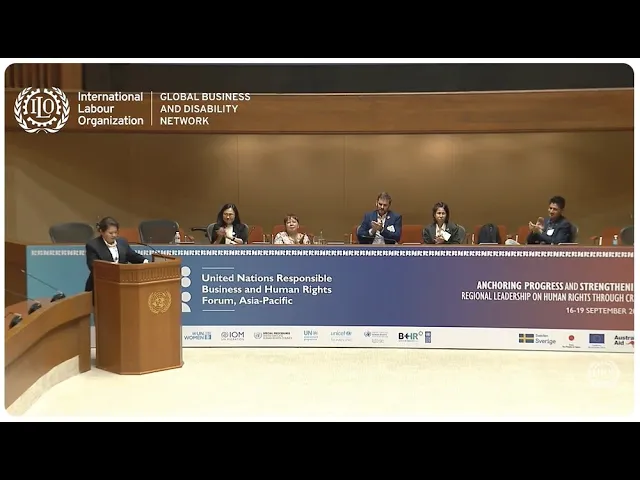
Really much appreciated that you have come to the session partnerships for progress upholding labor rights of persons with disabilities uh in the Asia-Pacific region. My name is Jung Mensah. I'm a disability inclusion specialist at the international labor organization, the ILO, and I'm also the coordinator of the ILO global business and disability network, which together with the UN working group on business And human rights and the UN uh economic and social commission for Asia Pacific, UNSCAP has organized this session. Just maybe for those uh who would appreciate a physical description, I'm a middle-aged white man uh
with a beard, white shirt, and a blue jacket today. So um with me today I will say a little bit more about what we try to do in this session but just to also introduce um quickly and then of course I will introduce them again when it's their Turn. We have an amazing uh panel with us today. On my right uh we have Sawak Tong Kai. She's a steering committee member of the Azan Disability Forum. Thanks so much for joining us today. Next to Sawak we have Carrie Chao. She's an accessibil accessibility evangelist at ATOSS,
one of the company members of the global business and disability network. Then on my left we have Nantan Apple Suan Nawut and I apologize for any misprononunciations. Uh she's a director of international cooperation at the department of empowerment of persons with disabilities here in Thailand. And then next to Apple we have Krishna Sha. He's the executive director of the UN global compact a country network in Nepal. So thanks so much to all of you here also the panelists for joining us and of course for you uh to you uh joining us today. Now why do
we have this session? It's always Good to start with a why. First, we need to recognize that people with disabilities are a huge group in society. Here in the Asia-Pacific regions, hundreds of millions of persons with disabilities are there. Um, sometimes with nonobvious, non-visible disabilities, so we might not even know if somebody has a disability or not. A common experience, however, is that people with disabilities experience less favorable outcomes when it comes to Labor market outcomes and in society at large. We know that labor market inactivity rates are higher, unemployment rates are higher, and when
people with disabilities are in employment, they also experience typically worse conditions, including a disability wage gap. The ISO research department put out for example last year a paper that proves shows the evidence that even when people with disabilities are formally employed they earn less Than those without disabilities. So the exclusion and systemic barriers in the labor market prevent people with disabilities uh to fully participate in the labor market and business has a leading role already and can of course always get more active in in addressing the systemic barriers together with partners like government, trade unions
and of course civil society uh most prominently organizations of persons with Disabilities. And the systemic barriers are manifold. Physical accessibility, digital accessibility, but also legislation that might be not conducive. But in the end, in the end, it always comes back to attitudinal barriers. So when you when you have a more inclusive mindset, I think a lot of these systemic barriers can be addressed not automatically with a lot of advocacy and persistence. But I think in the end we need to change also Awareness. But we we don't have to wait until everybody's fully aware. That's not
what I'm saying. But awareness goes hand inhand with a practical solutions of which we will hear a few also today. Now this session is of course part of the business and human rights forum here in Asia Pacific region. And to give the context to this, of course, we have from on the one side what applies to business and the UN guiding principles on on business and human rights are also of Course talking about uh non-discrimination and and doing not only no harm. In our case, what we do in the global business and disability network is
not not do harm, do good. And for us it means employ people with disabilities, provide equal opportunities for career progression and provide decent work opportunities like you do also for persons without disabilities. from the disability rights perspective. Of Course, we have the UN convention on the rights of persons with disabilities which those who have signed it almost all UN countries member states um has a particular uh article on work and employment article 27 and of course there's also the role of government to make it easier for for business to um to include people with disabilities
in their policies and procedures including when it comes to employment. We need of course also in this forum Remind ourselves that as part of human rights due diligence disability need to be integral part. So when you engage in human rights due diligence processes discussions don't forget about people with disabilities. They need to be included. They're a huge group and still very much marginalized around the world including in this region. Now, human rights, disability justice, these are good arguments to do better in business on disable inclusion. At the Same time, there's a clear case, business case.
It shows that when companies are flexible enough, inclusive enough, they are more competitive overall because if you are able to accommodate people with disabilities, if you promote accessibility, it does not only benefit persons with disabilities, it benefits all employees in an organization, in an employer, and it just makes it much more effective compared to those who have a very rigid Um and non-inclusive approach. So the the the case we're trying to make here is that if you work on disable inclusion accessibility, it's not only because it will benefit persons with disabilities. You will create better
more more robust and more effective companies because you're also able to address problems and and and uh react more flexibly um in in terms in in times of crisis. Now like we have here today uh in the global business and disability network we have Both businesses and business allies in the in in in the end we try to make it easier in the global business and disability network for companies to include people with disabilities in the policies procedures especially when it comes to employment but business can't do it alone. They're amazing uh companies in our
network. One of the companies represented here ATOSS but we also need to uh work in partnership and that's why the session is called Partnerships for progress. It's a joint responsibility and joint commitment to make labor markets around the world including Asia Pacific disability inclusive and with that also efficient labor markets where everybody deserves a fair uh chance. Just quickly on the GVDN, the global business and disability network. Just to put that also in context, we currently have four 43 multinational enterprises in the network including ATOS. At the Same time at country level, we have more
than 45 national business and disability networks. Uh one of them represented here through Krishna in Nepal. Um and we have a few non-b businessiness allies um in in that network. I'm mentioning this because maybe you want to learn more about so a bit of self self-promotion but if you want to learn more about the global business and disability network Google us or just put business and disability.org uh into your browser and See if you're representing a multinational enterprise always happy to welcome you on board. if you're uh active in one country only um see if
we can work through a national business and disability network or get you involved uh if if you're a civil society. Now with that said um just to give you an idea what to expect in terms of the flow of the session. I will ask uh two rounds of questions. Um, in each round I will ask one question to each of the Panelists and then we should have some time for Q&A with you the in-person audience here today. Now let's start with Sawalak. So Sawak you represent the disability rights community here today. Um, and there's a
slogan nothing about us without us in in in in when we talk about disability inclusion. And from your perspective what are the common misconception? I was talking about awareness. we need to raise awareness. So what are the common misconceptions actually when we talk about people with disabilities and how have you tried to address these misconceptions these stereotypes when you work with companies? >> Thank thank you very much. Um you know this question is very very uh classical question since uh 1981 when the UN general assembly adopted the first UN uh remarkable decade of person with
disability and its world program of Action years to challenge this misconceptions. So first um society always you know understand misunders misunderstand that person with disability is a small group. It is very rare to find persons with disability all around the world. But in fact you know persons with disability allow the world constitutes six um 15% of uh person I mean persons without disability worldwide And most of them are a part of every community and workplaces and second misconceptions disability is only a personal and medical problems. You know um person with disability actually results from the
interaction between a persons and barriers for instance uh policies barrier in uh the policies attitudinal barriers and inaccessible design. So we need to remove those barriers to enhance the Meaningful participations. And next um society society always uh perceive that uh there in the world only uh visible visible disability but in fact many persons you know um hold the identity of invisible impairments including like chronic pain, psychosocial impairment, neuro divergent impairment I mean but they are all invisibles and they are a part of workplaces and then persons with Disability cannot make their own decisions but in
fact all of on all of us persons with disability are a part of human being. We are a citizen of our own country. So all person so therefore all person with disability have a legal capacity on an equal basis with other but we need a support to make the decision we don't we don't need substitutions decision making we don't need we deny no sub uh substitute decision making Deplies our um legal capacities of all persons with disability. So next persons with disability are asexuals. They don't have sexual identities. So they should not mar. But in
fact we are as um other human being. So persons with disability are not homogeneous groups. We are diverse amongst uh human uh beings allow allow the the worlds. So we need uh support um and also the practical u measures to stop for sterilization. So fosterizations and forth you know decision making uh discrimination and violate human right and human um being uh its legal capacity and children with disability and this is the the perceptions of society the children with disability can't learn in mainstream schools because it it's difficult for them you know to uh to to
learn to understand a difficulty uh topics and then it is difficulty for the school and teachers to take care of Students with disability. But you know as uh from the the first the the misconception from the p the first point that uh this enabling barriers are the most you know challenge attitude um among this enabling barriers. Attitudinal barriers is you know the roots cause of um discrimination that prevents children with disability to study in inclusive school. And we know that inclusive education Improves learning and reduces a stigma barriers that I already mentioned that stigma and
barrier always form you know come produce you know form attitudes and environments not in individual impairment or in individual capabilities. And how about misconception specifically in workplace? I I would like to make a clear clearcut. Yeah. In general, yeah, in the first Part, it is the misconception in general. But in workplaces, employee with disability are less productive comparing with employees without disability. But the fact the barriers you know the work workplace are you know full of barriers and there is no reasonable accommodations provided. So that's why performance is you know less than persons without disability.
One the adjustment I mean listen reason Listenable accommodations are considered the performance is comparable with persons without disability. And the second point is okay providing reasonable accommodation and adjustments are very expensive and difficult but you know in fact if we plan it from the beginning there are no cost or a little cost or nothing but the bigger you know little is failing to accommodate Or provide little accommodation turn to you know aha High percentage of turnover and lost talented talent. And next three thing everyone exactly the same is fairness. Okay. We don't we don't have
any um policy to exclude persons with disability. Yeah. policy targeted a person with disability and also we have the equal strategy name equal but we don't recognize reasonable accommodation we don't recognize the the company does not have the policy to Tracking to track the um diversity of uh persons with disability and to provide reasonable accommodation and uh support um I mean advisor and support decision making. And you know from the uh international uh standard a particular the convention on the lives of persons with disability the denying to provide reasonable accommodation is a kind of dis
discrimination and next the term the terminologies That society always you know apply. wheelchair, bow, the disabled, invalid. What else? This term, you know, the we know that uh the terminology has a power and convey uh connotation. When we love someone, we we use a very beautiful and softly word. But when we hate someone, what word do we apply for? You know that's why we have the many head speed. So We promote uh person first and identity affirming language. For instance person using the word person person with disability instead of wheelchair of disabled person or invalid
etc. and person with disability are mainly a charity kids. So okay our country has the uh kota system. We choose follow the quarter system because uh the company cannot you know uh break down the the law and it is for the Company benefit. Okay we apply a quarter system but there is no assumption about reasonable accommodation. There is no you know um any kind of uh I mean the process to understand a variety of diversity of person with disability and how to adjust workplace to welcome persons with disability to be able to work and to
uh perform uh uh the best you know to perform the best uh productive that is benefit to the the the the Business and person with disability are more like likely to be perpetrators of violence. You know why the evidence allow the world shows person with disability face a high risk of being targeted especially women and girl underscoding the need to confront stigma in workplaces. So equal pay CPD promote the equal pay for the equal work of the equal v for the equal value. But from the leases Persons with women with disability all around the world
still receive you know a lower uh a lower um rate of um payments than men with disabilities. And the last one maybe yeah the digital is automatically accessible but not true the digital is automatically accessible but I I don't have time to uh answer the second part of question how what strategy that OPD uh try to update them in uh working with the company maybe I can elaborate with the second part of my Presentation. Okay thank you very much. >> Thanks so much. Thanks so much Sawak and I think um I don't want to put
words in your mouth but I think it's important to highlight what you said you didn't use terminology but this social model of disability that is the responsibility of the environment to become inclusive and not for the person with disability to adapt to the environment I think it's a key message I think that you delivered so thanks so much so now moving to Carrie so at I mentioned is one of the more than 40 40 multinational enterprise members in the global business and disability network of the ILO. Um and the network of the ILO was also
chaired by your company uh in the last two years in 24 and 23. So and then then the natural question comes why and how is making ATOS disability inclusion and accessibility a top priority. >> Right. Hello everyone. So very proud to Be representing ATOS here. I'm also very proud that ATOSS has chaired um the global business disability network for 23 24. I think one of the things that uh we do recognize that it is very important that when so maybe I take a step back so is a digital services company and we exist we have
offices in 69 countries and 70,000 people when you hire anybody you do hire people for their skills for their capabilities and I think on this note we do recognize That when you hire someone you need to give somebody the workplace to that they can drive and they can work. So we do have also colleagues with um disabilities and in working in a space of digital it's also very important that when we make a digital workspace the workplace the digital workplace has to be accessible as well. With this we are able to tap on all the
true capabilities of everyone so that everyone can drive they can work Things uh use the tools and all in different ways to help themselves be better at their job let's say be more productive more efficient and um this can help bridge that gap and I think one of the two the two words which um Jorgen mentioned earlier >> um advocacy and persistence This is one of the things that is uh it's it's not easy. It's still an uphill for us even. So we've been in this business for like um 20 years. So we Help our
clients improve their workplace. So so not only we do it for ourselves, right? We help the clients as well. And even that even having been in this space for such a long time, we still have to continuously raise the awareness. And so therefore we celebrate um the global accessibility awareness day every year. And then in December 3rd, we also celebrate the um in the international day of persons with disabilities to help raise awareness Because you know when you have 70,000 people, not everyone is aware of uh these needs here. So it has to be a
continuous thing and also in digital everything change. I mean we all know right now right AI and how things are changing and moving. What we have at Atoss is that we need to we we make sure that in this workplace that we have anybody who needs certain tools to to bridge the gap and all they are able to request for it. So there's no you don't Need to specially uh like for example if I need a certain screen reader we have them in something what we call an assistive technology catalog. So people who need that
or they need a certain magnifier or for example narrator tools and things like that they can just go into our IT system just click and select whatever they want and then they can download it and and use it. So I think from that perspective at recognizing this need and this um Difficulty in getting people on board is also one of the probably driving factors that we are part of the global business and disability network because when you know how to do things you can actually share the best practice with other companies and help bring people
on board. So actually it is like um it's really really not not that difficult or not that expensive. It's a matter of awareness. So and I think companies who don't embark or or or have a accessible Workplace and always in my personal view I don't think they deliberately not deliberately made it that way probably they are not aware of it. So raising awareness is key and showing people how it is done is important. So on our front on on our side so it's not just the workplace in that sense it has to be a systematic
change in in in everything in procurement in hiring marketing and communications. So your website is it accessible? Are You going to put videos for example without captions? Uh so so these kind of things right it is not a major change in the things this little touch in there and you know like we've been you know talking about it here it's not difficult it's not expensive so just put it in so it will benefit everybody and um being a digital services company we really want to use technology to bridge this gap to help bridge this gap
as well and to you know right now um being a member as well Of um GBDN we also at the artsum.net net. That's our website. You can also see that we have an accessibility statement in there and inside the statement it leads to our policy. It's not like you know 20 30 pages long or so. It's simple. People can understand it. We use simple language, easy language and all. Therefore, it is also something that we can show our clients. And why is it important for us? Um we are in the business and we are not
only Just in the business, we're in a very competitive business. Um in the IT in the digital world is exceptionally competitive. But I always tell my sales people um my sales colleagues I say you know whatever proposal you put out there and you tell people that hey we also do accessibility um digital accessibility this is how we can help and then a lot of people were not aware they say oh you do this as well I say we normally do this we've Been doing this for like 20 years right so um I think it's also
an eye openener to to um um in the in in the competitive space to tell people that uh okay yes you sell digital services I mean but competitive they all sell the same thing but we have something more here right so I think it's a it really benefits the business yeah so just some notes for me here >> thanks so much Carrie and thanks so much for also using language that businesses Whoever is from business here can resonate with right it is a competitive advantage to work on inclusion and accessibility and and it it makes
sense for business and and thanks sharing is all what we try to do facilitate in the global business and disability network so thanks for sharing how you and others do it other companies also share how they do there this inclusion work in our network. So let's now hear from Krishna on the very left here on the panel. Krishna, so you're representing from Nepal, the UN global compact country network there and as executive director of that network in Nepal. You decided to take the lead on establishing a national business and disability network in your country. As
I mentioned, there are more than 45 of these national business and disability networks already in the world. So why did you decide as UN global compact country network to take the lead in establishing such a national Business and disability network? >> Thank you uh Jurgen. Uh my name is Krishna Sha. Once again I uh am also a middle-aged man maybe a little older. Um clean shaven, no beard unlike Jurgen. Uh olive complexion, black hair. Um let me see a light blue um shirt and dark blue coat. cockup pants. Um, we Well, first of all, um,
thank you so much for being here this afternoon. Like Jurgen said, it's lunchtime, but I think we're safe now. I counted 75 plus people. Um, Yesterday I came in here around the same time. There were five people in the room, and I was like, "Oh my goodness, we're doomed tomorrow." But this is great. So thank you again for making time during your lunch to come and listen to us on this very very important um topic of um disability and as the title of this session says partnerships we at the global compact and and just you
know for the interest of um in Introducing the global compact here to every one of you we're the wing of the United Nations that looks after private sector so we're not a UN agency but we are a UN initiative we are a membership based organization where private sector companies like ATOSS can come in and join. They pay a membership fee. Thank you. And in ATOSS's case, they paid a membership fee not only to the global compact but also to the global business and disability network. So they paid Twice. So if every company in the world
were like ATOS, then the world would be a better place already. But we still have a lot of work to do. In the case of Nepal where the global compact itself chose to host the business and disability network as part of the ILO. We did it because there was no one else doing it. The ILO had been trying to launch it in Nepal for I think three or four years already through the various business Associations that were available. Um and in 2022 in our foray of working in the field of disability we said if no
one else is going to do it we will do it in a year. And lo and behold in 2023 we stepped in and took uh the baton. We are in no sense experts on disability, but we catalyze partnerships and uh this is what I said in Singapore as well where we were two days ago with Jorgen um at the ILO APAC regional Disability conference. Partnerships I believe are super important in pushing the agenda of disability. Mainstreaming was my takeaway word at the Singapore conference. And that what that means is disability is or can be if
it's not already a sustainability initiative. We talk about gender, we talk about environment, human rights. I mean this is the BHR or RBHR conference in Bangkok right now. We should not treat disability with any less importance. That is the key message that we teach and learn at the global compact with private sector not only in Nepal not only in the region but all over the world. I'm quite happy to see that um the ILO the uh business and disability network led by Jurgen at the ILO is embracing more partnerships with organizations like the global compact
and other players in this field to promote disability inclusion in the Workplace. So I would like to end in my four minutes that have been allocated by saying these types of partnerships are key. I believe they are the way forward. We don't have to be experts. Like Miss um Sawalak said, reasonable accommodation does not have to be difficult, but people are apprehensive of it because they don't understand it. Right? So it can be easy. We can break it down. And how do we do it? With partnerships, with collaboration and That is what we're trying to
do at the global compact in the private sector. Thank you. Thanks a lot. Partnerships. Yeah, look and and I think it's an important message that you bring. No, we need political allies and technical expertise when they go hand in hand. I think uh we can achieve a lot together. One of one very important perspective in in this discussion of course is still missing the government Perspective. So Apple we have you here representing government. So we know that business cannot work in isolation on whatever topic. um also not when it comes to the employment of persons
with disabilities. So the question to you, how can governments support companies in making the labor rights of persons with disabilities a reality? I'll move my mic just over to you so it's just in front of you. >> Okay, thank you. >> They will hear you. Okay. >> Okay. Thank you. Thank you very much. First of all, thanks for having me. Um I'm representing the government and the department of empowerment of person with disabilities. that is the um national um organization responsible for any um disabilities matters including um um employment promotion here in Thailand. And um
to answer your questions, there are a couple of factors need to be Considered. First of all, of course, since we are a government, we should provide the list legislation and um then policies to support the the private um sectors like um here in Thailand, we also um we have um the sector dedicated to the promotion of um employment of person with disabilities and also um these um should um provide like an options right we have like section 33 to hire not hire we have go to 34 to pay the levy not paying the Levy we
um offer again section 35 which is great give the flexibility to the entrepreneurs and the employers to hire a person with disabilities and also this um um legislation apply compliant with the in international instruments Of course, just now you talk about the CRPD. We have the article 27, right? Everyone know that we need to promote um the employment here. And the next se um one is um about the incentive for employers. So everyone loves incentives, Right? So um tax reduction of course with dealing with the money revenue and the subsidize right for the entrepreneurs and
and in it can be offered in many forms or grant the companies that employ person with disabilities at least um we should give some um as incentives to the companies and yeah um through the the legislation we offer some that with some formula right um since you hire person with disabilities we can multiply by that we Offer the benefits is right. You you don't have is for the tax redu reduction and also um and also to incentive by recognizing and award best practices to um as the model to the society. And here um every year
we host the international disability day um and we award the um companies that um hire person with disabilities. We have many tiers, right? Like the gold um silver, bronze and um the gold medal. And so like last year we awarded u more than 160 companies who Hire person with disabilities according to the um the the the set of the dedicated numbers or the duration that they hire person with disabilities. Of course, we need the retainment of um disabled employees and um or to provide um accessible accommodations. Just now we talk about the RA right reasonable
accommodations or accessible environment. This can turn to be um they need they need require recognition and capacity building and support services. It can be in a form of um establish the doc placement or center the um the person with disabilities need to be equipped and to be uh empowered to be ready for the private sectors as well. And um this also we also have a number of vocational training centers and to to support to be ready for the labor market and to be competitive competitive right um to other um non-disabled and of course uh just
now we talk about Accessibility environment we should equipped we should um facilitate them to offer the audit system. Um so that it can be in a form of consultant or any type of the the the the facilitating um the companies to do the auditing themsel even and the fourth one is that just now um you talk about the partnership right of course we need the collaboration and also with the awareness we should um have the PPP right public private partnerships like everyone like um all Of you talk about this so I'm not going to repeat
that and we should do the awareness raising this is also important to give as a model to the society and last but not least to monitoring and accountability we have the legislation of course implementation need to be monitored just to keep them everything in place we should collect data um and outcome of this is to ensure the transparent reporting and to don't don't forget to Provide grievance mechanism for worker with disabilities to protect their rights. I think these are the mechanism that government can support the private sectors. Thank you. >> Thanks so much. It doesn't
uh look like your board at work, right? A lot to do also from the government perspective. Thanks so much. Now if my math is correct um I would have to ask the speakers now to reduce a little bit their speaking time. So I would ask you really to stick to three minutes for me. >> You said it yourself but yes please stick to three minutes in the second round of questions because I'm asking you to to to shorten a little bit your uh answer time because I would really love to hear two three questions from
the audience because that that would be really important part I think of our panel as well. So um Sawalak coming back to you. So we have just heard from from Apple what governments can do or especially the case here in Thailand. So now another business entity so to say are of course organizations of persons with disabilities and you are representing a regional one here and so how can uh OPD organization of person with disability best support companies in protecting and promoting the rights of persons with disabilities? >> Yeah. Okay. Okay, since I have only three
minutes, I would provide only Talking points. Okay, the first you know OPD uh I suggest OPD to register uh for being a member of the IO global business and disability network to learn from uh the network and me uh member of network and also the the the company uh and entrepreneur itself should uh be a member and adopt the ken principle and charters and also there I would like to intro introduce some of the um uh you mean equipment uh adopted by ILO IIO several years ago to promote uh Disability inclusive workplaces. First one is
IO code of practice managing disability in workplaces. um an IRO practice a practical guide to implement job class analysis, job clings and also low on cost accom accommodations policy and also how to make you know there are the equipment the MA materials uh to guide the company how to make digital accessables for instance um how to apply WCAT in uh to to to to to pro um in producing Um digitals uh digital uh document and to provide fairly digital environments and also build capacity uh of organizations of persons with disability and also build capacity and
understanding of the entrepreneur and business firms by you know delivers disability equality training. It is DE is once of the ILO um uh one of ILO model to promote um employee abilities for persons with disability and disability in inclusive Work place and also uh in term of uh building capacity of uh organizations of persons with disability. It could be like partnership uh between government among government business and OPD or include trade union and best practices from the global business business and disability network should be uh I mean you know uh deliver to be like lesson
learned uh for both uh OPD and business including the the governments and you know the meaningful participations of OPD is very important Because organizations or person with disability being live expertise and experience it's not that no any manual can replicate. So inviting OPD to walk for instance the sides or in your workplace and do barrier spotting walk through entrances um signage bathroom evacuation loots or digitals uh tap point repair this with the user and testing. you can get you know a lot of you know input and um the um the guideline how to develop more
Accessible and fairly workplace um and also uh the company in term of providing listen accommodation I have learned from my direct experience and my life experience many comp companies really appreciate to provide reasonable accommodations and install accessibility fe The challenge is they don't know who to call for help and how to do it. Yeah. Uh I mean for the te technical uh support. So organization of person with disability can ma maintain for instance You know if the company or entrepreneur need uh sign language interpreters organization of person with disability can provide it or even leotime
captain job coach or assisted technology vendor um and also disability inclusive procurements it is important because uh adopt and mean adoptance of the disability inclusive Procurement should not only you know be implemented at the headquarter only but it is also in a work uh in any workplace in uh companies Location to em embed the requirements into supplier code of conduct okay and work with trade union and as a public partnership okay and multi later law and regional partner like IO escap and asen etc. Great. So, I like the >> last one. Best practice is, you
know, >> thanks for almost sticking to the three minutes, but all the all the messages are of course very important and it sounded like you applied for a job in The ILO. So, thanks so much for mentioning all the >> I have an experience working with in this field you know in 2007 to 2010. >> Thank you. I was >> work for you know groups. >> Super. Thank you. you know and thanks for listing all the technical and just maybe just to add a little bit and I know we running out of short of time
but I think one important message because the lift experiences that nobody else Can have they're so important that's such a key message and uh Krishna mentioned we had as a global business and disability network just three days ago um our regional conference Asia Pacific in Singapore and one key message was also there when companies build a culture of trust and enable people already employed people with disabilities. So employees with disabilities to come forward and self-identify. It's so important to Listen to employees with disabilities typically through employee resource groups on disability. What do you need? What
do you need as employee with disability or employee with dependent with disability to thrive in the workplace and bring your most productive self to work? So listening to the lift experiences and the needs and how to address them is such an important message. So I took almost 3 minutes to add to what you said, but I think it's So important the lift experience and nothing about us without us. Now um so Carrie uh back to you. So you're representing of course a major multinational enterprise. So now for those listening in um as as as company
representatives listening to you, what would you tell them if you they just now say look okay we have never really fully thought about disability what would be your key recommendations for such a company to start their disability Inclusion journey recognize we're all in a journey but what are the key recommendations to start and three minutes um to answer that that easy question thanks >> yes I think the first thing is ask them to call me okay Um yes uh so we have experience in this and um just as as uh first thing first would be
I would just very quickly go through this is that um they need to have an executive support it has to come From the top because otherwise the the the chain reaction the systemic change will not happen okay so two things there one to get us exactly support and the other one what do you do after that so I'm not going to talk you know so much about getting that support so assuming right now like what yogen say yes we want to do something about it we didn't know about it now we want to know how
do we get about then we we at least on our side from our side we do Offer um advisory services so we can help people assess where they are right now so what is something what we call um maturity um assessment so different companies may have different journeys uh different stages of priorities because they are businesses right so they need to profit and need to do stuff and um based on their priorities what is their their road map and also that is something we we can advise them. So I just take um ATS for example
on our side we what we do is I would say the culture there is that we take um we treat exclusion like pollution. So why am I saying this? Because at we offer sustainability services as well. So it's green for IT and it for green and on that front it ties to our culture things that we directly create we need to create something already accessible right and if we procure something that's where procurement accessible procurement comes From and this is actually one of the things that we do it's very interesting we check the you know
we don't simply buy things from suppliers right we we got a new supplier and we check how how is their journey in accessibility and if they're not really good in that we we highlight to them and we also tell them we can help you not that we don't want to buy from you but we can also help you in this journey so there are there are some key things around there and this Systemic change and and all like I mentioned earlier about marketing and all it has to come from on top because why with the
executive support you will then be able to have somebody you need to have also an accessibility um a global head of accessibility for example like I report to the global head of accessibility at his name is Neil Malikan and he set up a team so I'm based in Switzerland we've got colleagues in America in Germany in in India. So who covers Apex. um different regions and all. And with that we try to you know we change things differently like we go to the marketing team and we say okay this you need to use the font
size a certain minimum font size certain kind of contrast this kind of guidelines easy language they didn't know before and we give it to them very easy guidelines as well so they can easily also adopt it and then um yoga mentioned also employee resource group And also I was the global chair of the employees resource group for our disability inclusion so we actually have a very big network there and sometimes S it's just peer people don't may not want to tell everything to their boss oh I don't have this and that but they can tell
their friends and um actually even personally I tell all all our new joiners you know if you cannot you you're stuck somewhere you just let me know I don't have all the answers to for You but I at least can tell you you know whom to talk to and these kind of things um they are very important um it it's kind of a friend friendly way of working as well um one of the other things that we do is also mentorship and reverse mentorship so we get somebody more junior for example who mentors um um
more senior person because most of the time people holding very senior positions they have very great mandate I mean they hired to to do great stuff and Um then you can have somebody who tell them also on the side oh I think it would be better um respecting um the the the objectives of of that person as well what they need to do that if you do something here it can improve your entire team um productivity and things like that then they will listen right because they they have managed to answer the question what's in
it for me and um I think on this note normally people who were not aware of it before what I am Aware of our mentorship program has always uh come up with something very positive the senior person always say oh my you know they're always very enlightened and um so so therefore you know get back down to this executive sponsorship things right when you have a leader pushing things and driving things. So at the executive level, it brings um raise awareness on the HR side and um all the departments. So you also touch on um
selfident ID identific um Identifying right uh because not everybody wants to identify. So it's a totally but you need to give a safe space for people and this safe space can only be created by somebody who has a certain authority in the company and therefore starting with such things it's it's um how do you say very important when you somebody up there who says yes I'm going to have this team like for example in my team all of us who join my team we are all um IAP certified right Everyone has to go through so
at least you know at a ground level everyone has the same basics and able to be a sort of ambassador and to help all the other people out as well because we cannot always say and just throw it back to to to the business in essence. Of course on our side we also sell it as a business right we do accessibility testing and um like what mak say as well we also have empanled we we empanled um a teams for example uh so that they could test Certain software and um websites also we as much
as we can um use people with lift experience so it's not just automated testing because we're digital but there's also the manual testing and then also testing with people with lift experience. So there are these things things like that when you uh I I think Artos is also a bit special because we we we do um accessibility for our own employees and we also help our clients um on that front and it's very Very um rounded let's say so um that's why I think like I get back to my first statement if any company or
anybody wants to um do something like that contact us yeah thank you >> thanks a lot Carrie and also feel free to contact SSIO and make also more introductions now Um I see that the the time of the session is almost up. I think we'll can go about 10 minutes over time because we started a little bit later but reminder please to stick to Ideally now even less than 3 minutes. So Krishna um I mentioned the regional conference of the GBDN um in Singapore and just before the regional conference we had a small technical workshop
for the national business and disability networks of which you represent one in the Asia-Pacific region. So these national networks do something similar to what we do at global level bringing companies together learn from each other inspire um and so what were your key Takeaways from this technical workshop of national business and disability networks and what would be your recommendations for initiatives in countries relevant initiatives in countries where these national business and disability networks do not yet exist. >> Thank you Jurgen. Okay I'll try to do it in two minutes. Okay wish me luck here. I
think it's good for business. That's the main key message I got from the Conference. Good for business in multiple ways. Like Miss Apple said, if you work with the government, you get tax subsidies or, you know, just subsidies in general, tax breaks, right? At the same time, you also realize your latent demand in the business. And what does that mean? you can use the global compact or the business and disability network as a marketing platform to um increase your bottom line. And I Don't want to be too blatant about that, but you know, for example,
when we go out to conferences, you get people like me at the global compact or the business and disability network to become your brand ambassadors. We listen to Carrie, right? ATOS does so many beautiful things and the latent demand is that is actually converting into you know free marketing right so mainstreaming I mentioned it before and um I'm going to answer the first Question as well what's a takeaway and I think taking that mainstreaming and not only doing what's right but actually being kind of a guiding light for other companies there as well again I'm
not going to say too many times but partnerships boils down to That mentorships is another thing that um Carrie mentioned. I think more and more of teaching and learning what we already do at the global compact with the sustainability initiatives that we are Active with. But mentorship is also a huge part of the puzzle that I think will solve this problem once and for all. I just got 15 more seconds. My next session is at 1:45 in meeting room A, the global compact session. to come there to learn more about not only disability but business
and human rights in general. We have Miss Tinting from ESCAP speaking there from the disability lens and um yeah I'm at two minutes. Thank you so much Jurgen but I hope I Was able to answer your question. >> Thanks so much Krishna and good marketing skills there for sure. So join him for the next session also. Um Apple so the last um question goes to you and you can we can look a little bit forward into the future. Let's say we meet again here in Bangkok at the business and human rights forum in yeah in
five years from now. What do you want? So it's a bit of a wish list so to say. What do you want the Thai Thailand labor market To look like in five years from now and what would need to change for this dream? >> Okay. Okay. Thank you. I have three minutes then I have three things that I want to see. First is about the inclusive accessible um of course and open is aligned with the CRPD person with disabilities are fully representative in our sectors not only in low skill jobs but also in the pro
professional manager and automate Entrepreneurial role. Okay. and workplace is the requirement is universally accessible physically, digitally and socially. Two, equitable opportunities. Of course, employment if person with disabilities is seen not a charity not um but is part of mainstream workforce development and the worker with disabilities also enjoy the same rights, career progression and social protection as others. The last thing is that skills the adaptive workforce um Person with disabilities benefit from lifelong learning digital upskilling and vocational training align with the needs with the evolving economy. So this um need to be done like um with
the legislation enforcement, with the um employment engagement, employer engagement um with the educational and um training um re re um rein re reinfor um and also with the um accessible infrastructure and of course technology that we often talk about. And the last Thing is that the culture and social change. So I want to see most importantly inclusive is no longer the norm and um is is is the norm but no longer is an exception and also the um the tight level market value the skills of person with disabilities and also with barriers are removed with
the full participation and or last but not least with the um equal contributor of the nation. development and the um to participate in the empowerment Um economic empowerment of course to pay the tax revenue as well as other people. Thank you so much. >> Thanks so much. Thanks so much Apple. Now um we're almost now already at the end of the extended time so to say. So I will actually not um provide closing remarks. I would but I would like to invite Pichamon Yopan Tong the chairperson of the UN working group on business and human
rights who made this session also possible. Thank you for Your personal commitment to disim inclusion to deliver a few remarks at the end of this session. Please come and happy to listen to you. Thank you. >> Thank you very much and thank you so much to our speakers for joining us today. Uh, I am an Asian female with brown hair that is tied up and I am wearing a navy blue blazer and a white shirt. Friends and colleagues, firstly, thank you again to ILO's Global Business and Disability Network and our esteemed Speakers today for joining
the RBHR forum. I'd also like to congratulate the network on organizing a successful regional conference for Asia and the Pacific this week in Singapore, which I still have FOMO about for not having been able to join in person. Um the UN working group is pleased to join forces with the ILO and UNSCAP for this very important session. For me, the topic of discussion today matters not only from the working group's perspective, but Also it is personal. I am neurodeivergent and proud to be so. This means this issue is not abstract, but one that is close
to my own heart. I know that people thrive only when barriers fall and inclusion is made real. But I also know that when stigma or prejudice persists, opportunities are denied and rights are undermined. As many colleagues in this room will know, the guiding principles on business and human rights or UNGPS give us the Authoritative framework to address many of these challenges. They make three things clear. First, states have a duty to protect against business related human rights abuses. This includes the discrimination and labor exploitation that persons with disabilities may be especially at risk of. Second,
businesses have a responsibility to respect human rights not just in their own workplaces but across their value chains. And third, when harms occur, Access to remedy must be available and effective. As Jurgen mentioned earlier, I understand that the ILO GBDN is focused on doing good to strengthen the rights of persons with disability, which is extremely valuable and definitely a commendable goal. like two sides of the same coin. The UNGP's approached this from a dis perspective that doing good cannot however off how however offset the human rights harms that a business may cause contribute to or
be linked With. A business may champion inclusion through one initiative, but if discrimination persists elsewhere in its operations or force, let's say we see forced labor of persons with disabilities, if that were to exist in its value chains, then human rights are still being abused. This fact doesn't change. The corporate responsibility to respect human rights means preventing and addressing actual and potential human rights harms. Compensating for Harms after the fact, while necessary, would be insufficient on this view. This is where human rights due diligence is essential. Disability rights must be embedded in due diligence processes,
identifying risks, addressing structural barriers, and tackling prejudices that too often remain invisible. This means engaging directly with persons with disabilities and their representative organizations, listening to their lift experiences, ensuring accessibility, and Making reasonable accommodation an integral part of workplace policies and practices. The Asia-Pacific region presents particular challenges as we've already heard fast changing labor markets, the rise of digital technologies, and the persistence of informal work. But it also offers opportunities. If we align these transformations that are underway with the guiding principles, we can ensure that they are built on accessibility and Equality rather than on
reproduction of exclusion. Access to effective remedies, I would add, is another critical pillar here. Too often, persons with disabilities who experience discrimination or exclusion have nowhere to turn. Remedy mechanisms, whether judicial or non-judicial, must be accessible, affordable, and designed in consultation with persons with disabilities themselves. Because without remedy, rights will invariably be Hollow. It goes without saying that governments must play a key role here as duty bearers, including by strengthening policies and enforcement to create a rights respecting environment for businesses to operate within. Alongside spearheading inclusive and accessibility programs, businesses too must commit to robust
human rights due diligence that explicitly addresses disability rights. And all of us must work together to build effective avenues for remedy. As Carrie noted in her eloquent remarks, respecting disability rights is a human rights imperative and also makes good business sense. Evidence shows that inclusion drives productivity, sparks innovation, and benefits societies as a whole. But more than that, it affirms dignity, equality, and justice, the values that must underpin the world of work in the Asia-Pacific and beyond. So together, partnership and innovation, I cannot agree more, are needed to ensure That the future of work is
one where every person can participate fully, contribute meaningfully, and live with dignity. Thank you very much again, and it is a real pleasure to have all of you here at the forum. >> Thanks so much, Pichimon. as always very clear very powerful messages. Thanks so much. I had promised that you would ask would be able to ask questions. I will deliver on the promise but not here in the room. Find the panelists, find Pitchman, find myself somewhere on in the hallways and I think they will will be happy to be approached by you and remember
Krishna is leading a session now in conference room A where we will hear even a bit more about disability. So thanks so much.




![study with me [pomodoro] 📚 3 hours of lofi focus music](https://img.youtube.com/vi/53gNFOqDFcE/mqdefault.jpg)