You're watching six men hang from a gallows in Port Royal and calculating how much money is in their pockets. That's the thought that crosses your mind. Not horror, not pity, math.
You're 19, broke, and the merchant vessel you crewed for 3 months just paid you enough to drink [music] for a week. The dead men swinging above the crowd made more in one raid than you'll make in 10 years. The rope is [music] the price.
You stare at it and decide the price is acceptable. Rank one, the pressed man. You don't even make it to volunteering.
A press gang hits the tavern that same night. Six men with cutlesses drawn and pistols visible. [music] They need sailors and you have the calloused hands that mark you as one.
By morning, you're aboard a sloop with black flags and no way home. The irony is you were about to go looking for exactly this. The universe just skipped the part where you had a choice.
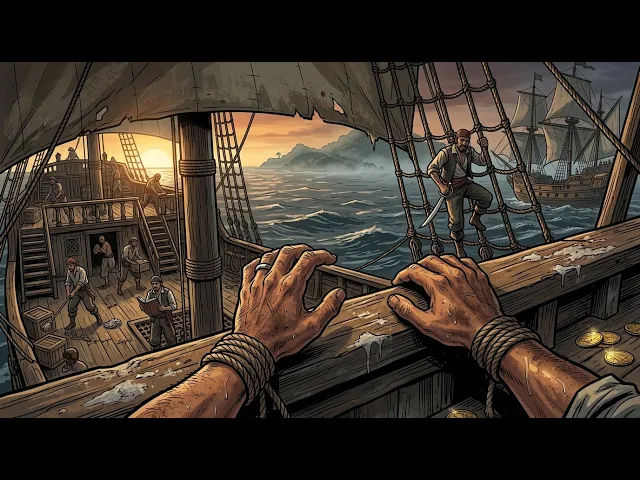
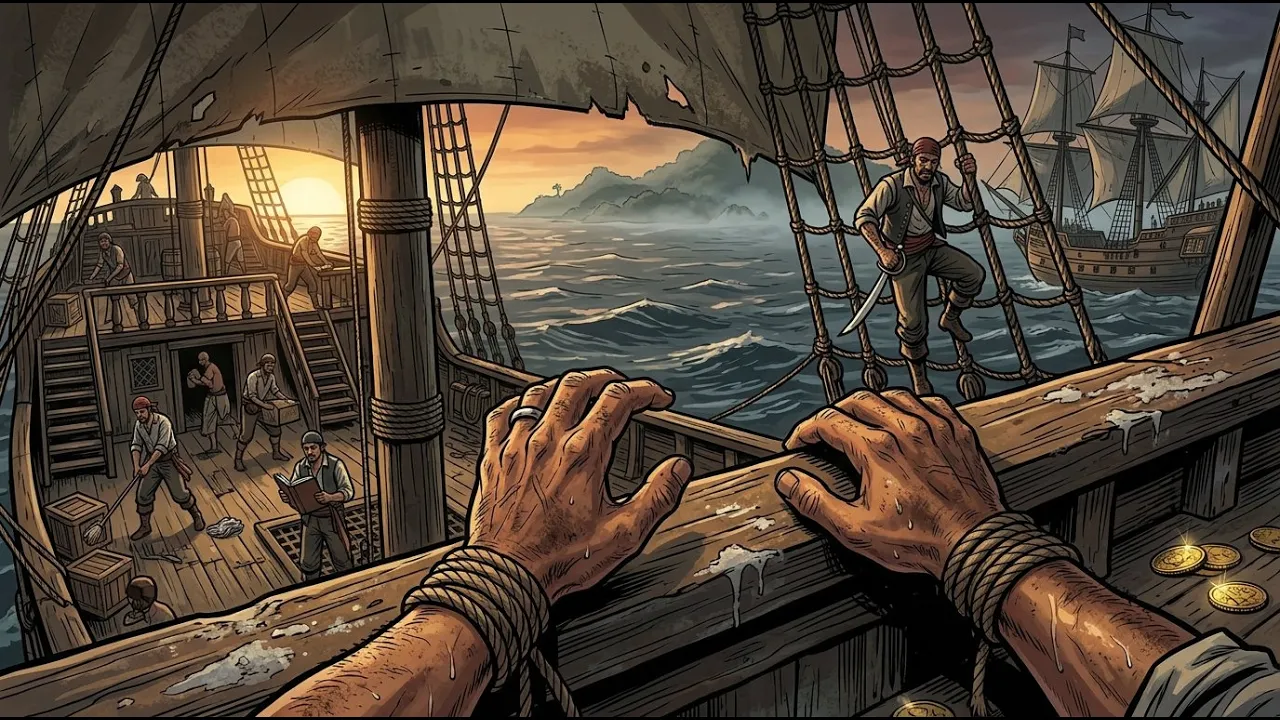
Your first week is disorientation and vomit, swabbing decks, hauling lines, [music] cleaning the BGE where seawater and filth collect in a soup that smells like death. The food is hardtac infested with weevils and salt [music] pork that's more salt than pork. You eat because starving is worse.
But here's what surprises you. The crew votes on everything. Where to sail, which ships to attack, how to split the plunder.
The captain is elected and can be removed. These criminals have more freedom than any lawful ship you've sailed on. The articles guarantee equal shares, compensation [music] for injuries.
A lost leg gets 800 pieces of eight. An eye is worth 100. They're not savages.
They're businessmen operating outside the law. Your first battle happens 2 weeks in. A merchant brig at dawn.
You're handed a cutless and told to follow. The fear is electric. Grappling hooks fly.
The ships lock together. The deck is chaos. A merchant sailor swings at you.
Your blades meet. He's stronger. You slip on blood.
You're going down. Then a man you've never spoken to drives a boarding axe into your opponent's shoulder. He doesn't wait for thanks.
He's already moving. His name is Marcus. That night during the share out, Marcus sits beside you.
He's been with the crew 2 years. Lean, quiet, hands, always busy. He ties knots and short [music] lengths of rope.
decorative ones, intricate patterns that look like tiny sculptures. One for every port, he says, showing you a collection of maybe 15, each one different. He holds up one that's unfinished, more complex than the others.
This one's for my mother. I'll finish it when I see her again. He says it like it's a certainty, like the ocean between them is just a temporary inconvenience.
Marcus teaches you things nobody else bothers to. How to read the wind by watching the surface of the water. How to tie a bow line in the dark.
How to sleep in a hammock during a storm without falling out. He doesn't do it because he likes you. He does it because a competent crew keeps everyone alive.
Rank two, the deck hand. 6 months in and you've stopped flinching at cannon fire. You're not new anymore.
Your crew. You've survived four engagements and earned your share each time. more money than the merchant navy would have paid in two years.
The articles protect you. The crew respects you. Marcus calls you his best [music] student, which is the closest thing to a compliment he gives anyone.
You learn the rhythms. Weeks of [music] boredom punctuated by hours of violence. Long stretches of open water where the only enemy is tedium.
Then the sudden rush when a sail appears on the horizon. The transition from calm to combat never gets comfortable. Your body adapts, but your mind keeps a running tally of everything that could go wrong.
You learn to sleep with one eye open. You learn that the sound [music] of wood creaking at night means nothing, but the sound of wood cracking means everything. You learn that the sea doesn't care about [music] articles or shares or democracy.
It kills pirates and merchant sailors with the same indifference. Marcus spends his off hours on the bow sprit, [music] legs dangling over open water, fingers working another knot. You sit with him sometimes.
He tells you about his mother's [music] house in Bristol, a garden with a stone wall. A cat that sleeps in the window. Things that feel impossibly far from where you are now.
He never asks about your family. You don't have one worth mentioning, but [music] you listen to his and somehow that's enough to make the ocean feel smaller. Rank three, the gunner.
You have a talent for artillery, steady hands, good spatial reasoning, the ability to calculate distance and wind speed without thinking about it. The master gunner takes you under his watch. Within a year, you're running a gun crew of four men.
Your cannon has the best accuracy record on the ship. The captain notices. Marcus notices, too.
He ties a new knot the day you get promoted. Gunner's hitch, he says. Seemed appropriate.
The thing about being a gunner is that you see the damage you do. A deckhand with a cutless fights face to face. A gunner watches a cannonball leave the barrel and tear through a ship 200 [music] yd away.
You see the wood explode. You see the mass come down. You don't see the men it falls on, but you hear them.
Sound carries across water in a way that land people don't understand. You hear everything. You learn to unhear it.
A Portuguese merchant vessel puts up [music] more fight than expected. Their gunner is good. A cannonball tears through the hole 6 f feet from your station.
Splinters the size of your forearm fly through the air. Two of your crew go down. You keep firing.
You don't stop to help them because the only way to help them is to end the battle. Your gun puts a shot through the merchant's rudder. The ship goes dead in the water.
The crew cheers. You check on your men. One is dead.
The other will lose his arm. You fill out the compensation according to the articles. 600 pieces of eight for the arm.
Business. Rank four. The boat swin.
You're promoted because nobody else wants the job and because Marcus tells the crew you're the right choice. The boat swin maintains the ship. Rigging, sails, anchors, hull integrity.
Everything that keeps the vessel alive is your responsibility. You manage 15 men and a ship that's held together by tar, stubbornness, and the desperate hope that the wood [music] will last one more voyage. You learn that a ship is a living thing.
It groans when the seas are rough. It settles when the water calms. It tells you when something is wrong if you know how to listen.
A loose line in the rigging sounds different than a tight one. A plank that's taking water has a smell before it has a leak. You become fluent in the language of a vessel that wants to stay afloat.
and your job is to make sure it gets what it wants. Marcus [music] works under you now. He doesn't resent it.
He was never interested in climbing. He just wants to sail, tie his knots, and eventually go home. You envy that simplicity.
Your ambition has a different shape. You're watching the quartermaster, watching how he handles disputes, manages the treasury, negotiates with fences in port. You're learning his job before he knows you want it.
Marcus sees you watching. He doesn't say anything, but one night on the bow sprit, he says, "The higher you climb on a ship, the further you fall when it sinks. " You laugh it off.
He doesn't. The captain takes a fever. Tropical disease, the kind that kills more pirates than cannonballs ever will.
He's dead in 4 days. The crew votes for a new captain. They choose the quartermaster, a man named Chambers, who sailed these waters for a decade.
Chambers needs a new quartermaster. Rank five, the quartermaster. The vote is close.
You win by two. Marcus voted for you. He tells you afterward like it's nothing.
You're smarter than the other option. Wasn't a hard choice. The quartermaster is the crew's representative.
You settle disputes. You enforce the articles. You divide the plunder.
You negotiate with criminals in port who buy stolen cargo while acting offended by your profession. A man is caught stealing from the common stores. The articles say marooning, but his brother aboard is sick and needs extra rations.
The crew wants justice. The brother begs mercy. You give 50 lashes.
[snorts] Harsh enough for order, merciful enough for circumstance. Both sides grumble. That means you found the right balance.
Two men nearly duel over a woman in Tortuga. You forbid it. Neither is happy.
Both are alive. That's what matters. The money flowing through your hands is staggering.
A successful voyage nets each man what a merchant sailor earns in 2 years. You save yours. Hide it across multiple locations.
[music] You're thinking about a future most pirates don't consider. This life has an expiration date. You'll die in battle, die of disease, or accumulate enough to disappear.
You're aiming for the third option. Marcus doesn't save. He spends his shares in port like every other sailor.
rum, food, a warm [music] bed for a night. He doesn't plan for the future because the future for Marcus is just the day he finishes that knot and goes home to Bristol. Marcus still ties his knots.
The collection has grown. 30 ports now. The one for his mother is still unfinished.
Almost done, he says every time you ask. It's never almost done. You're starting to understand.
It's not about finishing it. It's about having a reason to keep going. Rank six, the captain.
Chambers takes a musk ball through the throat during a raid gone wrong. The merchant vessel was a disguised naval frigot. A trap.
12 men dead in the retreat. [music] The crew votes. You win by a wide margin this time.
They trust your judgment. Marcus is the first to call you captain. Command is conditional.
A pirate captain serves at the crew's pleasure. Every decision balances what's smart against what's popular. You target a Spanish gallion carrying silver, heavily armed, well crude, but the potential prize is enormous, enough to let every man retire.
You make your case, you put it to a vote, they approve, barely. The raid succeeds. Eight men die taking the gallion.
The hold is full of silver. The crew forgives the casualties. Success erases doubt.
You don't forgive yourself. You remember every face. Three more prizes over the next year.
Your reputation grows. Merchants change their roots when they hear your ship is nearby. The prey that remains is either too valuable to rroot or too wellarmed to fear you.
Either way, the stakes increase with every hunt. Marcus has 42 [music] knots now. He still hasn't finished the one for his mother.
You've stopped asking about it. You've started to wonder if finishing it would break something in him. As long as the knot is unfinished, he has a reason to survive.
A finished knot means the story is over. You've been a pirate for 3 years. You've killed more men than you can count.
You've commanded respect through violence and cunning. You've watched friends die and made decisions that haunt you. The money is hidden.
The exit is planned. You just need to survive long enough to use it. You don't.
The Royal Navy catches you off the coast of Jamaica. Your ship is faster, but theirs has more guns, and the wind isn't yours today. The battle is brief, and the math is brutal.
You're outgunned and outmanned. Half the crew is wounded. The deck is slick with blood.
Surrender is the only option that doesn't end with every man aboard dead in the water. The Navy captain comes aboard. Clean uniform, polished boots on a deck stained with your crew's blood.
He offers a deal. He doesn't want the entire crew. He wants the officers, you specifically.
Your name is on a list. Your bounty is significant, but names can be negotiated if you give him the ship, the cargo, and the identity of your quartermaster and key officers. Some of the crew walks, not all, but some.
You look at Marcus. He's standing at the rail, bleeding from a gash above his eye, a length of knotted rope still in his pocket. He catches your look.
He doesn't understand it yet. He will. You give them Marcus.
You tell the Navy captain he's the quartermaster. The man who managed the treasury. The man who knows where the money is hidden.
Marcus has no money hidden anywhere. He spent his shares in port like every other sailor. But the Navy doesn't know that.
And by the time they figure it out, you'll have bought enough goodwill to negotiate your sentence down from hanging to prison. [music] Maybe. They take Marcus in chains.
He looks at you once. just once, not with anger. That would be easier.
He looks at you with the expression of a man who just realized the knot he's been tying for 3 years was never going to hold. He reaches into his pocket, pulls out the unfinished knot, the one for his mother. He drops it on the deck between you.
The trial takes a week. Marcus hangs with six others in Port Royal. The same gallows you watched from that tavern 3 years ago.
The same crowd, the same silence when the floor drops. [music] You watch from a cell with a window just large enough to see the rope go taught. Your deal works.
Barely. Prison instead of the noose. 7 years in a colonial jail where the food is worse than hard attack and the walls sweat with humidity that rots everything, including you.
You have time to think 7 years of it. You think about the Gallion raid, about the eight men who died for silver you'll never spend. about chambers bleeding out on the deck, about every vote the crew took that put their lives in your hands.
You think about Marcus more than all of them combined. You serve 5 years before a pardon clears your name. You walk out into sunlight and breathe free air and try to remember what you were before you became the thing you became.
The first thing you do is go to the tavern, the same one. It's still there. You order a drink.
You sit in the same seat. The gallows outside have been taken down, replaced by a market stall selling fruit. You reach into your coat and pull out a length of rope.
The unfinished knot. You picked it up off the deck the day they took Marcus. You've carried it for 5 years.
You've never tried to finish it. You wouldn't know how. Marcus was the only one who knew the pattern.
And Marcus is in the ground because you put him there. You hold the knot under the table where nobody can see it. Your hands are shaking.
Not from the drink, not from the years, from the weight of a promise someone else made to a mother he never saw again. Carried in the pocket of the man who made sure he never would. You leave the knot on the table, you walk out, you don't look back, but your hands remember the shape of it.
And every rope you touch for the rest of your life feels like a confession you'll never finish making.