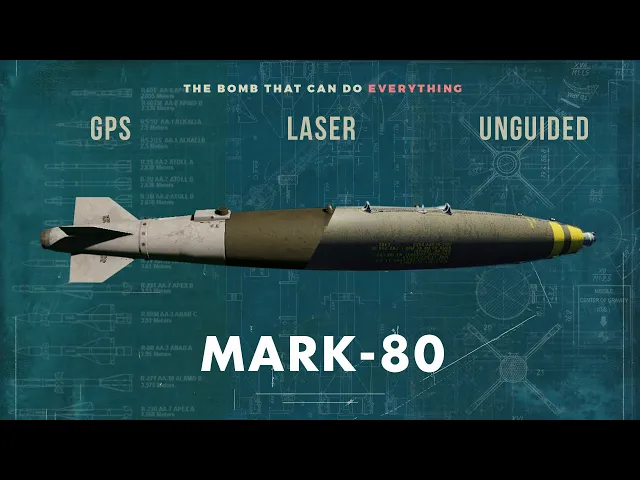
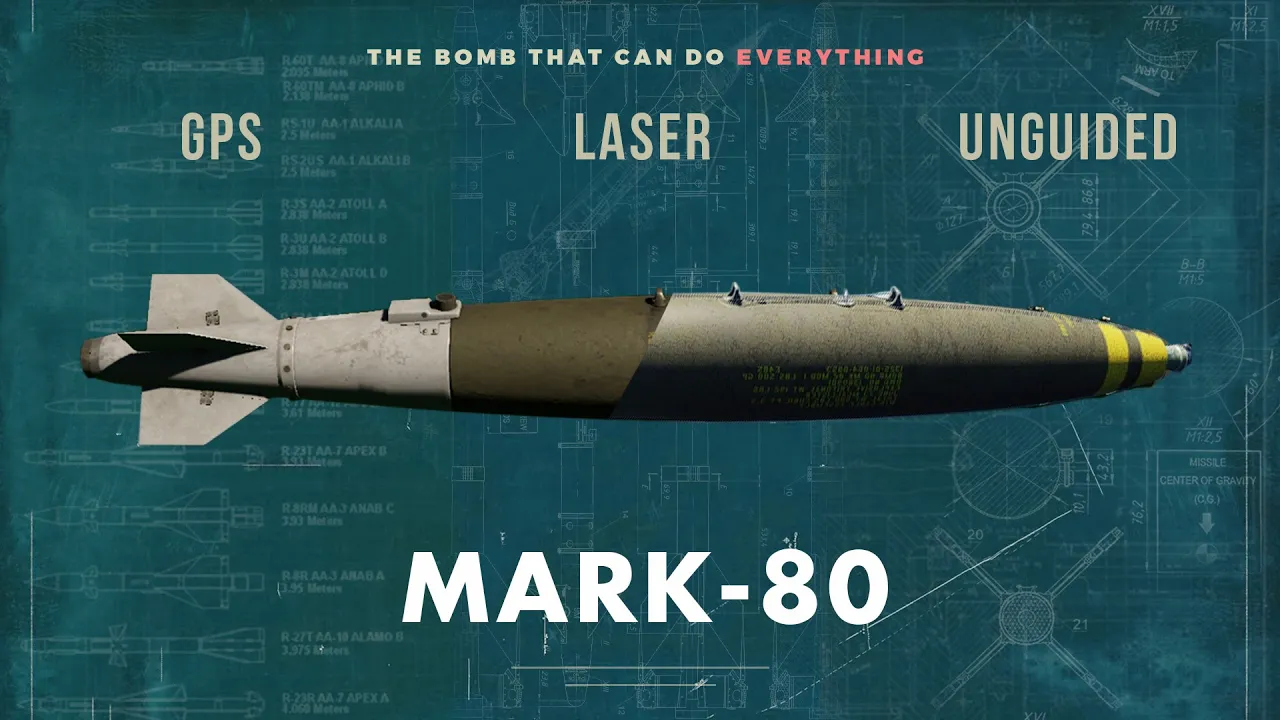
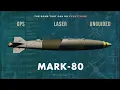
Of all aerial weapon systems, one bomb has played a decisive role in practically every major military operation since the Vietnam War. From the first retaliatory strikes at the Gulf of Tonkin in 1964 to hitting Libyan airbases in 1986, destroying tanks in Desert Storm, and still striking targets today, the Mark 80 series of bombs has become an indispensable asset. From the classic Mark 82, to the Paveway laser-guided bombs, and now the JDAM, the Mark 80 remains at the centre point.
Decades of research make it a reliable, safe, and cost-effective platform adaptable to almost any situation. Today, we look at what may be the unsung hero of air-deployed weapons: always present, but rarely acknowledged, the Mark 80 bomb. The story of the Mark 80 dates back to the early 1950s.
At the time, Western air forces were using a variety of different gravity weapons. Some of them were from World War 2; some were newer. The United States liked the M117, a 750-pound bomb, as well as the older M65.
These were good, but after the Korean War, a new general-purpose bomb was on the table. It would be referred to as the Mark 80 - a family of four different bombs, ranging from the 250-pound Mark 81 to the 2000-pound Mark 84. Compared to previous bomb types, this new proposal would look rather different.
What would set it apart, however, is its aerodynamics. In 1946, Ed Heinemann, a self-taught engineer at Douglas Aircraft, undertook a study of bomb and aircraft shaping and their effect on drag. One outcome of his study was a shape called Aero 1A.
The Mark 80 would integrate these lessons into its design, with a length-to-diameter ratio of 8:1 and nose and tail fuze wells. The end result was a bomb design that both packed a punch and had far less drag on the aircraft and itself. In contrast to older bombs, it was more stable in flight.
This feature would prove valuable in the future, as the bomb's precision would allow for more accurate computer-calculated impact and release cues. The first test of the weapon would occur with the outbreak of the Vietnam War. Within a matter of months, it had proven itself highly useful for everything from carpet bombing to bridge strikes.
The availability of a variety of sizes only helped its versatility in this sense. To fill other tasking, several modifications would enter service; the most notable was the Snakeeye, which would see massive use in Vietnam. The Ballute modification would not be employed extensively.
In both cases, they specifically gave strike aircraft crews the ability to employ bombs at low level without being caught in the shrapnel. In the midst of this, after considerable combat employment, crews decided that the Mark 81 - while working correctly - was simply too small to be effective for the tasks assigned to it. As such, the Mark 81 was actually taken out of service.
Major safety overhauls to the Mark 80 family would then come in 1967, following an infamous incident: the USS Forrestal fire. As a result, Mark 80s given to US Navy or Marine squadrons would receive a thick thermal coating, and two yellow bands indicating this shielding. Tangentially, after 2002, Marine and Navy Mark 80s were sometimes painted grey, though this does not necessarily indicate thermal protection.
Regardless, by the end of the Vietnam War, the Mark 80 family had become - by far - the most efficient gravity weapon available, despite competing with the older and more familiar M117. It filled every role it could, from carpet bombing to precision strike Over the decades, the Mark 80 established itself as one of the most reliable and efficient bomb types. As time went on, and the need for precision munitions grew, the Mark 80 would evolve.
Thanks to various modification programs, this bomb would also become the Paveway and the JDAM. During the Vietnam War, designers had experimented with early laser-guided bombs under PAVEWAY I. Among these experiments were the BOLT-117, using the M117, and the KMU-351, using the Mark 84—technically a GBU-10.
The latter would prove extremely promising. During combat testing, the Mark 84 modification would achieve an accuracy of 20 feet, with an average of three out of four bombs on target. Best of all, such a modification to a Mark 84 was only $3000, a tenth of the price of a similarly accurate Walleye.
While initially limited to action in Laos and South Vietnam, by the time of Linebacker II - and the renewed open hostilities with the north - the weapon system began to yield impressive results. Throughout 1972, these bombs were used to precisely strike ships in port - without harming other foreign vessels. They were used to knock out power plants without damaging surrounding infrastructure, and in one famous case, decimated a supply line by neutralising the so-called Drgon’s Jaw bridge.
All in all, 10,500 laser-guided bombs would be dropped between 1970 and 1973; 5100 of which were direct hits, and a further 4000 within 25 feet of the target. Over 100 bridges would be destroyed in this period using such bombs, and an Air Force study claimed they were 100 to 200 times as effective as conventional bombs— an unmatched level of accuracy for the time. In other words, by late in the war, the advantage of precision strikes was becoming obvious.
Fewer bombs, higher accuracy, and easier confirmation of target neutralisation. In the 1970s, work began on easier but more capable modifications for the Mark 80s. Under PAVEWAY II, beginning in 1976, the Mark 82 would formally receive the GBU-12 kit, while the Mark 83 would receive the GBU-16.
These systems still employed the rather archaic ‘bang-bang’ guidance method, in which the fins would deflect fully to correct for the target; they were nonetheless accurate, relatively affordable, and easily deployable in large numbers. Perhaps most importantly, PAVEWAY II would add folding, rather than fixed, tail fins. This resulted in several advantages: first, more bombs could be stored because they could be packed closer together; second, the bombs themselves offered less resistance en route or when dropped; and third, the design itself was more range-effective due to refinements.
It would be these PAVEWAY II bombs that would see action in El Dorado Canyon, striking Libyan positions with a high level of accuracy, proving the design's capability. That same year, in 1986, PAVEWAY III would emerge, exemplified by the GBU-24, a platform using the Mark 84. It was with this upgrade that the bomb would receive proportional guidance rather than the maximum deflection system, drastically improving accuracy and kinetic energy retention.
Desert Storm would see the first wide-scale reliance upon these new laser-guided precision weapons, not to mention systems like cruise missiles. Both PAVEWAY II and III bombs would prove more effective than ever, especially with the introduction of newer, more accurate targeting pods and gimbals. But even then, there were even greater ambitions on the horizon for the Mark 80.
In 1999, during the war in Kosovo, the US Air Force would demonstrate its most ambitious bomb modification yet. Referred to as the Joint Direct Attack Munition - or JDAM - a weapon that could be guided by INS or GPS. After Desert Storm, studies of bomb accuracy showed that, while unmatched thus far, laser-guided bombs were nonetheless limited by optical disturbances.
In Desert Storm, it was dust; elsewhere, it could be thick clouds, fog, or whatever else is kicked up in front of the laser designator. In a bold move, in 1992, a variety of tech manufacturers - including Honeywell and General Dynamics - were hired to assist the US Air Force's 46th Test Wing in designing a GPS-guided bomb. Over a twelve-month period, a working testbed was produced using a GBU-15, and on February 10th 1993, the first test was completed, with an F-16 dropping a bomb 27 kilometres downrange; the outcome was a direct hit.
Shortly after, Northrop Grumman - in a bid to arm its B-2 with its own precision weapon without the need for a targeting pod or cameras - made its own attempt at a GPS weapon. The outcome - the GBU-36 GAM, or GPS-Assisted Munition - proved promising. Using these existing studies, the JDAM program would get underway between 1995 and 1997.
The testbeds proved highly accurate; tested in rain, snow, and thick clouds, accuracy on target was basically unaffected. Better still, it would utilise an INS system assisted by GPS, meaning employment could still occur in GPS-denied environments if need be. With the first kits arriving between 1997 and 1998, the JDAM was an impressive piece of tech.
Three main variants were procured: the GBU-38, based on the Mark 82; the GBU-32, based on the Mark 83; and the GBU-31, based on the Mark 84. During this time, the Mark 81 would also be bought back for a precision modification. The rest is history; with the JDAM being employed in most major conflicts since the late 90s, including Iraq and Afghanistan, and still to this day, new upgrades for the series of bombs are planned.
Since its introduction in the 1950s, the Mark 80 has evolved from a basic unguided bomb into an entire family of air-to-ground munitions, adaptable to most bombing scenarios encountered on the battlefield today. These new additions to the family have few to no replacements on the horizon, and beyond safety modifications, even the base model Mark 80 bombs remain in service, with no plans for retirement any time soon. Few other weapons systems can boast of such a successful career.
It may be the most successful, yet overlooked, aerially employed weapon to date. There can be no doubt that we will see the Mark 80 derivatives continue in service for decades to come, and as more advanced guidance technology becomes available, the platform will only grow in its potential.